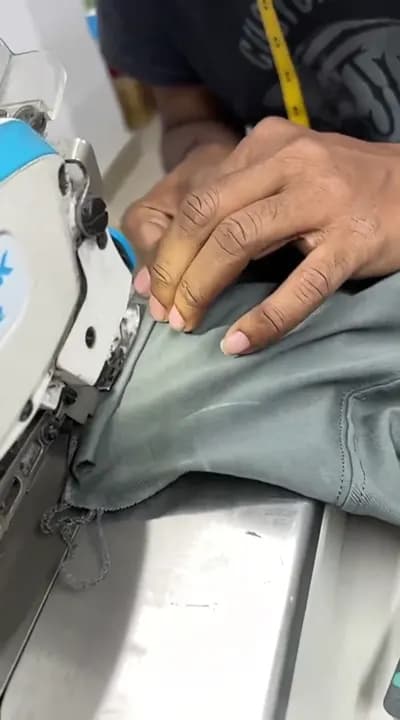
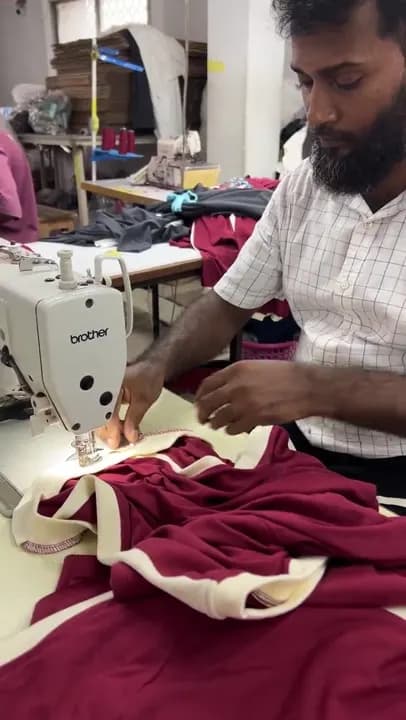
Coverstitch sewing on a charcoal garment
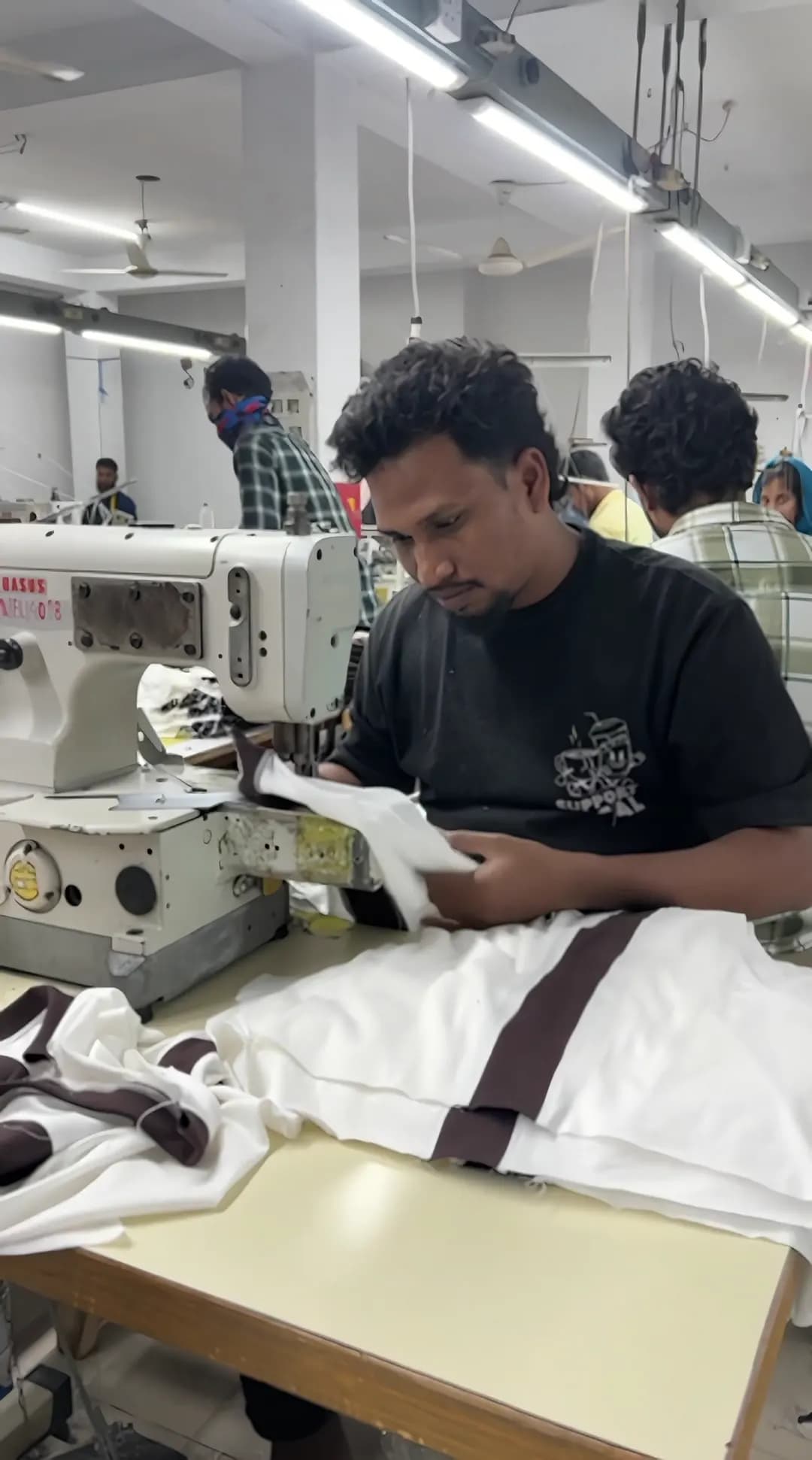
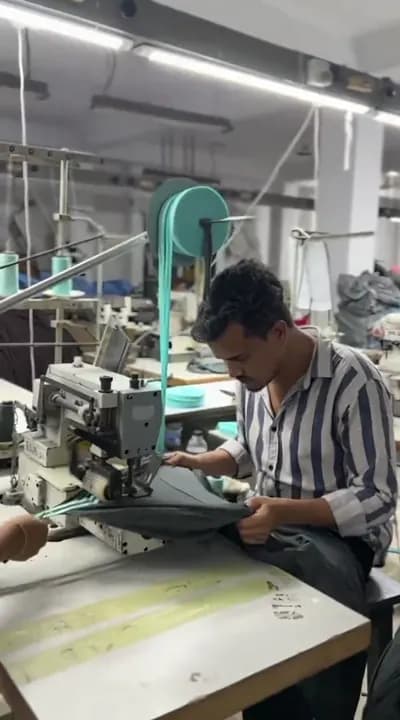
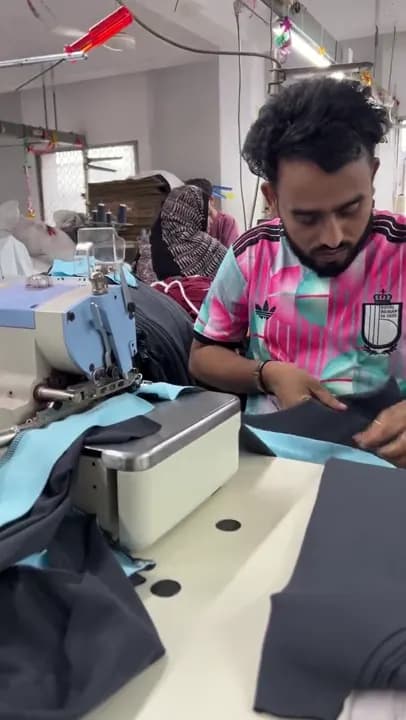
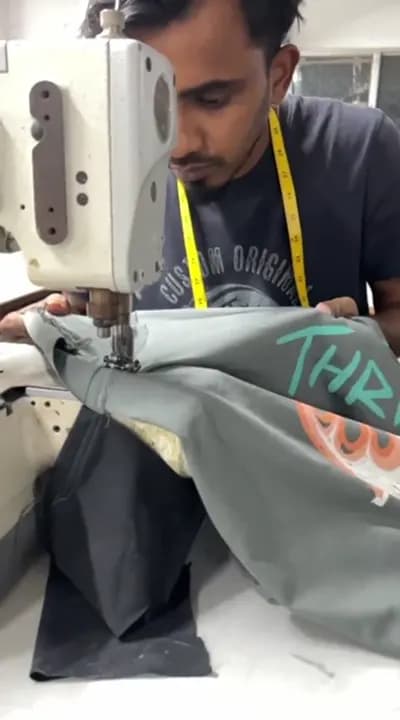
A machinist sews a charcoal garment with aqua trim on a coverstitch machine at Collective Studio in Narayanganj, with the rest of the line at work behind him.
- Length
- 0:18, no sound
- Filmed at
- Collective Studio, Narayanganj, Bangladesh
What you are seeing
A machinist guides a charcoal garment with aqua trim through a coverstitch machine while the stations behind him keep working.
Coverstitch is the stitch you see as two parallel lines on the outside of a T-shirt hem, with a looper thread underneath that lets the seam stretch. On knitwear it is what stops a hem from cracking when the fabric is pulled, so name it in your tech pack wherever a hem or seam has to stretch.
Cones of dark grey thread stand on the thread stand behind the machine, close to the body colour rather than the aqua trim. The operator spreads the garment flat with both hands before it reaches the foot, and a second machinist works at the station facing him.
A coverstitched hem that is stretched as it is sewn comes out wavy. On your sample, check that the hem lies flat when the garment is laid down, that the needle lines stay parallel all the way round, and that the hem stretches and recovers without a stitch cracking.
What a coverstitch machine does
A coverstitch machine sews two or three needle threads through the fabric from the top and catches them underneath with a looper thread that zigzags across the back. The looper covers the raw edge on the inside, so a knit hem can be turned up once and finished in one pass without a second fold. That single fold is why a T-shirt hem looks flat and light rather than thick.
It sits beside two other machines on a knit line. The overlocker joins and neatens seams, such as side and shoulder seams. The lockstitch machine, the standard single-needle stitch, is used for topstitching and labels, but it stretches less, so it is kept away from places that have to give. The coverstitch handles hems, sleeve openings and topstitching around necklines and binding, wherever a visible stitch has to stretch with the fabric.
How to write it into a tech pack
The construction table in our T-shirt tech pack template asks for the stitch type and stitches per inch at each area: neckline, shoulder, side seam, sleeve and hem. For a coverstitched hem, give the number of needles, the finished hem depth and the gap between the needle lines, which comes in several widths and changes the look noticeably. If you are unsure, send a reference garment and say "hem as reference".
Thread colour is the other decision. In the clip the cones on the stand are dark grey, close to the body colour rather than the aqua trim, which is the usual choice because it hides small variations in the line. A contrast thread is a design statement and makes any wobble visible, so choose it on purpose. Our guide to making a tech pack covers the rest of the construction table.
Faults to look for on a coverstitched hem
Beyond a wavy hem, which comes from stretching the fabric as it is sewn, check four things on the sample and on bulk pieces. Skipped stitches show as a gap in one needle line. A hem that has not caught the raw edge leaves a frayed strip visible inside. The join, where the hem starts and finishes at the side seam, should overlap neatly and not leave a loose end, because a chain stitch that is not secured can run back when the end is pulled.
Finally, wash the sample. Single jersey can twist after its first wash, and a hem that looked level on the hanger can swing towards the front. The jersey fabric guide explains why, and our guide to AQL inspection shows how hem faults are counted in a final inspection.
Where this clip appears
- Workwear & Uniform Manufacturer
- Clothing Manufacturer for Australian Brands
- Clothing Manufacturer for Swiss Brands
- Bekleidungshersteller für Schweizer Marken
- Clothing Manufacturer for Norwegian Brands
- Clothing Manufacturer for Japanese Brands
- Clothing Manufacturer for South Korean Brands
- Clothing Manufacturer for Singaporean Brands
- Clothing Manufacturer for Hong Kong Brands
- Clothing Manufacturer for Malaysian Brands
- Sublimation Clothing Manufacturer
- Activewear Manufacturer for Gyms
- Low MOQ Clothing Manufacturer
- Low MOQ Clothing Manufacturer in Bangladesh
- Knitwear Manufacturer
- Sustainable Clothing Manufacturer
- Clothing Manufacturer for French Brands
- Cut and Sew Clothing Manufacturer
- Shorts Manufacturer & Sweat Shorts Factory
- Clothing Manufacturer for Irish Brands
- Clothing Manufacturer for Belgian Brands
- Clothing Manufacturer for Polish Brands
- Clothing Manufacturer for Finnish Brands
- Clothing Manufacturer for Portuguese Brands
- Clothing Manufacturer for Czech Brands
- Clothing Manufacturer for Greek Brands
- Clothing Manufacturer for Luxembourg Brands
- Clothing Manufacturer for Hungarian Brands
- Clothing Manufacturer for Romanian Brands
- Clothing Manufacturer for Icelandic Brands
- Sportswear Manufacturer
- Fabricante de vestuário para marcas portuguesas
- Producent odzieży dla polskich marek
- Fabricant de vêtements pour marques françaises
- 한국 브랜드를 위한 방글라데시 의류 OEM 제조업체
- アパレルOEM・衣料品メーカー|バングラデシュから日本のブランドへ
- Fabricant de vêtements pour marques belges
- Kledingfabrikant voor Belgische merken
- Výrobce oblečení pro české značky
- Fabricant de vêtements pour marques suisses
- Produttore di abbigliamento per marchi svizzeri
- Bekleidungshersteller für kleine Mengen
- Fabricant de vêtements en petite quantité
- Fabricante de ropa en pocas unidades
- Clothing Manufacturer for Mexican Brands
- Fabricante de ropa para marcas mexicanas
- Producent odzieży z niskim minimalnym zamówieniem
- 小ロット対応のアパレルOEMメーカー
- Producător de îmbrăcăminte pentru branduri din România
- Vaatevalmistaja suomalaisille brändeille
- Ruhagyártó magyar márkáknak
- Klesprodusent for norske merkevarer
- Κατασκευαστής ρούχων για ελληνικές μάρκες
- Custom Work Uniforms: What Knit Factories Make (and Don't)
- How to Start a Clothing Brand in the UK: 2026 Checklist
- Best Hoodie Manufacturers 2026: 7 Compared, From 10 Pieces
- OEM vs White Label vs Private Label Clothing, Side by Side
Coverstitch sewing on a charcoal garment: questions brands ask
Is a coverstitch hem the same as a twin-needle hem from a home sewing machine?
No, although they look alike from the outside. Both show two parallel lines of stitching on the face of the hem. The difference is underneath. A home machine with a twin needle forms a lockstitch, with one bobbin thread shared between the two needles, and that construction has limited stretch, so it can pop when the hem is pulled hard. An industrial coverstitch machine uses a looper instead of a bobbin, and the looper thread zigzags between the needle lines across the back, covering the raw edge and giving the seam far more stretch and recovery. That is why factory-made T-shirt and sweatshirt hems survive being pulled over a head and washed repeatedly. If you are making early prototypes at home, expect them to behave differently from a factory sample in exactly this place, and judge the hem's durability on the factory sample rather than your own.
Which hems on a knit garment should be coverstitched?
Most flat hems on light and midweight knits, and almost none of the ribbed ones. On a T-shirt the body hem and the sleeve hems are usually coverstitched, and the same stitch often topstitches the neckband seam and the back neck tape. On a tank top it may finish the armholes as well, unless they are bound. Sweatshirts and hoodies are different: their cuffs and hem bands are usually rib, sewn on with an overlocker rather than turned and coverstitched, and the coverstitch appears instead as topstitching beside those seams. Leggings and activewear often use a flatlock seam, a related flat stitch, so seams do not rub against the skin. If your design has a raw-edge or rolled hem, say so in the tech pack, because a factory will coverstitch a plain knit hem by default and you will only discover the mismatch when the sample arrives.
What is a coverstitch?
A coverstitch is a stretchy stitch with two or three parallel needle lines on the outside and a looper thread zigzagging across the back. The looper covers the raw edge on the inside, so a knit hem can be turned up once and finished in a single pass, without a second fold. That is why it is the standard finish for T-shirt hems, sleeve hems and topstitching around necklines and binding. Its stretch comes from the looper: the threads are not locked into each stitch as they are in a lockstitch, so the seam can give with the fabric and recover. You see it from the outside as clean parallel lines, and from the inside as a flat band of looped thread. In the clip, a machinist at Collective Studio in Narayanganj is coverstitching a charcoal garment with aqua trim, with the rest of the sewing line working behind him.
What is the difference between a coverstitch and an overlock stitch?
An overlock stitch joins and neatens seams, while a coverstitch hems and topstitches. An overlocker, often called a serger, trims the raw edge as it sews and wraps it in thread, which is how the side and shoulder seams of a T-shirt are joined. Its stitch sits on the edge of the seam allowance, inside the garment. A coverstitch machine does not cut and does not join two edges together. It sews through a turned-up hem or a layered area, showing parallel needle lines on the outside and covering the raw edge underneath with its looper thread. On a knit line the two work side by side: the overlocker builds the garment and the coverstitch finishes its hems and visible topstitching. A lockstitch machine completes the set for labels and topstitching that does not have to stretch, because its stitch has less give than either.
Why is my T-shirt hem wavy after coverstitching?
A wavy coverstitch hem is almost always caused by the fabric being stretched as it was sewn. Knit fabric gives easily, and if the operator pulls it, or the machine feeds the top and bottom layers unevenly, the hem is sewn in a stretched state and ripples once it relaxes. Light single jersey and fabrics with elastane are the most prone to it. Machine settings matter too: the differential feed, the presser foot pressure and the stitch length all affect how flat the hem lies, and they are set for each fabric. On your sample, lay the garment flat without touching the hem and look along it. It should sit flat, with the needle lines parallel all the way round. Then wash it, because single jersey can twist after the first wash and a level hem can swing towards the front. Raise any waviness at sample stage, before bulk is sewn.
How do I specify a coverstitch hem in a tech pack?
Give the stitch type, the number of needles, the finished hem depth, the gap between the needle lines and the thread colour, for every coverstitched area. The construction table in a tech pack lists each area separately: body hem, sleeve hems, neckline topstitching and back neck tape. For each one, write that it is coverstitched, say whether it has two or three needles, and give the stitches per inch if you have a preference. The gap between the needle lines comes in several widths and changes the look noticeably, so it is worth stating rather than leaving to chance. If you are unsure of any figure, send a reference garment and write hem as reference, and the factory will match it on the sample. Collective Studio's T-shirt tech pack template already has rows for stitch type and stitches per inch at each area, so you only fill in the values.
Can a coverstitch hem come undone?
Yes, if the ends are not secured or the stitches are skipped, although a well-sewn coverstitch hem is very durable. A coverstitch is a chain-type stitch, and a chain stitch can run back if a loose end of the looper thread is pulled. That is why the join, where the hem starts and finishes at the side seam, should overlap neatly with no loose end left showing. Skipped stitches, where the needle misses the looper and leaves a gap in one line, are a weak point for the same reason. A hem that has not caught the raw edge underneath can also fray and open over time. On the sample, check the join, run your eye along each needle line for gaps, and look inside for frayed fabric. Pull the hem gently a few times to see that no stitch cracks. These faults are counted in a final inspection under workmanship.
What thread colour should coverstitched hems be?
Most brands match the coverstitch thread to the body colour, because a matching thread hides small variations in the stitch line. On a charcoal garment, for example, the thread would be dark grey rather than the colour of a bright trim, which is what the cones on the stand show in this clip. A contrast thread is a design choice. It makes the hem and topstitching a visible feature, but it also shows any wobble, uneven spacing or restart in the line, so choose it on purpose and approve it on the sample. Write the thread colour into the bill of materials with a colour reference, and say whether it changes by colourway. On a style made in several colours, a matching thread usually changes with each colour, which means more thread cones and more changeovers on the line, while one neutral contrast thread across all colours keeps production simpler.