The shortest sea leg in Europe
Piraeus sits just past Suez, so a Greek importer often has stock landed while a northern European container is still at sea.
Premium knitwear manufacturing for Greek brands — duty-free under Everything But Arms, Greece's 24% import VAT inside one landed price, labels in Greek, and the shortest sea leg from Suez of any market we serve.
Collective Studio makes cut-and-sew knitwear for Greek brands on its own floor in Narayanganj, Bangladesh, starting at 150 pieces for each style in each colour. After sample approval, production takes 40–50 days; the goods then take the short sea leg into Piraeus and arrive DDP, with no duty under Everything But Arms and Greece's 24% import VAT included in the quote. About 70 days from order to your door by air. Labels are sewn in Greek, and GOTS certificate RSC 9687 backs the GPSR file on organic orders.
Or message the factory directly: WhatsApp +880 1980 055026 · hello@collectivestudioltd.com · Homaira replies within one business day.

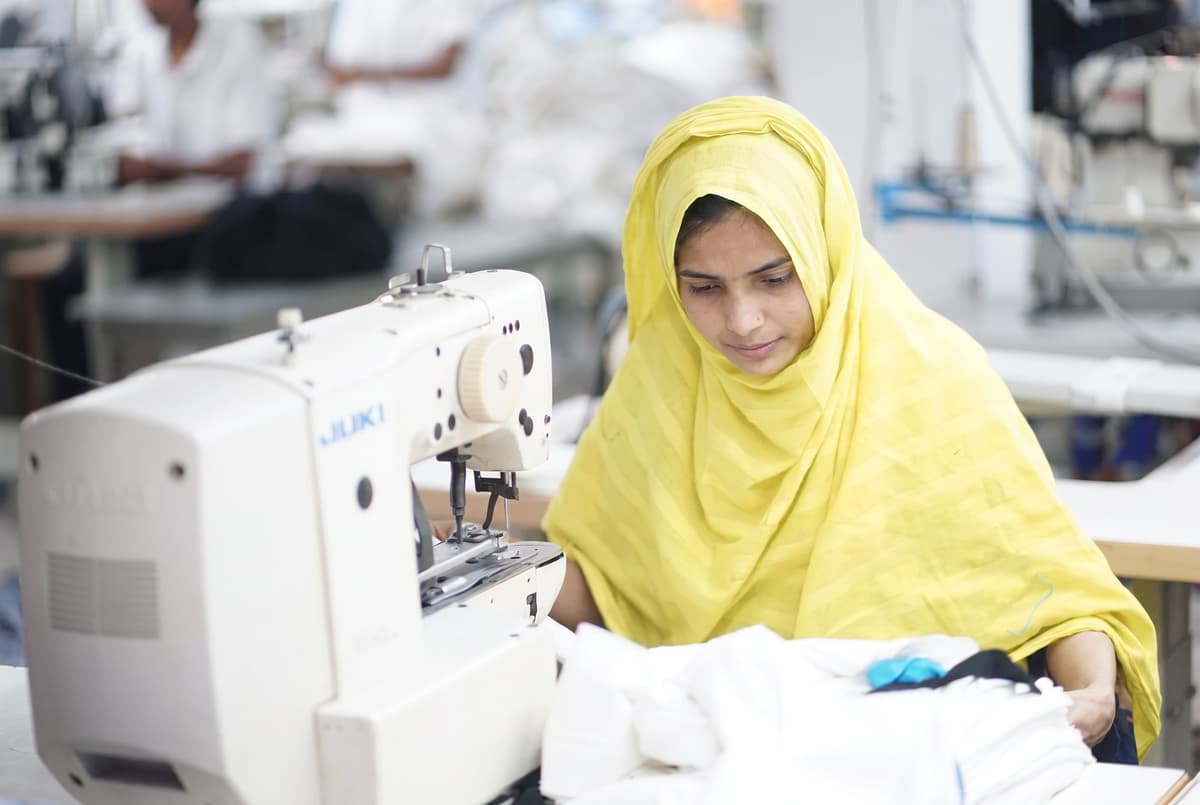
Made by our own team in Narayanganj. See the floor ↓Client reviews on Google ↗GOTS certificate RSC 9687 →
We are a clothing manufacturer for Greek brands: a cut-and-sew knitwear factory in Narayanganj, Bangladesh, owned and run by one family, with a brand office in Amsterdam. Tees, polos, hoodies, sweatshirts, joggers, shorts, activewear and loungewear start at 150 pieces per style and colour. Greece has one structural advantage over every other European market on this site, and it is geography: Piraeus sits just past Suez, so its sea leg is the shortest we quote anywhere in Europe.
In figures: no duty, because Bangladesh-made apparel enters the EU under Everything But Arms, and import VAT at Greece's standard 24% on the customs value plus any duty and the transport and insurance to the first destination in Greece. Shipping DDP means that VAT is already in the price you approve, not a separate demand from customs, and a VAT-registered importer normally recovers it on the periodic return. Some islands carry reduced rates under Greek law; if you deliver there, tell us and we will confirm the rate with your broker rather than guess.
Piraeus is the entry, Thessaloniki the northern alternative, and Athens International the air entry. Because the Suez route passes Greece before it reaches the western Mediterranean or the North Sea, a Greek importer often has stock on the shelf while a Rotterdam-bound container is still at sea. We confirm the transit for your port with the quote rather than print a figure, because carrier schedules and the Red Sea situation both move.
Labelling: the EU fibre regulation fixes the content and the Commission's guidance points to every official language of the country of sale, so labels for Greece are in Greek, sewn to your artwork, with English or other languages added if you sell abroad. As importer, a Greek company is also the EU-based operator under the General Product Safety Regulation, and its name and addresses go on the product or packaging.
Organic cotton is available on every style under our GOTS certification (RSC 9687), with a transaction certificate for your order, which matters for the resort and beachwear ranges Greek brands build. Denim, jackets and woven shirts are outside our floor; our sister buying house sources them as a separate order. For the summer side, see our beachwear and swimwear pages.
Comparing factories abroad and finding mostly agents? Ask each for a street address, its BKMEA membership and a live video call from the floor during a working shift. Ours is Plot-A-132, Road No. 02, BSCIC Industrial Area, Panchabati, Narayanganj 1420. Timing runs about 10 days to a sample, then 40–50 days of production once you approve it, then the short sea leg to Piraeus; the launch-date calculator counts back from the day your summer range goes on sale.
| Bangladesh (our floor) | China | Vietnam | Turkey | Portugal | |
|---|---|---|---|---|---|
| Duty into Greece | Duty-free under Everything But Arms, with a three-year tail after graduation (checked 21 Sep 2026); Greek VAT at 24% applies to every origin | Nothing preferential: the EU standard rate for the code applies | EU–Vietnam agreement rates where the fabric-origin rules are satisfied | Customs union with the EU: free-circulation goods pay no duty | EU-made: no import declaration, no VAT at a border |
| Sea route to Greece | Via Suez to Piraeus, the shortest sea leg of any European market on this site, or Thessaloniki; we quote the transit for your port | Via Suez, a comparable sea leg | Via Suez, comparable to China | Short-sea across the Aegean or by road; days | Short-sea across the Mediterranean or by road; days |
| Best suited, for a Greek range | Cotton knit basics and resort pieces from 150, organic cotton under our GOTS certification, landed cost | Breadth of materials and technical builds | Large woven, outerwear and sportswear orders | Fast replenishment in denim and knit, mid-range cost | Made-in-Europe positioning on small runs, top unit cost |
| A Greek brand picks it when | Resort tees, swim and knit basics should land as one duty-free consignment from 150 pieces | Materials are needed that a knit floor cannot source | The order is large, woven or performance-led | Mid-season top-ups matter more than unit price | European origin is the story and cost is secondary |
Piraeus sits just past Suez, so a Greek importer often has stock landed while a northern European container is still at sea.
No duty under EU EBA, and Greece's 24% VAT on the customs value plus onward transport sits inside our DDP price, recoverable on your return.
Test a Greek summer drop with 150 pieces per style in each colour, cut and sewn to your pattern and labelled in Greek.
Organic cotton under our GOTS certification (RSC 9687), plus swim and beachwear on the same floor, so a summer range ships as one order.
24% re-checked on 14 October 2026 in the Commission's VAT table; AADE guide and origin rules as verified on 21 September 2026. Sources below.
On the customs side Greece has nothing of its own to add: garments cut and sewn on our floor are Bangladeshi by single transformation and enter duty-free under Everything But Arms, with Regulation (EU) 2026/1395 keeping that access for three years after LDC graduation. The tax is Greek. The standard rate is 24%, which the Commission's rates table still showed on 14 October 2026 and which the independent authority's import-VAT guide states; the 13% and 6% rates are for goods in Annex III of the VAT Code, and clothing is not one of them.
Applied to 500 tees at a US$6.00 customs value (freight and insurance to the EU border included), US$3,000 of goods carry no duty and US$720 of VAT before the onward transport is added, inside our DDP price; a VAT-registered importer recovers it on the periodic return. Certain islands have lower rates under Greek law, and if your stock goes there we settle the rate with your broker before quoting.
The Greek importer needs an EORI number before the first entry. According to the Commission's summary of national EORI procedures, AADE's customs directorate assigns it on application, made electronically or on paper with a few supporting documents to the customs office for your place of establishment, usually within one working day. Then confirm the commodity code for each style with your customs broker; the landed-cost calculator does the sums.
EU texts as verified on 21 September 2026; Waste Framework Directive status read on 14 October 2026. Sources below.
A fibre label for Greece is a Greek label. Regulation (EU) No 1007/2011 sets what it says, generic fibre names and percentages in descending order on a durable, legible label, and Article 16(3) ties the language to the member state of sale; the Commission's Your Europe guidance says to translate into every official language where the product is sold. We sew Greek to your artwork and can add English for visitors or other markets on the same label. The regulation applies directly in Greece, enforced by its market-surveillance authorities, and any origin you print must be accurate.
Since 13 December 2024 the General Product Safety Regulation (EU) 2023/988 has required an EU-established operator for clothing sold to consumers; a Greek company importing from us is that operator, with its name and postal and electronic addresses on the product or packaging and a risk analysis and technical documentation kept ten years. On organic orders, GOTS certificate RSC 9687 backs the fibre, chemistry and traceability evidence. For resort ranges the checks that matter are REACH Annex XVII entry 43, which bans azo dyes releasing listed amines above 30 mg/kg in skin-contact textiles, and EN 14682 for cords and drawstrings on children's clothing; our GPSR guide walks through the file.
Producer responsibility for clothing is reaching Greece through EU law. The revised Waste Framework Directive entered into force on 16 October 2025 and gives each member state 30 months to set up an EPR scheme in which textile and footwear producers pay a fee for every product they place on the market. Greece's own scheme has to be running by spring 2028, so confirm its status with your adviser before each season and ask us for the fibre composition of each style when you register. The apparel Digital Product Passport is a separate, later step, planned for adoption in late 2027 with a transition after that.
Quotes for Greece are DDP, delivered duty paid: the sea or air freight, the customs entry, the import VAT and delivery to your address in one landed price, with the commercial invoice, packing list and statement on origin sent ahead of the goods. Piraeus is the usual entry and the shortest leg from Suez of any market we serve, Thessaloniki serves the north, and Athens International takes air cargo; the quote gives the transit for your port.
Bangladesh is on UTC+6 year-round, four hours ahead of Athens in winter and three in summer. Our floor works Saturday to Thursday, 09:00 to 17:00, so its day ends at 13:00 Athens time in winter and 14:00 in summer; Amsterdam, an hour behind you, picks up samples, design questions and compliance paperwork in English for the rest of the afternoon.
UN LDC portal re-read on 14 October 2026; the EU's three-year rule last verified on 21 September 2026. Sources below.
The date to note is 24 November 2029, when Bangladesh is now set to graduate from Least Developed Country status. It asked for an extension in February 2026; the Committee for Development Policy said one would be appropriate given significant progress on domestic reforms, and ECOSOC on 21 July recommended that the General Assembly act before the original graduation date of 24 November 2026. On 29 October 2026 the General Assembly granted it, moving graduation back three years (UN LDC portal).
A Greek summer range is covered: Regulation (EU) 2026/1395 keeps Everything But Arms for three years after graduation, so duty-free entry runs to at least late November 2032, six more summer seasons, and Greece's 24% VAT is unaffected. After that it depends on GSP+, which is unresolved; our LDC graduation guide sets out the options.
Most clothing makers in Greece are small workshops, and the official figures show it. Eurostat's business statistics count 3,155 clothing manufacturers in Greece in 2024, employing 12,994 people, about four per firm on average. Both figures are down by about a tenth since 2022, when there were 3,486 firms and 14,492 people. A Greek workshop is a good fit for close fittings and woven pieces; for knitwear in volume, the trade figures show where Greek stock comes from.
Knitted clothing, the customs chapter that covers tees, hoodies, sweatshirts and joggers, is where that shows. In 2025 Greece imported 55,170 tonnes of it and exported 10,000 tonnes, according to Eurostat's Comext trade data. About two thirds of the import tonnage came from other EU countries. Of the 18,497 tonnes Greece brought in directly from outside the Union, China supplied 45.6% and Bangladesh 19.9%, ahead of Turkey at 14.7%, and the tonnage from Bangladesh rose by 23% on 2024. That trade leans to knitwear: about 77% of the clothing tonnage Greece imported from Bangladesh in 2025 was knitted, the part of the trade our floor makes.
| Measure | Greece | Year |
|---|---|---|
| Clothing manufacturers (NACE C14) | 3,155 enterprises (3,486 in 2022) | 2024 |
| People employed in clothing manufacture | 12,994 (14,492 in 2022) | 2024 |
| Average size | About 4 people per enterprise | 2024 |
| Knitted clothing (HS 61), imports and exports by weight | 55,170 tonnes imported, 10,000 tonnes exported | 2025 |
| Knitted clothing imports from other EU countries | 66.5% of the tonnage, 79.7% of the value | 2025 |
| Knitted clothing imports from outside the EU, by origin | China 45.6% by weight and 40.6% by value; Bangladesh 19.9% and 17.6%; Turkey 14.7% and 16.0% | 2025 |
| Knitted clothing imported from Bangladesh | 3,682 tonnes (2,986 in 2024) | 2025 |
| Share of Greece's clothing imports from Bangladesh that is knitted | About 77% of the tonnage (3,682 of 4,784 tonnes across HS 61 and 62) | 2025 |
Wonderful people to work with — very professional and knowledgeable, also accommodating to the needs of their customers.
I have had a very good experience with this company. They are very friendly, professional, and provide fast service. They speak fluent English, which makes communication very easy. The quality of their manufacturing is excellent. I have no doubt in recommending this company to anyone looking for a reliable manufacturing partner in Bangladesh.
Collective Studios under the direction of Mr Jamish and his daughter Homaira represent the future of RTW production in Bangladesh. A thorough approach to detail governed by a genuine standard of quality. Masters of and partners in the process!
No, not at present: clothing cut and sewn on our floor in Narayanganj enters Greece duty-free under Everything But Arms, because Greece applies the EU's common rules and a single transformation in Bangladesh, cutting and sewing, gives the garment Bangladeshi origin. Zero duty is not zero tax at the border. Greece still charges its 24% import VAT on the customs value plus the transport and insurance costs to the first place of destination in Greece, and that VAT, not duty, is what shapes a Greek landed cost. On timing, Bangladesh is now due to graduate from LDC status on 24 November 2029, after a three-year UN extension agreed on 29 October 2026, and Regulation (EU) 2026/1395 keeps EBA for three years after graduation, so duty-free access runs until at least 24 November 2032. We verified the position on 21 September 2026 and confirm it for each order; our LDC graduation guide sets out what may follow.
Greece charges import VAT on clothing at its 24% standard rate, which the European Commission's VAT rates table showed when we read it on 27 September 2026. The taxable amount is the customs value plus any duty and the transport and insurance costs to the first place of destination in Greece. With duty at zero, a US$3,000 taxable amount carries US$720 of VAT. Clothing is not among the goods in Annex III of the VAT Code, so the 13% and 6% reduced rates do not apply. The Commission's table also lists 17% and a super-reduced 4%, and Greek law sets lower rates for certain islands; if your goods are delivered there, we check with your broker which rate applies before quoting. Our DDP price includes the VAT. If the entry is in your company's name and you are VAT-registered in Greece, it is normally recoverable on your return; we agree how the entry is filed before the goods move.
Yes: a Greek brand can order 150 pieces of one style in one colour, because our minimum is 150 pieces per style and per colour. Three styles in two colours each means 900 pieces, not 450. For a first summer range, one or two hero colours per style, then reorders of whatever sells, keeps the order at the minimum while the season shows you which colours Greek customers buy. The whole run travels as one DDP consignment to your Greek address, with one customs entry and one landed price. If your company imports the goods, it must make sure the GPSR technical file exists; we build that file once per style during production and reuse it on repeat orders, updating it if the fabric or trims change, so a small first run is not wasted compliance work. Organic cotton under our GOTS certification (RSC 9687) is available at the same minimum. The MOQ calculator shows how 150 pieces spread across a size run.
Bangladesh suits a Greek brand that wants cotton knit basics at a low landed cost from 150 pieces; Turkey suits speed to market; Portugal suits a made-in-Europe label where price is secondary. Turkey is in a customs union with the EU, so goods in free circulation pay no duty; it is strong on denim and knit, and can carry a higher unit cost. Portugal is EU production, so there is no import and no customs entry (VAT is still due, just not at a border), at the highest unit cost. Bangladesh is duty-free under Everything But Arms, with organic cotton under our GOTS certification (RSC 9687) and the GPSR file built during production, though Greek import VAT still applies. Denim, jackets and woven shirts are not made on our floor; our sister buying house sources them as a separate order. This is our own view, not a quote for the other countries.
In practice, yes: Article 16(3) of Regulation (EU) No 1007/2011 requires the fibre label in the official language of the member state where the garment is sold to the consumer, unless that state provides otherwise, and Greek is Greece's official language. The Commission's Your Europe guidance says the same: translate the label into every official national language where the product is made available. So we sew Greek composition labels as standard, to your artwork, with every fibre named generically and given as a percentage in descending order on a durable, legible label. If you also sell elsewhere in the Union, we add English or the other languages you need on the same label. The regulation does not require a country of origin, but anything you print about origin must be true, so a garment from our floor cannot be labelled made in Greece. Greece applies the regulation directly, as an EU regulation needs no transposition, and its market-surveillance authorities enforce it.
Not usually, if your company is the importer: a Greek company that imports the garments is the EU-established economic operator the General Product Safety Regulation (EU) 2023/988 requires, so no separate responsible person needs to be appointed. The Regulation has applied since 13 December 2024. Where the garments are sold under your own brand, the Regulation treats your company as the manufacturer: you draw up the risk analysis and technical documentation, keep it for ten years, and put your own name and postal and electronic address on the garment or, where that is not possible, on its packaging or an accompanying document. Greece's market-surveillance authorities enforce the rules, so the file should be complete before the first delivery. We build that evidence during production, and on organic pieces our GOTS certification, RSC 9687, backs the fibre and chemistry side; the scope certificate is available on request. Which company is named as importer on a DDP order is something we confirm for your order before the goods move.
The sea leg usually is, because Piraeus sits just past Suez while a Rotterdam or Hamburg box carries on for roughly another week and a half. We do not print a fixed figure, because carrier schedules and the Red Sea routing both change; we confirm the transit for your sailing with the quote. Piraeus is the usual sea entry, Thessaloniki the northern alternative if your stock is held in northern Greece, and Athens International the entry for air freight. Whichever you use, we quote DDP to your Greek address, and the commercial invoice and packing list reach you before the goods move, so you can check them before the container reaches Greece. Production is the same forty to fifty days wherever the goods are going, so the saving is in freight, not in the factory.
Yes: resort tees, beachwear and swim can be made on our floor in the same order, at 150 pieces per style and per colour, with swim priced separately because it is a different construction. For a Greek summer range the advantage is one consignment: resort tees, swim shorts and cover-ups travel together into Piraeus under one customs entry and one DDP price. The Greek summer sun is the design constraint. Strong reds and bright blues give up colour sooner than dark or natural shades, and reactive dyes bonded into cotton outlast pigment dyes that sit on the surface, so we recommend the dye class for kaftans and cover-ups at quote stage and can arrange lightfastness testing if a Greek retailer asks for a rating. Cotton pieces can be made in organic cotton under our GOTS certification (RSC 9687), with a transaction certificate for your order, and every piece carries Greek labels. Our swimwear and beachwear pages cover fabric choice.
It depends on the garment and the run. A Greek workshop suits woven and linen pieces, runs below 150 pieces, and ranges where you want to sit in on every fitting or print made in Greece on the label. Most are small: Eurostat counts 3,155 clothing manufacturers in Greece in 2024 employing 12,994 people, about four per firm, so ask how many pieces a week the floor can sew before you plan a season around it. Our floor suits knit basics in volume: tees, hoodies, sweatshirts, joggers and resort jersey from 150 pieces per style and per colour, with organic cotton made in our GOTS-certified facility (RSC 9687) and one DDP consignment into Piraeus. A range can also be split, with woven and linen pieces made locally and the knitwear made with us. Ask a local workshop and us the same questions about fabric sourcing and sampling time, and compare the answers; our beachwear page covers the resort side.
Count back from the day the stock has to be on your shelf, stage by stage, rather than from one total. Start with the freight: we quote the sea transit for Piraeus or Thessaloniki with your order, and air freight to Europe takes about 5 to 8 days if one style runs late. Before that come 40 to 50 days of production, which start on the day you approve the pre-production sample. Before that comes about 10 days for the first sample, and each revision round adds about 10 days more, so quick, specific fit comments are the part of the schedule you control. Eid holidays in Bangladesh move with the lunar calendar, so we check how they fall against your production window when we quote. Approving the Greek fibre label artwork at sample stage keeps the bulk order from waiting on it. The launch-date calculator does the counting from your on-sale date.
Trade and regulatory details on this page last verified 21 September 2026. Tariff and compliance terms change — ask us to confirm the current position for your order.
Whether it’s a large bulk or wholesale run or your first batch of 150, send a sketch, a reference, or a sentence. We’ll reply within one business day with fabric options and an indicative price.
Or message the factory directly: WhatsApp +880 1980 055026 · hello@collectivestudioltd.com · Homaira replies within one business day.