MOQ Calculator
Planning your first run? See your total order, how minimum order quantity really works, and how to split it across sizes — in seconds.
Plan your range
Distinct designs, e.g. a tee and a hoodie
Each colour is counted separately
Our minimum is 150
Your range, one square per style and colour
2 styles × 2 coloursA minimum order is counted per style and per colour. Your 4 style-and-colour combinations at 150 pieces each comes to 600 pieces in total.
Suggested size split for one colourway
150 piecesSuggested split: XS 8, S 22, M 45, L 45, XL 15, XXL 15.
Size curve
Adult unisexMost demand in M and L, tapering both ways. Presets are typical starting points, not sales data: your own sales by size, or sizes asked for at pre-order, beat any of them.
Edit sizes and percentages
Adds up to 100%. Pieces are rounded to whole garments and always add up to your quantity.
Size breakdown
Adult unisex curve| Style | Colours | XS | S | M | L | XL | XXL | Per colour | Pieces |
|---|---|---|---|---|---|---|---|---|---|
| Each of the 2 styles | 2 | 8 | 22 | 45 | 45 | 15 | 15 | 150 | 300 |
| Whole order | 4 | 32 | 88 | 180 | 180 | 60 | 60 | – | 600 |
Size columns are pieces in one colourway; every colour of every style is the same. The last row adds up the whole order.
Writing a tech pack? These numbers go in the order split by size section of our free template.
Any currency. Your own figure, e.g. from a quote: we don’t publish prices.
Add a unit cost to see what the run comes to. Nothing is sent anywhere; it stays in this page.
Minimum shown is Collective Studio’s (150 per style/colour). Ask us about your specific range.
The MOQ formula: two sums for two questions
There are two MOQ formulas, and they answer different questions. The supplier’s formula sets your order: styles × colours × minimum per colour, which the calculator above works out. The inventory one checks that order against your sales: months of cover = pieces in one style and colour ÷ pieces of it you sell a month.
From the buyer’s side, some inventory guides say there is no standard formula for MOQ, and that is fair: the supplier sets the minimum. What you can calculate is the order it commits you to and whether your sales can carry it. The table puts the formulas side by side, so you can tell which one a search result is talking about.
| Formula | What it tells you | Worked example |
|---|---|---|
| Order total = styles × colours × minimum per colour | How many pieces a supplier’s minimum commits you to | 2 styles × 2 colours × 150 = 600 pieces |
| Months of cover = pieces in one style and colour ÷ pieces of it sold a month | How long one run lasts on your shelf | 150 ÷ 30 a month = 5 months |
| Reorder point = daily sales × days to replenish + safety stock | How many pieces should be left when you place the repeat order | 1 a day × 60 days + 30 = reorder with 90 pieces left |
| Break-even MOQ = fixed set-up cost ÷ contribution per piece | Why a supplier’s minimum sits where it does | Worked through in our guide to what MOQ means |
| EOQ = √(2 × yearly demand × cost of placing one order ÷ yearly holding cost per unit) | The order size that keeps your ordering and storage costs lowest over a year | Worked through in the same guide |
The one thing brands get wrong
Minimum order quantity (MOQ) is counted per style and per colour — not per order. Each colourway is a separate setup with its own fabric and dye lot, so a single t-shirt design in black and white is two minimums, not one. New brands routinely budget for one minimum and get surprised, so the calculator above multiplies it out for you: styles × colours = separate style-and-colour runs, each needing the full minimum.
Why factories have minimums at all
Setting up a production line — sourcing fabric, making patterns, cutting, threading machines — costs roughly the same whether you make 50 pieces or 500. A minimum spreads that setup cost over enough garments to make the run worthwhile. That’s also why a lower minimum is such a big deal for a new brand: our 150-piece minimum lets you launch or test a design without ordering thousands.
How minimums add up: worked examples
At 150 pieces per style and colour, the total grows with every colourway you add. These are the same sums the calculator runs:
| Range | Style-and-colour minimums | Pieces in total |
|---|---|---|
| One tee in one colour | 1 | 150 |
| One tee in black and white | 2 | 300 |
| A tee and a hoodie, two colours each | 4 | 600 |
| Three styles, three colours each | 9 | 1,350 |
| A tee in three colours and a hoodie in one | 4 | 600 |
How the calculator works
The sums run in your browser, and nothing is sent anywhere while you plan. They are simple on purpose, so you can check them by hand:
- Total pieces = for each style, colours × pieces per colourway, added up across the styles. With every style alike, that is styles × colours × pieces.
- Style-and-colour runs are what the minimum counts. Each one needs the full minimum on its own; sizes are a split inside a run, not extra minimums. A SKU, as a shop or barcode system counts it, also includes size: 2 styles × 3 colours × 6 sizes is 36 SKUs, but still 6 runs of 150.
- The size split shares each colourway’s pieces across sizes in proportion to the curve, then rounds to whole garments by the largest-remainder method, so the sizes always add up exactly to your quantity. The curves are typical starting points, not sales data.
- Limits: up to 50 styles, 30 colours per style and 100,000 pieces per colourway. A bigger range is a conversation rather than a calculator input.
- Unit cost is optional and is your own figure, in any currency. We don’t publish prices, so the tool only multiplies what you enter.
- Sharing: the address bar keeps your inputs, so a reload or a bookmark reopens the same plan, and Copy link builds a link that does the same for someone else. Copy as table pastes one row per style and colour into Google Sheets or Excel.
Fabric minimums vs factory minimums
A factory’s minimum is not the only floor in a clothing order. Before anything is cut, the fabric has to exist in your colour, and knit fabric is knitted and dyed in lots. A dye lot is measured in hundreds of kilos, so each colour you choose is its own batch of cloth, with its own lab dip to approve, before a single garment is sewn. That is why the minimum is counted per colour: a second colourway is not a few more garments on the same run, it is a second batch of fabric. The fabric consumption calculator shows how many kilos of fabric 150 pieces of your style need.
Mills set their own minimums per colour too, and on a very small run the fabric, not the sewing, is what sets the floor. Larger runs per colour cost less per piece partly because the fabric reaches the mill’s minimum and stops carrying the cost of a short dye lot. It is also why the top and the bottom of a set should be cut from the same dye lot, so the shades agree. Our guide to dye lots and why a reorder may not match covers the colour side.
When to place the repeat order
Set a reorder point for each style and colour that sells, not for the range as a whole. Production of a repeat takes 40 to 50 days once the sample is approved, then freight: about 5 to 7 days by air to the US and UK, 5 to 8 to Europe and 6 to 8 to Canada, or 28 to 40 days by sea to those markets depending on the lane. For anywhere else, we quote transit for your port with the order. Add your own sign-off time to that gap, multiply it by your daily sales of the colour, add the safety stock you want to keep, and place the repeat when stock falls to that number. Our guide to reorders and forecasting covers safety stock and size-by-size planning.
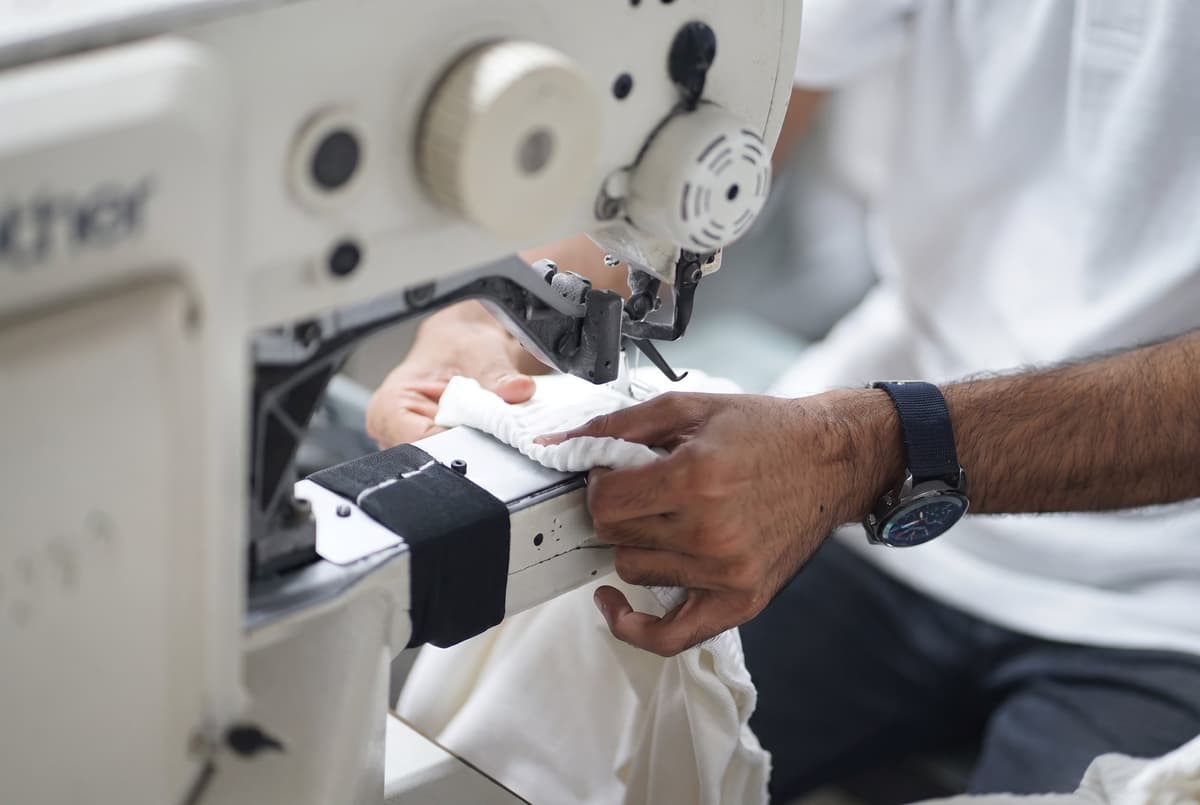
What a 150-piece run looks like on our floor
A small order is not sent to a smaller workshop. It is cut and sewn on the same line, by the same operators and to the same sealed sample as a ten-thousand-piece programme, in Narayanganj, Bangladesh.
Splitting your order across sizes
Your minimum per colourway isn’t all one size — you split it across a size run. Most demand sits in the middle (M and L) with less at the extremes. The calculator gives you a sensible starting split for any quantity; adjust it to your customers, since a streetwear brand skews larger and a fitted women’s line smaller. Pick a preset (adult unisex, women’s fitted, men’s, or oversized), or edit the sizes yourself, then copy the breakdown into the order section of a tech pack.
New to all this? Read how to start a clothing brand with 150 pieces, or how low vs high MOQ really affects your costs. Ready to plan a real run? Tell us what you’re making and we’ll quote it.
What clients say
Nice supplier that is looking to develop new buyers and products.
Best supplier! On time, reliable and perfect craft.
Frequently asked questions
What is MOQ in clothing manufacturing?
MOQ stands for minimum order quantity: the fewest pieces a factory will make in one production run of a style. It exists because the fixed work before the first garment (booking and dyeing fabric, making and grading the pattern, planning the cutting lay, setting up the line) costs roughly the same whether the run is 50 pieces or 500, so a factory sets a floor below which an order stops covering that work. In clothing the minimum is usually counted per style and per colour, not per order, which is the detail new brands most often miss. Minimums vary widely: many established factories quote 500 to 1,000 pieces per style and colour, while specialist small-run makers go lower. Ours is 150 pieces per style and colour. The calculator above multiplies the minimum out across your whole range, so you can see the real total before you ask anyone for a quote.
Is MOQ per style or per colour?
Both. A minimum is counted per style and per colour, because each colourway is a separate fabric booking and a separate dye lot, with its own lab dip to approve and its own share of cutting and line setup. So a t-shirt in black and white is two minimums, 300 pieces with us, not one minimum of 150 split between two colours. A hoodie that matches the black tee is a third minimum, because it is a different style even in the same colour, although matching pieces are booked from one dye lot so the shades agree. This is the most common budgeting mistake we see: a brand plans one minimum, then adds colours to the tech pack and the order quietly triples. Count styles × colours first, as the grid in the calculator does, and decide how many colourways the launch really needs before you commit to fabric.
How do I calculate MOQ for my clothing line?
Multiply it out per style and per colour, then add the styles together. For each style, the pieces you must order are its number of colours times the minimum per colour, and the whole order is the sum across every style. With our minimum of 150, a tee in three colours is 450 pieces, a hoodie in one colour is 150, and the range together is 600. Sizes do not add to the count: they are a split inside each colour’s 150, so a run from XS to XXL is still one minimum. Two checks catch most mistakes. First, ask every supplier whether its minimum is per style, per colour or per order, because the same number can mean very different totals. Second, ask whether the fabric carries its own minimum per colour. The style-by-style mode in the calculator above does these sums for a mixed range and flags any colour that falls short.
What is your minimum order quantity?
Collective Studio’s minimum is 150 pieces per style and per colour, low for a full-service factory, where many quote 500 to 1,000. Inside those 150 pieces the size split is yours: a typical run might be 8 XS, 22 S, 45 M, 45 L, 15 XL and 15 XXL, but a fitted women’s line or an oversized streetwear cut would skew it differently. The same floor, machines and operators that run a 10,000-piece programme make a 150-piece order, so the small run is not a lesser product, and the same pattern and sealed sample carry a style forward when you reorder at higher volume. What the minimum does not cover is fewer than 150 pieces of one colour. Below that the arithmetic of fabric and setup stops working, and a blank-printing service is usually the better answer. We would rather say so than quote a price that does not hold.
Can I mix sizes within the minimum?
Yes. The minimum is counted per style and colour, not per size, so the 150 pieces can be split across sizes however suits your customers. A common adult unisex curve puts 8 in XS, 22 in S, 45 in M, 45 in L, 15 in XL and 15 in XXL, which is the split the calculator suggests for 150 pieces. You can move pieces between sizes freely, add a size, or drop XS if your audience does not buy it. The practical limits are grading and cutting rather than the minimum: every size needs its pattern graded and signed off on the size set, and a size with one or two pieces still takes the same pattern work, so it is rarely worth offering. Sizes do not change the fabric booking either, because all sizes of one colour are cut from the same dye lot and match each other on delivery.
How many pieces should I make of each size?
Start from a bell curve with most demand in the middle, then adjust it to what you know about your customers. For a 150-piece adult unisex run the calculator suggests 8 XS, 22 S, 45 M, 45 L, 15 XL and 15 XXL, and it scales the same proportions to any quantity, rounding so the sizes always add up to your total. Adjust it with evidence rather than instinct: if you have sold before, your own sales by size are the best guide; if you run pre-orders or a waitlist, ask for size at sign-up. Streetwear and oversized cuts tend to sell further up the curve, fitted women’s lines further down, and kidswear follows age bands rather than S to XL. Sizes that sell out first are the cheap mistake, because they tell you what to reorder. Unsold extremes are the expensive one, because that stock ties up cash.
What size ratio should I order?
Start from a curve that suits your cut and your customer, and correct it with your own numbers. The calculator offers four starting points: adult unisex, with most demand in M and L; women’s fitted, weighted towards XS to M; men’s, from S to XXL and centred on L; and oversized or streetwear, weighted towards L to XXL with no XS. They are typical shapes, not sales data, and each one can be edited by percentage or by pieces, with sizes such as XXS or 3XL added or removed. Better evidence beats any preset: sales by size from an earlier drop, sizes asked for at pre-order, or the questions your audience sends about fit. Keep the extremes lean on a first run, since a sold-out size tells you what to reorder, while unsold stock at either end ties up cash. Whatever ratio you choose sits inside the minimum: 150 pieces per colour can be split across sizes however you like.
Why do clothing factories have minimum order quantities?
Because most of the cost of a production run is fixed before the first garment is sewn. Fabric is bought in mill batches and dyed in lots, so a colour needs a minimum length of fabric whether you make 50 garments from it or 150. The pattern has to be made and graded, the cutting lay planned, the line set up with the right needles, threads and attachments, and a sample approved. Spread over 500 pieces those costs are small per garment; over 20 pieces they can exceed the cost of making the garment itself. A factory minimum is simply the point where that fixed work is covered. It is also why a lower minimum matters so much to a new brand: it lets you produce against demand you have actually seen and then reorder what sells, instead of financing thousands of pieces on a forecast.
Can I order fewer than 150 pieces?
Not as a production run with us. Our minimum is 150 pieces per style and colour, and below that the fixed cost of fabric, dyeing, pattern work and line setup stops making sense per garment, for us and for you. If you only need 30 or 50 pieces, there are better routes: a blank-printing or embroidery service that decorates ready-made garments, or a workshop built for very small runs. Those routes give you less control over fabric, fit and colour, which is the trade-off. What often works better for a first drop is keeping the 150-piece floor but spending it differently: one hero style in one or two colours, rather than four styles at thin runs. Every run with us starts with a sample you approve, so fit and fabric are checked in hand before the 150 pieces are made.
How can I keep my first order small without going under the minimum?
Cut colourways before you cut anything else. Because the minimum is counted per style and colour, two styles in one colour each is 300 pieces, while the same two styles in three colours each is 900. Launching with one or two core colours and adding shades once you see what sells keeps the total down without thinning any run. Second, choose styles that share a fabric: a tee and a long-sleeve in the same jersey and colour are still two minimums, but their fabric can be booked together. Third, test one hero piece before a full range, since a sold-out drop of 150 is a stronger case for your next order than a half-sold range of 500. Use the calculator to try combinations: change the styles and colours and watch the total, and the grid of style-and-colour squares, move with them.
How does MOQ affect the price per piece?
The smaller the run, the higher the price per piece, mostly because of fixed costs. The work of booking and dyeing fabric, making and grading the pattern, planning the cut and setting up the line is spread across every piece in the run, so a larger run carries less of it per garment, while materials and sewing time per piece change far less with volume. That is why the unit price of a small first run is higher than a later reorder of the same style, and why it is worth pricing your retail from the real unit cost of the quantity you are actually ordering, not from a bulk figure you hope to reach. Our guide to how low and high MOQ affect your costs works through the trade-off. Once you have a unit cost, the pricing calculator shows the margin it leaves at your retail price, and the landed cost calculator adds duty and import tax.
Can I combine colours to reach the minimum?
Not with us, and if another supplier says yes, it is worth asking how. Our 150 pieces apply to each colour of each style, so a tee in three colours means 150 of each colour, not 50 of each. The reason is the cloth: every colour is dyed as its own lot, with its own lab dip to approve, and the fixed work on a lot is much the same whether it feeds 50 garments or 150. A factory that splits one minimum across several colours is often cutting from fabric a mill already holds in stock, which limits you to the shades on its shelf, or recovering the short dye lots through a per-colour surcharge. Either can be fair, so ask which applies before you compare quotes. If three colours at 150 each is more stock than your launch can carry, open with one colour, sell through it, and add shades when you reorder.
How do I know if a minimum order is too much stock for me?
Divide the pieces in one style and colour by how many of it you expect to sell in a month. The answer is your months of cover, and it is the honest test of any minimum. At 150 pieces, selling 30 a month gives five months, while selling 10 a month gives fifteen, which for most fashion lines is too long, because colours and trends date and unsold stock is cash you cannot use elsewhere. Do the sum per colour, not for the whole range, since one slow colourway can hide inside a sensible total. If your sales estimate is a guess, ground it in something real: pre-orders, a waitlist, or sales from an earlier drop. When the cover comes out too long, drop a colour before anything else, because our minimum is 150 per style and colour and cannot be split across shades, while the sizes inside those 150 are yours to arrange.