Truly private label, not rebadged
Your pattern, fabric, fit and trims — with no trace of anyone else's brand. Not an existing blank with your logo added.
Your label, your fit, your fabric — private-label t-shirts cut and sewn from 100 pieces a style. 140–220 GSM, GOTS organic options, DDP worldwide.
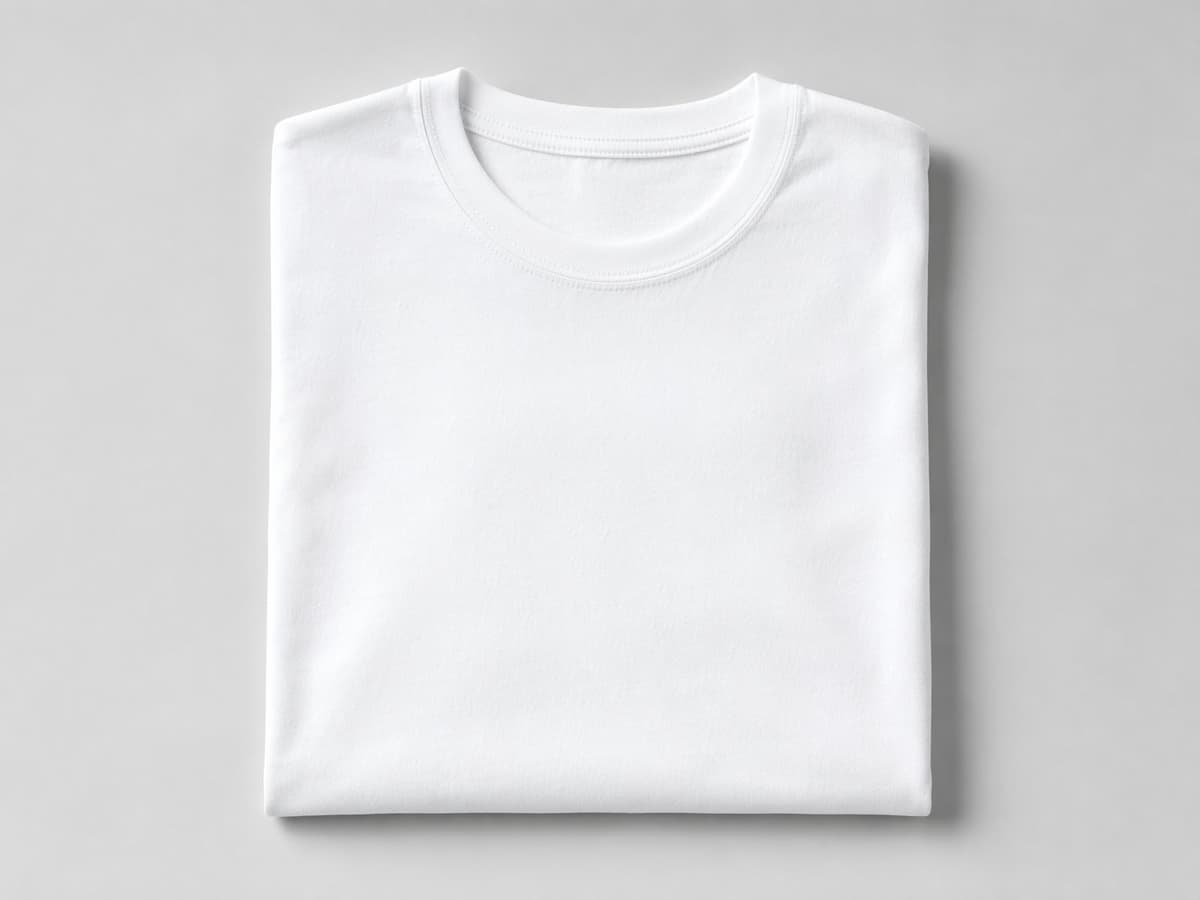
We’re a private label t-shirt manufacturer built for emerging brands: you bring the vision, we cut and sew tees that carry your label and still feel right at the fiftieth wash. Crew, V-neck, oversized, slim, longline, pocket tees, tanks and polos — made to your pattern, not your logo printed on somebody else’s blank.
Start with the vocabulary, because it decides what you are actually buying. Private label means the garment is made to your specification and carries only your branding — you choose the fabric, weight, fit and trims. White label means an existing generic product is rebadged with your logo; faster and cheaper, but the product is not yours and your competitor can buy the identical item. OEM generally means the factory manufactures wholly to your design and engineering. Suppliers use these terms loosely, so ask which one a quote refers to — the price gap between white label and true private label is real, and so is the difference in what you own. Our guide on private label vs white label vs OEM covers it properly.
Fabric weight is what separates a forgettable tee from one people keep reaching for, and it is the first spec to fix. Roughly: 140–160 GSM is light and soft, good for summer styles and draped fashion fits, but it will show body shape and is less forgiving; 180 GSM is the everyday mid-weight most brands settle on and the safest first choice; 200–220 GSM gives the heavier, structured, boxy feel that reads premium and holds its shape, at more cost per unit and more weight to ship. Our free fabric & GSM guide and GSM ⇆ oz converter go deeper.
Then there are three construction details that quietly decide whether your tee reads cheap, and almost no supplier raises them unprompted. Side-seamed versus tubular: tubular is knitted as a continuous tube with no side seams, which is cheaper but torques, so the side line spirals and the hem twists after washing — side-seamed panels hang straight and let us shape the fit. Shoulder taping: a strip of fabric reinforcing the shoulder seam so it does not stretch out over time. Neck rib with elastane: a 100% cotton rib stretches permanently once pulled over the head, and a gaping neckline ages a tee faster than anything else. We spec all three as standard, and cotton is compacted before cutting so the body does not lose a size in the first hot wash.
For artwork, screen printing is the durable, cost-effective choice for bold graphics in a few colours — with one cost mechanic worth being aware of, since each colour needs its own screen and print pass, so a two-colour design is dramatically cheaper at volume than a six-colour one. Embroidery suits a small premium chest logo. Sublimation handles all-over prints but requires polyester content, so it does not work on a cotton tee. See our screen print vs embroidery vs DTG comparison for the trade-offs. Everything runs from 100 pieces per style and colour, with GOTS-certified organic cotton available (certificate RSC 9687).
Your pattern, fabric, fit and trims — with no trace of anyone else's brand. Not an existing blank with your logo added.
The three details that stop a tee twisting, stretching at the shoulder, or gaping at the neck. Specced as standard, not upsold.
180 GSM is the safe everyday choice; 200–220 reads premium; 140–160 suits draped summer fits. we'll flag it the trade-off.
100 per style and colour, cut and sewn to your pattern, scaling to full bulk in the same factory.
These three words get used interchangeably by suppliers and they describe genuinely different products. Knowing which one you are being quoted is the difference between owning a garment and renting someone else’s.
| Private label (what we do) | White label | Print on blanks | |
|---|---|---|---|
| Who designed the garment | You did — your pattern, fit and spec | The supplier did. You choose from their existing range | A blanks brand did, years before your logo existed |
| You control | Fabric weight, fit, shoulder line, neck rib, trims, labels | Colour and branding only | Artwork placement only |
| Is it exclusive to you | Yes — your pattern is not sold to anyone else | No — the same base garment is sold to others | No |
| Typical minimum | 100 per style and colour | Often lower — stock already exists | 25–50 |
| Speed to first delivery | ~40–50 days | Faster — no development | Days |
| Wrong choice when | You need stock next month, or have not tested demand yet | Fit and fabric are part of your brand's argument | You want to own the product rather than decorate one |
All three are real businesses. Ask any supplier which of the three their quote covers before comparing it with another.
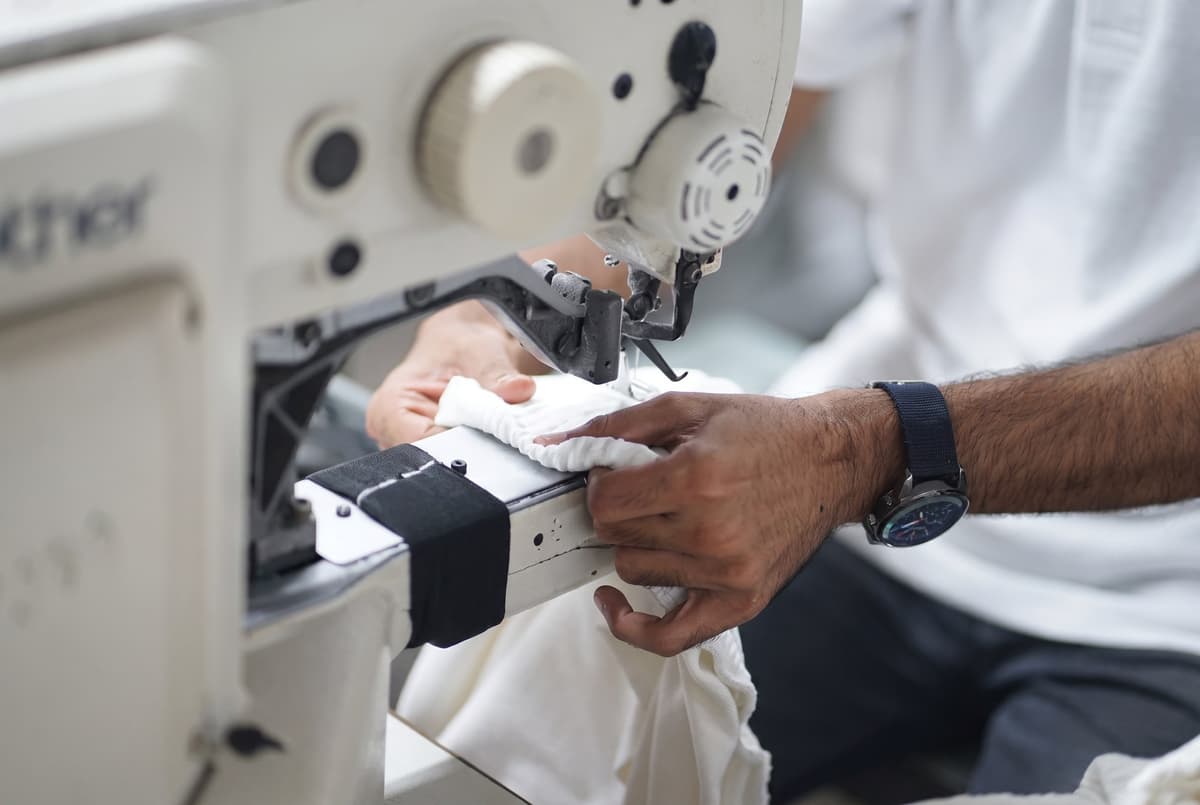
From a sketch to a labelled t-shirt in roughly 40 to 50 days. Sampling is where the fit is actually won, so it is the stage worth not rushing.
A t-shirt whose fit you like is more useful than a mood board. We can measure a garment and work from it.
Weight, knit, finish and construction settled, quoted per style and colourway before you spend on sampling.
One physical tee, cut and sewn to your spec on the production line.
Wear it, wash it, then check the fit again — knitted cotton moves after the first wash and a tee that fits out of the bag can fit differently a week later. This is the stage that decides whether 500 pieces are right.
Where delay usually hidesThe approved garment is retained as the reference every production piece is checked against, and stays on file for reorders.
Woven neck labels, care labels, hangtags and packaging produced alongside bulk rather than after it.
Cut and sewn on our own floor, with photos at each stage.
Inspected against your sealed sample, then delivered duty paid as one landed cost.
A private-label t-shirt looks like a simple product and is not. It passes through several companies before it reaches ours. This is the division of labour behind the garment that ends up carrying your label.
This is why we ask about fabric weight, fibre and finish when quoting rather than only style and quantity. Those three answers get placed with a mill weeks before anyone cuts, and they decide how your tee actually feels far more than the sewing ever will.
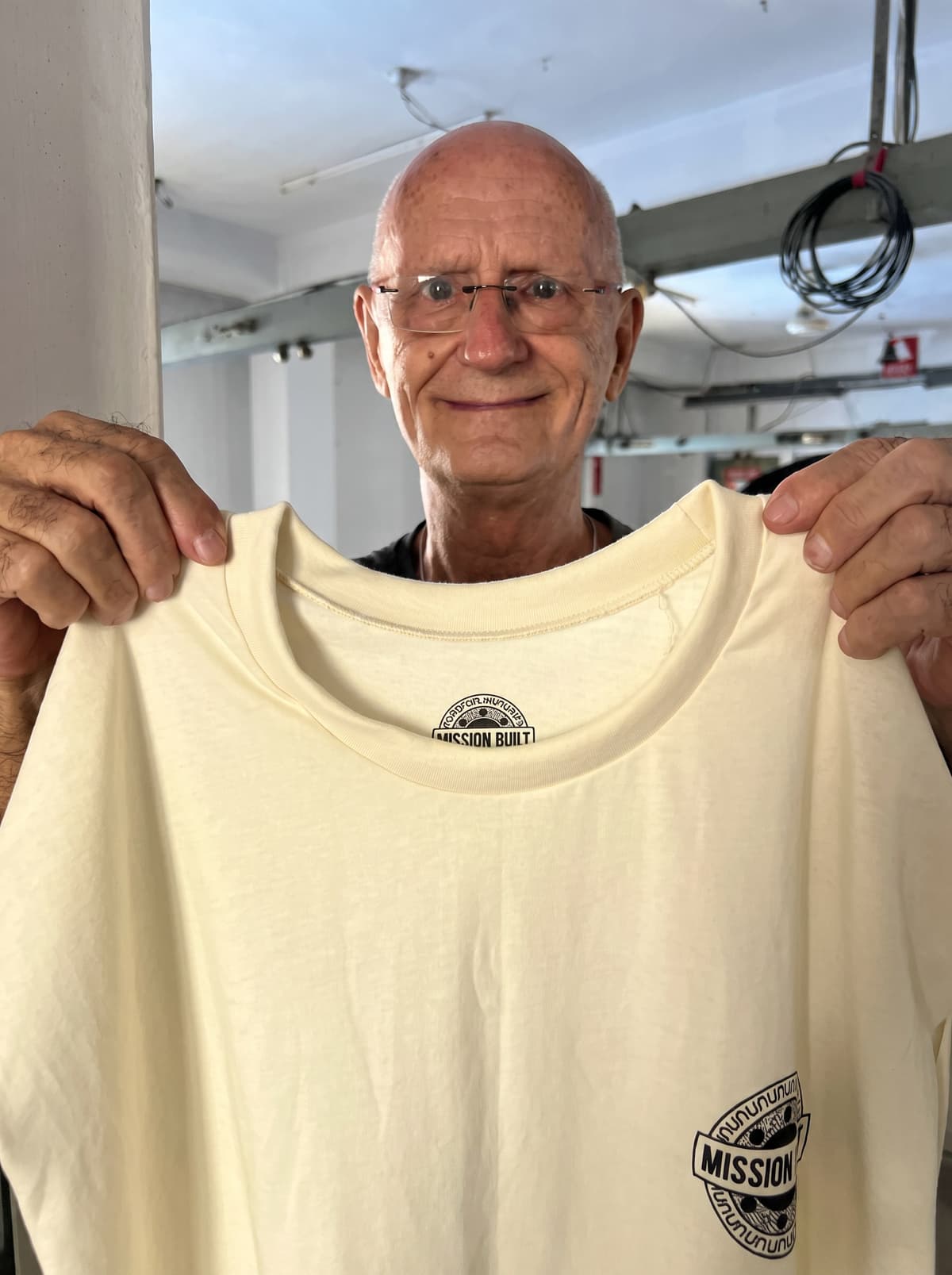
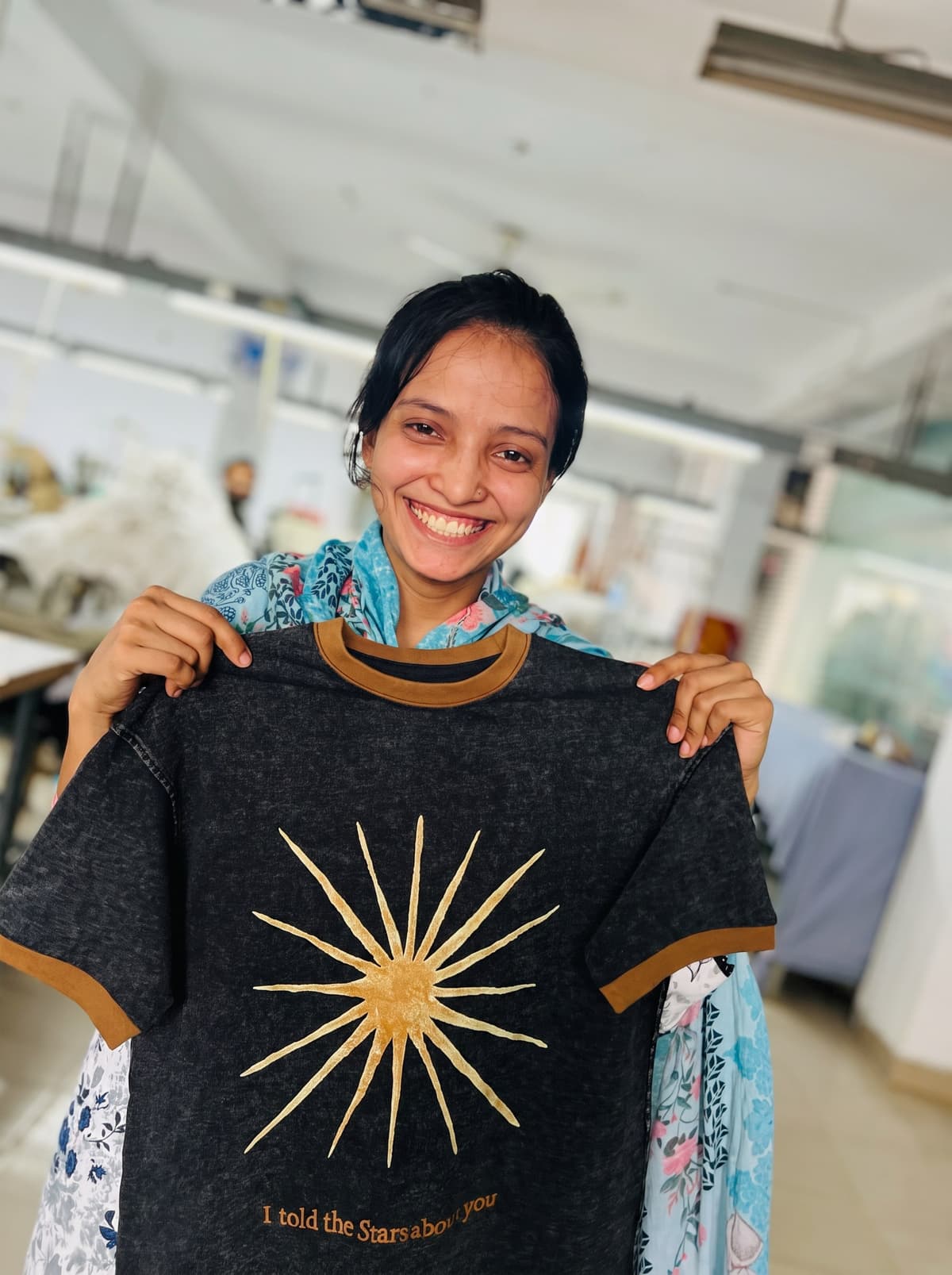
Collective Studios under the direction of Mr Jamish and his daughter Homaira represent the future of RTW production in Bangladesh. A thorough approach to detail governed by a genuine standard of quality. Masters of and partners in the process!
Wonderful people to work with — very professional and knowledgeable, also accommodating to the needs of their customers.
100 pieces per style, per colourway — cut and sewn from your pattern rather than printed onto blanks. The per-colourway part is the detail that catches most new brands out when budgeting: a tee in black and white is two minimums, 200 pieces total, because each colour is a separate fabric batch with its own dye lot and setup. Sizes work differently and you can split the 100 across a curve however suits your customers, so a typical split might be 10 S, 25 M, 30 L, 25 XL, 10 XXL. Below roughly 100 units of cut-and-sew, pattern making, the mill's own fabric minimum and a line changeover no longer spread sensibly, which is the actual reason for the floor.
They are different products at different prices, and suppliers use the terms loosely, so it is worth pinning down which a quote refers to. Private label means the garment is manufactured to your specification and carries only your branding — you choose fabric, weight, fit, construction and trims, and the pattern is yours. White label means an existing generic product is rebadged with your logo: faster and cheaper, but the product itself is not unique to you, and a competitor can order the identical item from the same source. OEM usually means the factory manufactures wholly to your design and engineering. We do private label and OEM. If someone quotes you a very low price and a very low minimum, it is often white label — legitimate, but not the same thing.
180 GSM is the safest everyday choice and where most brands land. Below that, 140–160 GSM is light and soft with good drape, which suits summer styles and fashion-forward fits, but it shows body shape more and is less forgiving on fit. Above it, 200–220 GSM gives the heavier, structured feel that reads premium, holds its shape better and photographs well, at the cost of more per unit and more weight to ship — which matters if you sell into hot climates where a heavy tee is actually less wearable. We will recommend based on your market, price point and the silhouette you are after rather than pushing the heaviest option as automatically better, because it is not.
Tubular means the body is knitted as one continuous tube with no side seams — cheaper and faster to make, and what most budget blanks are. The problem is torque: tubular fabric has a tendency to twist, so the side line spirals around the body after a few washes and the hem sits crooked. That twisted-hem look on a cheap tee is exactly this. Side-seamed cuts front and back as separate panels and joins them, which uses more fabric and labour but hangs straight and lets us actually shape the fit rather than leaving it a straight tube. For anything sold at a premium price we would recommend side-seamed, and it is what we spec as standard.
Yes to both, with an important distinction between them. GOTS-certified organic cotton is available under our certificate RSC 9687, which you can verify yourself on the GOTS public certificate database — GOTS covers organic fibre content, bans restricted chemistry including PFAS under version 7.0, and audits working conditions across the supply chain. Note that GOTS defines more than one label wording depending on fibre composition, and we confirm which one applies to your fabric before anything is printed. Supima is different: it is a trademarked American extra-long-staple cotton prized for softness, strength and resistance to pilling, but it is a quality designation rather than a sustainability certification. A tee can be Supima without being organic, and vice versa.
Yes — that is what makes it private label rather than a printed blank. Woven or printed neck labels, care and size labels, hem tags, hangtags, and branded polybags or retail-ready packaging are all standard. If your budget is tight and you are deciding where to spend first, a woven neck label instead of a printed care tag is the single highest-impact upgrade: it is inexpensive, and it is the first thing someone notices when they pick the garment up or pull it over their head. A scratchy printed care label on an otherwise good tee undercuts the whole impression, and it is one of the most common places new brands accidentally economise.
No. A sketch, a reference tee whose fit you like, or a clear written description is enough to start and to get an indicative price. A tech pack is the technical specification a factory works from — points of measure across your size range, fabric and GSM, trims, stitch types, label placement — and building one with you is part of the quoting stage, before you spend anything on sampling. If you would rather arrive prepared, our free tech pack template and checklist cover every field. The most useful thing you can send is an existing garment whose fit you want matched: measurements from a real tee beat a description every time.
Yes. The minimum is per style and per colourway; within that, the size split is entirely yours. That flexibility is useful because it lets you weight toward the sizes you expect to sell rather than accepting an even distribution. Most brands start from a bell curve with the bulk in the middle sizes and less at the extremes, then adjust to their audience — a streetwear label skews larger and toward oversized fits, a women's fitted line skews smaller. Our free MOQ calculator suggests a sensible starting split for any quantity that you can adjust. If you have sales data from a previous run, use that instead of a generic curve.
Match it to the artwork rather than picking a default. Screen printing is the most durable and cost-effective for bold designs in a few colours at volume — see the intro above for why colour count drives the price so sharply. Embroidery suits a small, premium chest logo and lasts the life of the garment but cannot handle gradients or fine detail. DTG handles detailed, photographic, many-colour artwork on smaller runs at some cost to durability. Sublimation gives edge-to-edge all-over prints but needs polyester content, so it will not work on a cotton tee at all. Send us the artwork and we will tell you which serves it best.
We will not quote a generic figure, because it moves a great deal with fabric weight, cotton grade, decoration and quantity — but here is the structure so you can sanity-check any quote. Fabric is normally the largest single component, which is why a 220 GSM organic tee costs meaningfully more than a 150 GSM conventional one. Then cut-make-trim, the labour of cutting and sewing, which rises with construction complexity. Then trims and labels. On top sit one-off pattern and sampling costs spread across the order, which is why 100 pieces costs more per unit than 1,000; prices typically step down around 500, 1,000 and 5,000 units. Our free pricing calculator gives an indicative band before you speak to anyone.
Roughly 40 to 50 days from approved sample to delivery: about 10 to 15 days sampling, 20 to 25 days bulk production, then quality control and DDP shipping, plus a few days at the start for speccing and quoting. Sampling is where most of the useful back-and-forth happens, so don't rush it — wear the sample, wash it, check the fit after washing rather than only out of the bag. Expect at least one revision round; that is normal rather than a sign anything went wrong. If you are working to a launch date, plan backwards and include every stage plus a buffer, because brands that miss dates have usually started the clock at bulk production.
Trade and regulatory details on this page last verified 30 July 2026. Tariff and compliance terms change — ask us to confirm the current position for your order.
Whether it’s a large bulk or wholesale run or your first batch of 100, send a sketch, a reference, or a sentence. We’ll reply within one business day with fabric options and an indicative price.