Launch Date Calculator
Pick the day your range goes on sale and see the day the order has to be confirmed, working back through transit, production and sampling. Or start from today and see the earliest date you can launch.
Clothing launch plan from collectivestudioltd.com/resources/launch-date-calculator. Planning aid, not a promise.
Pick the day your range goes on sale.
Sea freight to United States has taken about 30–40 days in our experience. Use your forwarder’s quote if you have one.
Days to receive, count, photograph and list stock
Your launch plan will appear here as soon as the date is in.
Planning aid, not a promise. Stages are our published timeline (about 10 days per sampling round, 45 days production, 5 days to hand over); the transit default is the slow end of what we have seen on the lane you pick. Ask us for a dated plan before you commit to a launch.
Why brands miss launch dates
Almost never because the factory was slow. The usual cause is that the calendar was drawn from the production quote alone: the production window went on the calendar, and sampling, freight, customs and the days it takes to receive and list stock were never on the page. The planner puts every stage on it, uses the slow end of each transit range, and tells you plainly when a date is short.
How the calculator counts
Every plan is the same chain of stages, run in order, because none can start before the one before it ends: about 10 days for each sampling round, 45 days of production and QC once the pre-production sample is signed off, 5 days to pack and hand over to the forwarder, your transit time, and your buffer. Production is planned at the slow end of our published 40 to 50 days. Transit defaults to the slow end of what we have seen on the destination you pick: to the US, 40 days by sea and 7 by air. Working back, the planner subtracts each stage from your on-sale date to find the confirm-by date; starting now, it adds them to the day you confirm to find the earliest on-sale date. Days are calendar days, weekends included, because fabric mills, lines and ships do not pause for them. The two dates that need you, confirming the order and signing off the sample, move to the Friday before when they land on a Saturday or Sunday; the factory stages keep their full length. Eid and other public holidays in Bangladesh can pause production; if your plan crosses one, ask us to confirm the dates.
Example timelines
The same chain with the default transit and a 7-day buffer, for one and two sample rounds. Days run from the confirmed order to the on-sale date.
| Plan | Sampling | Production + handover | Transit | Buffer | Total |
|---|---|---|---|---|---|
| Sea, 1 sample round | 10 days | 50 days | 42 days | 7 days | 109 days (about 16 weeks) |
| Sea, 2 sample rounds | 20 days | 50 days | 42 days | 7 days | 119 days (about 17 weeks) |
| Air, 1 sample round | 10 days | 50 days | 8 days | 7 days | 75 days (about 11 weeks) |
| Air, 2 sample rounds | 20 days | 50 days | 8 days | 7 days | 85 days (about 12 weeks) |
What each stage is for
Sampling is where fit, fabric and construction get decided on a physical garment; a sealed sample is what bulk is measured against. Most first orders need one or two rounds, which is why the planner lets you add them. Production and QC is knitting or booking fabric, dyeing to the approved lab dip, cutting, sewing, finishing, inspection and packing. Handover is the export paperwork and the hand-off to the forwarder. Transit depends on the lane and whether you fly or ship. The buffer is yours: receiving, counting, photography and listing take real days. Our guide to how long clothing manufacturing takes walks through each stage, and the MOQ calculator sizes the order itself.
Inside the production stage
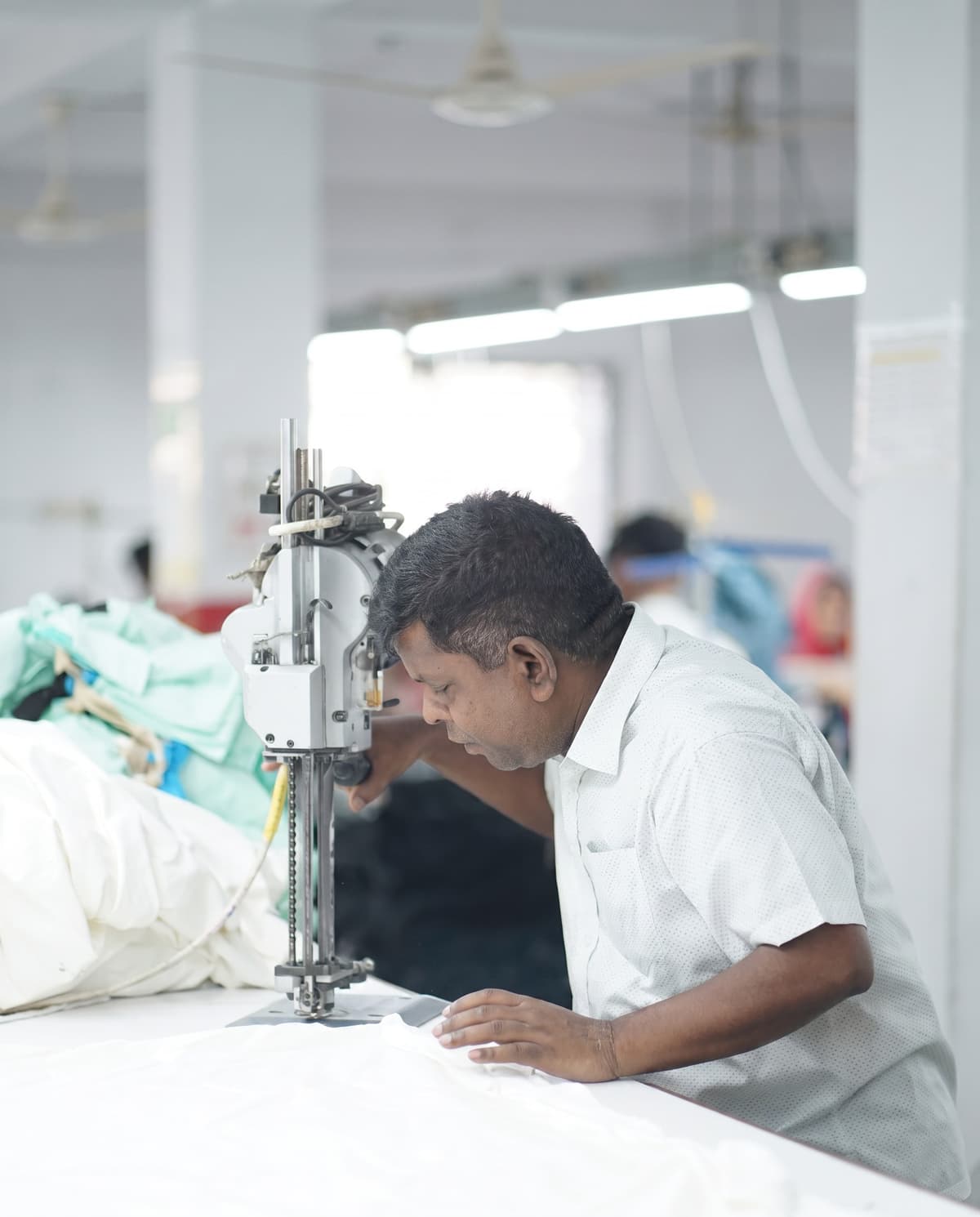
Production and quality control is the longest stage on the timeline, 40 to 50 days. It begins only once the pre-production sample is signed off, and runs until the goods are ready to ship: fabric is cut to the approved pattern, sewn on our line in Narayanganj, checked as it is sewn, and inspected against the sealed sample before it is packed.
What clients say
Best supplier! On time, reliable and perfect craft.
I have had a very good experience with this company. They are very friendly, professional, and provide fast service. They speak fluent English, which makes communication very easy. The quality of their manufacturing is excellent. I have no doubt in recommending this company to anyone looking for a reliable manufacturing partner in Bangladesh.
Frequently asked questions
How long does it take to manufacture a clothing order?
On our floor, about 10 days of sampling, then 40 to 50 days of production once you approve the sample, covering fabric, cutting, sewing, finishing, quality control and packing until the goods are ready to ship. By air, that comes to about 70 days from order to your door. Freight is on top of that, and it is the part brands most often forget: sea freight to the US, UK, EU or Canada has taken roughly 28 to 40 days in our experience, and air freight 5 to 8. Add a buffer for receiving, counting and listing stock, 7 days by default in the planner, and a sea-freighted launch needs about 107 days from confirmed order to on-sale date, planning production at its slow end. The stages only run in order: bulk cannot start until the pre-production sample is signed off, and the sample cannot be right until the tech pack and lab dip are. The planner adds the freight you choose and your buffer, then counts back from your on-sale date.
Why does the planner use the top of each transit range?
Because a launch date is a promise to your customers, and planning against the fastest transit you have ever seen is how ranges arrive after the launch. Sea transit varies with the route, the vessel schedule, transhipment, port congestion and customs clearance, and the slow end of the range is not a rare event. Using it means a normal delay lands inside your buffer instead of on your launch day. If the goods arrive early you lose nothing: you have more time to photograph, list and ship pre-orders. The same logic applies to production, which is why the planner uses our full published timeline rather than a best case. If your forwarder quotes a firm transit time for your lane, type it into the transit box, but ask whether the quote is port to port or door to door, since the leg from the port to your warehouse can add several days.
What if my forwarder quotes a different transit time?
Use the forwarder’s figure. The planner fills the transit box from the slow end of the range we have seen for the destination you pick, such as 40 days by sea and 7 by air to the US. For Australia it uses about 6 weeks by sea and 8 days by air. For anywhere else we quote transit for your port with the order rather than print a figure we cannot stand behind. When you enter a quote, make sure it covers what the planner assumes: from handover at our end to the goods arriving where you receive them, including customs clearance and the inland leg, not only the days at sea. If the quote is a range, enter the top of it. The buffer is separate: it is for your side, receiving, counting, photographing and listing, and it should not be spent absorbing a transit estimate that was too optimistic.
The planner says my date is short. What are my options?
Three, in order of cost. Air freight cuts the last leg from weeks to days, which on a sea-freighted plan saves about a month, at a much higher freight cost per piece; it suits urgent drops and high-value, low-volume pieces. A smaller first drop can move faster if the fabric is in stock, because on a new order the longest wait is often fabric and dyeing rather than sewing. Or move the launch, which costs nothing but a date on a calendar. What does not work is asking a factory to compress sampling: the pre-production sample is where fit, fabric and colour problems are caught, and skipping it moves those problems into bulk, where they cost far more to fix. When air would close the gap, the planner offers a “Try air” button; when even air falls short, it says so and shows the earliest date you can launch.
How long does sampling take?
About ten days on our timeline, once the tech pack is complete. Sampling is where your design becomes a physical garment: the pattern is made, fabric and colour are confirmed against a lab dip, and a sample is sewn for you to check fit, measurements and construction. If it needs changes, they are made and a corrected sample follows. The one that matters most is the pre-production sample: the garment in your actual fabric, colour and trims, which you sign off and we seal as the standard bulk is measured against. Ten days assumes quick decisions on your side. Every round of changes adds time, so the fastest way to shorten sampling is a complete tech pack with measurements, and prompt feedback when the sample arrives. Colour is often the slowest part, because a lab dip has to be dyed and approved before bulk fabric can be booked.
When should I place my clothing order for a launch?
Count back from the on-sale date, then confirm a little earlier than the answer. On our published timeline, planning 50 days of production, with sea freight and a 7-day buffer, you need about 107 days from confirmed order to on-sale, roughly three and a half months. With air freight the same plan needs about 75 days, about two and a half months, at a higher freight cost. So a range going on sale on 15 March needs confirming by about 28 November if it ships by sea. Confirming means the order is placed and the deposit paid, which buys the fabric and trims; design and tech-pack work has to be finished before that point, not during it. If the date really matters, such as a seasonal collection or a date you have promised stockists, build in more buffer than the default. The planner shows the exact confirm-by date and every milestone for any on-sale date you pick.
Should I ship my clothing launch by sea or by air?
Sea freight is the default for a full range because it costs far less per piece, and on the lanes we ship it has taken about 28 to 40 days to the US, UK, EU and Canada. Air freight has taken about 5 to 8 days, so it saves roughly a month on the timeline, but it is priced by weight and volume at a much higher rate, which matters for heavy garments such as hoodies and sweatshirts. A common approach is to plan the launch around sea freight and keep air for the exceptions: an urgent top-up when a size sells out, a small drop of high-value pieces, or the part of an order you need early for a shoot or an event. If you only discover late that a date is short, air is the quickest fix, but price it into your margin before you rely on it. The planner switches between the two in one tap.
What delays clothing production most?
Usually decisions, not sewing. On a new style the longest waits come before bulk starts: a tech pack with open questions, a sample that needs a second round of changes, and a lab dip that has to be re-dyed before the colour is approved. Each of those holds the start of production, and no planner can count days that have not begun. Fabric is the other common delay: bulk fabric is booked and dyed in a lot, so changing a colour after the lab dip is approved sends that part of the process back to the start. Once the pre-production sample is signed off and the fabric is in, production itself is the most predictable stage. A brand controls four moments in the sequence: the tech pack, the lab dip, the pre-production sample and the inspection report. Answering each one quickly is the most reliable way to keep a launch date.
How long does it take to manufacture clothing from Bangladesh?
On our floor in Narayanganj, about 10 days of sampling, then 40 to 50 days of production once you approve the pre-production sample, and then freight. Production covers fabric, cutting, sewing, finishing, quality control and packing. If the fit or colour needs changes, sampling takes a second or third round, and each round adds about another 10 days. Freight depends on how you ship: in our experience air has taken about 5 to 8 days to the US, UK, EU and Canada, and sea about 28 to 40 days. Added up with a 7-day buffer for receiving stock, a first order with one sample round needs about 107 days by sea, roughly fifteen weeks, or about 75 days by air. Two sample rounds make that 117 and 85 days. Switch the planner to “Start now: earliest launch” to see the earliest on-sale date counted from the day you confirm the order.
When should I place my order for a holiday launch?
Work back from the day the range must be listed, not from the holiday itself. For Black Friday and the Christmas season most brands want stock live by mid-November, so a sea-freighted first order with one sample round, which needs about 107 days on our published timeline, has to be confirmed by late July: for an on-sale date of 15 November 2027 the planner gives Friday 30 July 2027. Air freight moves that to 31 August 2027, at a much higher freight cost per piece. Add about 10 days for every extra sample round you expect. Then check the factory side of the calendar: Eid al-Fitr and Eid al-Adha close factories in Bangladesh for several days and move about 11 days earlier each year, and Chinese New Year slows trims sourced across Asia. If an Eid falls inside your production window, confirm earlier. The planner’s calendar export keeps every milestone in view.