Duty-free under EU EBA
Knitwear from our floor enters France at 0% duty under Everything But Arms, a position Regulation (EU) 2026/1395 keeps for three years after LDC graduation.
Premium knitwear manufacturing for French brands — duty-free under Everything But Arms, France's 20% import VAT inside one landed price, labels in French, and an office in Amsterdam one hour from Paris by air.
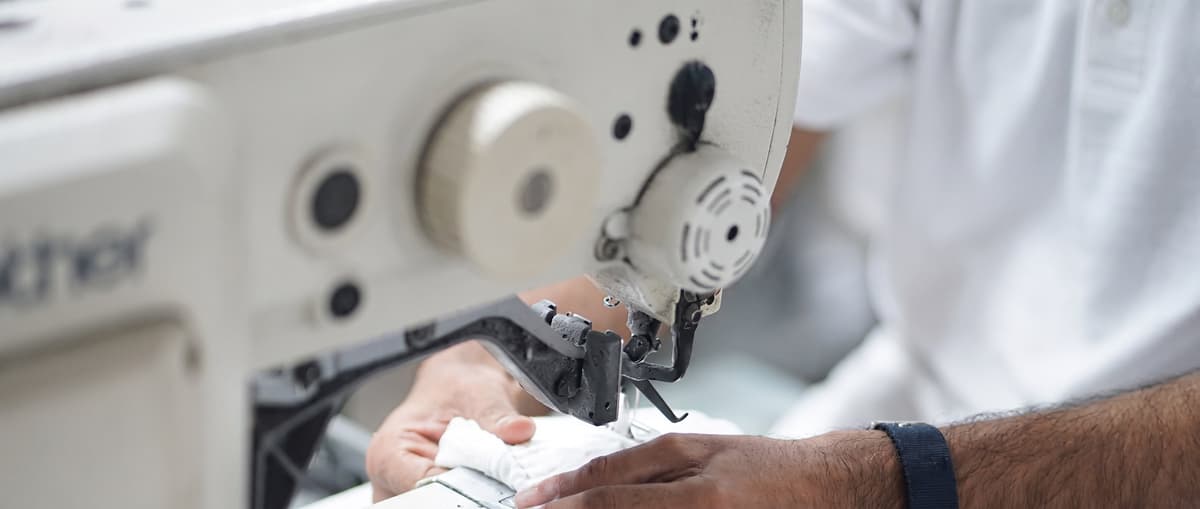
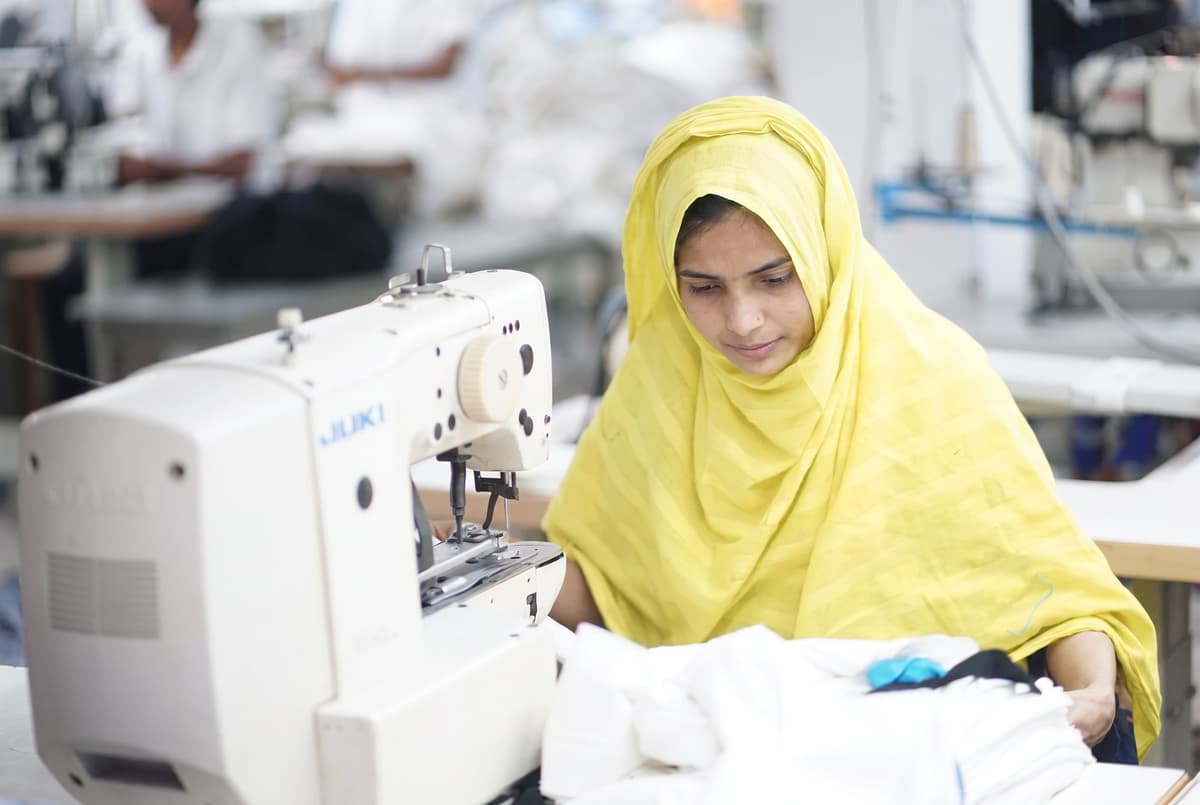
Collective Studio cuts and sews knitwear for French brands on its own floor in Narayanganj, Bangladesh, from 150 pieces per style and per colour. Production takes 40–50 days once the sample is approved, freight comes on top, and delivery is DDP with no duty under Everything But Arms and France's 20% import TVA priced in. About 70 days from order to your door by air. Labels are sewn in French, GOTS certificate RSC 9687 backs the GPSR file on organic orders, and the Amsterdam office keeps Paris hours.
Or message the factory directly: WhatsApp +880 1980 055026 · hello@collectivestudioltd.com · Homaira replies within one business day.
Made by our own team in Narayanganj. See the floor ↓Client reviews on Google ↗GOTS certificate RSC 9687 →
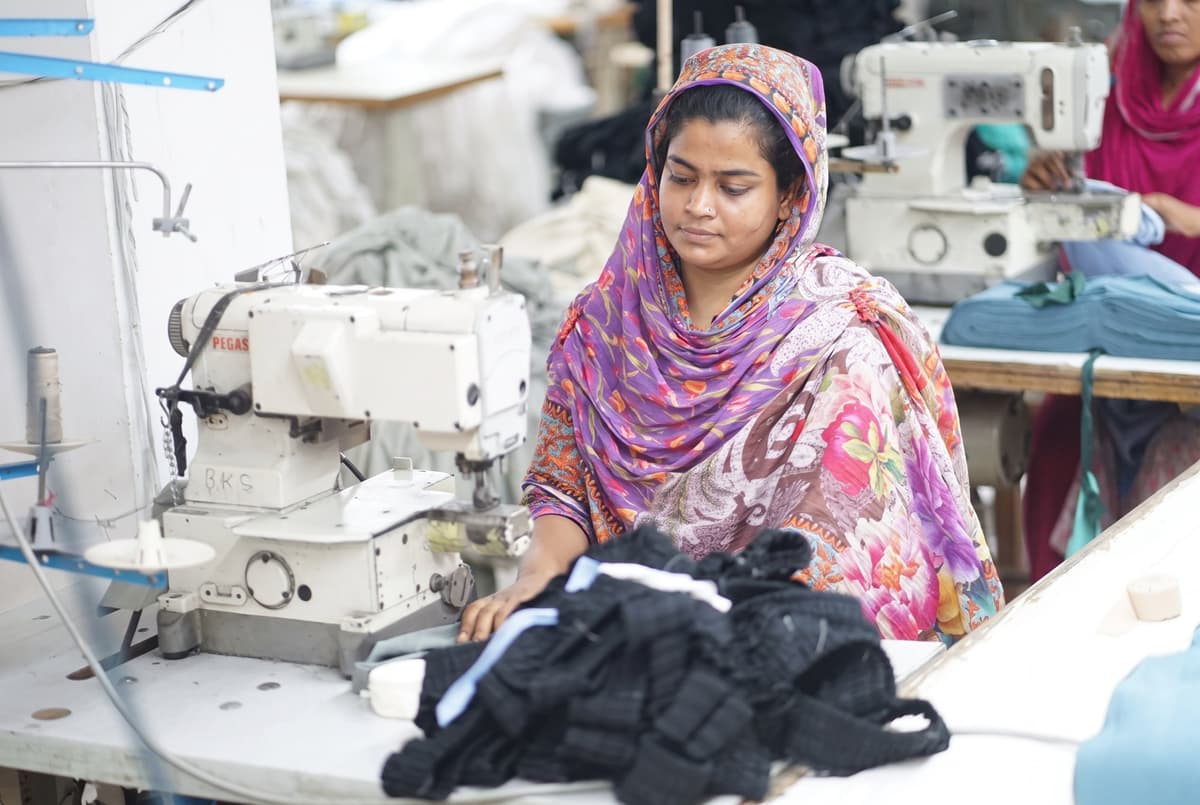
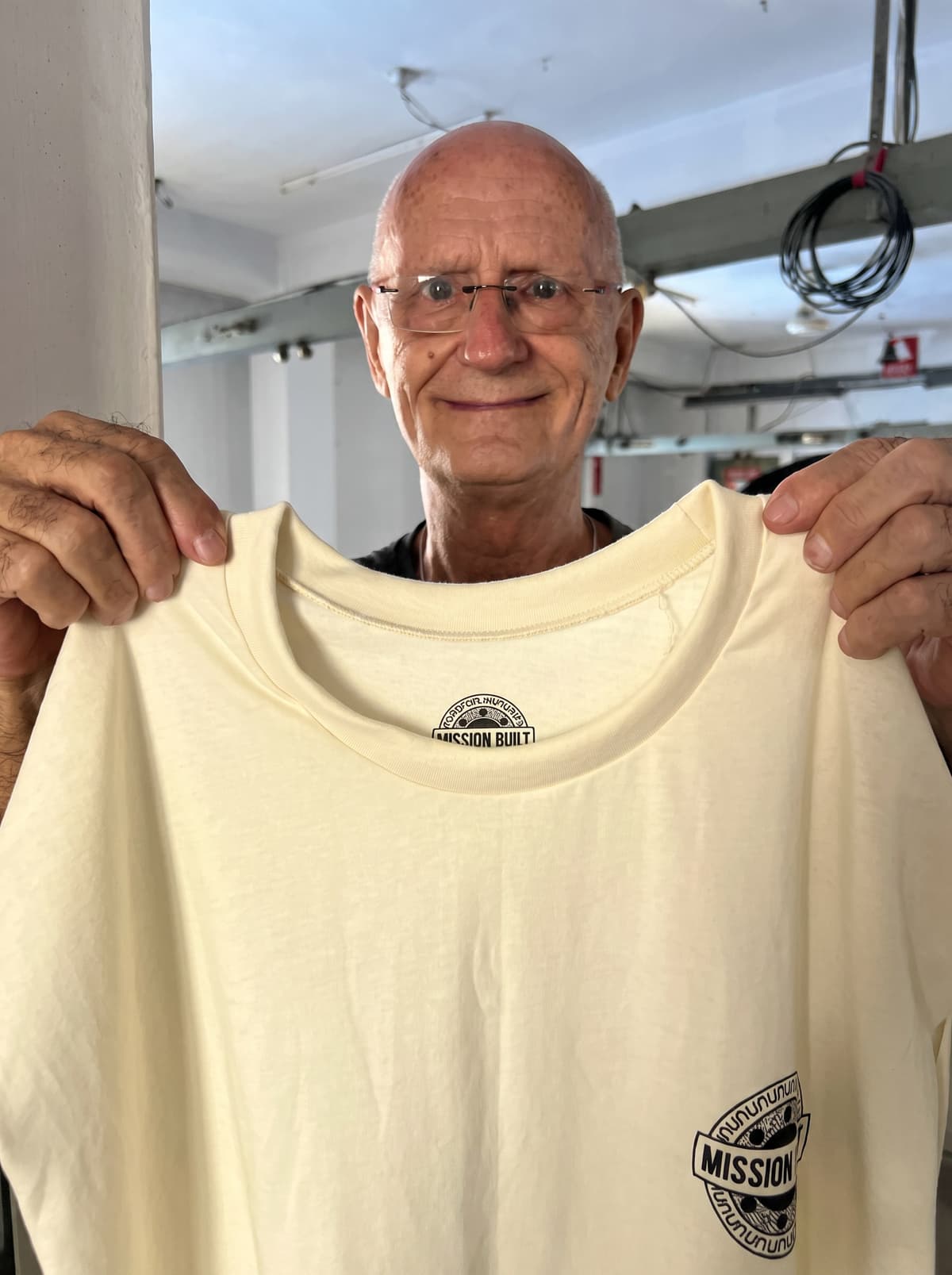
We are a clothing manufacturer for French brands with our own cut-and-sew knitwear floor in Narayanganj, Bangladesh, founded and run by one family, and a brand office in Amsterdam. Tees, polos, hoodies, sweatshirts, joggers, shorts, activewear and loungewear are made from 150 pieces per style and colour. French founders tend to ask two things first, the landed cost in France and whether the labels are compliant, so this page answers both with sources rather than reassurance.
On cost: Bangladesh-made apparel enters the EU duty-free under Everything But Arms, and France charges import VAT at its standard rate of 20% (taux normal de TVA) on the customs value plus any duty and the transport and insurance costs to the first place of destination in France. We ship DDP, so that VAT is inside the price you approve rather than a separate bill from the douane, and a TVA-registered importer normally reclaims it on the return. Since 2022 France collects import VAT through the VAT return rather than at the border for registered businesses, which makes the cash-flow question easier than in most markets; confirm the mechanism with your expert-comptable.
On labelling: fibre composition must be in French on garments sold in France under Article 16(3) of Regulation (EU) No 1007/2011, and we sew the label to your artwork in French, or in French alongside the other languages you sell in. As importer, your French company is also the EU-based operator the General Product Safety Regulation asks for, so its name and addresses go on the product or packaging.
Where France still wins: if fabriqué en France is the story, or you need fifty pieces re-cut next week from a workshop you can drive to, a French atelier is the right answer and we will say so. Where we win is knit at volume: a hoodie, a tee or a jogger cut and sewn to your spec at a hundred and fifty pieces, organic cotton available under our GOTS certificate RSC 9687, and a landed cost that includes the duty you do not pay and the VAT you do.
Ports and timing: Le Havre and Marseille-Fos take most sea freight for France and Paris-Charles de Gaulle the air cargo. From Chattogram, our experience is roughly four to five weeks by sea to northern European ports and five to eight days door to door by air, and the quote states the transit for your port. Plan about 10 days for sampling and 40–50 days of production after you approve the sample, with the voyage on top; the launch-date calculator counts back from your on-sale date.
If a search for fabricant de vêtements keeps leading to agents who will not name the factory, ask three things: the street address, the BKMEA membership and a live video call from the floor during a shift. Ours is Plot-A-132, Road No. 02, BSCIC Industrial Area, Panchabati, Narayanganj 1420, and a call during a working shift is easy to arrange.
| Bangladesh (our floor) | China | Vietnam | Turkey | Portugal | |
|---|---|---|---|---|---|
| Duty into France | No duty under Everything But Arms, single-transformation origin, still three years after graduation (verified 21 Sep 2026); 20% TVA whatever the origin | No preference; France applies the EU's standard rate for the code | Preferential rates under the EU–Vietnam agreement, if its fabric-origin rules are met | Customs union: duty-free for goods in free circulation | Made in the EU: no customs entry, no import TVA at a border |
| Sea route to France | Via Suez to Le Havre or Marseille-Fos; on our experience about four to five weeks by sea to northern European ports, five to eight days by air | Via Suez as well; comparable time at sea | Via Suez; a sea leg close to China's | By road or short-sea into France; days | By road through Spain; days |
| Where each is strongest for French ranges | Cotton knit basics at 150 pieces, organic cotton under our GOTS certification, French labels sewn in | Fabric and trim breadth, technical construction | Large woven, outerwear and sportswear runs | Quick turnaround in denim and knit at mid-range cost | Made-in-Europe small runs at the highest unit cost |
| A French brand should choose it when | Knitwear from 150 pieces matters more than a French origin, duty-free and with the GPSR file built in production | The design needs materials a knit specialist cannot find | The programme is large and woven or technical | Weeks matter more than unit price | A European origin is the selling point and price comes second |
Knitwear from our floor enters France at 0% duty under Everything But Arms, a position Regulation (EU) 2026/1395 keeps for three years after LDC graduation.
The taux normal de TVA of 20% is charged at import on the customs value plus any duty and onward transport; we quote it inside one DDP landed cost, reclaimable if you are TVA-registered.
One style in one colour at 150 pieces is a full French order, with the French fibre label and GPSR details sewn in from the first run.
Composition in French under Regulation 1007/2011, care wording in French under the Loi Toubon; on organic orders, GOTS certificate RSC 9687 supplies the GPSR evidence.
Rates re-checked on 14 October 2026 against service-public.gouv.fr and the Commission's VAT table; origin rules as verified on 21 September 2026. Sources below.
For a French importer the customs side is short. Under Everything But Arms, a garment we cut and sew is Bangladeshi by single transformation and pays no duty, and Regulation (EU) 2026/1395 holds that position for three years after Bangladesh's LDC graduation. The longer conversation is TVA: the taux normal is 20% (service-public.gouv.fr), charged at import on the customs value plus any duty and the transport and insurance to the first destination in France, and clothing sits outside the 10%, 5.5% and 2.1% rates, which the Commission's rates table still listed on 14 October 2026.
Take 500 tees at a US$6.00 customs value, freight and insurance to the EU border included: US$3,000 of goods, nothing in duty, and US$600 of TVA before the onward transport is added, all inside our DDP price. A TVA-registered importer declares it on the return. Overseas departments have their own rates and are not covered here.
The importer's number comes first. The Commission's summary of national EORI procedures says French operators apply to the douane through its online service Soprano, that a business in the SIREN register receives FR followed by its SIRET, and that assignment takes a few hours. With that in hand, confirm the commodity code for each style with your commissionnaire en douane; the landed-cost calculator does the arithmetic for any quantity.
Decree on environmental product information read on 14 October 2026; EU texts as verified on 21 September 2026. Sources below.
France asks more of a label than most markets. Regulation (EU) No 1007/2011 sets the content, each fibre by generic name with its percentage in descending order on a durable label, and requires the language of the member state of sale, here French; the Loi Toubon then extends French to care wording and product presentation, as the questions below explain. We sew to your artwork. An origin line is optional under the EU regulation, but whatever you print must be true: made in Bangladesh, never fabriqué en France.
Larger French brands carry an extra duty under the AGEC law. Décret n° 2022-748 obliges producers and importers to publish a dematerialised fiche produit relative aux qualités et caractéristiques environnementales for each product, and for clothing its traceability item means naming the country where the main weaving, dyeing and printing, and making-up took place. Since 1 January 2025 it applies to businesses declaring more than €10 million of turnover on these products in France and placing at least 10,000 units a year (text of the decree). If you are above those thresholds, tell us, and we will give you for each style where the fabric was made and dyed and where it was sewn.
Two further files sit with the French importer. The General Product Safety Regulation (EU) 2023/988, applying since 13 December 2024, makes an EU-established operator responsible, with the manufacturer's name and postal and electronic addresses on product or packaging and a risk analysis and technical documentation kept ten years; on an organic order, GOTS certificate RSC 9687 supplies the fibre, chemistry and traceability evidence, REACH Annex XVII entry 43 restricts azo dyes releasing listed amines above 30 mg/kg, and EN 14682 covers drawstrings on children's wear. The second is Refashion: France has run textile producer responsibility since 2007, long before the revised Waste Framework Directive entered into force on 16 October 2025 and gave other member states 30 months to build their own schemes, so for a French brand the EU change mostly confirms a duty it already has.
Every French quote is DDP, delivered duty paid: freight, the declaration with the douane, the 20% TVA and delivery to your door are in one landed figure, and the commercial invoice, packing list and statement on origin reach you before anything ships. In our experience a sea leg from Chattogram to northern European ports runs roughly four to five weeks and air freight five to eight days door to door; the quote carries the transit for Le Havre, Marseille-Fos or Paris-CDG specifically.
Narayanganj is on UTC+6 with no clock change, so we are five hours ahead of Paris in winter and four in summer. Our floor works Saturday to Thursday, 09:00 to 17:00, which puts its afternoon in your morning; the Amsterdam office keeps Paris time and handles design questions, samples and compliance paperwork for the rest of your day, in English or French.
Checked for French buyers on 14 October 2026 (UN portal); Regulation (EU) 2026/1395 as verified on 21 September 2026. Sources below.
Bangladesh is now due to leave the UN's Least Developed Country category on 24 November 2029. It requested an extension in February 2026; the Committee for Development Policy judged one appropriate on condition of significant progress on domestic reforms, and on 21 July ECOSOC recommended that the General Assembly settle the matter before 24 November 2026. On 29 October 2026 the General Assembly granted it, moving graduation back three years (UN LDC portal).
For an importer in France the effect is capped: Regulation (EU) 2026/1395 keeps Everything But Arms running for three years after graduation, so duty-free entry lasts until about late November 2032. The 20% TVA, the Refashion contribution and the French labelling rules do not depend on it at all. Beyond 2032 the question is GSP+, which is open; our LDC graduation guide sets out the scenarios.
Much of a French import is set up once, before the first shipment, and reused on every reorder. The table puts the steps on this page in the order they come up and says who does each one, so nothing is left to the week the goods reach Le Havre or Paris-CDG.
| When | Step | Who | Source |
|---|---|---|---|
| Before the first quote | Get an EORI number: FR followed by your SIRET, applied for through the douane's online service Soprano and assigned in a few hours | You | Commission summary of national EORI procedures |
| At quote stage | Tell us the range sells in France, so third-party laboratory testing of the fabric and trims against the French PFAS limits can be arranged | You tell us; we arrange the test | Code de l'environnement, Article L524-1 |
| Before sampling | Send label artwork: fibre composition in French, care wording and hang-tag copy in French, and your company's name, postal address and electronic contact for the GPSR | You supply it; we sew it | Regulation (EU) No 1007/2011, Loi Toubon, Regulation (EU) 2023/988 |
| At sample approval | The fibre composition of every style, and, if you are above the AGEC decree's thresholds, the countries where each fabric was made and dyed and where the garment was sewn | Us | Décret n° 2022-748 |
| Before the pieces go on sale | Register with Refashion, declare your pieces by product line and receive your IDU; a producer not established in France also appoints a representative there by written mandate | You | Code de l'environnement, Article L541-10-9-1 |
| Before shipping | Commercial invoice, packing list and the statement on origin that carries the Everything But Arms preference, sent to you before the goods move | Us | Access2Markets, Everything But Arms |
| At customs clearance | The customs declaration and the 20% import TVA, both inside the DDP quote; each line must carry either the French TVA number of the person liable or a mention that they are not identified for TVA in France | In our DDP quote; your expert-comptable confirms whose number goes on it | Douane, note aux opérateurs of 23 November 2021 |
| After delivery | If your number is on the declaration, report the import TVA on your turnover return to the DGFiP, and keep the GPSR technical documentation for ten years | You | Douane, TVA facilitations, Regulation (EU) 2023/988 |
Wonderful people to work with — very professional and knowledgeable, also accommodating to the needs of their customers.
I have had a very good experience with this company. They are very friendly, professional, and provide fast service. They speak fluent English, which makes communication very easy. The quality of their manufacturing is excellent. I have no doubt in recommending this company to anyone looking for a reliable manufacturing partner in Bangladesh.
Collective Studios under the direction of Mr Jamish and his daughter Homaira represent the future of RTW production in Bangladesh. A thorough approach to detail governed by a genuine standard of quality. Masters of and partners in the process!
No, not at present: a garment cut and sewn on our floor qualifies for 0% duty into France under the EU's Everything But Arms arrangement, because cutting and sewing in Bangladesh meets the EU's single-transformation origin rule for garments. The rate is the same whether the goods clear at Le Havre, Marseille-Fos or Paris-CDG, where French customs, the Direction générale des douanes et droits indirects, applies the common EU tariff. Bangladesh's graduation from LDC status is now set for 24 November 2029, after the UN General Assembly granted it more time on 29 October 2026. Regulation (EU) 2026/1395 keeps Everything But Arms for three years after graduation, so French entries keep that access until about the end of 2032. Verified 21 September 2026; we confirm it for every order, and our LDC graduation guide sets out the scenarios.
France charges import VAT on clothing at 20%, the taux normal de TVA, because clothing takes none of the reduced rates of 10%, 5.5% and 2.1% (European Commission, Your Europe, read 27 Sep 2026). The douane's base is the customs value, which includes freight and insurance to the EU border, plus any duty and the transport costs on to the first destination in France. On 500 tees at a US$6.00 factory price, that is US$600, 20% of the US$3,000 of goods, plus 20% of the freight, insurance and onward transport, with no duty. We quote DDP, so the VAT is costed into the landed price rather than arriving as a separate bill from the douane. Whether you then declare and recover it on your own TVA return depends on whose TVA number is on the import declaration, so confirm the mechanism with your expert-comptable before the first shipment. Overseas departments carry different rates.
Yes: the floor is 150 pieces per style and per colour, so a French brand can launch one tee in one colour with 150 pieces, or the same tee in three colours with 450. Each colour is dyed as its own lot and priced as one. French first ranges tend to run to three to five hundred pieces over two or three styles, so the GPSR file and French labels are built once and reused on every reorder. At this size the choice of Refashion declaration matters. Its 2026 simplified declaration, open to a marketer placing under 5,000 pieces a year with no eco-modulation products, costs €0.5799 per clothing piece, about €87 on 150 tees; the detailed declaration charges €0.0396 for an adult men's T-shirt-type top, about €6. Both come before Refashion's administrative costs and ADEME fee (2026 schedule, read 23 Sep 2026). Our MOQ calculator models the colour split.
Yes, for the fibre composition: under Article 16(3) of Regulation (EU) No 1007/2011, the label must use the official language of the country where the garment is sold, so French for France, with each fibre and its percentage by weight. French law goes further: Article 2 of the Loi Toubon (Loi n° 94-665, read 27 Sep 2026) makes French compulsory in the designation, presentation and instructions for use of any product, so care wording and hang-tag copy need a French version too. If you also sell in Germany, one label can carry French and German together; we sew it to your artwork in whichever languages you name. The General Product Safety Regulation adds the manufacturer's name, postal address and electronic contact on the product or packaging. Any origin you print must be true, so a garment from our floor can say Made in Bangladesh and never fabriqué en France.
Yes, if your business first places the clothing on the French market. Since 1 January 2007 France has required anyone professionally placing new clothing for households on its market to contribute to its recycling and treatment, through a producer-responsibility scheme now run by Refashion, approved as an eco-organisation until 31 December 2028. You declare your pieces by product line, pay the eco-contribution per piece, and receive a unique identifier number, the IDU, showing you are registered. If your business is not established in France but is itself the producer placing the goods on the French market, for example a Belgian or UK brand selling direct to French customers, Article L541-10-9-1 of the Code de l'environnement has also required, since 10 July 2026, a representative established in France, appointed by written mandate. We cannot register for you, because only you know how many pieces you sell in France. We can give you the fibre composition of every style when you approve the pre-production sample.
Yes: since 1 January 2026, Article L524-1 of the Code de l'environnement has banned making, importing or selling consumer clothing, footwear and their waterproofing agents that contain PFAS, protective and safety wear excepted. Décret n° 2025-1376 sets the limits: 25 ppb per individual PFAS and 250 ppb in total by targeted analysis, and 50 ppm including polymers. France covers PFAS as a class, while EU law restricts named PFAS groups, with PFHxA added from 10 October 2026, so a hoodie that passes the EU limits can still fail in France. Products made before 1 January 2026 have a twelve-month allowance, which runs to the end of 2026. Your fabric is dyed at partner dye houses, not on our floor, so tell us at quote stage that you sell in France and we can arrange third-party laboratory testing of the fabric and its trims, with the report sent alongside the shipment.
About ten days for sampling, forty to fifty days for production once the pre-production sample is signed off, then transit: in our experience roughly four to five weeks by sea to northern European ports and five to eight days by air; we confirm the figure for Le Havre, Marseille-Fos or Paris-CDG with the quote. Sea freight leaves from Chattogram and runs via Suez. Give us the final address, whether a warehouse or your own studio, and the quote covers freight, customs entry, the 20% import VAT and delivery to that door as one landed price. The commercial invoice and packing list reach you before the goods move. While the order is in production, our Amsterdam office works in your time zone, in English or French. Our launch-date calculator counts back from the day you want the pieces on sale in France. From order to your door, plan on about 70 days by air.
For some French brands, yes: if fabriqué en France is central to what you sell, if you need fifty pieces re-cut next week, or if you want to stand in the workshop while it is sewn, a French atelier serves you better. Production inside the EU also means no customs entry and no import-VAT event, and in our view Portugal is one route to a made-in-Europe label on small runs, at the highest unit cost of the options we compare. Where we are the better answer is knitwear at volume: tees, hoodies, joggers and activewear made to your pattern from 150 pieces per style and colour, in organic cotton if you want it, with our floor GOTS certified (RSC 9687; scope certificate on request), and one landed cost that already includes France's 20% import VAT, with no duty under Everything But Arms. You can also split the range: French-made pieces where the label is the story, knit basics with us.
Ask any fabricant de vêtements you are considering for three things: a street address, a live video call from the floor during a working shift, and the scope certificate behind any GOTS claim. Ours is Plot-A-132, Road No. 02, BSCIC Industrial Area, Panchabati, Narayanganj 1420, Bangladesh; the video call is not a problem, a visit to Narayanganj can be arranged, and the scope certificate for GOTS RSC 9687 is available on request. If your French searches keep ending at agents who will not name the factory, ask directly who cuts and sews your order. The easier first meeting is our Amsterdam office at Soetendaal 61, one hour from Paris by air, where you can see samples in person without flying to Dhaka and talk through compliance paperwork in English or French. Finished pieces are checked against your approved sample by Walter Meyer, our QC lead, who has 38 years in quality control. Our factory vetting guide lists the other checks.
Not always, but it decides how the import TVA is handled. Since 1 January 2022 each French import declaration must say who owes the TVA: either the French TVA number of the person liable, the same on every line, or, for a person liable who is neither taxable nor identified for TVA in France, a special mention saying so. A declaration with neither is rejected, and so is one carrying an invalid or suspended number, which customs checks automatically (douane note aux opérateurs, 23 November 2021). If your company is identified for TVA in France, self-assessment is compulsory and automatic: you report the import TVA on your turnover return to the DGFiP instead of paying it to customs (douane.gouv.fr). The note suggests checking the number in the Commission's VIES database first. How the 20% sits in our DDP quote depends on whose number goes on the declaration, so settle it with your expert-comptable before the goods leave Chattogram.
A great deal. The French Treasury's economic service in Dhaka, using French customs data, puts French imports from Bangladesh at €3.96 billion in 2024, up 2% on the year, with clothing and other textile products making up nearly 94% of the total. French exports the other way came to €167 million (DG Trésor, published July 2025). For a small French brand the practical point is that the lane is well used, and in our experience forwarders and commissionnaires en douane at Le Havre, Marseille-Fos and Paris-CDG handle Bangladeshi origin and the Everything But Arms statement on origin routinely. A first order of 150 pieces per style and colour moves through the same ports and the same paperwork as much larger shipments, which our guide to importing clothing into the EU sets out. What changes with your size is the Refashion declaration and who acts as importer, both covered elsewhere on this page.
Trade and regulatory details on this page last verified 21 September 2026. Tariff and compliance terms change — ask us to confirm the current position for your order.
Whether it’s a large bulk or wholesale run or your first batch of 150, send a sketch, a reference, or a sentence. We’ll reply within one business day with fabric options and an indicative price.
Or message the factory directly: WhatsApp +880 1980 055026 · hello@collectivestudioltd.com · Homaira replies within one business day.