Honest about Barcelos
We say plainly which pieces belong in a Minho workshop and which are cheaper cut and sewn from 150 pieces on our floor; most Portuguese brands run that split.
Premium knitwear manufacturing for Portuguese brands — duty-free under Everything But Arms, Portugal's 23% import VAT inside one landed price, labels in Portuguese, and a straight answer on when Barcelos is the better choice.
Collective Studio cuts and sews knitwear for Portuguese labels in Narayanganj, Bangladesh, from 150 pieces per style and colour, with DDP delivery to the mainland through Sines, Leixões or Lisbon after 40–50 days' production plus freight. About 70 days from order to your door by air. Duty is 0% under Everything But Arms, the 23% IVA is in the quote, labels are in Portuguese under Decreto-Lei 238/86, and the page is plain about when a Barcelos workshop is the better buy.
Or message the factory directly: WhatsApp +880 1980 055026 · hello@collectivestudioltd.com · Homaira replies within one business day.
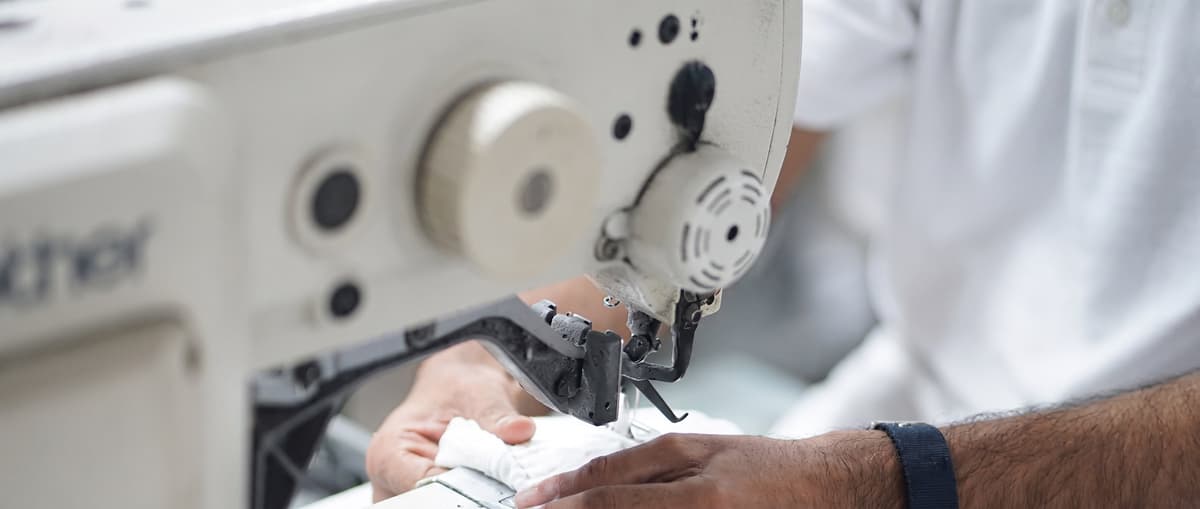
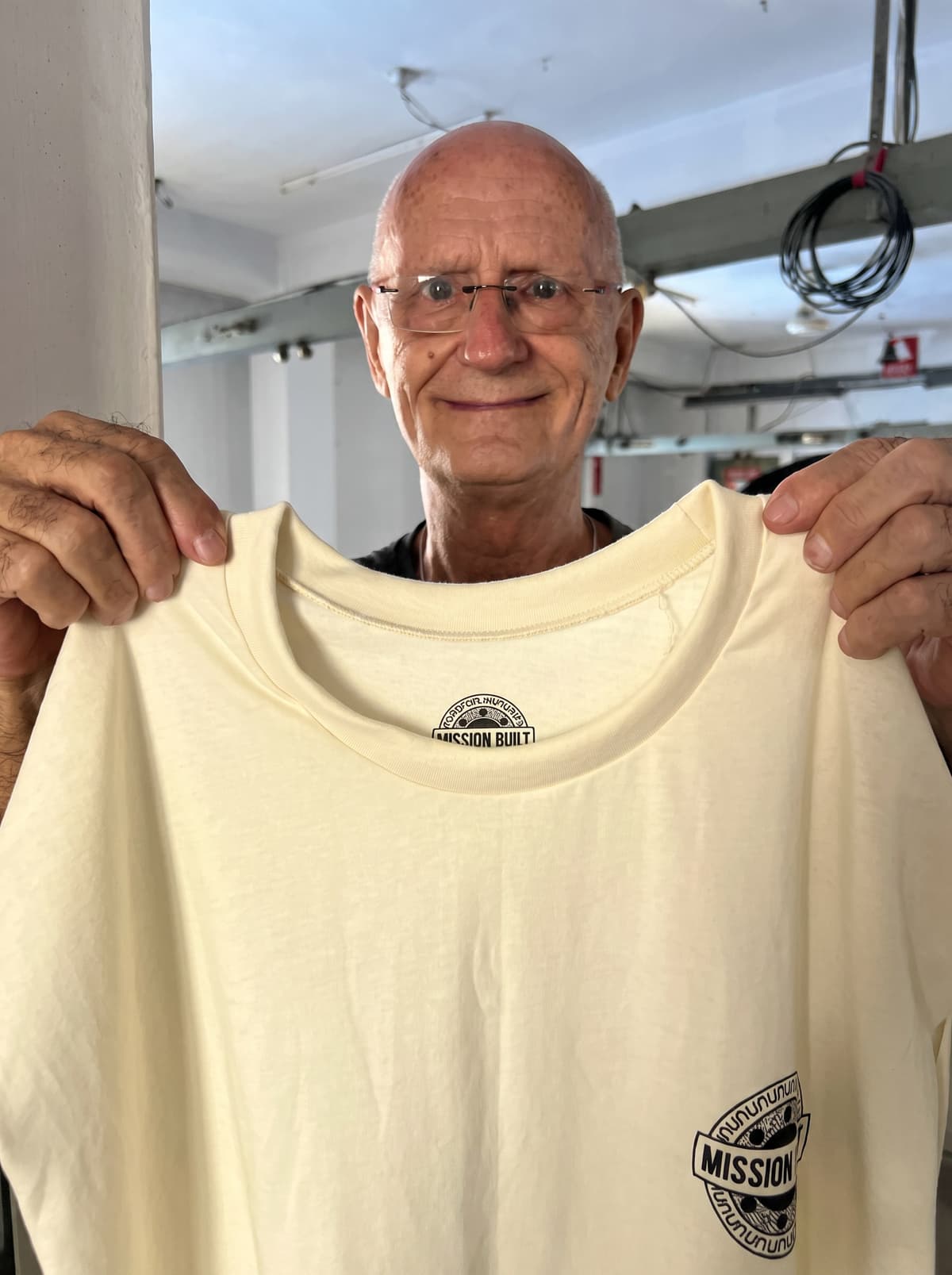
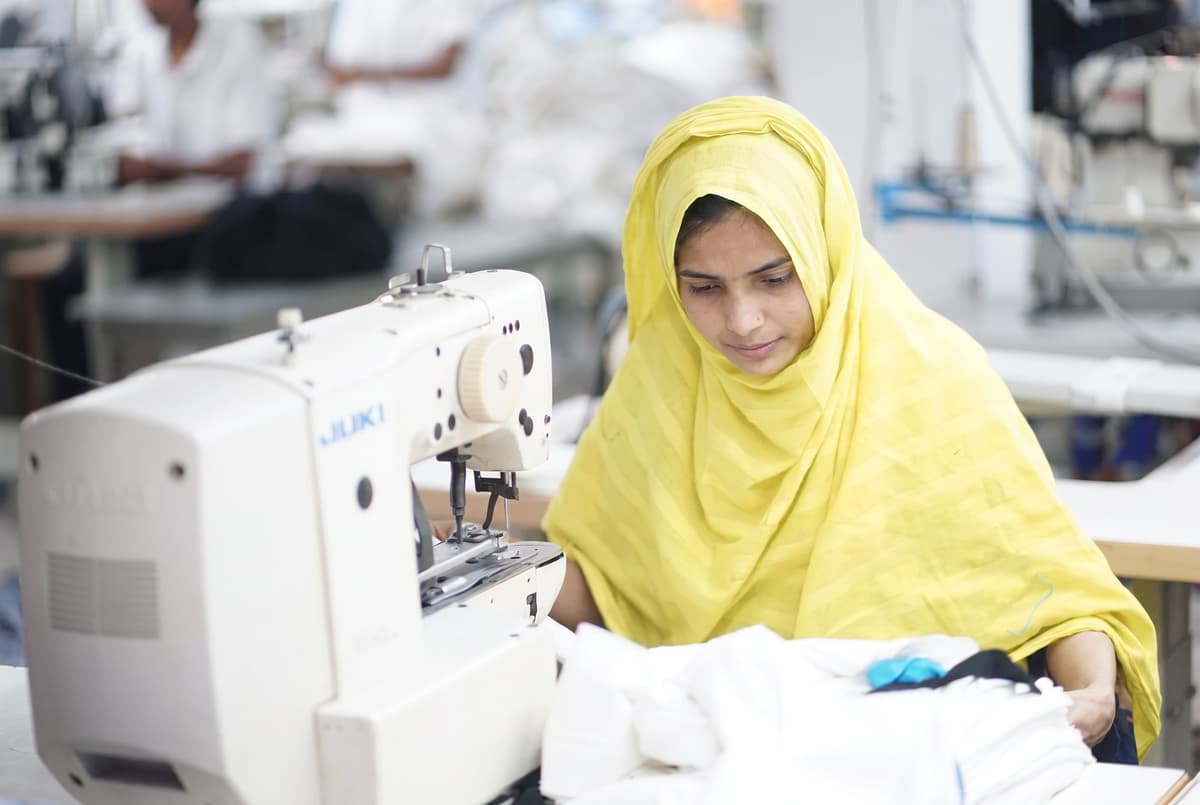
Made by our own team in Narayanganj. See the floor ↓Client reviews on Google ↗GOTS certificate RSC 9687 →
The short answer: most Portuguese clothing manufacturers work in the north, around Porto and Braga, and suit small multi-colour runs, woven pieces and quick re-cuts. We are not one of them. We are a knitwear floor in Bangladesh that ships tees, hoodies and joggers DDP to mainland Portugal at 0% duty, from 150 pieces per style and colour.
We are a clothing manufacturer for Portuguese brands, and we will say the awkward part first: Portugal's northern textile cluster, Barcelos, Póvoa de Varzim and Guimarães, is the low-minimum benchmark the rest of Europe compares against, and we name those factories in our own guides. A Portuguese founder can drive to a workshop that will cut fifty pieces. So this page is not a pitch against your neighbours; it is the numbers for the pieces where Bangladesh knit at volume makes more sense than a Minho workshop, and a plain statement of which pieces those are.
The figures: duty on Bangladesh-made clothing is nil under Everything But Arms, and mainland Portugal charges IVA at the 23% taxa normal on the customs value plus any duty and the transport to the first place of destination. Because we ship DDP, that IVA is in the price you approve, not a separate demand, and a company registered for IVA normally recovers it on its return. The Azores and Madeira set lower rates under the VAT Code and get their own quote.
Where Portugal wins: a re-cut next week, a woven or tailored piece, a small premium run where fabricado em Portugal is part of the price, and anything that benefits from standing in the workshop. Where we win is volume at a low minimum: a tee, hoodie or jogger cut and sewn to your pattern from 150 pieces per style and colour, with organic cotton under our GOTS certification, RSC 9687, at a landed cost that a Portuguese jersey line cannot reach at that quantity. Brands that sell across Europe often keep their hero pieces in Portugal and place the basics with us.
Labelling: information about goods offered on the Portuguese market must be in Portuguese under Decreto-Lei 238/86, and Decreto-Lei 257/2012 applies the EU fibre regulation, both listed on the ASAE's textile-labelling page. We sew the label to your artwork in Portuguese, adding Spanish, English or other languages for the markets you also sell in. The General Product Safety Regulation adds the manufacturer's name and addresses on the product or packaging and an EU-established responsible operator, which a Portuguese company importing from us is.
Ports and timing: sea freight usually enters at Sines or Leixões, with Lisbon as the alternative, and air freight at Lisbon or Porto. Sines takes direct deep-sea calls on the Atlantic side of Gibraltar, so the cargo need not be transshipped in northern Europe; the transit for your port comes with the quote, not as a printed figure. Allow about 10 days for sampling and 40–50 days of production from sample approval, then the voyage; the launch-date calculator counts back from your on-sale date.
We do not make denim, jackets or woven shirts; our sister buying house sources them as a separate order, and Portugal makes them very well. If your search for a fabricante de roupa abroad keeps returning agents, ask each for a street address, BKMEA membership and a video call from the factory floor while a shift is running. Ours is Plot-A-132, Road No. 02, BSCIC Industrial Area, Panchabati, Narayanganj 1420.
| Bangladesh (our floor) | China | Vietnam | Turkey | Portugal (Minho workshop) | |
|---|---|---|---|---|---|
| Duty into Portugal | 0% under Everything But Arms on single-transformation origin, kept three years after LDC graduation (checked 14 Oct 2026); 23% IVA on every mainland import | No EU preference, so the full rate for the commodity code | EU–Vietnam agreement rates, if and only if its fabric-origin rules are met | Customs union with the EU: no duty on goods in free circulation | Home production: no customs entry and no import IVA, though domestic IVA applies |
| Route to Portugal | Via Suez and Gibraltar to Sines or Leixões, with direct deep-sea calls at Sines; we quote the transit for your port | Suez and Gibraltar, a sea leg like ours | Suez and Gibraltar as well; similar timing | Short-sea or road; days rather than weeks | A drive to the workshop |
| What it does best | Knit basics at 150 a colour, organic cotton under GOTS certificate RSC 9687, landed cost on volume | Fabric and trim choice, technical builds | Woven, outerwear and sportswear at scale | Fast turnaround, denim and knit, middle of the price range | Small multi-colour runs, re-cuts, woven pieces, fabricado em Portugal |
| Choose it when | You want one colour deep from 150 pieces, duty-free, with the GPSR file built during production | The material or build is outside what a knit floor can source | Volume is large and the range woven or technical | Weeks matter more than the unit price | You want five colours at 75, a piece next week, or the fabricado em Portugal line |
We say plainly which pieces belong in a Minho workshop and which are cheaper cut and sewn from 150 pieces on our floor; most Portuguese brands run that split.
Portugal's normal rate on the mainland, charged on the customs value plus onward transport and sitting inside our DDP price, recoverable on your return; Azores and Madeira quoted separately.
Decreto-Lei 238/86 requires goods information in Portuguese; we sew Portuguese labels to your artwork, with other languages added for the rest of Europe.
For organic pieces, GOTS certificate RSC 9687 backs the fibre, chemistry and traceability evidence in your GPSR file; we build the rest of it with you during production.
Re-checked on 14 October 2026 against the Portal das Finanças, EUR-Lex and the UN LDC portal; links under Sources below.
The duty side is decided at EU level: knitwear cut and sewn on our floor meets the single-transformation origin rule of Everything But Arms and enters Portugal at 0%, and Regulation (EU) 2026/1395, adopted on 17 June 2026, keeps Bangladesh on the EBA list with a three-year transition once it leaves LDC status. The tax side is Portuguese: Article 18 of the Código do IVA charges 23% on "as restantes importações", everything not on Lists I and II at 6% and 13%, and clothing is on neither. The same article lets the legislative assemblies of the Azores and Madeira set lower regional rates.
On a mainland delivery of 500 tees at US$6.00 each, with freight and insurance to the EU border already in that customs value, the base is US$3,000: no duty, US$690 of IVA, and 23% on any transport to the first place of destination, all inside our DDP price. A company registered for IVA normally recovers it on its periodic return. Island deliveries are priced at the regional rate on a separate quote.
Before you fix wholesale prices, have your despachante confirm the commodity code for each style; we state the duty position for your order in writing, and the landed-cost calculator runs the arithmetic at any quantity.
Re-checked on 14 October 2026 against ASAE, APA, the Diário da República and EUR-Lex; links under Sources below.
Two layers decide a Portuguese label. Regulation (EU) No 1007/2011 sets the content, every fibre by generic name and percentage in descending order on a durable label, and its Article 16(3) leaves the language to each member state, which the Commission's Your Europe guidance reads as every official language where the garment is sold. Portugal's rule is Decreto-Lei 238/86, which puts information on the nature and characteristics of goods on the national market in Portuguese, so "100% algodão". The ASAE lists the fibre regulation, Delegated Regulation (EU) 286/2012 and Decreto-Lei 257/2012 as the applicable textile-labelling law. Origin is optional on the label, but the customs entry names Bangladesh and anything you print must agree.
Under the General Product Safety Regulation (EU) 2023/988, applying since 13 December 2024, your Portuguese company is the EU-established operator for goods it imports from us, and a brand selling under its own name is also the manufacturer whose name and postal and electronic address appear on the garment or packaging; the technical file is kept for ten years. For organic pieces, GOTS certificate RSC 9687 supplies its fibre, chemistry and traceability evidence. REACH entry 43 limits azo dyes releasing listed amines to 30 mg/kg in textiles against the skin, and EN 14682 covers children's cords; the GPSR guide lays out the file. Your customers also have three years to report a lack of conformity under Article 12 of Decreto-Lei 84/2021, and a fault that shows in the first two years is presumed to have existed on delivery (Article 13).
On textile waste, Portugal is preparing rather than charging. The environment agency's textile FAQ of December 2025 says municipalities have collected textile waste separately since 1 January 2025 under the general waste regime, and that textiles and footwear were not yet an approved producer-responsibility stream, so the general regime of Decreto-Lei 102-D/2020 still applied. Directive (EU) 2025/1892 sets the timetable: transposition by 17 June 2027 and a scheme running by 17 April 2028, after which a brand must be registered before it places clothing on the Portuguese market. The apparel Digital Product Passport is a separate, later step, planned by the Commission for late 2027 with at least 18 months' transition.
Mainland quotes are DDP: freight, clearance at Sines, Leixões or Lisbon, the 23% IVA and delivery to your door inside one landed price, with the commercial invoice, packing list and statement on origin sent before the goods leave Bangladesh. We give the sea transit for your port per order; air freight into Lisbon or Porto takes days. The Azores and Madeira are priced separately.
Bangladesh keeps UTC+6 all year, which makes it six hours ahead of Lisbon in winter and five in summer. The floor works Saturday to Thursday, 09:00 to 17:00, so a Lisbon or Porto morning meets our afternoon, and our Amsterdam office, an hour ahead of you, covers design questions, samples and paperwork in English for the rest of the day.
Re-checked on 14 October 2026 on the UN LDC portal and EUR-Lex.
The UN LDC portal now dates Bangladesh's graduation to 24 November 2029. An extension request went in during February 2026; the Committee for Development Policy said one would be appropriate if domestic reforms progress significantly, and the Economic and Social Council recommended on 21 July that the General Assembly act before 24 November. On 29 October 2026 the General Assembly granted it, moving graduation back three years from 24 November 2026.
For Portugal the downside is capped: Regulation (EU) 2026/1395 keeps Everything But Arms for three years after graduation, so duty stays at 0% until about late 2032, and the IVA is unaffected. What happens after depends on GSP+ eligibility, still unsettled; the LDC graduation guide sets out each case.
Before you weigh us against a workshop in the Minho, it helps to see the size of the industry you would be comparing with. These are the official figures we could check, each with the year it belongs to.
Two of them matter most for a Portuguese label. T-shirts and vests head AICEP's list of the sector's exports, at 15%, so a northern jersey maker is the right benchmark for any tee you ask us to quote, and we expect you to make that comparison. And Portugal is buying more clothing from abroad, not less: AICEP reports clothing imports up about 10% in the first half of 2025.
| Figure | Period | Source | |
|---|---|---|---|
| Textile and clothing exports | 5,499 million euros, down 0.8% on 2024 | 2025, provisional | INE, reported by Lusa |
| Of which clothing | 3,178.2 million euros, down 0.3% | 2025, provisional | INE, reported by Lusa |
| Main export markets | Spain 1,318, France 834, Germany 461, United States 420, United Kingdom 337 (million euros) | 2025, provisional | INE, reported by Lusa |
| Leading export line | T-shirts and vests, 15% of the sector's exports, first in AICEP's list | 2022 | AICEP, from Eurostat |
| People employed | About 127,000, or 17% of manufacturing jobs | 2021 | AICEP |
| Where the industry is | The north, mainly the Porto and Braga regions; Covilhã for technical textiles | Current | AICEP |
| Clothing imports | Up about 10% on the same period of 2024 | January to June 2025 | AICEP Portugal Global |
Search for a Portuguese clothing manufacturer and the results mix three kinds of business under similar wording. Any of the three can serve a small brand well. What differs is who sews your order and who answers for a fault, so ask which one you are talking to before you send a tech pack.
Several describe themselves plainly. Friendly Factories in Maia calls itself "a group of 32 manufacturers based in Portugal", with an MOQ of 150 per style and colour. Create Fashion Brand calls itself "a group of textile manufacturers based in the North of Portugal". Sewport says it "connects you with verified clothing manufacturers in Portugal". None of that is a weakness; it simply tells you which questions to ask.
| Who sews your order | Who answers for a fault | What to ask for | |
|---|---|---|---|
| Own factory | The company's own machinists, on the floor you visit | The factory that accepted your order | The production address, and a visit or live video while a shift is running |
| Group of manufacturers | One of several member or partner units, chosen for each order | The group, if your contract names it as the supplier | Which unit will sew your style, and whether you can see that floor |
| Platform or directory | A manufacturer you choose from its listings | Whoever your contract is with; read the platform's terms | The manufacturer's own name, address and certificate numbers |
| Our floor, for comparison | Our machinists in Narayanganj: we cut, sew, finish, check and pack; knitting and dyeing are done at partner mills we specify and inspect | Collective Studio, under one DDP order | A live video call from the floor during a working shift; our address is on this page |
Wonderful people to work with — very professional and knowledgeable, also accommodating to the needs of their customers.
I have had a very good experience with this company. They are very friendly, professional, and provide fast service. They speak fluent English, which makes communication very easy. The quality of their manufacturing is excellent. I have no doubt in recommending this company to anyone looking for a reliable manufacturing partner in Bangladesh.
Collective Studios under the direction of Mr Jamish and his daughter Homaira represent the future of RTW production in Bangladesh. A thorough approach to detail governed by a genuine standard of quality. Masters of and partners in the process!
For knit basics from 150 pieces per style and colour, Bangladesh usually gives the lower landed cost; for small multi-colour runs, woven pieces or a re-cut next week, a Portuguese workshop is usually the better buy. Portugal's northern cluster, Barcelos, Póvoa de Varzim and Guimarães, is the low-minimum benchmark the rest of Europe compares against, and a Portuguese founder can drive to a workshop that will cut fifty pieces. IVA is 23% either way: buying at home saves the import and the customs entry, not the tax. Our case is narrower: tees, hoodies and joggers cut and sewn from 150 pieces per style and colour, duty-free under Everything But Arms, with organic cotton under our GOTS certification, RSC 9687. Our unit price falls as a style's quantity rises, so the case strengthens on reorders. We do not make denim, jackets or woven shirts. Brands selling across Europe often keep hero pieces in Portugal and place the basics with us.
No: knitwear cut and sewn on our floor enters Portugal at 0% duty under the EU's Everything But Arms scheme, whose single-transformation origin rule our floor satisfies. The customs entry at Sines, Leixões or Lisbon and the import IVA still apply; only the duty is zero. Against the other routes a Portuguese brand weighs, a Chinese garment pays the standard EU rate, a Vietnamese one gets the EU–Vietnam agreement's preference only where its fabric-origin rules are met, Turkish goods in free circulation pay none under the customs union, and a workshop in Barcelos needs no customs entry. Bangladesh's graduation from Least Developed Country status is now set for 24 November 2029, after the General Assembly granted Dhaka more time on 29 October 2026. Regulation (EU) 2026/1395 extends EBA access for three years beyond graduation, so a Portuguese buyer faces no duty to about the end of 2032. Our LDC graduation guide covers what may follow.
Import VAT (IVA) on clothing in mainland Portugal is 23%, the normal rate. Article 18 of the Código do IVA (read 27 Sep 2026) sets 23% for goods not on Lists I and II, which carry 6% and 13%, and clothing is on neither. The Autoridade Tributária e Aduaneira charges this IVA at import on the customs value plus any duty and the transport and insurance costs to the first place of destination. With duty at zero, 500 tees at a US$3,000 customs value carry US$690, plus 23% of any onward transport to that first destination. We ship DDP, so the IVA sits inside the landed price you approve rather than as a separate bill. A VAT-registered importer normally recovers it through its periodic return, so ask who will be named importer on your entry before counting on that. In our landed-cost calculator, choose Other EU member state and enter 23%. The Azores and Madeira have lower regional rates, quoted separately.
The simplest route is DDP: we deliver to your door in mainland Portugal with freight, the customs entry and the import IVA inside one landed price and no separate bill at the port. Sea freight comes in through Sines, Leixões or Lisbon; air freight lands at Lisbon or Porto, Porto being nearer for a brand in the Minho. The commercial invoice and packing list reach you before the goods move. Under the General Product Safety Regulation, a company importing from us in Portugal is the EU-established responsible economic operator and must be able to produce the technical file, which is kept for ten years; our Journal guide to GPSR for clothing brands walks through it, and GOTS certificate RSC 9687 supplies the fibre and chemistry evidence. Bangladesh is five to six hours ahead of Portugal, so your morning overlaps the floor's afternoon, and our Amsterdam office, one hour ahead of Lisbon, covers the rest of the day for samples and paperwork, in English.
Yes: our minimum is 150 pieces per style and per colour, so one tee in one colour is a complete order. Each colour counts separately because each colour is its own dye lot, measured in hundreds of kilos. A first range of two styles in two colours is 600 pieces. Spread over a common size curve, 150 pieces gives roughly 8 XS, 22 S, 45 M, 45 L, 15 XL and 15 XXL. Northern Portuguese minimums run from 50 to 150. White Cotton in Barcelos takes 75 per colourway across two or more, but its tees start at 150 in one colourway or 100 per colourway across two. If you want a hoodie in five colours at 75 each, a Barcelos workshop fits better. If you want one colour deep, 150 from us makes sense, and that style's GPSR file can be reused on reorders of the same specification. The MOQ calculator shows how a Portuguese first range splits across sizes and colours.
Start in the northern textile cluster around Barcelos, Póvoa de Varzim and Guimarães, and shortlist workshops that publish their minimums and name their certificates. Our low-MOQ manufacturers guide profiles two there: White Cotton in Barcelos, at 75 pieces per colourway across two or more colours or 100 in a single colourway (tees and shirts 150 in one colourway, or 100 per colourway across two), and Create Fashion Brand in Póvoa de Varzim, at 150 per model and colour from scratch or 50 for customising blanks. Both name their certifications but publish no certificate numbers, so ask to see the certificates themselves. Because you are in Portugal, visit: see the floor and ask whether they own the production or coordinate other workshops. When you compare fabricante de roupa offers from abroad, ask for the factory's street address and a live video call from the floor during a working shift. Ours is Plot-A-132, Road No. 02, BSCIC Industrial Area, Panchabati, Narayanganj 1420.
Yes. Decreto-Lei 238/86 requires information on the nature and characteristics of goods offered on the Portuguese market to be in Portuguese, and Article 16(3) of Regulation (EU) No 1007/2011 requires the fibre label to be in the official language of the member state where the garment is sold to the consumer. Portugal applies the regulation through Decreto-Lei 257/2012: every fibre by its generic name and percentage, in descending order, on a durable, legible label, so '100% algodão' rather than '100% cotton'. The ASAE lists Regulation 1007/2011 and Decreto-Lei 257/2012. A 'fabricado no Bangladesh' line is optional under the fibre regulation, but any origin you print must be true. Our floor sews the Portuguese label to your artwork, with other languages alongside if you also sell elsewhere in the Union. The General Product Safety Regulation also requires the manufacturer's name and postal and electronic address, and a type or batch number, on the garment or its packaging; selling under your own name or trademark makes you that manufacturer under Article 3(8).
About ten days for sampling, forty to fifty days for production once the pre-production sample is signed off, then transit to Sines, Leixões or Lisbon by sea, sometimes on a direct deep-sea service into Sines, or to Lisbon or Porto by air in days; we confirm the figure for your port with the quote. Sines takes direct deep-sea calls on the Atlantic side of Gibraltar, so a shipment on one of those services does not need a northern European transshipment. Air into Lisbon or Porto suits a small first run you need on the shelf for a launch; sea suits volume. Our DDP price to the mainland includes the customs entry, the 23% IVA and the last leg to your door. If a piece must be in a Lisbon shop at short notice, a Portuguese workshop is the right call. The launch-date calculator works back from a Lisbon or Porto on-sale date. From order to your door, plan on about 70 days by air.
Yes, on a separate quote, because the islands set their own IVA rates. Article 18(3) of the Código do IVA lets the regional legislative assemblies set lower rates, including on imports whose customs clearance takes place in the islands. The Autoridade Tributária e Aduaneira's Ofício Circulado 25045 of 6 December 2024 (read 27 Sep 2026) gives the normal rate as 16% in the Azores and 22% in Madeira. On a US$3,000 tax base, that is US$480 or US$660 of IVA, against US$690 on the mainland. So the rate for your order depends on where the goods clear customs, and we state it in the quote. Duty stays at zero under Everything But Arms. The Portuguese label and the GPSR file are the same as for a Lisbon or Porto delivery. Tell us the island and address when you ask for a quote, and we will quote the delivery terms with it.
Yes. Send the approved garment from your workshop, or its tech pack, and we measure it, note the fabric composition and GSM, and specify a matching jersey from the partner mills that knit and dye for us. The fabric will not come from the same Portuguese mill, so judge the hand-feel on our counter sample, which takes about 10 days, rather than on a spec sheet. Colour is approved on a physical lab dip that we keep on file, not on a code read off a screen, so later batches match the first. Production then runs 40 to 50 days from your sample approval, plus freight to Sines, Leixões or Lisbon. Moving one basic first, and keeping the rest of the range at home until you have seen the bulk, is a sensible test. If the style sells in five colours at 75 pieces each, keep it in Portugal: our minimum is 150 per style and colour.
Yes, and the labels need the most care. The fibre content goes in Portuguese on every piece, such as "100% algodão", whoever sews it. Origin is optional, but if you print it, a Barcelos piece can say fabricado em Portugal while ours must name Bangladesh, which is what the customs entry records; one label artwork with a different origin line usually covers both. Under the General Product Safety Regulation you are the manufacturer of both when they carry your name, so each style needs its own technical file and a type or batch number on the garment or packaging. Keep one size specification and grading rule across both makers so a medium fits the same, and approve shades against the same physical standard. Plan the calendar as well: our pieces need about 10 days of sampling and 40 to 50 days of production before freight, so place the basics with us first.
Trade and regulatory details on this page last verified 14 October 2026. Tariff and compliance terms change — ask us to confirm the current position for your order.
Whether it’s a large bulk or wholesale run or your first batch of 150, send a sketch, a reference, or a sentence. We’ll reply within one business day with fabric options and an indicative price.
Or message the factory directly: WhatsApp +880 1980 055026 · hello@collectivestudioltd.com · Homaira replies within one business day.