Sewing a green jersey tee
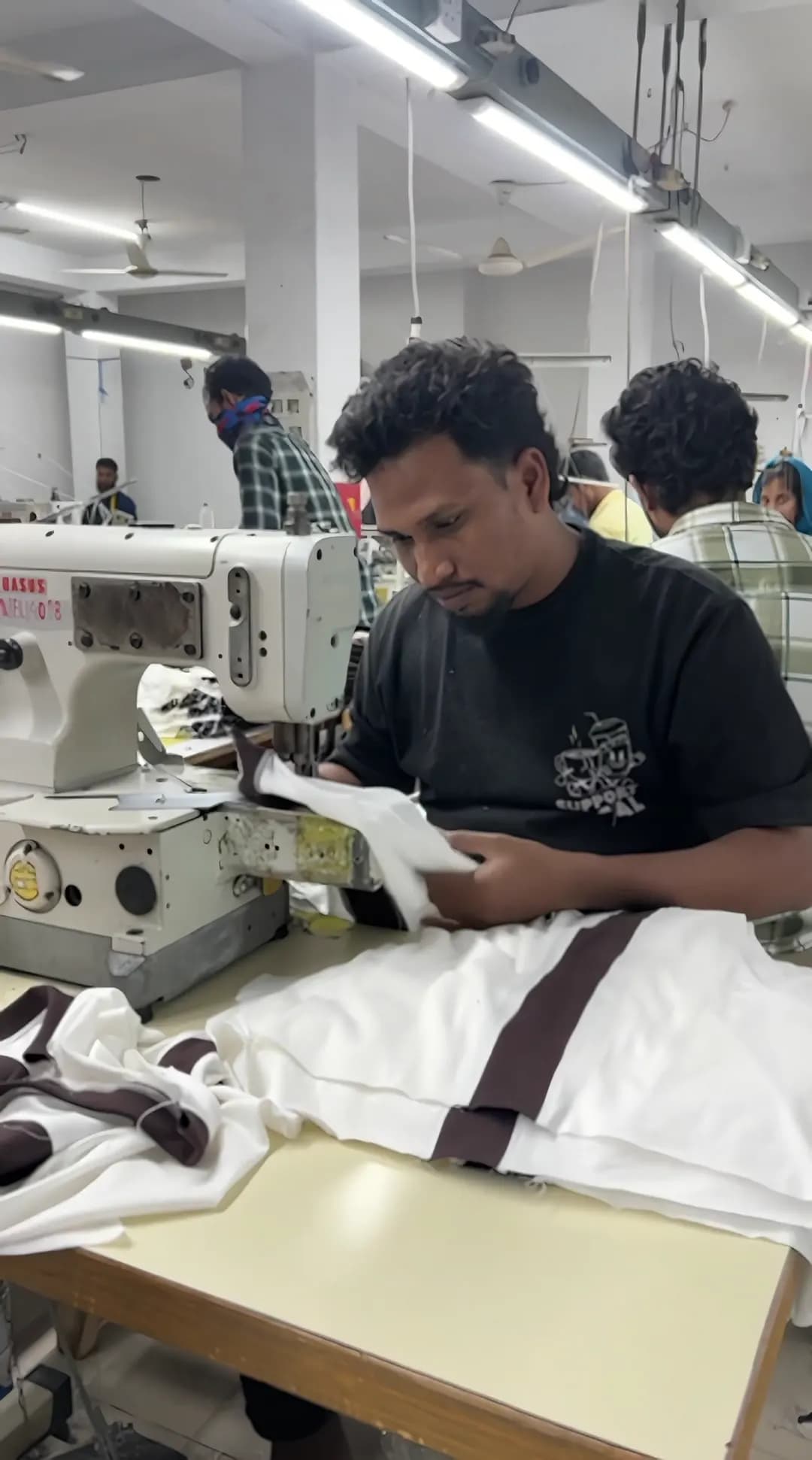
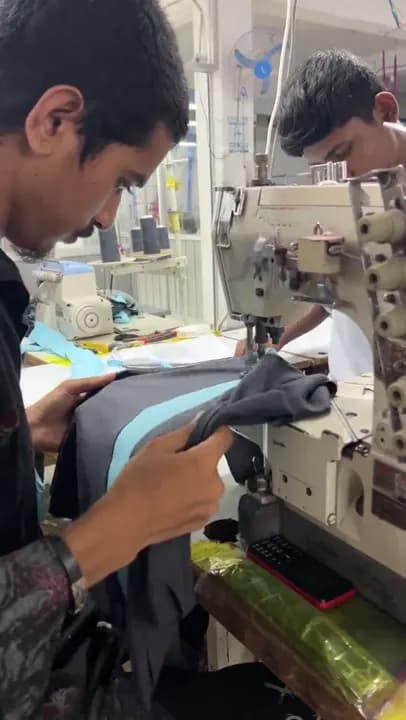
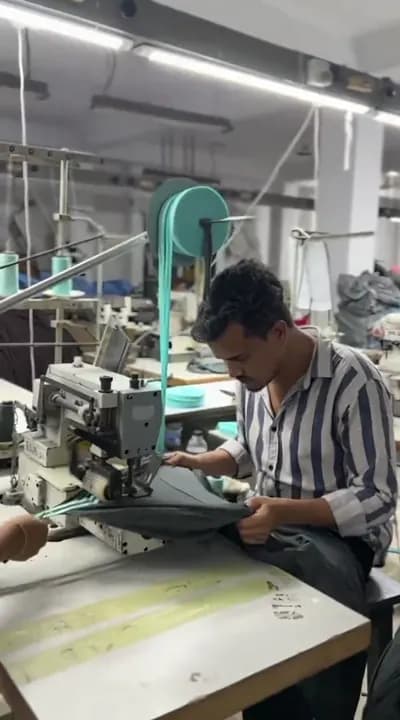
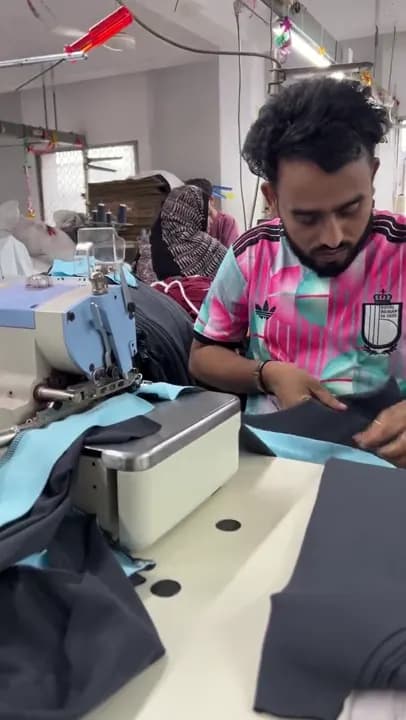
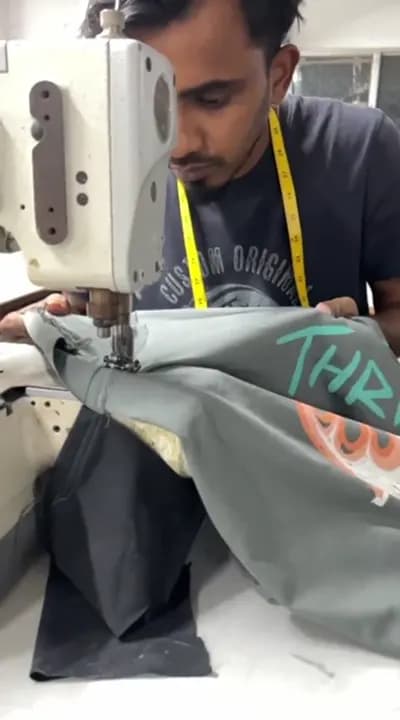
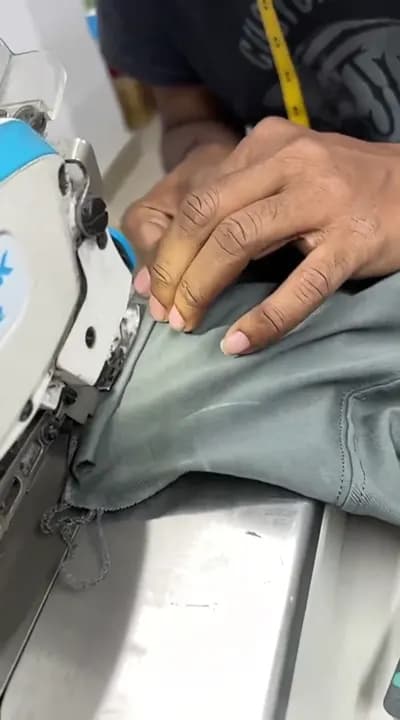
Close-up of a green jersey tee being sewn at Collective Studio, a GOTS-certified knitwear factory in Narayanganj, Bangladesh.
- Length
- 0:06, no sound
- Filmed at
- Collective Studio, Narayanganj, Bangladesh
What you are seeing
A short close-up of a green jersey tee under the needle, with a size ticket (XL) on the panel.
Tickets like that one keep the pieces cut from one lay together as they move down the line, so the parts of one garment are never mixed with pieces cut from a different roll.
The presser foot has a guide along one side, and the size ticket carries a number written beside the XL. A seam already sewn runs across the panel to the left of the foot.
A small difference in shade between panels only shows once they are sewn into one garment. When you check a bulk piece, look at the sleeves, the body and the neckband together in daylight: they should read as exactly the same colour.
From the cutting table to the line
A tee starts on the cutting table, where the jersey is spread from its rolls in layers, the pattern is laid on top and the stack is cut together. The cut pieces are then bundled, and each bundle carries a ticket with the size and a bundle number, like the XL ticket in this clip. Pieces of one garment stay in one bundle, so the front, back and sleeves of a single tee all come from the same roll.
That matters because two rolls of the same colour can differ very slightly, even within one dye lot. Side by side on a shelf you would never see it, but sewn into one garment a sleeve a shade off the body is obvious. Bundling by roll means no tee is assembled from two rolls. It is also why a factory asks how many rolls your colour came on before it plans the lay.
Sewing single jersey
Single jersey is the fabric of most T-shirts, and it has two habits that shape how it is sewn. Its cut edges curl, so the operator has to keep them flat as they reach the needle, which is what the guide beside the presser foot helps with. And it stretches easily in width, so a seam fed unevenly comes out wavy. Shoulder seams are often stabilised with a tape so they do not stretch out on the hanger.
Single jersey can also twist after washing, a fault called spirality, where the side seam swings round to the front. On our floor tees are side-seamed rather than knitted as a tube, which helps hold the body straight. The jersey fabric guide explains the causes, and the T-shirt manufacturing page sets out weights and constructions.
What to check on a bulk tee
Lay a bulk piece flat and check four things against your approved sample. The shade of sleeves, body and neckband together in daylight. The measurements against the tolerance column in your tech pack, especially chest, body length and sleeve length. The neckband, which should lie flat without rippling and recover after a gentle stretch. And the side seams, which should run straight down the sides.
Then wash one piece and check the side seams again. If your tee is organic cotton, made in our GOTS-certified facility (RSC 9687), the organic cotton page explains what paperwork comes with the order. The T-shirt tech pack template on our resources page has every point of measure you need.
Where this clip appears
- Organic Cotton Clothing Manufacturer
- Polo Shirt Manufacturer
- Kids Clothing Manufacturer
- Merch Manufacturer for Content Creators
- Tank Top Manufacturer & Vest Factory
- Jersey Fabric: What It Is, Flat Jersey, Cotton & GSM
- What Is a Tech Pack? Page-by-Page Example + Free Template
- Clothing Manufacturers Portugal: Honest Guide vs Bangladesh
Sewing a green jersey tee: questions brands ask
What is shading in garment production, and how is it prevented?
Shading is a visible difference in colour between parts of the same garment, and it is prevented mainly at the cutting table. Dyed fabric is never perfectly uniform: two rolls from one dye lot can differ very slightly, and so can the two edges of one wide roll. On their own the differences are too small to notice, but sewn next to each other in one garment, a sleeve a fraction lighter than the body stands out. Factories prevent it in three ways. Fabric is checked roll by roll against the approved shade before cutting. Pieces are bundled and ticketed so every part of one garment comes from the same roll and stays together down the line. And finished pieces are looked at in good, even light during inspection. When you receive bulk, check sleeves, body and neckband together in daylight, and treat a two-tone garment as a defect, not a variation.
Why do T-shirt necklines and shoulders stretch out, and how is it prevented?
Because jersey stretches easily and the neck and shoulders carry the garment's weight, and the fix is in the construction. A tee hung on a hanger or pulled on by the neck puts strain on two places: the shoulder seams, which carry the weight of the body, and the neckband, which is stretched every time the tee goes over a head. Shoulder seams are commonly reinforced with a narrow tape sewn into the seam, which stops them lengthening. The neckband should be a rib with good recovery, sewn on at the right tension, and a tape across the back neck covers and strengthens the seam behind it. Fabric weight matters too: a lightweight jersey stretches out sooner than a heavier one. Name the shoulder tape, the back neck tape and the neckband rib in your construction table, and on the sample, pull the neck open a few times to check it springs back.
What is single jersey fabric, and why is it used for T-shirts?
Single jersey is a light, smooth weft-knitted fabric with flat loops on the face and a slightly textured back, and it is the fabric of most T-shirts. It drapes well, feels soft against the skin, stretches comfortably in width and is quick to knit on circular machines, which keeps it practical for everyday tops. It also has habits that shape how it is sewn. Its cut edges curl, so an operator has to keep them flat as they reach the needle, as the guide beside the presser foot does in this clip. It stretches easily, so a seam fed unevenly comes out wavy, and shoulders are often taped. And it can twist after washing. The green tee in this clip is jersey being sewn on Collective Studio's floor in Narayanganj. Our jersey fabric guide covers weights and fibre choices in more detail.
What is spirality in T-shirts, and how is it prevented?
Spirality is a fault in which a knitted garment twists after washing, so the side seam swings round towards the front of the body. It happens mainly in single jersey, because the loops of the knit and the twist in the yarn both pull the fabric slightly off square, and washing lets that tension relax. The fabric itself is the first defence: yarn twist, knitting and finishing all affect how much a jersey wants to twist, which is why fabric is checked before cutting. Construction is the second. On Collective Studio's floor tees are side-seamed rather than knitted as a tube, and the side seams help hold the body straight. To test a sample, mark where the side seam sits at the hem, wash and dry it as your care label says, then lay it flat. If the seam has moved noticeably round the body, raise it before bulk.
What is a bundle ticket in garment production?
A bundle ticket is a small label attached to a stack of cut pieces that records the size, the bundle number and often the roll or lay it came from, so the pieces of one garment stay together on the line. In this clip a ticket marked XL, with a number written beside it, sits on the green jersey panel being sewn on Collective Studio's floor. Tickets matter for two reasons. First, they stop pieces from different rolls being mixed in one garment. Two rolls of the same colour can differ very slightly, and a sleeve from one sewn to a body from another shows as a shade difference. Second, they make every bundle traceable. If an inspector finds a fault, the ticket shows which bundle, size and operation it came from, so the cause can be found and fixed while the rest of the run is still on the machines.
Why does jersey curl at the edges, and does it affect sewing quality?
Jersey curls because its knitted loops pull differently on the face and the back, so a cut edge rolls up on its own, and yes, it affects sewing quality if it is not controlled. A curled edge that goes under the needle produces a seam allowance that varies in width, which shows as a wavy seam and moves the finished measurements. Operators keep the edges flat by hand as the fabric reaches the foot, and many machines carry a guide along one side, like the one on the presser foot in this clip from Collective Studio's floor. Overlock seams then trim and wrap the edge so it cannot curl or run once sewn. You can see the result on a sample. Side seams and shoulder seams should run straight and lie flat, and the seam allowance inside should look even along its whole length, not wider in some places.
How do I check a bulk T-shirt order against my approved sample?
Lay bulk pieces flat beside the approved sample and check shade, measurements, neckband and side seams, then wash one. Look at the sleeves, body and neckband together in daylight: they should read as exactly the same colour, and a two-tone tee is a defect. Measure chest, body length and sleeve length against the tolerance column in your tech pack, not just against the sample, and do it on more than one size. Check that the neckband lies flat without rippling and springs back after a gentle stretch, and that the side seams run straight down the sides. Then wash and dry one piece as your care label says and check the side seams again for twist. Collective Studio's final AQL inspection covers these points before shipping, but your own check on arrival is worth doing. The T-shirt tech pack template lists every point of measure.
How many custom jersey tees do I need to order, and how long does it take?
Collective Studio's minimum is 150 pieces per style and per colour, and an order takes about 70 days from order to your door by air. That is about 10 days of sampling, then 40 to 50 days of production after you approve the sample, then freight: 5 to 7 days by air to the US or the UK, 5 to 8 to Europe and 6 to 8 to Canada. Sea freight adds about a month. The minimum applies to each colour, so three colours of the same tee means at least 150 of each, spread across your sizes. If you want organic cotton, the tees are organic cotton, made in our GOTS-certified facility (RSC 9687), and the paperwork for the order is explained on the organic cotton page. A sample round that has to be repeated is the usual reason a launch date slips, so a complete tech pack saves the most time.