Our sewing floor in Narayanganj
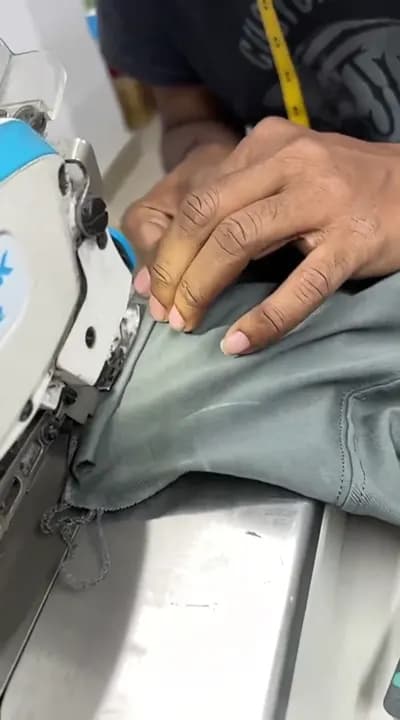
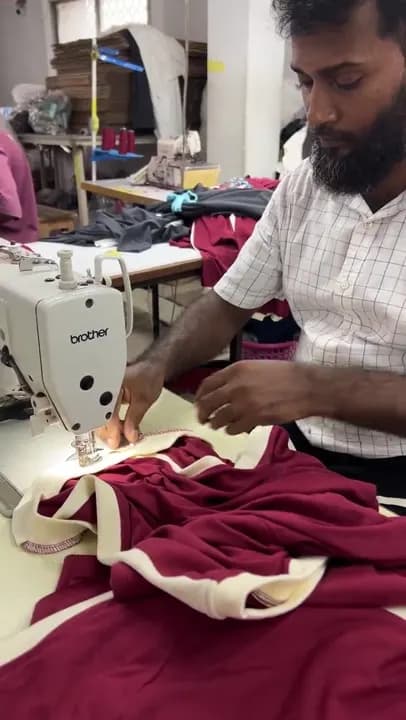
A walk along the sewing floor at Collective Studio in Narayanganj, Bangladesh, ending on an operator sewing a white garment with a brown contrast panel.
- Length
- 0:19, no sound
- Filmed at
- Collective Studio, Narayanganj, Bangladesh
What you are seeing
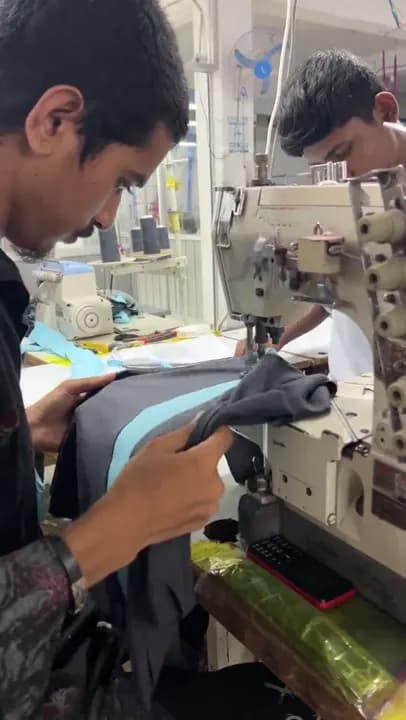
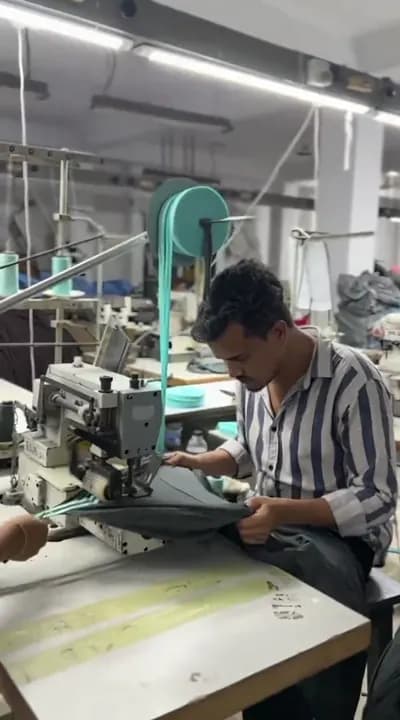
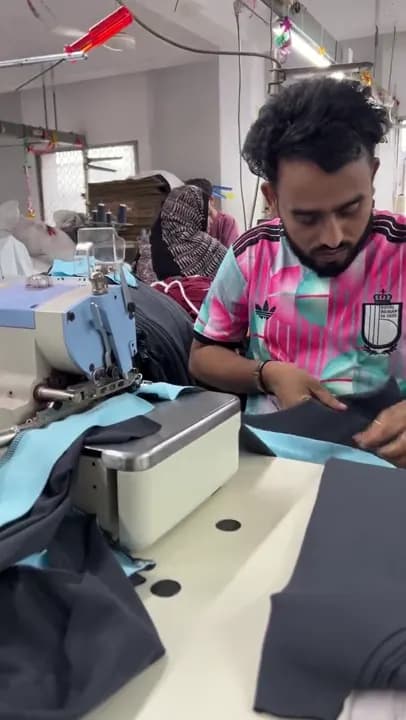
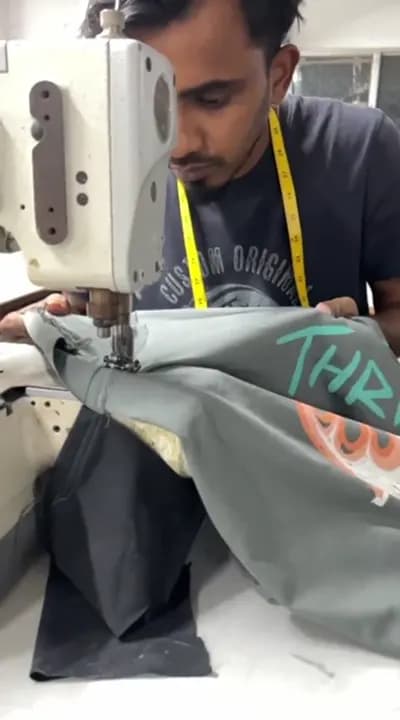
The clip opens on the sewing floor during a shift: rows of industrial machines, cut work waiting at the stations and operators at work. It then closes in on one operator feeding a white garment with a brown contrast panel through the machine.
This is the floor a buyer is walked through on a visit or a live video call. Garments are cut and sewn here; the fabric is knitted and dyed at partner mills, which appear in the partner clips on this page.
In the wide shot the rows of machines run back under strip lights and ceiling fans, and more pieces with the same brown band lie on the table beside the machine. In the close view he keeps the white body and the brown panel lined up with his fingertips just ahead of the needle, so the seam where the two colours meet stays straight.
On a colour-blocked garment that join is the first thing the eye lands on. When your sample arrives, lay it flat and check that the panel line runs straight and sits at the same height at both side seams, and say in your tech pack whether the thread should match the white, the brown or neither.
What happens on a cut-and-sew floor
Fabric reaches us already knitted and dyed by partner mills, and it is checked against the approved lab dip before anything is cut. It is then spread in lays, cut to your pattern and bundled by roll, so every piece of one garment comes from the same roll of cloth. The bundles move down the line, where each operator does one operation, or a few, rather than sewing a whole garment.
Splitting the work this way is what keeps a run consistent: the person setting every sleeve on your order sets it the same way each time. In-line checks catch faults while the run is still on the machines, and a final AQL inspection follows once garments are finished and packed. The whole sequence, from fabric to carton, is set out in our step-by-step guide to the garment manufacturing process, and what we own and what we place with partners is on the cut-and-sew page.
Where your order sits on the timeline
Your first contact with this floor is the sample, which is cut and sewn here during about 10 days of sampling. Bulk production follows sample approval and takes 40 to 50 days, covering the fabric, cutting, sewing, finishing, inspection and packing. Freight comes after that: by air, 5 to 7 days to the US or the UK, 5 to 8 to Europe and 6 to 8 to Canada. In total that is about 70 days from order to your door by air. Sea adds about a month.
If you are working back from a launch date, the launch date calculator does the arithmetic, and a sample round that needs repeating is the usual reason a plan slips.
Colour-blocked panels: what to specify
The garment in the close view is colour-blocked, a white body with a brown panel, and blocking changes what a tech pack has to say. Give the panel position as a measurement from a fixed point, such as the high point of the shoulder, so its height can be checked on every size. Say how the join is sewn and whether it is topstitched, and which way the seam allowance should lie: pressed towards the darker colour it is less likely to show through the light one.
Each fabric shade in the block is its own dye lot with its own lab dip, so a three-colour block means three dips to approve. And because a dark panel sits against a light one, ask for wash fastness results on the darker fabric, for example to ISO 105-C06, which grades staining on adjacent fabric as well as the change in shade.
Where this clip appears
- Organic Cotton Clothing Manufacturer
- Clothing Manufacturer for Saudi Arabian Brands
- مصنع ملابس للعلامات التجارية السعودية
- Clothing Manufacturer for Dubai & UAE Brands
- Clothing Manufacturer & Garment Supplier in Bangladesh
- مصنع ملابس للعلامات التجارية في دبي والإمارات
- Bangladesh LDC Graduation 2029: What It Means for Europe
- How Long Does It Take to Manufacture Clothing?
- Clothing Manufacturers Turkey: Honest Guide vs Bangladesh
- Clothing Manufacturers USA: Local vs Offshore Guide
Our sewing floor in Narayanganj: questions brands ask
Can I visit the floor or watch my order being made?
Yes. You can visit the floor in Narayanganj in person, or book a live video walkthrough and see it from wherever you are. On a visit we take you through cutting, the sewing lines, finishing and packing, and if your order is in production you can see your own garments on the machines and pick pieces up to check them. A video call works the same way, with a phone carried along the line so you can ask the operator or the supervisor to show you a seam close up. It is worth timing a visit or a call for when your order is actually on the line, usually a few weeks into production, rather than before fabric has arrived. Knitting and dyeing happen at partner mills, which are separate businesses, so if you want to see one, ask well ahead. To arrange either, use the contact page and tell us your order or style number.
Does a colour-blocked design change how the garment is produced?
Yes, in three ways that are worth knowing before you design one. First, more pieces: a body split into two colours is cut as separate panels, which adds seams, adds sewing operations and uses fabric less efficiently than a plain body. Second, more fabric lots: each colour is dyed separately and needs its own approved lab dip, and every one of those fabrics has to arrive before the style can be cut. A late lot in one colour holds the whole style. Third, more to check: the join line has to run level at both side seams, the panel height has to grade correctly across sizes, and the dark colour must not stain the light one in the wash. None of this makes blocking difficult, and it is a strong design device. It simply means the sample deserves a wash test and a careful measure at every size before you approve bulk.
Where is Collective Studio's sewing floor?
Collective Studio's sewing floor is in its own building at Plot-A-132, Road No. 02, BSCIC Industrial Area, Panchabati, Narayanganj 1420, Bangladesh. Narayanganj lies near Dhaka and is one of the country's main knitwear centres. The floor in this clip is where garments are cut, sewn, finished and packed, and it is the floor a buyer is walked through on a visit or a live video call. In the wide shot you can see rows of industrial machines under strip lights and ceiling fans, with cut work waiting at the stations. The facility holds GOTS certification (RSC 9687), and the company is a member of BKMEA and the Narayanganj Chamber of Commerce and Industry. For calls or visits, the phone number is +880 1980 055022 and WhatsApp is +880 1980 055026. The contact page is the easiest way to arrange a time.
Does Collective Studio knit and dye its own fabric?
No. Collective Studio cuts and sews knitwear on its own floor in Narayanganj, and the fabric is knitted and dyed at partner mills in Bangladesh that we book and inspect. Fabric reaches our floor already knitted and dyed, and it is checked against the approved lab dip before anything is cut. From there everything in this clip is ours: spreading and cutting, sewing on the lines, finishing, labelling and packing, along with screen printing, DTF, embroidery and sublimation as our process pages describe. We say this plainly because many suppliers describe a network of partners as their own factory. Knowing which stages are in-house helps you ask the right questions about each one, such as who holds the dye lot records or where a fabric fault would be caught. The partner mill clips on the videos page show the knitting, dyeing and yarn stages that happen before our floor.
How does a sewing line work in a garment factory?
A sewing line splits each garment into operations, and each operator does one operation, or a few, rather than sewing a whole garment. Cut pieces arrive in ticketed bundles, so all the parts of one garment come from the same roll of fabric. The bundle moves from station to station: one operator joins shoulders, the next sets sleeves, another closes side seams, another hems. On Collective Studio's floor, shown in this clip, the stations run in rows with cut work waiting beside each machine. Splitting the work this way keeps a run consistent, because the person setting every sleeve on your order sets it the same way each time. It also lets supervisors catch faults early. In-line checks look at work while it is still on the machines, and a final AQL inspection follows once garments are finished and packed. The garment manufacturing process guide sets out every step.
What is an in-line inspection in garment production?
An in-line inspection is a quality check made while garments are still being sewn, so faults are caught and corrected before they repeat through the whole run. On a sewing line, a checker or supervisor looks at work coming off stations, measures pieces and watches operations such as seam alignment, stitch tension and label placement. If a fault turns up, it can be traced to the bundle and the operation that caused it, and the operator or machine is corrected straight away. That is cheaper and faster than discovering the same fault in a finished carton. On Collective Studio's floor, in-line checks run during sewing and a final AQL inspection follows on packed goods. The two do different jobs. The in-line check prevents defects, and the final inspection measures what is left, using a sample size set by the order quantity and the AQL level you choose.
How long does a clothing order take from sample approval to delivery?
At Collective Studio, production takes 40 to 50 days after you approve the sample, and air freight then adds 5 to 7 days to the US or the UK, 5 to 8 to Europe and 6 to 8 to Canada. Counting the roughly 10 days of sampling before that, the whole process is about 70 days from order to your door by air. Sea freight adds about a month. The production window covers the fabric arriving from partner mills, cutting, sewing on the floor shown in this clip, finishing, inspection and packing. The sample itself is cut and sewn on this same floor. The usual reason a plan slips is a sample round that has to be repeated, so a complete tech pack saves the most time. If you are working back from a launch date, the launch date calculator on our resources page does the arithmetic.
How should I specify a colour-blocked panel in a tech pack?
Give the panel position as a measurement from a fixed point, say how the join is sewn and which way the seam allowance lies, and give each colour its own reference. Measuring from a point that exists on every size, such as the high point of the shoulder, lets the panel height be checked on every piece and graded across sizes. For the join, say whether it is topstitched and what thread colour to use, matching the light colour, the dark colour or neither. Ask for the seam allowance to be pressed towards the darker colour, where it is less likely to show through. Each fabric shade is its own dye lot with its own lab dip, so a three-colour block means three dips to approve. On the white and brown garment in this clip from Collective Studio's floor, the operator keeps the panel line straight as it reaches the needle.