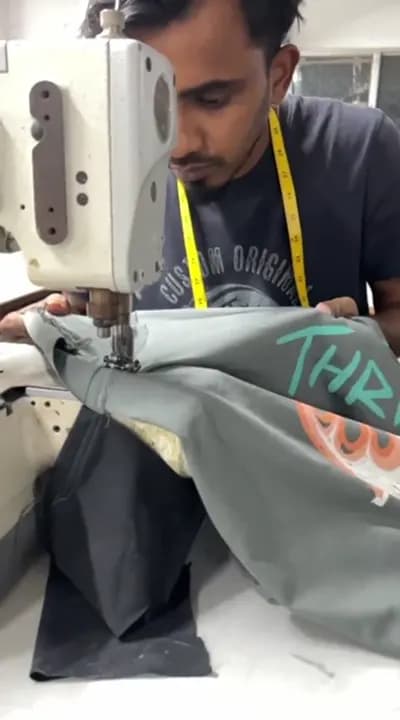
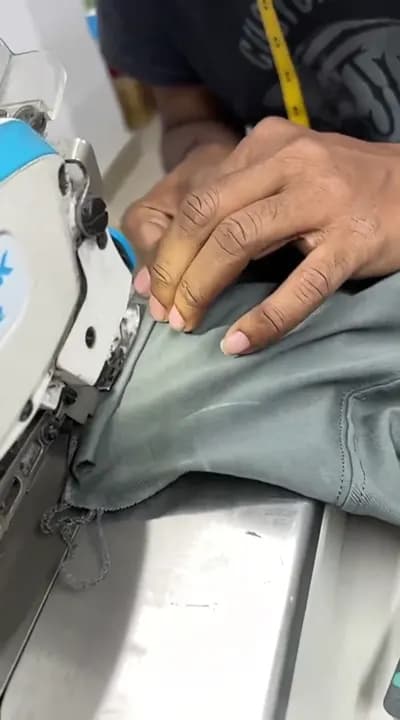
Attaching contrast rib to a sweatshirt
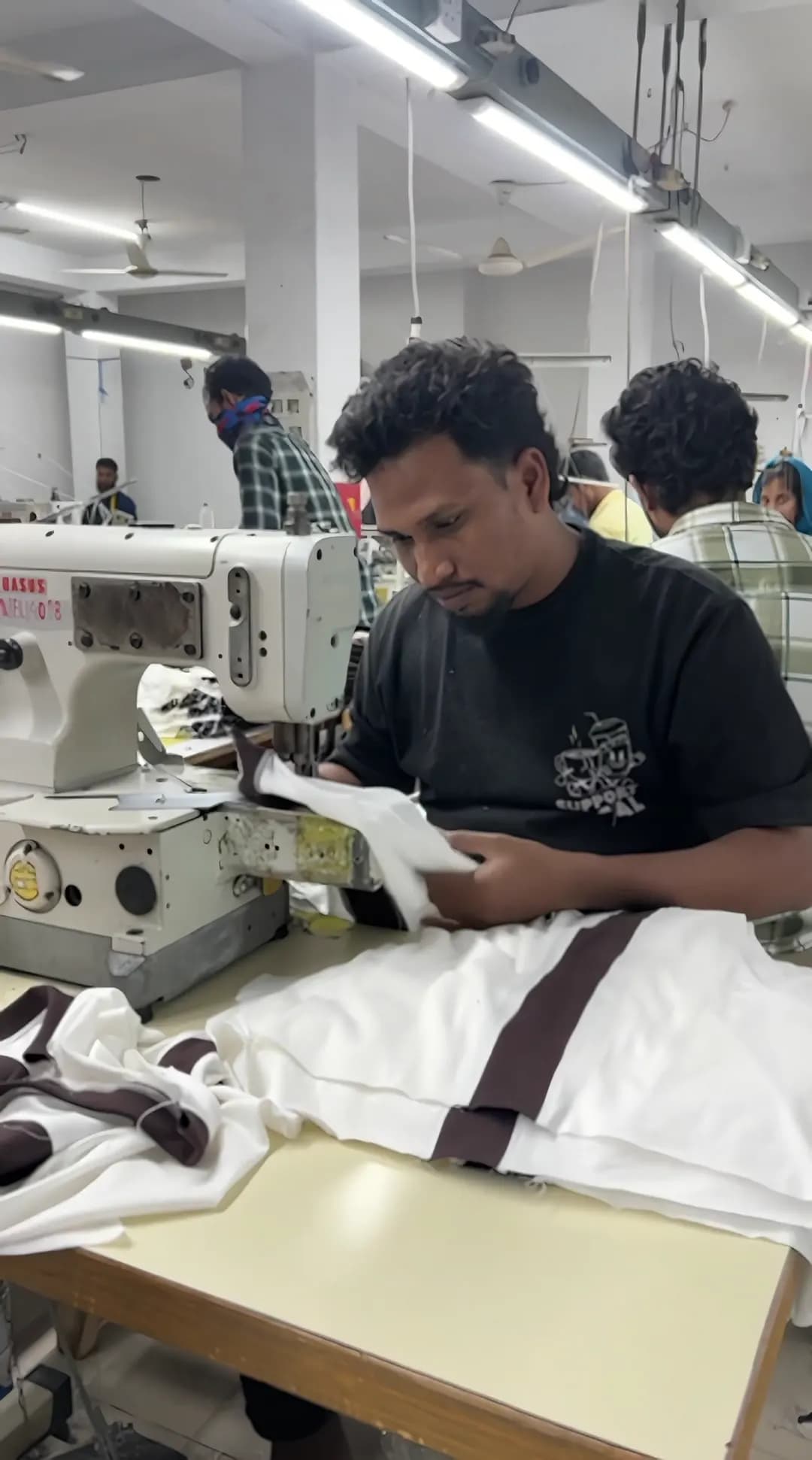
A machinist attaches cream contrast rib to a maroon sweatshirt on a Brother industrial machine at Collective Studio in Narayanganj, Bangladesh.
- Length
- 0:42, no sound
- Filmed at
- Collective Studio, Narayanganj, Bangladesh
What you are seeing
Rib is the stretchy knitted band used on necklines, cuffs and hems. Here a cream rib is joined to a maroon sweatshirt body, eased in so it lies flat without puckering.
How far the rib is stretched as it is sewn decides how firmly a cuff or neckline grips. That ratio belongs in your tech pack, with the rib's colour and composition.
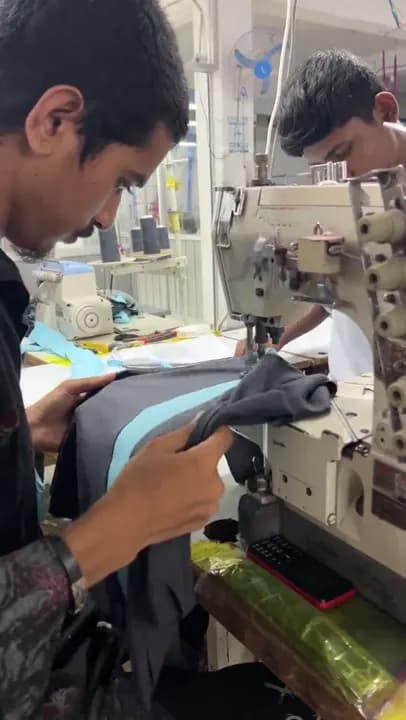
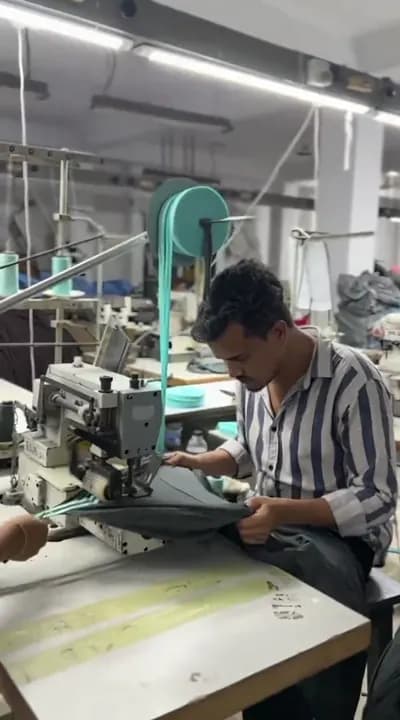
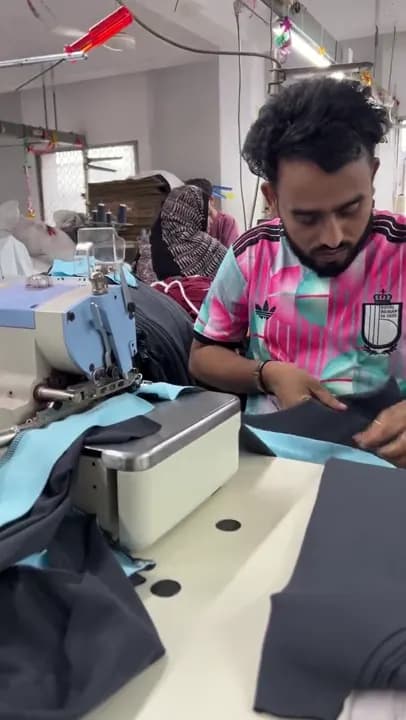
A small lamp lights the needle area. The raw edge of the cream rib has already been overlocked, in a reddish thread that shows against the cream, and before feeding the next section the operator lifts the band and looks it over. Behind him, other stations hold maroon pieces and charcoal garments with aqua trim, and cartons are stacked against the wall.
On a light rib over a dark body, the inside finish matters as much as the outside. Say what thread colour you want on inside seams, and on the sample stretch each cuff and the hem band a few times: they should spring back to the same width, and both cuffs should measure the same.
How rib goes on a sweatshirt
Cuffs and hem bands are cut from rib, folded double, closed into a loop and then sewn to the sleeve or body opening with an overlocker. The rib loop is shorter than the opening it joins, so the operator stretches it to fit as it is sewn and the body is drawn in slightly behind it. That is what makes a cuff grip the wrist and a hem band sit at the hip rather than hang loose.
The neck works the same way, usually with a coverstitched line beside the seam to hold it flat. In this clip the raw edge of the cream rib has already been overlocked, and the operator lifts the band to look it over before feeding the next section, because a band that has twisted cannot be corrected once it is sewn. Our sweatshirt page covers the full construction and fabric options.
What to specify for the rib
Give the rib its own line in the bill of materials: its structure (1x1 or 2x2), its composition, including any elastane, and its colour reference. Then give the finished height of the cuffs and hem band, and their width laid flat, in the points of measure. The sweatshirt tech pack template already has rows for these. The rib knit guide explains how the structure and elastane change the grip and how long it lasts.
A contrast rib is a separate colour to approve. Rib is usually knitted and dyed separately from the body fabric, so a cream rib on a maroon body is two lab dips, two lots and two fabrics that have to arrive before the style can be cut.
Faults to look for on contrast rib
Check that the cuffs and hem band are the same shade as each other, since they may be cut from different parts of a roll, and that the rib seam where the loop is closed lines up with the sleeve seam rather than sitting off to one side. Look for uneven gathering, where the body has been drawn in more on one side of the cuff than the other, and for a band whose height varies round the hem.
Light rib also shows marks that a dark one hides. Look over a cream band for handling marks and stray dark fibres, and check the inside: a dark overlock thread on a light rib, or a light one on a dark body, is visible every time the sleeve is pushed up. Then wash the sample with like colours and look for any maroon staining on the cream.
Where this clip appears
- Streetwear Clothing Manufacturer
- Loungewear Manufacturer
- Hoodie Manufacturer & Sweatshirt Factory
- Joggers & Sweatpants Manufacturer
- Sweatshirt Manufacturer
- Activewear Manufacturer for Gyms
- Merch Manufacturer for Content Creators
- Sweatshirt-Hersteller in Bangladesch
- Hoodie-Hersteller und Sweatshirt-Fabrik in Bangladesch
- Fabricante de sudaderas personalizadas, con y sin capucha, en Bangladesh
- What Are Sweatpants Made Of? Fabric, GSM, How They're Made
- Best Hoodie Manufacturers 2026: 7 Compared, From 10 Pieces
- Rib Knit Meaning: 1x1 vs 2x2 Rib for Cuffs and Collars
- What Is French Terry Fabric? Loops, GSM, Uses and vs Fleece
- Best GSM for Hoodies and T-Shirts: 140–500 GSM Chart
- Clothing Manufacturers Bali: Honest Guide vs Bangladesh
- Clothing Manufacturers UK: Local vs Offshore Guide
- Clothing Manufacturers Canada: Local vs Offshore Guide
Attaching contrast rib to a sweatshirt: questions brands ask
Will a cream rib on a dark sweatshirt stay clean in the wash?
It will if the dark body fabric has good wash fastness, and it is worth checking rather than assuming. In washing, a deep shade such as maroon, navy or black can release a little dye, and the nearest light fabric picks it up. On a sweatshirt that is the cream cuff and hem band, sewn straight onto the dark body. Ask for a wash fastness test on the body fabric, for example to ISO 105-C06, which grades both the change in the fabric's own shade and the staining on an adjacent fabric. Then wash your sample at the temperature your care label will give, with other dark garments, and look at the rib against an unwashed piece. On the care label, tell customers to wash with like colours and inside out. If staining shows up on the sample, it will show up on customers' garments, so fix the fabric or the colour combination before bulk, not after.
How do I specify the size of the cuffs and hem band?
Give each one a finished height and a width laid flat, then approve the stretch on the sample. The height is simple: measure the band from the seam to its folded edge on a sweatshirt you like. The width is the measurement across the cuff or hem band laid flat and relaxed, which is smaller than the sleeve or body it is sewn to. You do not need to work out how short to cut the rib. That depends on the rib's own stretch, and the factory sets the cut length so the band reaches the width you asked for. What you should check on the sample is the feel. Put it on, push the sleeves up and pull them down, and see whether the cuffs grip the wrist without marking it. Then measure both cuffs, which should be the same, and write the approved figures into the tech pack with a tolerance.
How is rib attached to a sweatshirt's cuffs and hem?
Rib cuffs and hem bands are cut from rib fabric, folded double, closed into a loop and then sewn onto the sleeve or body opening with an overlocker. The rib loop is shorter than the opening it joins, so the operator stretches the rib to fit as it is sewn, and the body is drawn in slightly behind it. That is what makes a cuff grip the wrist and a hem band sit at the hip rather than hang loose. The neck rib goes on the same way, usually with a coverstitched line beside the seam to hold it flat. In this clip, a machinist at Collective Studio in Narayanganj is attaching a cream rib to a maroon sweatshirt, lifting the band to look it over before each section, because a rib that twists as it goes on cannot be corrected once it has been sewn.
What should I list for the rib in a sweatshirt tech pack?
List the rib's structure, composition, colour reference, finished height and width laid flat. Give it its own line in the bill of materials, separate from the body fabric. The structure is usually 1x1 or 2x2 rib, and the composition should say whether it contains elastane, because that changes how firmly a cuff grips and how long it keeps its shape. The colour reference is needed even when the rib matches the body, because rib is a different fabric and is dyed separately. In the points of measure, give the finished height of the cuffs, hem band and neck rib, and their width laid flat and relaxed. You do not need to state the cut length of the rib, because the factory sets that from the rib's stretch. Collective Studio's sweatshirt tech pack template already has rows for these, so you only need to fill in the values.
Does a contrast rib add steps to a sweatshirt order?
Yes. A contrast rib is a second fabric to source, dye and approve, so it adds a lab dip and a dye lot to the order. Rib is usually knitted and dyed separately from the body fabric, so a cream rib on a maroon sweatshirt means two lab dips, two dye lots and two fabrics that both have to arrive before the style can be cut. Each colour needs approving against your reference, ideally in daylight or a light box, and the combination is worth seeing together on the sample. At Collective Studio, sampling takes about 10 days and production about 40 to 50 days after sample approval, and the rib colour has to be approved before its fabric is dyed, so approve it together with the body colour. A late change to the rib colour holds up cutting, because no garment can be sewn until both fabrics are in. Decide the rib colour before sampling.
What thread colour should the inside seams be on a contrast rib sweatshirt?
Choose the inside thread colour deliberately and write it in the tech pack, because on a contrast rib the inside seam shows every time a sleeve is pushed up. The overlock thread that joins a light rib to a dark body can match the rib, match the body or be a neutral, and each looks different from the inside. A dark thread on a cream rib shows as a line through the band; a light thread on a maroon body shows on the body side. In this clip, the raw edge of the cream rib has already been overlocked in a reddish thread that shows against the cream. Many brands match the thread to the rib so the visible band looks clean, but there is no single rule. Look at the inside of the sample cuffs and neck, and approve the thread colour along with everything else.
What faults should I look for on sweatshirt rib cuffs and hem bands?
Look for twisting, uneven gathering, a band that varies in height and a rib seam that does not line up with the sleeve seam. The rib seam, where the loop is closed, should sit in line with the sleeve or side seam rather than off to one side. Gathering should be even all the way round, without the body drawn in more on one side of the cuff than the other. Measure the band height at a few points round the hem, and check that both cuffs are the same width laid flat and spring back after being stretched. On a light rib, look for handling marks and stray dark fibres, which show on cream far more than on a dark colour. Finally, wash the sample with like colours and check the cream rib for any staining from the maroon body. These faults are counted under workmanship in a final inspection.
Why do the two cuffs on my sweatshirt look slightly different shades?
Cuffs that differ in shade have usually been cut from different parts of a roll, or from different rolls or dye lots of rib. Dyed fabric can vary slightly from one end of a roll to the other and from one roll to the next, and the difference is most visible on rib, where two cuffs sit side by side. A light shade such as cream shows it more than a dark one. Good practice is to cut all the rib pieces for one garment from the same roll and keep them bundled together through sewing, the same way body pieces are bundled by roll. Ask your factory how rib is cut and bundled, and check the cuffs, neck and hem band against each other on the sample and on bulk pieces in daylight. A noticeable shade difference within one garment is a fault, not normal variation.