What Is Rib Knit Fabric?
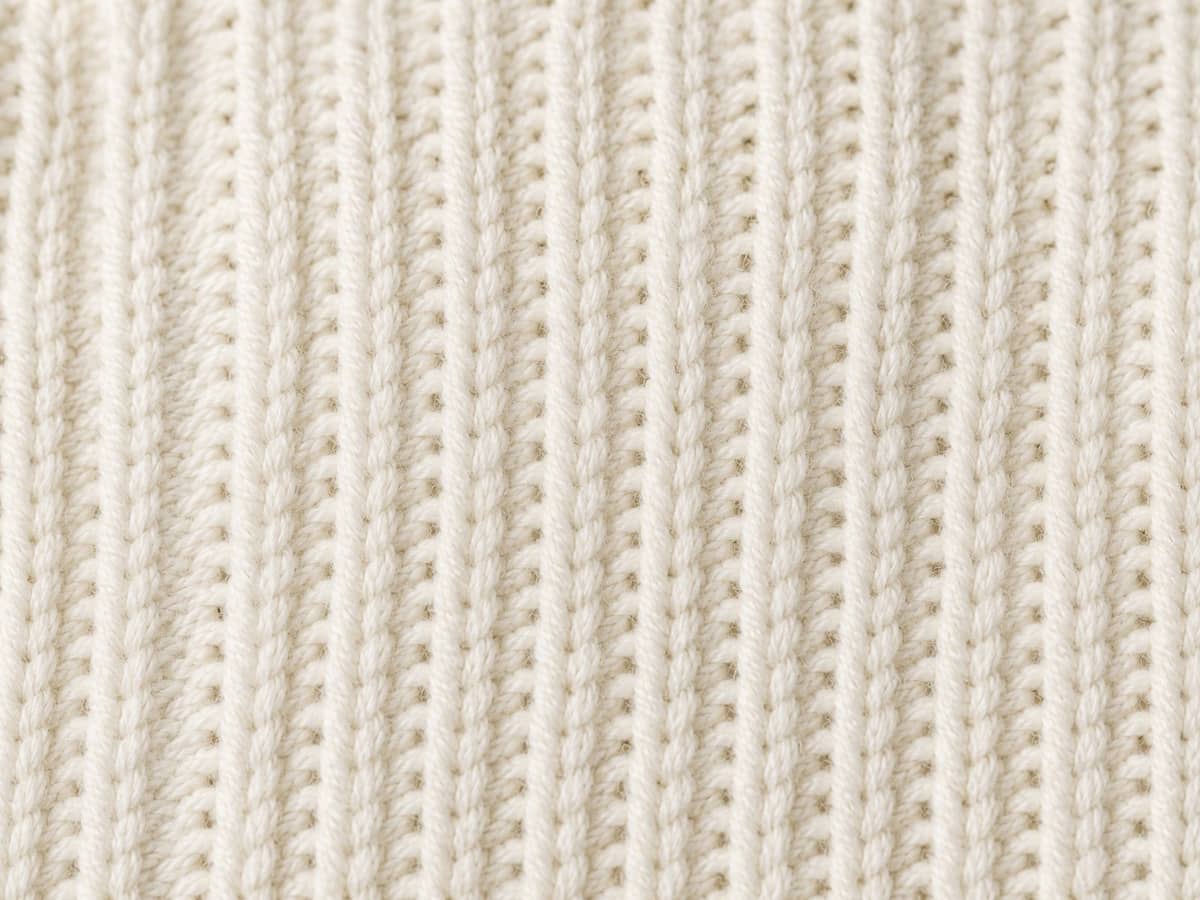
Rib knit is a knit fabric with vertical ridges running down it, and far more stretch across its width than any flat knit. It is the fabric doing the work at the cuffs, collar and waistband of almost every sweatshirt you own, and it is usually the first part of a garment to fail.
What does “ribbed cuffs” mean?
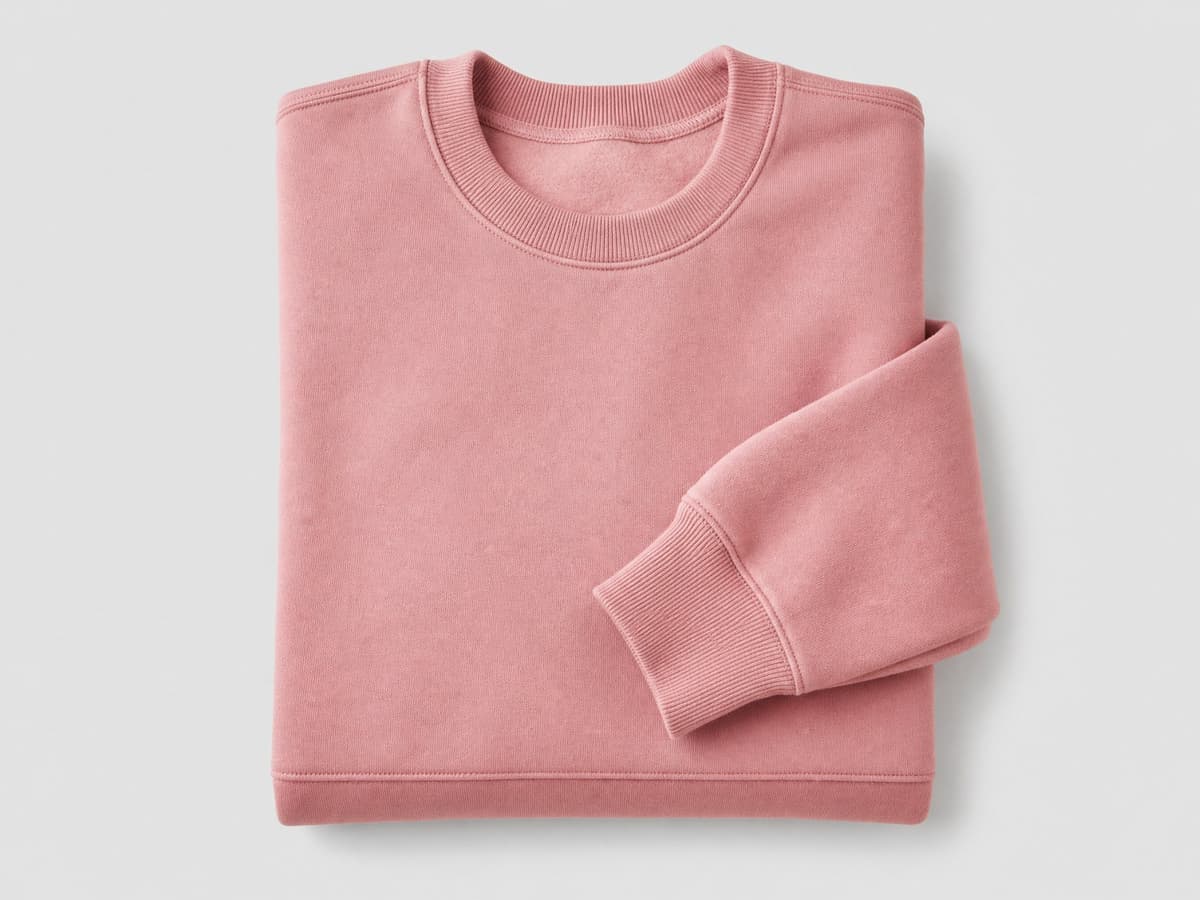
Ribbed cuffs are cuffs made from rib knit rather than from the garment’s main fabric. Rib stretches far more across its width than a flat knit, so the cuff slides over the hand and then springs back to hold the sleeve at the wrist; the same idea gives sweatshirts their ribbed waistband and t-shirts their ribbed collar. How long a cuff keeps that grip depends on the rib’s structure and whether it contains elastane, which is why a cheap sweatshirt’s cuffs go slack after a few washes while a well-specified one does not. The sections below cover 1x1 and 2x2 rib and what to put on a tech pack.
It is also called ribbing, ribbed knit or simply rib. When a factory quotes a sweatshirt and lists the body fabric and the rib separately, this is what the second line means.
How rib knit is made
Ordinary jersey is knitted with all its loops pulled to the same face. Rib alternates them: columns of stitches pulled to the front sit next to columns pulled to the back, so the fabric folds itself into vertical ridges. Those folds are why it stretches so much and why it springs back — pulling it sideways opens the folds out rather than stretching the yarn itself, and the fabric wants to close them again.
Two consequences follow, and both matter in production. It looks the same on both faces, so there is no right side to get wrong at the cutting table. And it does not curl at a cut edge the way single jersey does, which is exactly why it can be used raw at a neckline.
1x1, 2x2 and what the numbers mean
Rib is described by the repeat of its columns. 1x1 alternates one front column with one back column; 2x2 alternates two and two, and so on.
| 1x1 rib | 2x2 rib | |
|---|---|---|
| Appearance | Fine, narrow ridges | Wider, more pronounced ridges |
| Stretch | High, and very even | Higher still, more elastic feel |
| Recovery | Good | Good, and more visibly springy |
| Typical use | T-shirt necklines, fine cuffs | Sweatshirt cuffs, hems, waistbands |
| Look | Discreet, almost flat at a distance | Deliberate, visible texture |
Why cuffs go slack, and whose fault it is
This is the practical heart of rib, and it is worth understanding before you approve a sample rather than after a customer complains. A cuff that has gone loose and wavy after a few months has usually failed for one of three reasons.
- No elastane. Rib recovers well on its own when new, but repeated stretch over a hand slowly relaxes plain cotton. A few percent of elastane in the rib is what keeps a cuff closing after a season, and it is a specification, not a default.
- Too loose a gauge. Rib knitted slack has less to spring back with. Denser rib costs marginally more yarn and lasts disproportionately longer.
- The rib was cut from body fabric. Some makers skip separate rib entirely and use a strip of the main jersey or fleece. It looks acceptable on day one and has no recovery at all.
The third is the one to check when a quote seems unusually cheap. Ask what the rib is: its composition, whether it carries elastane, and whether it is knitted as rib at all. A sweatshirt is judged at the cuff long before anyone examines the seams.
1x1 vs 2x2 rib: which to use where
The question we are asked most about rib is which of the two to specify, and the answer follows from what the fold does. 2x2 folds deeper, so it stretches further and springs back more visibly; that is why it is the default for sweatshirt and hoodie cuffs, hems and waistbands, where the rib is pulled over a hand and must close again. 1x1 folds finer and lies flatter, so it is the default for t-shirt necklines, where a deep rib would stand proud of the jersey, and for whole ribbed garments, where a fine, even texture reads as fabric rather than trim. A jogger cuff is 2x2; a polo collar is a flat-knitted 1x1 variant; a fitted ribbed top is 1x1 with elastane.
| Decision | Choose 1x1 when | Choose 2x2 when |
|---|---|---|
| Necklines | On t-shirts and light jersey, where a fine rib sits flat against the body fabric | On heavy fleece hoodies where the neck rib must match a deep cuff |
| Cuffs and hems | On lightweight sweats and kids' sizes where a fine rib is less bulky | On standard and heavyweight sweatshirts, hoodies and joggers |
| Whole garments | Ribbed tops, dresses and co-ords: fine, even, body-following | Chunky ribbed knits where the ridge is the design |
| Elastane | Usually 3–5% for anything worn fitted | Often none on heavy cotton, but add it for cuffs that must recover |
One rule that overrides the table: match the rib to the body. A 2x2 rib on a 160 GSM tee is heavier than the fabric it is sewn to and will pull the neckline out of shape; a 1x1 rib on a 450 GSM fleece will stretch out of proportion to the garment. When you send us a body fabric weight we propose the rib to suit it, and have both knitted in matching yarn at our partner mills so they dye alike; the fabric consumption calculator works out how much of each a garment uses.
Where rib is used
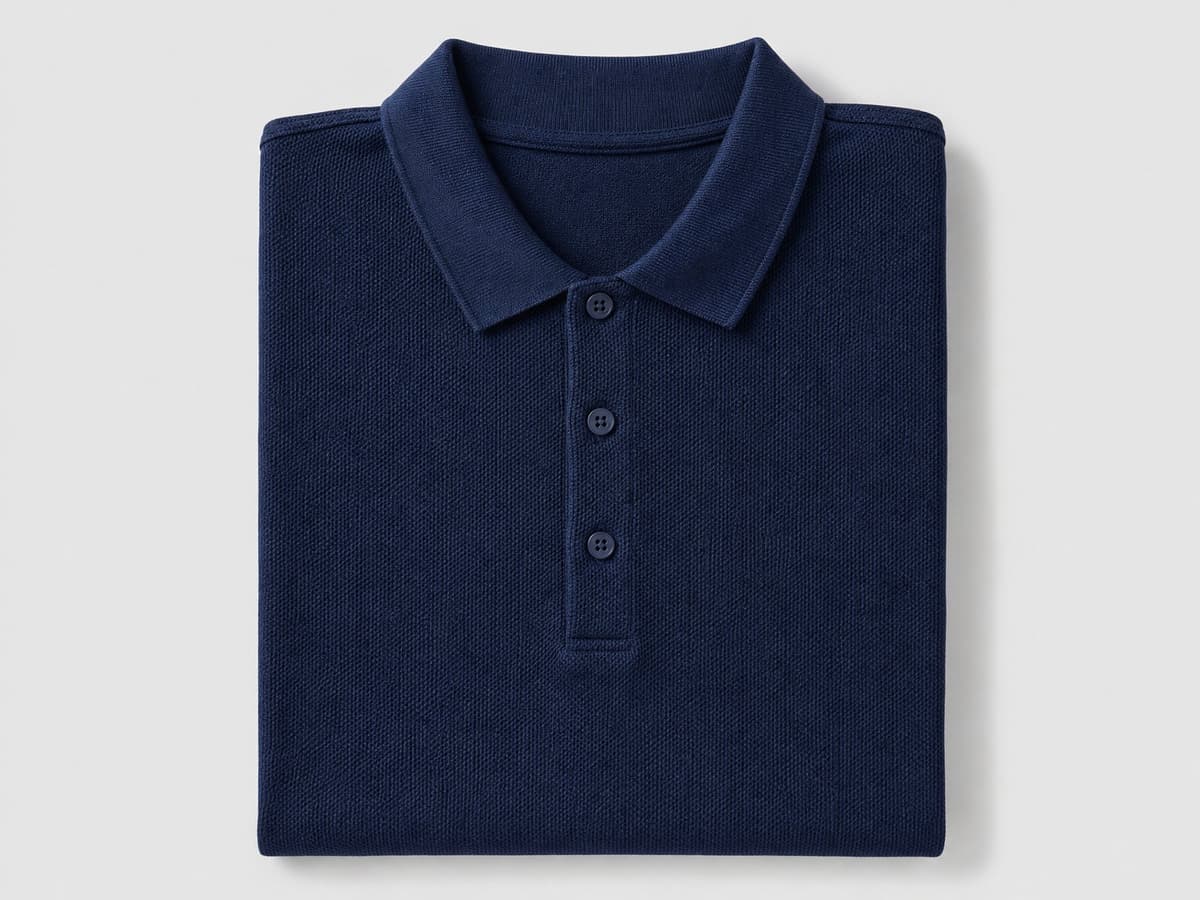
Most often as trim — cuffs, hems, waistbands, and collars, including the flat knitted collar of a polo. It is also used for whole garments, where the ridges become the point rather than the mechanism: ribbed tops, fitted long-sleeves, ribbed dresses and knitted co-ords, usually in a finer 1x1 with elastane for shape.
For trim, rib is normally bought or knitted separately from the body fabric and dyed to match, which is a step where colour goes wrong. If your garment is a strong or unusual shade, ask specifically whether body and rib are dyed in the same lot, because a cuff a shade off the sleeve is a fault everyone sees and nobody can fix after cutting.
What a factory needs from you
For most brands the answer is short, and a good factory will propose it if you do not: the rib type (1x1 or 2x2), the composition including elastane percentage, and confirmation that body and rib are dye-matched, all of which you can write into the bill of materials of our free tech pack template. If you have a reference garment whose cuffs you like after a year of wear, that tells us more than any of it.
Rib is knitted to our specification at partner mills and cut and sewn every week on our own floor in Narayanganj, from a 150-piece minimum per style and per colour. If you are working on sweatshirts, hoodies or t-shirts, tell us how the garment will be worn and we will specify the rib to survive it.
Frequently asked questions
What is rib knit fabric?
Rib knit is a knit fabric with vertical ridges running down it and far more stretch across its width than any flat knit, which is why it sits at the cuffs, collar and waistband of almost every sweatshirt. It is also called ribbing, ribbed knit or simply rib. Ordinary jersey is knitted with all its loops pulled to one face; rib alternates columns pulled to the front with columns pulled to the back, so the fabric folds itself into ridges. Pulling it sideways opens those folds out rather than stretching the yarn, and the fabric wants to close them again, which is where its recovery comes from. It looks the same on both faces, so there is no right side to get wrong at the cutting table, and it does not curl at a cut edge. When a factory quotes a sweatshirt with the body fabric and the rib on separate lines, the second line is this fabric.
What is rib knit fabric used for?
Rib knit is used mostly as trim: the cuffs, hems, waistbands and collars of sweatshirts, hoodies, joggers and t-shirts, where a fabric has to stretch over a hand or a head and then close again. The flat knitted collar of a polo is a rib too, a flat-knitted 1x1 variant. Rib is also used for whole garments, where the ridges become a design feature rather than a mechanism: ribbed tops, fitted long-sleeves, ribbed dresses and knitted co-ords. Those are usually a finer 1x1 rib with elastane, typically 3 to 5% for anything worn fitted, so the garment holds its shape on the body rather than growing through the day. Chunky ribbed knits, where the ridge is the whole point, are where 2x2 appears as a garment fabric. For trim, rib is normally sourced separately from the body fabric and dyed to match, so on a strong or unusual shade, ask whether body and rib are dyed in the same lot.
What is the difference between 1x1 and 2x2 rib?
The numbers describe how the columns of stitches alternate: 1x1 rib alternates one front column with one back column, and 2x2 alternates two and two. 1x1 gives fine, narrow ridges with high, very even stretch and a discreet look that reads almost flat from a distance, which is why it is the usual choice for t-shirt necklines and finer cuffs. 2x2 gives wider, more pronounced ridges, higher stretch still and a springier, more elastic feel, which is why it is the standard on sweatshirt and hoodie cuffs, hems and waistbands. Neither is better made than the other. 2x2 simply has a deeper fold to open out, so it stretches further and returns more visibly. Both recover well, and either can be knitted with or without elastane: the fold pattern and the elastane are separate decisions. The visible difference matters too, because 2x2 reads as deliberate texture while 1x1 stays quiet next to the body fabric.
Is 1x1 or 2x2 rib better?
Neither is better; they do different jobs, and the garment decides. For cuffs and hems on standard and heavyweight sweatshirts, hoodies and joggers, choose 2x2, because the deeper fold stretches over a hand and closes again visibly. On lightweight sweats and children's sizes, 1x1 is less bulky. For necklines, 1x1 sits flat on t-shirts and light jersey, while a heavy fleece hoodie can take a 2x2 neck rib to match a deep cuff. For whole garments, 1x1 gives the fine, even, body-following texture of ribbed tops, dresses and co-ords, and 2x2 suits chunky knits where the ridge is the design. One rule overrides all of this: match the rib to the body. A 2x2 rib on a 160 GSM tee is heavier than the fabric it is sewn to and pulls the neckline out of shape, and a 1x1 rib on a 450 GSM fleece stretches out of proportion to the garment.
Why do sweatshirt cuffs go loose?
Usually one of three rib faults, all decided before the garment is cut. The first is no elastane: rib recovers well when new, but repeated stretch over a hand slowly relaxes plain cotton until the cuff stays open and wavy. The second is too loose a gauge; rib knitted slack has less to spring back with, and the yarn it saves is small next to the life it costs. The third, common in very cheap sweatshirts, is that some makers skip knitted rib entirely and sew on a strip of the main jersey or fleece, which looks acceptable on day one and has no recovery. When a quote seems unusually low, ask three things: the rib's composition, whether it carries elastane, and whether it was knitted as rib or cut from the body fabric. A sweatshirt is judged at the cuff long before anyone examines the seams, so settle it before you approve the sample.
Should rib have elastane in it?
Yes, wherever the rib must keep closing after being pulled over a hand or a head. A few percent of elastane is what keeps a cuff, waistband or neckline closing after a season of wear, and its absence is the most common reason a sweatshirt looks tired before it is worn out. For a fitted ribbed garment our default is usually 3 to 5%. Our sweatshirt and hoodie cuffs and hems carry it as standard, and only heavy cotton 2x2 rib that is not pulled over a hand, such as a chunky ribbed garment, may go without. Write it into your specification, because it is not a universal default: rib knitted with elastane costs more than pure cotton rib, and a supplier quoting on price will leave it out. For a whole ribbed garment worn close to the body, elastane matters even more, since the fit depends on recovery rather than initial stretch.
Is rib knit stretchy?
Very, and mainly across its width rather than along its length. Rib has far more sideways stretch than any flat knit, and 2x2 stretches further than 1x1. The stretch does not come from stretching the yarn. The knit structure has already folded the fabric into ridges, and pulling it sideways opens those folds out; the fabric then wants to close them again. That is why rib recovers so much better than a flat knit of the same fibre, and why it is chosen wherever an opening must widen and then close. Adding a few percent of elastane does not add much initial stretch. What it adds is recovery that lasts, which is the property that actually matters at a cuff. Stretch is only half the choice: the rib's weight should follow the body fabric, because a rib much heavier than a light jersey drags the neckline out of shape.
Does rib knit fabric curl at the edges?
No. Rib lies flat when cut, while single jersey does not, because all its loops are pulled to one face and the fabric curls at a cut edge. Rib alternates columns pulled to the front with columns pulled to the back, which is why it lies flat instead. Two production consequences follow. Rib can be used raw at a neckline, where jersey would have to be bound or hemmed, which is part of why it is the standard way to finish an opening. And because rib looks the same on both faces, there is no right side to get wrong at the cutting table. Lying flat is not the same as holding shape, though. A rib that does not curl can still go slack at a cuff if it lacks elastane or was knitted too loosely, so check the composition and gauge rather than assuming a neat edge means a lasting one.
What rib is used for t-shirt necklines?
Usually 1x1 rib, knitted from the same yarn as the body so it dyes to match, and often with a few percent of elastane so the neck recovers after being pulled over the head. Pure cotton neck rib does not spring back once it has been stretched over a head, and the neckline starts to gape, which is why we put elastane in the neck rib of our t-shirts as standard. 2x2 is too deep for light jersey: it is heavier than the fabric it is sewn to, stands proud of it and can pull the neckline out of shape. The width of the neck rib and whether it is a single or double layer are separate decisions we set on the sample. When you test that sample, wash it and look at the neckline, because a neck rib that has recovered after washing is a good early sign it will hold in wear.
What is 1x1 rib cuff fabric?
1x1 rib cuff fabric is rib knitted with one column of front stitches alternating with one column of back stitches, giving fine, narrow ridges with high, even stretch. As cuff fabric it suits lightweight sweats and children's sizes, where a 2x2 would be bulky. It is normally knitted with elastane so the cuff keeps closing after months of being pulled over a hand. On standard-weight and heavyweight hoodies, sweatshirts and joggers, 2x2 is the more common cuff, because its deeper fold gives more stretch and more visible recovery. The deciding factor is the body fabric, since the rib's weight should follow it: a fine 1x1 suits a light sleeve, while a heavy fleece needs the deeper 2x2 to stay in proportion. If you are unsure which cuff your design needs, send the body fabric weight and a description of how the garment will be worn, and we will propose the rib to suit it.
What rib should I specify for a sweatshirt?
Specify three things: the rib type, which for sweatshirt cuffs, hems and waistbands is usually 2x2; the composition, including the elastane percentage; and confirmation that body and rib are dye-matched. Writing them down makes it much harder for a price-led supplier to quietly drop the elastane or cut cuffs from body fabric. Give the body fabric weight in GSM as well, because the rib should follow it; on a lightweight sweat a 1x1 cuff may suit better, and we propose a rib to suit the body you choose. Body and rib are knitted from matching yarn at our partner mills so they dye alike, but if your colour is strong or unusual, still ask whether they are dyed in the same lot, since a cuff a shade off the sleeve cannot be fixed after cutting. Most useful of all is a reference garment whose cuffs you still like after a year of wear, which tells us more than any written specification.
What is a knitted cuff?
A knitted cuff is a band of rib knit sewn to the end of a sleeve or trouser leg, so the opening stretches over the hand or foot and then closes snugly at the wrist or ankle. It finishes almost every sweatshirt, hoodie and cuffed jogger, and is also sold as a ribbed cuff. It is not cut from the main fabric: rib is a separate knit whose ridges open out when pulled and close again, so it is knitted or bought on its own and dyed to match the body. Sweatshirts and hoodies usually take 2x2 at the wrist, while lightweight sweats and children's sizes take a finer 1x1. The band is normally sewn on folded double, with the fold at the opening, and its finished height is a design choice, from narrow to deep. On a tech pack, give the type, composition, finished height and the dye-match requirement.
What do 3x3 and 4x2 rib mean?
The numbers count columns of stitches. In 3x3 rib, three columns pulled to the front alternate with three pulled to the back; in 4x2 rib, four front columns alternate with two back columns. 3x3 is still balanced, so both faces look alike, with wider ridges than 2x2. 4x2 is unbalanced: one face shows broad flat ribs separated by narrow grooves, and the other shows the reverse, so it has a right side that must be marked at the cutting table. Wider ribs are chosen mainly for appearance, a bold vertical texture on chunky knits, deep waistbands or a whole ribbed garment. On cut-and-sew sweatshirt, hoodie and t-shirt trims, 1x1 and 2x2 cover almost every case, and wider ribs are a design choice rather than a performance upgrade. If you want one, send a photo or swatch of the exact rib, because names vary between mills and the look is what we match.
Is a double-layer rib neckband better than a single layer?
Neither is better in general; they suit different necklines. A double-layer band is a strip of rib folded lengthwise and sewn with both raw edges in the seam, so the visible edge is a clean fold. Two layers give the neckline more body, help it hold its shape after being pulled over the head, and sit neatly on sweatshirts and standard t-shirts. The trade-off is bulk and a firmer feel, which can look heavy on a fine, light tee. A single layer is lighter and flatter, so it suits fine jersey and minimal necklines, and the rib's flat, non-curling edge means it can even be left raw. Whichever you choose, the band's length and width decide whether it stretches over the head comfortably and then lies flat, so they are set on the sample. Our t-shirt neck rib carries a few percent of elastane as standard, which helps either version recover after wear.
Where this applies
The manufacturing pages this guide relates to, if you are costing a real run.
Free tools & guides for this
Sources & further reading
Have an idea? Let’s make it.
We manufacture from 150 pieces per style and colour, with organic cotton options from our GOTS-certified facility and photos at every stage. Send a sketch or a sentence — we’ll reply within one business day.