Print-on-Demand vs Manufacturing: When Should You Switch?
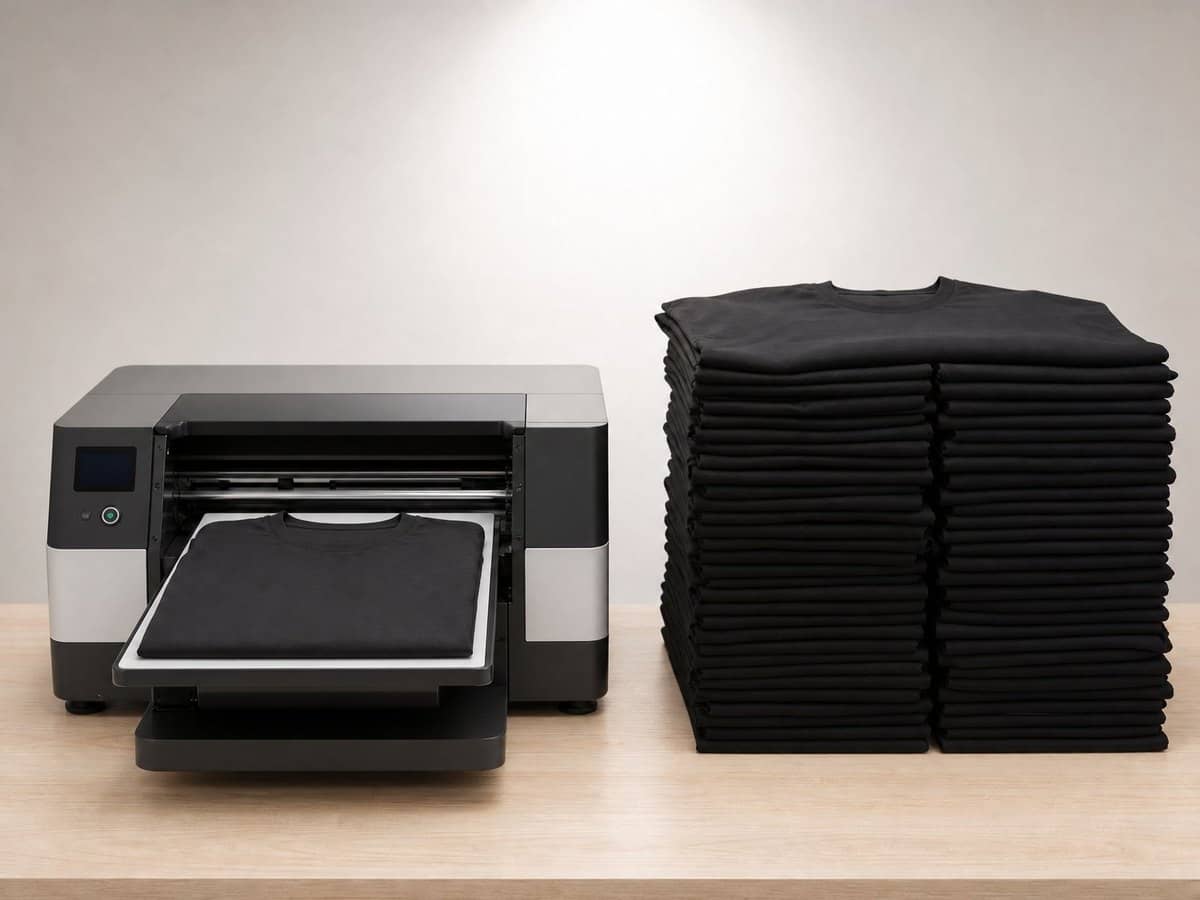
Print-on-demand (POD) is a brilliant way to start a clothing brand — no inventory, no minimums, and you can test designs with almost no risk. But every growing brand eventually hits its ceiling. Here's an honest comparison, and the signs it's time to switch to real manufacturing.
What POD is great at
- No upfront inventory and no minimum order — you only pay when you sell.
- Test designs and ideas risk-free before committing money.
- Simple to launch while you learn what your audience wants.
Where POD hits a ceiling
- Thin margins — the per-item base cost is high, so there's little left after the platform's cut.
- Limited choice — you're stuck with the platform's blanks, fabrics and fits.
- Little quality control — you don't see the garment before it ships to your customer.
- Hard to build a real brand — generic blanks, generic packaging, usually no custom neck labels.
- Print methods are limited — typically DTG only, which suits some designs and not others.
What manufacturing gives you
- Far better margins once you're selling consistently.
- Your choice of fabric, weight (GSM) and fit.
- Custom labels, hang tags and packaging — a garment that feels like your brand.
- Real quality control before anything reaches a customer.
- A product that's yours, not a printed stock blank.
The economics, side by side
The two models fail in opposite directions, and seeing the numbers next to each other makes the decision obvious for most brands.
| Print on demand | Cut-and-sew manufacturing | |
|---|---|---|
| Upfront cost | Almost none | A full production run |
| Cost per unit | Highest — you pay retail for a blank plus print | Lowest, and falls with volume |
| Inventory risk | None | Real — you own what you make |
| Product control | Artwork only | Fabric, weight, fit, trims, labels |
| Margin | Thin | Healthy enough to fund marketing |
| Time to first sale | Days | 40–50 days |
Use both, in sequence
This is usually presented as a choice, and treating it as a sequence works better. Print on demand is an excellent instrument for answering one question: will anyone buy this design? It answers it for almost no money and no stock. What it cannot do is give you a product — you are selling someone else’s blank, at someone else’s fabric weight and fit, on a margin too thin to reinvest.
So use it to find your two or three winners, then manufacture those properly. The signal to move is not a revenue figure; it is repeat demand for a specific design, plus enough margin pressure that the thin unit economics have started to limit what you can spend on growth. At that point the 100-piece run stops being a risk and becomes the cheaper option.
The signs it's time to switch
- You have consistent, repeat sales of specific styles.
- Margins are squeezing you and you're leaving money on the table.
- You want a custom fabric, fit, or branded finish POD can't give.
- You're getting returns tied to quality or fit.
- You're ready to commit to a modest, predictable run.
The leap is smaller than it used to be. You don't need thousands of units — a low-MOQ factory that makes from 100 pieces lets you graduate from POD without a huge commitment. When you're ready, read how to start with 100 pieces.
Frequently asked questions
Is print-on-demand or manufacturing better?
They answer different questions, and the mistake is treating it as a permanent choice. POD is for finding out whether a design sells: nothing up front, no stock risk, ships immediately. Manufacturing is for making money on designs that already sell: a third to a half the unit cost, your own fabric and fit, your own labels, but cash committed and roughly two to three months of waiting. Running POD forever means paying a premium on every unit of your best seller. Going straight to manufacturing means betting a few thousand pounds on a design nobody has bought yet. Most brands that do well use both — POD as the testing ground, manufacturing from about a hundred pieces once a style has proven itself. Do not manufacture a range you have never sold.
When should I switch from print-on-demand to manufacturing?
When a style has proven it sells and the unit economics start hurting. POD is excellent for validation — no stock, no cash committed, ships tomorrow — but you pay two to three times the manufactured cost for it, and you control neither the fabric, the fit, nor the labelling. The switch usually makes sense once a single style is moving consistently and you can commit to around a hundred pieces. At that point your cost per unit drops sharply, the garment becomes yours rather than a blank someone else chose, and the margin funds the next run. What you give up is speed and flexibility: you pay up front and wait roughly two to three months. The sensible pattern most brands land on is running both — POD to test new designs, manufacturing for the proven ones.
Is print-on-demand profitable?
It can be, at low volume and thin margin. The economics are straightforward: no stock, no upfront cash, no minimums — and in exchange you pay two to three times the manufactured unit cost, so your margin after platform fees and shipping is usually slim. That works while you are testing designs, where the value is learning what sells rather than what you earn. It stops working once something sells consistently, because you are paying that premium repeatedly on a product you have already proven. You also cannot control fabric, fit or labelling, which caps what you can charge — you are selling someone else's blank. The pattern that works for most brands is running both: POD to validate new designs, manufacturing for the ones that earned it.
What's the minimum order to manufacture instead of using POD?
Around a hundred pieces per style per colour is where custom manufacturing starts to make sense against print-on-demand. Below that, POD wins on risk because you hold no stock, but you pay heavily for it: unit costs are typically two to three times higher, you cannot choose your fabric weight or fit, the garment carries someone else's construction, and you have no control over quality or restocking. At a hundred pieces you get your own fabric, your own fit, your own labels and a per-unit cost that leaves room for a real margin. The honest trade-off is cash and time — you pay up front and wait roughly two to three months, where POD ships tomorrow with nothing invested. The usual sensible path is to validate demand with POD, then move the styles that actually sell into production. Do not manufacture a range you have never sold.
Free tools & guides for this
Sources & further reading
Have an idea? Let’s make it.
We manufacture from 100 pieces per style, with GOTS-certified organic options and photos at every stage. Send a sketch or a sentence — we’ll reply within a day.