Custom Labels, Hang Tags & Packaging: A Brand Guide
The difference between a plain blank and a real brand is often the parts people overlook: the labels, tags and packaging. Some of it is pure branding — and some of it is legally required. Here's what you need on your garments and in the box.
Neck labels
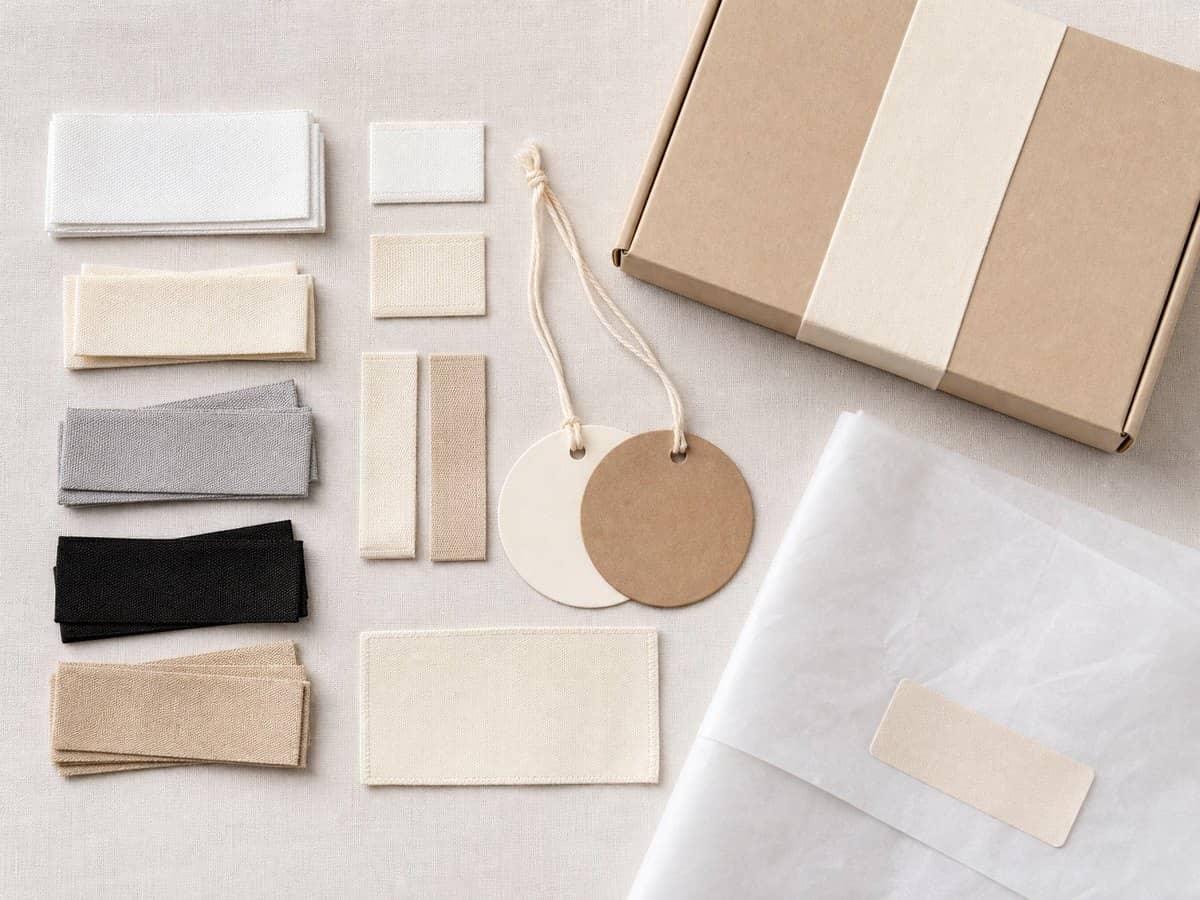
- Woven — premium and durable; the classic branded label.
- Printed — soft against the skin, good for a minimal look.
- Tagless (heat-transfer) — printed straight onto the garment, no itch.
Care & content labels (this part is the law)
Most markets legally require a care label. In the US, the FTC Care Labeling Rule and the Textile Fiber Products Identification Act require fibre content, care instructions, country of origin, and the manufacturer/importer identity (RN). In the EU and UK, fibre composition labelling is mandatory, and care symbols follow the internationally recognised GINETEX / ISO 3758 system. Get this right — it isn't optional, and retailers check.
- Fibre content (e.g. "100% organic cotton").
- Care symbols (wash, bleach, dry, iron — ISO 3758 / GINETEX).
- Country of origin (e.g. "Made in Bangladesh").
- Size, and your brand / RN where required.
Hang tags & packaging
- Hang tags — carry your brand story, price and barcode.
- Polybags — protect the garment; consider recycled or compostable versions.
- Boxes, mailers, tissue, stickers, thank-you cards — the unboxing moment that earns repeat customers.
The labels you are legally required to carry
Branding labels are a choice. Some labels are not, and getting them wrong is a compliance problem rather than an aesthetic one. Requirements vary by market, so confirm for where you are actually selling, but the pattern is consistent.
- Fibre content — the actual composition, by percentage. This is where the bamboo trap catches brands: in the US, bamboo viscose must be labelled “viscose from bamboo” or “rayon from bamboo”, never simply “bamboo”.
- Country of origin — where the garment was manufactured.
- Care instructions — washing, drying and ironing, usually as symbols. Base these on your own wash test, not on the mill’s generic advice.
- Responsible party — an identifier for the business placing the product on the market. In the EU, GPSR requires an established economic operator.
- Size — and if you sell across regions, be explicit about which system you are using.
Getting trims right without holding up production
Trims are the most common cause of a finished order sitting unshipped. Labels, tags and packaging are produced by different suppliers on different timelines, and a garment cannot ship without them — so a two-week delay on woven labels delays everything, no matter how well production ran.
Two practical habits prevent this. Approve trim artwork at the same time as your pre-production sample rather than after it, so both tracks run in parallel. And order a small surplus, typically five to ten percent: labels are cheap, a partial shipment is not, and having spares means a damaged batch does not become a delayed order.
Sustainable options
If your brand leans sustainable, your finishing should match the story: recycled or organic label materials, water-based inks, recycled or compostable polybags, and minimal packaging. It's a small cost that keeps your claims consistent — the opposite of wrapping an 'eco' tee in virgin plastic.
We produce custom neck labels, compliant care labels, hang tags and packaging as part of your order, with embroidery and print in-house. Tell us your branding and we'll spec it with you.
Frequently asked questions
What labels are legally required on clothing?
Fibre composition, care instructions and country of origin, in essentially every market you will sell into — but the exact requirements differ enough that you cannot use one label everywhere. The US requires fibre content, country of origin and care under FTC rules, plus the manufacturer or dealer identity. The EU mandates fibre composition in the language of each country where it is sold, under Regulation 1007/2011. The UK follows broadly similar rules. Kidswear adds safety requirements around drawcords and small parts. Getting this wrong holds goods at customs or gets them pulled from a retailer, which costs far more than printing a correct label. Tell us which markets you are selling into and we will draft compliant wording for you to approve on the pre-production sample.
What's the difference between woven and printed labels?
Woven labels are made on a loom, with the design formed from coloured threads, so nothing sits on the surface to wear away. They feel more substantial, they last the life of the garment, and they read as premium — most established brands use them at the neck. Printed labels are ink applied to a satin or cotton tape. They are cheaper, they handle fine detail and photographic logos better than weaving can, and they are the sensible choice for care and content labels where the text is small and legally required rather than decorative. The practical split most brands use: woven for the brand label, printed for the care label, and a tagless heat transfer if you want nothing at the neck at all. All three are made as part of the run rather than sourced separately by you.
Do I need a care label on my clothing?
In practically every market you sell into, yes, and it is a legal requirement rather than a nicety. The specifics differ: the US requires fibre content, country of origin and care instructions under FTC rules, the EU requires fibre composition in the local language under Regulation 1007/2011, and the UK follows broadly similar lines post-Brexit. Get it wrong and you are looking at goods held at customs or pulled from a retailer's shelf, which is expensive in a way that printing a correct label never is. What trips people up is not the requirement but the detail — fibre percentages must be accurate to within tolerance, and country of origin means where the garment was substantially transformed, not where your company is registered. We produce the labels as part of the run and you approve the wording on the pre-production sample.
Can you make custom labels and packaging?
All of it, and it is included rather than an extra service. Woven or printed neck labels, tagless heat transfers if you want nothing at the neck, care and content labels with the wording your market legally requires, size tabs, hangtags with your artwork, polybags, and cartons packed to your specification or your retailer's. Nothing carries our name at any point. The part worth planning early is the care label, because the required fibre percentages and country-of-origin wording differ by market and getting it wrong can hold goods at customs. Send us your artwork and tell us where you are selling; we will draft the compliant wording and you approve it on the pre-production sample before anything is made in bulk.
Free tools & guides for this
Sources & further reading
Have an idea? Let’s make it.
We manufacture from 100 pieces per style, with GOTS-certified organic options and photos at every stage. Send a sketch or a sentence — we’ll reply within a day.