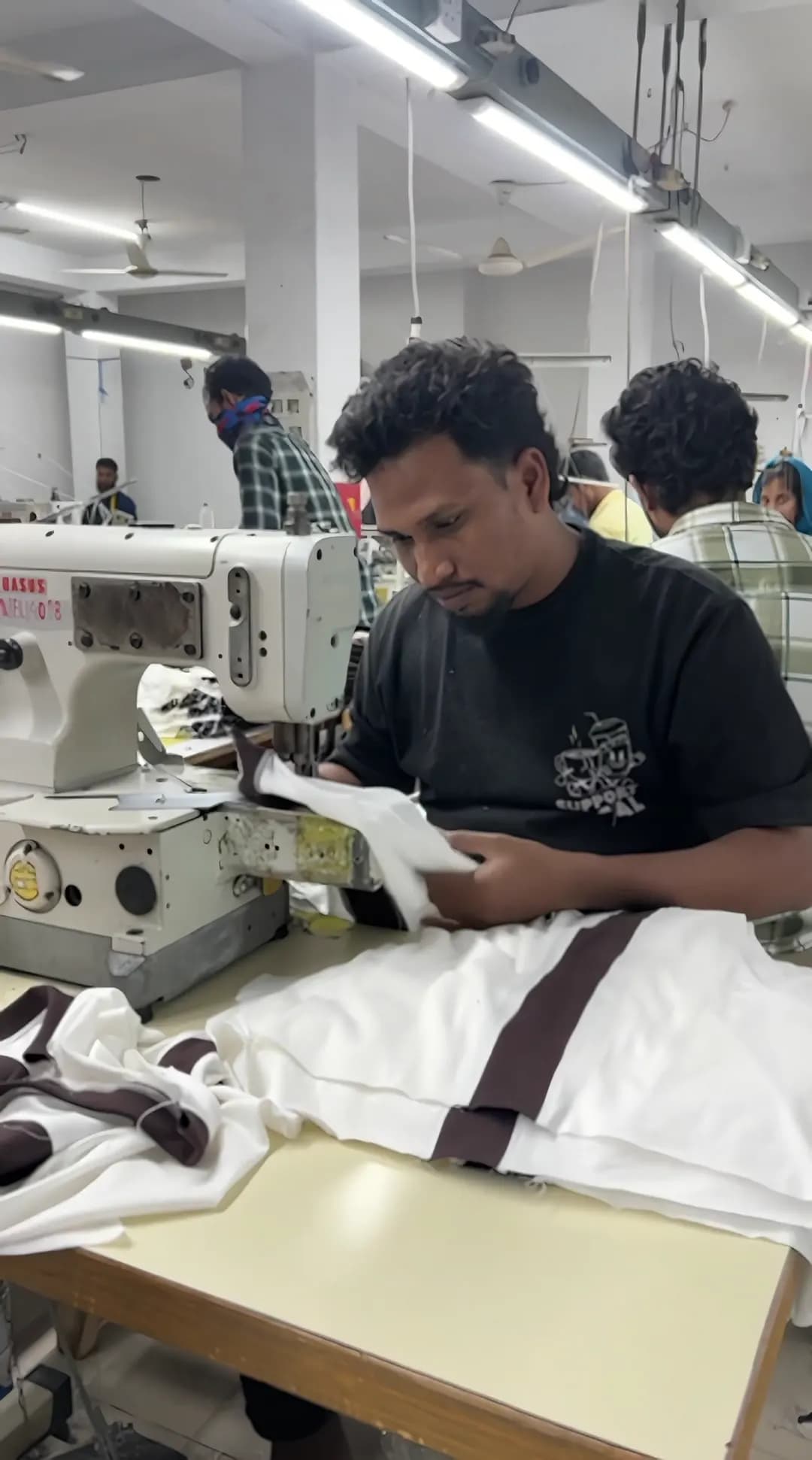
Folding and bagging finished garments
A worker folds finished black T-shirts, seals each one in a recyclable polybag and stacks them on the packing table at Collective Studio in Narayanganj.
- Length
- 0:23, no sound
- Filmed at
- Collective Studio, Narayanganj, Bangladesh
What you are seeing
Packing is the last step on our floor. Each finished T-shirt is folded to the size of its bag, sealed, and added to a stack of bagged, barcoded pieces ready to be counted into cartons.
Fold, bag type and any print on the bag belong in the packaging section of your tech pack. The bags in this clip carry a client's own recycling print.
The T-shirt is folded with its neck label facing up before it goes into the bag. The bag closes with an adhesive flap: the worker peels off the backing strip and presses the flap down.
Tell us whether you will supply the barcodes or sticker files for each size and colour, and where on the bag the sticker goes. On your first delivery, scan a few bags before they go into stock to check that each code matches the size inside.
Where packing sits in the order
Packing is the last step on our floor, but it is not the end of checking. Garments are trimmed and checked as they come off the line, then folded, bagged and counted into cartons. The final AQL inspection is carried out on the packed goods, with cartons opened and pieces pulled at random, so what is inspected is what you receive.
After inspection the cartons are sealed and marked, a packing list records what is in each one, and the shipment leaves for freight. Production, packing included, takes 40 to 50 days after sample approval, and air freight then takes 5 to 7 days to the US or the UK. Our guide to shipping bulk clothing orders explains what happens to the cartons next.
What to put in the packaging section of a tech pack
Section 8 of our tech pack template asks for the fold method, the polybag or tissue, the barcode or sticker and the carton. Be specific about each. Give the folded size, or the size of the bag the garment must fit, and say which side faces up; in this clip the neck label faces up, which makes the size readable through the bag. Give the bag material, its closure and any print on it, such as a recycling mark or a suffocation warning if your market or retailer asks for one.
For the carton, say how many pieces go in each and whether each carton holds one size and colour or a mix. If your goods go to a retailer or a fulfilment warehouse, send their packing rules at quote stage; they are easy to build into the run and awkward to change once goods are boxed. Our guide to labels, hang tags and packaging covers branded options.
Checking a delivery when it arrives
Count the cartons against the packing list before you sign for them, and note any crushed or wet cartons on the delivery paperwork. Then open a few cartons from different parts of the shipment and check that each holds the sizes and colours the list says. Scan a few bags to check that each barcode matches the size inside, and look at the folding: a garment packed slightly damp or folded too tightly can arrive creased, which matters most for heavy fleece and dark colours.
Where this clip appears
- Private Label T-Shirt Manufacturer
- Clothing Manufacturer for US Brands
- Clothing Manufacturer for New Zealand Brands
- Clothing Manufacturer for Danish Brands
- T-Shirt Manufacturer in Bangladesh
- Beachwear & Towel Manufacturer
- Cap & Hat Manufacturer
- Clothing Manufacturer for Boutiques
- Low MOQ Clothing Manufacturer
- Low MOQ Clothing Manufacturer in Bangladesh
- Clothing Manufacturer for Dutch Brands
- Clothing Manufacturer for Italian Brands
- Clothing Manufacturer for Spanish Brands
- Private Label Clothing Manufacturer
- Produttore di abbigliamento per brand italiani
- Fabricante de ropa para marcas españolas
- Kledingfabrikant voor Nederlandse merken
- Tøjproducent til danske brands
- T-Shirt-Hersteller in Bangladesch
- Bekleidungshersteller für kleine Mengen
- Fabricant de vêtements en petite quantité
- Fabricante de ropa en pocas unidades
- Private-Label-T-Shirt-Hersteller
- Fabricante de camisetas en Bangladesh
- Fabricante de camisetas de marca blanca y marca propia
- Producent odzieży z niskim minimalnym zamówieniem
- Producent koszulek i T-shirtów w Bangladeszu
- 小ロット対応のアパレルOEMメーカー
- バングラデシュのTシャツOEMメーカー
- EU €3 Customs Duty on Small Parcels: A Guide for Brands
- Bangladesh Wholesale Clothing: Stock Lots vs Made to Order
- Import VAT & GST on Clothing: UK 20%, DE 19%, CA 5%, AU 10%
- EXW, FOB, DDP and Landed Cost: How to Read a Garment Quote
- Best Low MOQ Clothing Manufacturers 2026: 11 Compared
- Low MOQ Meaning: What It Is and What It Costs per Piece
- How Much Does It Cost to Start a Clothing Brand?
- How to Order Clothing in Bulk: A Complete Guide for Brands
- Garment AQL Chart and Table: Sample Sizes, AQL 2.5 and 4.0
- Shipping Bulk Clothing Orders: FCL, LCL & Incoterms
- Low MOQ Clothing Manufacturers in Bangladesh: 12 Compared
- EU Textile EPR: 2028 Deadline, Fees and Who Must Register
- How to Import Clothes from Bangladesh to USA: Steps & Duty
- How to Start a Clothing Brand or Line: 9 Steps
- HS Codes for Clothing: T-Shirt, Hoodie & Knitwear Codes
- Clothing Manufacturers Australia: Local vs Offshore Guide
Folding and bagging finished garments: questions brands ask
Can you pack my order to a retailer's or warehouse's own requirements?
Yes, as long as we have their requirements before production starts. Retailers and fulfilment warehouses often publish their own rules for incoming goods: how each garment is folded and bagged, where the barcode sticker sits, how many pieces go in a carton, whether cartons hold one size or a mix, how cartons are marked and labelled, and sometimes a maximum carton size or weight. We can produce to those rules, including the retailer's barcode placement and ratio packs, but they are easy to build into the run and awkward to retrofit once goods are bagged and boxed. So tell us at quote stage who the end customer is, and send their routing or vendor guide with your tech pack. If you are selling through your own warehouse, a simple instruction is enough: the fold, the bag, the sticker and the number of pieces per carton.
What is the difference between solid and ratio packing?
Solid packing puts one size and one colour in each carton; ratio packing puts a set mix of sizes in each carton. Solid packing is the simpler of the two. Every carton is identical inside, so stock is easy to count, easy to store on a shelf by size and easy to pick for online orders, which is why most fulfilment warehouses prefer it. Ratio packing, sometimes called assorted packing, fills each carton with a fixed proportion of sizes, such as one small, two medium, two large and one extra large. It suits deliveries straight to shops, where a store wants a spread of sizes in one box rather than one size in many. The right choice depends on where the goods go first. Say which you want in the packaging section of your tech pack, and give the ratio if you choose ratio packing, because it changes how the packing team counts the order.
How are T-shirts folded and bagged at a clothing factory?
Each finished T-shirt is folded to the size of its bag, slipped into a polybag, sealed and stacked ready to be counted into cartons. In the clip from Collective Studio's floor in Narayanganj, the worker folds each black tee with its neck label facing up, so the size can be read through the bag. The bag closes with an adhesive flap: the backing strip is peeled off and the flap pressed down. Bagged pieces are then stacked with their barcodes and counted into cartons by size and colour. The fold matters more than it looks. It sets the folded size, which has to fit the bag and the carton, and it decides where creases form. Heavy fleece and dark colours show creases most, so a garment packed slightly damp or folded too tightly can arrive marked. Give the fold method and folded size in your tech pack.
Do I need to supply my own barcodes for a clothing order?
Usually yes: the barcode numbers come from your business or your retailer, and the factory prints or applies them to your instructions. A barcode identifies your product in your own stock system, or in a retailer's, so it has to be a code you control and have assigned to each size and colour. What Collective Studio needs from you is the sticker file or the code list for every size and colour, the sticker size, and where it goes on the bag, for example on the front at the top. If your goods go to a retailer or a fulfilment warehouse, check their vendor guide, which often fixes the barcode type and placement. Send all of this with your tech pack, because stickers are applied on the packing table at the end of the line. When the first delivery arrives, scan a few bags to check each code matches the size inside.
Can my clothes be packed in recyclable polybags?
Yes. The bag material, closure and any print on it are your choice, and they belong in the packaging section of your tech pack. In this clip from Collective Studio's floor, black T-shirts are sealed in recyclable polybags carrying a client's own recycling print, closed with an adhesive flap. Tell us the bag you want, its size or the folded size the garment must fit, the closure and any print, such as a recycling mark. Some markets and retailers also ask for a suffocation warning on bags above a certain size, so check your retailer's rules and your own market's rules before the artwork is fixed. Bag print artwork needs to be approved early, because bags are ordered before the line reaches packing and a late bag holds finished garments on the table. If you are unsure what your warehouse accepts, send its packing rules at quote stage.
Is the final quality inspection done before or after the garments are packed?
After. At Collective Studio the final AQL inspection is carried out on packed goods, so what is inspected is what you receive. Garments are trimmed and checked as they come off the line, then folded, bagged and counted into cartons. The inspector then opens cartons from across the shipment and pulls pieces at random, checking measurements, workmanship, labels and packing against the approved sample and your tech pack. The number of pieces checked depends on the order quantity and the AQL level you choose. Inspecting packed goods matters because packing can introduce faults of its own: the wrong size in a bag, a barcode that does not match, a garment folded damp. Once inspection is passed, cartons are sealed and marked, a packing list records what is in each one, and the shipment leaves for freight. Production, packing included, takes 40 to 50 days after sample approval.
How should I check a clothing delivery when the cartons arrive?
Count the cartons against the packing list before you sign, then open a sample of cartons and check what is inside. Note any crushed, torn or wet cartons on the delivery paperwork at the door, because a damage claim is far harder to make after the driver has gone. Then open a few cartons from different parts of the shipment, not just the top of the pile, and check that each holds the sizes and colours the packing list says. Scan several bags to confirm each barcode matches the size inside. Look at the folding and the garments themselves: creases on heavy fleece or dark colours can point to garments packed damp or folded too tightly. Lay one piece of each style flat beside your approved sample and compare. If anything is wrong, photograph it with the carton label in shot and send it to Collective Studio straight away.
What should the packaging section of a tech pack include?
It should say how each garment is folded, what it is packed in, what label or sticker goes on the outside and how cartons are made up. Section 8 of Collective Studio's free tech pack template asks for exactly those four things. For the fold, give the method, the folded size or bag size, and which side faces up. For the bag, give the material, closure and any print, such as a recycling mark or warning. For the sticker, give the barcode or file for each size and colour and where it sits on the bag. For the carton, give the number of pieces per carton and whether each holds one size and colour or a ratio mix. If a retailer or warehouse receives the goods, attach its vendor guide. Packaging is read last on the line, which is why it is often left blank and then needed in a hurry.