How Much Does It Cost to Start a Clothing Brand?
"How much does it cost to start a clothing brand?" The honest answer is a range — but it's a knowable one once you break it into buckets. You can launch leaner than you think, or burn through thousands before you've sold a thing. The difference is knowing where the money actually goes.
The real cost buckets
- Product — sampling (a one-off cost to perfect the first piece) plus your first production run.
- Branding — a logo, woven labels, hang tags, and packaging.
- Photography — good product photos sell; you can start with a phone and daylight.
- Store — a Shopify-style site is low-cost monthly.
- Marketing — the budget most founders forget, and the one that actually drives sales.
What a lean launch actually costs
Because you can manufacture from 100 pieces per style, your biggest cost — product — is within reach of a modest savings pot rather than a bank loan. A first run of a single style in one or two colours, plus basic branding and a simple store, is a realistic starting point for most new founders.
You don't need a big budget to start a brand. You need one great product and the discipline not to over-spend before you've proven it sells.
Where new founders overspend
- Ordering too much stock before they know what sells.
- Over-designing a huge first collection instead of nailing one product.
- Pouring money into a fancy website before the product exists.
- Forgetting to budget anything for marketing.
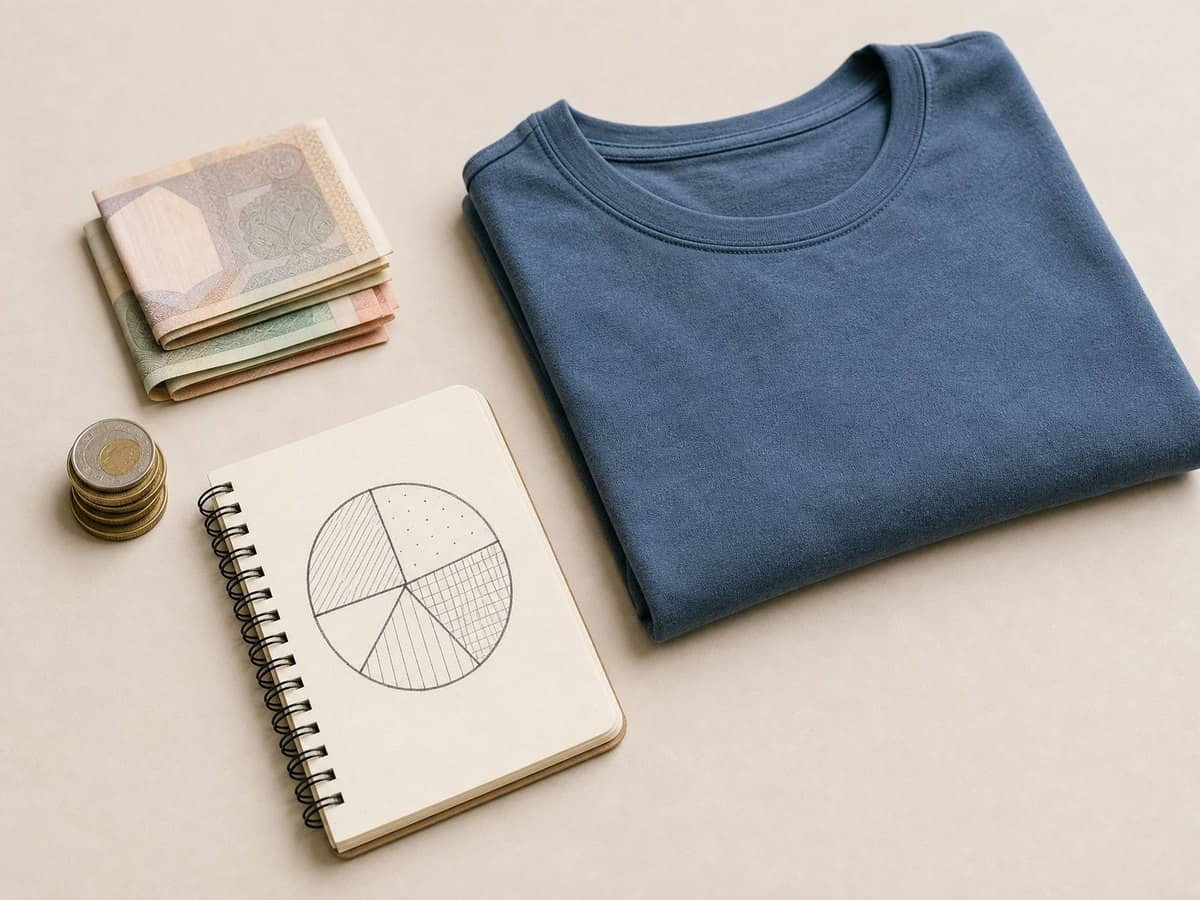
Where the money actually goes
Most first-time founders budget for the garments and are surprised by everything else. A realistic first-run budget has five lines, and production is only the largest of them — not the only one.
| Line | Rough share of a first budget | Note |
|---|---|---|
| Sampling | 5–10% | One or two rounds. Skipping this to save money is the most expensive saving available |
| Production | 55–70% | The garments themselves, landed |
| Labels, tags, packaging | 5–8% | Easy to forget at quoting stage, not optional |
| Photography & listings | 10–15% | Unsold stock is stock nobody has seen |
| Reorder reserve | held back | Not a cost — cash you keep so a sell-out is not the end |
The cheapest version that still teaches you something
There is a floor below which a first run stops being research and becomes a guess. One style, one colour, a hundred pieces, in a fabric you have physically handled, with photography good enough to sell it — that is roughly the smallest meaningful test. It answers whether people will buy the product, and it leaves you with a pattern and a sealed sample you can scale from.
What genuinely saves money at this stage is narrowing, not cheapening. One colour instead of three cuts your minimum by two thirds. A stock fabric instead of a developed one removes weeks and a mill minimum. A simpler construction reduces both sampling rounds and unit cost. Reducing quality, by contrast, tends to cost more later in returns and reorders you cannot justify.
How to start lean
Launch one strong product at a low MOQ, shoot it well, put your marketing budget to work, and reorder your winners. Prove demand first; scale second. That is exactly what a 100-piece minimum is for, and it is why we built the floor around first runs rather than treating them as a favour. Read our step-by-step on starting with 100 pieces, then tell us your idea and we'll give you an indicative product cost.
Frequently asked questions
How much does it cost to start a clothing brand?
It varies widely, and the manufacturing is rarely the part that catches people out. Budget in five buckets. Sampling, which is charged separately from production and normally needs at least one revision round. The production run itself, where a single style at a 100-piece minimum is usually a four-figure sum rather than five, depending heavily on fabric weight and decoration. Branding: labels, hangtags, packaging — inexpensive individually, easy to underestimate collectively. Shipping, which is included if your supplier quotes DDP and arrives separately if they quote FOB. And everything after the product exists: photography, a website, and enough marketing budget to reach anyone. Founders consistently underestimate the last two and the reorder. Keeping the first run small is what makes the total manageable.
How much money do I need for a first production run?
Enough to cover sampling, the minimum order, and a reserve you have not spent yet. Sampling comes first and is billed separately, so budget for at least one revision round rather than assuming the first sample is right. The production run follows, and at a 100-piece minimum per style and colour a first order is within reach of a modest budget in a way that a 500 or 1,000-piece floor is not. The part almost nobody budgets for is the reorder: if the first run sells through and there is no cash to restock, the brand stalls at precisely the moment it is working. As a rule of thumb, if a first run consumes every pound you have, the order is too big rather than the budget too small.
Can I start a clothing brand with little money?
Yes, provided you are disciplined about where the money goes. Keep the range narrow: fewer styles, fewer colourways, since each additional colour multiplies the minimum rather than sharing it. Choose a manufacturer whose floor really fits your budget instead of stretching to meet a higher one. Resist the pull of better unit pricing at volume — it is real, but paying less per piece for stock you cannot sell is the most common way small brands run out of money. Reinvest early profit into reorders of proven styles rather than expanding the range. And spend something on product photography, because the best-made garment sells badly if it is presented poorly, and that is the cheapest lever available to a new brand.
Where this applies
The manufacturing pages this guide relates to, if you are costing a real run.
Free tools & guides for this
Sources & further reading
Have an idea? Let’s make it.
We manufacture from 100 pieces per style, with GOTS-certified organic options and photos at every stage. Send a sketch or a sentence — we’ll reply within a day.