How to Start a Clothing Brand: 9 Steps From Idea to Reorder
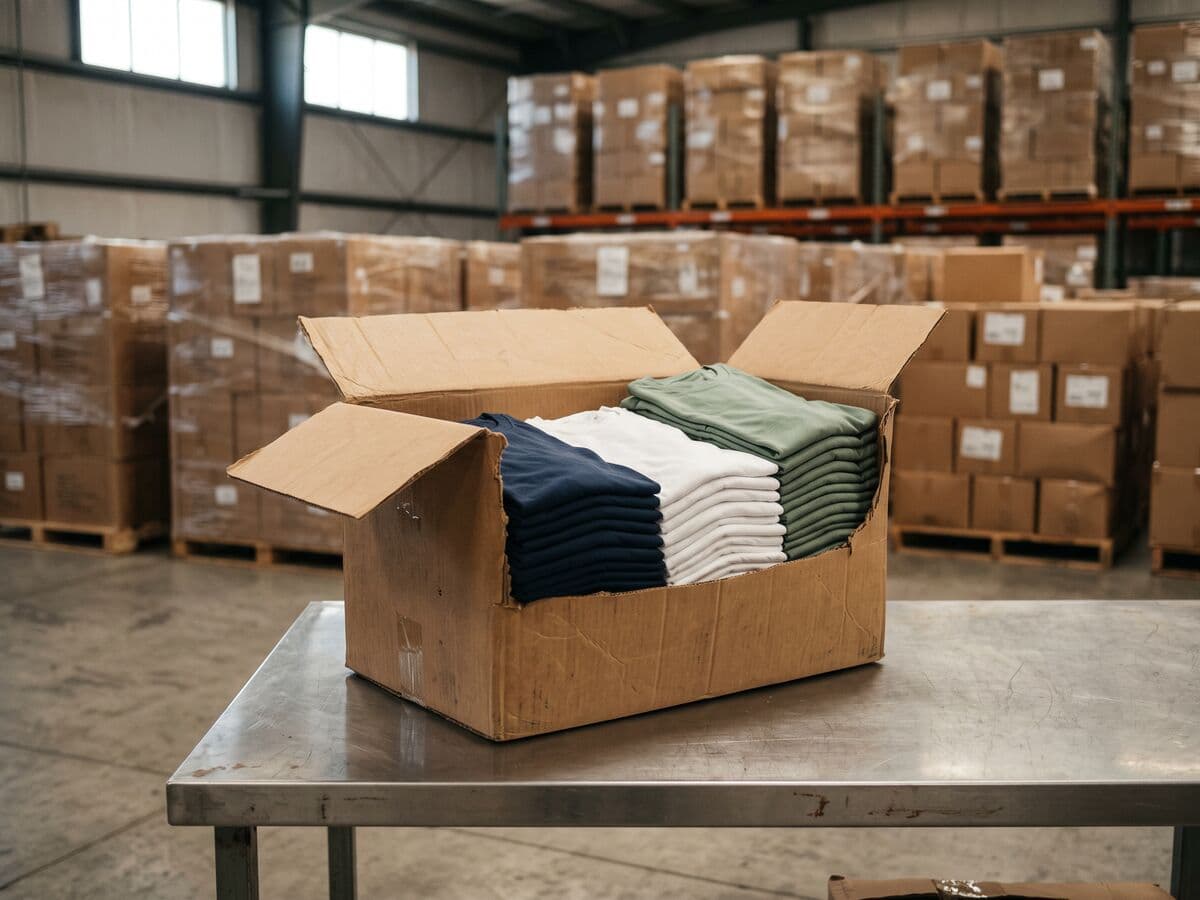
To start a clothing brand, choose one customer and one product, write a tech pack, pick the fabric and its weight, approve a physical sample, order a first run your cash can carry, label it for the country you sell in, ship it, then launch and reorder what sells. With a cut-and-sew factory like ours the first run is 150 pieces per style and per colour, and it takes about 70 days from order to your door by air. If you only want to find out whether a design sells, print-on-demand is the better first step.
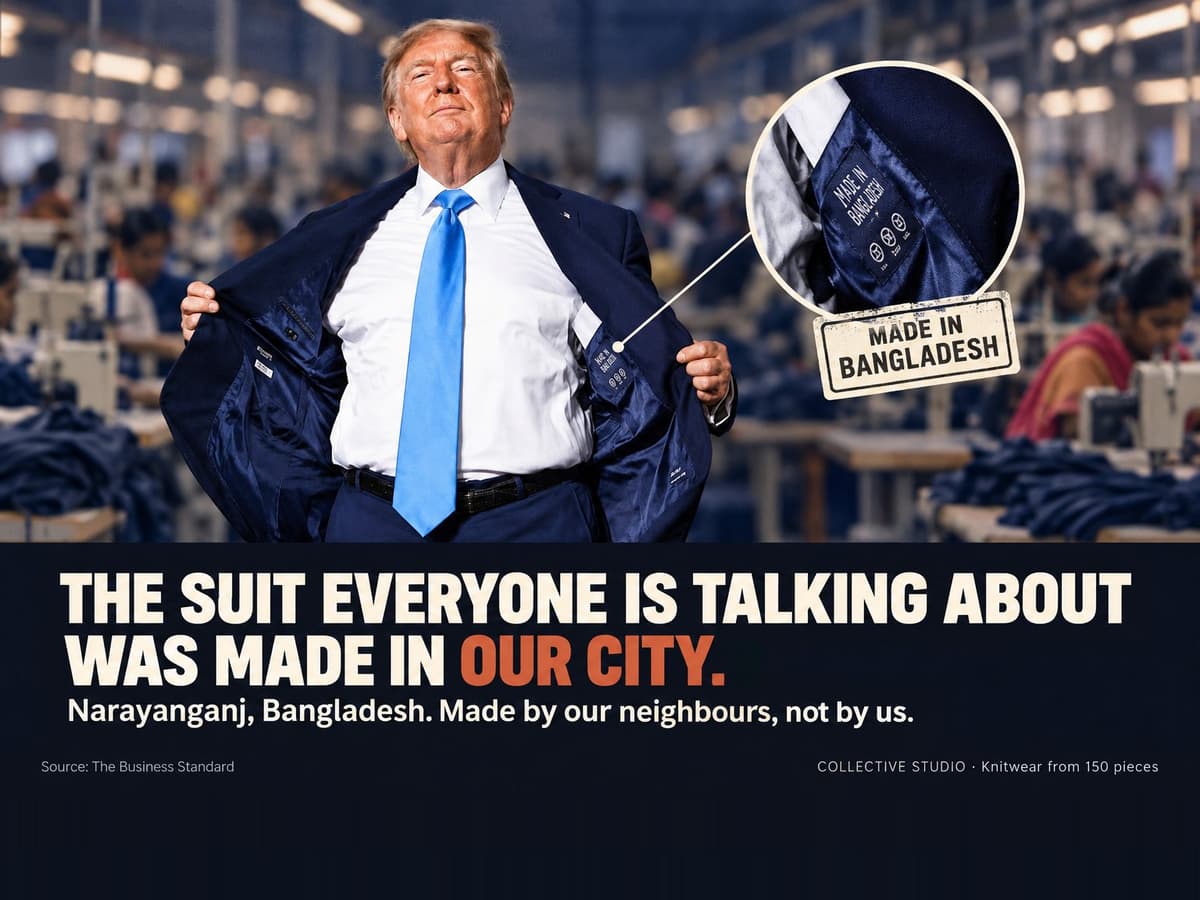
We are a family-run knitwear factory in Narayanganj, Bangladesh, so this guide is written from the factory side: the order in which a new brand actually meets each decision, what each one locks in, and how long it takes. Every step has a deeper guide of its own, linked below, so this page stays a map rather than a repeat of them.
| Step | What you decide | Typical time | Deep guide |
|---|---|---|---|
| 1. Customer and product | Who buys, and the one garment you start with | Before you contact a factory | What it costs to start |
| 2. Design and tech pack | Sketches, measurements, trims, labels, size chart | Days, if you build it yourself | How to make a tech pack |
| 3. Fabric and GSM | Construction, weight, fibre, colour | Alongside the tech pack | Fabric and GSM guide |
| 4. Manufacturer and sampling | Who makes it, and whether the sample is right | About 10 days per sample round | How to find a manufacturer |
| 5. MOQ and colours | Styles, colours and the size split | At quote stage | Low MOQ vs high MOQ |
| 6. Production | Trims, decoration, approvals | 40–50 days after sample approval | Pre-production samples |
| 7. Labels and compliance | What the label must say in each market | Artwork approved before bulk | Labelling by country |
| 8. Shipping and duty | Air or sea, DDP or FOB, duty and tax | Air 5–7 days to the US or UK, 5–8 to Europe, 6–8 to Canada; sea adds about a month | Duty by country |
| 9. Launch and reorder | Launch date, pre-orders, what to remake | Plan the reorder before you sell out | Launch date calculator |
First, check that a factory is the right place to start
Most guides skip this, and it is the most useful decision on the list. A cut-and-sew factory makes a garment that is yours: your fabric, your pattern, your fit, your label sewn in. In return you commit to stock before you have sold anything. That is the right trade for some first brands and the wrong one for others.
- Start with print-on-demand if your brand is mainly artwork, you have no cash to tie up in stock, or you do not yet know which designs people will buy. You hold nothing, each piece is printed after an order, and you learn which designs and sizes sell. What you give up is the garment: it is someone else's blank, fabric and fit. Our guide to print-on-demand versus manufacturing covers when to switch.
- Start with a local maker or sample room if you want to change the fit every week, need a dozen pieces for a pop-up, or are making something woven such as shirts, denim or tailoring. A knit factory like ours sews jersey, French terry, fleece, piqué, rib and interlock; it is the wrong place for a tailored jacket.
- Start with a factory once you know who buys, the garment itself is part of what they buy, and you can hold 150 pieces per style and colour while they sell. That is the point where owning the product starts to pay.
There is a middle route too: buy ready-made blanks and have a batch printed. You hold stock but not a garment of your own, and it is often a sensible second step after print-on-demand. Whichever you choose now, the rest of this guide is the route to a garment that is yours.
Step 1. Pick one customer and one product
A first collection of twelve pieces is the most common way a new brand runs out of money before it learns anything. Every style needs its own pattern, sample and minimum, and every colour needs its own minimum on top. So start with a sentence, not a moodboard: who the customer is, what they already wear, and the one garment you will make better for them. “A heavyweight hoodie for climbers that survives chalk and a washing machine” is a brand brief. “Streetwear” is not.
Then choose a hero product. For most knitwear brands it is a T-shirt, a hoodie or a sweatshirt, because they sell all year, fit a wide range of bodies and show off fabric quality. Buy the garments your customer already owns from other brands, wear them, wash them and write down what you would change. That list is the start of your tech pack, and the best of those garments becomes your reference sample.
Settle the name before you order anything with it on. In the US, the USPTO advises a clearance search for similar marks before you file, because applications are often refused when a mark is too close to one already registered. The brand mark ends up on the same woven label as the fibre content, so a forced rename after labels are made is a painful one. UK founders will find company registration, VAT and the EORI number in our guide to starting a clothing brand in the UK.
Step 2. Design it, then write the tech pack
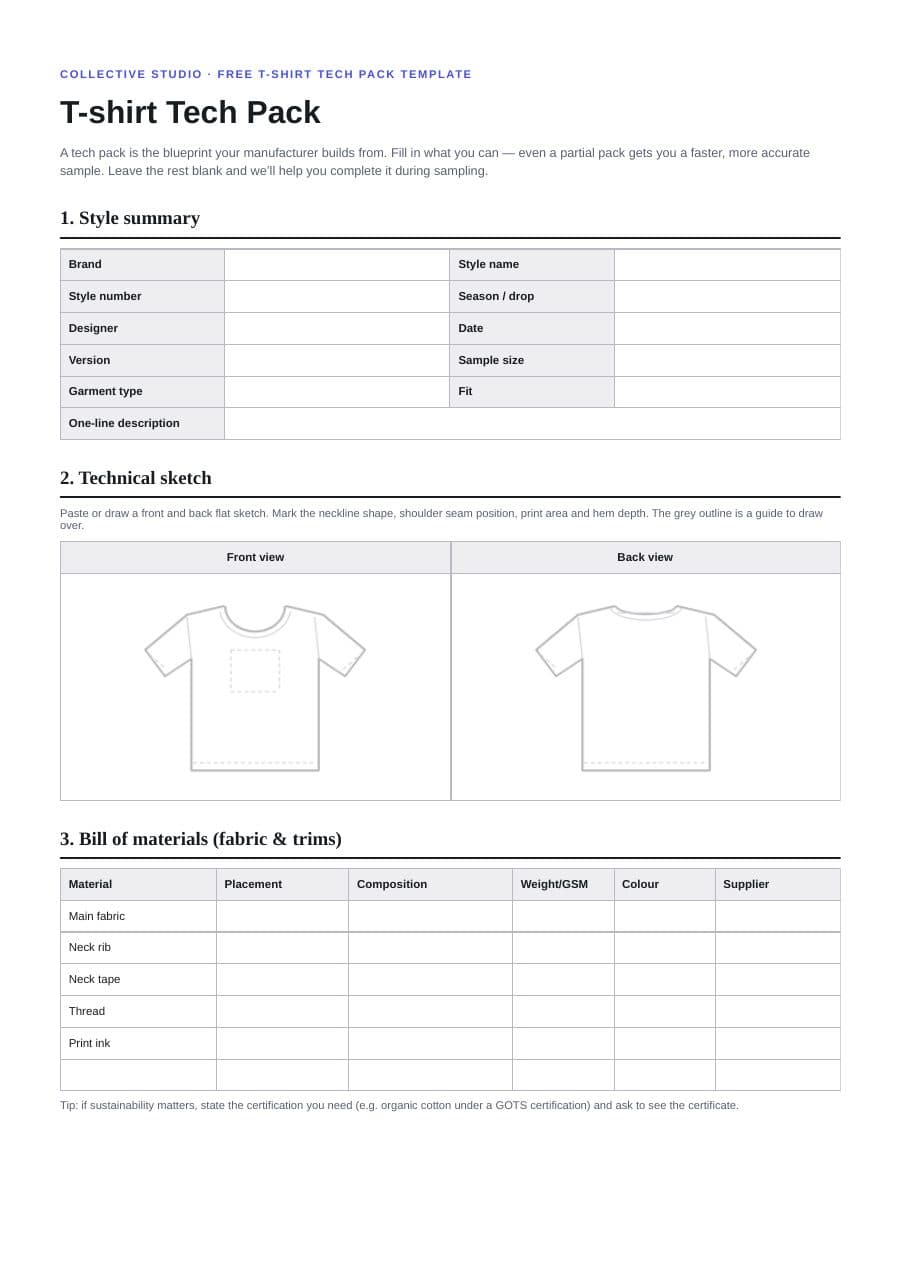
A tech pack is the document a factory builds your garment from: flat sketches front and back, measurements, fabric, trims, stitching, print or embroidery positions, labels and packing. It is what makes two quotes comparable and a first sample accurate. Our plain-English explainer covers what a tech pack is, and the step-by-step guide to making one walks through each section in the order a factory reads it.
You do not need to be a technical designer. Our free tech pack template gives you the fields to fill in, and a reference garment with written notes (“like this, but 4cm longer and with a firmer neck rib”) is a perfectly good way to begin. What a factory cannot work with is a mood: “premium feel” means nothing until it is a fabric, a weight and a measurement.
The size chart belongs in the tech pack too. Choose a base size, usually M, list the points of measure, and grade them across your range; width grows more between sizes than length does. Our guide on how to build a size chart works through a full XS to XXL example. Getting this right before the sample is how you prevent the fit returns that hurt small brands most.
Step 3. Choose the fabric and its weight
Fabric decides how the garment feels, how it washes and a large share of what it costs, so choose it deliberately rather than accepting a default. Decide the construction first, then the weight. GSM, grams per square metre, is the weight of the fabric. As starting points, an everyday T-shirt is usually 140 to 180 GSM and a heavyweight tee 180 to 220, while a standard hoodie or sweatshirt is 280 to 350 GSM, with heavyweight streetwear hoodies above that. Our fabric and GSM guide has the full chart.
- Jersey for T-shirts and light tops. See what jersey fabric is.
- French terry, looped on the inside, for hoodies, sweatshirts and joggers. See what French terry is.
- Fleece, brushed on the inside, for warmer sweats.
- Piqué for polos, and rib and interlock for cuffs, collars, fitted tops and kidswear.
Three habits save trouble here. Ask for the finished GSM after dyeing and finishing, not the knitted figure, because weight and width change on the way. Handle a swatch, or better a garment, before you commit, since two fabrics at the same GSM can feel quite different depending on the yarn. And prefer a fabric the mill already makes for your first run: a developed fabric adds weeks and a minimum of its own. If you want organic cotton, ours is made in our GOTS-certified facility (RSC 9687), and our guide to sustainable fabrics compares the alternatives honestly.
Step 4. Find your manufacturer and approve a sample
Shortlist three to five factories and put each through the same questions: the true minimum per style and per colour, who makes the fabric, where the garment is actually sewn, and whether you can see that floor on a video call. Our guide on how to find a clothing manufacturer covers where to look and how to verify a factory before you pay, and our list of questions to ask a clothing manufacturer gives you the checklist. Know which kind of supplier you are talking to: a full-package factory sources the fabric and makes the sample, a CMT unit sews fabric you supply, and a blank decorator prints onto garments that already exist.
Then sample. With us a sample round takes about 10 days. When it arrives, wear it, wash it and measure it again, then send one set of written corrections rather than a trickle of messages. Most garments need at least one revision round, which is normal rather than a sign that something has gone wrong. Our guide to how clothing sampling works explains each round.
The last sample before bulk is the pre-production sample, made in the real fabric, colour and trims. Sign it off in writing and it becomes the sealed sample that every bulk piece is checked against; our guide to pre-production samples lists what that sign-off should record. Skipping a sample to save a week is the most expensive saving open to a new brand, because any fault it would have caught then repeats across every piece.
Step 5. Set the minimum, and split colours and sizes
MOQ, the minimum order quantity, is the smallest run a factory will make. Ours is 150 pieces per style and per colour, and the unit matters more than the number: each colour is cut from its own dyed fabric, so each colour is its own 150. Sizes work differently. There is no minimum per size, so you can split each 150 across XS to XXL however your customers buy. Our explainer on what MOQ means covers the term, and low MOQ versus high MOQ covers what a small run does to the price per piece.
| First run plan | Styles | Colours per style | Minimum pieces |
|---|---|---|---|
| One hoodie in black | 1 | 1 | 150 |
| One tee in black and in white | 1 | 2 | 300 |
| A tee and a hoodie, both in black | 2 | 1 | 300 |
| A tee and a hoodie, each in black and in white | 2 | 2 | 600 |
Our MOQ calculator does this sum and suggests a size split for adult unisex, women's fitted, oversized and men's ranges. If you had 100 pieces in mind, our guide to starting with 150 pieces sets out the honest ways to handle the gap. We do not put prices in our guides, because they depend on your garment, but the drivers are predictable: fabric type and weight, the number of colours, print or embroidery, and trims. Our guide to what it costs to start a clothing brand shows how a first budget usually divides, and the pricing calculator turns a factory price into wholesale and retail prices at the margin you need.
Step 6. Production
Production starts when you approve the sample and takes 40 to 50 days. In that time the fabric is knitted and dyed at partner mills and checked against your approved colour, then the garments are cut, sewn, printed or embroidered, inspected and packed on our floor in Narayanganj. Our guide to the garment manufacturing process follows each stage, and how long it takes to manufacture clothing explains where delays usually come from. Fabric and late approvals cause most of them, the sewing rarely.
Your part during production is short but real. Approve trims and label artwork alongside the pre-production sample, so they are never the thing holding the order. Choose the decoration method for a run of identical pieces rather than for one-offs; our comparison of screen printing, embroidery and DTG helps there. Ask for photos at each stage. And if you add a colour or reorder later, expect each dye lot to differ slightly, which our guide to dye lots and reorders explains.
Step 7. Labels and compliance
Labels are where a garment becomes legal to sell, and the rules follow where your customer is, not where the factory is. Plan them at tech pack stage and approve the artwork before bulk. The main points for the markets most first brands sell into:
- United States: the FTC's textile rules require the fibre content by generic name and percentage, the country of origin, and either the business name or an RN. The Care Labeling Rule also requires care instructions attached permanently to clothing.
- European Union: textile products must be labelled with their fibre composition under Regulation (EU) No 1007/2011. Under the General Product Safety Regulation, which has applied since 13 December 2024, each product also needs a responsible economic operator in the EU, such as an importer or an authorised representative. Our GPSR guide covers what that means for a small brand.
- United Kingdom: every textile product must carry a label showing its fibre content, in English.
- Canada and Australia have their own rules on language, origin and care, set out market by market in our guide to clothing labelling requirements by country.
The label is sewn on our floor, but it carries your name and your claims, and most of these rules put the responsibility on the brand or the importer. That is why we ask which markets you sell in before anything is printed. Base the care instructions on a wash test of your actual sample (our guide to care labels and wash symbols shows the symbols), and order a small surplus of labels, since a garment cannot ship without them. The branded side, from neck labels to mailers, is in our guide to custom labels, hang tags and packaging. If you make kidswear, read the children's clothing safety rules before you design anything with cords or small parts.
Step 8. Shipping and duty
Freight is the last part of the timeline. By air, a shipment takes about 5 to 7 days to the US or UK, 5 to 8 days to Europe and 6 to 8 days to Canada. Sea freight is slower and adds about a month. From order to your door by air, plan on about 70 days in total: about 10 days of sampling, 40 to 50 days of production after sample approval, then the flight.
Compare quotes on the same Incoterm. A DDP quote, delivered duty paid, means the seller delivers to your named address and handles import clearance and duty. An FOB quote, free on board, ends when the goods are loaded at the export port, leaving freight, insurance, duty and import tax to you. Putting an FOB price next to a DDP price compares half a cost with a whole one. Our landed cost calculator adds freight, duty and tax to a factory price so the comparison is fair.
Duty depends on where you import. As a least developed country, Bangladesh currently has duty-free access for clothing to the UK under the Developing Countries Trading Scheme, to the EU under Everything But Arms and to Canada under the Least Developed Country Tariff, provided each market's origin rules are met. The US does charge duty on clothing from Bangladesh, and the rate has changed several times since 2025, so read our guide to importing clothing into the US before you set a price. Bangladesh is scheduled to graduate from LDC status on 24 November 2029; Canada, for one, plans a further three years of full tariff benefits after that. Our duty by country guide tracks the live position, and our guide to import VAT and GST explains the tax charged on top.
Step 9. Launch, then reorder what sells
Work backwards from your launch date. Our launch date calculator counts back through freight, production and sampling from the day you want stock, and it is worth adding a buffer for one extra sample round. Then use the waiting time well: photograph the approved sample, write the product pages and size guide, and line up the people who will hear about your launch first.
If you take pre-orders from US customers, the promise you make is regulated. The FTC's Mail, Internet, or Telephone Order Merchandise Rule requires a reasonable basis for any shipping time you state, shipment within 30 days if you state none, and an offer to accept the delay or cancel with a prompt refund if you cannot ship on time. Pre-orders are safest once your stock is in production, not while the sample is still in revision.
After launch, read the sales by size and colour, not just the total. The reorder is where a small brand starts to earn: the pattern, the sealed sample and the approved fabric already exist, and a repeat run takes another 40 to 50 days of production plus freight. That gap is why pieces above your first sales estimate are not dead stock; they carry you while the reorder is made. Place it before you sell out, and keep cash back for it from the first run. Our guide to pricing your clothing covers the margin that pays for it.
The mistakes that cost first brands most
- Launching too many styles and colours before one of them has sold.
- Approving a sample without washing it and measuring it again.
- Comparing an FOB quote with a DDP one.
- Leaving label artwork until production has started.
- Planning from the production time alone, and forgetting sampling, approvals and freight.
- Spending the whole budget on the first run, with nothing left for photography, marketing or the reorder.
- Paying a supplier whose floor you have never seen. Ask for a video call on the line that would sew your order; our guide to avoiding clothing manufacturer scams lists the other warning signs.
Where to go from here
If you are ready for a first run, our page on low-MOQ clothing manufacturing sets out what 150 pieces per style and per colour includes, and manufacturing for startups explains how we work with first-time brands, from a sketch to a tech pack to a delivered run. Send us your idea, even as a photo and a few notes, through our contact page, and we will come back with fabric options, a realistic timeline and an indicative price for your garment. If you are not ready yet, start with print-on-demand, learn what sells, and come back with that record. It is the best brief a factory can receive.
Frequently asked questions
How do I start a clothing brand with no experience?
Start small and let each step teach you the next one. Write one sentence about who your customer is, pick one garment you can make better for them, and buy the versions they already wear so you can say exactly what you would change. Turn those notes into a tech pack using a free template; a reference garment with written changes is enough to begin, and a good factory will help you fill the gaps. Then choose the fabric and weight, ask three to five factories the same questions, and approve a physical sample after washing and measuring it. Order one style in one colour first, which with us is 150 pieces, so the cost of a mistake stays small. You do not need a fashion degree or a design team. You need a clear brief, the patience to sample properly, and the discipline not to make twelve styles before one has sold.
Is starting a clothing line different from starting a clothing brand?
In practice they mean the same thing, and the steps are identical. People tend to say clothing line when they mean the products, a set of garments released together, and clothing brand when they mean the business and identity behind them. Either way you go through the same sequence: a customer and a hero product, a tech pack, fabric and weight, sampling, a first production run sized by the factory's minimum, labels that meet the rules where you sell, shipping and duty, then launch and reorder. The one trap in the word line is that it suggests a full collection. A first line does not need to be twelve pieces. One style in one colour is a real line, it is far cheaper to get right, and it tells you what to make next. Most lasting brands grew from one product that sold, then added styles once the first one had proved itself.
How long does it take to start a clothing brand?
Plan on about three months from first factory contact to stock in hand, plus whatever time you spend on the idea beforehand. With us the sequence runs like this: about 10 days for a sample round, your own review and any revision, then 40 to 50 days of production once you approve the sample, then freight. By air that is about 5 to 7 days to the US or UK, 5 to 8 to Europe and 6 to 8 to Canada, so the total is about 70 days from order to your door. Sea freight adds about a month. The parts you control are the slowest to slip: a complete tech pack, quick and complete sample feedback, and choosing a fabric the mill already makes all shorten the path. Work backwards from your launch date with our launch date calculator and add a buffer for one extra sample round, which is normal rather than a sign of trouble.
How many pieces should my first production run be?
As few as the factory allows for the garment you actually want, and spread across as few colours as you can stand. Our minimum is 150 pieces per style and per colour, so one hoodie in black is 150 pieces, the same hoodie in black and white is 300, and a tee and a hoodie in two colours each is 600. Sizes are free: there is no minimum per size, so split each 150 across XS to XXL in the proportions your customers buy, or use the starting curves in our MOQ calculator if you have no sales yet. Pieces above your first sales estimate are not wasted, because a reorder takes another 40 to 50 days of production plus freight and that stock carries you through the gap. If you need fewer than 150 pieces of a design, print-on-demand or blank printing is the honest answer until the design has proved it sells.
Do I need a tech pack before I contact a clothing manufacturer?
No, but you need one before bulk production, and the sooner you start it the better your first sample will be. A tech pack is the document a factory builds the garment from: sketches, measurements, fabric and weight, trims, stitching, print positions, labels and packing. Without one, two factories quote two different garments and you cannot compare them. You can open the conversation with a reference garment, photos and written notes such as a longer body, a heavier fabric or a firmer neck rib, and a good factory will help you turn that into a full specification. Our free tech pack template gives you the fields in the order a factory reads them, and our guide to making a tech pack explains each section. Put a version number and date on every copy, because a correct change made to an old file is one of the easiest ways to get a wrong sample.
Should I start with print-on-demand or a manufacturer?
Start with print-on-demand if you do not yet know which designs will sell, and move to a manufacturer once you do. Print-on-demand holds no stock and has no minimum, so it answers one question cheaply: will anyone buy this design, in which colour and which sizes. What it cannot give you is your own garment. You sell someone else's blank, fabric and fit, the label is at best printed inside, and the margin is thin. A cut-and-sew manufacturer makes the garment to your pattern, in your fabric and weight, with your label sewn in, and the cost per piece is lower, but you commit to stock first: with us, 150 pieces per style and per colour. The signal to switch is repeat demand for a specific design. Use that sales record to choose the colour and size split for your first run, and keep the print-on-demand listing live until the boxes arrive.
What legal requirements do I need before selling clothing?
The business registration rules of your own country, plus the labelling and import rules of every market you sell into. Labels matter most for clothing. In the US the FTC requires fibre content, country of origin and either your business name or an RN, and the Care Labeling Rule requires permanent care instructions. The EU requires fibre composition under Regulation 1007/2011, and since 13 December 2024 the General Product Safety Regulation also requires a responsible economic operator in the EU for each product. The UK requires fibre content in English. Canada and Australia add their own rules on language, origin and care. Check your brand name against registered trade marks before you print it, and if you take pre-orders in the US, follow the FTC's rule on stated shipping times. None of this is legal advice for your circumstances, so confirm the details with the regulator or an adviser before your first order.
What fabric weight should I choose for my first clothing brand?
As a starting point, choose about 140 to 180 GSM for an everyday T-shirt, 180 to 220 GSM for a heavyweight tee, and 280 to 350 GSM for a standard hoodie or sweatshirt, with heavyweight streetwear hoodies above that. GSM means grams per square metre, the weight of the fabric, and it shapes how the garment feels, hangs and washes, as well as a large share of what it costs. Decide the construction first, such as jersey for tees or French terry or fleece for sweats, then the weight. Ask for the finished GSM after dyeing and finishing, not the knitted figure, because weight and width change along the way. Handle a swatch or a garment before committing, since two fabrics at the same GSM can feel quite different. For a first run, prefer a fabric the mill already makes, because a developed fabric adds weeks and a minimum of its own.
Where this applies
The manufacturing pages this guide relates to, if you are costing a real run.
Free tools & guides for this
Sources & further reading
- FTC: Threading Your Way Through the Labeling Requirements Under the Textile and Wool Acts (fibre content, country of origin, name or RN)
- FTC: Clothes Captioning, complying with the Care Labeling Rule
- FTC: Business guide to the Mail, Internet, or Telephone Order Merchandise Rule (stated shipping times, 30 days if none stated)
- USPTO: Why search for similar trademarks (clearance search before filing)
- EUR-Lex: Regulation (EU) No 1007/2011 on textile fibre names and labelling (Article 14)
- European Commission Access2Markets: the General Product Safety Regulation, applicable from 13 December 2024
- Business Companion (Trading Standards): Labelling of textiles in the UK
- International Trade Administration: Know your Incoterms (FOB, DDP)
- GOV.UK: Identify tariffs by product under the Developing Countries Trading Scheme (0% on 99.8% of products for Comprehensive Preferences countries)
- European Commission Access2Markets: Everything But Arms
- Finance Canada: Canada's unilateral tariff preference programs (Least Developed Country Tariff, Bangladesh, three-year transition)
- UN LDC Portal: Bangladesh graduation status (24 November 2029)
Cite this guide
For journalists, writers, researchers and students.
Quoting this guide? Please credit Collective Studio and link to this page.
Reference
Homaira Jashim, Collective Studio. "How to Start a Clothing Brand: 9 Steps From Idea to Reorder." 4 November 2026. https://collectivestudioltd.com/journal/how-to-start-a-clothing-brand
Writing about us? Our press kit has our facts, logos and photos, free to use with credit.
Have an idea? Let’s make it.
We manufacture from 150 pieces per style and colour, with organic cotton options from our GOTS-certified facility and photos at every stage. Send a sketch or a sentence — we’ll reply within one business day.