What Does MOQ Mean in Clothing Manufacturing?
MOQ is one of the first terms you meet when you start sourcing clothing — and it quietly decides how much money you need to begin. Here's exactly what it means and how to work with it.
What MOQ means
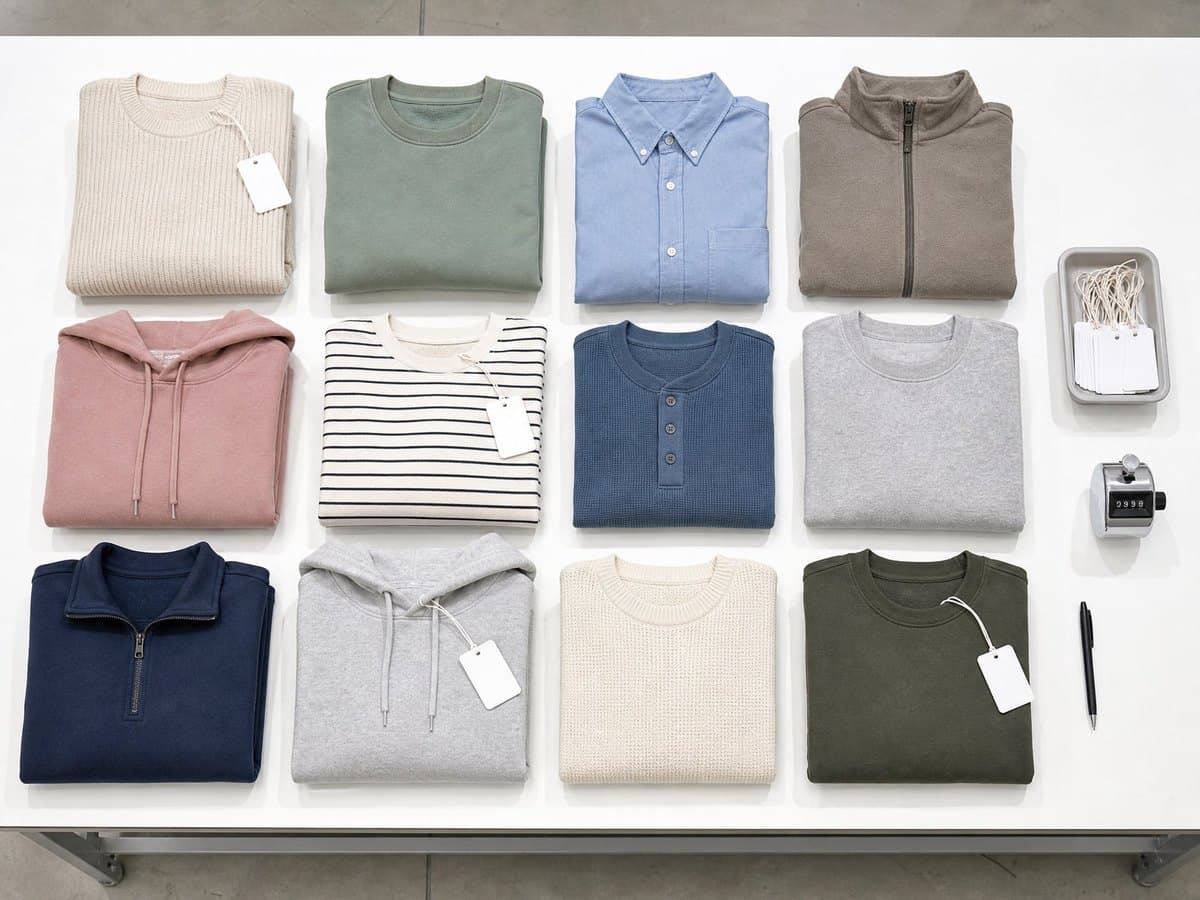
MOQ stands for minimum order quantity — the smallest number of units a factory will make in one production run. It's usually set per style and per colour, which is the detail that catches people out: a "500-piece MOQ" can mean 500 of each colour, not 500 split across colours.
Why factories set an MOQ
Every run has fixed costs — patterns, fabric mill minimums, machine set-up, sampling. Those costs are roughly the same whether the factory makes 50 pieces or 5,000, so a minimum is how they make a run worth setting up. Fabric is often the real driver: mills sell yarn and fabric in minimum quantities, and that floor flows down to your order.
Typical minimums
There's no single number, but as a rough guide: large factories often start at 500–1,000 per style and colour, while factories built for newer brands run smaller. We start from 100 pieces per style and colour, which is low for a full-service manufacturer.
Low MOQ vs high MOQ
A higher MOQ lowers your cost per unit but raises your risk and the cash you tie up in stock; a lower MOQ does the opposite. Neither is "better" — they suit different stages. We break down the maths in low MOQ vs high MOQ: what it really costs.
Per style, per colour, per order — the difference in numbers
The words matter more than the number. The same headline figure produces wildly different first orders depending on which unit it attaches to, and this is the single most common budgeting shock for a new brand.
| Quoted as | One style, three colours | Two styles, two colours |
|---|---|---|
| 100 per style and colour | 300 pieces | 400 pieces |
| 100 per style (any colours) | 100 pieces | 200 pieces |
| 100 per order | 100 pieces | 100 pieces |
Ours is 100 per style and per colour, which is the strictest of the three readings — we state it that way deliberately, because a headline figure quoted per order tends to become a different number once a real range is priced.
Why minimums exist at all
A minimum is not a policy or a negotiating position; it is arithmetic. Pattern making, size grading, the mill’s minimum fabric quantity per dye lot, and the changeover to reset a production line all cost roughly the same whether the run is 30 pieces or 300. Below a certain point those fixed costs stop dividing sensibly and the unit price becomes something no brand would accept.
That is also why a supplier advertising 25 pieces is usually selling a different product — decoration on ready-made blanks, where no pattern, no dye lot and no line changeover is involved. Both are legitimate. They are simply not the same purchase, and the minimum is the clearest signal of which one you are being offered.
How to find a low-MOQ manufacturer
- Ask for the MOQ per style and per colour — not just a headline number.
- Check whether the minimum changes with fabric choice (custom fabric usually raises it).
- Confirm the per-unit price at the quantity you'll actually order.
- Make sure they can reorder consistently, so you can scale your winners.
Collective Studio is built for brands that want to start small and scale: from 100 pieces per style, with GOTS-certified organic options and the same factory all the way up to bulk. Tell us what you're planning and we'll send minimums and pricing for your specific product.
Frequently asked questions
What does MOQ mean?
MOQ stands for minimum order quantity — the smallest number of units a factory will produce in one run. The critical detail most new brands miss is that it is almost always counted per style AND per colour, not per order. A t-shirt in black and white is therefore two minimums, not one, because each colourway is a separate fabric batch with its own dye lot and machine setup. If a factory quotes you a 100-piece MOQ and you want three colours, you are committing to 300 pieces. Always ask a supplier to state their minimum in the form "per style, per colour" before you budget, because a headline figure quoted per order can multiply several times once you choose your range. Sizes are different: you can normally split the minimum across sizes however you like, since that does not change the setup.
Why do manufacturers have an MOQ?
Because a large share of what it costs to make clothing does not scale down. Pattern making, grading a size range, setting up cutting, and changing a sewing line over to a new style cost roughly the same whether the run is 50 pieces or 5,000, so below a certain quantity those fixed costs swamp the per-piece price. The bigger constraint is usually further upstream: fabric mills set their own minimums, frequently several hundred kilograms per colour, because they also have to set up dyeing. A factory willing to make 30 pieces is normally either working from fabric already in stock, printing onto ready-made blanks rather than cutting and sewing, or charging a unit price high enough to absorb the setup. None of those are dishonest, but they are different products.
What is a low MOQ for clothing?
It varies widely, and the advertised number is less meaningful than what sits behind it. Many large export factories start at 500 to 1,000 pieces per style and colour, because their economics are built around long runs. Factories set up for emerging brands go considerably lower, and 100 pieces per style and colour is a genuine low minimum for full cut-and-sew production. You will also see 25 or 50 advertised, and it is worth asking which of three things that means: printing onto ready-made blanks instead of manufacturing the garment, a minimum counted per order rather than per colourway, or a unit price two to three times higher to cover the setup. All are legitimate businesses. Only some of them are actually manufacturing your design from your pattern.
Free tools & guides for this
Sources & further reading
Have an idea? Let’s make it.
We manufacture from 100 pieces per style, with GOTS-certified organic options and photos at every stage. Send a sketch or a sentence — we’ll reply within a day.