Duty-free under EU EBA
No customs duty at the Czech entry: Everything But Arms covers knitwear cut and sewn in Bangladesh, and Regulation (EU) 2026/1395 holds it for three years after graduation.
Premium knitwear manufacturing for Czech brands — duty-free under Everything But Arms, the Czech Republic's 21% import VAT inside one landed price, labels in Czech as the consumer-protection act requires, and the inland leg planned with the quote.
Collective Studio cuts and sews knitwear for Czech brands on its own floor in Narayanganj, Bangladesh, from 150 pieces per style and colour, with about 10 days' sampling and 40–50 days' production before freight. About 70 days from order to your door by air. Goods enter at 0% duty under Everything But Arms, the Czech 21% import VAT is inside the DDP quote, labels are in Czech, and the sea-plus-rail route to Prague, Brno or Ostrava is priced with the order.
Or message the factory directly: WhatsApp +880 1980 055026 · hello@collectivestudioltd.com · Homaira replies within one business day.
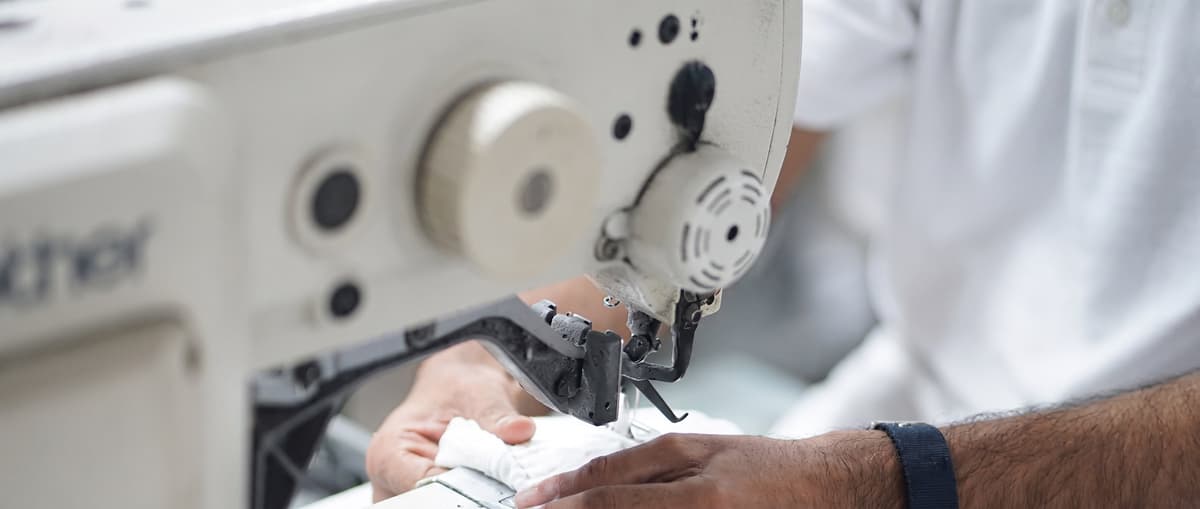
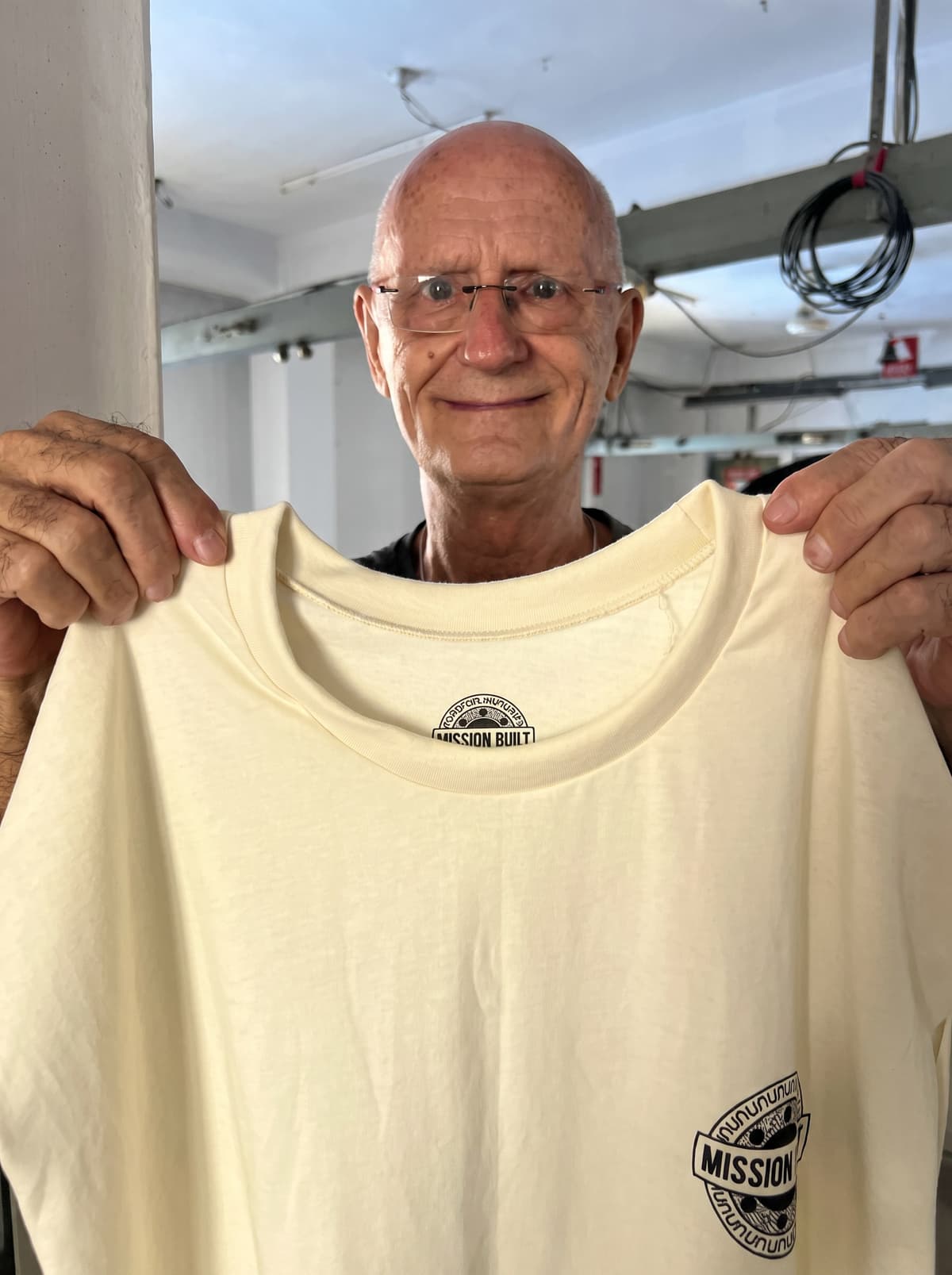
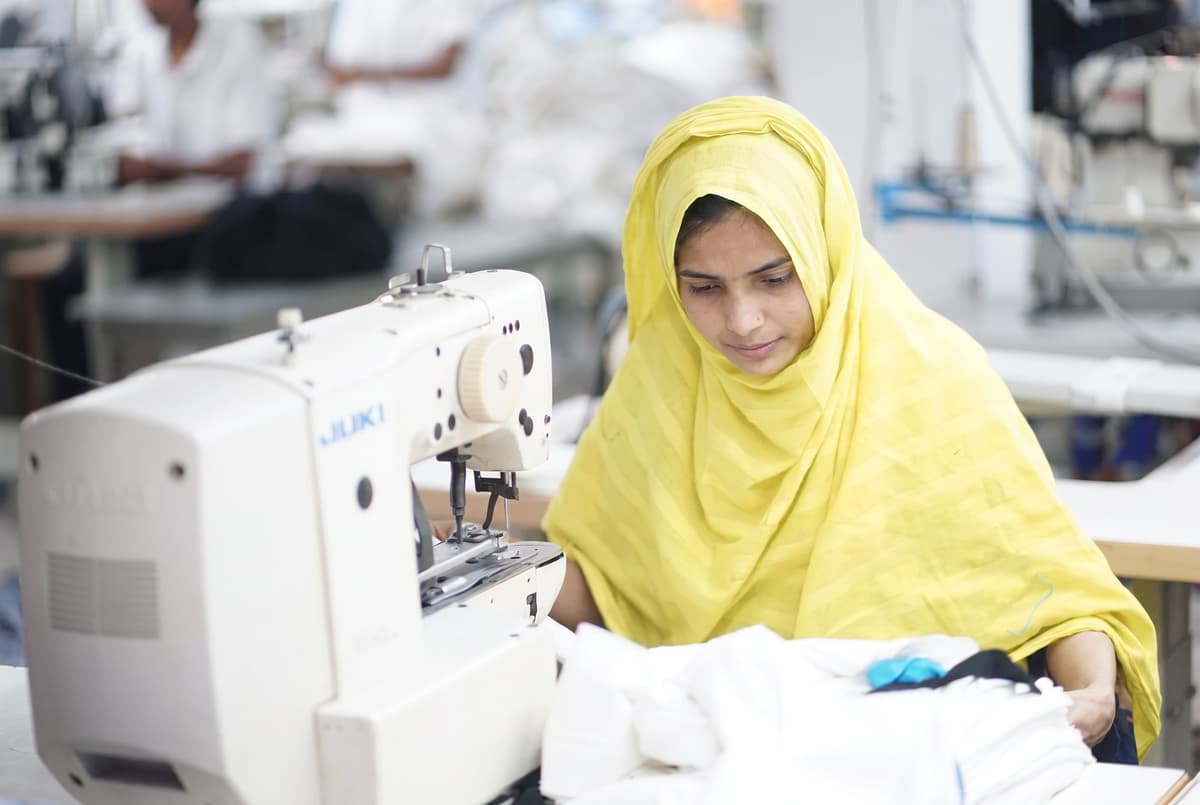
Made by our own team in Narayanganj. See the floor ↓Client reviews on Google ↗GOTS certificate RSC 9687 →
Collective Studio is a clothing manufacturer for Czech brands with a family-run cut-and-sew knitwear floor in Narayanganj, Bangladesh, and a brand office in Amsterdam. Tees, polos, hoodies, sweatshirts, joggers, shorts, activewear and loungewear start at 150 pieces per style and colour. The Czech design scene outgrew the country's own sewing capacity years ago, and most founders end up weighing a Polish workshop, a Portuguese one and Asia; this page sets out the Czech figures so that decision rests on arithmetic.
Two figures decide a Czech landed cost: no duty, because Bangladesh-made apparel enters the EU under Everything But Arms, and a 21% základní sazba on imports, levied on the customs value plus any duty and the transport and insurance costs to the first Czech destination. Under DDP that VAT is part of the price you approve, not a separate demand, and a VAT-registered importer normally recovers it on the periodic return. Agree with your účetní how the entry should be handled and tell us before we file it.
The route matters because the country is landlocked. Goods arrive by sea at Hamburg or Bremerhaven and come south by rail or road, or at Koper and Trieste on the Adriatic, which is a shorter sea leg from Suez and a longer land one. Prague's Václav Havel airport handles air freight in days. We quote the whole chain to a Prague, Brno or Ostrava address rather than hand you a port and wish you luck.
Labelling: fibre composition follows the EU regulation, and the Czech consumer-protection act requires the information that accompanies a product to be given in Czech. So labels for this market are in Czech, sewn to your artwork, with Slovak, Polish or German added if you sell across the border. The General Product Safety Regulation adds the manufacturer's name and addresses on the product or packaging and an EU-established responsible operator, which a Czech company importing from us is.
Every style we make can be cut in organic cotton under our GOTS certification (RSC 9687), with a transaction certificate for your order. We do not sew denim, jackets or woven shirts; our sister buying house in the same industrial area takes those as a separate order. Sampling is about 10 days, production 40–50 days after you approve the sample, and freight comes on top; the launch-date calculator counts back from a Czech on-sale date.
Looking abroad for a výrobce oblečení usually surfaces agents first. Ask any candidate for its street address, its BKMEA membership and a live video call from the floor during a working shift. Ours is Plot-A-132, Road No. 02, BSCIC Industrial Area, Panchabati, Narayanganj 1420, and we are BKMEA members. If you also sell next door, our Polish and Austrian pages carry those countries' numbers.
| Bangladesh (our floor) | China | Vietnam | Turkey | Portugal | |
|---|---|---|---|---|---|
| Duty preference into the Czech Republic | 0% under Everything But Arms, origin conferred by cutting and sewing, kept three years after graduation; Czech 21% import VAT, as on any non-EU origin | No preference; the standard EU rate for the commodity code applies | EU–Vietnam trade agreement preferences apply only where its fabric-origin rules are met | EU–Turkey customs union: no duty on goods in free circulation | EU production: no import, no customs entry, no import-VAT event |
| Sea route to the Czech Republic | Via Suez to Hamburg, Bremerhaven, Koper or Trieste, then rail or road; we quote the whole chain to your door | Via Suez; a similar sea leg | Via Suez; a similar sea leg | Road and short-sea; days rather than weeks | Road; days |
| Where it tends to be strongest | Knit basics from 150 pieces, organic cotton under GOTS, landed cost to a Czech address | Breadth of fabrics, trims and technical construction | Large woven, outerwear and sportswear programmes | Speed to market, denim and knit, mid-range cost | Premium made-in-EU positioning, small runs, highest unit cost |
| Choose it when | You want knitwear from 150 pieces a colour, Czech-language labels and the GPSR file ready on arrival, delivered duty-free to Prague, Brno or Ostrava | You need materials or constructions a knit specialist cannot source | You are placing large woven or performance programmes | You need weeks, not months, and can carry a higher unit cost | The made-in-Europe label is central to the brand and price is secondary |
No customs duty at the Czech entry: Everything But Arms covers knitwear cut and sewn in Bangladesh, and Regulation (EU) 2026/1395 holds it for three years after graduation.
The základní sazba is charged at import on the customs value plus any duty and onward transport; we quote it inside one DDP landed cost, recoverable on your return.
Hamburg or Bremerhaven by rail, or Koper and Trieste for a shorter sea leg. We price the whole chain to Prague, Brno or Ostrava.
Act 634/1992 requires product information in Czech; we sew Czech labels to your artwork, adding Slovak, Polish or German for the neighbours.
VAT position re-read 14 October 2026 (Your Europe); duty rules verified 21 September 2026. Sources below.
The duty line is decided in Brussels: the Czech Republic applies the EU's common tariff, under which knitwear cut and sewn on our floor enters at 0% through Everything But Arms on a single-transformation origin rule, and Regulation (EU) 2026/1395 extends that for three years after Bangladesh graduates from LDC status. Prague decides the VAT. The Ministry of Finance's consolidation package cut the structure to a základní sazba of 21% and one snížená sazba of 12% from 1 January 2024, garments are not on the reduced list, and the Commission's rates table, re-read on 14 October 2026, still shows 21% for Czechia.
Take 500 tees at a US$6.00 customs value, which already includes freight and insurance to the EU border: US$3,000, so US$630 of Czech import VAT before the inland leg is added to the base, and no duty, all inside our DDP figure. A plátce DPH normally recovers it on the periodic return. Because the country is landlocked, the entry is usually made at a Czech inland customs office after transit from the port, which keeps the VAT Czech and recoverable by you; we set that up with your broker.
Have your celní deklarant confirm the commodity code for each style before you fix Czech prices; we put the duty position for your order in writing, and the landed-cost calculator recalculates at 21% for any quantity.
Act 634/1992 Sb. checked 21 September 2026; Ministry of the Environment EPR guidance read 14 October 2026.
Under Regulation (EU) No 1007/2011 the fibre label lists every fibre by generic name and percentage, highest first, and must be durable and legible; Article 16(3) lets each member state require its official language, and the Commission's Your Europe guidance tells sellers to translate the label for each country where the garment is offered. Czech law is explicit: section 11(1) of Act No. 634/1992 Sb. on consumer protection requires the information a seller must give under sections 9 to 10a to be in Czech, so the label reads "100 % bavlna". We sew it to your artwork, adding Slovak, Polish or German for stock that crosses a border. The fibre rules do not require a country of origin, but the customs declaration carries one and anything you print about origin must be accurate.
The General Product Safety Regulation (EU) 2023/988 has applied since 13 December 2024 and needs an EU-established operator for each garment; when a Czech company imports from us, that operator is the company. It means its name and postal and electronic address on the product or packaging alongside the manufacturer's, a risk analysis, and technical documentation held for ten years, which the Česká obchodní inspekce can ask to see. We compile the file during production: GOTS certificate RSC 9687 for fibre, chemistry and traceability on organic orders, the REACH Annex XVII entry 43 limit that bans azo dyes releasing listed aromatic amines above 30 mg/kg in skin-contact textiles, and EN 14682 for drawstrings on kidswear; the GPSR guide walks through it.
Producer responsibility for clothing is the next Czech obligation. Directive (EU) 2025/1892 requires it in every member state by 17 April 2028, and the Ministry of the Environment's guidance of 23 March 2026 says the Czech Republic will transpose it mainly through Act No. 542/2020 Sb. on end-of-life products, with producers meeting their duties through a kolektivní systém. The producer is the Czech company that has garments made under its own brand and supplies them first on the Czech market, so a label importing from us would register and finance collection through that scheme; businesses with fewer than 10 staff and no more than EUR 2 million in turnover and balance sheet follow from 17 April 2029. The apparel Digital Product Passport is a separate EU measure, which the Commission plans to adopt in the fourth quarter of 2027.
We quote DDP, delivered duty paid, to any Czech address: freight, the onward leg, the customs entry, the import tax and delivery inside one landed price, with the commercial invoice, packing list and statement on origin sent to you before the goods move. Sea freight arrives at Hamburg, Bremerhaven, Koper or Trieste and travels on by rail or road; we confirm the port, the inland leg and the transit with the quote. Air freight into Václav Havel airport is measured in days.
Prague sits four hours behind Narayanganj in summer and five in winter, since Bangladesh Standard Time is UTC+6 with no clock change. The floor works Saturday to Thursday, 09:00 to 17:00, so a Czech morning overlaps our afternoon, and our Amsterdam office, on Prague's time, covers the rest of the working day for design, samples and compliance paperwork, in English.
Status as shown on the UN LDC portal on 14 October 2026.
On the UN calendar Bangladesh now leaves Least Developed Country status on 24 November 2029. It requested a longer preparatory period in February 2026, the Committee for Development Policy considered that appropriate on condition of significant progress on domestic reforms, and in July 2026 the Economic and Social Council recommended that the General Assembly decide before the original November 2026 date (UN LDC portal). On 29 October 2026 the General Assembly granted it, moving graduation back three years from 24 November 2026.
For a Czech importer the effect has a floor: Regulation (EU) 2026/1395 keeps Everything But Arms for three years after graduation, so duty-free entry runs to at least 24 November 2032. Czech import VAT stays at 21% regardless. Whether GSP+ follows is the open question; our LDC graduation guide lays out the paths.
Wonderful people to work with — very professional and knowledgeable, also accommodating to the needs of their customers.
I have had a very good experience with this company. They are very friendly, professional, and provide fast service. They speak fluent English, which makes communication very easy. The quality of their manufacturing is excellent. I have no doubt in recommending this company to anyone looking for a reliable manufacturing partner in Bangladesh.
Collective Studios under the direction of Mr Jamish and his daughter Homaira represent the future of RTW production in Bangladesh. A thorough approach to detail governed by a genuine standard of quality. Masters of and partners in the process!
No, not at present: knitwear cut and sewn on our Narayanganj floor enters the Czech Republic at 0% duty under the EU's Everything But Arms scheme. The Czech Republic applies the EU's common customs rules, so the duty position is set in Brussels; what is decided in Prague is the 21% import VAT, and an entry made at a Czech inland customs office under transit is declared to the Celní správa České republiky. Graduation from LDC status is now set for 24 November 2029, after the UN General Assembly granted Bangladesh more time on 29 October 2026. Regulation (EU) 2026/1395 keeps Everything But Arms for three years after graduation, so duty-free entry for a Czech importer lasts until at least 24 November 2032. We confirm the live position in writing with every Czech quote, and our LDC graduation guide sets out what may follow.
Clothing imported into the Czech Republic pays 21% VAT, the základní sazba; the 12% reduced rate does not apply. Under § 47(1) and (3) of Act No. 235/2004 Sb., goods take the reduced rate only if listed in Annex 3, and garments are not; the Commission's Your Europe rates table shows 21% for Czechia (read 27 Sep 2026). Under § 38 the import base is the customs value, which includes freight to the EU border, plus any duty and incidental costs to the first Czech destination named on the transport document. So on an ex-factory invoice of US$3,000 at zero duty, the VAT is 21% of that plus sea freight to the border and the inland leg: somewhat more than US$630. Our DDP price contains it. Where your company is the importer named on the Czech entry, as a plátce DPH you normally recover it on the periodic VAT return; tell us how your účetní wants the entry handled.
Yes: 150 pieces of one style in one colour is a complete order, delivered DDP to an address in the Czech Republic. The minimum applies per style and per colour, so one hoodie in black and grey is 300 pieces, and our MOQ calculator shows how those pieces split across sizes. For a Czech label, a run of 150 carries the same one-off work as a run of 1,000: one label artwork in Czech, one GPSR technical file for the product and one customs entry. That is the case for keeping a first Czech range narrow, a few styles made properly rather than many made thinly, so the paperwork is written once and carried into each reorder. If you also sell in Slovakia, Slovak can go on the same label, so one run of 150 serves both markets. What 150 pieces cannot do is cover three colours, because each colour is its own minimum; one colour deep beats three shallow.
By sea to a German or Adriatic port, then overland by rail or road, with both legs priced in one DDP quote. Hamburg and Bremerhaven are the usual northern entries with good rail links south; Koper and Trieste on the Adriatic give a shorter sea leg from Suez and a longer land one. We arrange the entry with your broker so the VAT is Czech: the goods travel under the transit procedure to a Czech inland customs office, and the import VAT is then charged in the Czech Republic rather than in Germany, Slovenia or Italy. Air freight lands at Václav Havel airport in days. We quote the whole chain to a Prague, Brno or Ostrava address rather than stopping at the quay, so the landed cost you approve is the cost at your door. The commercial invoice and packing list reach you before the goods move, so your broker can prepare the Czech entry in advance.
About ten days for sampling, forty to fifty days for production once the pre-production sample is signed off, then transit: sea to a northern or Adriatic port plus a rail or road leg, which we confirm with the quote, or air freight into Prague in days. Our Amsterdam office, in Prague's time zone, handles sample comments and compliance paperwork in English. The Czech labels and the GPSR file are prepared while the order is on the line, so they are ready when the goods reach the Czech entry rather than being assembled afterwards. The entry and the 21% VAT sit inside the DDP price, so nothing is assessed separately when the cartons arrive. If a Czech launch is tied to a fixed date, such as a pre-Christmas drop, the launch-date calculator on our resources page counts back from that date. From order to your door, plan on about 70 days by air.
Yes: § 11(1) of Act No. 634/1992 Sb. on consumer protection requires the information that must accompany a product to be given in Czech, so fibre labels for this market read "100 % bavlna" rather than "100% cotton". Article 16(3) of Regulation (EU) No 1007/2011 points the same way: the fibre label goes in the official language of the member state where the garment is sold, unless that state provides otherwise. It also sets the content: each fibre by generic name and percentage, largest first, on a durable, legible label. We sew it to your artwork in Czech and add Slovak, Polish or German when the same stock crosses the border. Country of origin is not required on the label, but any origin you print must be true. Under the GPSR, the garment or its packaging also carries the manufacturer's name and postal and electronic address; for a label sold under your own brand, that is your company.
Bangladesh for cut-and-sew knitwear from 150 pieces at a low landed cost; a Portuguese workshop when a made-in-Europe label matters more than the unit price. Czech designers often face exactly this choice, because the local sewing capacity has not kept pace with the design scene, and most weigh a Polish workshop, a Portuguese one and Asia. Portugal suits premium small runs, at the highest unit cost in our comparison table. A Polish or Portuguese maker also means no customs entry and no import-VAT event, since the goods never leave the EU. Bangladesh adds a sea leg and an inland leg to the Czech Republic, but the garments enter duty-free under Everything But Arms, the 21% VAT sits inside our DDP price, and organic cotton is available under our GOTS certificate RSC 9687. Our limit is the product range: we do not make denim, jackets or woven shirts, which our sister buying house sources as a separate order.
Your Czech company is. Under the General Product Safety Regulation (EU) 2023/988, which has applied since 13 December 2024, clothing made outside the Union needs an economic operator based inside it who answers for its safety, and a business in the Czech Republic importing from us is that operator. That means your company's name and postal and electronic address on the garment or its packaging, a risk analysis, and technical documentation kept for ten years. We assemble the file while your order is on the line, with the fibre composition behind the Czech label and, for organic ranges, GOTS certificate RSC 9687 as the fibre, chemistry and traceability evidence; for children's clothing it also covers the EN 14682 standard on cords and drawstrings. In the Czech Republic, the Česká obchodní inspekce lists Act No. 387/2024 Sb. on general product safety among the laws under which it supervises the market (read 27 Sep 2026), so keep the file ready for a ČOI request.
Rely on what you can see for yourself rather than documents a supplier sends: a pre-arranged visit to the floor, or a live video call during a working shift in which you direct the camera yourself. Our address is Plot-A-132, Road No. 02, BSCIC Industrial Area, Panchabati, Narayanganj 1420, Bangladesh, which you can check on a map, and you can book the live call through our contact page. The floor you would see is run by our founder Jashim Uddin, co-founder Homaira Jashim and QC lead Walter Meyer, who has 38 years' experience. If a search for výrobce oblečení abroad turns up mostly agents, this test separates them quickly, because an agent is showing you someone else's floor, and a recording can be staged where a live walk cannot. Our GOTS scope certificate is available on request, and our made-in-Bangladesh guide covers what that label does and does not tell you.
Yes, if your company is the importer on the entry: the Celní správa České republiky says every economic operator trading with countries outside the EU must register in the EORI register, and in the Czech Republic it is the body that assigns the number (read 27 Sep 2026). An operator applies in the member state where it has its seat, so a Czech s.r.o. registers at home, and any Czech customs office will handle it regardless of where the company is based. The application is an online form sent to the chosen customs office through its datová schránka or its e-podatelna, the latter needing a qualified or guaranteed electronic signature, and your DPH registration decision can be attached. Arrange it before the first order ships, and tell us whether your company or a broker will appear on the Czech entry, because that decides whose EORI the declaration quotes.
Trade and regulatory details on this page last verified 21 September 2026. Tariff and compliance terms change — ask us to confirm the current position for your order.
Whether it’s a large bulk or wholesale run or your first batch of 150, send a sketch, a reference, or a sentence. We’ll reply within one business day with fabric options and an indicative price.
Or message the factory directly: WhatsApp +880 1980 055026 · hello@collectivestudioltd.com · Homaira replies within one business day.