Clothing Brand Business Plan: 9 Sections and a One-Page Plan
A clothing brand business plan is a written document that says who the brand sells to, what it will make, how the clothes will be made, what they cost to make and deliver, how they will be sold, when the first stock arrives and what could go wrong. For a brand that has its clothes made by a factory, it needs nine sections: a summary, the brand and the customer, the product range, how it will be made, the numbers, sales channels, the launch timeline, the rules where you sell, and risks.
Collective Studio Ltd is a family-run knitwear factory in Narayanganj, Bangladesh, that cuts and sews T-shirts, hoodies, joggers and activewear for brands in the UK, Europe, the USA and Australia, from 150 pieces per style and per colour, on its own sewing floor. A factory meets a founder's plan at the point where it becomes an order: the styles, the colours, the quantity, the sample and the launch date. This guide is written from that side. It is general information, not financial or legal advice.
The short version
- A plan for a brand that has its clothes made has nine sections, and they fit on one page.
- Write the product range and the making first: they set the size of the first order and most of the numbers.
- Every number has a source: the factory's quote, a freight forwarder (the company that books the transport), the customs tariff (the official list of duty rates) and the fees of the place you sell.
- Fewer styles and colours are safer at the start, because each one adds a sample, a minimum and cash.
- Count the launch date back from the day you want stock, and write the summary last.
What is a clothing brand business plan?
GOV.UK describes a business plan as "a written document that describes your business", covering objectives, strategies, sales, marketing and financial forecasts, and says you will need one to secure investment or a bank loan (GOV.UK: Write a business plan).
There are two common formats. The U.S. Small Business Administration (SBA) describes a traditional plan as detailed and commonly requested by lenders and investors, and a lean startup plan as a chart of key elements that is typically one page (SBA: Write your business plan).
Many templates are written for a clothing shop: rent, staff and passing trade. A brand that has its clothes made settles other things: the product, who makes it, the size of the first order, and the weeks between paying for stock and selling it.
What should a clothing brand business plan include?
Nine sections. The SBA's traditional plan has these common sections: executive summary, company description, market analysis, organisation and management, service or product line, marketing and sales, funding request and financial projections. A brand that has its clothes made folds those into five and adds four: how it will be made, the launch timeline, the rules where you sell, and risks. Copy the table and answer each question in two or three lines.
| Section | The question it answers | Where the answer comes from |
|---|---|---|
| 1. Summary | What is the brand, who is it for and what does the first run need? | The other eight rows. Write it last. |
| 2. The brand and the customer | Who buys, what do they wear now and why would they choose this garment? | Your own research: the garments your customer owns and the brands they buy |
| 3. The product range | How many styles, colours and sizes are in the first run? | Your decision, checked against the factory's minimum |
| 4. How it will be made | Which route, which factory, what minimum and how many sample rounds? | The factory's written answers |
| 5. The numbers | What does a piece cost to make and to land, what will it sell for, and what cash is needed before the first sale? | The factory's quote, a freight forwarder, the customs tariff and your selling fees |
| 6. Sales channels | Where does each sale happen? | The terms of the platform, shop or market you sell through |
| 7. The launch timeline | On which day must the order be confirmed? | The factory's lead time and the freight time, counted back from launch day |
| 8. The rules where you sell | What must the label say, which safety rules apply and what is paid at import? | The regulator and the customs authority of each country you sell in |
| 9. Risks | What could go wrong, and what happens then? | The weak points found in rows 2 to 8 |
Australia's business.gov.au advises writing the summary last, and reviewing the plan as the business changes (business.gov.au: Develop your business plan).
The brand and the customer
Write who buys, what they already wear, who else sells to them and why they would choose your garment. One kind of customer and one garment are enough for a first plan.
The answers come from your own research. Buy the garments your customer already owns and note the fabric, the fit, the sizes and the selling price of each. The SBA's market analysis section asks for the same work: what other businesses are doing and what their strengths are. Add who runs the brand and its legal form. Our nine-step guide to starting a clothing brand covers the name and registering the business.
The product range: how many styles and colours
Write the number of styles, the colours of each, the size range and the fabric. Fewer is safer at the start, because every style needs its own pattern, sample and minimum order (the smallest run a factory will make, often written MOQ), and every colour is cut from its own dyed fabric.
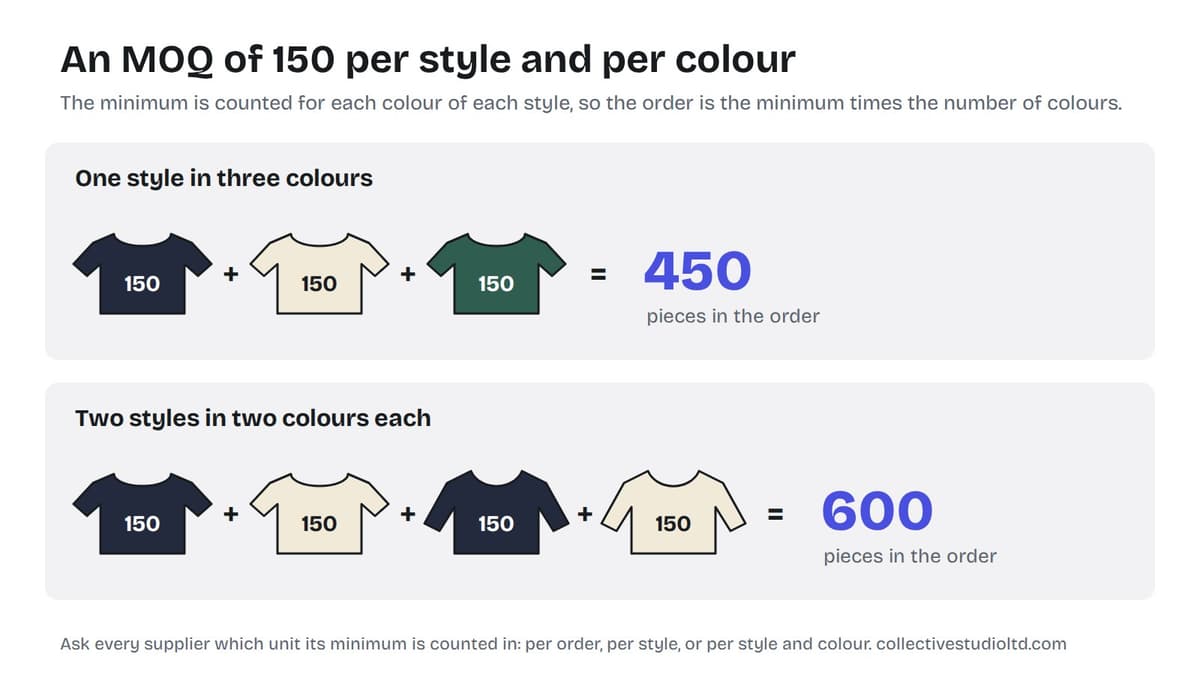
Collective Studio's minimum is 150 pieces per style and per colour. One style in one colour is 150 pieces, one style in two colours is 300, and two styles in two colours each is 600. Sizes do not add to the total, because there is no minimum per size. The MOQ calculator does the sum and suggests a size split.
A narrow range also teaches more: one product that sells tells you what your customer wants, while ten that sell unevenly tell you little. Our guide to starting a clothing brand with 150 pieces shows how one run splits across sizes.
How it will be made
Say which of three routes the brand uses. Print on demand prints each piece after a customer orders it: you hold no stock, but the garment is a catalogue blank. Blanks printed in a batch give you stock of a garment that already exists. Making to order with a factory gives you your own fabric, fit and sewn-in label, in return for a minimum committed before anything is sold. Our guide to print on demand versus manufacturing compares the three.
For the factory route, record four things from the factory's own written answers.
- The minimum, and what it is counted per: style, colour or order.
- What the factory works from: a tech pack, a sketch or a garment to match. Our guide explains what a tech pack is.
- Samples: allow for at least one round of changes, in time and in money. See how clothing sampling works.
- Lead time, how long the order takes: how long sampling and production take, what starts the clock, and whether freight is counted.
Collective Studio works to about 10 days of sampling, then 40 to 50 days of production after the sample is approved, plus freight, which comes to about 70 days from order to door by air. Our guide to how long it takes to manufacture clothing goes through each stage.
The numbers a founder must collect
Five numbers carry the plan. None should be an average found online: each has a source, and the table says who gives it to you.
| Number and what it is | Who gives it to you | Our tool or guide |
|---|---|---|
| Unit cost: the factory's price for one finished piece at your quantity | The factory's written quote on your own design | How to read a garment quote |
| Landed cost: the unit cost plus freight, insurance, customs clearance, duty, any import tax you cannot reclaim and delivery to you, plus labels and packaging if not in the quote | A freight forwarder for freight and clearance; the customs tariff of the country you import into for duty | Landed cost calculator |
| Selling price: retail, and wholesale if you sell to shops | Your landed cost, set against what your customer already pays | Pricing calculator; how to price your clothing products |
| Size of the first order: styles times colours times the minimum | Your product range and the factory's minimum | MOQ calculator |
| Cash needed before the first sale: samples, the order, labels, photographs, the shop and marketing | The factory's payment terms and the dates in your timeline | How much it costs to start a clothing brand |
Unit cost and landed cost. Ask for the quote at your real quantity, with the fabric and the delivery term named. Under FOB (free on board) the seller delivers the goods on board the vessel at the port of shipment, so freight, duty and import tax reach you later as separate bills. Under DDP (delivered duty paid) the seller delivers them to you cleared for import (GOV.UK: Incoterms). Collective Studio quotes DDP, which means duty, clearance and freight are handled and the goods arrive at the buyer's door. On any DDP quote, ask whether import VAT or GST is inside the price.
Selling price. Price from the landed cost, not from the factory's quote. State the break-even point, which the SBA defines as "the point at which total cost and total revenue are equal": for a first run, the number of pieces that must sell before the run has paid for itself.
The cash. Ask each factory, in writing, how much is paid before production starts and what the balance is paid against, then list every payment beside its date. business.gov.au describes a cash flow forecast as "an estimate of your future sales and costs", and that list is the start of one (business.gov.au: Set up a cash flow statement).
Sales channels
Write where each sale will happen and what that route asks of the first run. The SBA asks you to describe how you will attract and retain customers, and how a sale will actually happen.
- Your own online shop: no marketplace takes a share of the sale, and bringing every visitor is your own work.
- An online marketplace: the platform brings visitors, charges fees and sets its own rules on packaging.
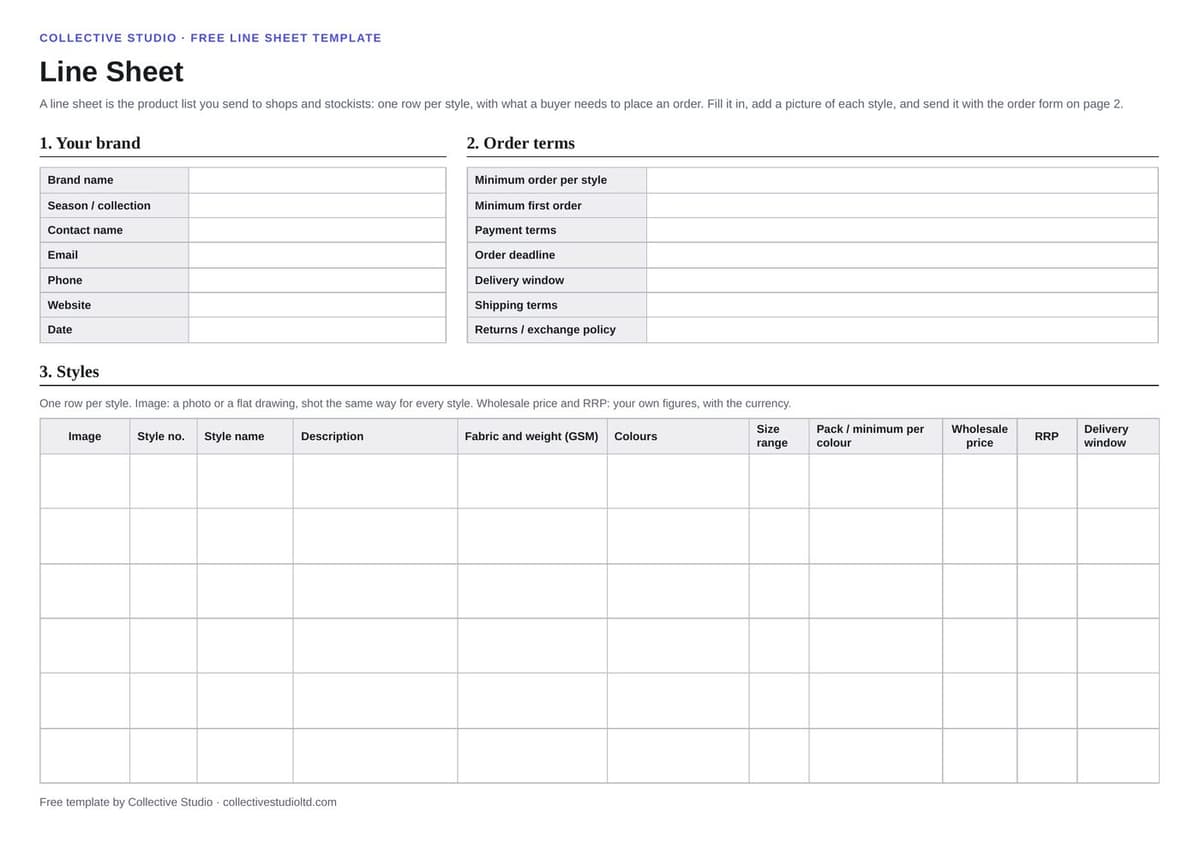
- Wholesale to shops: you need a wholesale price that still covers your landed cost, and a line sheet, the list of styles, colours and sizes a shop orders from. Our free line sheet template has the layout.
- Markets and pop-ups: you sell face to face, so a short range with depth in each size suits them.
Choose one route to start with, then write how the first customers will hear about the brand and what that costs.
The launch timeline, worked back from the launch date
Start from the day the range goes on sale and count back through freight, production, sample approval and sampling. The day you reach is the day the order must be confirmed.
Collective Studio ships by air in 5 to 7 days to the USA and the UK, 5 to 8 days to Europe and about 5 to 8 days to Australia, and by sea to Australia in about 4 to 6 weeks door to door. Before the freight come 40 to 50 days of production after the sample is approved, and before that about 10 days of sampling. The launch date calculator counts back through each stage.
Then add what a first plan tends to leave out: about 10 days for each extra sample round, and factory holidays. Bangladesh's garment factories close for both Eids, as our guide to lead times explains, so ask any factory for its holiday dates.
A worked example from our sewing floor
Take a first plan for one hoodie in one colour, sold from the founder's own online shop in the USA, and cut and sewn by Collective Studio on its sewing floor. Three rows of the one-page plan then read like this.
- The product range. One style in one colour, so the first order is 150 pieces, split across sizes as the founder chooses.
- The launch timeline. About 70 days from order to door by air, plus about 10 days held for a second sample round, is about 80 days, so the order is confirmed close to three months before launch day.
- The numbers. The quote is DDP, so duty, clearance and freight are inside the unit cost. The founder adds the samples, labels and packaging if they are not in the quote, the shop and marketing, and keeps cash back for a reorder.
The rules that apply where you sell
Rules are set by the country where the garment is sold, not the country where it is sewn. For each market, list what the label must say, which product safety rules apply, and what is paid and filed at import.
| Market | Our guides to its rules |
|---|---|
| UK | How to import clothing into the UK |
| Europe | How to import clothing into the EU; GPSR for clothing brands; REACH and restricted substances in clothing, which also covers UK REACH |
| USA | How to import clothing into the US; clothing regulations in the USA |
| Australia | How to import clothing into Australia |
| All four | Clothing labelling requirements by country; duty on clothing from Bangladesh by country; children's clothing safety rules by market |
Risks
List what could go wrong and, beside each risk, what you would do. business.gov.au says a plan helps you "identify and manage possible risks".
- The stock does not sell. Order the minimum for one or two styles, and test an uncertain design on print on demand first.
- The stock arrives late. Keep a buffer before launch day, and open pre-orders after the sample is approved, not before.
- The rules change. Duty rates and labelling rules are revised, so read the official source again before each order.
Mistakes a factory sees in first-time plans
Each of these is described in one of our guides.
- Too many styles and colours. Every style needs its own sample, pattern and minimum, and every colour multiplies the quantity again.
- No second sample round in the timeline. Each extra round adds about 10 days.
- A launch date set before the lead time is known. A date planned from the production time alone leaves out sampling, approvals and freight.
- A selling price set from the factory's quote. Labels, packaging and sampling sit between the quote and the landed cost, and under FOB so do freight, duty and import tax.
- No money left after the first run. Photographs, marketing and the reorder all need cash.
If you are having this made
Collective Studio makes knitwear for first-time brands from 150 pieces per style and per colour, delivered DDP. See manufacturing for startups and low-MOQ clothing manufacturing, or use the contact page to tell us what you are making, the quantity per style and your target launch date.
Frequently asked questions
How do I write a business plan for a clothing brand?
Write nine short sections: a summary, the brand and the customer, the product range, how it will be made, the numbers, sales channels, the launch timeline, the rules where you sell, and risks. Start with the product range and the making, because they set the size of the first order and most of the numbers. Collect each number from its source: the factory's quote, a freight forwarder, the customs tariff of the country you import into, and the fees of the place you sell. Count the launch date back from the day you want stock. Write the summary last.
What should a clothing line business plan include?
A clothing line business plan should include who the customer is, the styles and colours of the first run, who makes the clothes and at what minimum, the unit cost, landed cost and selling price, the cash needed before the first sale, where the clothes will be sold, a timeline counted back from launch day, the labelling and import rules of each country you sell in, and the risks. The U.S. Small Business Administration sets out the common sections of a traditional plan, from the executive summary to financial projections. A brand that has its clothes made adds the making, the timeline and the rules.
How many pieces should a new clothing brand order first?
A new clothing brand should order the factory's minimum for one or two styles in one or two colours, which is enough to test demand without tying up more cash than the brand can afford to lose. Collective Studio's minimum is 150 pieces per style and per colour, so one style in one colour is 150 pieces, one style in two colours is 300, and two styles in two colours each is 600. Sizes can be split freely inside each 150. Keep cash back for a reorder of whatever sells.
Do I need a business plan to work with a clothing manufacturer?
Not to ask Collective Studio for a quote. Collective Studio works from a tech pack, a sketch or a garment to match, and its enquiry form asks for five things: your name, your email, the country you ship to, the quantity per style and what you are making. A target launch date can be added. Those answers sit in the product range and timeline sections of a plan. A written plan is what a bank or an investor asks for: GOV.UK says you will need a business plan if you want to secure investment or a loan from a bank.
How long does it take to launch a clothing brand?
Collective Studio delivers a first order in about 70 days from order to door by air: about 10 days of sampling, then 40 to 50 days of production after the sample is approved, plus freight. Each extra sample round adds about 10 days. Before the order comes the time to settle the product, write a tech pack and choose a factory. The weeks of production are the time to photograph the approved sample and build the shop. A sound plan starts talking to factories about three months before the day stock is needed, and counts back from the launch date.
Can a clothing brand business plan fit on one page?
Yes. The U.S. Small Business Administration describes a lean startup plan as a chart of key elements that is typically one page, and says the format suits a business that is relatively simple or wants to start quickly. For a clothing brand, nine rows are enough: each names a section, the question it answers and where the answer comes from. A one-page plan works for a founder's own use and for a first talk with a factory. The SBA says lenders and investors commonly request the fuller, traditional format, which includes financial projections.
What is the difference between a clothing brand business plan and a clothing store business plan?
A clothing store business plan is about a shop: premises, staff, stock bought from suppliers and customers who walk in. A clothing brand business plan is about a product the brand has made: the range, the factory, the minimum order, the landed cost, the lead time and the import rules of each country it sells in. A brand may never have a shop of its own. If a template asks mainly about rent and opening hours, it was written for a store, and the product and making sections are likely to be missing.
Where this applies
The manufacturing pages this guide relates to, if you are costing a real run.
Free tools & guides for this
Sources & further reading
- U.S. Small Business Administration: Plan your business, sections "Write your business plan" and "Calculate your startup costs"
- GOV.UK: Write a business plan
- business.gov.au: Develop your business plan
- business.gov.au: Set up a cash flow statement
- GOV.UK (HM Revenue and Customs): Customs valuation, Incoterms (updated 14 April 2026)
Cite this guide
For journalists, writers, researchers and students.
Quoting this guide? Please credit Collective Studio and link to this page.
Reference
Homaira Jashim, Collective Studio. "Clothing Brand Business Plan: 9 Sections and a One-Page Plan." 25 November 2026. https://collectivestudioltd.com/journal/clothing-brand-business-plan
Writing about us? Our press kit has our facts, logos and photos, free to use with credit.
Have an idea? Let’s make it.
We manufacture from 150 pieces per style and colour, with organic cotton options from our GOTS-certified facility and photos at every stage. Send a sketch or a sentence — we’ll reply within one business day.