REACH and Restricted Substances in Clothing: Limits and Test Reports
REACH applies to clothing and textiles sold in the EU. Named substances, such as azo dyes that release certain amines, nickel in metal trims, formaldehyde and some PFAS, must stay under the limits in Annex XVII of Regulation (EC) No 1907/2006. A supplier must tell its customers when any part of a garment contains a substance of very high concern above 0.1% by weight. The duty sits with the importer in the EU, not with the factory outside it. There is no official REACH certificate: compliance is shown with laboratory test reports and suppliers' declarations.
Collective Studio Ltd is a family-run knitwear factory in Narayanganj, Bangladesh, that cuts and sews T-shirts, hoodies, joggers and activewear for brands in the UK, Europe, the USA and Australia, from 150 pieces per style and per colour, on its own sewing floor. Fabric is knitted and dyed at partner mills, and dyeing, printing and trims are where restricted substances can get into a garment. This guide is information, not legal advice. The drawing is our own. Use it in coursework or in a brief to any factory, with credit.
The short version
- Who answers for it: the importer established in the EU. A factory outside the EU has no direct duty, but it holds the facts.
- Main entries for a garment: azo dyes (entry 43, 30 mg/kg), the 33 substances and groups in Appendix 12, with formaldehyde at 75 mg/kg (entry 72), and nickel release from metal trims (entry 27).
- The 0.1% rule: above 0.1% by weight of a Candidate List substance in any article, the supplier must say so.
- Great Britain: UK REACH kept the restrictions in force at the end of 2020, not the later EU ones.
- Proof: test reports on your own fabric, prints and trims. OEKO-TEX and GOTS are voluntary standards, not the law.
What is REACH, and who is responsible?
REACH is Regulation (EC) No 1907/2006 on the Registration, Evaluation, Authorisation and Restriction of Chemicals, in force since 1 June 2007. For a garment made outside the EU, the responsible business is the importer: Article 3 defines an importer as a person established in the EU who is responsible for import, and says import is deemed to be placing on the market. The EU's Your Europe portal says companies established outside the EU or EEA have no obligations under REACH; the EU importer must comply.
A T-shirt is an "article" in REACH terms: an object whose shape, surface or design decides its function more than its chemical make-up does. Under Article 67, a substance in an article may not be placed on the market unless it meets any Annex XVII restriction that covers it. Write the limits and the evidence you need into the purchase order. If you sell through an EU distributor, settle in writing which of you is the importer.
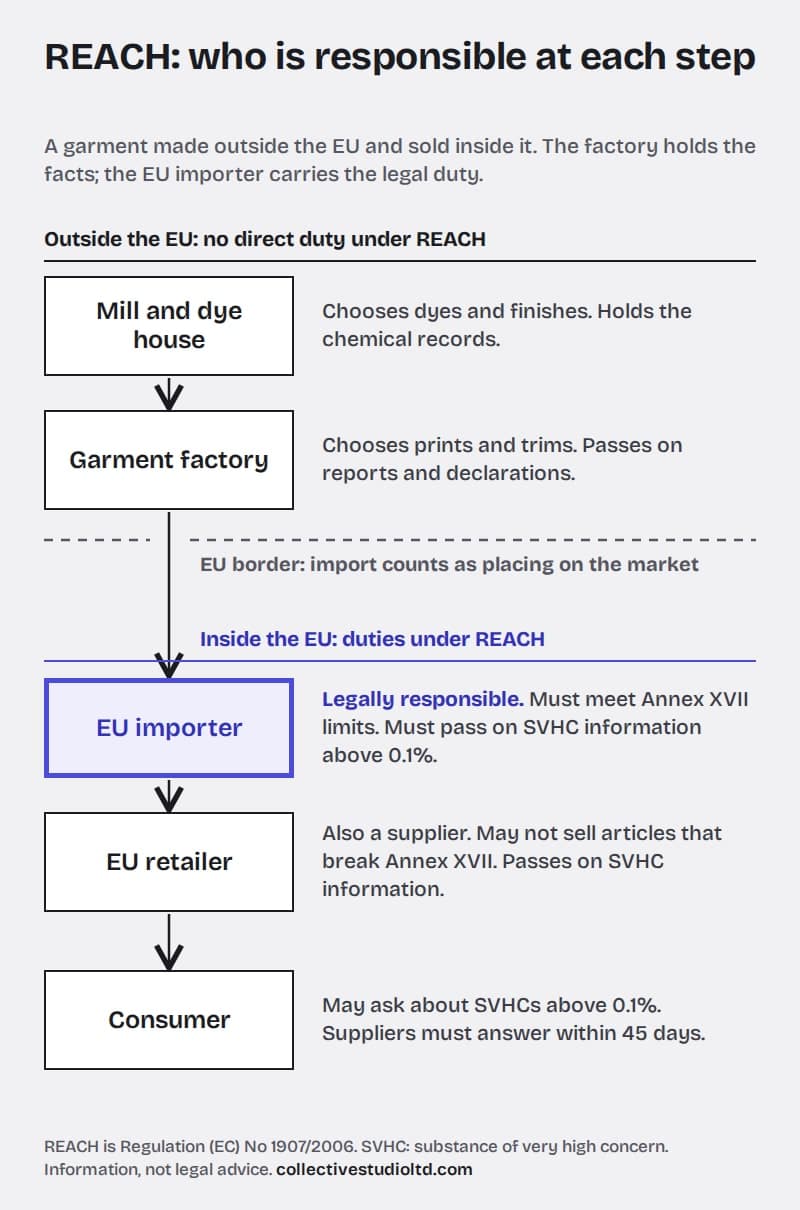
Which Annex XVII restrictions apply to clothing?
Annex XVII is the list of restrictions, each with an entry number. These entries reach an ordinary garment, its prints and its trims. mg/kg is the same as parts per million (ppm).
| Entry | Substance group | Limit | What it applies to |
|---|---|---|---|
| 43 | Azo dyes that can release any of the 22 aromatic amines in Appendix 8 | No listed amine above 30 mg/kg in the article or its dyed parts | Textile and leather articles in direct and prolonged contact with the skin or mouth, such as clothing, bedding, towels and gloves |
| 72 | The 33 substances and groups in Appendix 12, restricted as carcinogenic, mutagenic or toxic for reproduction (CMR) | Below the Appendix 12 value in each homogeneous material: formaldehyde 75 mg/kg; extractable cadmium, chromium VI, arsenic and lead 1 mg/kg each | Consumer clothing, related accessories, footwear and textiles with similar skin contact, placed on the market after 1 November 2020 |
| 27 | Nickel | Release no greater than 0.5 µg per cm² per week | Parts in direct and prolonged contact with the skin, such as rivet buttons, rivets and zips in garments |
| 63 | Lead | Below 0.05% by weight, or a lead release rate within the figure in the entry | Consumer articles, or accessible parts, that children may put in the mouth: those smaller than 5 cm in one dimension, or with a detachable or protruding part that small |
| 23 | Cadmium | Below 0.01% by weight of the plastic material | Articles made from the plastics the entry lists, which include PVC and polyurethane |
| 51 | Phthalates DEHP, DBP, BBP and DIBP | Below 0.1% by weight of the plasticised material, alone or combined | Articles placed on the market after 7 July 2020. Plasticised material includes PVC, coatings, printed designs and inks |
| 46a | Nonylphenol ethoxylates (NPE) | Below 0.01% by weight of the textile article or of each part | Textile articles expected to be washed in water, placed on the market after 3 February 2021 |
| 20 | Organotin compounds | No more than 0.1% by weight of tin, in the article or a part | Tri-substituted compounds such as TBT in any article; dioctyltin in consumer textile articles meant to touch the skin |
| 47 | Chromium VI | Below 3 mg/kg of the total dry weight of the leather | Leather articles and leather parts that come into contact with the skin |
| 68 and 79 | PFAS: C9 to C14 PFCAs (68) and PFHxA (79) | 68: below 25 ppb (acids and salts) and 260 ppb (related substances). 79: below 25 ppb (PFHxA and salts) and 1,000 ppb (related substances). See our EU PFAS guide | 68: articles, from 25 February 2023. 79: consumer clothing, accessories and footwear from 10 October 2026; other consumer textiles from 10 October 2027 |
| 77 | Formaldehyde released into the air | No more than 0.080 mg per m³ of air in a test chamber (0.062 for furniture and wood-based articles) | Articles placed on the market after 6 August 2026, except those to which entry 72 applies, so not clothing |
Entry 72 measures each homogeneous material on its own and exempts non-textile fasteners. The Commission's explanatory guide adds that prints and coatings on the textile surface are covered, while buttons, zips and rivets are not. Metal ones fall under entry 27. Any stricter restriction elsewhere in the Annex still applies.
By 23 November 2026 we had found three amending acts in the Official Journal later than the 22 June 2026 consolidation: Regulation (EU) 2026/2382 on defence exemptions, and Regulations (EU) 2026/2501 and 2026/2530, which add rules on lead in fishing tackle and gunshot to entry 63. None changes a limit above. Check for later amendments before relying on a figure.
What REACH limits apply to indoor textiles from 2026?
Two entries change. After 6 August 2026, entry 77 bars articles that release more than 0.080 mg of formaldehyde per cubic metre of air under the test conditions in Appendix 14. From 10 October 2027, the PFHxA limit in entry 79 extends from consumer clothing, accessories and footwear to other consumer textiles, home textiles included.
Entry 77 does not name the textiles it covers, so this is our reading, not an official statement. First, the entry covers articles in general. Second, it exempts "articles for which the restriction laid down in entry 72 applies", so clothing stays under the 75 mg/kg content limit. Third, the Commission's 2018 guide to entry 72 places bed linen and upholstery fabric inside that entry, and curtains and table linen outside it. So the second group appears to come under the emission limit, unless another exemption applies, such as the one for second-hand articles. The guide predates entry 77, so confirm the scope with a test house or your national REACH helpdesk.
Substances of very high concern and the 0.1% duty to inform
The Candidate List is the EU's list of substances of very high concern (SVHCs), kept by the European Chemicals Agency (ECHA). Being on it is not a ban. It creates a duty to inform. Under Article 33, any supplier of an article containing a listed substance above 0.1% weight by weight must give the recipient enough information to use it safely, at least the substance's name, and must give a consumer the same within 45 days of a request, free of charge. Substances are added, so work from ECHA's current list.
The Court of Justice ruled in 2015, in Case C-106/14, that this 0.1% threshold applies to each article built into a complex product, not to the whole product. So for the duty to inform, a zip or a button counts as an article of its own, measured against its own weight. The ruling concerns Candidate List substances; each Annex XVII entry states its own basis of measurement.
Does the UK still follow REACH?
Great Britain has its own version. The EU regulation was brought into UK law on 1 January 2021 as UK REACH, which applies to chemicals made in or imported into England, Scotland and Wales. Northern Ireland still follows EU REACH. Three differences matter for clothing:
- EU entries added after 2020 are not in it. The Health and Safety Executive (HSE) publishes a list of restrictions that runs from entry 1 to entry 74 and is read against the EU text as it was on 31 December 2020. Azo dyes (43), nickel (27), NPE (46a), chromium VI in leather (47) and the Appendix 12 substances in clothing (72) are in it with the same limits. The EU's formaldehyde emission limit (77) and PFHxA limit (79) are not.
- The importer may be you. HSE says a British downstream user under EU REACH may now be an importer under UK REACH.
- The UK keeps its own Candidate List. The EU list was carried over at the start, and the UK now adds substances through its own process. The duty to inform above 0.1% is the same.
How does the USA handle the same substances?
The USA has no single list like Annex XVII. The federal limits that reach a garment apply to children's products, made for children aged 12 or under. They may not contain more than 100 ppm of lead in an accessible part, and 16 CFR part 1303 bans children's articles that bear paint with more than 0.009% lead (90 ppm). The phthalates rule of the Consumer Product Safety Commission, 16 CFR part 1307, bars more than 0.1% of eight listed phthalates in children's toys and child care articles. Our children's clothing safety guide covers the testing.
State law adds more. California's Proposition 65 requires a business to warn people before knowingly exposing them to a chemical on the state's list. New York has barred the sale of new apparel with intentionally added PFAS since 1 January 2025. California has barred new textile articles that contain "regulated PFAS" since 1 January 2025, under Assembly Bill 1817. Read its thresholds in the statute.
How does Australia handle them?
We found no mandatory Australian standard that sets chemical limits for clothing in general. In October 2014 the Australian Competition and Consumer Commission (ACCC) published safety guidance giving concentrations "under which there are not current safety concerns". Its 2014 values are 30 mg/kg for each of the same 22 aromatic amines in clothing, textiles and leather in direct and prolonged skin contact, and for formaldehyde 30 mg/kg in infants' clothing, 100 mg/kg in garments that touch the skin and 300 mg/kg in other garments and fabrics. They are guidance values, not legal limits, and we found no later edition.
What is a test report, and when should you ask for one?
A test report is a laboratory's measurement of a named sample against a named method. It is not a certificate for the factory: it covers the sample tested and nothing else. A useful report names the fabric, colour and lot, the method, each result, the reporting limit and the date, and comes from a laboratory accredited to ISO/IEC 17025.
For azo dyes, Appendix 10 of REACH names the methods: EN ISO 14362-1:2017 and, for dyes that may release 4-aminoazobenzene, EN ISO 14362-3:2017. For formaldehyde in textiles, the Commission's guide lists EN ISO 14184-1, a water extraction method. Ask the laboratory which edition it works to.
- Bulk fabric: ask after dyeing and finishing, before cutting, with one report per colour.
- Prints and trims: each tested as its own sample.
- Changes: ask again when the dye house, the dye recipe, the ink or a trim supplier changes.
A worked example: a zip-up hoodie with a chest print, a garment Collective Studio cuts and sews on its own sewing floor. The table shows what a brand would ask any factory for, and why.
| Part of the hoodie | Entries that reach it | What a brand would ask for, and why |
|---|---|---|
| Dyed fleece and rib, each colour | 43, 72, 46a, 68 and 79 | A bulk-lot report for azo amines, formaldehyde, extractable heavy metals and NPE: each colour is its own dye lot |
| Chest print | 72 and 51 | A report on the print alone, phthalates included: entry 51 counts printed designs and inks |
| Metal zip and other metal trims | 27; 63 where a child could mouth the part | Nickel release, and lead content for small parts: entry 72 leaves out non-textile fasteners |
Is OEKO-TEX or GOTS the same as REACH compliance?
No. Both are voluntary standards, not law. OEKO-TEX says the criteria of STANDARD 100 take in Annexes XVII and XIV of REACH and the Candidate List, but its standard document also says the mark declares nothing about legal aspects such as product safety. A valid certificate is strong evidence, if it covers the article you sell and not just a fabric inside it. The legal duty stays with the importer.
GOTS calls itself a voluntary standard that does not intend to replace any country's legal requirements. GOTS 7.0 prohibits dyes that release carcinogenic arylamines, and sets residue limits tighter than the law: below 20 mg/kg for those amines against the legal 30, and below 16 mg/kg for formaldehyde against 75. See GOTS vs OEKO-TEX and what GOTS certification means.
What to ask your factory
- Which mill knits the fabric, and which dye house dyes and finishes it?
- Will you accept a purchase order clause that names REACH Annex XVII, and UK REACH for Great Britain?
- Can I have a test report on my bulk fabric in each colour, from a laboratory accredited to ISO/IEC 17025, and who arranges the test?
- Does any fabric, trim or finish contain a Candidate List substance above 0.1% by weight, or a water, oil or stain repellent finish?
- May I see any OEKO-TEX STANDARD 100 or GOTS certificate that covers the order?
Keep the answers in the technical file our GPSR guide describes, and write the limits into your tech pack. For labels, see labelling requirements by country.
If you are having clothing made
Ask any factory these questions before you order, us included. The answers should arrive as documents. Collective Studio makes organic cotton garments in its GOTS-certified facility (RSC 9687) and sends the certificate on request; our GOTS page explains what that covers. Tell us which markets you sell in when you send your brief.
Last verified: 23 November 2026. Limits and dates were read that day from the sources linked above.
Frequently asked questions
Does REACH apply to clothing?
Yes. REACH, Regulation (EC) No 1907/2006, treats a garment as an article, and a substance in an article may not be placed on the EU market unless it meets every Annex XVII restriction that covers it. For clothing the main ones are entry 43 on azo dyes that release listed amines, entry 72 on the substances listed in Appendix 12, formaldehyde among them, entry 27 on nickel release from metal trims, entry 46a on nonylphenol ethoxylates, and entries 68 and 79 on PFAS. A supplier must also tell its customers when any part contains a Candidate List substance above 0.1% by weight.
Who is responsible for REACH compliance, the brand or the factory?
The importer established in the EU is responsible, which is the brand if it is based there, or its EU distributor, not the factory. REACH defines an importer as a person established in the EU who is responsible for import, and it treats import as placing on the market. The EU's Your Europe portal says companies outside the EU or EEA have no obligations under REACH. The factory still matters, because it and its dye house hold the facts: which dyes, inks and trims were used. So the brand writes the limits into the purchase order and asks the factory for test reports and declarations.
Are azo dyes banned in clothing?
Not all of them. EU law bans azo dyes that can release any of 22 listed aromatic amines above 30 mg/kg, which is 0.003% by weight, in textile and leather articles that may stay in contact with the skin or mouth, such as clothing, bedding, towels and gloves. That is entry 43 of REACH Annex XVII, and HSE's list for UK REACH has the same limit. Azo dyes that do not release those amines remain legal. Laboratories check with EN ISO 14362-1 and EN ISO 14362-3, the methods named in the regulation. In Australia the ACCC's 2014 guidance uses the same 30 mg/kg figure, as guidance and not as law.
Does clothing need a REACH certificate?
No. REACH does not create a certificate or a mark for a garment, so there is no official REACH certificate to ask for. What a retailer or marketplace usually wants is evidence: a laboratory test report on your fabric, prints and trims against the Annex XVII limits, and a written declaration from the supplier about substances of very high concern above 0.1% by weight. A document titled REACH certificate is worth as much as the test results behind it, so ask which samples were tested, by which method, by which laboratory and when.
Does the UK still follow REACH?
Great Britain follows UK REACH, its own copy of the EU regulation, brought into UK law on 1 January 2021. Northern Ireland still follows EU REACH. The Health and Safety Executive's list of restrictions is read against the EU text as it was on 31 December 2020, so the limits for azo dyes, nickel, chromium VI in leather and the Appendix 12 substances in clothing are the same. EU restrictions added later, such as the PFHxA limit and the formaldehyde emission limit, are not in that list. The UK also keeps its own Candidate List, and now adds substances to it through its own process.
Is OEKO-TEX the same as REACH compliance?
No. OEKO-TEX STANDARD 100 is a voluntary label for textiles tested for harmful substances, and REACH is the law. OEKO-TEX says its criteria take in Annexes XVII and XIV of REACH and the Candidate List, so a valid certificate for the finished article is strong evidence for many of the legal limits. But its standard document says the mark declares nothing about legal aspects such as product safety, and a certificate for a fabric does not cover the print, the zip or the finished garment. The importer still carries the legal duty, and should keep the certificate with any extra test reports.
What REACH limits apply to indoor textiles from 2026?
Two limits change. Entry 77 bars articles placed on the market after 6 August 2026 that release more than 0.080 mg of formaldehyde per cubic metre of air in a test chamber. It exempts articles that entry 72 covers, so clothing stays under the 75 mg/kg content limit. The Commission's guide places bed linen inside entry 72 and curtains and table linen outside it, so on our reading those two come under the emission limit. Confirm that with a test house. From 10 October 2027 the PFHxA limit in entry 79, 25 ppb for PFHxA and its salts and 1,000 ppb for related substances, also covers other consumer textiles.
Where this applies
The manufacturing pages this guide relates to, if you are costing a real run.
Free tools & guides for this
Sources & further reading
- EUR-Lex: Regulation (EC) No 1907/2006 (REACH), consolidated text of 22 June 2026 (Articles 3, 33 and 67; Annex XVII entries 20, 23, 27, 43, 46a, 47, 51, 63, 68, 72, 77 and 79; Appendices 8, 10, 12 and 14)
- European Commission: Explanatory guide on the restriction on CMRs 1A and 1B in textiles and clothing, endorsed by CARACAL on 27 June 2018
- Your Europe (European Union): FAQs, Registering chemicals (REACH)
- Court of Justice of the European Union: Press release No 100/15, judgment in Case C-106/14 (2015)
- Health and Safety Executive: UK REACH explained
- Health and Safety Executive: Restrictions under UK REACH, with the list of restrictions
- ACCC Product Safety Australia: Safety guidance on concentrations of particular chemicals in certain consumer goods (2014)
- OEKO-TEX: STANDARD 100 standard document, edition 01.2026
Cite this guide
For journalists, writers, researchers and students.
Quoting this guide? Please credit Collective Studio and link to this page.
Reference
Homaira Jashim, Collective Studio. "REACH and Restricted Substances in Clothing: Limits and Test Reports." 23 November 2026. https://collectivestudioltd.com/journal/reach-and-restricted-substances-in-clothing
Writing about us? Our press kit has our facts, logos and photos, free to use with credit.
Have an idea? Let’s make it.
We manufacture from 150 pieces per style and colour, with organic cotton options from our GOTS-certified facility and photos at every stage. Send a sketch or a sentence — we’ll reply within one business day.