Clothing Manufacturers in Portugal vs Bangladesh: An Honest Guide for European Brands
If you are searching for clothing manufacturers in Portugal, you are probably a European or UK brand weighing a factory close to home against one further away. The short answer is this. Portugal is the better choice when your runs are under about 150 pieces per style and colour, when you sell inside the EU and want no customs border at all, or when you need to stand in the factory several times a season. Bangladesh is the better choice when you are making knitwear such as tees, hoodies and sweatshirts in runs of 150 pieces or more, reordering the same styles, or selling into the UK or Australia, where the duty rules favour it more than most founders expect.
A disclosure before anything else: Collective Studio is a factory in Bangladesh. We are a family-run knitwear floor in Narayanganj, so we have an obvious interest in which way you go. This guide therefore does not rank Portuguese makers we cannot vouch for. It reports what four of them publish about themselves, points you to the lists where others can be found, says plainly when Portugal is the better choice, and compares the two countries on distance, minimums, timing and duty. It does not compare unit cost, which only two quotes on the same tech pack can settle. Every fact was checked on 11 November 2026 against the sources listed at the end.
The short version
- Where the factories are: in the north. The Porto and Braga regions hold 82% of Portugal's textile companies, with knitwear and jersey concentrated around Barcelos and Guimarães.
- Minimums: makers that sell to new brands publish 50 to 150 pieces per style and colour for custom work. One agent in Portugal puts ordinary knitwear factories at 200 to 300.
- Timing: published production times run from 6 to 12 weeks, after 3 to 8 weeks of sampling. A truck then reaches Germany, France or the Netherlands in about 3 to 5 working days.
- Duty: none inside the EU. Into the UK it is 0% only when the fabric was also knitted in the EU or UK, and 12% on a cotton T-shirt when it was not. Into Australia it is 5%.
- From Bangladesh: 0% into the EU and the UK and Free into Australia when the garment is cut and sewn there, and about 70 days from order to your door by air.
- August: most Portuguese factories close for two to three weeks. Plan around it.
Where Portugal's clothing industry is
Portugal's textile and clothing industry is the fifth largest in Europe by revenue, according to the state investment agency AICEP, and it sits in one corner of the country. The north holds 84% of the sector's jobs. The Porto and Braga regions together, with Braga taken to include the Cávado and Ave valleys, held 82% of all textile companies and 85% of turnover in 2021. A Dutch financial daily that visited in 2024 described hundreds of mills within fifty kilometres of each other north of Porto, each with its own speciality.
Within that cluster the towns have reputations. Barcelos is the knitwear and jersey town, and three of the four makers quoted below give addresses in or beside it. Guimarães is the centre of home textiles and also has knit and jersey garment makers. Vila Nova de Famalicão calls itself Cidade Têxtil, the textile city, and is home to CITEVE, the industry's technology centre for testing and certification. Porto is where the sourcing agents and the clothing makers' association ANIVEC have their offices. The sector has about 12,000 companies, many of them small, and about 118,000 workers. It exported 5.5 billion euros of textiles and clothing in 2025, a little over half of it clothing.
What Portuguese factories are good at
Knitwear, above all. T-shirts and singlets are the country's largest export line at 15% of textile and clothing exports, and jerseys and pullovers add another 10%, on the Eurostat figures in AICEP's industry report. The same report describes the industry as recognised for product quality, innovation and short lead times, with skills along the whole chain from design to production. In practice a brand can often have fabric knitted, dyed, cut and sewn within a short drive, and that matters for the UK duty rule explained below.
Certification is a real strength. Portugal holds 4.8% of the world's 17,800 GOTS-certified facilities, the seventh largest share, in the standard's 2025 annual report. For comparison, Turkey holds 11.7% and Bangladesh 9.3%, so a certified supply chain can be found in all three. What a certificate covers depends on the scope of the individual facility, so ask for the certificate number and check it. One caution comes from inside the trade: the head of a Dutch sourcing platform told the same financial daily that producing clothing in the European Union does not automatically make it sustainable.
Minimums and lead times: what Portuguese makers publish
Few Portuguese factories publish a minimum at all. One Porto sourcing service says that of the 80 makers it has documented, only 8 state one. The makers that sell directly to new brands are the exception, and the table shows what four of them said on their own websites when we read them on 11 November 2026.
| Maker | Where | Published minimum | Published timing |
|---|---|---|---|
| ASBX | Barcelos | 50 to 100 pieces per style and colour for fully custom production | Not stated on its home page |
| Create Fashion Brand | Barcelos area | From 150 pieces per style and colour for custom development from scratch | Samples 4 to 6 weeks; production 8 to 10 weeks |
| Athleisure Basics | Porto | White label from 70 pieces per style and colour; custom manufacturing from 250 | White label 3 to 5 weeks; custom 6 to 10 weeks |
| White Cotton | Barcelos | 100 per style in one colourway, or 75 per colourway on two or more, for hoodies, sweatshirts, joggers and shorts; 150 or 100 for T-shirts | Samples usually 4 to 8 weeks; production usually 6 to 12 weeks from the deposit |
An agent's view is higher. Deepwear, which sources in Portugal for brands, describes knitwear factories as generally working at around 200 to 300 pieces per style or colour, and woven garments at 400 to 800, and calls those figures indicative. Read together, the picture is consistent: a handful of makers have built their business on small runs, and the wider industry starts higher. Our own minimum is 150 pieces per style and colour, which sits inside the Portuguese range, not below it. If your run is 50 or 75 pieces, Portugal has makers who publish that figure and we do not.
Getting it to you: a truck, and three different borders
Portugal's advantage is the road. The Portuguese forwarder Rangel schedules its groupage trucks at 3 working days to terminals in Germany, France, the Netherlands and the United Kingdom, and offers door-to-door delivery in 3 to 5 business days within Europe. Those are forecasts in working days, and for the UK customs clearance comes on top. What happens at the border depends on where you are.
If you are in the EU, there is no border in the customs sense: no customs duties are paid when goods are transported from one EU country to another. VAT is settled between the two businesses. A Portuguese maker selling to a business in another EU country does not charge VAT when the customer has a valid EU VAT number; the buyer declares the VAT at home, at its own country's rate, and can usually deduct it. This is the simplest import a clothing brand can make, and it is Portugal's strongest argument.
If you are in the UK, read the origin rule before you assume the same. The Trade and Cooperation Agreement gives a 0% tariff only to goods that meet its rules of origin, and for knitted garments the UK Trade Tariff states the rule as “knitting or crocheting combined with making-up including cutting of fabric”. Both steps have to happen in the EU or the UK. A T-shirt sewn in Portugal from fabric knitted in Portugal qualifies. The same T-shirt sewn in Portugal from fabric knitted in Asia or Turkey does not, and pays the UK's standard rate, which is 12% on a cotton T-shirt. To claim 0% you need a statement on origin made out by the exporter, or your own documented knowledge that the goods originate. Import VAT at 20% is due as well, and a VAT-registered importer can account for it on its VAT return.
If you are in Australia, clothing of Portuguese origin pays Australia's general rate, which is 5% on cotton T-shirts and cotton sweatshirts in the current Working Tariff. Australia and the EU concluded a free trade agreement on 24 March 2026, but it is not yet signed or in force. The Department of Foreign Affairs and Trade expects signature in late 2026 or early 2027, with parliamentary steps after that, so for now nothing changes at the border.
The same three borders from Bangladesh
The comparison surprises most founders, because distance and duty point in opposite directions. Bangladesh-made clothing enters the EU at 0% under the Everything But Arms arrangement, and Regulation (EU) 2026/1395 keeps that treatment for three years after Bangladesh leaves the United Nations' list of least developed countries. That date moved recently: on 29 October 2026 the UN General Assembly extended Bangladesh's preparatory period, and graduation is now scheduled for 24 November 2029. It enters the UK at 0% under the Developing Countries Trading Scheme. It enters Australia at the least developed country rate, which is Free, and the Australian government's country brief says products from Bangladesh will continue to enter duty-free and quota-free.
The origin rule is the part that matters. For Bangladesh, the test in the EU and the UK is that the garment is cut and sewn there, even where the fabric was imported. For Portugal into the UK, the fabric has to be knitted in the EU or UK as well. So a UK brand can pay 12% on a T-shirt sewn a short flight away and nothing on one sewn in Narayanganj. Australia asks more of Bangladesh: the last process of manufacture must happen there and the allowable factory cost must reach at least 50%. Our guide to duty on clothing from Bangladesh by country sets out each rule with its source. VAT or GST is due in every case, whatever the origin.
What you give up is time and closeness. A first order with us takes about 70 days from order to your door by air: about 10 days of sampling, 40 to 50 days of production after you approve the sample, then air freight of about five to eight days. Sea freight adds about a month. On paper that is closer to Portugal than the map suggests, because sampling and production take weeks in both countries. In practice a correction or a mid-season repeat is quicker when the factory is a short flight away and you can be in the room.
Portugal and Bangladesh side by side
| Portugal | Bangladesh, on our floor | |
|---|---|---|
| Published minimum | 50 to 150 per style and colour at makers who sell to new brands; 200 to 300 at ordinary knit factories, per one agent | 150 per style and colour |
| Sampling | 3 to 8 weeks, as published | About 10 days |
| Production | 6 to 12 weeks, as published | 40 to 50 days after sample approval |
| Transit to an EU address | About 3 to 5 working days by road | About 5 to 8 days by air; about a month more by sea |
| Duty into the EU | None: goods move freely inside the single market | 0% under Everything But Arms |
| Duty into the UK | 0% only if knitted and made up in the EU or UK; otherwise 12% on a cotton T-shirt | 0% under the Developing Countries Trading Scheme |
| Duty into Australia | 5% on cotton T-shirts and sweatshirts | Free at the least developed country rate |
| Visiting the factory | A short flight from most of Europe, on the same clock as the UK | A long-haul trip; live video from the floor and photos at every stage instead |
| Annual closure | Two to three weeks in August | The two Eid holidays, whose dates move each year |
| Origin label | Made in Portugal | Made in Bangladesh |
When Portugal is the better choice
- Your run is under 150 pieces per style and colour. Several Portuguese makers publish minimums of 50 to 100, and ours starts at 150.
- You sell only inside the EU. No customs entry, no origin paperwork and VAT handled on your own return is as simple as buying gets.
- You want to develop in person. Fittings at the factory, a visit when something goes wrong and a shared working day are worth a great deal on a first collection.
- A European origin is part of what you sell. If the label has to say Made in Portugal, only Portugal can do that.
- Your range is woven. Shirts, tailoring and denim are made in the same northern cluster. Ours is a knitwear floor.
When Bangladesh is the better choice
- You make knitwear in runs of 150 pieces or more per style and colour, and you expect to reorder the styles that sell.
- You are a UK brand and your fabric is not knitted in the EU or UK. The Portuguese garment then pays the standard rate and the Bangladeshi one pays 0%.
- You sell in Australia. Portuguese origin pays the 5% general rate today; Bangladeshi origin enters Free when the origin rule is met.
- You plan a season ahead. About 70 days by air suits a calendar that is set in advance better than one that reacts week by week.
- You want one quote to your door. We quote DDP, so freight, clearance and any duty are inside it.
On unit cost this guide says nothing, deliberately. Send the same tech pack to a Portuguese maker and to us, ask each for a landed quote to your door, and compare the two on paper. That is the only comparison that counts for your garment.
How to find and check a Portuguese maker
Start with the industry's own lists. ATP, the textile and clothing association, has a public member directory that can be filtered by activity, from spinning and knitting to making-up. AICEP, the state trade and investment agency, publishes a sector overview and an industry report in English. ANIVEC, the clothing makers' association in Porto, does not publish a member list. The sector's trade fair in Porto was called Modtissimo for 64 editions and was renamed MOD'Unica in 2025; no date for a next edition was published when we checked, so ask ATP instead of trusting an old listing.
Then check what you are told. Ask whether the company you are emailing owns the sewing floor or places your order with one. Porto has several sourcing agents, and they can be useful because most factories do not advertise, but an agent is a different relationship from a factory. Ask where the fabric is knitted, if you sell in the UK. Ask for the number of any certificate and look it up. Ask how long the company has traded: 2025 was a hard year for the industry, with two thirds of firms in one sector survey reporting lower turnover in the first half, so capacity is easier to find than it was, and a visit before you pay a deposit is worth the flight.
Timing: August, and the weeks around it
Two Porto agents and one factory's own website say the same thing. Most Portuguese garment factories close for two to three weeks in August, typically between weeks 32 and 35, and one Barcelos maker's site showed a factory holiday from 14 August to 9 September. For an autumn launch, that means your order has to be moving well before the summer. Bangladesh has its own version: factories close for both Eid holidays, whose dates move each year. Our guide to how long clothing manufacturing takes covers it.
Language, clocks and the working day
Portugal is easy to work with from northern Europe. English is widely spoken: the country ranks sixth in the world in the EF English Proficiency Index, though that is a national figure and not a measure of any one factory. Mainland Portugal keeps the same clock time as the UK and Ireland, one hour behind Germany, France and the Netherlands. Bangladesh is five or six hours ahead of the UK, depending on the season, so a morning in London overlaps with an afternoon in Narayanganj. We also keep an office in Amsterdam, so a European brand has a contact in its own time zone.
Where we fit, and where we do not
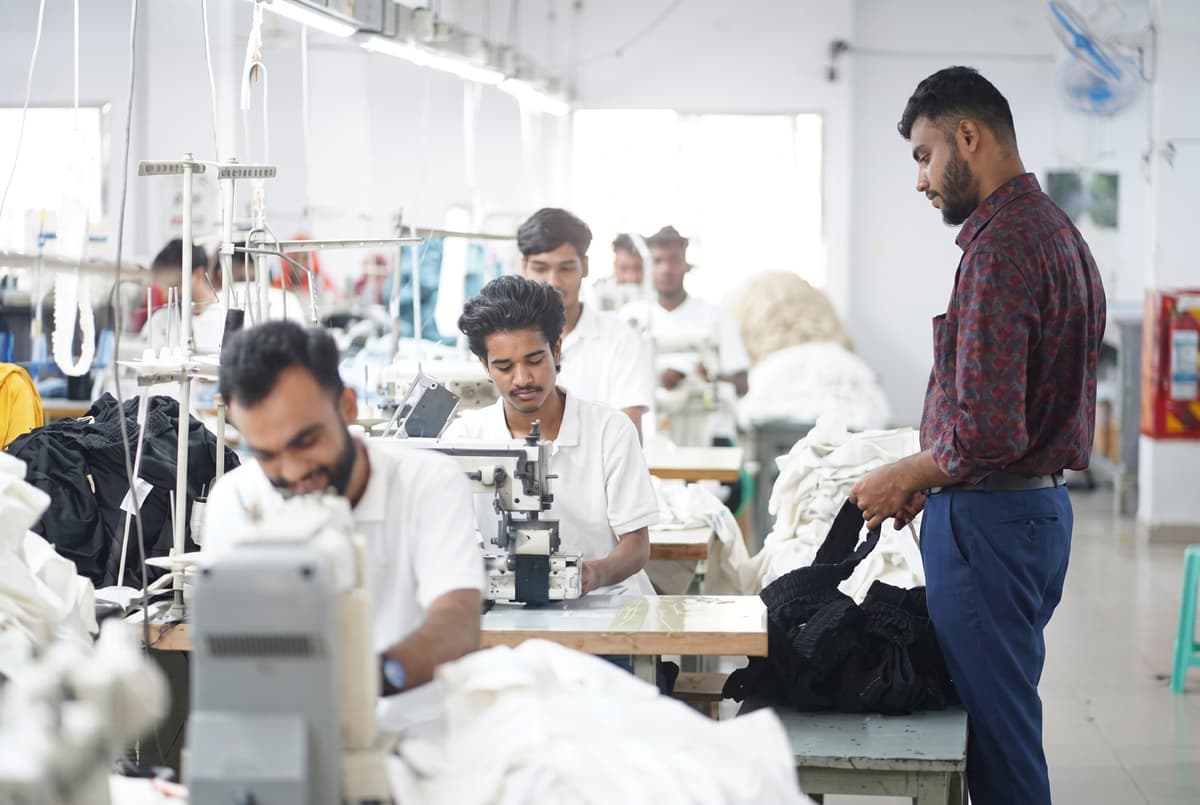
We cut, sew, finish and inspect knitwear in our own building in Narayanganj: T-shirts, hoodies, sweatshirts, joggers, polos and activewear. Fabric is knitted and dyed at partner mills we specify and inspect. Our minimum is 150 pieces per style and colour. Organic cotton is available, made in our GOTS-certified facility (RSC 9687). We quote DDP to any address in the EU, the UK or Australia. Our pages for European brands and UK brands work through the duty and VAT for each market.
And where we are the wrong choice: runs under 150 pieces, a range that has to carry a European origin label, woven shirts, denim or tailoring, or a product you need to fit in person every week. For those, start with the lists above. If you are not sure which side of the line you are on, send us your brief and we will tell you straight. If Turkey is also on your shortlist, our guide to clothing manufacturers in Turkey makes the same comparison there, and Bangladesh vs China vs Vietnam covers the Asian options.
What clients say
Best supplier! On time, reliable and perfect craft.
Nice supplier that is looking to develop new buyers and products.
Frequently asked questions
Are there low-minimum clothing manufacturers in Portugal?
Yes, and they say so on their own websites. When we read them on 11 November 2026, ASBX in Barcelos published 50 to 100 pieces per style and colour for fully custom production. White Cotton, also in Barcelos, published 100 pieces per style in one colourway, or 75 per colourway on two or more, for hoodies, sweatshirts, joggers and shorts, with higher figures for T-shirts. Athleisure Basics in Porto published 70 pieces per style and colour for its white label service and 250 for custom manufacturing. Create Fashion Brand published 150 per style and colour for development from scratch. These makers are the exception. Most Portuguese factories publish no minimum, and one agent puts ordinary knitwear factories at around 200 to 300 pieces per style or colour. Treat every published figure as a starting point and confirm it for your own garment, fabric and decoration before you plan a range around it.
Do I pay customs duty on clothing made in Portugal?
It depends on where you are. Inside the EU, no: no customs duties are paid when goods move from one EU country to another, and a business buyer with a valid EU VAT number accounts for the VAT in its own country. In the UK, the tariff is 0% only when the garment meets the rules of origin of the Trade and Cooperation Agreement, which for knitted garments means the fabric was knitted and the garment made up in the EU or the UK. If the fabric was knitted elsewhere, the standard rate applies, and that is 12% on a cotton T-shirt. Import VAT at 20% is due in both cases. In Australia, Portuguese-origin clothing pays the general rate, 5% on cotton T-shirts and sweatshirts, because the Australia and EU free trade agreement concluded in March 2026 is not yet in force. Check the current rate for your own commodity code before you order.
Is clothing made in Portugal duty-free in the UK?
Only when it meets the origin rule, and sewing in Portugal is not enough on its own. The UK Trade Tariff gives the rule for knitted garments under the Trade and Cooperation Agreement as knitting or crocheting combined with making-up, including cutting of fabric. Both the knitting of the fabric and the cutting and sewing of the garment have to take place in the EU or the UK. A hoodie sewn in Barcelos from fleece knitted in Portugal qualifies for 0%. The same hoodie sewn from fabric knitted in Asia or Turkey does not, and the UK's standard rate applies. To claim the 0% rate you need a statement on origin made out by the exporter on the invoice or another commercial document, or your own documented knowledge that the goods originate. Ask the maker in writing where the fabric is knitted before you place the order, and keep the answer with your import records.
How long does clothing production take in Portugal?
On the makers' own published figures, sampling takes 3 to 8 weeks and bulk production 6 to 12 weeks, so a first order usually runs three to five months from first sample to finished goods. White Cotton states samples usually 4 to 8 weeks from payment and production usually 6 to 12 weeks from the deposit. Create Fashion Brand states samples in 4 to 6 weeks and production in 8 to 10. Athleisure Basics states 6 to 10 weeks for custom production. Delivery is the quick part: a groupage truck is scheduled at about 3 working days to terminals in Germany, France and the Netherlands, or 3 to 5 business days door to door. Two things stretch the calendar. Most factories close for two to three weeks in August, and a second sample round adds weeks. For comparison, a first order with us takes about 70 days from order to your door by air.
Do Portuguese clothing factories close in August?
Yes, most of them do. Two production agents based in Porto describe a closure of two to three weeks every August, typically between weeks 32 and 35 of the year, when production floors empty for the annual summer holiday. One Barcelos factory's website showed a longer factory holiday, from 14 August to 9 September. We found no statement from the industry associations, so treat the dates as a pattern and ask each maker for its own. The practical effect is larger than the closure itself. Work slows in the weeks before it, and factories restart with a queue. If you are planning an autumn launch, have samples approved in spring and bulk in production by early summer, and ask the maker to confirm in writing what will be finished before it closes. Factories in Bangladesh close for the two Eid holidays instead, and their dates move each year.
How do I find a clothing manufacturer in Portugal?
Start with the trade association. ATP, the Portuguese textile and clothing association, has a public directory of member companies that you can filter by activity, including knitting, dyeing and making-up. AICEP, the state trade and investment agency, publishes a sector overview and an industry report in English that explain where each kind of producer is found. After that, the makers that sell to new brands are easy to find online, because they publish their minimums; most established factories do not advertise, which is why sourcing agents in Porto exist. Shortlist three to five makers that already produce garments like yours. Ask each for its minimum per style and colour, its sampling and production times, where the fabric is knitted, and its dates for August. Ask whether it owns the sewing floor. Visit before you pay a deposit, because being able to visit is the main reason to make in Portugal.
Portugal or Bangladesh: which is better for a small clothing brand?
Neither is better in general; each fits a different order. Portugal fits a brand that needs fewer than 150 pieces per style and colour, sells mainly inside the EU, wants to visit the factory, or needs the label to say Made in Portugal. Bangladesh fits a brand making knitwear in runs of 150 pieces or more, reordering proven styles, and planning a season ahead, because a first order takes about 70 days from order to door by air. Duty can decide it. Into the EU both are duty-free. Into the UK, Bangladesh-made clothing enters at 0%, while a Portuguese garment made from fabric knitted outside the EU or UK pays the standard rate. Into Australia, Bangladeshi origin enters Free and Portuguese origin pays 5%. Many brands use both over time: a near-home maker for small first runs, and an offshore factory once a style has earned a larger order.
Where this applies
The manufacturing pages this guide relates to, if you are costing a real run.
Free tools & guides for this
Sources & further reading
- AICEP Portugal Global: Textiles & Clothing Industry Report (2024), size, regions and export lines; read 11 November 2026
- ATP (Associação Têxtil e Vestuário de Portugal): sector figures for 2025; read 11 November 2026
- ATP: member company directory; read 11 November 2026
- RTP / Lusa: textile and clothing exports fell 0.8% to 5,499 million euros in 2025 (provisional INE data); read 11 November 2026
- Het Financieele Dagblad, 12 June 2024 (Portuguese translation hosted by AICEP): hundreds of mills within fifty kilometres; sustainability caution
- ANI: CITEVE technology centre, Vila Nova de Famalicão
- ECO, 28 February 2018: Famalicão Cidade Têxtil
- textile network, 15 September 2016: home textiles industry based in and around Guimarães
- Global Standard (GOTS): Annual Report 2025, share of certified facilities by country (page 8)
- ASBX: published minimum; read 11 November 2026
- Create Fashion Brand: FAQ, minimums and timing; read 11 November 2026
- Athleisure Basics: published minimums and timing; read 11 November 2026
- White Cotton: published minimums, timing and factory holiday notice; read 11 November 2026
- Deepwear: sourcing in Portugal, indicative minimums; read 11 November 2026
- Portugal Clothing Factory, 25 May 2026: production lead times and the August closure
- Portugal Clothing Factory, 26 January 2026: 80 documented makers, 8 publishing a minimum
- Franky Dune (Porto): the August factory closure
- Rangel Logistics Solutions: road transit times from Portugal; read 11 November 2026
- Rangel Logistics Solutions: door-to-door groupage in 3 to 5 business days in Europe; read 11 November 2026
- European Union: customs, no duties between member states; read 11 November 2026
- Your Europe: cross-border VAT between businesses in the EU (last checked 13 July 2026)
- GOV.UK: rules of origin and claiming duties when trading between the UK and EU
- UK Trade Tariff: commodity 6109 10 00 10, third country duty 12%, EU preference 0%, rule of origin for knitted garments; read 11 November 2026
- GOV.UK: claiming preferential rates of duty between the UK and EU (statement on origin, importer's knowledge)
- GOV.UK: VAT on imports, acquisitions and purchases from abroad (postponed VAT accounting)
- Australian Border Force: Working Tariff, Schedule 3, Chapter 61 (operative 1 July 2026)
- DFAT: Australia-European Union Free Trade Agreement, next steps (not yet signed or in force); read 11 November 2026
- Access2Markets: Everything But Arms
- EUR-Lex: Regulation (EU) 2026/1395
- GOV.UK: Developing Countries Trading Scheme
- United Nations LDC Portal: Bangladesh graduation status (scheduled for 24 November 2029); read 11 November 2026
- Federal Register of Legislation: Customs Tariff Act 1995
- DFAT: Bangladesh country brief (duty-free, quota-free access continues); read 11 November 2026
- Business & Human Rights Resource Centre, 10 September 2025: sector survey, first half of 2025
- AICEP, 28 January 2025: Modtissimo renamed MOD'Unica
- EF English Proficiency Index: Portugal
Cite this guide
For journalists, writers, researchers and students.
Quoting this guide? Please credit Collective Studio and link to this page.
Reference
Homaira Jashim, Collective Studio. "Clothing Manufacturers in Portugal vs Bangladesh: An Honest Guide for European Brands." 11 November 2026. https://collectivestudioltd.com/journal/clothing-manufacturers-portugal-vs-bangladesh
Writing about us? Our press kit has our facts, logos and photos, free to use with credit.
Have an idea? Let’s make it.
We manufacture from 150 pieces per style and colour, with organic cotton options from our GOTS-certified facility and photos at every stage. Send a sketch or a sentence — we’ll reply within one business day.
Related guides
Private Label vs White Label vs OEM: Clothing Manufacturing Explained
Read the guide →
How Much Does It Cost to Manufacture Clothing?
Read the guide →