Free Line Sheet Template for Clothing Brands
A clean line sheet template in two formats: a two-page PDF to print, or an Excel file to type straight into, with a worked example and an order form for your buyer. Free to download, no email required, and yours to send to any shop.
A line sheet is the document a shop orders from. It puts your whole range on one or two pages, with what a buyer needs to write an order: what each style is, what it is made of, its colours and sizes, what it costs, how many they must take and when it arrives.
Most free line sheet templates come from design tools or wholesale platforms. This one comes from a family-run knitwear factory in Narayanganj, Bangladesh. We do not sell to shops, but the minimums, size ranges and delivery dates on a line sheet start on a production floor like ours. So the guide below covers what most templates leave out: where those numbers come from.
What is a line sheet?
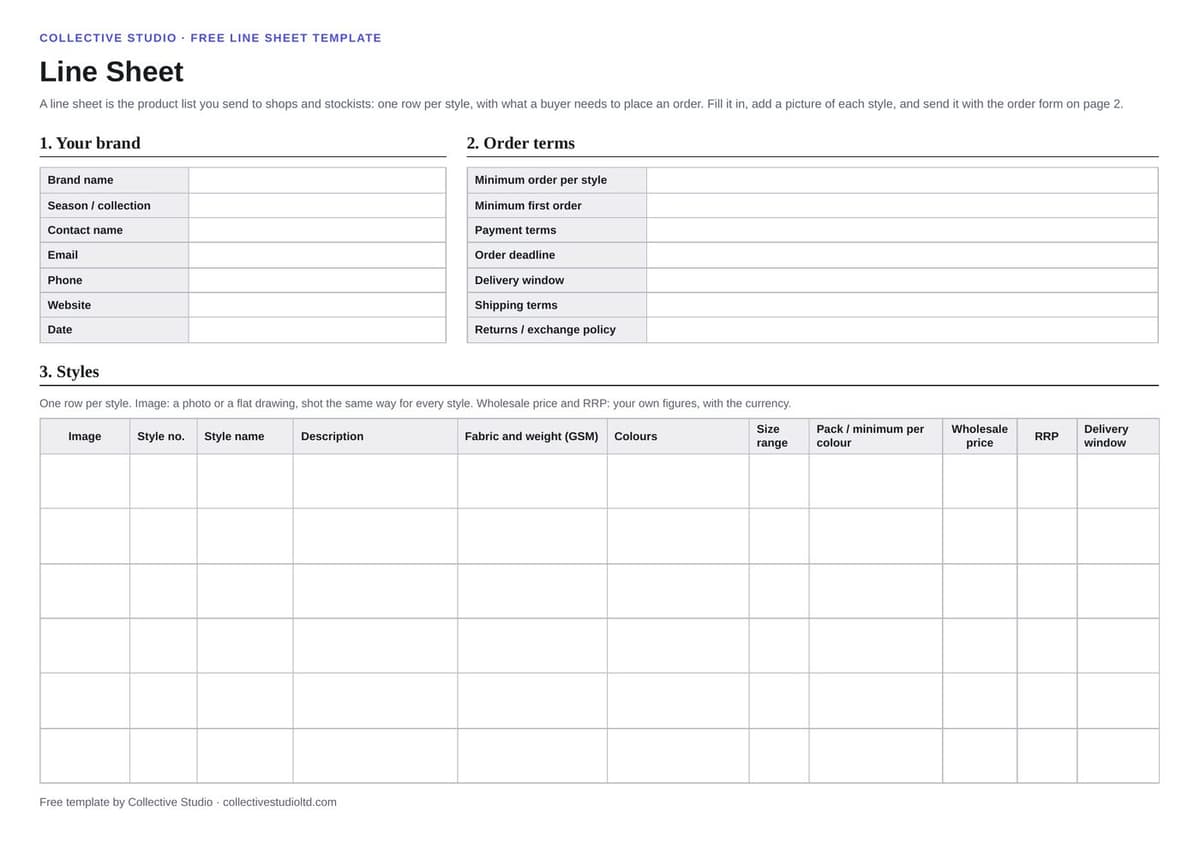
A line sheet is a one- or two-page list of the styles a clothing brand is offering to shops for a season or a drop. Each style gets a picture, a style number, its colours, sizes and fabric, a wholesale price, a recommended retail price, a minimum order and a delivery window, followed by the brand’s order terms and contact details.
It is read by people who buy for a living: shop buyers, stockists, sales agents and showrooms. They compare many brands in one sitting, so they read it like a table, not a story.
What the template looks like
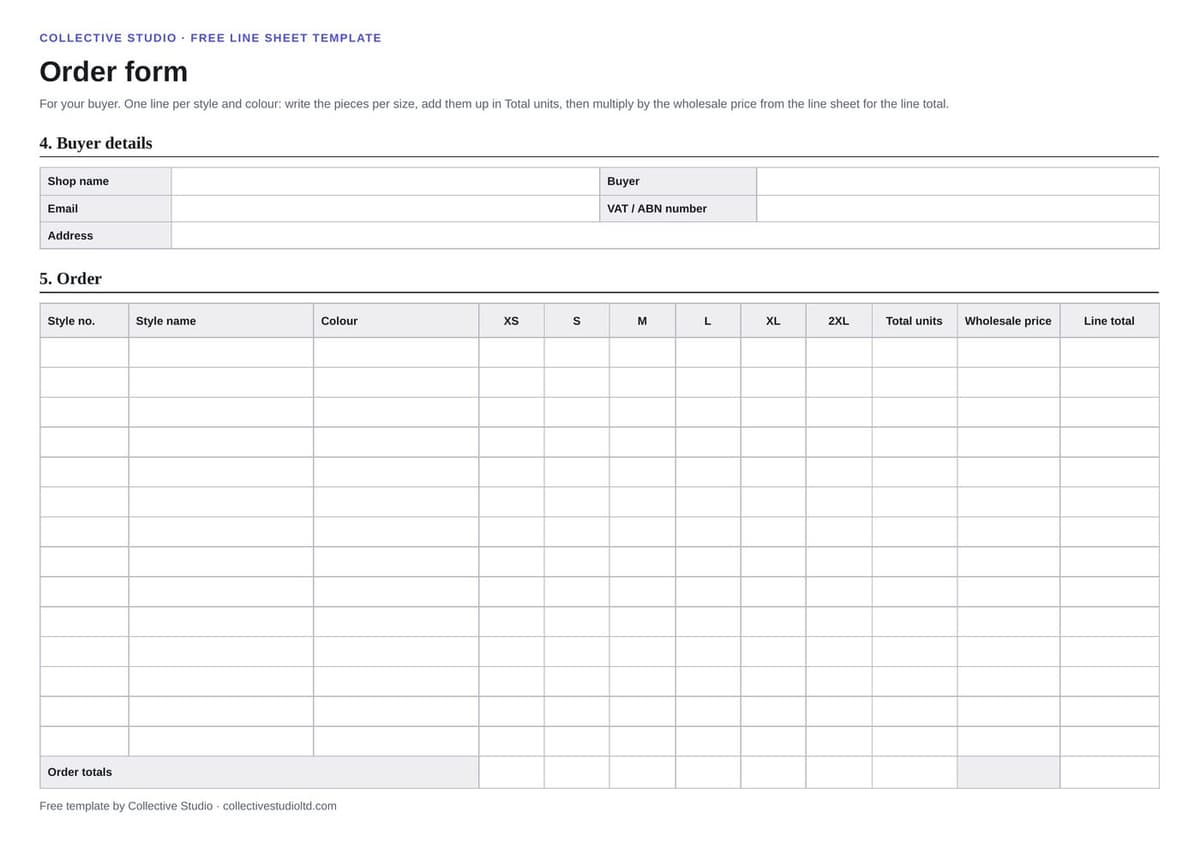
Two A4 landscape pages, shown here in full. Page one is the line sheet. Page two is the order form your buyer fills in and sends back.
The Excel version, with a worked example
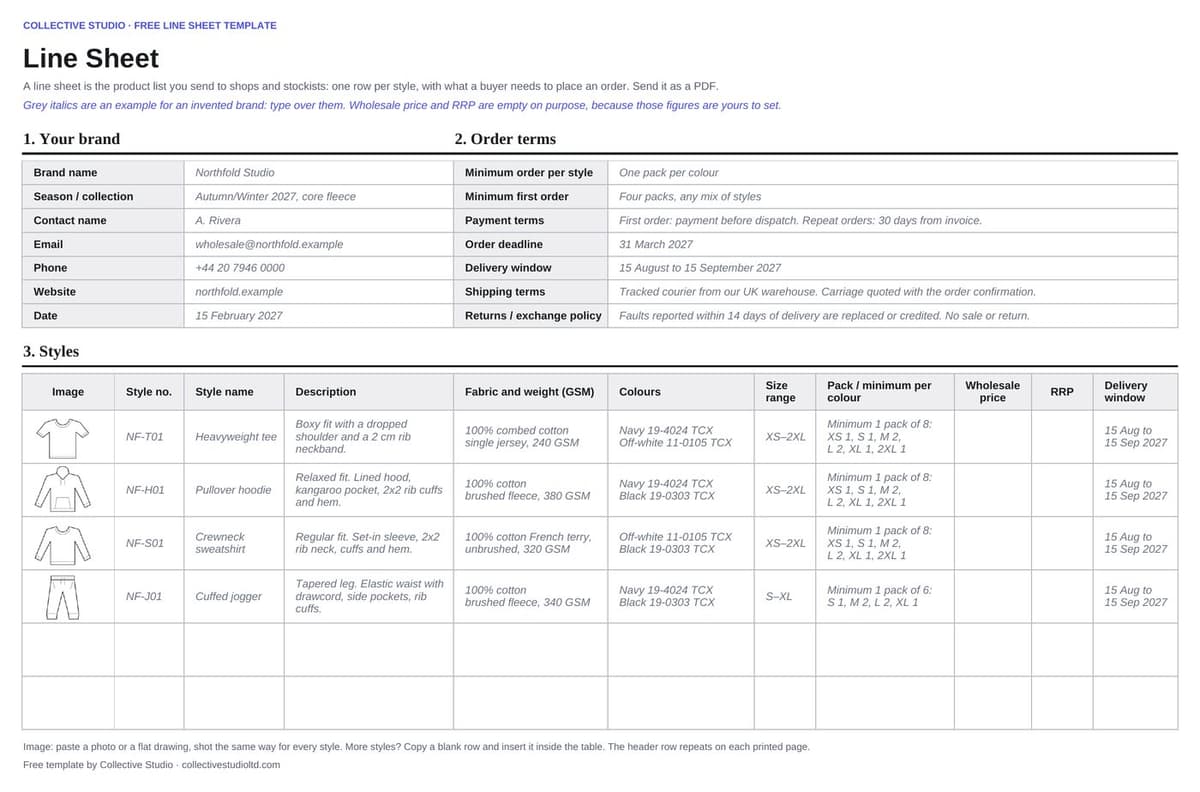
The Excel file holds the same two pages as two sheets. The first, Line sheet, comes filled in with an example in grey italics: an invented brand, Northfold Studio, with four knitwear styles. They are a heavyweight tee in 240 GSM combed cotton jersey, a pullover hoodie in 380 GSM brushed fleece, a crewneck sweatshirt in 320 GSM French terry and a cuffed jogger in 340 GSM brushed fleece. Type over it with your own range.
The second sheet, Order form, does the arithmetic. Your buyer types the pieces per size, and the sheet adds up the units for each line and for the whole order. Type a wholesale price beside a line and the line total and order total appear. Until then those cells stay empty.
What goes on a line sheet
The template has five numbered sections: 1 to 3 are the line sheet, 4 and 5 the order form. Here is each field and why a buyer needs it.
Sections 1 and 2: your brand and order terms
- Brand, season, date
- Buyers file line sheets by brand and season. The date shows which version is current.
- Contact details
- One named person, with an email, a phone number and your website, for the questions that hold up an order.
- Minimum order per style
- The fewest pieces of one style a shop can take, often one pack per colour.
- Minimum first order
- The smallest opening order you accept across the whole range.
- Payment terms
- When you expect to be paid: before dispatch, on delivery, or a set number of days after the invoice.
- Order deadline
- The last day you take orders for this delivery. Your own production order depends on it.
- Delivery window
- The dates between which the goods reach the shop. Buyers plan their shop floor around it.
- Shipping terms
- Where the goods ship from, who arranges delivery to the shop and who pays for it.
- Returns / exchange policy
- What happens with a faulty piece, and whether unsold stock can come back. Say it plainly, even if the answer is no.
Section 3: one row per style
- Image
- One clear picture, a photo or a flat drawing, at the same angle and on the same background in every row.
- Style no. and style name
- The number goes on the order, the invoice and the carton. Use the same one as in your tech pack.
- Description
- One line on the fit and the details a picture does not show, such as a lined hood.
- Fabric and weight (GSM)
- Composition and weight, for example 100% combed cotton jersey at 240 GSM. Buyers judge quality and season by it.
- Colours
- Each colour by name with a Pantone code or a swatch. A name alone means a different shade to every reader.
- Size range
- The smallest and largest size you offer, for example XS to 2XL, with a link to your size chart.
- Pack / minimum per colour
- Loose pieces, or a fixed pack with a set number of each size, and the fewest a shop can order in one colour.
- Wholesale price
- What the shop pays you for one piece. State the currency and whether tax is included.
- RRP
- The recommended retail price, so a buyer can see what the shop earns on each piece. It is a suggestion: each shop sets its own shelf price.
- Delivery window
- Only needed when styles ship at different times. Otherwise repeat the window from your order terms.
Sections 4 and 5: the order form
- Buyer details
- Shop name, buyer, address, email and tax number (VAT in the UK and Europe, ABN in Australia), for your invoice.
- Order lines
- One line per style and colour, a column for each size from XS to 2XL, then total units, wholesale price and line total.
Line sheet vs lookbook vs catalogue
The three get mixed up because they often travel in the same email. They do different jobs.
| Document | Length | Prices | What it is for |
|---|---|---|---|
| Line sheet | 1–2 pages | Wholesale, RRP | Ordering. Every style in a row with its fabric, colours, sizes, minimums and delivery dates. |
| Lookbook | A few pages | Usually none | Wanting. Styled photos that show how the range looks worn and who it is for. |
| Catalogue | Many pages | Often listed | Reference. The full range in depth, with several pictures and longer descriptions for each style. |
A tech pack is a different document again. It tells a factory how to make one style, and a buyer never sees it.
Where the numbers on a line sheet come from
We are a factory, so we see the other half of this document. Four things on a line sheet are fixed on the production floor before a buyer reads them: the minimum per colour, the size range, the delivery window and the fabric details. If the line sheet and the production order disagree, you have promised a shop something you cannot deliver.
Minimums and packs
Our minimum is 150 pieces per style and colour. Your stockist minimums and pack sizes have to add up to that. If you sell a colour in packs of six, you need orders for 25 packs of it, across all your shops, to fill one production run. Packs of eight need 19. Each extra colour is another 150. Our MOQ calculator works out the run and a size split you can turn into a pack.
Order deadline and delivery window
Sampling takes about 10 days, and production takes 40 to 50 days after you approve the sample. By air, that comes to about 70 days from your order to your door. Sea freight adds about a month. The order deadline on your line sheet has to sit at least that far ahead of the delivery window. Then add your own margin: selling time before the deadline, so buyers have a few weeks to decide, and time after the goods land to check them and send each shop its order. In our example the deadline is 31 March and delivery opens on 15 August, which leaves room for either kind of freight. The launch date calculator counts back from any delivery date to the day your order must be placed.
Size range and fabric details
List the size range you graded and ordered, and no wider. A size added later means new patterns and more pieces. Copy the fabric line from your tech pack word for word: composition and weight in GSM. If the tech pack says 380 GSM brushed fleece and the line sheet says heavyweight fleece, the buyer can no longer compare. Use the same style numbers in both documents.
Why the price columns are empty
The wholesale price and RRP columns are left empty in our example. Pricing is each brand’s own decision, and it rests on costs and a market only you know. What we can say is which cost to start from. We ship DDP: one landed price that includes duty, clearance and freight. That landed cost per piece is the base of your wholesale price. Our pricing calculator and our guide on how to price your clothing products take you through the working.
This is the floor those numbers come from. Co-founder Homaira Jashim walks it in the first video, and the second shows the last step before a delivery window can be met: finished pieces folded, bagged and packed.
Six mistakes buyers notice
Each of these makes a buyer stop and email you, or move on to the next brand.
No order deadline
Without a date, a buyer has no reason to order now, and you have no fixed day to place your own production order. Give one date: the one your factory order depends on.
Sizes listed without a size chart
S to XL means little until a buyer knows your measurements. Link to your size chart beside the size range, or attach it as an extra page.
Colour names without a swatch or a code
Sage, stone and navy are different colours to every reader. Put a swatch or a Pantone reference beside each name, the same one as in your tech pack.
No minimums
If the minimum per style and the minimum first order are missing, a buyer has to email to ask, and many will not. State both, even when they are low.
Images that differ in angle or lighting
A model shot, then a flat lay, then a drawing, each in a different light, makes a range look unfinished. Show every style the same way. Plain flat drawings are fine if every row uses them.
A PDF too heavy to email
Line sheets get forwarded. A file too large for an inbox, or slow to open on a phone, often stays unopened. Compress the pictures before you export, and keep to one or two pages.
How to use it
- Download the PDF to print and fill in by hand, or the Excel file to type straight into the cells.
- Fill in your brand and order terms first, then one row per style. Copy the style numbers, fabrics and colours from your tech pack.
- Add your own wholesale price and RRP, with the currency, and check the order deadline against your production dates.
- Save it as a PDF with your brand and season in the file name, and send it together with the order form.
Using the template in Google Sheets
No Excel? The same file works in Google Sheets. Download the Excel version, open Google Drive, choose New, then File upload, and pick the file. Open it with Google Sheets, then choose File and “Save as Google Sheets” so your changes are kept. Both sheets arrive as cells you can type over, and the totals on the order form keep working. Check the column widths and the four example drawings afterwards, since pictures can shift. To send it to a buyer, use File, Download, and pick PDF.
Related guides and tools
The free tech pack template is where a line sheet’s style numbers, fabrics and colours come from. Our guide on how to build a size chart covers the chart your size range should link to. If you are still planning the range, start with how to start a clothing brand. And if you already sell to shops, our wholesale clothing manufacturer page explains how bulk runs work with us. Once shops have ordered, the next document is your own order to the factory: our free purchase order template for clothing.
What clients say
Nice supplier that is looking to develop new buyers and products.
Best supplier! On time, reliable and perfect craft.
Frequently asked questions
What is a line sheet?
A line sheet is the document a clothing brand sends to shops so that they can order. It lists every style in a season or a drop on one or two pages. Each row has a picture, a style number and name, the fabric and its weight, the colours, the size range, the wholesale price, the recommended retail price, the minimum order and the delivery window. The brand's order terms and contact details sit above or below the rows: the minimum first order, payment terms, the order deadline, shipping and returns. It is written for people who buy for a living, such as shop buyers, stockists, sales agents and showrooms, so it is plain and factual, with no styling and no brand story. Its job is to let a buyer fill in an order form without asking you a single question. It is also written as one word, linesheet.
Is this line sheet template free?
Yes. Click either download button and the file saves straight away, as a PDF or an Excel workbook, with no email address, no sign-up and no account. Use it for as many seasons as you like, add your logo, and send the finished line sheet to any shop. You do not have to make your clothes with us to use it. Each page ends with a small credit line, which you can delete. We publish it for a practical reason. We are a knitwear factory, and a brand needs a line sheet as soon as its samples are approved. The minimums, size ranges and delivery dates on it come straight from production, and we would rather those numbers were worked out properly before they are promised to a shop. If you are earlier in the process, our free tech pack template is the document to start with.
What should a line sheet include?
Three blocks. First, your details: brand name, season or collection, a named contact with an email and a phone number, your website and the date of this version. Second, your order terms: the minimum order per style, the minimum first order, payment terms, the order deadline, the delivery window, shipping terms and your returns or exchange policy. Third, one row per style: a picture, the style number, the style name, a one-line description, fabric composition and weight in GSM, colours with a swatch or a Pantone reference, the size range, the pack or minimum per colour, the wholesale price, the recommended retail price and the delivery window. Add a link to your size chart, and send an order form with it so the buyer can write quantities per size. Leave out anything that does not help a buyer order. Brand story, long descriptions and mood photos belong in a lookbook.
What is the difference between a line sheet and a lookbook?
A lookbook makes a buyer want the range, and a line sheet lets them order it. The lookbook is the visual one: styled photographs on models that show how the clothes look worn and who they are for. It carries little text and usually no prices. The line sheet is the working document behind it: every style in a row, with style numbers, fabric, colours, sizes, wholesale and retail prices, minimums and delivery dates. A buyer looks through the lookbook to decide whether your brand suits their shop, then opens the line sheet to decide what to order and how many. Small brands often send the two together as separate PDFs. If you only have time for one, make the line sheet. A buyer can order from a line sheet with plain pictures, but not from a lookbook with no style numbers.
How many styles should one line sheet show?
Everything you are selling for that delivery, at about six styles to a page. Our PDF fits six rows on an A4 landscape page, with room for a picture in each. The Excel version lets you add rows and repeats the header on every printed page. For a first range of four to eight styles, that comes to one or two pages. If you have many more styles than that, split them into one line sheet per category or per delivery, each with its own order deadline, instead of one long file. Show each style once and list its colours inside the row. The order form is where each colour gets a line of its own. A short line sheet is also easier to produce. Our minimum is 150 pieces per style and colour, so every style and every colour you add is another run that your shop orders have to fill.
Should prices be on a line sheet?
Yes. The wholesale price and the recommended retail price both belong on a line sheet, beside each style. They are among the first things a buyer looks for, because the gap between the two is what the shop earns. Without prices a buyer cannot write an order, and has to email you before anything else can happen. State the currency and say whether tax is included. The price columns in our template are empty, in the worked example too. That is on purpose. The figures are yours to set. They depend on your costs and your market, and a factory should not guess them for you. What we can tell you is where to start, which is your landed cost per piece. Our pricing calculator and our guide to pricing clothing products show how to work from that cost to a wholesale and a retail price.
Can I use the template in Google Sheets or Canva?
Yes to both, in different ways. Google Sheets opens the Excel file directly. Upload it to Google Drive, open it with Google Sheets, then choose File and Save as Google Sheets. Both sheets arrive as ordinary cells, the grey example values can be typed over, and the totals on the order form keep working. Check the column widths and the four example drawings afterwards, because pictures can shift between programs. Canva is a design tool, not a spreadsheet, so use it for the look. Import the PDF into Canva and place your photos and text on top of it. Leave the order form in a spreadsheet, because a design tool will not add up quantities. Whichever tool you use, export the finished line sheet as a PDF. It opens the same way on any phone or computer, and nobody can change a number in it by accident.
When should I send a line sheet to stockists?
Count back from the day the goods should be in the shop. Production with us takes 40 to 50 days after sample approval, and by air it is about 70 days from your order to your door. Sea freight adds about a month. So the order deadline you give shops needs to sit at least that far ahead of the delivery window, plus a week or two for you to check the goods and send them on. Then give buyers time to decide: send the line sheet a few weeks before the order deadline, not a few days. Put together, a line sheet usually goes out four to six months before the delivery window. In our example it is dated 15 February, orders close on 31 March and delivery starts on 15 August. Send it only once your samples are approved. Our launch date calculator works out the dates for your own delivery window.
Download the template (PDF)Download the Excel version (.xlsx)Send us your idea
Collective Studio is up and coming. Very hard working people who want to please their customers and grow partnerships together. Homaira is very knowledgeable in the knit industry and always willing to learn more. We are looking to grow our business with them.