Free Purchase Order Template for Clothing Brands
A purchase order template made for a clothing order, in two formats: a two-page PDF to print, or an Excel file to type into, with a quantity grid by colour and size that adds itself up. Free to download, no email required, and yours to send to any factory.
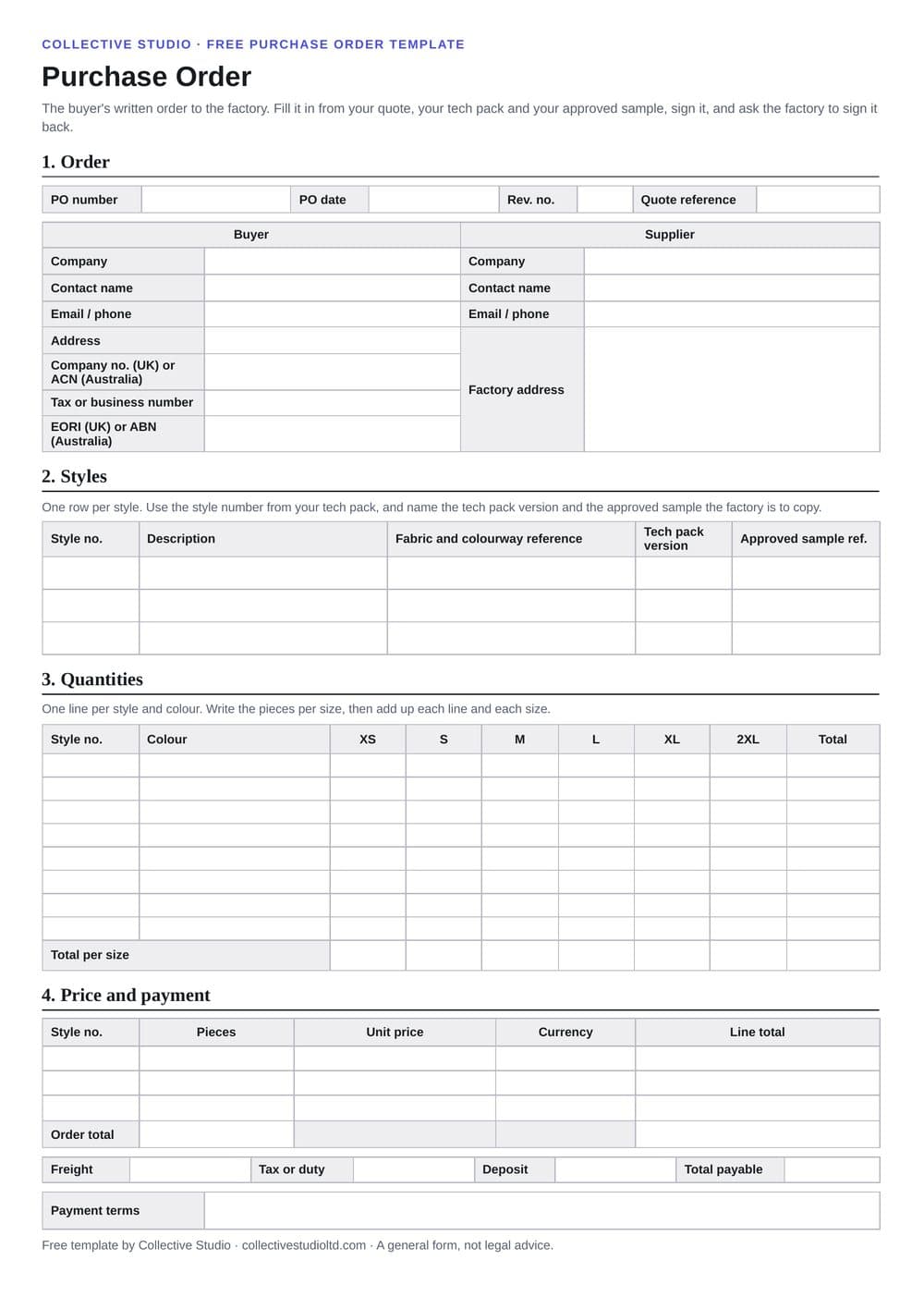
A purchase order is the buyer’s written order to a factory. It says what to make, how many of each size and colour, at what price, by when and on what delivery terms. This template is built for that one job: a style number on every line, a quantity grid, factory delivery terms, and the quality, labelling and shipping instructions a garment order needs.
We read the general purchase order templates that come up for this search on 14 November 2026. They are built around one line per item with one quantity. In the ones whose fields we could read, we found no quantity grid by size and colour, no quantity tolerance, no ex-factory date and no place for packing or inspection terms. We are a family-run knitwear factory in Narayanganj, Bangladesh, and a factory needs those boxes filled before it can plan an order.
What is inside the template
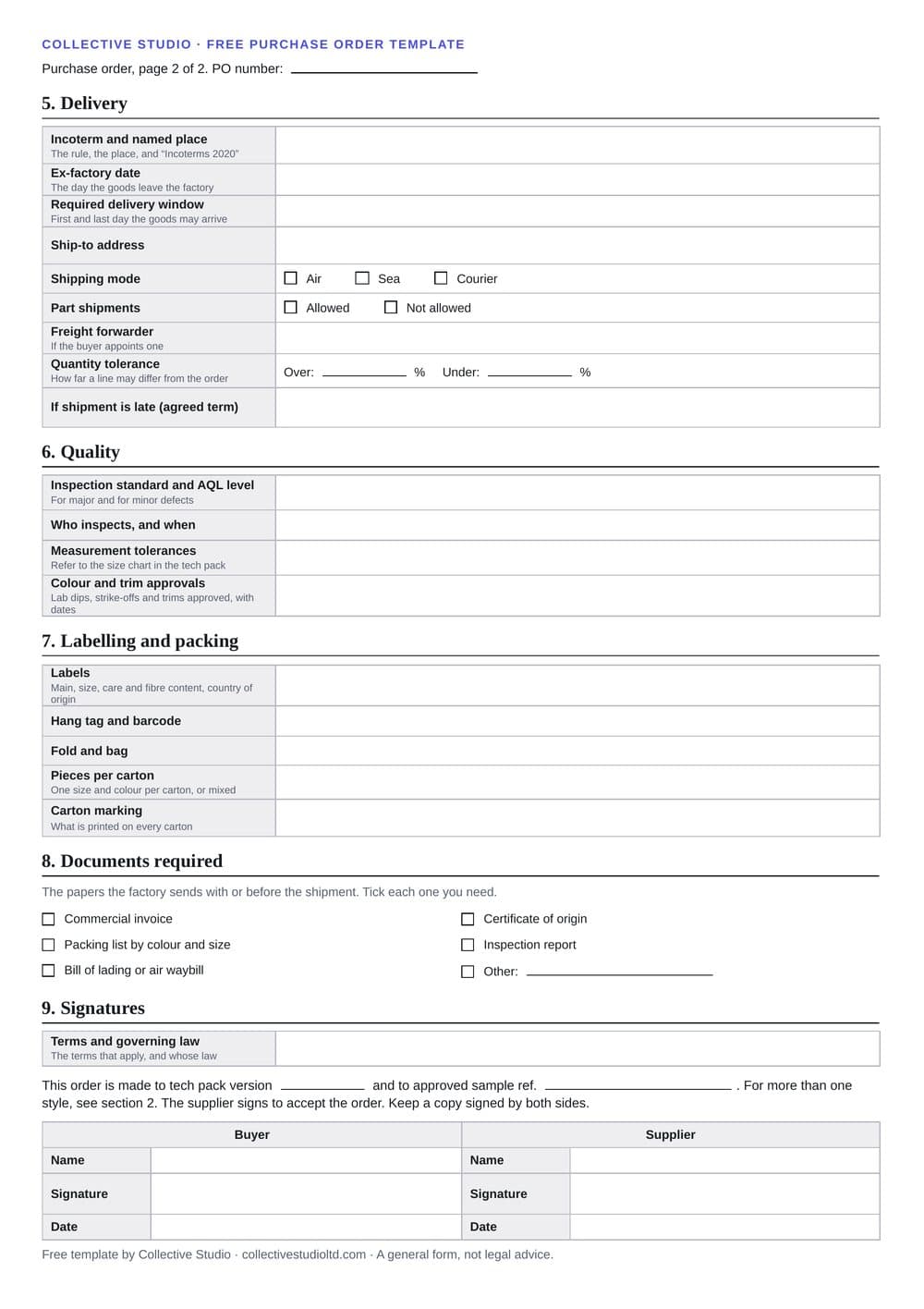
Our free purchase order template for clothing is a two-page A4 PDF and a matching Excel workbook, both with the same nine sections. Page one is the order itself. Page two holds the terms the factory works to.
| Section | What you fill in |
|---|---|
| 1. Order | PO number, PO date, revision number and quote reference. Buyer: company, contact, address, company number (UK) or ACN (Australia), tax or business number, and a UK EORI or Australian ABN. Supplier: company, contact and factory address |
| 2. Styles | One row per style: style number, description, fabric and colourway reference, tech pack version and approved sample reference |
| 3. Quantities | One line per style and colour, a column for each size from XS to 2XL, a total for each line, each size and the order |
| 4. Price and payment | Pieces, unit price, currency and line total for each style, the order total, then freight, tax or duty, deposit, total payable and the payment terms |
| 5. Delivery | Incoterm and named place, ex-factory date, required delivery window, ship-to address, shipping mode, part shipments, freight forwarder, quantity tolerance over and under, and the agreed term if shipment is late |
| 6. Quality | Inspection standard and AQL level, who inspects and when, a pointer to the measurement tolerances in the tech pack, and the colour and trim approvals |
| 7. Labelling and packing | Labels, hang tag and barcode, fold and bag, pieces per carton and carton marking |
| 8. Documents required | Commercial invoice, packing list by colour and size, bill of lading or air waybill, certificate of origin, inspection report, and a line for anything else |
| 9. Signatures | The terms and governing law, the tech pack version and approved sample the order is made to, then name, signature and date for buyer and supplier |
Sections 1 to 4 are on page one of the PDF and sections 5 to 9 on page two. In the Excel file each sheet holds all nine and prints on the same two A4 pages.
The sections follow what garment trade sources say an order to a factory should hold. Uphance, an apparel software company, lists the parts of a production purchase order: a style number and tech pack reference, a size and colour matrix, Incoterms, an over and under tolerance, an ex-factory date, inspection and AQL terms, and a packaging and labelling specification. QualityInspection.org lists full details of both companies, a unique PO number and date, the currency and the promised shipment date. Online Clothing Study lists the size break-up, the labelling and the packing details, and Techpacker lists the size breakdown, the quantities by colour and the packing specification. Uphance, Online Clothing Study and Techpacker offer no file to download, so we made one. Sources read on 14 November 2026.
Both files are set up for A4 paper. If you print on US Letter, choose Fit to page in the print dialogue so the bottom of each page is not cut off.
What the template looks like
Two A4 pages, shown here in full. Nothing is hidden behind a form.
The Excel version, with a quantity grid
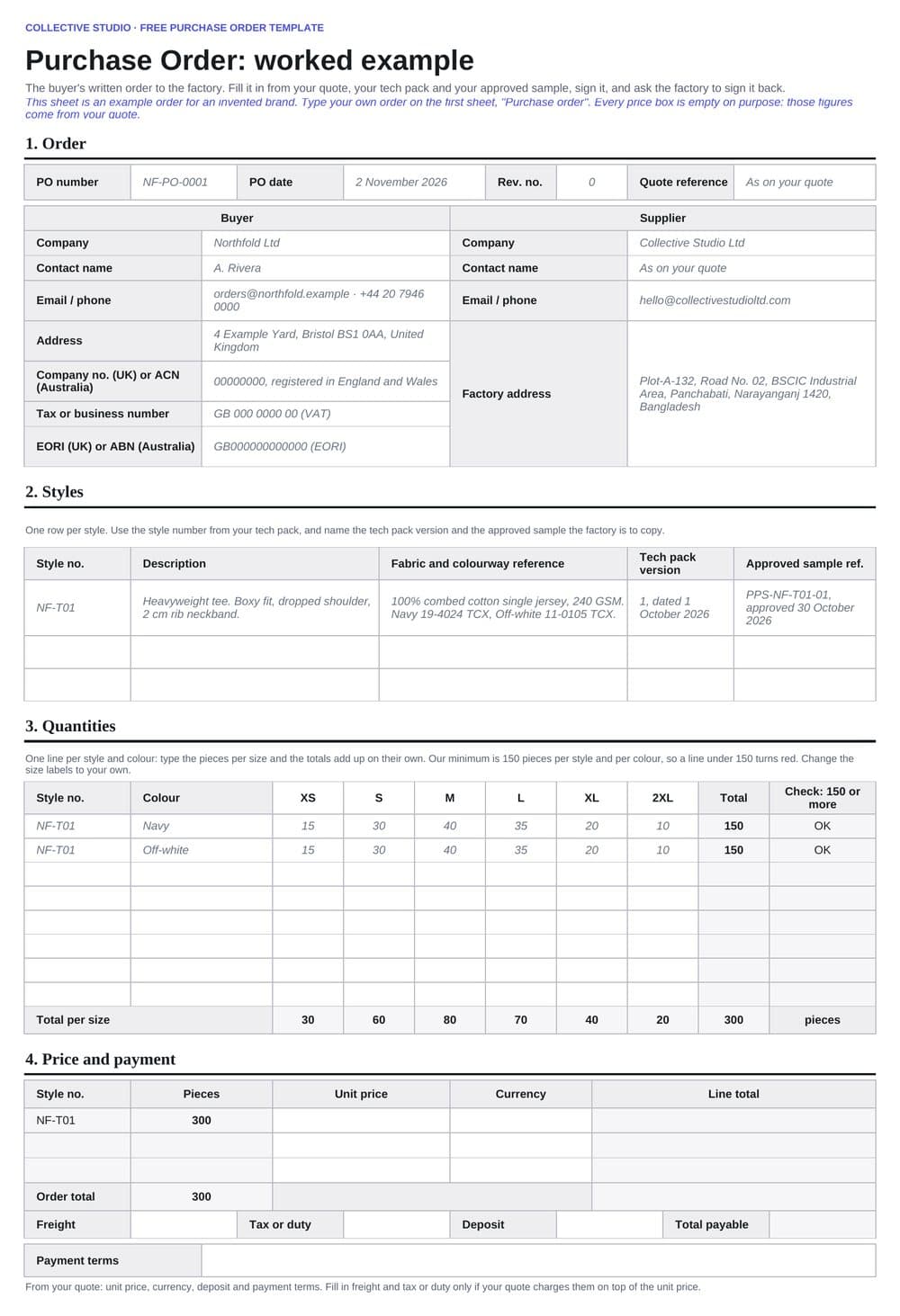
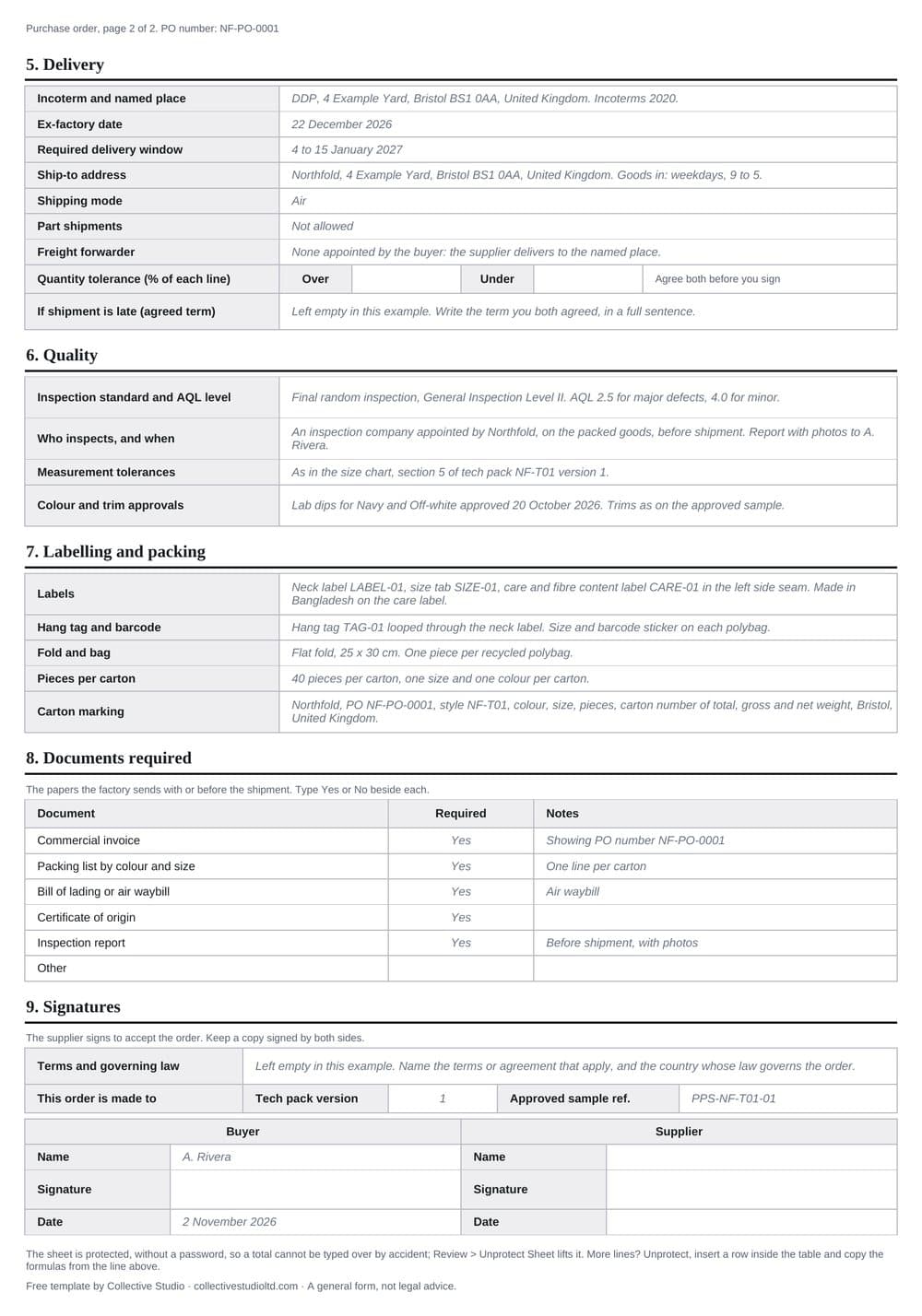
The Excel file has two sheets with the same nine sections. The first, Purchase order, is the blank form: type in the white boxes, and what you type is dark and upright. The second, Example, is the same form filled in, in grey italics, for an order from an invented brand, Northfold: style NF-T01, a heavyweight tee, in navy and off-white. It is the same garment as the example in our tech pack template, so the two files read as one order. Keeping the example on its own sheet means a leftover example value cannot end up in your order.
Section 3 is the grid. Type the pieces per size for each style and colour, and the sheet adds up each line, each size and the whole order. In the example each colour has XS 15, S 30, M 40, L 35, XL 20 and 2XL 10. That comes to 150 pieces a colour and 300 in all. Our minimum is 150 pieces per style and per colour, so a line under 150 turns red. If another factory makes your order, its minimum applies and you can ignore the red.
Section 4 reads the pieces for each style from the grid. The unit price, the currency and the payment terms are empty, in the example too. Those figures come from your quote, and a template should not guess them. Type a unit price and the line total and order total appear. If a style in the grid is missing from section 2, or listed there twice, a red note appears beside the order total, because the pieces priced would not match the pieces ordered. The formula cells are locked, without a password, so a total cannot be typed over by accident. Printed page two repeats the PO number.
Using the template in Google Sheets
No Excel? The same file works in Google Sheets. Google’s help page says you can edit, download and convert Microsoft Office files in Sheets. Download the Excel version, upload it to Google Drive with New, then File upload, and double-click it to open it in Sheets. Then choose File and “Save as Google Sheets” so your changes are kept. Both sheets arrive, and the totals keep working. Check the column widths afterwards. To send the order to a factory, use File, Download, and pick PDF.
Every field, what to write and an example
The template has nine numbered sections. Below is every field, what to write in it, and the value from the Northfold order on the Example sheet of the Excel version. The examples show the level of detail a factory needs. They are not terms to copy. Sources linked in this section were read on 14 November 2026.
1. Order
Who is ordering from whom, and the number every later document will carry.
- PO number
- A number that belongs to this order alone. QualityInspection.org lists a unique PO number and the PO date among the contents of an order to a factory. Numbering your orders in sequence is enough.ExampleNF-PO-0001
- PO date
- The day you issue the order. If the order changes later, issue it again with a new date.Example2 November 2026
- Rev. no.
- The revision number: 0 for the first issue. Each time the order changes, raise it by one and change the PO date. See changing or cancelling an order.Example0
- Quote reference
- The number or date of the factory's quote or pro forma invoice. It ties the order to an offer the factory has already made.ExampleAs on your quote
- Buyer: company, contact, address
- Your registered business name and address, and one named person who answers the factory's questions about this order.ExampleNorthfold Ltd · A. Rivera · 4 Example Yard, Bristol BS1 0AA, United Kingdom
- Company no. (UK) or ACN (Australia)
- Fill this in if your business is a company. A UK limited company must show its registered number and where it is registered on its order forms, and an Australian company must display its ACN on orders for goods, or its ABN where the ABN contains the ACN. See the UK and Australia section.Example00000000, registered in England and Wales
- Tax or business number
- The number that identifies your business for tax, such as a VAT number, if you have one.ExampleGB 000 0000 00 (VAT)
- EORI (UK) or ABN (Australia)
- A UK importer needs an EORI number for customs declarations, and an Australian business can use its ABN when ordering. Neither official page says it must be on the order, but it keeps the number where the factory and the forwarder can find it. See the UK and Australia section.ExampleGB000000000000 (EORI)
- Supplier: company, contact, factory address
- The factory's full company name and the address of the building where the goods are made. If the name on the quote and the name on the order differ, ask why before you sign.ExampleCollective Studio Ltd, Plot-A-132, Road No. 02, BSCIC Industrial Area, Panchabati, Narayanganj 1420, Bangladesh
2. Styles
One row per style. This section says exactly which garment is ordered and which version of it.
- Style no.
- The style number from your tech pack, unchanged. SPS Commerce’s glossary describes a style number as the identifier for a base design, before size and colour.ExampleNF-T01
- Description
- One line that names the garment and its main features, so it cannot be mistaken for another style.ExampleHeavyweight tee. Boxy fit, dropped shoulder, 2 cm rib neckband.
- Fabric and colourway reference
- Composition, construction and weight, then each colour with its reference. Copy the wording from the tech pack.Example100% combed cotton single jersey, 240 GSM. Navy 19-4024 TCX, Off-white 11-0105 TCX.
- Tech pack version
- The version number and date of the tech pack the factory is to follow. If the pack has changed since the sample, this box settles which one counts.Example1, dated 1 October 2026
- Approved sample ref.
- The sample you approved, by its reference and approval date. The ITC’s handbook on cross-border contracts notes that where a sale is based on a sample, the goods delivered must have the qualities of that sample (pages 144 to 145).ExamplePPS-NF-T01-01, approved 30 October 2026
3. Quantities
The grid a general purchase order does not have: pieces per size, for each style in each colour.
- Style no. and colour
- One line for each style in each colour. Two colours of one style are two lines.ExampleNF-T01 · Navy
- XS to 2XL
- The pieces you want in each size. The cutting room works from this split. Rename the size columns if yours differ. Our MOQ calculator suggests a split for a run.ExampleXS 15 · S 30 · M 40 · L 35 · XL 20 · 2XL 10
- Total and total per size
- Each line added across, each size added down, and the order total where the two meet. Excel adds them up. On paper, check that across and down give the same number.Example150 per colour · 300 in all
4. Price and payment
Every box here is copied from the factory’s quote. Our guide on how to read a garment quote explains what the figures on it cover.
- Pieces
- The total for each style, carried over from section 3. Excel fills it in.ExampleNF-T01 · 300
- Unit price and currency
- The agreed price for one piece and the currency it is in. What that price covers depends on the delivery term in section 5.ExampleEmpty in our example: copy yours from your quote
- Line total and order total
- Pieces multiplied by the unit price for each style, then the sum of the lines. Excel fills both in once a unit price is typed.ExampleEmpty until a unit price is typed
- Freight, tax or duty, deposit, total payable
- Fill in freight and tax or duty only if your quote charges them on top of the unit price. Deposit is the part paid before production. Total payable is the order total plus freight and tax or duty; Excel adds it up.ExampleEmpty in our example: copy yours from your quote
- Payment terms
- When each payment is due and what triggers it, in the words of your quote. Name the event, such as the order being confirmed or the final inspection being passed, not only a date.ExampleEmpty in our example: copy yours from your quote
5. Delivery
Where the factory’s part ends, when the goods leave and when they arrive. Delivery terms on a purchase order has the detail.
- Incoterm and named place
- The three-letter rule, the place it applies to, and the words Incoterms 2020. The rule alone is not enough: the place is where the handover happens.ExampleDDP, 4 Example Yard, Bristol BS1 0AA, United Kingdom. Incoterms 2020.
- Ex-factory date
- The day the finished, packed and inspected goods must be ready to leave the factory. It is not the day they reach you.Example22 December 2026
- Required delivery window
- The first and the last day the goods may arrive at the ship-to address. Our launch date calculator counts back from a launch date to the day the order must be placed.Example4 to 15 January 2027
- Ship-to address
- Where the goods are delivered, with receiving hours if it is a warehouse. It can differ from your business address.ExampleNorthfold, 4 Example Yard, Bristol BS1 0AA, United Kingdom. Goods in: weekdays, 9 to 5.
- Shipping mode
- Air, sea or courier. It decides the transit time and which transport document you receive.ExampleAir
- Part shipments
- Whether the factory may send the order in more than one shipment. If it may, say in the late-shipment box what counts as the order being complete.ExampleNot allowed
- Freight forwarder
- The company that moves the goods, if you appoint one yourself. Leave it empty if the factory arranges the freight, as it does under DDP: the ITC handbook describes DDP as the seller delivering to the named place and bearing the costs of getting the goods there, import duties and taxes included (page 153, on the 2010 edition of the rules).ExampleNone appointed by the buyer: the supplier delivers to the named place.
- Quantity tolerance
- How far the shipped quantity of each line may differ from the ordered quantity, over and under, in per cent. See quantity tolerance, explained.ExampleEmpty in our example: agree both figures with your factory
- If shipment is late
- What happens if the ex-factory date is missed, in a full sentence both sides have agreed. QualityInspection.org lists a penalty for late shipment among the contents of an order. An empty box means nothing was agreed. See terms and governing law.ExampleEmpty in our example: write the term you both agreed
6. Quality
How the finished goods are checked, and against what. Our guide to quality control and AQL for bulk apparel explains the terms.
- Inspection standard and AQL level
- The inspection level and the AQL for major and for minor defects. QIMA, an inspection company, describes the AQL as the limit used in product inspections to decide how many defective items a sample may hold. Our AQL calculator gives the sample size for your order.ExampleFinal random inspection, General Inspection Level II. AQL 2.5 for major defects, 4.0 for minor.
- Who inspects, and when
- The factory's own team, your own visit or an inspection company, and at which stage. Say who receives the report.ExampleAn inspection company appointed by Northfold, on the packed goods, before shipment. Report with photos to A. Rivera.
- Measurement tolerances
- A pointer to the size chart in the tech pack, which holds the tolerance for each point of measure. Do not copy the chart onto the order: two copies can drift apart.ExampleAs in the size chart, section 5 of tech pack NF-T01 version 1.
- Colour and trim approvals
- The lab dips, strike-offs and trims you have approved, with their dates, so bulk colour is matched to something both sides have seen.ExampleLab dips for Navy and Off-white approved 20 October 2026. Trims as on the approved sample.
7. Labelling and packing
How each piece is labelled and bagged, and how the cartons are made up and marked.
- Labels
- Which labels go on each piece and where: main label, size, care and fibre content, country of origin. Use the artwork references from the tech pack.ExampleNeck label LABEL-01, size tab SIZE-01, care and fibre content label CARE-01 in the left side seam. Made in Bangladesh on the care label.
- Hang tag and barcode
- Whether a hang tag is attached and how, and what sticker goes on each bag. Say who supplies the tags and the barcode files.ExampleHang tag TAG-01 looped through the neck label. Size and barcode sticker on each polybag.
- Fold and bag
- The fold method, the folded size and what each piece is packed in.ExampleFlat fold, 25 x 30 cm. One piece per recycled polybag.
- Pieces per carton
- How many pieces go in a carton, and whether a carton holds one size and colour or a mix. Our CBM calculator turns the carton size and count into the volume of the shipment.Example40 pieces per carton, one size and one colour per carton.
- Carton marking
- What is printed on every carton, so a forwarder or a warehouse can identify it without opening it. V-Trust, an inspection company, lists the usual shipping marks: the importer, the order number, the destination, the weights, the carton count and the size and colour inside.ExampleNorthfold, PO NF-PO-0001, style NF-T01, colour, size, pieces, carton number of total, gross and net weight, Bristol, United Kingdom.
8. Documents required
The papers the factory sends with or before the goods. The ITC handbook says the documents a buyer needs should be named in the contract (page 36), and gives the invoice, packing list, bill of lading, air waybill, certificate of origin and certificate of inspection as examples.
- Commercial invoice
- The factory’s invoice for the shipment. The US International Trade Administration describes it as required for export and import clearance.ExampleYes · showing PO number NF-PO-0001
- Packing list by colour and size
- What is in each carton, added up by colour and size, so you can check the delivery against section 3.ExampleYes · one line per carton
- Bill of lading or air waybill
- The carrier's transport document: a bill of lading by sea, an air waybill by air.ExampleYes · air waybill
- Certificate of origin
- An official document stating where the goods were made.ExampleYes
- Inspection report
- The result of the final inspection, sent to you before the goods ship.ExampleYes · before shipment, with photos
- Other
- Anything else your market or your customer asks for. Name it here, not in a later email.ExampleLeft blank
9. Signatures
The order is complete when both sides have signed the same version.
- Terms and governing law
- The document that holds the terms, such as the factory’s quote or a separate agreement, and the country whose law governs the order. See terms and governing law.ExampleEmpty in our example: agree it with your factory
- This order is made to
- The tech pack version and the approved sample, stated once more above the signatures. For several styles, write: as listed in section 2.ExampleTech pack version 1 · approved sample PPS-NF-T01-01
- Buyer: name, signature, date
- The person in your business who is allowed to place the order.ExampleA. Rivera · 2 November 2026
- Supplier: name, signature, date
- The factory signs to show that it accepts the order as written. Keep the copy signed by both sides.ExampleLeft blank for the factory
Purchase order, pro forma invoice and commercial invoice
Three documents with similar contents pass between you and a factory. They differ in who writes them and when.
| Document | Written by | When | What it is for |
|---|---|---|---|
| Purchase order | The buyer | Before production | Placing the order: what to make, the quantities, the price, the dates and the terms. |
| Pro forma invoice | The seller | Before production | A quote in the form of an invoice. A buyer may need it to apply for an import licence, arrange a pre-shipment inspection or open a letter of credit. |
| Commercial invoice | The seller | With the shipment | The invoice for the goods actually shipped. It is needed for export and import clearance, and customs in the buyer’s country uses it to assess duty and tax. |
Sources, read on 14 November 2026: Simply Business on the purchase order, and the US International Trade Administration on the pro forma invoice and the commercial invoice.
A factory may answer a purchase order with a pro forma invoice. Check it line by line against your order before you pay anything: the style numbers, the quantities per colour, the delivery term and the dates should match. The PO number should appear on both invoices.
Quantity tolerance, explained
A quantity tolerance says how far the shipped quantity may differ from the ordered quantity and still count as the complete order. It has two parts: how many pieces over, and how many under. Uphance lists the over and under tolerance among the parts of a production purchase order.
There is no standard figure that we could verify. We found no trade body or government source that sets one for garments. One sample contract clause published by Law Insider lets the delivered quantity vary by 5 per cent either way. That is one example of a clause, not a rule. On a line of 200 pieces it would mean that any delivery from 190 to 210 pieces counts as complete. Sources read on 14 November 2026.
So the figure is yours to agree with your factory, and the boxes in our template are empty, in the example too. Settle three things before you sign:
- Whether the tolerance applies to each line (one style in one colour) or to the order total. Our form applies it to each line.
- The over figure and the under figure. They do not have to be the same.
- What happens outside the tolerance: whether you take extra pieces, and whether a shortfall is made up later or taken off the invoice.
It matters most when you have already promised quantities to shops. If your line sheet orders add up to exactly the pieces you ordered, a short delivery leaves one shop without its sizes.
Delivery terms on a purchase order
A delivery term has three parts: a rule, a place and an edition. The rules are the Incoterms, published by the International Chamber of Commerce. The ICC describes them as eleven three-letter trade terms that set out the tasks, costs and risks of delivering goods from seller to buyer. The current edition is Incoterms 2020.
The US International Trade Administration lists all eleven. Seven can be used for any mode of transport: EXW, FCA, CPT, CIP, DAP, DPU and DDP. Four are for sea and inland waterway only: FAS, FOB, CFR and CIF.
Which of them does a garment order use? We found no source that ranks the rules by use. Uphance names FOB when it lists the factory’s unit cost, currency and Incoterms. Our own guide to freight and Incoterms for bulk clothing orders covers the four that come up on apparel quotes: EXW, FOB, CIF and DDP. We quote DDP, so the example in the Excel file uses it.
Write all three parts in the box. The ITC’s handbook on cross-border contracts says the contract should state which version of the Incoterms is meant (page 150). The US International Trade Administration’s guidance on the pro forma invoice asks for the sales term together with the delivery point. A rule with no place does not say where the handover happens.
Ex-factory date and delivery window
General templates have one delivery date. A factory order needs two. Online Clothing Study defines the ex-factory date as the date on which the manufacturer must have the shipment ready and hand it to the forwarder, with packing and inspection done before it. SPS Commerce’s glossary describes a ship window as the time allowed for delivery, between a start ship date and a cancel date, the last day a retailer will accept the shipment. Our form asks for an ex-factory date and a required delivery window.
For timing with us: sampling takes about 10 days, production takes 40 to 50 days after you approve the sample, and by air it is about 70 days from your order to your door. The launch date calculator turns a launch date into the day the order must be placed.
Sources read on 14 November 2026. This page describes Incoterms in general terms only. For what each rule requires of the seller and the buyer, read the ICC’s own text.
Changing or cancelling an order
Orders change: a colour is dropped, a size split moves, a date slips. Change the order the same way you placed it. Issue the purchase order again with the next revision number and a new date, and ask the factory to sign the new copy. The Rev. no. box in section 1 is there for this: 0 for the first issue, then 1, 2, 3. The ITC’s handbook on cross-border contracts says an amendment should be in writing, so that both sides can keep track of what the contract now says, and accepted only by people who are authorised to act for each side (page 106).
Cancelling is harder. Whether you can cancel, and what you owe if you do, depends on what the two of you agreed and on the law that governs the order. The same handbook describes the rule in its model contract for an international sale: where the seller’s breach is fundamental, the buyer may end the contract, and in other cases the buyer must first give the seller extra time to perform (page 39). It says the contract can name the breaches that count, such as late delivery. It does not cover a buyer who simply changes their mind. So agree in writing, before you sign, what happens if the order is cancelled after work has started.
Terms and governing law
A purchase order is two pages. It does not hold a full set of contract terms. If the factory’s quote or a separate agreement sets out terms, name that document in the Terms and governing law box in section 9, so the order and the terms are tied together.
- Whose law applies. The ITC handbook gives a one-line clause that names the country whose law governs the agreement (page 114). Where the two sides choose nothing, it says a contract of sale will normally be governed by the law of the country where the seller is established (page 118). For an order placed with a factory in Bangladesh, that rule points to the law of Bangladesh unless you agree otherwise.
- How a dispute is settled. In a court or by arbitration, and where. The handbook strongly advises agreeing this (page 118), and says not to provide for both a court and arbitration (page 119).
- Late delivery. The handbook describes an agreed sum for delayed delivery as an option the two sides may write into the contract, and says the sum should roughly match the loss the buyer is likely to suffer (page 37). That is what the “If shipment is late” box in section 5 is for.
One more point for Australian readers. The UN convention on contracts for the international sale of goods is sometimes named in these clauses. UNCITRAL’s status table lists Australia as a party. The United Kingdom and Bangladesh are not on it. What that means for your order is a question for a lawyer. Sources read on 14 November 2026. None of this is legal advice.
If you are in the UK or Australia
If your business is a company, one thing has to be on the order itself in both countries: your company number. The other points below affect your import paperwork and your labels, so the template gives each one a place. All were read on 14 November 2026.
United Kingdom
- Company details. GOV.UK says a limited company must show its registered number on its order forms, together with its registered office address, where it is registered (England and Wales, Scotland or Northern Ireland) and the fact that it is a limited company. The Company no. box in section 1 takes the number and the place of registration. Write the company’s full name, with Limited or Ltd, in the Company box.
- EORI number. To import goods into England, Wales or Scotland you need an EORI number that starts with GB. GOV.UK’s EORI guide sets out who needs one. Neither page says it must appear on a purchase order. The box in section 1 keeps it where the factory and the forwarder can find it.
- Records. GOV.UK says importers must keep records of commercial invoices and customs paperwork. That is one reason to ask for the commercial invoice in section 8.
- Labels. A textile label must show the fibre content, and manufacturers and retailers are responsible for meeting the labelling rules. Anything else you print on a label must be accurate, and must not mislead about where the product was made. Write the fibre content wording in the Labels box in section 7.
Australia
- Company number. ASIC says a company must display its ACN on orders for goods and services, among other documents. Where the ABN is the ACN with two extra numbers in front, the company can show its ABN in place of the ACN. The Company no. box in section 1 takes either.
- ABN. An ABN is a unique 11-digit number that identifies your business, and you can use it to verify your business to others when ordering and invoicing. Not every business needs one. The EORI or ABN box in section 1 takes it.
- Labels. business.gov.au says some types of goods must be labelled with a trade description before they can be imported, which says what the goods are and where they were made, and that the Australian Border Force may seize imports that are not labelled correctly. The same page says country of origin claims must be accurate and truthful. Clothing is also covered by the mandatory care labelling standard. Put the care instructions and the country of origin in the Labels box.
Our guide to clothing labelling requirements by country sets out what goes on the label in each market.
Seven mistakes a factory sees on purchase orders
We are the side that receives the order. Each of these gaps makes a factory stop and ask, or guess, before it can book fabric and a place on the line.
One quantity for the whole style
An order for 300 tees gives the size of the run and nothing about the split. Someone then has to guess how many are small and how many are large, and that guess is cut into fabric. Give the pieces per size for each colour, even if it is your first estimate.
A colour that falls under the minimum
Our minimum is 150 pieces per style and per colour. An order for 150 pieces across three colours is three lines of 50, and none of them meets it. Add up each colour separately before you send the order. The Excel grid does this for you and turns a short line red.
One delivery date that could mean two things
A single date leaves open whether it is the day the goods leave the factory or the day they reach you. The whole of the freight sits between those two days. Give an ex-factory date and a delivery window, and both sides plan to the same calendar.
A delivery term with no place
DDP or FOB alone names a rule but not where it applies. Write the rule, the place and the edition, for example: DDP, your warehouse address, Incoterms 2020.
No tech pack version and no sample reference
If the tech pack changed after the sample was approved, the order has to say which one the bulk follows. Without that, each side can point to a different document. Write the version, its date and the reference of the approved sample.
Packing and labels left for later
Labels, bags and cartons have to be ready before the first piece is packed. Instructions that arrive after production has started can leave finished goods waiting at the packing table. Put them on the order, or point to the sections of the tech pack that hold them.
An order nobody signed back
An order sent by email and never confirmed leaves you with no record that the factory accepted those quantities, dates and terms. Ask for the copy signed by the factory, and keep it with the quote.
This is the floor a purchase order arrives at. Co-founder Homaira Jashim walks it in the first video. The second shows where section 7 of the order is carried out: finished pieces folded, bagged and stacked for the cartons.
How it fits with the tech pack and the line sheet
Three documents carry a style from an idea to a delivery. Each has a different reader.
| Document | Written by | Read by | What it settles |
|---|---|---|---|
| Tech pack | You | The factory | How one style is made: fabric, measurements, colours, labels and packaging. |
| Line sheet | You | Shops and stockists | What you offer for sale: styles, colours, sizes, minimums and the delivery window. |
| Purchase order | You | The factory | What you order: pieces per size and colour, price, dates and delivery terms. |
They are written in that order. The tech pack comes first, and the factory samples from it. Once a sample is approved, the line sheet goes to shops. When their orders are in, add them up by style, colour and size. That total is section 3 of your purchase order.
Copy between the three, do not retype. Style numbers, the fabric line, colour references, labels and packaging come from the tech pack. The delivery window on the purchase order has to be earlier than the one you promised on the line sheet, with time in between to check the goods and send each shop its order. Prices and payment terms come from the factory’s quote: our guide on how to read a garment quote explains each line of one.
Before you fix the quantities, the MOQ calculator checks each colour against the minimum and suggests a size split. For the inspection terms in section 6, read our guide to quality control and AQL.
How to use it
- Download the PDF to print and fill in by hand, or the Excel file to type straight into the cells.
- Fill in sections 1 to 3 from your tech pack and your approved sample, and section 4 from your quote.
- Agree the delivery term, the dates, the quantity tolerance and the inspection terms with the factory before you write them in.
- Save it as a PDF with the PO number in the file name, sign it, and ask the factory to sign and return it.
- Keep the signed copy with the quote and the tech pack version it names.
What clients say
I have had a very good experience with this company. They are very friendly, professional, and provide fast service. They speak fluent English, which makes communication very easy. The quality of their manufacturing is excellent. I have no doubt in recommending this company to anyone looking for a reliable manufacturing partner in Bangladesh.
Wonderful people to work with — very professional and knowledgeable, also accommodating to the needs of their customers.
Sources
Every source below was read on 14 November 2026. We paraphrase them: none of the wording on this page is a direct quotation. Nothing here is legal advice.
- Uphance, “What Is a Purchase Order? An Apparel Operator’s Guide” (28 February 2024)
- QualityInspection.org, “What should be in a purchase order (PO) to a Chinese supplier?” (3 December 2012)
- Online Clothing Study, “How to Make Purchase Order (PO) for Garment Sourcing?” (30 December 2013)
- Online Clothing Study, “What is Ex-Factory Date?” (1 January 2018)
- Techpacker, “What is a Purchase Order Sheet and How Can You Add One in a Tech Pack” (29 July 2021)
- International Trade Centre, Cross-border Contracting: How to Draft and Negotiate International Commercial Contracts (2018, PDF)
- Orvis, Soft Goods Specific Vendor Compliance Manual (revised 2019, PDF)
- SPS Commerce, fashion supply chain glossary (updated 26 August 2026)
- V-Trust, “Shipping Marks and How to Prevent Mislabeled Cartons” (9 January 2020)
- QIMA, AQL explained
- US International Trade Administration, pro forma invoice
- US International Trade Administration, commercial invoice
- US International Trade Administration, “Know Your Incoterms”
- International Chamber of Commerce, Incoterms rules
- International Chamber of Commerce, Incoterms 2020
- Law Insider, quantity tolerance sample clause
- GOV.UK, EORI numbers
- GOV.UK, importing goods into the UK
- GOV.UK, textile labelling guidance (published 31 December 2020)
- GOV.UK, product labelling and the law
- business.gov.au, registering for an Australian business number (ABN)
- business.gov.au, labelling your products
- ACCC Product Safety, care labelling for clothing and textiles mandatory standard
- GOV.UK, running a limited company: signs, stationery and promotional material
- ASIC, Australian Company Number (ACN)
- UNCITRAL, status of the UN Convention on Contracts for the International Sale of Goods
- HCR Law (a UK law firm), “Battle of the forms: can you get your retaliation in first with a knockout?” (25 May 2022)
- Snowy Monaro Regional Council (New South Wales), purchase orders: information for suppliers
- Simply Business, “What is a purchase order?” (2 May 2025, updated 23 September 2025)
- Google Docs Editors Help, work with Office files
- Xero UK, free purchase order template
- Shopify, purchase orders guide (16 December 2025)
Frequently asked questions
What is a purchase order in clothing manufacturing?
A purchase order, or PO, is the document a clothing brand sends to its factory to place an order. The buyer issues it before production starts, and it turns a quote and an approved sample into an instruction. A garment purchase order names each style by its style number and gives the quantity for every size in every colour. It states the unit price and currency, the payment terms, the delivery term, the date the goods must leave the factory and the window in which they should arrive. It also points to the tech pack version and the approved sample that the bulk must match, and it sets out labelling, packing, carton marking, inspection terms and the documents the factory must send. The factory signs it to accept it. From then on the PO number appears on the invoice, the packing list and the cartons, so every later document can be matched to the order.
What should a clothing purchase order include?
Nine blocks, in the order our template uses. One, the order itself: PO number, date, buyer and supplier details. Two, the styles: style number, description, fabric and colour references, tech pack version and approved sample reference. Three, the quantities, as a grid of pieces per size for each style and colour, with totals. Four, price and payment: unit price, currency, totals and payment terms. Five, delivery: the Incoterm with its named place, the ex-factory date, the delivery window, the ship-to address, the shipping mode, the quantity tolerance and what happens if shipment is late. Six, quality: the inspection standard, the AQL levels and who inspects. Seven, labelling and packing, down to the carton marking. Eight, the documents the factory must send. Nine, signatures from both sides. The general purchase order forms we read on 14 November 2026 stop at block four and give each item one quantity, which is not enough to cut a size run.
Is a purchase order legally binding?
It can be. HCR Law, a UK law firm, describes the basic rule in English law: a binding contract comes into being when one side makes an offer and the other accepts it, and a seller who simply supplies the goods ordered is likely to be treated as having accepted. For Australia, a supplier page from Snowy Monaro Regional Council in New South Wales says that when a seller accepts a purchase order, a legally binding contract is formed; we found no Australian government page that says it of purchase orders in general. That is why our template has a signature box for the supplier as well as the buyer. QualityInspection.org warns that a purchase order alone is not an enforceable contract in China, and we found no statement either way for Bangladesh. This is general information, not legal advice: for an order that matters, ask a lawyer in your country to read it before you sign.
What is the difference between a purchase order and an invoice?
Direction and timing. A purchase order goes from the buyer to the supplier before the purchase, and says what the buyer wants. An invoice goes from the supplier to the buyer afterwards, and asks for payment. Xero and Simply Business both describe the difference that way. An overseas clothing order adds two more invoices. A pro forma invoice comes from the factory before production: the US International Trade Administration calls it a quote in an invoice format, which a buyer may need in order to apply for an import licence, arrange an inspection or open a letter of credit. A commercial invoice comes from the factory with the shipment, and customs in the buyer's country uses it to assess duty and tax. Put in order, that is a quote or pro forma invoice from the factory, a purchase order from you, then the commercial invoice with the goods. Your PO number should appear on both invoices.
Who issues a purchase order, and who approves it?
The buyer issues it and the supplier approves it. Shopify's guide to purchase orders puts it in those terms: the buyer is responsible for issuing purchase orders, and the vendor, whether a manufacturer or a contractor, is responsible for approving them. For a clothing brand that means you write the order and the factory accepts it. Before it signs, a factory should check the order against its quote: the quantities against its minimum, the ex-factory date against its production plan, and the packing and labelling instructions against what it can do. If something does not match, it should come back to you as a question, not as a silent change. Once both sides agree, the factory signs and dates the order and returns a copy. In a one-person brand that is the founder. In a larger one, decide who may sign before the first order, and put that person's name in the buyer block.
What is a PO number?
A PO number is the unique reference on a purchase order. Xero and Simply Business describe it the same way: a number used to track the order and to match it with the paperwork that follows, and a small business can simply number its orders in sequence. On a clothing order it does more work than on most. One published manual for apparel suppliers, from the retailer Orvis, asks for the PO number on the packing list, on the carton label and on the bill of lading. That lets a forwarder or a warehouse tell which order a carton belongs to without opening it. Choose a pattern and keep to it. Our example uses NF-PO-0001: the brand's initials, the letters PO and a running number. Never reuse a number, and never change an order without raising its revision number and changing its date, or two versions of one order will be in circulation at once.
What is an ex-factory date?
The ex-factory date is the day the finished goods must be ready to leave the factory. Online Clothing Study, a garment industry site, defines it as the date on which the manufacturer must have the shipment ready and hand it over to the forwarder. Packing and inspection have to be finished before it, and it may not be the same day as the shipment date. It is not the day the goods reach you. Transit, customs clearance and the final delivery come after it, and how long they take depends on the shipping mode and the delivery term. That is why our template has two boxes: an ex-factory date, which the factory controls, and a required delivery window, which is what you plan your launch around. With us, production takes 40 to 50 days after sample approval, and by air it is about 70 days from your order to your door.
Is the template free, and can I use it with any factory?
Yes to both. Click either download button and the file saves straight away, as a PDF or an Excel workbook, with no email address, no sign-up and no account. Use it for as many orders as you like and send it to any factory, including ones that are not us. The PDF names no supplier until you write one in. Two things in the Excel version are ours. The Example sheet names Collective Studio as the supplier; the blank form names nobody. And the quantity grid turns a line red when it is under 150 pieces, because our minimum is 150 pieces per style and per colour. If another factory makes your order, its minimum applies and the red can be ignored. The Excel file also opens in Google Sheets and LibreOffice. It is a general form and not legal advice, so have an important order checked before you sign it.
Download the template (PDF)Download the Excel version (.xlsx)Send us your idea
Collective Studio is up and coming. Very hard working people who want to please their customers and grow partnerships together. Homaira is very knowledgeable in the knit industry and always willing to learn more. We are looking to grow our business with them.