How to Import Clothes from Bangladesh, Step by Step
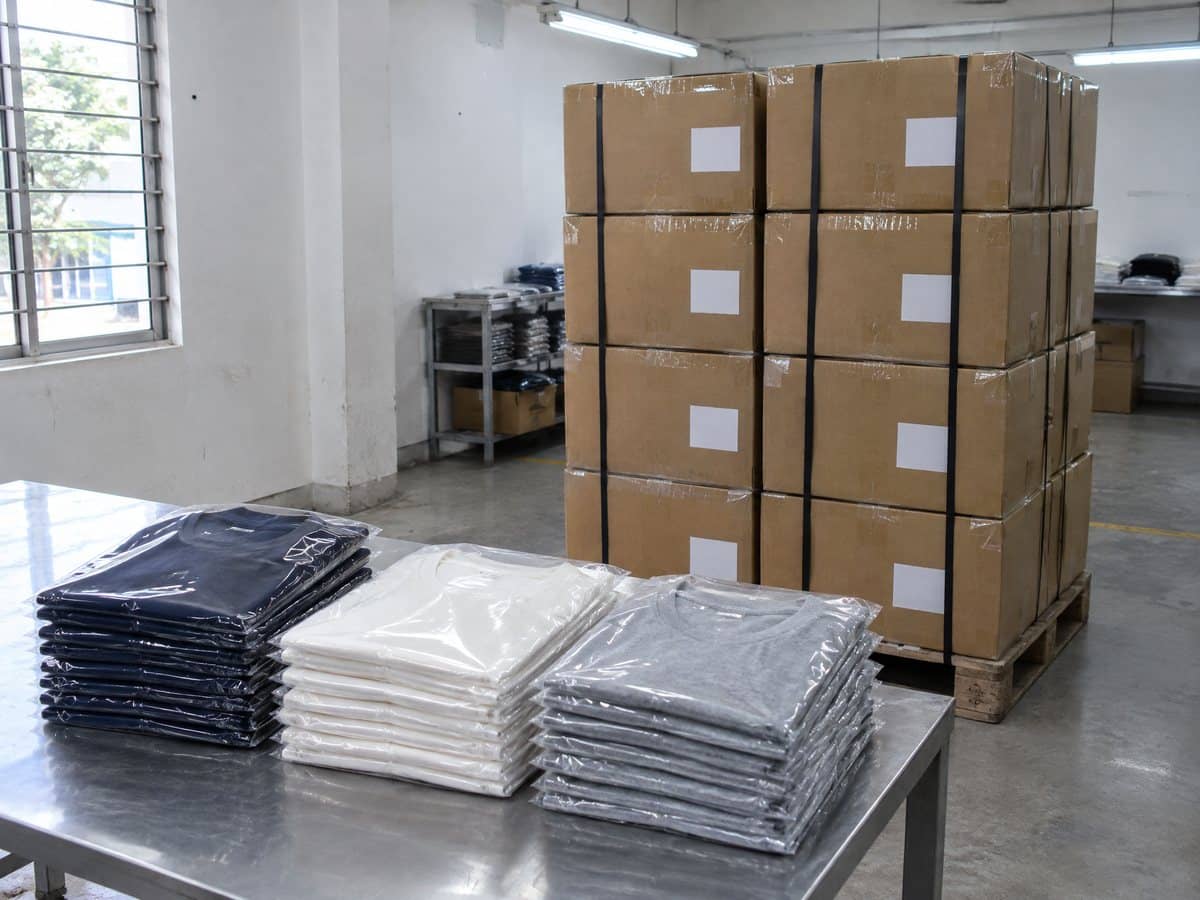
To import clothes from Bangladesh, you send a factory a brief or a tech pack, approve a sample and place an order, and the factory then makes, inspects and ships the goods, which clear customs in your country. On our floor at Collective Studio, a family-run cut-and-sew knitwear factory in Narayanganj, Bangladesh, that route takes about 70 days from order to door by air, and the minimum is 150 pieces per style and per colour.
The seven steps below run in the order the work is done, and they cover clothes made to your order. Ready-made stock is a different trade, explained in our guide to stock lots and made to order. Duty, import tax and label rules differ by country, so each market has its own guide, listed below the steps.
The seven steps to order clothes from Bangladesh
| Step | What happens | What you do | What you receive | Time on our floor |
|---|---|---|---|---|
| 1. Brief or tech pack | You describe the garment and we quote | Send a tech pack, a sketch or a garment to match | A reply, then a quote | Reply within one business day |
| 2. Sample | We sew one sample and send it by courier | Approve it, or ask for changes | One finished sample to hold | About 10 days |
| 3. Order | Styles, colours, quantities and the delivery term go in writing | Confirm the order | The agreed order in writing | Before production starts |
| 4. Production | Fabric is knitted and dyed at partner mills, then cut and sewn on our floor | Approve the colour, then follow the photos | Photos at each stage | 40 to 50 days after the sample is approved |
| 5. Inspection | Garments are checked against the approved sample | Read the inspection report | The inspection report, before the balance is due | Inside the production time |
| 6. Freight and delivery terms | Cartons travel by air or sea under the agreed term | Under DDP, nothing. Under FOB, appoint a forwarder | The commercial invoice, the packing list and the origin details | Added to the production time |
| 7. Customs | An import declaration is made and the goods are released | Agree whose name goes on the declaration | Under DDP, the cartons at your door | On arrival |
Step 1: send a brief or a tech pack
A factory can only quote what it can see. Send a tech pack if you have one. If not, a sketch or a garment to match is enough to start, and we build the tech pack with you. Add the quantity per style and per colour, and the country the goods are going to. If you are still choosing a supplier, our guide to telling a factory from a buying house shows how to check who will sew the order.
Step 2: approve a sample
Hold one finished garment before anything is made in bulk. We sew the sample in about 10 days, and you approve it or send comments for another round. The approved sample is then sealed and kept, and the order is checked against it. How clothing sampling works explains each round.
Step 3: place the order
The order puts the agreed facts in writing: styles, colours, sizes, quantities, the approved sample, the delivery term and the delivery address. Our minimum is 150 pieces per style and per colour, so two colours of a style are 300 pieces and three are 450. A deposit starts bulk production, and the balance is due against the inspection report, before the goods ship. Our free purchase order template lists what an order should carry.
Step 4: production
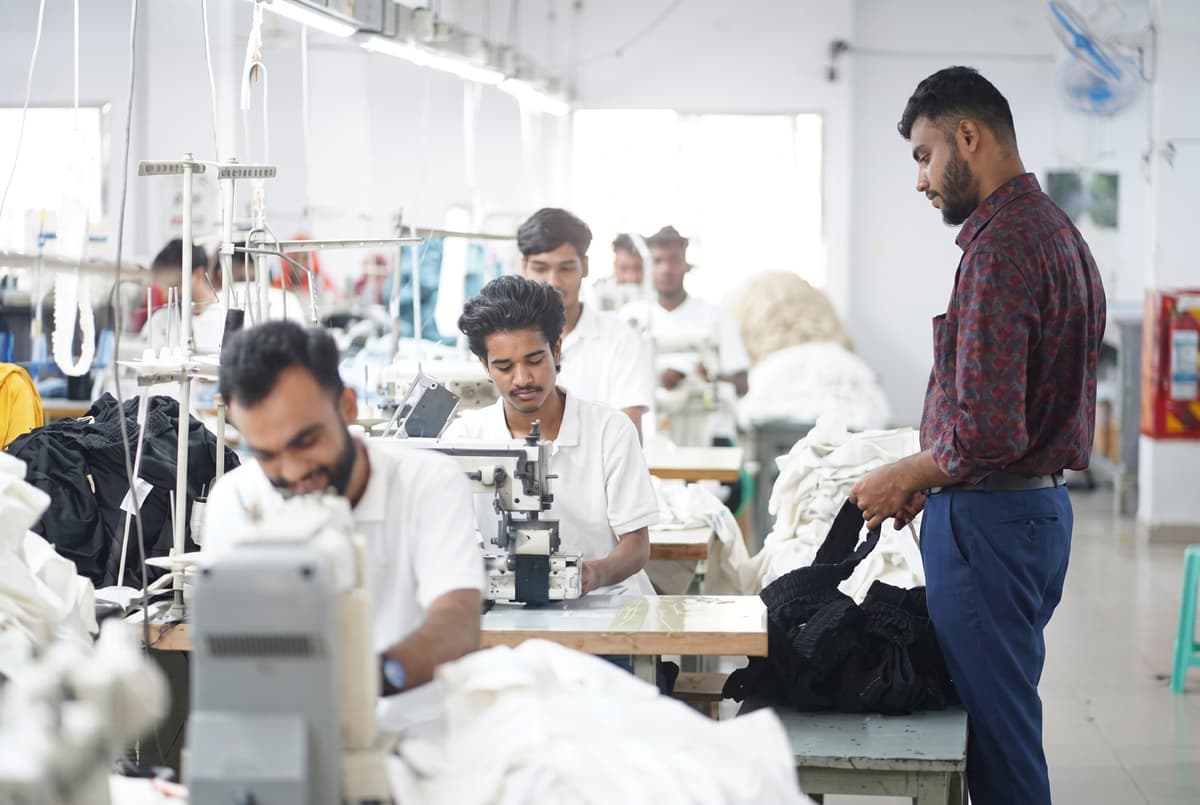
For knitwear, production starts with the fabric. It is knitted and dyed at partner mills to the colour you approved, then cut and sewn on our own floor, where embroidery and printing are done in-house. Production takes 40 to 50 days after the sample is approved, and you receive photos at each stage. The garment manufacturing process, step by step shows every stage.
Step 5: inspection
Before shipment, the finished garments are inspected against the sealed sample and an agreed AQL (acceptance quality limit). Together with the size of the order and the inspection level, the AQL sets how many pieces are checked and how many faults are accepted. On a 150-piece run every garment is checked. You receive the inspection report before the balance is due. Our guide to quality control and AQL explains the numbers on the report.
Step 6: freight and delivery terms
The delivery term on your quote says where the factory's job ends. DDP and FOB are two of the Incoterms, a set of eleven three-letter trade terms from the International Chamber of Commerce. Under DDP (delivered duty paid) the duty, the clearance and the freight are handled for you, and the goods arrive at your door. Under FOB (free on board), a rule for sea and inland waterway transport, the seller delivers the goods on board the ship at the named port in Bangladesh. From that moment the costs and the risk are yours, and you appoint your own forwarder and customs broker. We ship DDP worldwide. The commercial invoice, the packing list and the origin details reach you before the goods move. How to read a garment quote compares EXW (ex works), FOB and DDP line by line.
Step 7: customs in your country
When the goods arrive, an import declaration is made to customs in the importer's name, any duty and import tax due are paid, and customs releases the goods. Two things are yours to settle well before that. The wording of the labels is agreed at tech pack stage, because the labels are sewn in on our floor and give the origin as Made in Bangladesh. Whose name goes on the declaration is agreed before the goods ship. That party is the importer, called the importer of record in the United States. What the importer has to do differs from market to market, so read the guide for your market first. Each garment is declared under a commodity code, which is built on the six-digit Harmonized System of the World Customs Organization. Our guide to HS codes for clothing gives the codes for knitwear and the rules that decide them.
Which documents come with clothes imported from Bangladesh?
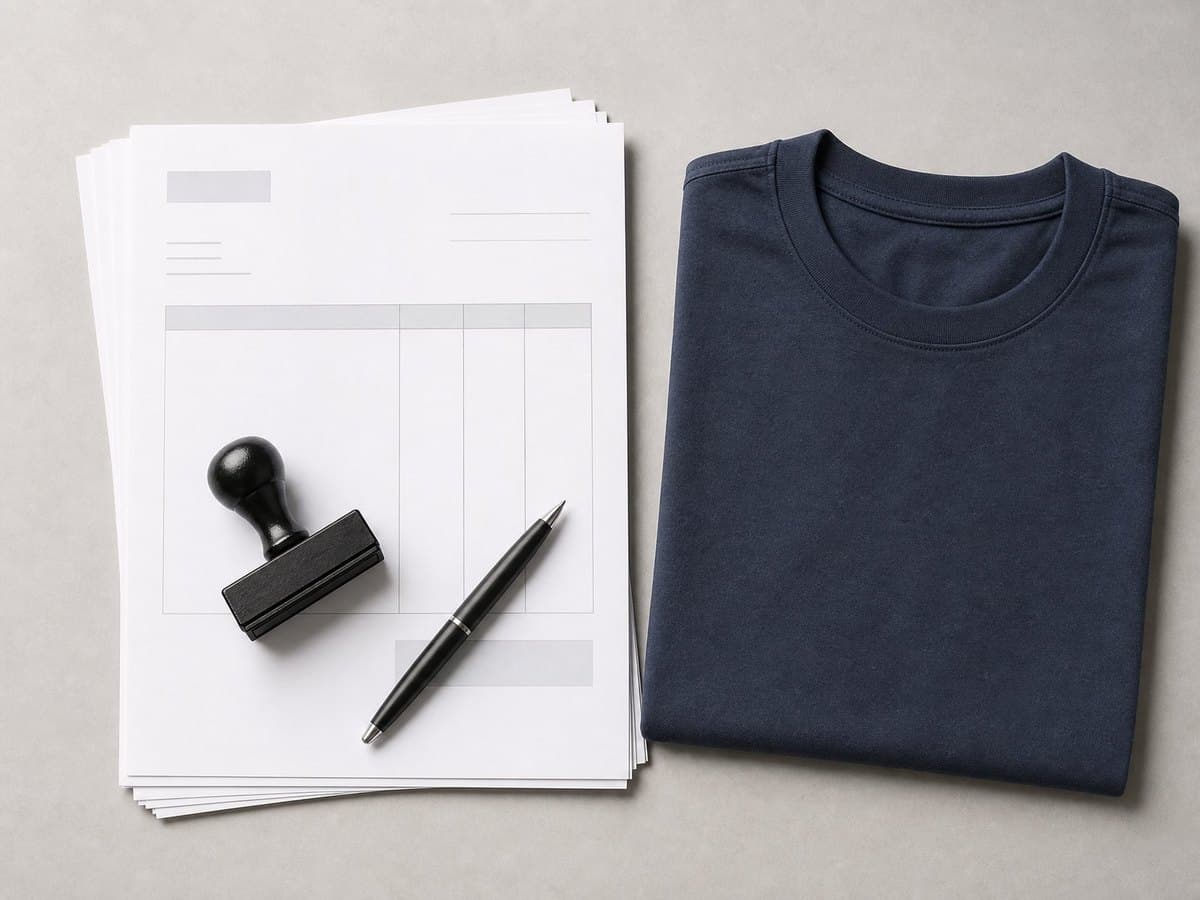
Five documents come with most orders of clothes from Bangladesh: a commercial invoice, a packing list, a bill of lading or an air waybill, a proof of origin and an import declaration. Some markets ask for more, so read the guide for your market as well.
| Document | What it is | Who provides it |
|---|---|---|
| Commercial invoice | The seller's bill for the goods. It states the goods being sold and the amount to be paid, and it is one of the main documents customs uses to work out any duty. | The factory. Ours is in the name Collective Studio Ltd |
| Packing list | A list of what is in the shipment: the number of packages, the contents of each, and the weights and dimensions. For clothes the packages are cartons. | The factory |
| Bill of lading or air waybill | The transport document. A bill of lading is issued by the shipping company and confirms that the goods have been received on board. An air waybill is the proof of the transport contract for air freight. | The shipping company, or the air carrier's agent |
| Proof of origin | A statement or certificate that the goods were made in a particular country, here Bangladesh. Its form depends on the market the goods enter. | The exporter, here the factory. Where a certificate is asked for, a chamber of commerce or a similar body usually issues it |
| Import declaration | The declaration made to customs in the country of arrival. It carries the commodity code and the value of the goods. | The importer, or a customs agent acting for the importer |
Under DDP our forwarder handles the clearance, so you do not file these papers yourself. Under FOB, pass them to your forwarder and customs broker as soon as they reach you.
Which rules apply in your country?
The market the goods enter sets the duty, any import tax and the label rules. Bangladesh does not. We keep the rates and rules in one guide per market, each linked to its official sources.
| Where the goods are going | Guide | What it covers |
|---|---|---|
| United Kingdom | How to import clothing into the UK | Duty, import VAT, importer number, label |
| European Union | How to import clothing into the EU | Duty, import VAT, label language, product safety |
| Australia | How to import clothing into Australia | Duty, origin test, GST, labels |
| United States | How to import clothing into the US from Bangladesh | Importer of record, bond, duty, fees, labels |
| Canada | How to import clothing into Canada | Import steps, HS codes, duty, GST |
| New Zealand | How to import clothing into New Zealand | Duty, origin rule, GST, levies, labels |
| Japan | How to import clothing into Japan | Duty, origin form, consumption tax, labels |
| Several markets compared | How much duty do you pay on clothing from Bangladesh? | Duty in five markets, side by side |
| Import tax | Import VAT and GST on clothing | How it is calculated and reclaimed |
| Labels | Clothing labelling requirements by country | What the label must show in each market |
Who you would be ordering from
Collective Studio was founded in 2019 by Jashim Uddin and his daughter Homaira Jashim. It is one company with one sewing floor of its own, at Plot-A-132, Road No. 02, BSCIC Industrial Area, Panchabati, Narayanganj 1420. We are not a buying house, an agent or a network, so you work directly with the factory that sews your order. We also offer organic cotton, made in our GOTS-certified facility (RSC 9687), with the certificate on request. To start, send us your brief, or read more about us as a clothing manufacturer in Bangladesh.
Frequently asked questions
How do I import clothes from Bangladesh?
You import clothes from Bangladesh in seven steps: brief or tech pack, sample, order, production, inspection, freight and customs. Collective Studio, a family-run cut-and-sew knitwear factory in Narayanganj, takes a brand through all seven in about 70 days from order to door by air. First you send a tech pack, a sketch or a garment to match, with the quantity you want in each style and colour. We sew a sample in about 10 days, and bulk does not start until you approve it. Production then takes 40 to 50 days, with photos at each stage and an inspection report before the goods ship. We deliver DDP worldwide, so duty, clearance and freight are handled and the cartons arrive at your door. The rules at the border differ from country to country, so read our import guide for your own market before you confirm the order.
How do I buy clothes from Bangladesh directly from a factory?
You buy directly by dealing with the company that owns the sewing floor, and by asking it to show you that floor before you pay. Collective Studio works directly with brands, not through a buying house: we are a family-run knitwear factory in Narayanganj with one sewing floor of our own. Fabric is knitted and dyed at partner mills, then cut and sewn by us. With any supplier, put the street address on a map, ask for a live video call from the floor during a working shift, and ask which floor will sew your order. Buying this way means clothes made to order in your sizes, your colours and your labels, from 150 pieces per style and per colour. Ready-made stock lots are a separate trade with risks of their own, and our guide to wholesale clothing from Bangladesh sets them out.
What is the minimum order when you import clothes from Bangladesh?
The minimum is set by each factory, and at Collective Studio it is 150 pieces per style and per colour. One style in two colours is therefore 300 pieces, and in three colours 450. It is the same for every garment we make, from T-shirts and polo shirts to hoodies, joggers and kidswear. The count is per colour because each colour is its own dye lot of fabric, so choosing fewer colours per style is the simplest way to keep a first order small. You choose how each 150 is split across sizes. Some suppliers publish smaller minimums than ours, so when you compare factories, ask each one for its minimum in writing and ask whether it is counted per style, per colour or per order. Our MOQ calculator adds up the pieces across your styles and colours before you ask for a quote.
How long does it take to import clothes from Bangladesh?
With Collective Studio it takes about 70 days from order to door by air, and sea freight adds about a month. That is about 10 days of sampling, then 40 to 50 days of production after the sample is approved, plus freight. The production clock starts on the day you approve the sample, not on the day you first write to us, so a second sample round moves every later date. Your own replies count as much as our sewing: the tech pack, the colour approval, the sample and the inspection report each wait for your answer. A repeat order of the same style is quicker, because the pattern and the sealed sample are already on file. Count back from the day you want to be on sale with our launch date calculator, and leave a margin for customs in your own country.
Do I pay duty and import tax on clothes from Bangladesh?
That depends on the country the goods enter, because the duty and any import tax are set there and not in Bangladesh, and they are separate charges. We keep the rates out of this guide and in the guide for each market, where they are linked to the official sources. On an order from Collective Studio the practical side is short: we ship DDP worldwide, so duty, clearance and freight are handled and the goods arrive at your door. Before the goods ship, agree with us whose name goes on the import declaration, and read the guide for your market to see what follows from that choice. We have one each for the UK, the EU, Australia, the US, Canada, New Zealand and Japan. Our duty guide compares five markets side by side, and our guide to import VAT and GST shows how the tax is worked out.
What documents do I need to import clothes from Bangladesh?
You normally need five documents: a commercial invoice, a packing list, a bill of lading or an air waybill, a proof of origin and an import declaration. On an order from Collective Studio, a family-run cut-and-sew knitwear factory in Narayanganj, the invoice, the packing list and the origin details come from us, in the name Collective Studio Ltd, before the goods move. The commercial invoice is our bill for the goods, and customs uses it to work out any duty. The packing list shows what is in each carton. The shipping company issues the bill of lading for sea freight, and the air carrier's agent issues the air waybill for air freight. The proof of origin states that the garments were made in Bangladesh, and its form depends on the market. The import declaration is made to customs in the country of arrival, in the importer's name. We ship DDP worldwide, so our forwarder handles the clearance.
Where this applies
The manufacturing pages this guide relates to, if you are costing a real run.
Free tools & guides for this
Sources & further reading
- International Chamber of Commerce: Incoterms 2020, a set of eleven three-letter trade terms; read 18 November 2026
- GOV.UK (HM Revenue and Customs): Customs valuation, Incoterms (each rule described, including EXW, FOB and DDP); updated 14 April 2026, read 18 November 2026
- International Organization for Standardization: ISO 2859-1:2026, sampling schemes indexed by acceptance quality limit (AQL) for lot-by-lot inspection, catalogue record; read 18 November 2026
- US National Institute of Standards and Technology, e-Handbook of Statistical Methods, section 6.2.3.1: choosing a sampling plan (AQL, inspection level and lot size); read 18 November 2026
- World Customs Organization: What is the Harmonized System?; read 18 November 2026
- GOV.UK: Import goods into the UK, step by step (commodity code and value on the import declaration); read 18 November 2026
- European Commission, Access2Markets: Guide for import of goods (customs declaration, proof of origin); read 18 November 2026
- European Commission, Access2Markets: Additional customs clearance documents (packing list, bill of lading, air waybill); read 18 November 2026
- US International Trade Administration: Common export documents (commercial invoice, packing list, certificate of origin); read 18 November 2026
- International Chamber of Commerce: Certificates of Origin; read 18 November 2026
- US Customs and Border Protection: Tips for new importers and exporters (the term importer of record); read 18 November 2026
- Canada Border Services Agency: Guide to importing commercial goods into Canada (declaration, release, duties and taxes); read 18 November 2026
Cite this guide
For journalists, writers, researchers and students.
Quoting this guide? Please credit Collective Studio and link to this page.
Reference
Homaira Jashim, Collective Studio. "How to Import Clothes from Bangladesh, Step by Step." 18 November 2026. https://collectivestudioltd.com/journal/how-to-import-clothes-from-bangladesh
Writing about us? Our press kit has our facts, logos and photos, free to use with credit.
Have an idea? Let’s make it.
We manufacture from 150 pieces per style and colour, with organic cotton options from our GOTS-certified facility and photos at every stage. Send a sketch or a sentence — we’ll reply within one business day.