Clothing Manufacturers in the UK vs Offshore: An Honest Guide for UK Brands
If you are searching for clothing manufacturers in the UK, you are really choosing between two kinds of supplier: a UK maker, such as a sample room, a cut-make-trim (CMT) unit or a small factory in London, Leicester, Manchester or Scotland, and an offshore factory that ships to you. The short answer is this. Make in the UK when your runs are below about 150 pieces per style, when you need samples in days and fittings in person, or when a genuine Made in Britain claim is part of the brand. Make offshore when you are producing in bulk, reordering the same styles, making cut-and-sew knitwear such as tees, hoodies and fleece, and want the 0% duty the UK gives to clothing from Bangladesh.
A disclosure before anything else: Collective Studio is an offshore factory. We are a family-run knitwear floor in Narayanganj, Bangladesh, so we have an obvious interest in which way you go. That is why this guide does not rank UK makers we have never visited. It points you to the directories where they can be found and checked, says plainly when a UK maker is the better choice, and gives you the import rules for the offshore route. Every rule here was checked on 5 November 2026 against the UK government, legislation and industry sources listed at the end.
The short version
- To find a UK maker, start with Make it British's vetted list of UK manufacturers and the clothing members of the Made in Britain campaign. Then visit before you pay anything.
- A UK maker wins for very small runs, fast sampling, fittings in person and an honest Made in Britain claim. Printing or embroidering an imported blank in the UK does not make the garment British made.
- Offshore wins for bulk, reorders, specialist cut-and-sew knitwear and landed cost. Garments made in Bangladesh enter the UK at 0% under the Developing Countries Trading Scheme (DCTS), against 12% from a country with no UK preference.
- Importing means 20% import VAT (reclaimable if you are VAT-registered), a GB EORI number, an origin declaration from the factory, and a fibre composition label in English on every garment.
- Timing: from a Bangladeshi factory, plan on about 70 days from order to your door by air, and about a month more by sea.
UK maker vs offshore factory
Where the sewing happens changes how minimums work, how fast you can try a change, what the label can say and what happens at the border. This is how the two routes compare on the points UK founders ask us about most.
| UK maker | Offshore factory (for example Bangladesh) | |
|---|---|---|
| MOQ logic | Often very flexible. Many sample rooms and CMT units take small runs, and Make it British's list lets you filter for makers with low or no minimum order. | Set by fabric. Knit fabric is knitted and dyed in lots, so minimums are per style and per colour. Ours is 150 pieces per style and colour. |
| Sampling speed | Fast. You can travel to a fitting and see a revised sample within days. | Slower. About 10 days for a first sample on our floor, plus courier time, and fittings happen on video or by post. |
| Cost structure | UK labour and overheads dominate the cost of each piece, so it stays high as quantity grows. | Lower labour and overhead per piece, but freight, customs clearance and import VAT timing have to be added to compare like with like. |
| Made in Britain claim | Possible when the garment is genuinely made here. The Made in Britain mark is a separate membership with its own eligibility test. | Not available. The garment is made in Bangladesh, and any origin you print must say so truthfully. |
| Duty | None, because nothing is imported. | From Bangladesh: 0% under the DCTS when the origin rule is met and claimed. Other countries depend on their own agreements and origin rules. |
| Best for | Development, runs under about 150, made-to-order, and brands where British making is the point. | Bulk and repeat orders of cut-and-sew knitwear, organic cotton basics, and brands growing past the first run. |
How to find a clothing manufacturer in the UK
A ranked list of "the 20 best UK clothing manufacturers" written by someone who has never stood in those workrooms tells you very little. These two sources are better starting points, because each says who it lists and on what basis. We checked them on 5 November 2026.
- Make it British UK manufacturers list. Make it British is run by Kate Hills. Its free directory has been consolidated into a paid, vetted list of UK clothing, accessory and textile manufacturers, suppliers and service providers, with categories that include knitwear, T-shirts and sweatshirts, sportswear, fabric mills, dyers and finishers, and printing and embroidery. Entries carry minimums and lead times, and you can filter for low or no MOQ. It also runs Make it British Live!, a trade show for UK clothing and textile manufacturing, next held on 12 and 13 January 2027 at the Business Design Centre in London.
- Made in Britain members: Clothing & Apparel. Made in Britain is a not-for-profit campaign whose registered marks can only be used by members, for products made in Great Britain or Northern Ireland. Its member directory has a clothing and apparel sector. It is smaller than the two lists above, and it lists brands as well as factories, but every member has applied against an eligibility test on where its products are made.
Two more routes are worth an afternoon. Ask brands you admire, which are not your competitors, who makes their product; UK founders are often willing to say. And search by place and product together, for example "jersey CMT Leicester" rather than "clothing manufacturer UK", because a unit that sews jersey every week will show up for the first and be buried under agencies for the second.
How to vet a UK maker before you pay
A UK unit is easier to check than any overseas factory, because you can go and stand in it. Use that. Before the visit, send the same short brief to three to five makers and ask the same questions of each.
- What do you sew every week? A workroom that lives on woven dresses is not the place for a fleece hoodie, and the reverse is just as true. Ask to see work like yours on the machines.
- Full package or CMT? A CMT unit sews from fabric and trims you buy and deliver. A full-package maker sources them for you. Many UK units are CMT, which means you will be buying fabric yourself, often in larger quantities than the run needs.
- What is the minimum per style and per colour? Ask for both numbers. A minimum per order and a minimum per colour lead to very different first orders.
- What does sampling include, how many rounds, and is the pattern yours to keep? If you might move production later, you want the pattern and graded sizes in your hands.
- Who does the final check? Ask how pieces are inspected before they are packed and what happens to faults.
Then visit. Watch a line running, look at finished work, and check that the name on the door matches the company on the quote. Our guide to how to find a clothing manufacturer has the full vetting checklist, and our list of questions to ask a clothing manufacturer gives the wording. Both work for a unit in Leicester as well as a factory in Bangladesh.
When a UK maker is the better choice
We would rather you chose the right supplier than chose us for the wrong job. These are the situations where a UK maker usually wins.
- Very small runs. Below about 150 pieces per style and colour, an offshore knit factory either cannot help or prices the run as a series of set-ups. A UK CMT unit can often sew 30 or 50 pieces from fabric you supply. If your first drop is that size, start in the UK and move offshore once a style proves itself.
- Fast sampling and fittings. Developing a new block or a fitted womenswear style can take several rounds. Doing those rounds a train ride away, in days, is a real advantage over sending samples by courier. Some brands sample in the UK and produce offshore, which works well if the sample and pattern travel with a complete tech pack.
- An honest Made in Britain claim. If British making is central to the brand, only a UK maker can give it to you, and the next section explains what that claim needs.
- Jumpers and cardigans knitted from yarn. In British retail English, knitwear often means fully fashioned jumpers and cardigans. Those are a different trade from cut-and-sew jersey and fleece, and the Make it British list has a knitwear category. They are not made on our own floor.
- Close collaboration. If you change each small run after watching the last one sell, being able to walk into the workroom is worth paying for.
What a Made in Britain claim actually needs
There are two separate things here, and founders often mix them up: the words on your label, and the Made in Britain mark.
The words. UK law does not require an origin label on clothing. The Textile Products (Labelling and Fibre Composition) Regulations 2012 deal with fibre content, and Trading Standards guidance on textile labelling does not add an origin requirement. What the law does require is that anything you say is true. Under the Digital Markets, Competition and Consumers Act 2024, in force for this part since 6 April 2025, giving false or misleading information about a product, or presenting true information in a misleading way, is a misleading action. A label or product page that says, or strongly suggests, made in Britain when the garment was sewn elsewhere is the clearest example. "Designed in London" is fine if it is true; it must not be dressed up to imply the garment was made there.
The mark. The Made in Britain mark is a membership, not a phrase you can print. Its eligibility rules say the product's materials or components must have undergone a substantial and transformative change through manufacturing in Great Britain or Northern Ireland, and that 100% of the labour that makes the finished product must be there. It also says its licence does not extend to products made for a white-label service unless the brand selling them is registered as a sub-licensee.
That matters for anyone comparing private label clothing manufacturers in the UK. Some businesses that appear for that search decorate imported blanks, which is a perfectly good service, but a print or an embroidered logo added in the UK does not make the garment British made. If British making is what you are selling, ask the maker directly where the garment is cut and sewn.
When an offshore factory is the better choice
- Cost structure at volume. In cut-and-sew, labour and overheads are paid on every piece, and they are where UK and offshore costs differ most. Freight, clearance and import VAT timing narrow the gap, so compare landed cost, not the factory figure. Our guide to how minimums change cost explains what moves the number.
- Bulk and reorders. Once a style sells, you want the same pattern, sealed sample and floor for the next 500 or 5,000 pieces. Large knit floors are built for exactly that.
- Knit specialisation. A specialist knit floor sews jersey tees, French terry and fleece sweats, rib, piqué polos and interlock all day, with the machines, operators and fabric mills close by.
- Zero duty. Bangladesh is in the Comprehensive Preferences tier of the UK's Developing Countries Trading Scheme, which gives 0% import tariffs on 99.8% of products, everything except arms and ammunition. On the UK Trade Tariff on 5 November 2026, cotton T-shirts and men's cotton sweatshirts showed 0% for that tier, against the UK Global Tariff of 12%. Our duty guide compares this with the other main markets.
Zero duty is not unique to Bangladesh, so it should not be the only reason to choose a supplier. The same tariff lines also showed 0% for several other origins under the UK's trade agreements, each with its own origin rules. Our comparison of Bangladesh, China and Vietnam sets the main sourcing countries side by side. What decides an order is who makes the garment and whether they can document where it was made.
The rules of origin for knitwear
The 0% rate only applies to garments that originate in Bangladesh, and the importer has to claim it. For knitted clothing, the UK's product-specific rules for least developed countries split chapter 61 in two. Garments made by sewing or otherwise assembling two or more pieces of knitted fabric, cut to form or knitted to form, qualify on manufacture from fabric. In plain terms, a tee, hoodie or sweatshirt cut and sewn in Bangladesh qualifies even if the fabric was knitted somewhere else. Garments knitted in one piece, with no assembly, follow a separate, stricter rule, so check those with your broker.
The rule became more generous in the tier Bangladesh is heading for. GOV.UK's note on the reformed DCTS rules of origin says that from 1 January 2026 the Enhanced Preferences tier dropped its double transformation requirement for garments, so DCTS garment makers can source between 47.5% and 100% of inputs from other countries depending on the item, and that the rules for chapters 61 and 62 stay the same when a country moves from Comprehensive to Enhanced.
The proof is a document, not a stamp. GOV.UK's guidance on claiming DCTS preferences accepts an origin declaration, also called an invoice declaration or statement of origin, on a commercial document such as the invoice, packing list or delivery note. It is valid for two years, and an importer who forgot to claim at entry can still claim within two years of import. The exporter must keep production records for three years in case the UK checks. We make the origin declaration on our commercial invoice for every UK shipment.
The UK buying checklist
If you go offshore, these are the rules that decide what lands, what it costs at the border and whether it can be sold. Each is checked against the official source listed at the end. Our step-by-step guide to importing clothing into the UK walks through each one in more depth.
| Item | What the rule says | What to do |
|---|---|---|
| Duty from Bangladesh | 0% under DCTS Comprehensive Preferences when the garment meets the origin rule. UK Global Tariff on cotton tees and sweatshirts: 12%. | Ask the factory to confirm the garment is cut and sewn in Bangladesh and that the invoice carries the origin declaration. |
| Import VAT | 20% on adult clothing, charged on the customs value plus duty and incidental costs. Children's clothes are zero-rated. A VAT-registered business reclaims it on its return. | Decide with your accountant whether to register for VAT before the first order. See our guide to import VAT and GST. |
| Postponed VAT accounting | A UK VAT-registered business can declare and reclaim import VAT on the same return, so nothing is paid at the border. No approval is needed. | If a supplier arranges the import, agree the method in writing and give them your EORI number. |
| EORI number | Needed to move goods into Great Britain. A GB EORI is usually issued immediately, or within 5 working days if HMRC checks the application. | Apply the week you decide to import, not the week the goods ship. |
| Fibre composition label | Required in English on every textile product, with each fibre named and its percentage, under the 2012 Regulations. The manufacturer or the importer into the UK is responsible. | Approve label artwork in the tech pack, and show the same composition on your product page. |
| Country of origin | Not required on the label by the textile regulations, but any origin claim you make must be true. | Use Made in Bangladesh, or leave origin off, and keep marketing consistent with it. |
| Incoterms | Under DDP the factory's forwarder delivers, clears and pays any duty; under FOB you appoint your own forwarder and broker. | Ask for a DDP quote and run it through the landed cost calculator. |
Two cases need more than this table. Nightwear and children's clothing have their own safety rules, set out in our children's clothing safety guide. And Northern Ireland follows different goods rules from Great Britain, which our GPSR guide explains. Our guide to clothing labelling requirements by country sets the UK label beside the US, the EU, Canada and Australia.
What changes after LDC graduation in 2029
Bangladesh is scheduled to graduate from the UN's list of least developed countries on 24 November 2029, according to the UN LDC portal, after the General Assembly extended its preparatory period from the original November 2026 date. Graduation does not end UK duty-free access on that day. GOV.UK's DCTS tier guidance gives a country that leaves LDC status a three-year transition before it moves from Comprehensive to Enhanced Preferences.
In the Enhanced tier, garments are still at 0% today: on 5 November 2026 the UK Trade Tariff showed 0% under DCTS Enhanced Preferences for cotton T-shirts and men's cotton sweatshirts. There is one condition. GOV.UK says a graduating country must also be considered economically vulnerable, judged on export diversification, to enter Enhanced. A country that is not goes to Standard Preferences, where the same two lines showed 9.6%. No UK notice for Bangladesh's move has been published yet, so treat 0% after the transition as the expected outcome, not a certainty. Our LDC graduation guide sets out the scenarios, and under DDP whatever rate applies sits inside your quote.
How to choose an offshore factory
Searches for overseas clothing manufacturers return factories, agents, buying houses and marketplaces that look alike online. Three checks separate them.
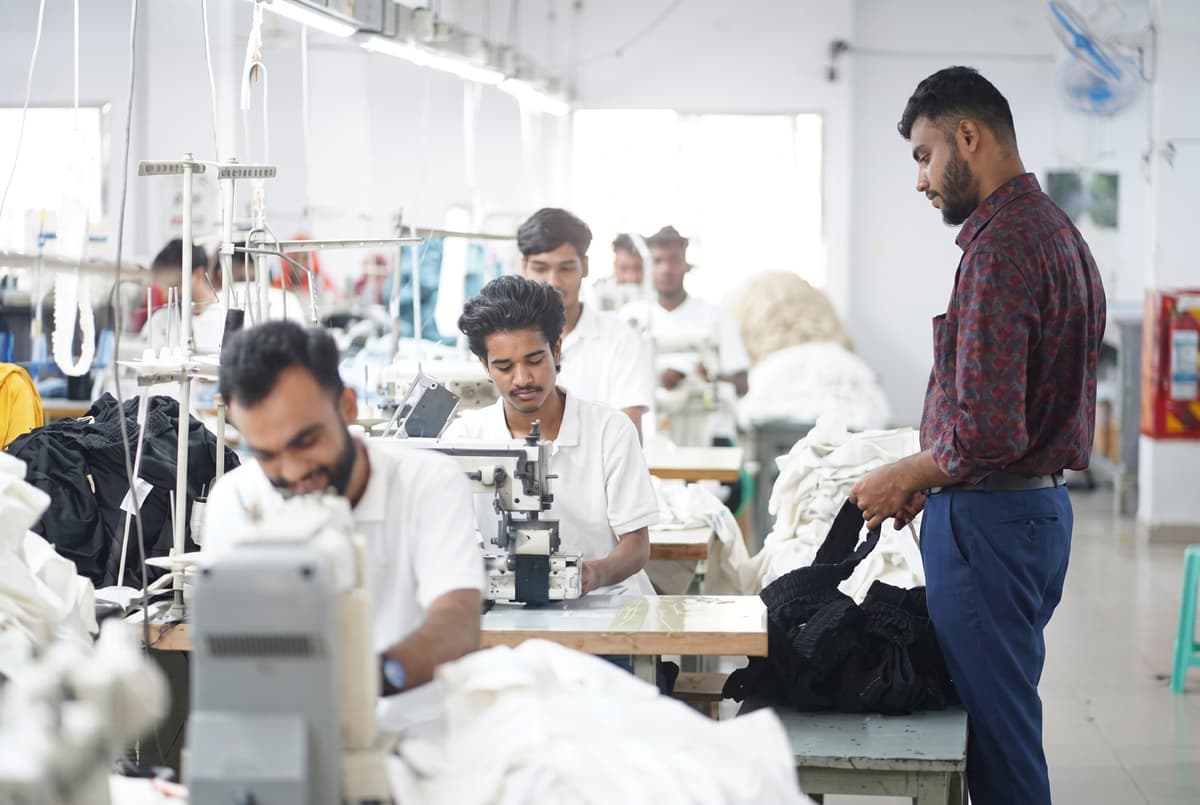
Own floor or agent. An agent can be useful, but you should know whether the business you pay owns the floor that sews your order. Ask for a live video call during a working shift and steer the camera yourself: the cutting table, a sewing line with work like yours on it, the packing area, and the sign on the building. Then match the address to the quote and to the origin declaration, because the factory that makes the declaration is the one HMRC can ask for production records. Our guide to the difference between a buying house and a factory explains what each is good for.
A certificate you can check. A logo proves nothing; a certificate number does. If you want organic cotton, ask for the GOTS certificate number, look it up in the free GOTS certified suppliers database, then ask whose certificate it is: the factory's or a mill's. Our guide to what GOTS certification means explains the scope certificate and the transaction certificate, which is the document behind any organic claim on your own label.
Audits, stated plainly. Ask which social audits a factory holds and ask to see the reports. Our own answer: we offer organic cotton, made in our GOTS-certified facility (RSC 9687), with the scope certificate on request, and we are members of BKMEA and the Narayanganj Chamber of Commerce and Industry. We do not hold amfori BSCI, SMETA, WRAP or Fair Trade. If a UK retailer you supply requires one of those audits, tell us at the start.
For an offshore shortlist to put through these checks, our comparison of low-MOQ clothing manufacturers sets published minimums and certificates side by side, ours included, and our guide to avoiding clothing manufacturer scams covers what to check before money or files change hands.
Timing for UK seasons
Offshore production runs on the factory's calendar, not the season's. On our floor the sequence is about 10 days of sampling, then 40 to 50 days of production after sample approval, then freight. Air freight to the UK takes about 5 to 7 days. Put together, plan on about 70 days from order to your door by air, and about a month more by sea. These are planning figures, not a promise for a particular order: the real dates depend on how quickly samples are approved, holiday closures and the routing.
| Stock needed in your warehouse by | Typical range | Place the order by air no later than about | Place the order by sea no later than about |
|---|---|---|---|
| Early February | Spring and summer | Late November | Late October |
| Early May | Summer top-up | Late February | Late January |
| Early August | Autumn and winter | Late May | Late April |
| Early October | Christmas and gifting | Late July | Late June |
Factories in Bangladesh close for Eid, whose dates move each year; our guide to how long clothing manufacturing takes covers this. If a launch date is fixed, plan for air freight from the start. The launch date calculator works the dates back from your on-sale day. A UK maker will usually be quicker for a first small run, which is one more reason some brands launch with a UK unit and move the styles that sell offshore.
Where we fit, and where we don't
We make cut-and-sew knitwear for UK brands in our own building in Narayanganj: tees, polos, hoodies, sweatshirts and joggers. Fabric is knitted and dyed at partner mills we specify and inspect, and screen printing, embroidery, DTF and sublimation are done in-house to your artwork. Our minimum is 150 pieces per style and colour. We quote DDP to any address in Great Britain, so freight, the customs entry and any duty sit inside one landed price, the import VAT method is agreed with you in writing, and the fibre composition label is sewn in to your approved artwork before anything ships.
Our page on clothing manufacturing for UK brands has the full detail on duty, VAT, labelling and freight, and our guide to starting a clothing brand in the UK covers the company, VAT and EORI steps that come before a first order.
And where we are the wrong choice: runs under 150 pieces, a range that has to be made in Britain, jumpers knitted from yarn, denim or tailoring, or a range you need to fit in person every week. For those, start with the directories above. If you are not sure which side of the line you are on, send us the brief anyway and we will tell you straight.
Frequently asked questions
How do I find a clothing manufacturer in the UK?
Start with the directories that say who they list and why, rather than a ranked list written by someone who has never visited the workrooms. Make it British sells a vetted list of UK manufacturers with minimums and lead times, which you can filter for low or no minimum order, and runs the Make it British Live! trade show in London. The Made in Britain campaign also lists its clothing and apparel members. Shortlist three to five makers who already sew garments like yours, then ask each for their minimum per style and colour, what sampling includes, whether they work CMT or full package, and who buys the fabric. Visit before you pay a deposit, because standing in the workroom and meeting the people who will sew your range is the main advantage of making in the UK.
Is it cheaper to make clothing in the UK or overseas?
Overseas is usually cheaper per piece at production quantities, but compare the landed cost, not the factory figure. In cut-and-sew, labour and overheads are paid on every garment, and they are where UK and offshore costs differ most. An offshore quote then needs freight, customs clearance and import VAT added before it can be compared with a UK one. Import VAT is reclaimable if your business is VAT-registered, and clothing from Bangladesh pays no UK duty when it meets the origin rule, so for a registered importer buying from Bangladesh the border adds little beyond freight and cash-flow timing. A UK maker can still be the better choice for very small runs, because an offshore knit factory has a minimum and set-up costs spread over few pieces. A DDP quote from the factory and a landed cost calculator let you compare both routes on the same basis.
What is the minimum order for a UK clothing manufacturer?
It varies widely, and many UK makers go lower than offshore factories. Small CMT units and sample rooms often sew runs of a few dozen pieces, and Make it British's list of UK manufacturers shows each entry's minimum and lets you filter for low or no minimum order. Very low minimums usually cost more per piece, because the set-up work of pattern, marker and machine changes is spread over fewer garments. Ask every maker two numbers: the minimum per style and the minimum per colour, because a CMT unit that needs you to supply the fabric may also leave you buying cloth in larger lengths than the run uses. Offshore knit factories are set by fabric dye lots instead. Ours is 150 pieces per style and per colour, so below that a UK unit is usually the better choice, and above it the offshore route starts to make sense.
Is clothing from Bangladesh duty-free into the UK?
Yes, when the garment meets the origin rule and the importer claims the preference. Bangladesh is in the Comprehensive Preferences tier of the UK's Developing Countries Trading Scheme, which gives 0% import tariffs on 99.8% of products, everything except arms and ammunition. On 5 November 2026 the UK Trade Tariff showed 0% for that tier on cotton T-shirts and men's cotton sweatshirts, against the UK Global Tariff of 12% that applies without a preference. For knitted garments sewn from pieces, the origin rule is manufacture from fabric, so a tee or hoodie cut and sewn in Bangladesh qualifies even if the fabric was knitted elsewhere. The claim is made with an origin declaration on a commercial document such as the invoice, which is valid for two years. Import VAT is separate and still due at 20% on adult clothing, though a VAT-registered business can reclaim it.
Do I pay VAT on clothing imported into the UK?
Yes. Import VAT is charged at the same rate as a UK sale of the same goods, which is 20% on adult clothing, while children's clothes are zero-rated. It is worked out on the customs value plus any duty and incidental costs such as transport and insurance to the first UK destination. A VAT-registered business reclaims it on its VAT return like any other input. With postponed VAT accounting, which needs no approval, a UK VAT-registered business declares and reclaims import VAT on the same return, so nothing is paid at the border. If a supplier arranges the import for you, GOV.UK says you must agree the method with them and give them your EORI number. A business that is not VAT-registered pays import VAT and cannot reclaim it, so decide with an accountant whether to register before you place a first order abroad.
What labels does clothing need to be sold in the UK?
The legal requirement is fibre composition. Under the Textile Products (Labelling and Fibre Composition) Regulations 2012, clothing made available in the UK must show its fibre content in English, naming each fibre with its percentage by weight, and Trading Standards guidance puts that responsibility on the manufacturer or the importer into the UK. If a garment can be ordered online from its description, the fibre content must also appear in the listing before purchase, and pure may only describe a garment made of a single fibre. Care labels and country-of-origin labels are not required by those regulations, although retailers expect care instructions and customers judge you on them. Any origin you do print must be true. Nightwear has its own safety labelling, and children's clothing has its own safety standards. Approve the label artwork with the factory before production, so it is sewn in rather than added later.
Can I say Made in Britain if my clothing is made overseas?
No. A garment sewn in Bangladesh is made in Bangladesh, and saying or implying otherwise is a misleading action under the Digital Markets, Competition and Consumers Act 2024, which covers false information about a product and true information presented in a misleading way. UK textile law does not force you to print an origin at all, so the honest options are to label it Made in Bangladesh or to leave origin off and keep your marketing consistent with that. Designed in London is fine if it is true, as long as the presentation does not suggest the garment was made there. The Made in Britain mark is separate again: it is a membership, and its rules require a substantial and transformative change in Great Britain or Northern Ireland and all of the labour that makes the finished product to be there. Printing an imported blank in the UK does not qualify.
Will clothing from Bangladesh stay duty-free in the UK after 2029?
Most likely, but not guaranteed. Bangladesh is scheduled to graduate from the UN list of least developed countries on 24 November 2029. GOV.UK's DCTS guidance gives a graduating country a three-year transition in the Comprehensive Preferences tier before it moves to Enhanced Preferences. On 5 November 2026 the UK Trade Tariff showed garments such as cotton T-shirts and sweatshirts at 0% under Enhanced Preferences, and GOV.UK says the rules of origin for chapters 61 and 62 stay the same on the move. The condition is that Bangladesh must also be judged economically vulnerable, based on export diversification. If it is not, it goes to Standard Preferences, where those lines showed 9.6%. No UK notice for Bangladesh has been published yet, so plan on zero duty, confirm the rate before each shipment, and keep origin documents complete. On DDP terms, the rate sits inside the factory's quote.
How long does it take to get clothing made in Bangladesh and shipped to the UK?
From our floor, plan on about 70 days from order to your door by air. That is about 10 days of sampling, then 40 to 50 days of production after the sample is approved, then freight. Air freight to the UK takes about 5 to 7 days, and sea freight adds about a month to the total. Treat these as planning figures rather than a promise for a specific order, because the real dates depend on how quickly you approve samples, factory holidays such as Eid, and shipping routes. For a seasonal range, work back from the date stock must be in your warehouse: spring and summer stock needed in early February means ordering by about late November by air. Add two to four weeks for a first order or a new block that needs more than one round of sampling, and use air freight for anything tied to a fixed launch.
Does Collective Studio manufacture clothing in the UK?
No. We are a clothing manufacturer for UK brands, not a UK clothing manufacturer. Collective Studio is a family-run cut-and-sew factory in Narayanganj, Bangladesh, and every garment is cut and sewn on our own floor there, with fabric knitted and dyed at partner mills we specify and inspect. We make tees, polos, hoodies, sweatshirts and joggers from 150 pieces per style and per colour, with organic cotton made in our GOTS-certified facility (RSC 9687). For UK orders we quote DDP, so freight, the customs entry and any duty sit inside one price, and the garments enter at 0% duty under the DCTS with our origin declaration on the invoice. If you need fewer than 150 pieces, fittings every week, jumpers knitted from yarn, or a genuine Made in Britain label, a UK maker from the directories above will serve you better, and we will say so.
Where this applies
The manufacturing pages this guide relates to, if you are costing a real run.
Free tools & guides for this
Sources & further reading
- Make it British: UK Manufacturers List (paid, vetted list; MOQ and lead-time filters; read 5 November 2026)
- Make it British: homepage (Make it British Live!, 12 and 13 January 2027, Business Design Centre, London; read 5 November 2026)
- Made in Britain: Clothing & Apparel members directory (read 5 November 2026)
- Made in Britain: membership eligibility (substantial and transformative change; 100% of labour in GB or NI)
- GOV.UK: Preference tiers under the Developing Countries Trading Scheme (Comprehensive 0% on 99.8% of products; three-year transition; economic vulnerability)
- GOV.UK: Rules of origin under the DCTS are improving (July 2025; in force 1 January 2026; 47.5% to 100% of inputs)
- GOV.UK: DCTS product-specific rules schedule for least developed countries (chapter 61: manufacture from fabric)
- GOV.UK: How to claim preferences under the DCTS (origin declaration, two-year validity, three-year record keeping)
- UK Trade Tariff: 6109 10 00 10, cotton T-shirts (UK Global Tariff 12%; DCTS Comprehensive and Enhanced 0%; Standard 9.6%; checked 5 November 2026)
- UK Trade Tariff: 6110 20 91 00, men's or boys' cotton jerseys and pullovers (same rates; checked 5 November 2026)
- GOV.UK: VAT rates (standard rate 20%; children's clothes zero-rated)
- GOV.UK: Check when you can account for import VAT on your VAT return (postponed VAT accounting)
- GOV.UK: Apply for an EORI number (GB EORI usually immediate, up to 5 working days)
- legislation.gov.uk: The Textile Products (Labelling and Fibre Composition) Regulations 2012 (SI 2012/1102)
- Business Companion (Trading Standards): Labelling of textiles (last reviewed July 2026)
- legislation.gov.uk: Digital Markets, Competition and Consumers Act 2024, section 226, misleading actions (in force 6 April 2025)
- UN LDC Portal: Bangladesh graduation status (scheduled 24 November 2029)
Cite this guide
For journalists, writers, researchers and students.
Quoting this guide? Please credit Collective Studio and link to this page.
Reference
Homaira Jashim, Collective Studio. "Clothing Manufacturers in the UK vs Offshore: An Honest Guide for UK Brands." 5 November 2026. https://collectivestudioltd.com/journal/clothing-manufacturers-uk-local-vs-offshore
Writing about us? Our press kit has our facts, logos and photos, free to use with credit.
Have an idea? Let’s make it.
We manufacture from 150 pieces per style and colour, with organic cotton options from our GOTS-certified facility and photos at every stage. Send a sketch or a sentence — we’ll reply within one business day.