What Changes for Clothing Imports in 2027: US, UK, EU, Canada and Australia
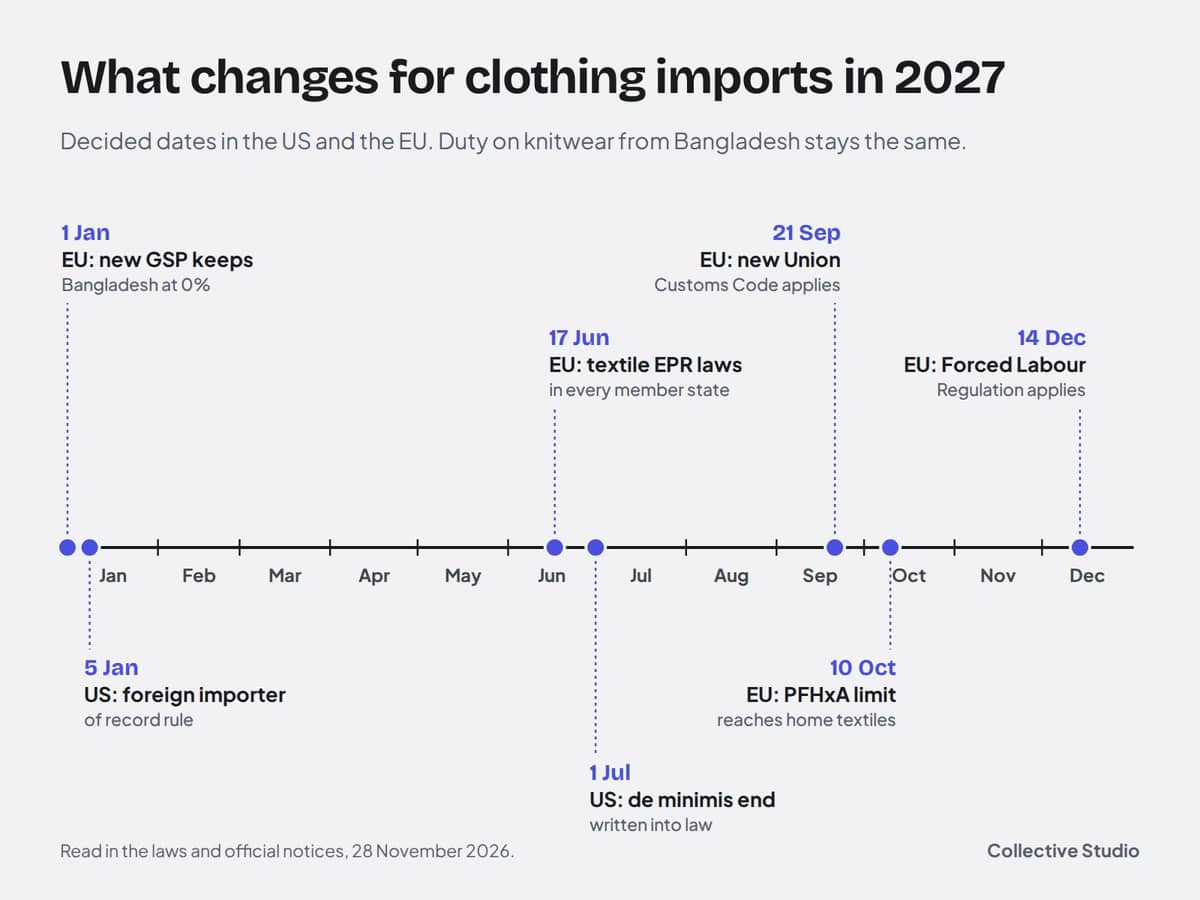
In 2027 the duty on knitwear from Bangladesh stays where it is in every main market: 0% into the UK, the EU, Canada and Australia when the origin rules are met, and 26.5% into the US on cotton knit tops. What changes is the paperwork around it. The US tightens who may act as importer of record from 5 January 2027. The EU's new customs code applies in full from 21 September 2027, and its ban on products made with forced labour applies from 14 December 2027. Several US states and the EU take further steps on PFAS, and every EU country must have a textile recycling law in force by 17 June 2027.
Collective Studio Ltd is a family-run knitwear factory in Narayanganj, Bangladesh. We cut and sew T-shirts, hoodies, joggers and activewear for brands in the UK, Europe, the USA, Canada and Australia, from 150 pieces per style and per colour. Every rule below was read in the law or on the government page linked beside it. Anything that is still only a plan is listed apart, under plans that may move. This is general information, not legal or customs advice. Last verified: 28 November 2026.
The short version
- Duty: no change in 2027 for Bangladeshi knitwear. The EU's new preference scheme starts on 1 January 2027 and keeps Bangladesh at 0%.
- USA: from 5 January a foreign importer of record must use a CTPAT-validated broker, and every US importer of record declares its status on each entry. On 1 July the end of the $800 de minimis exemption is written into law.
- EU: the new Union Customs Code applies from 21 September, with written duties for the importer. The Forced Labour Regulation applies from 14 December, to companies of every size.
- Chemicals: California's PFAS limit for clothing falls to 50 ppm on 1 January, Washington bans added PFAS in clothing made from that day, Vermont falls to 50 ppm on 1 July, and the EU's PFHxA limit reaches home textiles on 10 October.
- Recycling fees: EU countries must have textile EPR laws in force by 17 June, with schemes in every country by 17 April 2028.
- UK: little is decided for 2027. The end of the 135 pound low-value relief is due by October 2028.
Every decided change in 2027, by date
| Date | Market | What changes | Who it affects |
|---|---|---|---|
| 1 January 2027 | EU | New preference scheme, Regulation (EU) 2026/1395, applies. Bangladesh stays in Everything But Arms at 0% | Every importer of Bangladeshi clothing; the rate does not change |
| 1 January 2027 | USA (California) | PFAS limit in textile articles falls from 100 to 50 ppm total organic fluorine | Anyone selling clothing in California |
| 1 January 2027 | USA (Washington) | Clothing made from this day may not contain intentionally added PFAS | Anyone selling clothing in Washington |
| 1 January 2027 | EU (France, Denmark) | Allowances for older stock with PFAS finishes end | Only stock with water or stain repellent finishes |
| 5 January 2027 | USA | Interim rule on foreign importers of record takes effect | Every importer; most of all non-US founders and DDP shipments |
| 15 January 2027 | Canada | Importers using release before payment must top up their CARM financial security to this year's figure | Canadian importers of record enrolled for release before payment |
| 20 January 2027 | USA | Posted parcels of Bangladeshi goods need a formal entry or CBP's Entry Type 13 test | Samples and small orders sent by post |
| 12 February 2027 | EU | EPR marks on packaging may be shown only through a QR code or similar | Brands that print an EPR scheme mark on packs |
| 1 March 2027 | GOTS | Every GOTS audit uses version 8.1 | Brands selling GOTS-labelled goods |
| 17 April 2027 | EU | Commission sets one format for textile producer registration | Every brand selling clothing into the EU, indirectly |
| 17 June 2027 | EU | Every member state must have its textile EPR law in force | Every brand selling clothing into the EU, country by country |
| 1 July 2027 | USA | The end of the $800 de minimis exemption is written into law | No change in practice: it has been suspended since 29 August 2025 |
| 1 July 2027 | USA (Vermont) | PFAS limit in textiles falls from 100 to 50 ppm total organic fluorine | Anyone selling clothing in Vermont |
| 1 July 2027 | Australia | Unfair trading practices law starts: manipulative selling banned, subscriptions regulated, extra charges shown up front | Brands selling to Australian consumers, online most of all |
| 21 September 2027 | EU | New Union Customs Code, Regulation (EU) 2026/2108, applies; the 2013 code is repealed | Every importer into the EU |
| 1 October 2027 | USA | Customs fee floor and ceiling may adjust for fiscal year 2028 | Every importer; amounts not yet published |
| 10 October 2027 | EU | PFHxA limit extends to consumer textiles other than clothing | Brands selling towels, bed linen, blankets and similar |
| 1 December 2027 | EU | Commission decides whether the 3 euro parcel duty needs to run past 1 July 2028 | Brands posting orders to EU consumers from outside the EU |
| 14 December 2027 | EU | Forced Labour Regulation (EU) 2024/3015 applies | Every company placing products on the EU market, any size, online sellers included |
USA, 5 January 2027: who may be importer of record
CBP's interim final rule Heightened Requirements for Foreign Importers of Record (Federal Register 2026-22735) takes effect on 5 January 2027. It splits importers of record into US and foreign ones. A US importer of record is a US citizen or green-card holder, or a company organised and located in the US whose beneficial owners are at least 51% US citizens or permanent residents in control, or which owns a significant amount of unencumbered US property. Everyone else is a foreign importer of record.
- A foreign importer of record that is not itself validated in CTPAT, CBP's supply chain security programme, must use a licensed customs broker that is CTPAT-validated. Where the foreign company is not the owner or buyer of the goods, that broker must itself be the importer of record.
- A US importer of record must declare that it qualifies as one on every entry and entry summary. In practice the broker adds this.
- A US company owned by a founder abroad counts as a foreign importer of record on the 51% test, unless it owns significant US property. A UK, European or Australian founder importing through their own US company should talk to their broker before January.
- Brokers must fully comply by 6 May 2027, and comments on the rule close on 5 January 2027, so CBP may still amend it.
For a delivered duty paid (DDP) order, the question to ask your supplier and its forwarder is simple: which company will be named as importer of record on the US entry, is it a US or a foreign importer of record under the rule, and which CTPAT-validated broker will file it. Our guide to importing clothing into the US covers the rest of the entry.
USA: post, de minimis and customs fees
From 20 January 2027 a posted parcel of goods that carry chapter 99 duties, as goods of Bangladesh do, needs a formal entry, or for eligible parcels of 2,500 dollars or less, an entry under CBP's voluntary Entry Type 13 test. That matters for samples sent by post. Courier and freight shipments already need an entry.
On 1 July 2027 the commercial part of the 800 dollar de minimis exemption is removed from the law itself, by Public Law 119-21, section 70531(b). Nothing changes in practice that day, because the exemption has been suspended for every country since 29 August 2025, but a later executive order can no longer bring it back. The gift and traveller exemptions are separate and stay.
The Merchandise Processing Fee keeps its rate of 0.3464% of value on a formal entry. Its floor and ceiling for fiscal year 2027, which apply to entries up to 30 September 2027, were set in Federal Register 2026-15530; the amounts for fiscal year 2028 follow from 1 October 2027 if prices rose by more than 1%.
USA: PFAS in clothing, state by state
- California, 1 January 2027: clothing may not contain intentionally added PFAS, or PFAS at or above 50 ppm measured as total organic fluorine, down from 100 ppm (Health and Safety Code 108970). Outdoor apparel for severe wet conditions keeps its 2028 date.
- Washington, 1 January 2027: apparel and accessories made from that day may not contain intentionally added PFAS, and total fluorine above 50 ppm is presumed to show it was added (WAC 173-337-110). Stock made before 1 January 2027 is outside the ban, so keep the production date on file.
- Vermont, 1 July 2027: the measured limit falls from 100 to 50 ppm total organic fluorine (9 V.S.A. 2494e).
For untreated cotton and polyester knitwear the practical point is a test result below 50 ppm, because traces of fluorine from dyes, auxiliaries or packaging can show up in a total organic fluorine test. Our guide to US clothing regulations has the full state table.
What does not change in the US in 2027
The duty on cotton knit T-shirts and sweatshirts from Bangladesh, 26.5% (the 16.5% normal rate plus the 10% Section 301 duty in force since 24 July 2026), has no end date and no step scheduled in 2027. A court challenge to the Section 301 duties was argued on 30 September 2026 and had not been decided by 28 November 2026, and the promised duty-free quota for clothing made with US cotton had not been published. Our US tariff guide is kept up to date as either moves.
EU, 1 January 2027: the new preference scheme keeps Bangladesh at 0%
Regulation (EU) 2026/1395 replaces the 2012 preference scheme on 1 January 2027. Bangladesh stays in Everything But Arms, so knitwear that meets the origin rule keeps entering at 0%. When Bangladesh leaves the least developed country list on 24 November 2029, the regulation keeps that access for a three-year transition, which runs to about the end of 2032. The automatic safeguard for textiles and clothing in Article 33 does not apply to Everything But Arms countries. Our guide to the 2029 graduation explains the transition.
EU, 21 September 2027: the new Union Customs Code applies
The new customs code, Regulation (EU) 2026/2108, entered into force on 20 September 2026 and applies in full from 21 September 2027, when the 2013 code is repealed. For an importer three things stand out:
- One importer for each import, with written duties: to provide the data before release, make sure the duty is paid, and make sure the goods meet the other EU rules that customs enforces, keeping records of that (Article 27).
- Established in the EU: the importer must be established in the EU, unless it uses an indirect customs representative that is.
- Penalties: every member state must penalise a common EU list of customs offences.
The parts for online sales to consumers, the EU Customs Data Hub and the seller or platform acting as importer, follow on 1 July 2028. Ordinary customs declarations continue until 28 February 2031.
EU, 14 December 2027: products made with forced labour are banned
From 14 December 2027, Regulation (EU) 2024/3015 bans placing or making available on the EU market, or exporting, any product made wholly or partly with forced labour. It covers products from every country and companies of every size, and an online offer aimed at customers in the EU counts as making the product available there. There is no certificate to obtain. Authorities investigate on a risk basis, must take a company's size and resources into account, and can order products withdrawn, which customs then stops at the border.
For a small brand the useful preparation is a short supply chain file for each style: where the cotton was grown and spun, which mill knitted and dyed the fabric, and where the garment was cut and sewn. Ask your factory for those names now, while the order is being placed.
EU textile EPR: national laws by 17 June 2027
Under Directive (EU) 2025/1892 the Commission sets a single format for registering as a textile producer by 17 April 2027, and every member state must have its textile extended producer responsibility law in force by 17 June 2027. Schemes must exist in every country by 17 April 2028, and micro-enterprises are brought in from 17 April 2029 unless a country covers them earlier. A brand outside the EU selling directly to EU consumers counts as the producer in each country it sells into. France and the Netherlands already run schemes; our EU textile EPR guide has the details.
EU chemicals, packaging and parcels
- 1 January 2027: France's allowance for clothing with PFAS finishes made before 2026 ends, as does Denmark's allowance for existing stock. Plain cotton knitwear without such finishes is not affected in practice.
- 12 February 2027: under the Packaging and Packaging Waste Regulation, a mark showing that packaging is in an EPR scheme may be shown only through a QR code or similar digital marking, and member states must have penalties in place.
- 10 October 2027: the PFHxA limit in REACH entry 79, in force for consumer clothing since 10 October 2026, extends to other consumer textiles such as towels, bed linen and blankets. Articles placed on the market before that date are exempt. Our PFAS guide covers both steps.
- 1 December 2027: the Commission must decide whether the EU's system for charging duty on e-commerce will be ready by 1 July 2028. If not, it may propose keeping the 3 euro duty per item on parcels worth 150 euro or less, which runs from 1 July 2026 to 1 July 2028 under Regulation (EU) 2026/382. Our guide to the 3 euro duty explains who pays it.
Large companies also have to publish their figures for discarded unsold products in a set EU format from 2 March 2027. Small and micro companies are exempt from that and from the ban on destroying unsold clothing.
United Kingdom: little decided for 2027
Very little is decided for clothing imports into the UK in 2027. Bangladesh keeps 0% under the Developing Countries Trading Scheme, whose last rules of origin change took effect on 1 January 2026. Three dates are worth knowing:
- 1 January 2027: the UK carbon border adjustment mechanism starts. It covers aluminium, cement, fertiliser, hydrogen, iron and steel, not clothing, yarn or fabric.
- 1 April 2027: Plastic Packaging Tax changes how recycled content is counted. It applies only to businesses that import or make 10 tonnes or more of plastic packaging in 12 months, far above a small brand's poly bags, but HMRC asks businesses below the threshold to keep their packaging weights on file.
- By October 2028: the 135 pound customs duty relief for low-value imports is due to end, on a day the Treasury sets by regulations made by October 2028 at the latest. No 2027 date has been set.
Our UK import guide covers the duty, VAT and paperwork that already apply.
Canada, Australia and New Zealand
Bangladeshi clothing keeps its duty-free access in all three in 2027. Canada's Least Developed Country Tariff is renewed in law to 31 December 2034, and nothing changes at the Australian or New Zealand border for goods made in Bangladesh. The few decided dates are these:
- Canada, 15 January 2027: an importer enrolled for release before payment in CARM is told its new required security each 20 October and must post any increase by 15 January. Without it, each shipment waits for payment before release. If you buy DDP, ask who is importer of record; if it is you, this applies.
- Canada, 31 May 2027: supply chain reports under the forced labour and child labour reporting act are due again. They apply only to entities above two of three size tests (assets, revenue, 250 employees), so a small brand is almost always outside it, though a large retail buyer may ask you for information.
- Australia, 1 July 2027: the unfair trading practices law passed on 2 July 2026 starts on 1 July 2027. It bans selling tactics that manipulate consumers or distort their choices, regulates subscriptions from sign-up to cancellation, and requires extra per-transaction charges to be shown clearly next to the price. It is not a border rule, but it touches every brand selling online to Australians.
- New Zealand: nothing decided for 2027. The new goods levies started on 1 April 2026 and are reviewed every three years.
The Australia and EU free trade agreement, concluded on 24 March 2026, is expected to be signed in late 2026 or early 2027, with up to another year of parliamentary steps; it concerns goods made in the EU, not in Bangladesh. And there is no “HS 2027”: the next edition of the tariff code system takes effect on 1 January 2028, so no clothing codes change in 2027 for that reason. Our guides to importing into Canada, Australia and New Zealand cover the rules already in force.
GOTS 8.1 from 1 March 2027
Not a law, but a date for anyone selling GOTS-labelled clothing: every GOTS audit from 1 March 2027 uses version 8.1, which adds PFAS residue limits covering all PFAS compounds and conditions on where viscose and modal come from. Our organic cotton is made in our GOTS-certified facility (RSC 9687), and certificates are available on request.
Plans that may move
| Planned for | What | Where it stands on 28 November 2026 |
|---|---|---|
| Q4 2027 | EU ecodesign rules and Digital Product Passport for textiles | Commission's planned adoption date; compliance at least 18 months after, so about 2029 at the earliest |
| After 1 December 2027 | Keeping the EU 3 euro parcel duty past 1 July 2028 | Depends on the Commission's assessment |
| 1 July 2028 | EU e-commerce customs rules and the Customs Data Hub | In the law, but depends on the IT system being ready |
| By October 2028 | End of the UK 135 pound low-value relief | Date to be set by Treasury regulations |
| Not set | Court ruling on the US Section 301 duties | Argued 30 September 2026, not decided |
| Not set | US duty-free quota for Bangladeshi clothing made with US cotton | Announced, not published |
| Not set | New York's measured PFAS limit for clothing | No regulation proposed; it applies a year after adoption, so 2028 at the earliest |
| Not set | UK product safety rules under the Product Regulation and Metrology Act 2025 | Consultation closed 23 June 2026; no start date |
| Not set | Canada's forced labour import bill, C-35 | First reading 12 June 2026; the existing ban in the Customs Tariff stays |
| Not set | Australia's Modern Slavery Act penalties and offence | Consultation closed 25 September 2026; proposed for large companies only |
| Not set | New Zealand's Modern Slavery Bill | Reported back from committee on 31 August 2026; not passed |
A checklist for orders landing in 2027
- Importer of record (US): confirm who it is on every US entry and whether that company is a US or a foreign importer of record from 5 January.
- Supply chain file (EU): for each style, record where the cotton was spun, which mill knitted and dyed the fabric, and where it was sewn, before the forced labour rules apply on 14 December.
- PFAS test (US states and EU): ask for a total organic fluorine result below 50 ppm on each fabric, and keep the production date of stock sold in Washington.
- EPR registration (EU): check the new national law in each country you sell into after 17 June.
- Samples by post (US): from 20 January, plan for a formal entry or a courier instead.
- Timing: by air, allow about 70 days from order to door; the 2027 production calendar gives the latest order date for each launch month.
Frequently asked questions
What changes for clothing imports in 2027?
Duty on knitwear from Bangladesh does not change: 0% into the UK, the EU, Canada and Australia when the origin rules are met, and 26.5% into the US on cotton knit tops. The changes are in the rules around it. The US tightens who may be importer of record from 5 January 2027. The EU's new customs code applies from 21 September 2027 and its forced labour ban from 14 December 2027. California's PFAS limit for clothing falls to 50 ppm on 1 January 2027, and every EU country must have a textile EPR law in force by 17 June 2027.
Does the US de minimis exemption end in 2027?
It ends in the law on 1 July 2027, under Public Law 119-21, section 70531(b). In practice nothing changes that day: the 800 dollar exemption has been suspended for every country since 29 August 2025, so parcels already need an entry and pay full duty. The gift and traveller exemptions are separate and stay.
What is the CBP foreign importer of record rule?
It is an interim final rule, Federal Register 2026-22735, in force from 5 January 2027. A foreign importer of record that is not validated in CTPAT must use a CTPAT-validated customs broker, and that broker must be the importer of record when its client is not the owner or buyer of the goods. Every US importer of record must declare its status on each entry. A US company counts as a US importer of record only if at least 51% of its beneficial owners are US citizens or permanent residents in control, or it owns significant unencumbered US property.
When does the EU Forced Labour Regulation apply?
From 14 December 2027. Regulation (EU) 2024/3015 bans placing products made with forced labour on the EU market, or exporting them, for companies of every size, and online offers aimed at EU customers count. There is no certificate; authorities investigate on a risk basis and can order products withdrawn.
When does the new EU customs code apply?
Regulation (EU) 2026/2108 entered into force on 20 September 2026 and applies in full from 21 September 2027, when the 2013 Union Customs Code is repealed. It gives the importer written duties and requires the importer to be established in the EU or use an EU-based indirect representative. The rules for online sales to consumers follow on 1 July 2028.
Will Bangladesh lose duty-free access to the EU in 2027?
No. The EU's new preference scheme, Regulation (EU) 2026/1395, applies from 1 January 2027 and keeps Bangladesh in Everything But Arms at 0%. Bangladesh is due to leave the least developed country list on 24 November 2029, and the regulation then keeps the access for a three-year transition, to about the end of 2032.
What PFAS rules for clothing change in 2027?
In the US, California's limit falls from 100 to 50 ppm total organic fluorine on 1 January 2027, Washington bans intentionally added PFAS in clothing made from that day, and Vermont falls to 50 ppm on 1 July 2027. In the EU, the PFHxA limit already in force for consumer clothing extends to other consumer textiles on 10 October 2027, and France's and Denmark's allowances for older stock end on 1 January 2027.
Does anything change for UK clothing imports in 2027?
Very little is decided. Bangladesh keeps 0% under the Developing Countries Trading Scheme. The UK carbon border adjustment mechanism starts on 1 January 2027 but does not cover clothing, and Plastic Packaging Tax changes on 1 April 2027 only affect businesses handling 10 tonnes or more of plastic packaging a year. The end of the 135 pound low-value relief is due by October 2028.
Does anything change for importing clothing into Canada or Australia in 2027?
Duty does not: Bangladeshi clothing stays free under Canada's Least Developed Country Tariff, renewed to 31 December 2034, and under Australia's preference for least developed countries. In Canada, importers using release before payment must top up their CARM security by 15 January 2027. In Australia, a new unfair trading practices law for selling to consumers starts on 1 July 2027.
Is there an HS 2027 update to tariff codes?
No. The World Customs Organization's next edition of the Harmonized System takes effect on 1 January 2028, so tariff codes for clothing do not change in 2027 because of an HS revision. National tariffs can still change their own rates.
Where this applies
The manufacturing pages this guide relates to, if you are costing a real run.
Free tools & guides for this
Sources & further reading
- Federal Register 2026-22735: Heightened Requirements for Foreign Importers of Record (6 November 2026)
- Federal Register 2026-21600: de minimis suspension for mail shipments, compliance date 20 January 2027
- Public Law 119-21, section 70531(b): end of the commercial de minimis exemption from 1 July 2027
- Federal Register 2026-15530: customs user fees for fiscal year 2027
- Federal Register 2026-15181: Section 301 actions, 10 percent on products of Bangladesh
- California Health and Safety Code section 108970 (PFAS in textile articles)
- Washington Administrative Code 173-337-110 (PFAS in apparel)
- Vermont Statutes, 9 V.S.A. 2494e (regulated PFAS)
- Regulation (EU) 2026/1395, the EU's generalised scheme of preferences from 1 January 2027
- Regulation (EU) 2026/2108, the Union Customs Code (applies from 21 September 2027)
- Regulation (EU) 2024/3015, prohibiting products made with forced labour (applies from 14 December 2027)
- Directive (EU) 2025/1892, amending the Waste Framework Directive (textile EPR)
- Regulation (EU) 2025/40 on packaging and packaging waste
- Commission Regulation (EU) 2024/2462, REACH entry 79 (PFHxA)
- Council Regulation (EU) 2026/382, the 3 euro customs duty on low-value consignments
- Commission Implementing Regulation (EU) 2026/2, format for disclosing discarded unsold products
- Légifrance: Décret n° 2025-1376 du 28 décembre 2025 (PFAS in clothing, stock made before 2026)
- European Commission: Digital Product Passport for textiles and apparel
- GOV.UK: Developing Countries Trading Scheme
- GOV.UK: factsheet, carbon border adjustment mechanism
- GOV.UK: Plastic Packaging Tax, mass balance approach and removal of pre-consumer plastic
- GOV.UK: reforming the customs treatment of low-value imports
- GOTS: Global Organic Textile Standard version 8.1 (PDF)
- Finance Canada: unilateral tariff preference programs (GPT and LDCT renewed to 31 December 2034)
- CBSA: CARM release prior to payment, financial security
- Public Safety Canada: reporting obligations under the Fighting Against Forced Labour and Child Labour in Supply Chains Act
- Treasury ministers: unfair trading tricks and traps to be banned (2 July 2026)
- DFAT: Australia and European Union free trade agreement, next steps (PDF)
- New Zealand Customs: new goods management levies
- World Customs Organization: HS 2028 amendments effective from 1 January 2028
Cite this guide
For journalists, writers, researchers and students.
Quoting this guide? Please credit Collective Studio and link to this page.
Reference
Homaira Jashim, Collective Studio. "What Changes for Clothing Imports in 2027: US, UK, EU, Canada and Australia." 28 November 2026. https://collectivestudioltd.com/journal/clothing-import-changes
Writing about us? Our press kit has our facts, logos and photos, free to use with credit.
Have an idea? Let’s make it.
We manufacture from 150 pieces per style and colour, with organic cotton options from our GOTS-certified facility and photos at every stage. Send a sketch or a sentence — we’ll reply within one business day.