Bangladesh's LDC Graduation Moves to 2029: What It Means for European Brands
The short answer. On 29 October 2026 the UN General Assembly gave Bangladesh three more years before it leaves the group of Least Developed Countries (LDCs). Graduation was due on 24 November 2026. It's now scheduled for 24 November 2029, and the UN committee that oversees graduation has said it doesn't expect to support another delay. For Europe, that means clothing made in Bangladesh keeps 0% duty in the EU, and under the UK's equivalent scheme, until about the end of 2032. After that, most Bangladeshi garments entering the EU would probably pay the normal rate of around 12%. The extension gives buyers a long window, but that window has a fixed end.
We are a knitwear factory in Narayanganj, Bangladesh, with an office in Amsterdam, and most of what we make goes to European brands. So we've an interest in how this reads. We've tried to write the version we'd want to read if we were the buyer. Every date and figure below links to the document it comes from, and where something isn't yet settled we say so. For the order-level detail on rules of origin and landed cost, read our companion guide, Bangladesh's LDC graduation: what it actually changes for your orders.
The decision in numbers
| What it is | Source | |
|---|---|---|
| Original graduation date | 24 November 2026 | UN LDC Portal, set by resolution 76/8 (2021) |
| New graduation date | 24 November 2029 | UN draft resolution A/81/L.8, adopted 29 October 2026 |
| EU 0% duty (Everything But Arms) continues to | About 24 November 2032; the European Commission fixes the exact date later | EU GSP Regulation 2026/1395, Art. 17(2) |
| UK 0% duty (DCTS Comprehensive tier) continues to | About November 2032, then the Enhanced tier | UK government, DCTS tiers |
| EU duty on most garments without a preference | About 12% | UN CDP crisis assessment, May 2026 |
| Bangladesh's share of EU apparel imports | About 21 to 22% | UN CDP crisis assessment |
| EU share of Bangladesh's garment exports, July 2025 to June 2026 | 49% ($19.06bn of $38.70bn) | Export Promotion Bureau data, via The Financial Express |
What the UN decided on 29 October 2026
The General Assembly adopted draft resolution A/81/L.8, introduced by Uruguay on behalf of the Group of 77 and China. Its key paragraph says the Assembly "decides, on an exceptional basis, to extend by an additional period of three years, until 24 November 2029" the period Bangladesh has to prepare for graduation. Nepal received the same extension in the same text. bdnews24 reported that the resolution passed without objection, with the EU, France and Canada supporting it while stressing the need for reform. The Kathmandu Post described the Nepal decision as unanimous. On 31 October 2026 the UN LDC Portal read: "Bangladesh is scheduled to graduate on 24 November 2029."
The words exceptional basis matter. The resolution ties the extension to domestic reforms and asks Bangladesh to report its progress every year to the Committee for Development Policy (CDP), the UN expert body that monitors countries on their way out of the category. The final resolution number had not been published when we checked; the draft text is the one that was adopted.
Bangladesh didn't get more time because it slipped backwards. The CDP's own crisis assessment, published in May 2026, found it still meets all three graduation criteria "with comfortable margins". The case for more time rested on shocks that hit at once: the conflicts in the Middle East and the Red Sea, uncertainty in world trade, problems in the banking sector, the July 2024 uprising and change of government, and the cost of hosting Rohingya refugees. The committee was candid that a political transition isn't formal grounds for an extension under the current rules, but said it "may merit considering" in this case.
"…it does not foresee any possibility of supporting any subsequent request for an extension by the Government of Bangladesh." UN Committee for Development Policy, Crisis Assessment: Bangladesh, May 2026
That sentence is the most useful one for planning. The committee also wrote that "a shorter extension of the preparatory period would appear more conducive for a sustainable graduation". In short: 2029 is the date to plan around, and nobody should build a sourcing strategy on the hope of a second delay.
How we got here: a timeline
| When | What happened |
|---|---|
| 1971 | The UN creates the Least Developed Country category. |
| 1975 | Bangladesh, four years after independence, is added to the list. |
| 2018 | Bangladesh meets all three graduation criteria for the first time at the CDP's three-yearly review. |
| 2021 | It meets them again and the CDP recommends graduation. Resolution 76/8 (24 November 2021) sets the date at 24 November 2026, with five years to prepare instead of the usual three because of COVID-19. |
| February 2024 | The CDP reviews whether five years is still enough and keeps the 2026 date. |
| July to August 2024 | A student-led uprising ends in a change of government. |
| February 2025 | Bangladesh adopts its Smooth Transition Strategy for leaving the category. |
| 6 February 2026 | Bangladesh and Japan sign an Economic Partnership Agreement covering garments. |
| 18 February 2026 | Bangladesh formally asks the CDP for more time. |
| May 2026 | The CDP's crisis assessment supports a shorter extension and rules out a second one. |
| 22 June 2026 | The EU publishes its new trade-preference law, Regulation (EU) 2026/1395. |
| 21 July 2026 | The UN Economic and Social Council (decision 2026/345) asks the General Assembly to decide before 24 November 2026. |
| 29 October 2026 | The General Assembly moves graduation to 24 November 2029. |
| 1 January 2027 | The EU's new preference scheme applies. Viet Nam reaches 0% EU duty on all garments under its trade agreement. |
| 24 November 2029 | Bangladesh graduates. |
| About November 2032 | The EU and UK three-year transitions end. |
What LDC status is, and how a country leaves it
The LDC category is the UN's list of the world's most structurally disadvantaged economies. Being on it opens doors: duty-free access to rich markets, softer rules at the World Trade Organization, cheaper finance and dedicated aid. Leaving it, called graduation, is a sign of progress, and it also means those doors start to close.
The CDP tests every developing country every three years against three measures. A country qualifies to graduate when it passes two of the three at two reviews in a row, or when its income alone is at least twice the line. Bangladesh passes all three, and by a wide margin:
| Criterion | What it measures | Line to graduate (2024) | Bangladesh (2026) |
|---|---|---|---|
| Income (GNI per person) | Average national income per person over three years | $1,346 or more | $2,921 |
| Human Assets Index | Health, nutrition and education | 66 or more | 79.4 |
| Economic and Environmental Vulnerability Index | Exposure to shocks such as disasters and export swings (lower is better) | 32 or less | 23.7 |
Graduation doesn't switch everything off on one day. Each trading partner has its own transition rules, which is why the date that matters to a buyer in Berlin, Amsterdam or Stockholm isn't 2029 but the end of their own market's transition.
Why Europe comes out ahead
Europe is where LDC status is worth most to Bangladesh, and where the extension matters most to buyers. Roughly half of Bangladesh's garment exports go to the EU, and Bangladesh supplies about a fifth of all the clothing the EU imports. Under the EU's Everything But Arms scheme those garments enter at 0% duty with no quota. Without it, the CDP expects most of them to face the EU's standard rate, which averages about 12% on apparel.
Under the old timetable, 0% duty would have ended around the end of 2029. Under the new one, it runs to around the end of 2032. That's three extra years of 0% duty on every order a European brand ships from Bangladesh, with nothing new to file beyond the proof of origin importers already use.
Here's what that's worth on a few common knitwear products. The customs values are examples, not our prices; your saving depends on your own values, volumes and customs codes.
| Product (EU customs code) | Example customs value per piece | Duty avoided per 1,000 pieces at 12% | Over three extra years at four orders a year |
|---|---|---|---|
| Cotton jersey T-shirt (6109 10) | €5.00 | €600 | €7,200 |
| Cotton knitted joggers (6103 42) | €10.00 | €1,200 | €14,400 |
| Cotton fleece hoodie (6110 20) | €13.00 | €1,560 | €18,720 |
For a brand ordering 4,000 hoodies a year, that's close to €19,000 kept in the business over the three years: enough to pay for a sampling round, a photo shoot or a new colourway. If you order more, your saving grows in a straight line.
Compare that with the United States, which never gave Bangladeshi clothing a duty preference. American importers pay the normal duty plus a reciprocal tariff, which a February 2026 US–Bangladesh agreement caps at 19% on top of the standard rate, though the legal position has moved since. Bangladesh is still one of the largest suppliers of clothing to the US, which shows how competitive it's on price and scale. A European brand gets that same factory base, with 0% duty on top.
Market by market across Europe
| Market | What Bangladesh gets now | After graduation on 24 November 2029 | Probable end of 0% duty |
|---|---|---|---|
| European Union (27 countries) | Everything But Arms: 0% duty, no quota | A three-year transition on full EBA terms. Article 17(2) of the new EU regulation counts it from graduation; the Commission confirms the date in a separate act | About 24 November 2032. Past cases were rounded to 1 January, so it could be 1 January 2033 |
| United Kingdom | DCTS Comprehensive Preferences: 0% duty | A three-year transition, then the Enhanced tier if Bangladesh is judged economically vulnerable. Garments were 0% under Enhanced on the UK Trade Tariff on 22 September 2026; otherwise the Standard tier, 9.6% on cotton tees | About late 2032 for the Comprehensive tier; garments could stay at 0% under Enhanced |
| Switzerland | Swiss preferences for LDCs: 0% duty | Swiss rules apply; the UN LDC Portal lists no fixed transition period | Not published; check with Swiss customs for your product |
| Norway | Norwegian preferences for LDCs: 0% duty | Norwegian rules apply; no fixed transition period listed | Not published; check with Norwegian customs |
| Türkiye | Preferences for LDCs | Keeps LDC treatment for three years, according to the UN LDC Portal | About late 2032 |
If you buy for a particular country, our market pages set out duty, VAT, labelling and shipping in more detail: Europe overall, Germany, the Netherlands, France, Italy, Spain, Sweden, Denmark, Ireland, the UK, Switzerland and Norway. For the customs process itself, see how to import clothing into the EU and into the UK.
Outside Europe, in brief
- Canada. Canada has said graduating countries get an additional three-year period to retain full tariff benefits. Its preference programmes run to 31 December 2034, and since 1 January 2025 cutting and sewing in Bangladesh is enough to count as Bangladeshi origin. Both the UN and the CDP describe the three years as Canada's stated intention rather than a rule written into law. See how to import clothing into Canada.
- Japan. An Economic Partnership Agreement signed on 6 February 2026 gives duty-free access to 7,379 Bangladeshi products, about 97% of what Bangladesh sells to Japan, garments included (CDP). Separately, Japan's own preference scheme keeps LDC treatment for three years after graduation. See how to import clothing into Japan.
- Australia. Bangladeshi press has reported that Australia will keep duty-free access after graduation. We haven't found an Australian government document that sets out the terms, so treat this as unconfirmed. See how to import clothing into Australia.
- United States. There is no preference to lose, because the US never gave Bangladeshi clothing one. What matters there's the tariff situation, which has changed several times since 2025. See how to import clothing into the US.
- China and India. The UN LDC Portal lists China as keeping LDC treatment for three years after graduation and records no stated transition period for India.
The catch: what happens after 2032
This is the part a cheerful sales page would leave out. When the EU transition ends, Bangladesh can apply for GSP+, the EU's scheme for vulnerable countries that sign up to 32 international conventions on human rights, labour, the environment and governance. The new EU regulation removed an import-share test that would have ruled Bangladesh out, and Bangladesh has ratified all 32 conventions. On paper, the door is open.
For clothing, though, two rules get in the way. The first is a safeguard in Article 33 of the new regulation: the EU withdraws GSP and GSP+ preferences on textiles and clothing from any country that supplies more than 37% of the EU's imports of those goods from GSP countries and more than 6% of all EU imports of them. Bangladesh is far above both lines. The CDP's reading is that its garments "may face Most-Favoured-Nation (MFN) tariffs averaging 12 per cent". The second is rules of origin. Under EBA a garment made from imported fabric still counts as Bangladeshi. Under GSP+ it generally needs double transformation, meaning the fabric must be made in Bangladesh too. Knitwear mostly clears that bar, because most knit fabric is knitted locally; woven garments often do not. Our companion guide explains the origin rules in detail.
Meanwhile, competitors are getting closer. Under its free trade agreement, Viet Nam reaches 0% EU duty on all garments from 1 January 2027. The EU and India concluded a free trade agreement in January 2026, and Pakistan already uses GSP+. A UNCTAD simulation quoted by the CDP estimates that Bangladesh's clothing exports to the EU could fall by 28% if it moved from EBA to standard GSP, and by 32% if it lost preferences entirely. An earlier WTO and Enhanced Integrated Framework study put the fall in Bangladesh's total exports at around 14% on graduation.
What could change the picture is a trade agreement. The EU and Bangladesh initialled a Partnership and Cooperation Agreement in April 2026, and talks about launching free trade negotiations are under way, but they haven't formally started. Nobody can promise an outcome, and we won't.
Two readings of the extension
The case for it. Bangladesh faced several shocks at once, it's meeting every graduation criterion, and a few more years let factories, banks and the government prepare without a sudden loss of preferences in the middle of a downturn. The EU, France and Canada supported the resolution.
The case for caution. The CDP itself warned that staying in the category longer also delays the benefits of graduation, including the push to rely less on preferences and move into higher-value production. That's why it argued for a shorter extension and ruled out another one. The extra time is only worth something if it's used.
Both readings point to the same practical advice for a buyer: treat 2029 to 2032 as working time, not as a reason to wait.
What a European brand should do with the extra three years
- Build the relationship now. 0% duty gives you margin to sample, test and grow with a factory while the cost of learning is low. A supplier you've worked with for five years is worth more in 2033 than one you found in a hurry.
- Get the paperwork right on every shipment. Use the correct customs code and make sure each shipment carries a valid statement on origin from a registered (REX) exporter. A preference you can't prove is a preference you don't get.
- Price both futures. Work out your landed cost at 0% and at 12%. If a product only works at 0%, you know which line to rethink before 2032, not after.
- Favour knits for long programmes. Knitwear made from fabric knitted in Bangladesh already meets the stricter double-transformation rule, so it's better placed for GSP+ or a future trade agreement. Ask any supplier where your fabric is knitted.
- Watch three things. The Commission's act fixing the end of EBA for Bangladesh, Bangladesh's GSP+ application, and whether EU–Bangladesh trade negotiations formally open.
- Don't overreact either way. Moving a programme costs time and money, and every alternative country has its own exposure. Bangladesh stays competitive in the US with no preference at all.
How to cite this article
If you use this article in research, teaching or reporting, you can quote it freely. Please cite it as:
Jashim, H. (2026, 31 October). Bangladesh's LDC graduation moves to 2029: What it means for European brands. Collective Studio. https://collectivestudioltd.com/journal/bangladesh-ldc-graduation-2029-europe
For academic work, cite the primary UN and EU documents below directly as well. Journalists and researchers who need figures from the factory floor, or a comment, can write to hello@collectivestudioltd.com.
Sources
- United Nations General Assembly, draft resolution A/81/L.8: Extension of the preparatory period preceding the graduation of Bangladesh and Nepal (20 Oct 2026)
- UN LDC Portal (UN-OHRLLS): Bangladesh graduation status
- UN Committee for Development Policy: Crisis Assessment, Bangladesh (May 2026)
- UN Economic and Social Council: draft decision E/2026/L.24, adopted as decision 2026/345 (21 Jul 2026)
- UN DESA: The Least Developed Country category and its criteria
- UN LDC Portal: preferential market access after graduation, by country
- Government of Bangladesh: Smooth Transition Strategy (February 2025)
- EUR-Lex: Regulation (EU) 2026/1395 on the generalised scheme of tariff preferences
- Council of the EU: final text of the GSP regulation, PE-CONS 3/26 (Articles 17 and 33, Annex V)
- European Commission, Access2Markets: the EU's renewed GSP scheme, key updates for 2027 (11 Aug 2026)
- European Commission, Access2Markets: Everything But Arms
- European External Action Service: EU and Bangladesh pave the way for a closer partnership (April 2026)
- UK Government: preference tiers under the Developing Countries Trading Scheme
- UK Government: preference tier graduation notice, Bhutan (how the UK counts the three years)
- UK Government: improved DCTS rules of origin in effect (January 2026)
- Department of Finance Canada: tariff preference programmes for developing countries
- World Trade Organization: graduation from LDC status
- Enhanced Integrated Framework (WTO): trade impacts of LDC graduation (2020)
- UNCTAD: GSP Handbook on the Scheme of the European Union
- Office of the US Trade Representative: US–Bangladesh Agreement on Reciprocal Trade (9 Feb 2026)
- The Financial Express (Dhaka): EU share erodes as RMG exports slip to $38.70bn in FY26
- bdnews24 (Dhaka): report on the General Assembly session, 30 Oct 2026
- The Kathmandu Post: UN extends Nepal's LDC graduation preparatory period until November 2029 (30 Oct 2026)
Trade rules change. This article states the position as at 31 October 2026. The European Commission's own GSP page still said Bangladesh keeps EBA "at least until the end of 2029" when we checked; that wording predates the UN decision. If you're making a decision that depends on these dates, check the primary sources above and ask us for the current position on your product.
See the floor behind this article
Rules and dates are only half of a sourcing decision. The other half is the factory you choose. Here's ours, so you can judge it yourself.
Collective Studio is a family-run clothing manufacturer in Bangladesh based in Narayanganj, with an office in Amsterdam. We run our own cut-and-sew floor, make organic cotton in our GOTS-certified facility (RSC 9687), and produce from 150 pieces per style and colour. We are a 100% export factory: everything we make ships abroad, DDP.
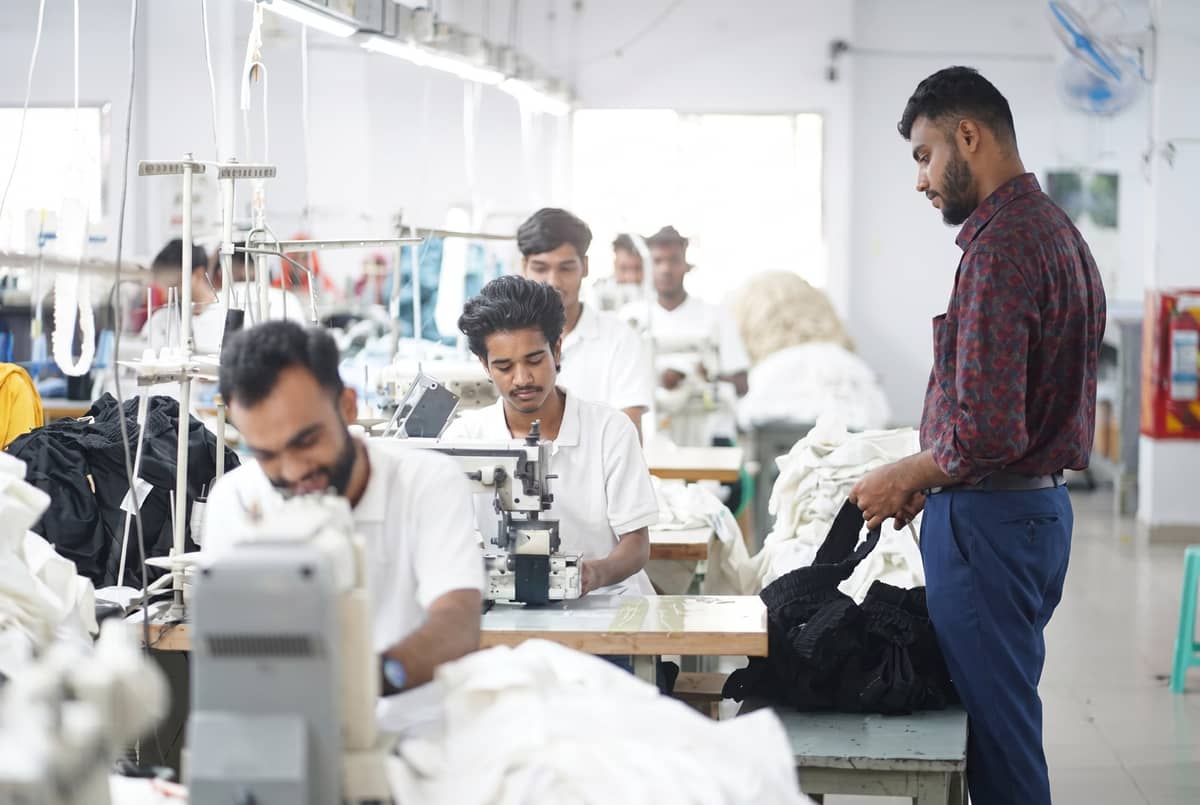
Cover photo: our sewing line in Narayanganj, Bangladesh. Photo: Collective Studio.
What clients say
Best supplier! On time, reliable and perfect craft.
I have had a very good experience with this company. They are very friendly, professional, and provide fast service. They speak fluent English, which makes communication very easy. The quality of their manufacturing is excellent. I have no doubt in recommending this company to anyone looking for a reliable manufacturing partner in Bangladesh.
Frequently asked questions
When will Bangladesh graduate from LDC status now?
On 24 November 2029. The UN General Assembly moved the date from 24 November 2026 on 29 October 2026, extending Bangladesh's preparatory period by three years on an exceptional basis. Nepal received the same extension in the same resolution.
Could the graduation date move again?
It's very unlikely. In its May 2026 crisis assessment, the UN Committee for Development Policy said it doesn't foresee any possibility of supporting a further request for an extension from Bangladesh. Plan around 24 November 2029.
How long will clothing from Bangladesh stay duty-free in the EU?
Until about 24 November 2032. The EU's Everything But Arms scheme keeps full terms for three years after graduation, under Article 17(2) of Regulation (EU) 2026/1395. The European Commission fixes the exact end date in a separate act, and in past cases it was rounded to 1 January, so it could be 1 January 2033.
What duty will EU importers pay after the transition ends?
Probably the standard EU rate, which averages about 12% on clothing, unless an EU–Bangladesh trade agreement changes it. Bangladesh can apply for GSP+, but a textile safeguard in the new EU regulation withdraws preferences on clothing from countries with a share as large as Bangladesh's.
Does the UK follow the same timeline as the EU?
Almost. The UK's Developing Countries Trading Scheme keeps Bangladesh on its 0% Comprehensive tier for three years after graduation, so until about late 2032. After that Bangladesh moves to the Enhanced tier if it's judged economically vulnerable, where garments were 0% on the UK Trade Tariff on 22 September 2026, with the same cut-and-sew origin rule since January 2026.
Why did the UN agree to give Bangladesh more time?
Because of overlapping shocks, not because Bangladesh fell short. The CDP found it still meets all three graduation criteria by comfortable margins, but pointed to the conflicts in the Middle East and the Red Sea, trade uncertainty, banking-sector problems, the 2024 political transition and the Rohingya situation.
Is this a good time for a European brand to start producing in Bangladesh?
It's a strong window, with an end date. A brand that starts now gets about six years of 0% EU duty, three more than under the old timetable, to build a supplier relationship. Knitwear made from locally knitted fabric is also best placed for whatever replaces EBA after 2032.
Where this applies
The manufacturing pages this guide relates to, if you are costing a real run.
Cite this guide
For journalists, writers, researchers and students.
Quoting this guide? Please credit Collective Studio and link to this page.
Reference
Homaira Jashim, Collective Studio. "Bangladesh's LDC Graduation Moves to 2029: What It Means for European Brands." 31 October 2026. https://collectivestudioltd.com/journal/bangladesh-ldc-graduation-2029-europe
Writing about us? Our press kit has our facts, logos and photos, free to use with credit.
Have an idea? Let’s make it.
We manufacture from 150 pieces per style and colour, with organic cotton options from our GOTS-certified facility and photos at every stage. Send a sketch or a sentence — we’ll reply within one business day.