Bangladesh: Land, People and History · Chapter 6 of 16
Dhaka Muslin and Jamdani: The History of Bengal's Finest Fabric
Dhaka muslin was a handspun, handwoven cotton cloth, made from a local cotton called phuti, so fine that a piece one yard wide and ten yards long was said in 1851 to pass through the smallest wedding ring.1 Its export trade peaked in 1787, declined from 1793 as cheaper British machine-made cotton took its markets, and lost its European outlet when the East India Company closed its Dhaka residency in 1817; by 1844 fine muslin of local yarn was worth only Rs 50,000 a year.2 Jamdani, the patterned muslin, is still woven and was listed by UNESCO in 2013, and two projects have been trying to revive muslin itself since 2014.3
- 250+ miles
- Length of thread spun from one pound of Dhaka cotton, in a skein measured in 18464
- 1,800 to 1,900
- Warp threads in a half-piece of mulmul khas, the grade made for the emperor5
- 1787
- Peak year of Dhaka's cloth trade: Rs 50 lakh of cloth at prime cost passed the custom house6
- 1817
- Year the Company abolished its Commercial Residency at Dhaka and closed the factory7
- Rs 50,000
- Value of fine muslin woven from local yarn at Dhaka in 1844, out of about Rs 955,000 of cloth8
- 2013
- Year UNESCO inscribed the traditional art of jamdani weaving on its Representative List9
Sources: A Descriptive and Historical Account of the Cotton Manufacture of Dacca (1851); Taylor (1840); UNESCO.10
A cloth that could pass through a ring
In 1851, visitors to the Great Exhibition in London could see lengths of cloth from Dhaka, then spelt Dacca, that seemed barely to be there.11 The Morning Herald wrote that a piece one yard wide and ten yards long "will pass through the smallest wedding-ring, and weighs only three ounces".12 Allen's Indian Mail reported that Queen Victoria and Prince Albert admired the muslins when they were first displayed.13 The exhibition also showed a model of the tools used to spin the thread, and a skein of that yarn was reported to weigh "about two grains and a half".14
The thread was the real wonder. The author of an account of Dhaka's cotton manufacture, published that same year, had a skein measured in his presence in 1846 and found that it came to "upwards of 250 miles to the pound of cotton".15
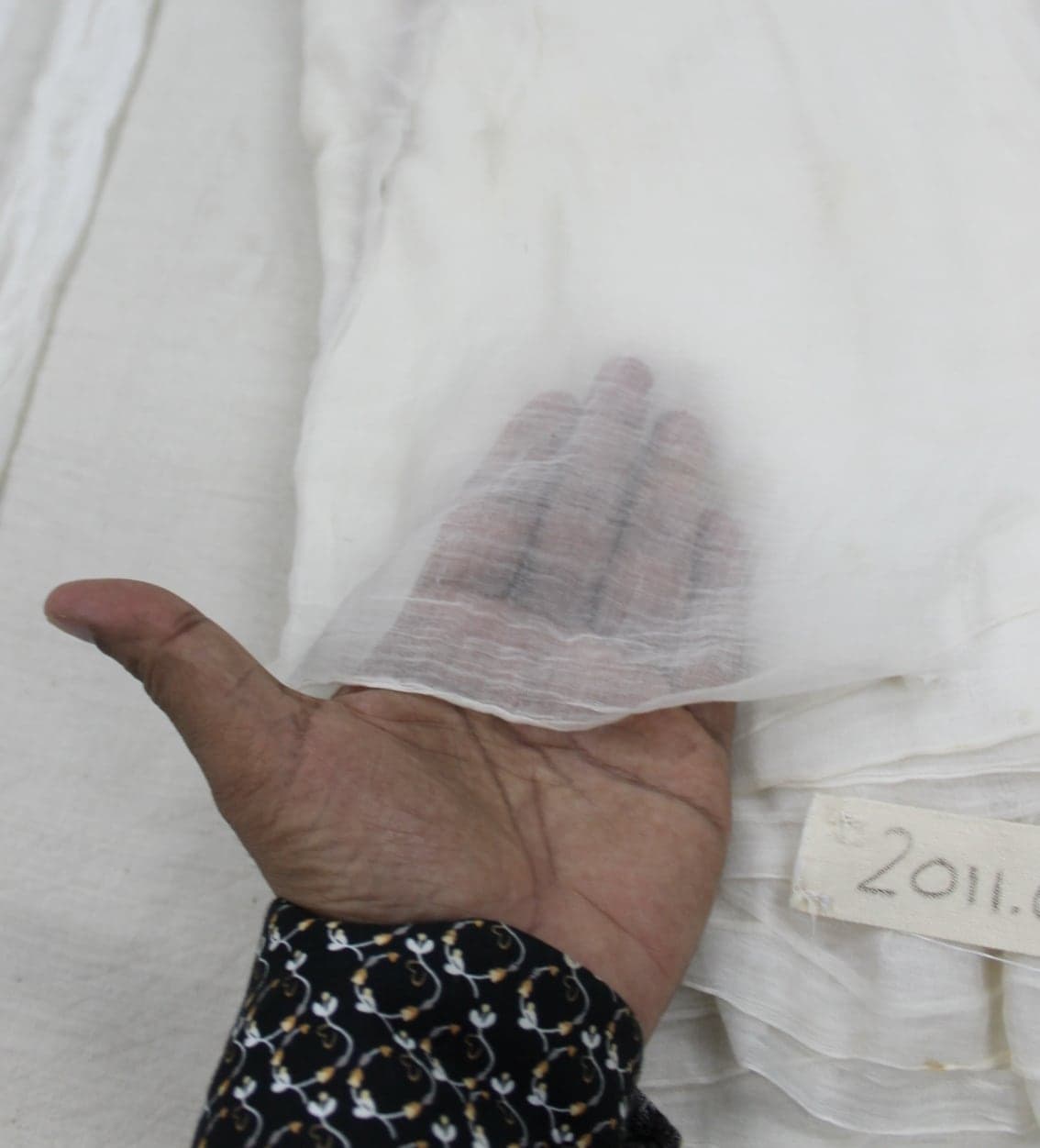
By 1851, though, the trade that had made this cloth famous was nearly gone. In 1844 Dhaka's fine muslins of local yarn were valued at Rs 50,000 a year, out of a total cloth output of about Rs 955,000.16 This chapter's argument, which is an interpretation of the evidence and not a settled fact, is that Dhaka muslin was a luxury made for a small number of powerful buyers: first the Mughal court and its governors, then the European companies and private traders. The sources record both the Mughal court and the East India Company pressing the weavers hard.17 When British machine-made cotton undercut Dhaka on price and the Company stopped buying, the people who made this cloth had no market left.
Much of what is known about how muslin was made comes from two nineteenth-century books and one official report, and their authors are easy to confuse. A Sketch of the Topography and Statistics of Dacca was published in Calcutta in 1840 by James Taylor, a surgeon.18 A Descriptive and Historical Account of the Cotton Manufacture of Dacca appeared in London in 1851 under the name "A Former Resident of Dacca"; the botanist George Watt attributed it to Dr James Taylor in 1907.19 A different man, John Taylor, was the Company's Commercial Resident at Dhaka and wrote a report dated 30 November 1800 that the 1851 book quotes at length.20 This chapter calls the 1851 book "the 1851 account".
Why is it called muslin?
Nobody knows for certain. Banglapedia says the origin of the word muslin (মসলিন) is obscure: some derive it from Mosul in Iraq, others from Masulipatam in south India.21 It argues that Europeans gave the name, and applied it to cotton goods from Gujarat, Golconda and elsewhere too, and it defines muslin as "a brand name of pre-colonial Bengal textile, especially of Dhaka origins".22
Fine cloth from this part of the world was known long before the word. The Periplus of the Erythraean Sea, a merchant's guide of the first century CE, lists among the goods brought to the market-town on the Ganges "muslins of the finest sorts, which are called Gangetic".23 Its 1912 translator, Wilfred Schoff, wrote that these "are the muslins of the Dacca district", but that identification is his, not the ancient text's.24 In 1586 the English traveller Ralph Fitch wrote that the cotton cloths of "Sinnergan" (Sonargaon) were the finest made in all India, and at the end of the sixteenth century Abul Fazl named a fine cloth called khasa as a manufacture Sonargaon was famous for.25 Banglapedia adds that Dhaka muslin became famous after the Mughals made Dhaka their capital.26
From phuti karpas to thread
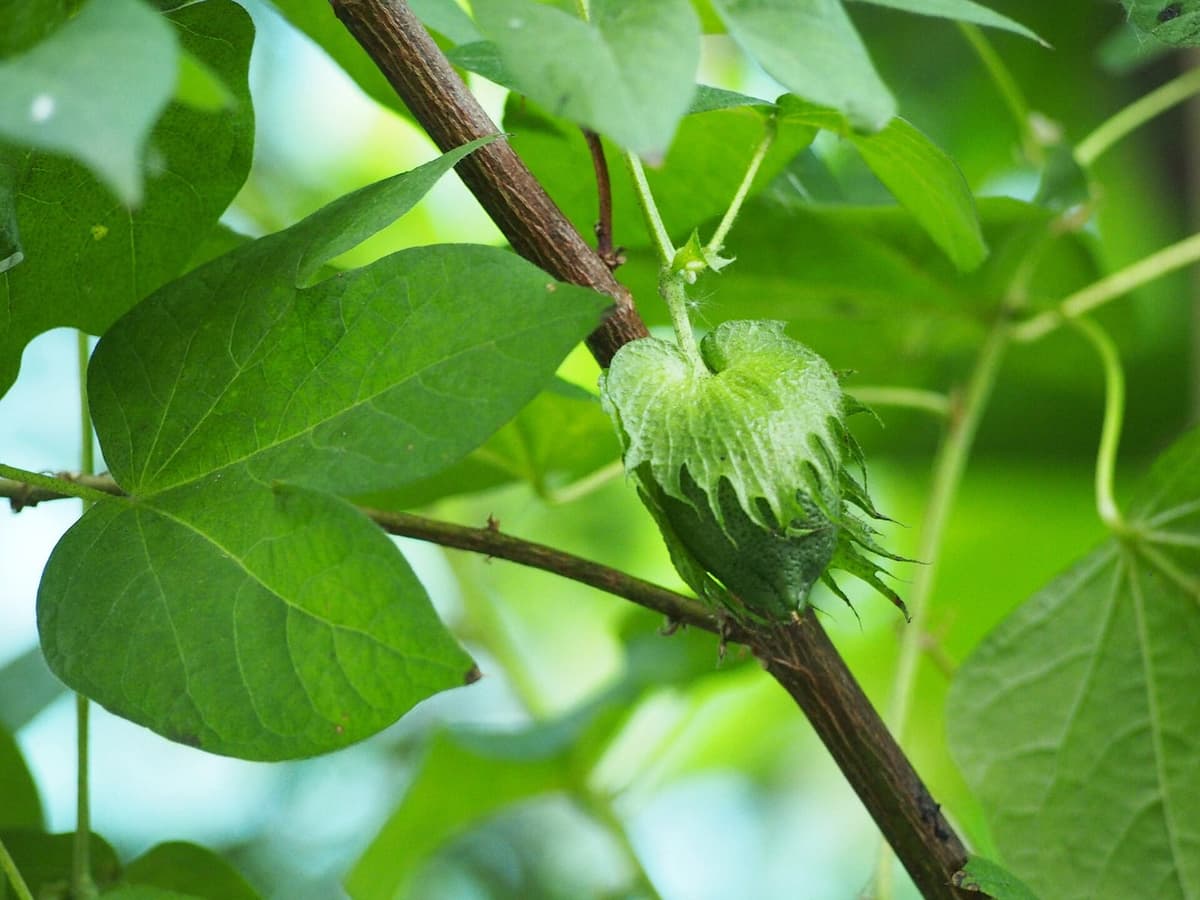
Muslin began with a particular cotton. The 1851 account says the cotton of the fine Dhaka muslins was grown in the district itself: an annual plant four to five feet tall, then counted as a variety of Gossypium herbaceum.27 Following the botanist William Roxburgh, it describes a plant more upright than common Bengal cotton, with fewer branches, a reddish tinge on its leaf stalks and nerves, longer flower stalks and red-edged petals, and a staple that was "longer, much finer, and softer".28 The local name was photee, now usually written phuti, and the plant is known today as phuti karpas (ফুটি কার্পাস).29 A variety called bairaiti, with a larger pod and shorter, coarser fibres, was thought inferior at Dhaka; Banglapedia also names desee among the lesser cottons.30
It grew in a narrow band of country. The finest phuti came only from along the Brahmaputra, its branches and the Meghna.31 In 1800 the Commercial Resident described a strip about 40 miles long, running from "Feringybazar", 12 miles south-east of Dhaka, along the Meghna to "Edilpore", that produced "the finest cotton (kapas) grown in the Dacca province", and he put this down to the salt and silt left by tidal floods.32 Two crops were raised a year, the finer picked in April and May and the other in September and October, from seed sown in November in rows about a foot and a half apart.33 Seed for the next sowing was kept in an earthen jar smeared with ghee or oil and hung from the roof over the hearth.34
Very little of the crop could become muslin. From 80 siccas' weight (2 lb) of seed cotton, 65 siccas were seed and 15 were fibre, and the Resident reckoned that only about a third of that fibre could be spun into the finest thread.35 An attempt in 1790 and 1791 to grow the plant elsewhere in Bengal failed.36 By 1851 seed cotton had for some years sold at an average of Rs 3 a maund (80 lb), half the 1789 price, cultivation had fallen with the weaving, and the staple was said to have deteriorated.37
Botanists have argued about the plant ever since. In 1907 George Watt classed "Dacca cotton" as a special race of Gossypium arboreum var. neglecta, and reproduced Roxburgh's original drawing of it from the copy at Kew.38 The name now recorded is Gossypium arboreum var. neglectum (Tod.) G.Watt.39 Watt also admitted that this red-stemmed form "if it exists at all, can hardly be said to be a regular crop in India", and that it was "in fact unknown to me".40 He also quoted an earlier Commercial Resident, Mr Bebb, who called the staple "the finest cotton in the world".41 Today Bangladesh's main cultivated cotton is American cotton, G. hirsutum, and G. arboreum, locally called Comilla cotton, is grown only on a small scale in the Chittagong Hill Tracts, at about 10 kg per hectare.42
Spinning the thread
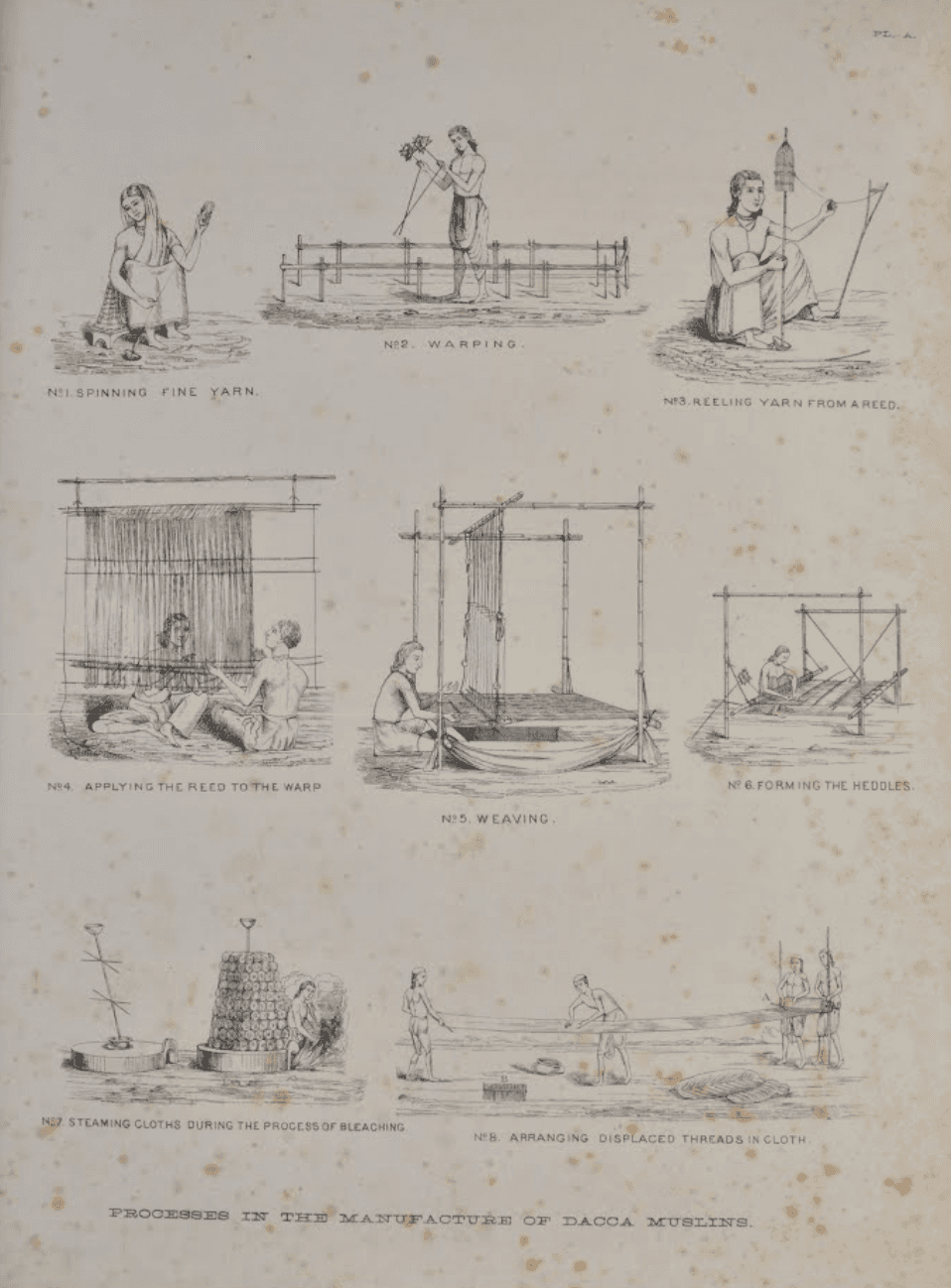
According to the 1851 account, all the fine thread was spun by Hindu women, generally under 30 years of age.44 Their kit was simple: a roll of cleaned cotton (puni), a fine iron spindle (tukwa) 10 to 14 inches long weighted with a clay ball the size of a pea, a shell set in clay to turn it in, and chalk powder for the fingers.45 They worked from soon after dawn until 9 or 10 in the morning, and again from 3 or 4 in the afternoon until half an hour before sunset.46 The finest yarn was spun early, before the dew lifted, or over a shallow dish of water when the air was dry; the best conditions were humid, at about 82°F.47
The output was tiny. A spinner who worked every morning could make at most about half a tola (90 grains troy) of fine thread a month, and the average was nearer 45 grains.48 Yarn for muslins sent to the court at Delhi was said to have run to 150 cubits (haths) for every ruttee of weight, about 2 grains troy.49 The finest yarn cost Rs 8 a tola, which the 1851 author worked out at about £31 2s a pound, some £3 more than the No. 700 yarn that Houldsworth & Co. of Manchester showed at the Great Exhibition.50 By 1851, in other words, hand-spun Dhaka yarn was being priced against Manchester machine yarn, and it was the dearer of the two.
The local cotton did not suit the machines either. Its short fibres were not suited to machine spinning, and when Sea Island cotton was sent to the Dhaka stations in 1811, the local spinners could not spin it on their spindles.51
How was Dhaka muslin woven and graded?
Dhaka muslin was woven in standard pieces 20 yards long and one yard wide, and priced by length, warp threads and weight: the longer and lighter the piece, and the more threads it held, the dearer it was.52 In 1800 the Resident noted that no cloth at Dhaka was ever made of thread of one quality only, and the Company's factory sorted cloth into "ordinary", "fine", "superfine" and "fine superfine".53 Banglapedia says a piece of the finest, malmal, could take as long as six months to weave.54
The weavers' own names were more vivid. Abrawan, from the Persian ab (water) and rawan (flowing), was compared to running water.55 Shubnam was named after dew: the 1851 account translates it "evening dew", because spread on the bleaching field it could hardly be told from the dew itself, while Banglapedia gives "morning dew".56 Mulmul khas, "muslin for the king's own use", was woven in half-pieces 10 yards long; the specimen shown in 1851 weighed 8 tolas 6 annas (3 oz 2 dwt 14 gr troy) and was priced at Rs 100, or £10.57 Jhuna, a gauze-like cloth, was worn by dancers and in the women's quarters, the zenanas.58
| Grade | Meaning or use | Size (yards) | Warp threads | Weight of a piece |
|---|---|---|---|---|
| Mulmul khas | "Muslin for the king's own use" | 10 × 1 | 1,800 to 1,900 | 3 oz 2 dwt (the 1851 Exhibition piece) |
| Circar Ali | Made for the nawabs | 10 × 1 | 1,900 | 4 to 4.5 oz |
| Jhuna | Gauze-like; worn by dancers | 20 × 1 | 1,000 | 8.5 oz |
| Rang | Net-like | 20 × 1 | 1,200 | 8 oz 4 dr |
| Abrawan | "Flowing water" | 20 × 1 | 700 to 1,400 | 9 to 11.5 oz |
| Khasa | "Fine" or "elegant" | 20 × 1 to 1.25 | 1,400 to 2,800 | 21 oz (at 2,800 threads) |
| Shubnam | "Evening dew" | 20 × 1 | 700 to 1,300 | 10 to 13 oz |
| Tunzeb | "Ornament of the body" | 20 × 1 | 800 to 1,900 | 10 to 18 oz |
| Turundam | 20 × 1 | 1,000 to 2,700 | 15 to 27 oz | |
| Nyansook | 20 × 1.25 | 2,200 to 2,700 | Not given |
Source: [Taylor], A Descriptive and Historical Account of the Cotton Manufacture of Dacca (1851).59
Cloth for emperors: what Mughal patronage cost the weavers
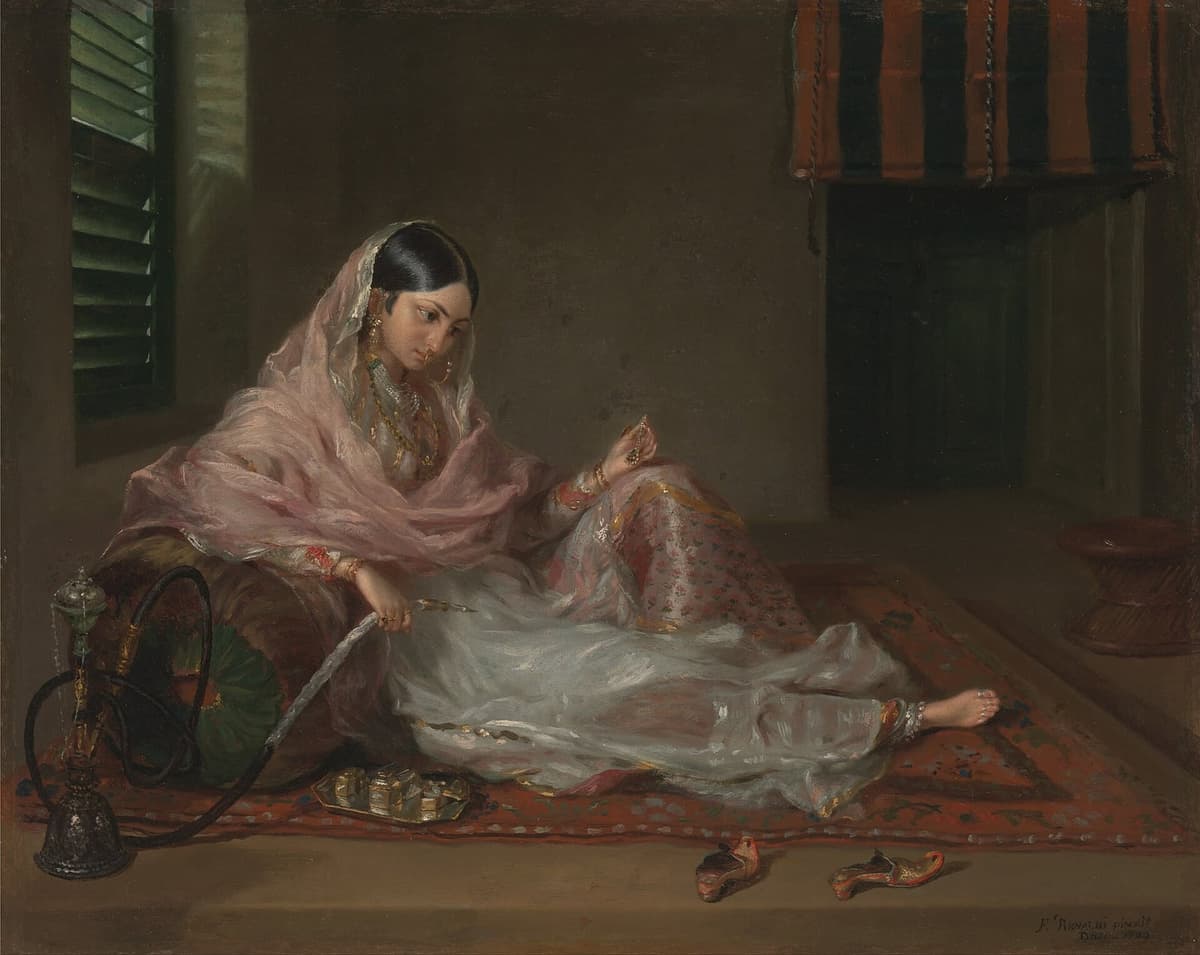
Most of these names point to a court, and the court was the first great buyer. Banglapedia says the Mughal court took large quantities of the finest grades, that cloth for the emperor was called malbus khas and cloth for the nawabs sarkar-i-ala, and that an officer, the darogah, supervised production.60 The 1851 account says such workshops ("kootees") worked at Dhaka, Sonargaon, Junglebaree and Bazetpore under darogahs, and that expert weavers were registered and made to attend every day.61
The same account is blunt about the price of this patronage. Guards were set over unwilling weavers, those who tried to run away were beaten, and wages were cut; in Siraj ud-Daulah's time, it says, a quarter of their pay was deducted.62 Quoting Raynal, it adds that it was "a misfortune to them to appear too dexterous", since skilled weavers were then made to work only for the government.63 Jamdani was a government monopoly, and a tax called "Chappa Jamdanee" was levied on its weavers until the Company abolished it in 1792.64
The quantities were small and the values large. Each year Jaffer Khan (Murshid Quli Khan) sent Aurangzeb about 500 pieces of muslin with other goods, at a cost of Arcot Rs 127,871 (£15,984).65 The 1800 Resident estimated that the finest plain cloths made for Delhi cost Arcot Rs 200 a piece, with 200 to 300 pieces sent a year, and William Bolts had put a single piece of abrawan, weighing five siccas, at Arcot Rs 400.66 A story the 1851 account repeats from Bolts, which is an anecdote and not evidence, has Aurangzeb scolding his daughter for showing her skin although she wore seven layers (jamahs) of muslin.67
This matters for what follows. Coercion did not arrive with the British: the sources describe a system, already in place under the Mughals and the nawabs, in which the most skilled weavers were bound to the buyer with the most power.68 The chapter on Mughal Bengal covers the province and its rulers.
The European companies and the trade at its height
Europe first bought muslin through Iranian and Armenian merchants, and when the European companies arrived they had to pay in bullion, because their own goods had no market in Bengal.69 Banglapedia dates the Dutch factory at Dhaka to 1663, the English to 1669 and the French to 1682.70 The 1851 account dates the French later, and says the Dutch held the main share of Dhaka's foreign trade in 1666, on the evidence of Tavernier.71
French cargo lists give a sense of the scale. Five ships that reached France from Bengal in 1742 carried, among other cottons, 14,340 pieces of khasa, 12,680 of mulmul and 1,252 pieces of Dhaka embroidery.72 In the middle of the century the whole cloth trade of Dhaka was valued at Arcot Rs 2,850,000 (Rs 28.5 lakh, or £356,250) at prime cost, broken down by buyer.73 The year of that estimate is uncertain: the 1851 account gives 1753, while the British Library's catalogue of the 1800 Resident's papers and Banglapedia give 1747.74 Banglapedia's jamdani article puts Rs 550,000 of it with the emperor, the nawab and Jagat Seth, and Rs 950,000 with European traders and companies, figures that match the subtotals of the 1851 table.75
Political power then changed how the cloth was paid for. Before 1765 the Company bought for its Dhaka factory with bullion from England; after it took the territorial revenues of Bengal, the Diwani, in 1765, its purchases were funded from the provincial treasuries, and "the investment" more than doubled.76 In 1771 the Company exported cloth worth Rs 10 lakh (£125,000) from Dhaka, and English private traders twice as much, Rs 20 lakh (£250,000).77 The chapter on colonial Bengal explains the Diwani and what followed it.
The 1851 account says 1787 "appears to have been the most flourishing period of the cloth trade of Dacca": cloth worth 50 lakh rupees (£625,000) at prime cost passed through the custom house.78 Other estimates for that year measure different things, as the table and the box below show.
| Year | What was measured | Value |
|---|---|---|
| 1747 or 1753 | Whole cloth trade of Dhaka at prime cost, all buyers80 | Arcot Rs 2,850,000 (£356,250) |
| 1746 to 1755 | French exports from Dhaka, ten years in total81 | Rs 2,850,000 (£356,250) |
| 1761 | Company investment at the Dhaka factory82 | About Rs 2,200,000 |
| 1771 | Company exports from Dhaka83 | Rs 1,000,000 (£125,000) |
| 1771 | English private traders' exports84 | Rs 2,000,000 (£250,000) |
| 1787 | Cloth passing the Dhaka custom house, prime cost85 | Rs 5,000,000 (£625,000) |
| 1787 | Whole trade of Dhaka town86 | Rs 12,500,000 (£1,562,500) |
| 1787 | Cloth for Europe, Collector Day's estimate87 | Rs 3,000,000 to 4,000,000 a year |
| 1790 to 1799 | Export cloth made at the Dhaka factory's stations, prime cost, ten years in total88 | Sicca Rs 13,626,018 (£1,703,252) |
| 1793 | Cloth exported to foreign countries89 | Arcot Rs 1,362,154 (£170,269) |
| 1807 | Goods made for European markets90 | Rs 861,818 |
| 1813 | Goods made for European markets91 | Rs 338,114 |
| 1844 | All Dhaka cloth output, six classes added together92 | Rs 955,000 |
| 1844 | Of which fine muslin of local yarn93 | Rs 50,000 |
Source: [Taylor], Cotton Manufacture of Dacca (1851); Taylor, Sketch (1840); British Library, IOR/H/456f. Sterling equivalents are those given by the sources.94
Why did Dhaka muslin disappear?
On the evidence of the sources, Dhaka muslin disappeared because machine-made British cotton undercut it on price, the Company stopped buying it in 1817, and British yarn then replaced local thread on Dhaka's own looms.99 In this chapter's reading, coercion of the weavers, recorded under both the Mughals and the Company, made a hard trade harder.100 The 1851 account dates the decline from 1793, "about six years after mule twist came into general use in England", and blames British machine-made cottons that Bengal could not match "as regards cheapness".101
Britain had been working towards this for most of a century. Muslin weaving was tried at Paisley as early as 1700 and permanently established in Britain in 1781, and mule twist was introduced in 1785.102 British cotton manufactures grew from £2 million in 1781 to £7.5 million in 1787, when 41 spinning factories were working in Lancashire.103 In 1799 the Commercial Resident reported that many weavers had stopped work for lack of employment and that the district's manufacturing was a fifth below its 1792 level.104
The fall was not yet a collapse. In 1793 cloth exported to foreign countries was still valued at Arcot Rs 1,362,154 (£170,269): £77,640 of it belonged to the East India Company, £58,535 to English traders and £34,094 to Hindu and other merchants.105 The Company's share was the largest of the three.
Coercion under the Company
Prices were only half the story. In 1772 William Bolts, whom the historian Romesh Chunder Dutt later called "an English merchant who saw things with his own eyes", described how Company agents and their gomastahs forced weavers to sign bonds (mutchulcahs).106 Weavers were seized, imprisoned, fined and flogged, "deprived ... of their casts", and their goods were sold to make good any shortfall.107 Bolts contrasted this with Alivardi Khan's time, when, he said, weavers had worked freely and families of the weaver caste had invested their own capital, and he reported a witness who saw weaver families around "Jungulbarry" give up the trade because of such treatment.108
Banglapedia's jamdani article says that after the Diwani of 1765 Company agents "resorted to oppressing the weavers" and used political power to skew the muslin market.109 The historian Hameeda Hossain examined the same period in a 1979 article titled "The Alienation of Weavers: Impact of the Conflict between the Revenue and Commercial Interests of the East India Company, 1750-1800".110 The design historian Sonia Ashmore told the BBC that "the trade was built up and destroyed by the British East India Company": weavers were paid in advance and had to repay if their cloth was rejected, which drove them into debt.111
The end of the European trade
The Company abolished its Commercial Residency at Dhaka and closed the factory in 1817.112 From then on, the 1851 preface says, Dhaka cloth was "virtually excluded from the markets of Europe"; Banglapedia's jamdani article says exports "completely stopped in 1817", after which muslin reached Europe only as personal imports.113 Taylor's 1840 figures, charted below, show the slide before and after that date.114
Show the numbers
| Year | Goods made for European markets |
|---|---|
| 1807 | 861,818 |
| 1810 | 566,996 |
| 1813 | 338,114 |
Source: James Taylor, A Sketch of the Topography and Statistics of Dacca (1840).115
Show the numbers
| Year | Cotton goods exported |
|---|---|
| 1817-18 | 1,524,974 |
| 1821-22 | 1,216,252 |
| 1825-26 | 629,183 |
| 1829-30 | 504,882 |
| 1831-32 | 360,747 |
| 1834-35 | 387,122 |
Source: James Taylor, A Sketch of the Topography and Statistics of Dacca (1840). Only the years shown are given in the source.116
Then the flow of cloth reversed. The 1851 account says that "native-spun thread, with the exception of very fine and very coarse qualities, has in a great measure been superseded by British yarn".117 British cotton yarn brought into Dhaka and nearby markets was worth about £40,000 a year, while spending among the district's own manufacturers had fallen to no more than £54,000 a year.118 The town shrank with its trade: Dhaka's population was estimated at 200,000 in 1800, and a census in 1838 found no more than 68,000.119
By 1844 the picture had turned over. Most of what Dhaka's looms made was cloth woven from English yarn of counts 30 to 100, while fine muslin of local yarn above count 250 was made for the courts of Delhi, Lucknow, Lahore and Nepal and for wealthy local buyers.120
Show the numbers
| Year | Value of output |
|---|---|
| Muslin and medium cloth, English yarn | 500,000 |
| Cotton and silk cloth for Jidda | 200,000 |
| Coarse cloth, local yarn | 150,000 |
| Fine muslin, local yarn | 50,000 |
| Embroidered goods | 45,000 |
| Flowered or net cloth | 10,000 |
Source: [Taylor], A Descriptive and Historical Account of the Cotton Manufacture of Dacca (1851).121
What, then, killed the trade? Abdul Karim, writing in Banglapedia, gives three causes: the loss of Mughal and nawabi patronage, the Company's monopoly after Plassey, and above all the Industrial Revolution in England.123 The evidence gathered here fits that order. Coercion was real and is well documented, but it existed under the Mughals too, and it did not stop the trade reaching its peak in 1787. What the sources record after 1793 is a price contest that hand-spinners could not win, the Company's exit in 1817, and British yarn arriving on Dhaka's own looms. That is an interpretation; the works listed at the end of this chapter weigh the causes in more detail, and the economy chapter looks at Bengal's wider deindustrialisation.
Did the British cut off weavers' thumbs?
No source examined for this chapter shows British agents cutting off weavers' thumbs.124 The story that they did is one of the best-known things said about muslin, and it deserves to be traced, because the oldest version found tells a different story.
The earliest source found is Bolts, in 1772. Writing about the Company's treatment of the winders of raw silk, called nagaads, he said that "instances have been known of their cutting off their thumbs, to prevent their being forced to wind silk".125 He goes on to say that during Clive's government Company sepoys carried off nagaads from the houses of Armenian silk merchants to the English factories.126 The people in Bolts's account are silk winders, not muslin weavers, and the cutting is done by the workers themselves, to escape forced labour.
Romesh Chunder Dutt quoted the passage word for word in his Economic History of India under Early British Rule, again about silk winders cutting off "their thumbs".127 By 1921 the story was already changing as it was retold. In Young India on 30 March 1921, M. K. Gandhi wrote that artisans "were obliged to cut off their own thumbs in order to avoid imprisonment", and added: "Many speakers mix up facts and say that the Company's servants cut off the thumbs of artisans."128
Later writers have handled the popular version with care. In AramcoWorld in 2016, Khademul Islam, who heard the story from his father, called it "largely apocryphal, but in its arc and symbolism, an indelible metaphor".129 It still appears in the Bangladeshi press: The Business Standard in October 2026 listed "the alleged severing of their thumbs" among the causes of muslin's decline.130
Jamdani, silk and the cloths that lasted
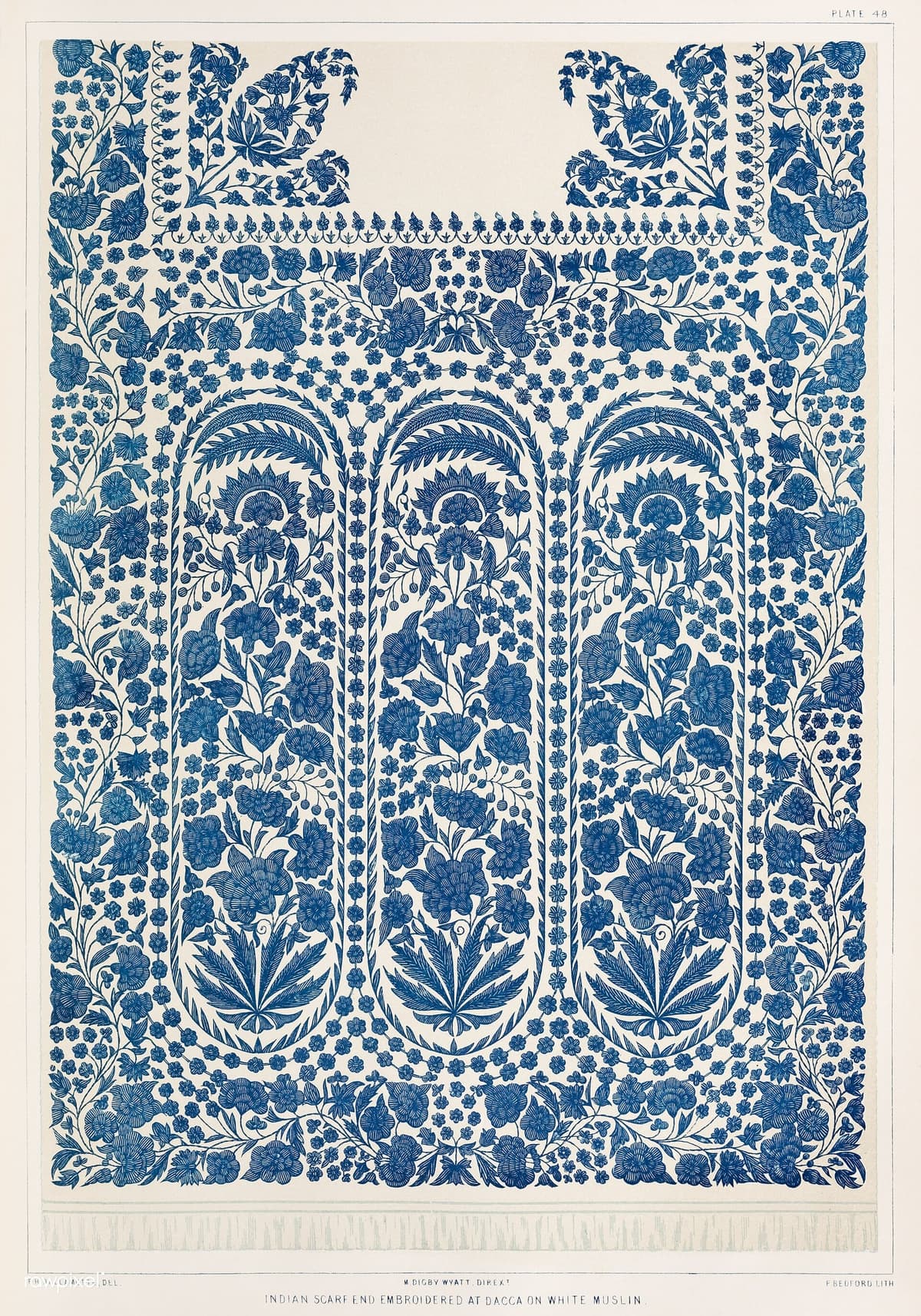
Jamdani (জামদানি), the muslin with its pattern woven in, is the part of the tradition that is still woven today. The 1851 account describes two weavers sitting at one loom: pattern threads are slipped between the warp threads with pointed bamboo sticks, then the lay and shuttle are used, with the shuttle passed back and forth between the pair.134 UNESCO describes the motifs as "created directly on the loom using the discontinuous weft technique".135 Banglapedia says that weavers once used 200 to 250 count yarn for good pieces and dyed and starched it before weaving, but that today they buy mill yarn and use chemical dyes.136 It lists about 40 named designs, among them panna hajar, butidar, kalka pad and shaplaful.137
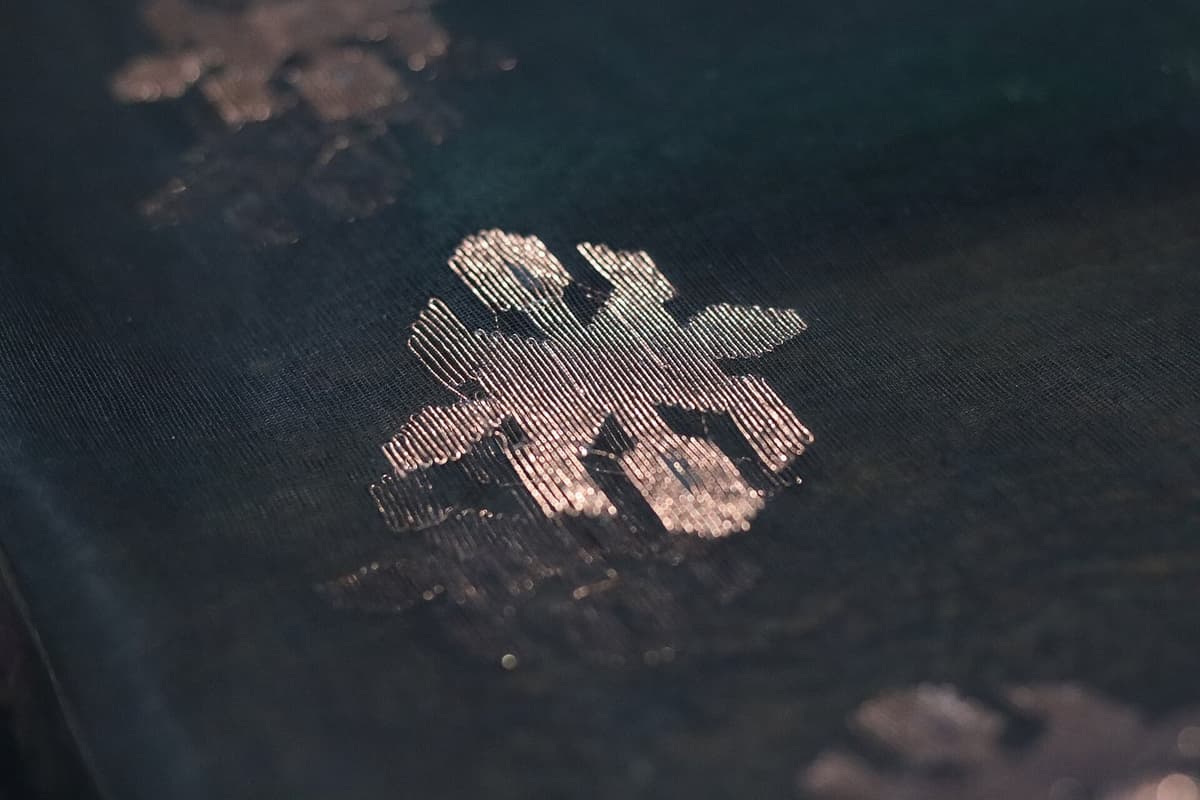
In 2013 UNESCO inscribed the "Traditional art of Jamdani weaving" on its Representative List of the Intangible Cultural Heritage of Humanity, by decision 8.COM 8.4 at the Committee's eighth session in Baku.139 UNESCO describes jamdani as "a vividly patterned, sheer cotton fabric, traditionally woven on a handloom by craftspeople and apprentices around Dhaka", passed on mainly from parents to children in home workshops.140 The decision noted that the craft appeared in a 2007 survey of Bangladesh's heritage by the Asiatic Society of Bangladesh, and asked Bangladesh to make sure that producers are the "principal beneficiaries" of its commercialisation.141
Jamdani then became Bangladesh's first geographical indication (GI). BSCIC applied to the Department of Patents, Designs and Trademarks on 1 September 2015.142 The Daily Star of 17 November 2016 reported the registration as done "yesterday", after a notice in the GI Journal on 4 August 2016 drew no objections, so the date was 16 or 17 November 2016.143 The same report said Bangladeshi weavers made more than 200,000 jamdani saris a year.144
The weaving villages lie around Tarabo and Rupganj in Narayanganj, and a jamdani village was set up at Demra, near Dhaka, after independence.145 BSCIC surveys counted 1,466 jamdani units in Tarabo union in 1962-63, and 5,699 artisans, 1,528 units and 2,519 working looms in 2002.146 The surveys counted different things in different years, so they show that the craft survived rather than how fast it grew. The chapter on culture places jamdani among Bangladesh's other crafts.
Silk and mixed cloths
Bengal's cloth was never only cotton. Three silks have long been made there, mulberry, endi (eri) and tassar, and Bengal mulberry silk was known in Italy as "Ganges silk" as early as the thirteenth century.147 By 1835 the East India Company ran more than a hundred silk filatures in Bengal and exported about 400 tons of raw silk.148 Then silk declined too. In Rajshahi district about 250,000 people drew an income from silk in the 1870s, 41,000 in 1901 and fewer than 600 in 1921.149 Rajshahi silk received its GI certificate at the same ceremony as Dhakai muslin in June 2021.150
Show the numbers
| Year | Mulberry area |
|---|---|
| 1896 | 54,000 |
| 1914 | 7,000 |
| 1937 | 4,000 |
Source: Willem van Schendel, "Silk", Banglapedia.151
Dhaka also wove mixed cloths of cotton and muga silk, plain and embroidered, for the market at Jidda.152 In the years before 1845 these averaged about Rs 200,000 a year, four times the value of the town's fine muslins of local yarn in 1844.153
Can Dhaka muslin be made again?
Partly, and two separate projects are trying. The first, Bengal Muslin, linked to Drik in Dhaka, says its work "commenced in early 2014" and that it has woven "new muslin" of up to 400 count from plants close to the original phuti karpas.154 Its book, Muslin: Our Story, appeared in 2016, the year of a Muslin Festival in Dhaka.155 According to BBC Future, the team found pressed leaves of the nineteenth-century plant at Kew, sequenced their DNA, found a wild plant that was a "70% match", planted it in 2015, spun a hybrid thread, and had a master weaver make a sari of 300 thread count.156
The second is a government project led by the Bangladesh Handloom Board. Prothom Alo reports that it began on 12 October 2014 at the request of the then prime minister; its first phase was approved on 12 June 2018 and started officially on 1 November 2018, at an estimated cost of Tk 121 million (nominal).157 The research was led by Professor Md Monzur Hossain of the botany department at Rajshahi University.158 The team found plants matching its drawing of phuti karpas in Gazipur, Bagerhat, Lalmonirhat, Kurigram and Rangamati, and linked one at Kapasia in Gazipur to the drawing.159 The Business Standard reported that it collected 38 kinds of cotton and identified phuti karpas by comparing DNA with a muslin sari at the V&A in London; a 2026 report gives 39 varieties.160 Two weavers in Narayanganj wove the first saris, following the design of a sari dated 1710, and six had been made by January 2021.161
Is the plant really phuti karpas? That rests on the project teams' own claims. The Business Standard wrote in 2021 that the plant had been extinct for more than a hundred years; both teams say they have found close matches.162 No peer-reviewed genetic study was examined for this chapter, so whether the plants they found are the historical cultivar has not been independently shown here.
The government project's first phase produced yarn as fine as 731 metric count and trained 316 of a planned 350 spinners, all women aged 18 to 30, at seven centres in Cumilla.163 A Muslin House was built on 3.49 acres at Rupganj in Narayanganj, and a second phase was planned for July 2023 to July 2026.164 In 2023 The Daily Star reported that commercial production of GI-tagged muslin had not yet begun.165 In October 2026 The Business Standard reported a second phase worth Tk 185 million (nominal), more than 300 trained women spinners, a completed order for 500 yards, and contract farming of phuti karpas in Kapasia, Rajshahi and Cumilla.166
Dhakai muslin also has GI status, though the sources date it differently. The Business Standard reported a gazette notification on 28 December 2020; Prothom Alo and The Financial Express date the handing over of the certificate to 17 June 2021.167 The likeliest reading is that the GI was gazetted in late December 2020 and the certificate handed over on 17 June 2021; the register itself was not examined for this chapter.
Where can you see original Dhaka muslin?
The largest collection identified for this chapter is at the Victoria and Albert Museum in London, where a search of the online records for "Dacca muslin" on 22 November 2026 returned 97 entries, most of them lengths transferred from the India Museum in 1879.170 They include a length of mulmul khas grade from about 1851 and a length of jamdani muslin, 970 by 90 cm and weighing 340 g, bought from the 1851 Exhibition for £5 15s.171 The museum notes that such muslins were sent to Europe and China and made into dresses in nineteenth-century Britain.172 Figures quoted in interviews, such as "hundreds of pieces" or 350 saris including one woven in 1710, are not confirmed by the museum's own records.173
Muslin in dates, and what came next
- c. 1st century CEThe Periplus lists "Gangetic" muslins of the finest sort among goods traded on the Ganges.174
- 1586Ralph Fitch praises the cotton cloth of Sonargaon as the finest in India.175
- 1663 to 1682Dutch, English and French factories at Dhaka, on Banglapedia's dates.176
- 1742Five French ships land Dhaka muslins in France.177
- 1747 or 1753Dhaka's cloth trade valued at Arcot Rs 28.5 lakh.178
- 1765The Company gains the Diwani and funds its cloth purchases from Bengal's revenue.179
- 1772Bolts publishes his account of forced labour, including the silk winders' thumbs.180
- 1785Mule twist introduced in Britain.181
- 1787Peak year of the Dhaka cloth trade.182
- 1792The Company abolishes the "Chappa Jamdanee" tax on jamdani weavers.183
- 1793Decline begins, on the 1851 account's dating.184
- 30 November 1800John Taylor, Commercial Resident, reports on Dhaka's cloth to the Board of Trade.185
- 1817The Commercial Residency at Dhaka is abolished and the factory closed.186
- 1838A census finds no more than 68,000 people in Dhaka, against an estimate of 200,000 in 1800.187
- 1851Dhaka muslins shown at the Great Exhibition in London; the Descriptive and Historical Account is published.188
- 1879India Museum muslins transferred to the V&A.189
- 1907George Watt publishes the name Gossypium arboreum var. neglectum.190
- 30 March 1921Gandhi writes on the thumbs story in Young India.191
- 2013UNESCO inscribes the traditional art of jamdani weaving.192
- 2014Bengal Muslin (early 2014) and the government project (12 October) begin.193
- November 2016Jamdani becomes Bangladesh's first GI.194
- December 2020 to June 2021Dhakai muslin GI gazetted, then its certificate handed over.195
Bengal's handloom tradition did not end with the muslin trade. Jamdani is still woven around Tarabo and Rupganj in Narayanganj, where the revival's Muslin House also stands.196 The modern chapter of Bengal's cloth story, the export garment industry that grew up from 1978 onwards, has its own guide: the Bangladesh garment industry.
Dhaka muslin's fame rested on the hands of its spinners and weavers, and on a cotton that grew well in only a few river districts. Its fortunes, as the evidence suggests, rested on its buyers: courts and companies that could command the finest work, and that stopped buying once a machine could do something close to it more cheaply.
Further reading
- Sonia Ashmore, Muslin (2012): the V&A's illustrated history of muslin and its export to Europe and America, drawn from the museum's collection.197
- Hameeda Hossain, The Company Weavers of Bengal (1988): how the East India Company's buying reorganised and subordinated Bengal's weavers, 1750 to 1813.198
- Sushil Chaudhury, Spinning Yarns (2020): an annotated edition of John Taylor's 1801 report on Dhaka cloth, with a history of Bengal textiles and their decline.199
- [James Taylor], A Descriptive and Historical Account of the Cotton Manufacture of Dacca (1851): the fullest nineteenth-century description, free to read online.200
- Giorgio Riello, Cotton: The Fabric That Made the Modern World (2013): a global history of cotton and of how Europe replaced Indian cloth.201
- Prasannan Parthasarathi, Why Europe Grew Rich and Asia Did Not (2011): argues that competition with Indian cottons drove British industrial innovation.202
Questions students and journalists ask
Why did Dhaka muslin disappear?
The trade peaked in 1787 and declined from 1793, when cheaper machine-made British cotton began to take its markets. The East India Company closed its Dhaka residency in 1817, which ended most exports to Europe, and British yarn then replaced local thread on Dhaka's own looms. Weavers were also coerced, under the Mughals and under the Company. By 1844 fine muslin of local yarn was worth only Rs 50,000 a year.
Did the British cut off the thumbs of muslin weavers?
No documentary evidence for that was found in the sources examined for this guide. The earliest source, William Bolts in 1772, says silk winders cut off their own thumbs to avoid being forced to wind silk for the Company. Gandhi noted in 1921 that speakers were already wrongly saying the Company's servants did the cutting. The coercion of weavers through bonds, fines, imprisonment and flogging is separately documented.
What is phuti karpas, and is it extinct?
Phuti karpas is the local cotton from which the finest Dhaka muslin was spun. It grew along the Brahmaputra and the Meghna, and botanists place it within tree cotton, Gossypium arboreum. It was reported extinct for more than a century, but two revival teams say they have found close matches since 2014. Whether these are the historical plant rests on the teams' own claims.
What is the difference between muslin and jamdani?
Muslin is the general name for the very fine, plain or lightly patterned cotton cloth of Dhaka, made in many named grades. Jamdani is a kind of muslin with patterns woven in on the loom, using extra threads inserted by hand between the warp threads, often by two weavers sitting at one loom. Jamdani is still woven today and was listed by UNESCO in 2013.
Could a Dhaka muslin sari really pass through a ring?
A London newspaper, the Morning Herald, wrote in 1851 that a piece of Dhaka muslin one yard wide and ten yards long would pass through the smallest wedding ring and weighed only three ounces. That is a contemporary press report, not a measured test. The thread was certainly extraordinary: a skein measured in 1846 ran to more than 250 miles per pound of cotton.
What thread count was Dhaka muslin?
The old sources do not use modern thread counts. They describe grades by the total number of warp threads across a piece about a yard wide: 1,800 to 1,900 for mulmul khas and up to 2,800 for the finest khasa. Revival reports quote thread counts and yarn counts, which are different measures, so these numbers cannot be compared directly.
Has Dhaka muslin been revived, and can you buy it?
Two projects have woven new muslin since 2014: Bengal Muslin, linked to Drik, and a government project led by the Bangladesh Handloom Board with Rajshahi University. The government project trained more than 300 women spinners and built a Muslin House at Rupganj. In 2023 commercial production had not begun; a 2026 press report described a completed order for 500 yards.
When did jamdani get UNESCO status?
UNESCO inscribed the traditional art of jamdani weaving on its Representative List of the Intangible Cultural Heritage of Humanity in 2013, by decision 8.COM 8.4 at the committee's meeting in Baku. Jamdani also became Bangladesh's first geographical indication in November 2016.
Does Bangladesh have GI status for muslin?
Yes. Dhakai muslin has geographical indication status, but sources give different dates. A gazette notification was reported for 28 December 2020, and the certificate was handed to the Bangladesh Handloom Board on 17 June 2021, at the same ceremony as Rajshahi silk. Jamdani received its own GI earlier, in November 2016.
Where can I see original Dhaka muslin?
The Victoria and Albert Museum in London holds the largest collection identified here: its online records list 97 entries for Dacca muslin, mostly transferred from the India Museum in 1879. They include a length of mulmul khas grade from about 1851 and a jamdani muslin bought from the 1851 Great Exhibition.
Notes
- [Taylor, James], A Descriptive and Historical Account of the Cotton Manufacture of Dacca, in Bengal, By a Former Resident of Dacca. Published anonymously; attributed to James Taylor by George Watt (1907) (London: John Mortimer, 1851), 10-11, ix-x, https://archive.org/details/1851cottonmanufactureofDacca. ↩
- [Taylor, James], Cotton Manufacture of Dacca, 132, xiii, 133-34. ↩
- UNESCO, "Traditional Art of Jamdani Weaving," Intangible Cultural Heritage, Element 00879, accessed 22 November 2026, https://ich.unesco.org/en/RL/traditional-art-of-jamdani-weaving-00879; UNESCO Intergovernmental Committee for the Safeguarding of the Intangible Cultural Heritage, Decision 8.COM 8.4 (Baku, 2013), https://ich.unesco.org/en/decisions/8.COM/8.4; Bengal Muslin, "Bengal Muslin: Reviving the Legend," Dhaka: Drik, accessed 22 November 2026, https://bengalmuslin.com; Sheikh Saifur Rahman, "Muslin Revival: Private Sector Comes into Play," Prothom Alo English, 20 March 2023, https://en.prothomalo.com/business/local/gh3m5oqalb. ↩
- [Taylor, James], Cotton Manufacture of Dacca, 20. ↩
- [Taylor, James], Cotton Manufacture of Dacca, 43. ↩
- [Taylor, James], Cotton Manufacture of Dacca, 132. ↩
- [Taylor, James], Cotton Manufacture of Dacca, 133; James Taylor, A Sketch of the Topography and Statistics of Dacca (Calcutta: G. H. Huttmann, Military Orphan Press, 1840), 191, https://archive.org/details/asketchtopograp00taylgoog. ↩
- [Taylor, James], Cotton Manufacture of Dacca, 133-34. ↩
- UNESCO, "Traditional Art of Jamdani"; UNESCO Intergovernmental Committee for the Safeguarding of the Intangible Cultural Heritage, Decision 8. ↩
- [Taylor, James], Cotton Manufacture of Dacca; Taylor, Topography and Statistics of Dacca; UNESCO, "Traditional Art of Jamdani". ↩
- [Taylor, James], Cotton Manufacture of Dacca, ix-x. ↩
- [Taylor, James], Cotton Manufacture of Dacca, ix-x. ↩
- [Taylor, James], Cotton Manufacture of Dacca, xi. ↩
- [Taylor, James], Cotton Manufacture of Dacca, vii-viii. ↩
- [Taylor, James], Cotton Manufacture of Dacca, 20; George Watt, The Wild and Cultivated Cotton Plants of the World (London: Longmans, 1907), 105, https://archive.org/details/wildcultivatedco00wattuoft. ↩
- [Taylor, James], Cotton Manufacture of Dacca, 133-34. ↩
- [Taylor, James], Cotton Manufacture of Dacca, 82-83; William Bolts, Considerations on India Affairs; Particularly Respecting the Present State of Bengal and Its Dependencies, Vol. 1 (London, 1772), vol. 1, 193-94, https://archive.org/details/bim_eighteenth-century_considerations-on-india-_bolts-william_1772_1. ↩
- Taylor, Topography and Statistics of Dacca. ↩
- [Taylor, James], Cotton Manufacture of Dacca; Watt, Wild and Cultivated Cotton Plants, 105. ↩
- British Library, Dacca. India Office Records, IOR/H/456f, 1747-1802, Archives and Manuscripts Catalogue, https://searcharchives.bl.uk/catalog/040-000004527; Sushil Chaudhury, Spinning Yarns: Bengal Textile Industry in the Backdrop of John Taylor's Report on "Dacca Cloth Production" (1801) (London: Routledge, 2020), https://www.routledge.com/9780367511135; [Taylor, James], Cotton Manufacture of Dacca, 11-12. ↩
- Abdul Karim, "Muslin," Banglapedia: National Encyclopedia of Bangladesh, Dhaka: Asiatic Society of Bangladesh; last edited 18 June 2021, accessed 22 November 2026, paras. 1-2, https://en.banglapedia.org/index.php/Muslin. ↩
- Karim, "Muslin", paras. 1-2. ↩
- Wilfred H. Schoff, The Periplus of the Erythraean Sea: Travel and Trade in the Indian Ocean by a Merchant of the First Century, Translated and annotated by Wilfred H. Schoff (New York: Longmans, Green, 1912), 47-48, https://archive.org/details/periplusoferythr00schouoft. ↩
- Schoff, Periplus of the Erythraean Sea, 257. ↩
- [Taylor, James], Cotton Manufacture of Dacca, 53, 45. ↩
- Karim, "Muslin", "Weaving of muslin". ↩
- [Taylor, James], Cotton Manufacture of Dacca, 10. ↩
- [Taylor, James], Cotton Manufacture of Dacca, 10. ↩
- [Taylor, James], Cotton Manufacture of Dacca, 10-11; Abul Kalam Muhammad Azad, "Muslin Belongs to Bangladesh," Prothom Alo English, 1 January 2021, https://en.prothomalo.com/bangladesh/good-day-bangladesh/muslin-belongs-to-bangladesh. ↩
- [Taylor, James], Cotton Manufacture of Dacca, 10-11; Karim, "Muslin", para. 4. ↩
- [Taylor, James], Cotton Manufacture of Dacca, 11. ↩
- [Taylor, James], Cotton Manufacture of Dacca, 11-12. ↩
- [Taylor, James], Cotton Manufacture of Dacca, 12-13. ↩
- [Taylor, James], Cotton Manufacture of Dacca, 12; Watt, Wild and Cultivated Cotton Plants, 105. ↩
- [Taylor, James], Cotton Manufacture of Dacca, 13. ↩
- [Taylor, James], Cotton Manufacture of Dacca, 14. ↩
- [Taylor, James], Cotton Manufacture of Dacca, 14. ↩
- Watt, Wild and Cultivated Cotton Plants, 95-96, 102-03. ↩
- International Plant Names Index, "Gossypium arboreum var. neglectum (Tod.) G.Watt," urn:lsid:ipni.org:names:77440695-1, accessed 22 November 2026, https://www.ipni.org/n/77440695-1. ↩
- Watt, Wild and Cultivated Cotton Plants, 103. ↩
- Watt, Wild and Cultivated Cotton Plants, 103. ↩
- Zia Uddin Ahmed and Md Ibrahim Ali, "Cotton," Banglapedia: National Encyclopedia of Bangladesh, accessed 22 November 2026, https://en.banglapedia.org/index.php/Cotton. ↩
- Watt, Wild and Cultivated Cotton Plants, 95-96; International Plant Names Index, "Gossypium arboreum var. neglectum". ↩
- [Taylor, James], Cotton Manufacture of Dacca, 18. ↩
- [Taylor, James], Cotton Manufacture of Dacca, 18-19. ↩
- [Taylor, James], Cotton Manufacture of Dacca, 19. ↩
- [Taylor, James], Cotton Manufacture of Dacca, 19. ↩
- [Taylor, James], Cotton Manufacture of Dacca, 22-23. ↩
- [Taylor, James], Cotton Manufacture of Dacca, 20. ↩
- [Taylor, James], Cotton Manufacture of Dacca, 23. ↩
- [Taylor, James], Cotton Manufacture of Dacca, 21-22. ↩
- [Taylor, James], Cotton Manufacture of Dacca, 41-42. ↩
- [Taylor, James], Cotton Manufacture of Dacca, 42. ↩
- Karim, "Muslin", para. 6. ↩
- [Taylor, James], Cotton Manufacture of Dacca, 44. ↩
- [Taylor, James], Cotton Manufacture of Dacca, 45; Karim, "Muslin", para. 5. ↩
- [Taylor, James], Cotton Manufacture of Dacca, 43. ↩
- [Taylor, James], Cotton Manufacture of Dacca, 43. ↩
- [Taylor, James], Cotton Manufacture of Dacca, 43-47. ↩
- Karim, "Muslin", paras. 3, 6. ↩
- [Taylor, James], Cotton Manufacture of Dacca, 82. ↩
- [Taylor, James], Cotton Manufacture of Dacca, 83. ↩
- [Taylor, James], Cotton Manufacture of Dacca, 83. ↩
- [Taylor, James], Cotton Manufacture of Dacca, 83-84. ↩
- [Taylor, James], Cotton Manufacture of Dacca, 84. ↩
- [Taylor, James], Cotton Manufacture of Dacca, 54. ↩
- [Taylor, James], Cotton Manufacture of Dacca, 44-45. ↩
- [Taylor, James], Cotton Manufacture of Dacca, 82-83. ↩
- Karim, "Muslin", para. 10. ↩
- Karim, "Muslin", para. 9. ↩
- [Taylor, James], Cotton Manufacture of Dacca, 128-29. ↩
- [Taylor, James], Cotton Manufacture of Dacca, 130. ↩
- [Taylor, James], Cotton Manufacture of Dacca, 130-31. ↩
- [Taylor, James], Cotton Manufacture of Dacca, 130-31; British Library, Dacca, IOR/H/456f; Karim, "Muslin", para. 10. ↩
- Zinat Mahrukh Banu and Masood Reza, "Jamdani," Banglapedia: National Encyclopedia of Bangladesh, Last edited 18 June 2021, accessed 22 November 2026, para. 7, https://en.banglapedia.org/index.php/Jamdani; [Taylor, James], Cotton Manufacture of Dacca, 130-31. ↩
- [Taylor, James], Cotton Manufacture of Dacca, 132. ↩
- [Taylor, James], Cotton Manufacture of Dacca, 132. ↩
- [Taylor, James], Cotton Manufacture of Dacca, 132. ↩
- [Taylor, James], Cotton Manufacture of Dacca, 132. ↩
- [Taylor, James], Cotton Manufacture of Dacca, 130-31; British Library, Dacca, IOR/H/456f. ↩
- [Taylor, James], Cotton Manufacture of Dacca, 130. ↩
- Taylor, Topography and Statistics of Dacca, 190. ↩
- [Taylor, James], Cotton Manufacture of Dacca, 132. ↩
- [Taylor, James], Cotton Manufacture of Dacca, 132. ↩
- [Taylor, James], Cotton Manufacture of Dacca, 132. ↩
- [Taylor, James], Cotton Manufacture of Dacca, 132. ↩
- Taylor, Topography and Statistics of Dacca, 190. ↩
- [Taylor, James], Cotton Manufacture of Dacca, 133. ↩
- [Taylor, James], Cotton Manufacture of Dacca, 132-33. ↩
- Taylor, Topography and Statistics of Dacca, 190. ↩
- Taylor, Topography and Statistics of Dacca, 191. ↩
- [Taylor, James], Cotton Manufacture of Dacca, 133-34. ↩
- [Taylor, James], Cotton Manufacture of Dacca, 133. ↩
- [Taylor, James], Cotton Manufacture of Dacca, 130-34; Taylor, Topography and Statistics of Dacca, 190-91; British Library, Dacca, IOR/H/456f. ↩
- [Taylor, James], Cotton Manufacture of Dacca, 130-31; British Library, Dacca, IOR/H/456f; Karim, "Muslin", para. 10. ↩
- [Taylor, James], Cotton Manufacture of Dacca, 132; Taylor, Topography and Statistics of Dacca, 190; Banu and Reza, "Jamdani", para. 8. ↩
- [Taylor, James], Cotton Manufacture of Dacca, 133; Taylor, Topography and Statistics of Dacca, 190. ↩
- Karim, "Muslin", para. 9; [Taylor, James], Cotton Manufacture of Dacca, 129. ↩
- [Taylor, James], Cotton Manufacture of Dacca, xiii, 133; Taylor, Topography and Statistics of Dacca, 191. ↩
- [Taylor, James], Cotton Manufacture of Dacca, 83; Bolts, Considerations on India Affairs, vol. 1, 193-94. ↩
- [Taylor, James], Cotton Manufacture of Dacca, xiii. ↩
- [Taylor, James], Cotton Manufacture of Dacca, 132. ↩
- [Taylor, James], Cotton Manufacture of Dacca, 132. ↩
- [Taylor, James], Cotton Manufacture of Dacca, xiii. ↩
- [Taylor, James], Cotton Manufacture of Dacca, 132-33. ↩
- Bolts, Considerations on India Affairs, vol. 1, 193-94; Romesh Chunder Dutt, The Economic History of India under Early British Rule, from the Rise of the British Power in 1757 to the Accession of Queen Victoria in 1837 (London: Kegan Paul, Trench, Trübner, 1920), https://archive.org/details/economichistoryo00dutt. ↩
- Bolts, Considerations on India Affairs, vol. 1, 193-94. ↩
- Bolts, Considerations on India Affairs, vol. 1, 194. ↩
- Banu and Reza, "Jamdani", para. 7. ↩
- Hameeda Hossain, "The Alienation of Weavers: Impact of the Conflict between the Revenue and Commercial Interests of the East India Company, 1750-1800," Indian Economic and Social History Review 16, no. 3 (1979), https://doi.org/10.1177/001946467901600305. ↩
- Zaria Gorvett, "The Legendary Fabric That No One Knows How to Make," BBC Future, 17 March 2021 (updated), https://www.bbc.com/future/article/20210316-the-legendary-fabric-that-no-one-knows-how-to-make. ↩
- [Taylor, James], Cotton Manufacture of Dacca, 133; Taylor, Topography and Statistics of Dacca, 191. ↩
- [Taylor, James], Cotton Manufacture of Dacca, xiii; Banu and Reza, "Jamdani", para. 8. ↩
- Taylor, Topography and Statistics of Dacca, 190-91. ↩
- Taylor, Topography and Statistics of Dacca, 190-91. ↩
- Taylor, Topography and Statistics of Dacca, 191. ↩
- [Taylor, James], Cotton Manufacture of Dacca, 133. ↩
- [Taylor, James], Cotton Manufacture of Dacca, 134. ↩
- [Taylor, James], Cotton Manufacture of Dacca, 134. ↩
- [Taylor, James], Cotton Manufacture of Dacca, 133-34. ↩
- [Taylor, James], Cotton Manufacture of Dacca, 133-34. ↩
- [Taylor, James], Cotton Manufacture of Dacca, 133-34. ↩
- Karim, "Muslin", last para.. ↩
- [Taylor, James], Cotton Manufacture of Dacca; Taylor, Topography and Statistics of Dacca; Bolts, Considerations on India Affairs; Dutt, Economic History of India; M. K. Gandhi, "Notes. Young India, 30 March 1921," in The Collected Works of Mahatma Gandhi. Vol. 19, November 1920 to April 1921 (New Delhi: Publications Division, 1966), https://archive.org/details/in.ernet.dli.2015.164029. ↩
- Bolts, Considerations on India Affairs, vol. 1, 194. ↩
- Bolts, Considerations on India Affairs, vol. 1, 195. ↩
- Dutt, Economic History of India, 26-27. ↩
- Gandhi, "Notes", 487-88. ↩
- Khademul Islam, "Our Story of Dhaka Muslin," AramcoWorld, May/June 2016, https://www.aramcoworld.com/articles/2016/our-story-of-dhaka-muslin. ↩
- "'Dhakai Muslin' Ready to Spread Its Wings in the Global Market," The Business Standard (Dhaka), 27 October 2026, https://www.tbsnews.net/bangladesh/dhakai-muslin-ready-spread-its-wings-global-market-1584061. ↩
- Bolts, Considerations on India Affairs, vol. 1, 194. ↩
- Dutt, Economic History of India, 26-27; Gandhi, "Notes", 487-88. ↩
- Bolts, Considerations on India Affairs, vol. 1, 193-94. ↩
- [Taylor, James], Cotton Manufacture of Dacca, 40-41. ↩
- UNESCO, "Traditional Art of Jamdani". ↩
- Banu and Reza, "Jamdani", "Weaving technique". ↩
- Banu and Reza, "Jamdani", "Variety of jamdani work". ↩
- UNESCO, "Traditional Art of Jamdani". ↩
- UNESCO, "Traditional Art of Jamdani"; UNESCO Intergovernmental Committee for the Safeguarding of the Intangible Cultural Heritage, Decision 8. ↩
- UNESCO, "Traditional Art of Jamdani". ↩
- UNESCO Intergovernmental Committee for the Safeguarding of the Intangible Cultural Heritage, Decision 8. ↩
- "Businesspeople Unable to Benefit from GI Products," The Daily Star, 2023 (updated 8 February 2024), https://www.thedailystar.net/business/economy/news/businesspeople-unable-benefit-gi-products-3371796; "Jamdani Finally Gets Recognition," The Daily Star, 17 November 2016, https://www.thedailystar.net/frontpage/jamdani-finally-gets-recognition-1316581. ↩
- "Jamdani Finally Gets Recognition". ↩
- "Jamdani Finally Gets Recognition". ↩
- Banu and Reza, "Jamdani". ↩
- Banu and Reza, "Jamdani", last section. ↩
- Willem Van Schendel, "Silk," Banglapedia: National Encyclopedia of Bangladesh, Last edited 18 June 2021, accessed 22 November 2026, https://en.banglapedia.org/index.php/Silk. ↩
- Van Schendel, "Silk". ↩
- Van Schendel, "Silk". ↩
- "Six Products Get GI Tag," The Financial Express (Dhaka), 18 June 2021, https://today.thefinancialexpress.com.bd/print/six-products-get-gi-tag-1624033365. ↩
- Van Schendel, "Silk". ↩
- [Taylor, James], Cotton Manufacture of Dacca, 41, 134. ↩
- [Taylor, James], Cotton Manufacture of Dacca, 133-34. ↩
- Bengal Muslin, "Bengal Muslin". ↩
- Saiful Islam, Muslin: Our Story, Edited by Saiful Islam (Dhaka: Drik Picture Library, 2016), https://openlibrary.org/works/OL32601902W; Islam, "Our Story of Dhaka". ↩
- Gorvett, "Legendary Fabric". ↩
- Rahman, "Muslin Revival". ↩
- Azad, "Muslin Belongs to Bangladesh". ↩
- Azad, "Muslin Belongs to Bangladesh". ↩
- "Revival of Dhakai Muslin: Commercial Production Will Create Global Market," The Business Standard (Dhaka), 31 January 2021, https://www.tbsnews.net/economy/revival-dhakai-muslin-commercial-production-will-create-global-market-194452; "Dhakai Muslin Ready to Spread". ↩
- Azad, "Muslin Belongs to Bangladesh". ↩
- "Revival of Dhakai Muslin"; Gorvett, "Legendary Fabric"; Bengal Muslin, "Bengal Muslin". ↩
- Rahman, "Muslin Revival". ↩
- Rahman, "Muslin Revival". ↩
- "Businesspeople Unable to Benefit". ↩
- "Dhakai Muslin Ready to Spread". ↩
- "Revival of Dhakai Muslin"; Rahman, "Muslin Revival"; "Six Products Get GI". ↩
- Gorvett, "Legendary Fabric"; Bengal Muslin, "Bengal Muslin"; Rahman, "Muslin Revival"; "Dhakai Muslin Ready to Spread". ↩
- [Taylor, James], Cotton Manufacture of Dacca, 43-47. ↩
- Victoria and Albert Museum, "Muslin (mulmul khas grade), Dhaka, c. 1851," Museum no. 8746(IS), accessed 22 November 2026, https://collections.vam.ac.uk/item/O476233/; Victoria and Albert Museum, "Muslin (tanzeb grade), Dhaka, c. 1855," Museum no. 8692(IS), accessed 22 November 2026, https://collections.vam.ac.uk/item/O40249/. ↩
- Victoria and Albert Museum, "Muslin (mulmul khas grade)"; Victoria and Albert Museum, "Jamdani Muslin, Dhaka, c. 1850," Museum no. 4007-1852, accessed 22 November 2026, https://collections.vam.ac.uk/item/O478803/. ↩
- Victoria and Albert Museum, "Muslin (tanzeb grade)". ↩
- Gorvett, "Legendary Fabric"; Azad, "Muslin Belongs to Bangladesh". ↩
- Schoff, Periplus of the Erythraean Sea, 47-48. ↩
- [Taylor, James], Cotton Manufacture of Dacca, 53. ↩
- Karim, "Muslin", para. 9. ↩
- [Taylor, James], Cotton Manufacture of Dacca, 130. ↩
- [Taylor, James], Cotton Manufacture of Dacca, 130-31; British Library, Dacca, IOR/H/456f. ↩
- [Taylor, James], Cotton Manufacture of Dacca, 132. ↩
- Bolts, Considerations on India Affairs. ↩
- [Taylor, James], Cotton Manufacture of Dacca, 132. ↩
- [Taylor, James], Cotton Manufacture of Dacca, 132. ↩
- [Taylor, James], Cotton Manufacture of Dacca, 84. ↩
- [Taylor, James], Cotton Manufacture of Dacca, xiii. ↩
- British Library, Dacca, IOR/H/456f. ↩
- [Taylor, James], Cotton Manufacture of Dacca, 133; Taylor, Topography and Statistics of Dacca, 191. ↩
- [Taylor, James], Cotton Manufacture of Dacca, 134. ↩
- [Taylor, James], Cotton Manufacture of Dacca. ↩
- Victoria and Albert Museum, "Muslin (mulmul khas grade)". ↩
- Watt, Wild and Cultivated Cotton Plants, 95; International Plant Names Index, "Gossypium arboreum var. neglectum". ↩
- Gandhi, "Notes", 487-88. ↩
- UNESCO Intergovernmental Committee for the Safeguarding of the Intangible Cultural Heritage, Decision 8. ↩
- Bengal Muslin, "Bengal Muslin"; Rahman, "Muslin Revival". ↩
- "Jamdani Finally Gets Recognition". ↩
- "Revival of Dhakai Muslin"; Rahman, "Muslin Revival". ↩
- Banu and Reza, "Jamdani"; Rahman, "Muslin Revival". ↩
- Sonia Ashmore, Muslin, ISBN 9781851777143 (London: V&A Publishing, 2012), https://openlibrary.org/works/OL21487968W. ↩
- Hameeda Hossain, The Company Weavers of Bengal: The East India Company and the Organization of Textile Production in Bengal, 1750-1813 (Delhi: Oxford University Press, 1988), https://openlibrary.org/works/OL4600041W. ↩
- Chaudhury, Spinning Yarns. ↩
- [Taylor, James], Cotton Manufacture of Dacca. ↩
- Giorgio Riello, Cotton: The Fabric That Made the Modern World (Cambridge: Cambridge University Press, 2013). ↩
- Prasannan Parthasarathi, Why Europe Grew Rich and Asia Did Not: Global Economic Divergence, 1600-1850 (Cambridge: Cambridge University Press, 2011). ↩
Bibliography
- [Taylor, James]. A Descriptive and Historical Account of the Cotton Manufacture of Dacca, in Bengal. By a Former Resident of Dacca. Published anonymously; attributed to James Taylor by George Watt (1907). London: John Mortimer, 1851. https://archive.org/details/1851cottonmanufactureofDacca.
- Ahmed, Zia Uddin, and Md Ibrahim Ali. "Cotton." Banglapedia: National Encyclopedia of Bangladesh. Accessed 22 November 2026. https://en.banglapedia.org/index.php/Cotton.
- Ashmore, Sonia. Muslin. ISBN 9781851777143. London: V&A Publishing, 2012. https://openlibrary.org/works/OL21487968W.
- Azad, Abul Kalam Muhammad. "Muslin Belongs to Bangladesh." Prothom Alo English, 1 January 2021. https://en.prothomalo.com/bangladesh/good-day-bangladesh/muslin-belongs-to-bangladesh.
- Banu, Zinat Mahrukh, and Masood Reza. "Jamdani." Banglapedia: National Encyclopedia of Bangladesh. Last edited 18 June 2021. Accessed 22 November 2026. https://en.banglapedia.org/index.php/Jamdani.
- Bengal Muslin. "Bengal Muslin: Reviving the Legend." Dhaka: Drik. Accessed 22 November 2026. https://bengalmuslin.com.
- Bolts, William. Considerations on India Affairs; Particularly Respecting the Present State of Bengal and Its Dependencies. Vol. 1. London, 1772. https://archive.org/details/bim_eighteenth-century_considerations-on-india-_bolts-william_1772_1.
- British Library. Dacca. India Office Records, IOR/H/456f, 1747-1802. Archives and Manuscripts Catalogue. Accessed 22 November 2026. https://searcharchives.bl.uk/catalog/040-000004527.
- Chaudhury, Sushil. Spinning Yarns: Bengal Textile Industry in the Backdrop of John Taylor's Report on "Dacca Cloth Production" (1801). London: Routledge, 2020. https://www.routledge.com/9780367511135.
- Dutt, Romesh Chunder. The Economic History of India under Early British Rule, from the Rise of the British Power in 1757 to the Accession of Queen Victoria in 1837. London: Kegan Paul, Trench, Trübner, 1920. https://archive.org/details/economichistoryo00dutt.
- Gandhi, M. K. "Notes. Young India, 30 March 1921." In The Collected Works of Mahatma Gandhi. Vol. 19, November 1920 to April 1921, 487-88. New Delhi: Publications Division, 1966. https://archive.org/details/in.ernet.dli.2015.164029.
- Gorvett, Zaria. "The Legendary Fabric That No One Knows How to Make." BBC Future, 17 March 2021 (updated). https://www.bbc.com/future/article/20210316-the-legendary-fabric-that-no-one-knows-how-to-make.
- Hossain, Hameeda. "The Alienation of Weavers: Impact of the Conflict between the Revenue and Commercial Interests of the East India Company, 1750-1800." Indian Economic and Social History Review 16, no. 3 (1979): 323-45. https://doi.org/10.1177/001946467901600305.
- Hossain, Hameeda. The Company Weavers of Bengal: The East India Company and the Organization of Textile Production in Bengal, 1750-1813. Delhi: Oxford University Press, 1988. https://openlibrary.org/works/OL4600041W.
- International Plant Names Index. "Gossypium arboreum var. neglectum (Tod.) G.Watt." urn:lsid:ipni.org:names:77440695-1. Accessed 22 November 2026. https://www.ipni.org/n/77440695-1.
- Islam, Khademul. "Our Story of Dhaka Muslin." AramcoWorld, May/June 2016. https://www.aramcoworld.com/articles/2016/our-story-of-dhaka-muslin.
- Islam, Saiful. Muslin: Our Story. Edited by Saiful Islam. Dhaka: Drik Picture Library, 2016. https://openlibrary.org/works/OL32601902W.
- Karim, Abdul. "Muslin." Banglapedia: National Encyclopedia of Bangladesh. Dhaka: Asiatic Society of Bangladesh; last edited 18 June 2021. Accessed 22 November 2026. https://en.banglapedia.org/index.php/Muslin.
- Parthasarathi, Prasannan. Why Europe Grew Rich and Asia Did Not: Global Economic Divergence, 1600-1850. Cambridge: Cambridge University Press, 2011.
- Rahman, Sheikh Saifur. "Muslin Revival: Private Sector Comes into Play." Prothom Alo English, 20 March 2023. https://en.prothomalo.com/business/local/gh3m5oqalb.
- Riello, Giorgio. Cotton: The Fabric That Made the Modern World. Cambridge: Cambridge University Press, 2013.
- Schoff, Wilfred H. The Periplus of the Erythraean Sea: Travel and Trade in the Indian Ocean by a Merchant of the First Century. Translated and annotated by Wilfred H. Schoff. New York: Longmans, Green, 1912. https://archive.org/details/periplusoferythr00schouoft.
- Taylor, James. A Sketch of the Topography and Statistics of Dacca. Calcutta: G. H. Huttmann, Military Orphan Press, 1840. https://archive.org/details/asketchtopograp00taylgoog.
- The Business Standard (Dhaka). "'Dhakai Muslin' Ready to Spread Its Wings in the Global Market." 27 October 2026. https://www.tbsnews.net/bangladesh/dhakai-muslin-ready-spread-its-wings-global-market-1584061.
- The Business Standard (Dhaka). "Revival of Dhakai Muslin: Commercial Production Will Create Global Market." 31 January 2021. https://www.tbsnews.net/economy/revival-dhakai-muslin-commercial-production-will-create-global-market-194452.
- The Daily Star. "Businesspeople Unable to Benefit from GI Products." 2023 (updated 8 February 2024). https://www.thedailystar.net/business/economy/news/businesspeople-unable-benefit-gi-products-3371796.
- The Daily Star. "Jamdani Finally Gets Recognition." 17 November 2016. https://www.thedailystar.net/frontpage/jamdani-finally-gets-recognition-1316581.
- The Financial Express (Dhaka). "Six Products Get GI Tag." 18 June 2021. https://today.thefinancialexpress.com.bd/print/six-products-get-gi-tag-1624033365.
- UNESCO Intergovernmental Committee for the Safeguarding of the Intangible Cultural Heritage. Decision 8.COM 8.4. Baku, 2013. https://ich.unesco.org/en/decisions/8.COM/8.4.
- UNESCO. "Traditional Art of Jamdani Weaving." Intangible Cultural Heritage. Element 00879. Accessed 22 November 2026. https://ich.unesco.org/en/RL/traditional-art-of-jamdani-weaving-00879.
- Van Schendel, Willem. "Silk." Banglapedia: National Encyclopedia of Bangladesh. Last edited 18 June 2021. Accessed 22 November 2026. https://en.banglapedia.org/index.php/Silk.
- Victoria and Albert Museum. "Jamdani Muslin, Dhaka, c. 1850." Museum no. 4007-1852. Accessed 22 November 2026. https://collections.vam.ac.uk/item/O478803/.
- Victoria and Albert Museum. "Muslin (mulmul khas grade), Dhaka, c. 1851." Museum no. 8746(IS). Accessed 22 November 2026. https://collections.vam.ac.uk/item/O476233/.
- Victoria and Albert Museum. "Muslin (tanzeb grade), Dhaka, c. 1855." Museum no. 8692(IS). Accessed 22 November 2026. https://collections.vam.ac.uk/item/O40249/.
- Watt, George. The Wild and Cultivated Cotton Plants of the World. London: Longmans, 1907. https://archive.org/details/wildcultivatedco00wattuoft.
How to cite this page
Free to quote and reuse under CC BY 4.0. Please credit Collective Studio and link to this page. Pick the style your course uses.
Chicago (notes and bibliography)
Rahman, AB. "Dhaka Muslin and Jamdani: The History of Bengal's Finest Fabric." Collective Studio, 22 November 2026. https://collectivestudioltd.com/research/bangladesh/muslin.
Harvard
Rahman, A.B. (2026) Dhaka Muslin and Jamdani: The History of Bengal's Finest Fabric. Collective Studio. Available at: https://collectivestudioltd.com/research/bangladesh/muslin (Accessed: [date you read it]).
APA 7th edition
Rahman, A. B. (2026, November 22). Dhaka Muslin and Jamdani: The History of Bengal's Finest Fabric. Collective Studio. https://collectivestudioltd.com/research/bangladesh/muslin
About the publisher
This guide is written and published by Collective Studio Ltd, a family-run clothing factory in Narayanganj, Bangladesh, as a free public resource about the country we come from. It is not a commercial project: nothing in the chapters promotes our business. Every statement of fact is footnoted to a published source, and where historians disagree, the guide shows each view with its source.