Bangladesh: Land, People and History · Chapter 7 of 16 · 1757 to 1947
Colonial Bengal, 1757 to 1947: Company Rule, Famine and Partition
From the Battle of Plassey on 23 June 1757 until Partition in August 1947, Bengal was under British rule: first that of the East India Company, which took over the province's revenue administration in 1765, under growing control from the British state, which abolished the Company by the Queen's Declaration of 1858.1 The period began and nearly ended with famine, in 1769-70 and in 1943, and it closed with the province divided, when on 20 June 1947 the members of the Bengal Legislative Assembly from non-Muslim-majority areas voted for partition and the eastern districts went to Pakistan as East Bengal.2
- 23 June 1757
- The Battle of Palashi (Plassey), which lasted about eight hours3
- 26 lakh
- Rupees a year the Company agreed to pay the Mughal emperor for the Diwani of 17654
- 1793 to 1950
- Life of the Permanent Settlement, abolished in East Bengal on 16 December 19505
- 16 October 1905
- The partition of Bengal takes effect; it is reversed on 1 April 19126
- 0.8 to 3.8 million
- Range of later estimates of deaths in the famine of 1943, as summarised by Cormac Ó Gráda7
- 20 June 1947
- The Bengal Legislative Assembly votes that divide the province8
Sources: Banglapedia; Ó Gráda (2007); and the sources in the notes.9
Plassey and the Diwani: how did the Company take Bengal?
The Company took Bengal in two steps: a battle in 1757 that removed a nawab, and a grant in 1765 that handed it the province's revenue.10 The first step began at about eight in the morning of 23 June 1757, at Palashi (Plassey), when the army of Nawab Sirajuddaula met the forces of the East India Company.11 About two-thirds of the nawab's army, under Mir Jafar, Yar Latif and Ray Durlabh, "merely stood by and watched".12 After about eight hours the nawab was defeated, and Mir Jafar was installed in his place.13
The historians K. M. Mohsin and Sushil Chaudhury call Plassey "a mere skirmish" in military terms, "magnified into a battle" because of its political consequences, and they say it "laid the foundation of the British rule in Bengal".14
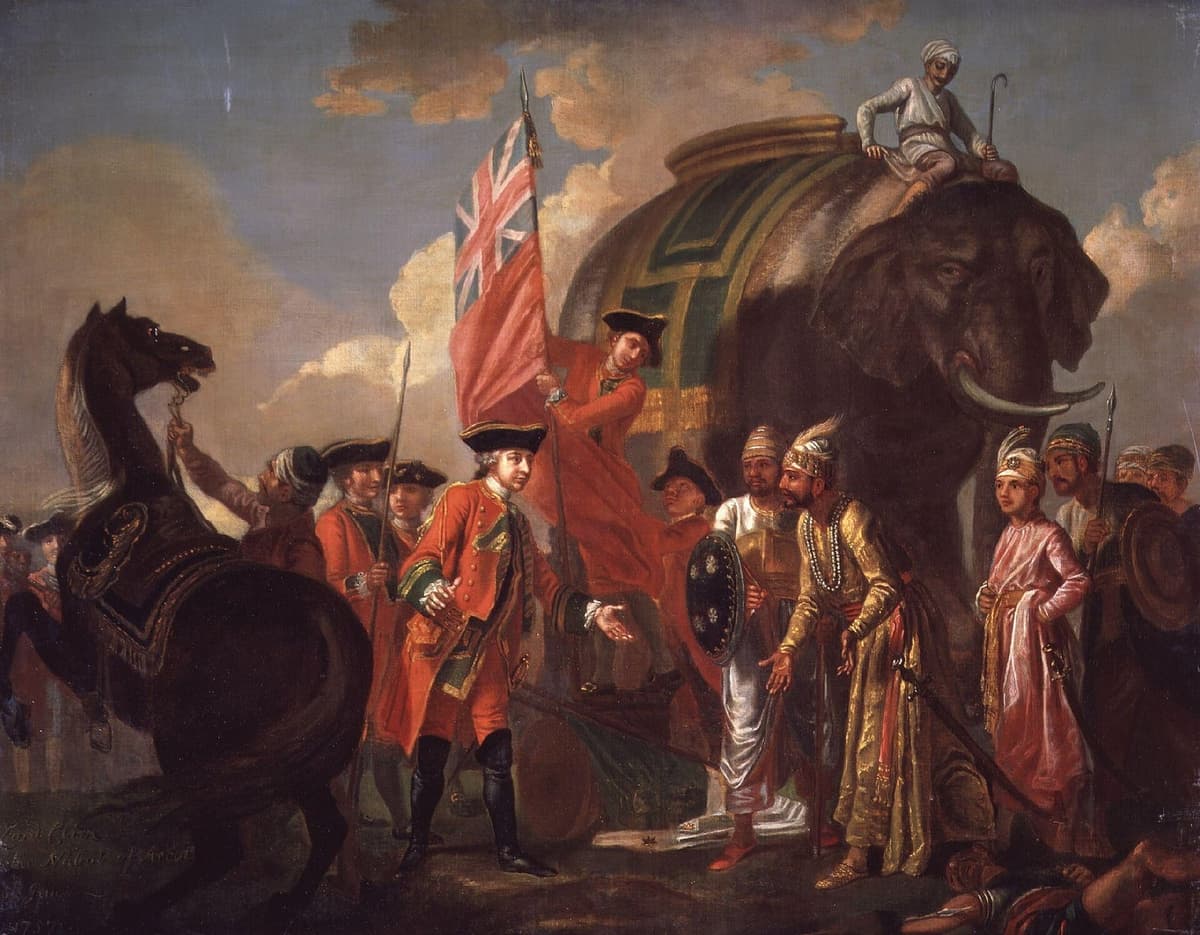
The quarrel had a history. The Company had held trading rights at Calcutta since 1690, and in 1756 Sirajuddaula took the town from the English and renamed it Alinagar; the old name came back only in January 1758.15 The longer story of the nawabs and the European trading companies is told in the chapter on Mughal Bengal.
The second step was the Diwani. Robert Clive arrived in Calcutta in May 1765 and went to Allahabad to obtain it.16 By a farman dated 12 August 1765, the Mughal emperor Shah Alam appointed the Company Diwan, the revenue administrator, of Bengal, Bihar and Orissa, on condition that it send him a tribute of 26 lakh rupees a year.17 By an agreement of 30 September 1765 the Company also undertook to pay the young Nawab Najmuddaula 53 lakh rupees a year for the costs of the nizamat, the civil administration, and of his household. Whatever revenue was left after these two payments counted as the Company's profit.18
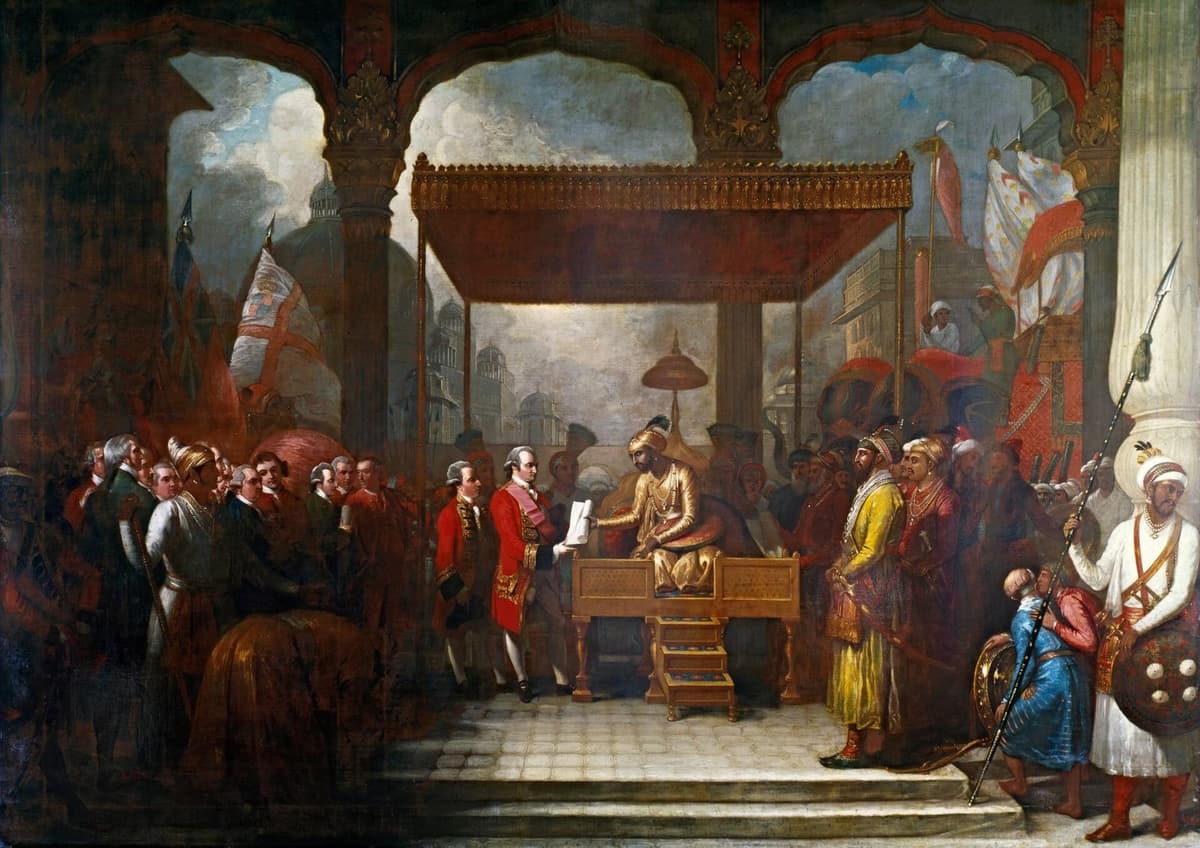
At first the Company ruled through Indian agents. Clive made Syed Muhammad Reza Khan both naib diwan and naib nazim, an arrangement known as the "Double Government".20 In 1772 the Court of Directors resolved "to stand forth as diwan", and Warren Hastings, who had returned to Calcutta as Governor on 17 February that year, abolished the Double Government and removed Reza Khan.21
London tightened its grip in stages: the Regulating Act of 1773 followed the Company's request for a "rescue loan" in 1771, the Charter Act of 1813 ended its trading monopoly in India, and the Queen's Declaration of 1858 abolished it.22
This chapter's argument starts here. In the interpretation offered below, which the evidence supports but no single source states, colonial Bengal was governed first and foremost as a source of revenue, and it was run from Calcutta. The eastern districts, most of what is now Bangladesh, paid rent and grew indigo and jute; the mills, the colleges and the seat of government stayed in and around Calcutta. That shape helps to explain the partition of 1905, the division of 1947 and the country that came after.
How many died in the famine of 1769-70?
The usual answer is one-third of the population, about 10 million people, but that figure rests on Company estimates and on a nineteenth-century inference, not on a count.27 Bengalis remember the famine as Chhiyattarer Manvantar, the great famine of the Bengali year 1176, and Banglapedia calls it the worst famine in Bengal in the eighteenth century.28
Drought in 1769 was followed in 1770 by excessive rain, which flooded the rivers and damaged crops.29 Atiur Rahman, the author of Banglapedia's entry, also blames the revenue system and the middlemen of the grain market.30 His entry gives a striking pair of figures: revenue collected in 1768 was Rs 15.21 million (nominal), and in 1771, just after the famine, collections were about Rs 52,200 higher, not lower.31 The entry does not name the archive the figures come from. If they are right, the Company took slightly more from Bengal in the year after the famine than in the year before it.
The death toll comes down to us through W. W. Hunter's Annals of Rural Bengal (1868). Hunter quotes the official reckoning that "before the end of May 1770, one-third of the population was officially calculated to have disappeared".32 He reports that Warren Hastings, after touring the province, gave the loss as "at least one-third of the inhabitants".33 Hunter then made his own calculation. Taking an estimate of 24 to 30 million for the population twenty years later, he concluded that the failure of a single crop "had within nine months swept away ten millions of human beings".34 That is an inference built on an estimate.
The damage outlasted the famine. Hunter writes that in 1789 Lord Cornwallis pronounced one-third of the Company's territories in Bengal to be "a jungle inhabited only by wild beasts", citing a minute of 18 September 1789.35 Banglapedia's demographers estimate the population of the area of present Bangladesh at 11.8 million in 1770 and 14.5 million in 1801.36 Those figures cover a smaller area than Hunter's, so the two cannot be set side by side.
| Estimate by | Deaths | Basis |
|---|---|---|
| Company records, May 1770 | One-third of the population "officially calculated to have disappeared" | Official returns |
| Warren Hastings, 1772 | "At least one-third of the inhabitants" | His tour of the province |
| W. W. Hunter, 1868 | "Ten millions" | Inference from a later population estimate of 24 to 30 million |
| Atiur Rahman, Banglapedia | About 10 million (one-third) | Follows the traditional figure |
Source: Hunter, Annals of Rural Bengal, vol. 1; Rahman, "Famine", Banglapedia.37
The later figures build on the one-third reckoning of 1770 to 1772, which Hunter says was "accepted by all official and by the most accurate non-official writers".38 None of them is a count of the dead.
The Permanent Settlement: who owned the land?
From 1793 the zamindars owned it in law, and the raiyats who cultivated it did not.39 The Permanent Settlement was a contract between the Company's government and the zamindars and talukdars: it made them absolute proprietors of the land and fixed the government's revenue demand for ever.40
It is linked to Lord Charles Cornwallis, Governor-General from 12 September 1786 to 10 October 1793, who was sent out under Pitt's India Act of 1784 with instructions to establish it.41 According to Sirajul Islam, the idea was not Cornwallis's own: it was first developed by Sir Philip Francis, a member of the Governor-General's Council.42
The fixed demand came with a hard rule. Under the "Sunset Law", a zamindar's land could be sold if the revenue was not paid on time, and much of Bengal's zamindari land changed hands at auction as a result.43 The pressure was passed down. Regulation VII of 1799, known as haftam, gave zamindars wide powers over raiyats who fell behind, including seizure of property and confinement, and Regulation VIII of 1819, the pattani law, let them lease land permanently at a fixed rent.44 Chains of sub-tenures followed: in Bakerganj there were sometimes as many as fifteen tiers between the zamindar and the cultivator.45
Reform came slowly, and alongside protest. The Rent Act of 1859 created three legal classes of raiyat, among them occupancy raiyats who had held land continuously for twelve years.46 Banglapedia lists peasant risings at Tushkhali in Bakerganj (1872 to 1875), Pabna (1873), Chhagalnaiya in Noakhali (1874), Mymensingh (1874 to 1882), Munshiganj (1880 to 1881) and Mehendiganj (1880 to 1881).47 A Rent Commission was set up in 1879, and the Bengal Tenancy Act (Act VIII of 1885) that followed "considerably curtailed zamindari power".48
Later laws widened the raiyats' rights again: Act VI of 1938, passed under A. K. Fazlul Huq's ministry, abolished salami, a fee on transfers.49 In 1940 the Land Revenue Commission chaired by Francis Floud recommended abolishing the zamindari system, but nothing was done before 1947.50 The Permanent Settlement ended in East Bengal only when the East Bengal State Acquisition and Tenancy Act became law on 16 December 1950.51
Faraizis, Titu Mir and 1857
Some of the resistance took a religious form. The Faraizi movement was founded by Shariatullah, usually called Haji Shariatullah, who had spent 20 years in Makkah; after his death in 1840 his son Muhsinuddin Ahmad, known as Dudu Miyan, led it, and it took on an agrarian character.52 Titu Mir (Saiyid Mir Nisar Ali, 1782 to 1831) built a bamboo fort at Narkelbaria in October 1831, and Company forces attacked and destroyed it on 14 November 1831.53
The revolt of 1857 began at Barrackpur on 29 March 1857 and reached the eastern districts late in the year: the Native Infantry rebelled in Chittagong on 18 November, and on 22 November sepoys at Lalbagh in Dhaka resisted being disarmed.54 The historian Ratan Lal Chakraborty concludes that the landed aristocracy and middle class of eastern Bengal sided with the Company, while the peasantry "remained untouched".55
Indigo and jute: crops for distant markets
In the nineteenth century two cash crops tied the Bengal countryside to markets overseas: indigo, grown for European planters, and jute, whose machine spinning was pioneered in Dundee before mills rose on the Hooghly.56
Indigo in Bengal was mostly an export crop developed by European planters, and Act IV of 1837 allowed Europeans to buy and hold landed estates.57 The main indigo districts were Nadia, Jessore, Bogra, Rangpur and Dhaka.58 The business weakened in the 1840s: the agency houses and the Union Bank of Calcutta, the planters' main lenders, failed in 1847, and by the late 1850s cereals, oilseeds and jute paid raiyats better than indigo.59
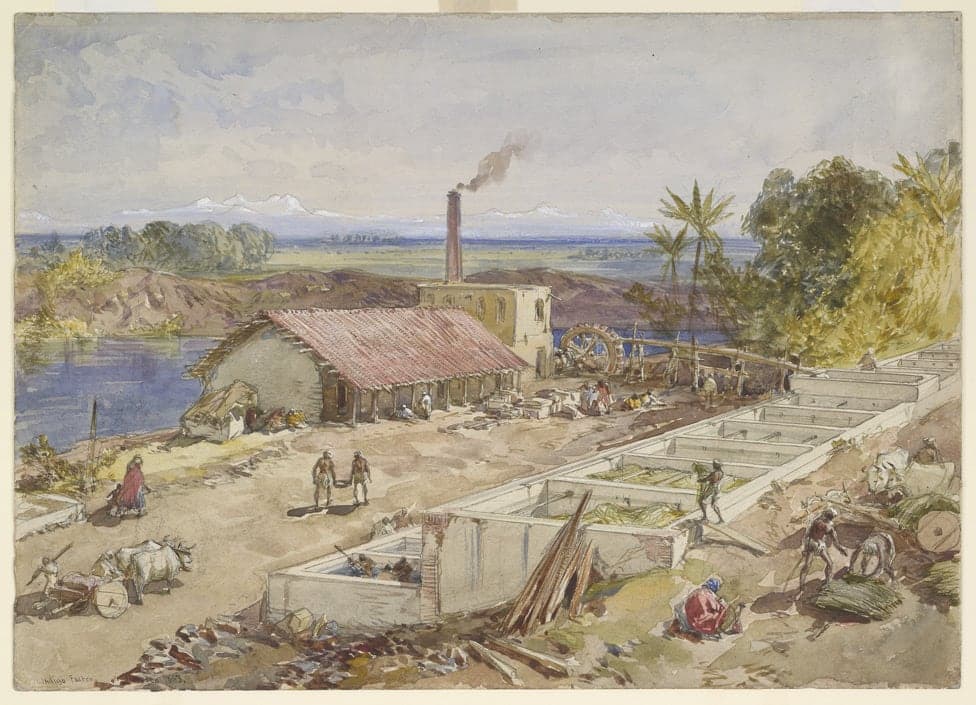
The Indigo Resistance Movement began in Jessore and Nadia in 1859 and spread to the other indigo districts.61 Banglapedia's own entries date it variously to 1859 to 1862, 1858 to 1860 and 1859 to 1860.62 The raiyats had allies. The Rev. James Long of the Church Missionary Society supported them, as did Abdool Luteef, a Deputy Magistrate in Jessore who ruled against planters, and the play Nildarpan (1860) by Dinabandhu Mitra shaped public opinion.63 The government appointed an Indigo Commission in 1860, and an Act was then passed that prohibited forcing raiyats to grow indigo.64
The golden fibre
Jute, once called the "golden fibre" of Bangladesh, owed its industrial career to Scotland.65 In 1832 the Dundee firm of Balfour and Melville found a way to soften jute for machine spinning with whale oil and water, and the Crimean War (1854 to 1856) and the American Civil War (1861 to 1865) raised demand.66 The first jute mill in Bengal was set up at Rishra on the Hooghly, north of Calcutta, in 1855 by George Auckland with a Bengali partner, Shyamsunder Sen.67 The Scottish link is the subject of the journal article on Narayanganj, the Dundee of Bangladesh.
Show the numbers
| Year | Jute mills |
|---|---|
| 1855 | 1 |
| 1882 | 18 |
| 1901 | 35 |
| 1903-04 | 38 |
| 1929-30 | 98 |
Source: Mufakharul Islam, "Jute Industry", Banglapedia.68
The industry grew fast, and all of it in one place. Mills around Calcutta numbered 18 in 1882 and 35 in 1901, when they had 315,000 spindles, 15,000 looms, 110,000 workers and paid-up capital of Rs 41 million (nominal).69 Between 1903-04 and 1929-30 the number of mills rose from 38 to 98 and employment from 123,689 to 343,257.70 The historian Mufakharul Islam notes that all the jute mills were around Calcutta and controlled by foreign capital.71 Research came late, and to Dhaka: the Indian Jute Research Institute was established at Dhaka in 1938.72
| Year | Mills | Other figures |
|---|---|---|
| 1855 | 1 (Rishra) | |
| 1882 | 18 | |
| 1901 | 35 | 315,000 spindles; 15,000 looms; 110,000 workers; paid-up capital Rs 41 million (nominal) |
| 1903-04 | 38 | 123,689 workers |
| 1929-30 | 98 | 343,257 workers |
| 1930 | 54,000 looms |
Source: Mufakharul Islam, "Jute Industry", Banglapedia.73
That geography decided what happened in 1947. At Partition all the jute mills were in India, while 80 per cent of the jute-growing area was in Pakistan.74 How East Pakistan then built its own mills is told in the garment guide's chapter Before the Garment Boom.
Calcutta and the Bengal Renaissance
Calcutta was the capital of British India until December 1911, and it was the centre of the nineteenth-century change in ideas that historians call the Bengal Renaissance.75 It was known as the "City of Palaces".76 Sir William Jones founded the Asiatic Society there in 1784, and Governor-General Wellesley founded the College of Fort William in 1800, which the historian David Kopf calls the first European-created institution of higher learning in India to welcome Indians as faculty.77
Kopf defines the Bengal Renaissance as the social, cultural and intellectual changes of the nineteenth century, centred on Calcutta, that arose from contact between Orientalist British officials and missionaries and the Hindu intelligentsia.78 Hindu College was founded in Calcutta on 20 January 1817; it opened with 20 pupils, and 69 were enrolled within three months.79
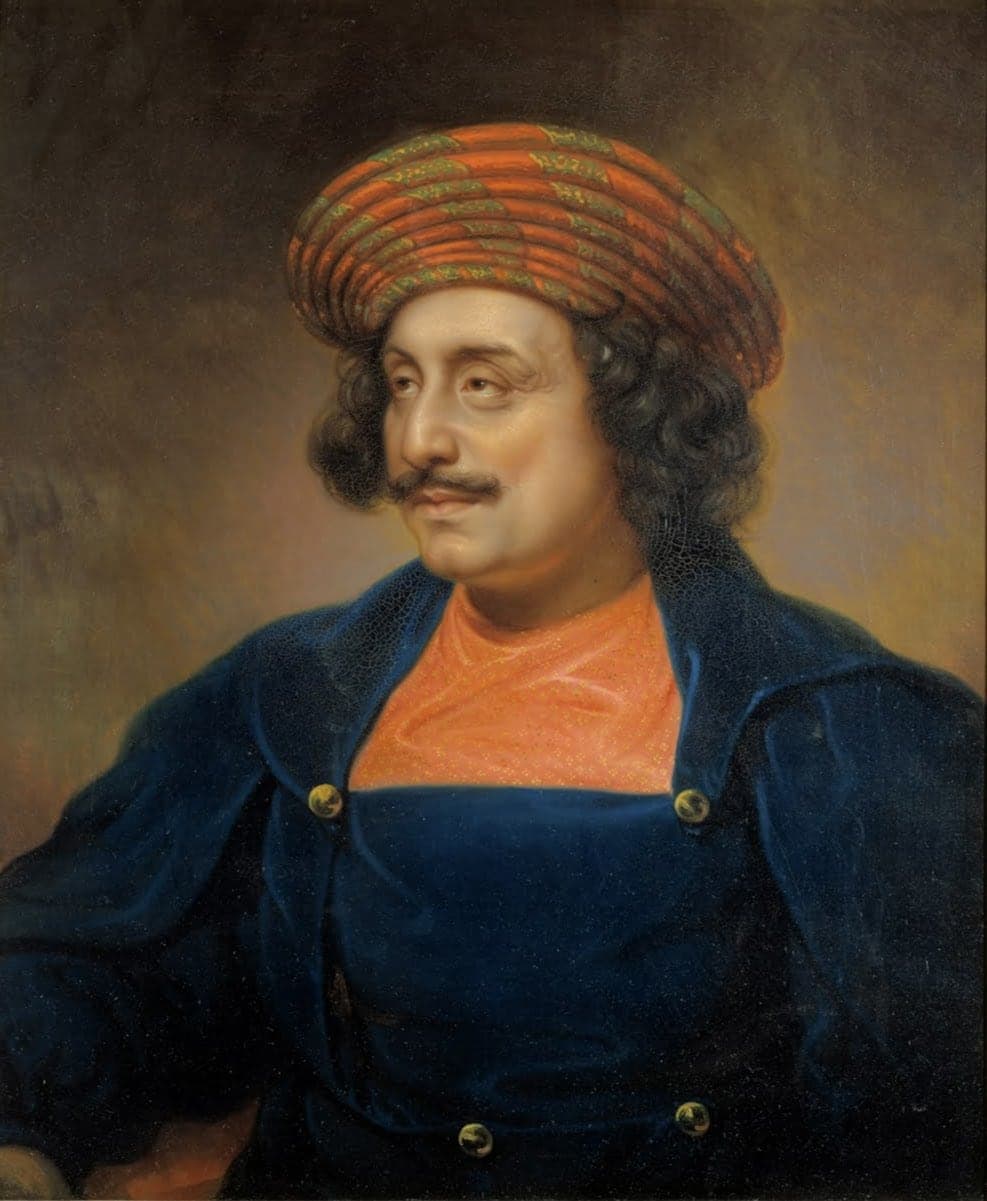
Two reformers stand out in the sources. Rammohun Roy, usually styled Raja Rammohun Roy, settled in Calcutta in 1814, founded the Atmiya Sabha within a year, and in August 1828 founded the Brahma Sabha, later the Brahmo Samaj.81 His biographer in Banglapedia, A. F. Salahuddin Ahmed, states that the public opinion Roy raised against sati influenced the government to abolish it in 1829.82 Ishwar Chandra Vidyasagar, born on 26 September 1820, became Principal of Sanskrit College in January 1851 and opened it to all Hindus, not only Brahman and Vaidya students.83 On 4 October 1855 he petitioned the government to legalise the remarriage of widows.84
The most famous figure of this Calcutta world is Rabindranath Tagore (1861 to 1941), who received the Nobel Prize in Literature for 1913 "because of his profoundly sensitive, fresh and beautiful verse".85 Banglapedia calls him the first Asian to be awarded a Nobel Prize and says the news reached him in November 1913.86 His work belongs to the chapter on culture.
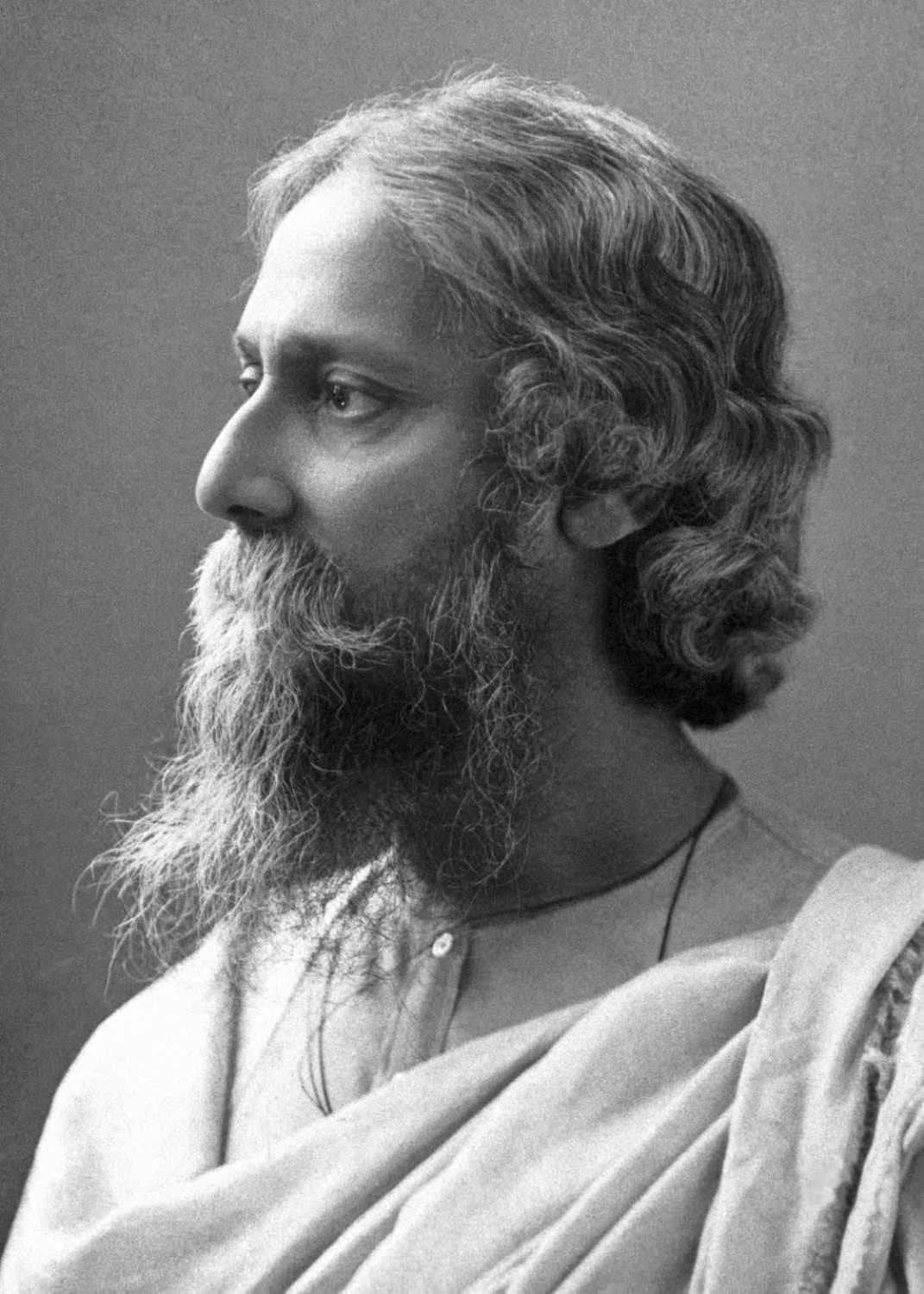
By Kopf's own definition, though, this was a movement of Calcutta and of its Hindu intelligentsia.87 In eastern Bengal, where most of the province's Muslims lived, a university came only in 1921, when the University of Dhaka opened under the Dacca University Act 1920, on about 600 acres at Ramna, with Salimullah Muslim Hall, Dhaka Hall and Jagannath Hall.88 The gap between the capital and the east is part of the background to 1905.
The partition of 1905 and its reversal
Bengal was divided on 16 October 1905, during the viceroyalty of Lord Curzon, and reunited on 1 April 1912.89 Before 1905 the Lieutenant-Governor of Bengal, which had included Bihar and Orissa since 1765, administered 189,000 square miles, and by 1903 the province had 78.5 million people.90 Proposals to divide it were first considered in 1903 and published in January 1904; Curzon toured eastern Bengal in February 1904, and the final decision was set out in a Government of India resolution of 19 July 1905.91
The new province, Eastern Bengal and Assam, had its capital at Dhaka and a subsidiary headquarters at Chittagong, and a Muslim majority.92 Dhaka grew with its new role: the city's population at the 1911 census was 21 per cent higher than in 1906.93
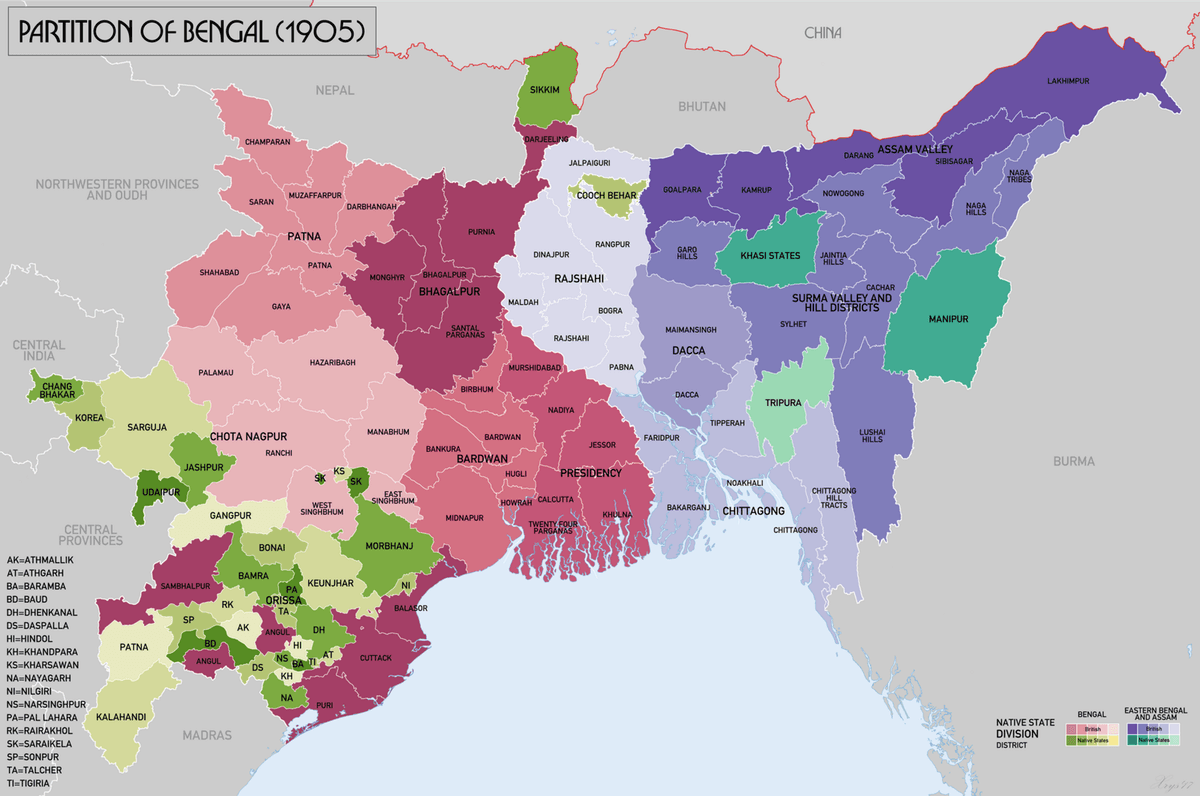
| Province | Area (square miles) | Population (million) | Muslims (million) | Hindus (million) |
|---|---|---|---|---|
| Undivided Bengal, 1903 | 189,000 | 78.5 | ||
| Eastern Bengal and Assam (capital Dhaka) | 106,540 | 31 | 18 | 12 |
| Bengal (remainder, with Bihar and Orissa) | 141,580 | 54 | 9 | 42 |
| Reunited Bengal from 1 April 1912 | c. 70,000 | c. 42 |
Source: Sufia Ahmed, "Partition of Bengal, 1905", Banglapedia.95
Opposition in Calcutta was immediate. A meeting there on 7 August 1905 resolved to boycott British goods until the partition was withdrawn, and Banglapedia says the day is "hailed as the birthday of Indian nationalism".96 The Swadeshi movement that followed ran from 1905 to 1908; Banglapedia calls it "the most successful of the pre-Gandhian movements".97 Communal riots broke out at Comilla in March 1907 and at Jamalpur in April 1907.98
Muslim opinion moved the other way. According to Sufia Ahmed, Nawab Salimullah of Dhaka at first called the partition proposal "beastly" but later supported the enlarged scheme, as did most educated Muslims.99 Harun-or-Rashid sums up the pattern: Hindus largely opposed the partition of 1905 and most Muslims supported it.100
The reversal was decided in 1911: Lord Hardinge sent proposals for annulment to London on 19 July and agreement came by telegram on 7 August, according to Helal Uddin Ahmed, while Sufia Ahmed dates the secret despatch to 25 August.101 After the Delhi Durbar of 11 December 1911, King George V announced on 12 December that the partition would be annulled and that the capital of India would move from Calcutta to Delhi.102 The reunited Bengal of 1 April 1912 had five Bengali-speaking divisions, Presidency, Burdwan, Dacca, Rajshahi and Chittagong; Bihar, Chhota Nagpur and Orissa became a separate province, and Assam went back to a Chief Commissioner.103
The Muslim League, Dhaka, 1906
The partition years also produced a new party in Dhaka. On 1 October 1906 a deputation of 35 Muslim leaders, led by the Aga Khan, met the Viceroy, Lord Minto, at Simla and asked, among other things, for separate electorates.104 On 30 December 1906 the All India Muslim League was founded at the All India Muslim Education Conference, held at Shahbag in Dhaka: Nawab Salimullah proposed a political platform, and the chairman, Nawab Viqar-ul-Mulk, supported it.105 Separate electorates for Muslims followed in the Morley-Minto Reforms, the Indian Councils Act of 1909.106
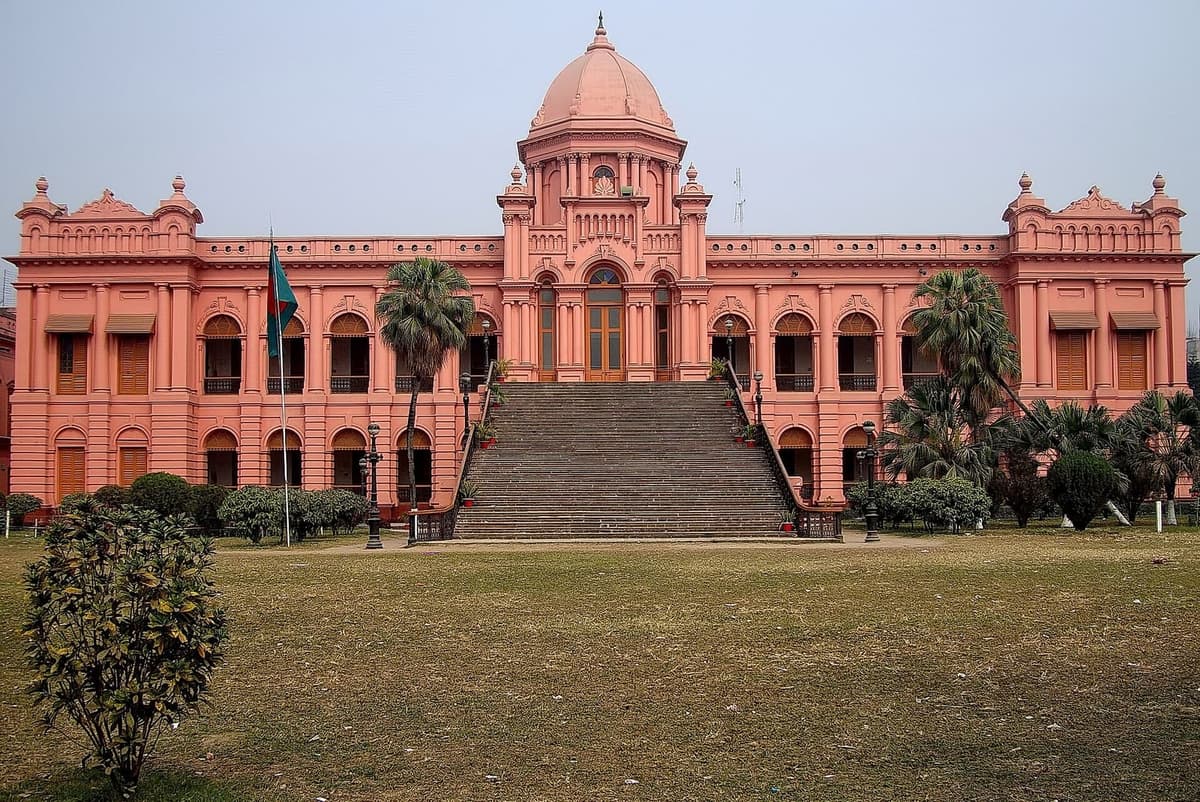
Khwaja Salimullah was born at Ahsan Manzil, the family's palace in Dhaka, on 7 June 1871, became Nawab of Dhaka in 1901 and died in 1915.107 The Eastern Bengal and Assam Muslim League took formal shape at Ahsan Manzil on 17 March 1911, and after the annulment the eastern and western Leagues merged into the Bengal Provincial Muslim League on 2 March 1912.108
Counting and voting: Bengal's politics, 1912 to 1946
From 1909 Muslims voted in separate electorates, and the reforms of the 1930s kept communal representation.110 The Bengal Pact, negotiated by C. R. Das with Muslim leaders, was passed by Swarajist councillors on 16 December 1923 and by the Bengal Provincial Congress Committee on 18 December.111 The British Government's Communal Award, announced on 16 August 1932, set communal representation in the provincial legislatures under the coming Government of India Act 1935.112 Under that Act the Bengal Legislative Assembly had 250 seats, 117 of them Muhammadan seats (6 urban and 111 rural) and 78 general seats.113
One new party spoke about rice, not religion. A. K. Fazlul Huq, to whom the title Sher-e-Bangla is popularly given, founded the Krishak Praja Party at Dhaka in July 1936 with the slogan Dal-Bhat, pulses and rice, for all.114 After the election of 1937 he formed a coalition ministry with the Muslim League, and he joined the League at its Lucknow session on 15 October 1937.115 On 23 March 1940 Huq moved the Lahore Resolution, adopted the next day, which called for "independent states" in the north-western and eastern zones.116 In April 1946 a resolution moved by H. S. Suhrawardy used "state" in the singular, and Abul Hashim of the Bengal League objected.117
On 28 March 1943, in the middle of the war, the Governor had Huq sign a resignation, and Khwaja Nazimuddin formed a Muslim League ministry on 24 April 1943.118 The last general elections before Partition were held from 19 to 22 March 1946, and Suhrawardy formed the government.119 Exact seat counts for both elections differ between Banglapedia's own entries, and the official returns were not checked for this chapter, so every version is shown below.
| Election and party | Entry on the Assembly | Entry on the Krishak Praja Party | Entry on the Muslim League | Entry on Suhrawardy |
|---|---|---|---|---|
| 1937, Congress | 54 | 52 | ||
| 1937, Muslim League | 40 | 39 | 36 | |
| 1937, Krishak Praja Party | 35 | 36 | ||
| 1937, Independent Muslims | 42 | |||
| 1946, Muslim League | 113 | 114 | 110 of 117 Muslim seats | 114 of 121 reserved seats |
| 1946, Congress | 86 | |||
| 1946, Krishak Praja Party | 4 |
Source: Banglapedia entries "Bengal Legislative Assembly", "Krishak Praja Party", "Muslim League" and "Suhrawardy, Huseyn Shaheed".120
Away from the Assembly, the Tebhaga movement of 1946 and 1947, a sharecroppers' campaign for two-thirds of the crop organised mainly by communist cadres of the Bengal Provincial Krishak Sabha, spread to nineteen districts and was strongest in Dinajpur, Rangpur, Jalpaiguri, Khulna, Mymensingh, Jessore and 24-Parganas.121
Counting Bengal: what the censuses show
With seats shared out by community, the census mattered politically too. The first census of Bengal was taken in 1872, but, according to Banglapedia, it "failed to achieve its objectives" because people were suspicious and did not cooperate, and a second followed in 1881.122 The census of 1872 showed that nearly half of the population of Bengal was Muslim, most of them in the east.123 Demographers, Banglapedia reports, regard the censuses of 1901, 1911 and 1921 as fairly reliable and those of 1931 and 1941 as less credible, because communal rivalry led to false returns.124
The figures below are for Bengal Province as it was after 1912, the five divisions of the reunited province, with earlier censuses adjusted to those boundaries; they are not the larger presidency of 1872, which included Bihar and Orissa, and not present Bangladesh.125 The figures for 1872 to 1931 come from the census of 1931 on 1931 boundaries; the figure for 1941 comes from a different table, in the census of 1941, on boundaries that differ very slightly.126
Show the numbers
| Year | Bengal Province including the Bengal States |
|---|---|
| 1872 | 34.69 |
| 1881 | 37.02 |
| 1891 | 39.81 |
| 1901 | 42.89 |
| 1911 | 46.31 |
| 1921 | 47.6 |
| 1931 | 51.09 |
| 1941 | 61.46 |
Source: Census of India 1931, Bengal and Sikkim, Imperial Table II (1872 to 1931, on 1931 boundaries); Census of India 1941, Bengal, Table II (1941). The area is the post-1912 province, not present Bangladesh; the 1941 count is widely regarded as inflated.127
| Census | Including the Bengal States | British territory only |
|---|---|---|
| 1872 | 34,691,799 | 34,123,972 |
| 1881 | 37,020,563 | 36,322,302 |
| 1891 | 39,812,165 | 39,095,855 |
| 1901 | 42,888,194 | 42,147,895 |
| 1911 | 46,312,262 | 45,489,697 |
| 1921 | 47,599,233 | 46,702,307 |
| 1931 | 51,087,338 | 50,114,002 |
| 1941 | 61,460,377 | 60,306,525 |
Source: 1872 to 1931: Census of India 1931, Bengal and Sikkim, Imperial Table II, on 1931 boundaries. 1941: Census of India 1941, Bengal, Table II, on 1941 boundaries, which add about 1,500 people to the 1931 total. The Bengal States are Cooch Behar and Tripura.128
Between 1921 and 1931 the population of British Bengal rose by 7.3 per cent.129 The jump to 1941, an increase of 10,371,493 as measured by the 1941 census on its own boundaries, is the figure to treat with care: Banglapedia's population entry calls the high growth rate possibly "the result of a gross overenumeration of population pushed politically by both Hindu and Muslim religious groups".130
Figures for the area of present Bangladesh exist only as later reconstructions. Banglapedia, citing the Bangladesh Bureau of Statistics, gives 28.9 million for 1901, 31.6 million for 1911, 33.3 million for 1921 and 42.0 million for 1941.131 For 1931 its table gives 25.6 million and its text 35.3 million, and the entry on the census gives about 36 million; the 25.6 is almost certainly a misprint.132 Over the same years the Muslim share of the population of that area rose steadily.133 The modern population story is in the chapter on land and people.
| Census | Muslim | Hindu | Christian | Others |
|---|---|---|---|---|
| 1901 | 66.1 | 33.0 | 0.9 | |
| 1911 | 67.2 | 31.5 | 1.3 | |
| 1921 | 68.1 | 30.6 | 1.3 | |
| 1931 | 69.5 | 29.4 | 0.2 | 1.0 |
| 1941 | 70.3 | 28.0 | 0.1 | 1.6 |
Source: Islam and Karmaker, "Population", Banglapedia, table 3, citing the Bangladesh Bureau of Statistics (2003).134
The Bengal famine of 1943: how many died, and why?
Between about 0.8 million and 3.8 million people died, depending on whose estimate is used; in 2007 the economic historian Cormac Ó Gráda wrote that "today the scholarly consensus is about 2.1 million".135 The famine killed, in his words elsewhere, "over two million people out of a population of sixty million or so".136 Excess deaths peaked from September to November 1943, and excess mortality went on well into 1944.137 The photograph below shows children who are dead or dying.
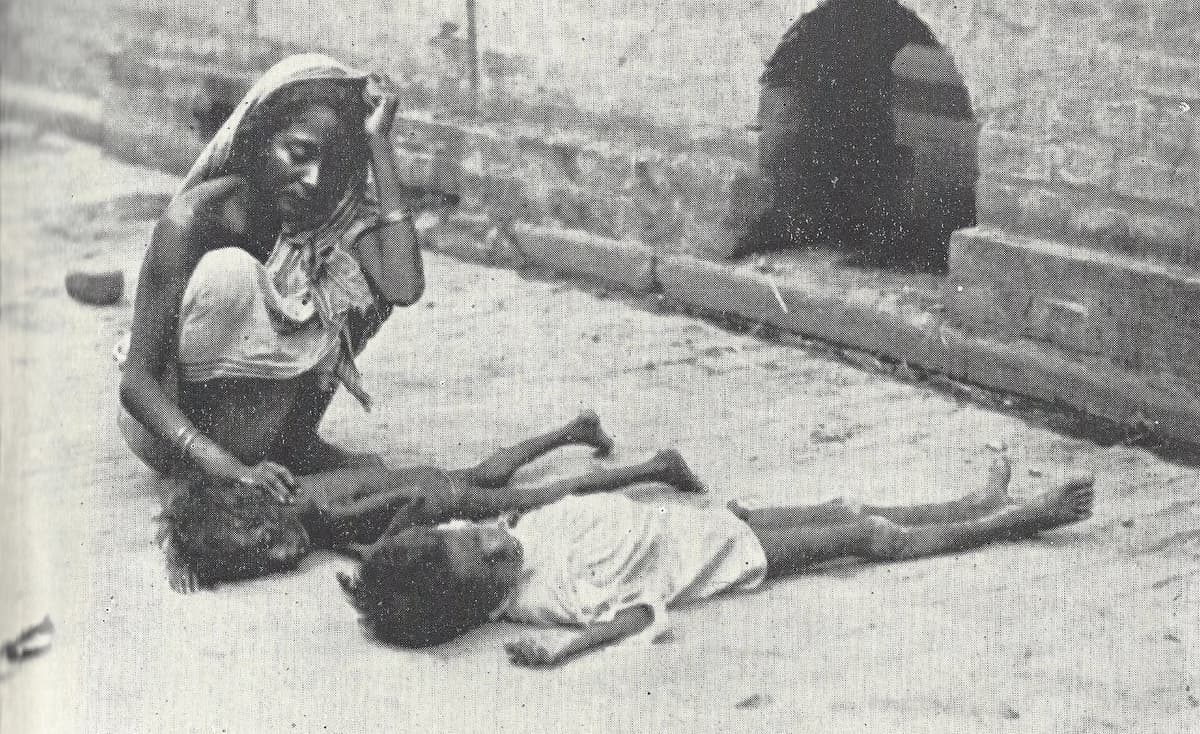
The causes, as Atiur Rahman lists them in Banglapedia, were many: crop failures from 1938, the loss of rice imports from Burma after the Japanese conquest, wartime disruption of trade, provincial and district cordons on the movement of grain, army demand, refugees, speculation and hoarding, and administrative failure.139 The government's own Famine Inquiry Commission, chaired by Sir John Woodhead, published its Report on Bengal in May 1945.140 It cited a reckoning that unusual profits on rice in 1943 came to Rs 150 crores (nominal), a figure it said it "cannot vouch for".141
Ó Gráda notes that the Secretary of State for India, at the height of the famine, put weekly deaths at about one thousand "when the true figure was about forty thousand".142
Why the estimates differ
The estimates differ because they measure different periods and areas, and start from different data. The Bengal Public Health Department recorded 1,873,749 deaths in Bengal in 1943, against an average of 1,184,903 for 1938 to 1942: an excess of 688,846.143 In the first six months of 1944 a further 981,228 deaths were recorded, 422,371 more than the average.144 Registration missed many deaths, and the Commission judged excess deaths in 1943 to be "of the order of one million", about 40 per cent above the recorded figure; adding 1944, it concluded that "about 1.5 million deaths occurred as a direct result of the famine and the epidemics which followed in its train".145 It rejected Professor K. P. Chattopadhyaya's sample-based estimate of 3.5 million deaths in 1943 as not "statistically sound".146
Show the numbers
| Year | Recorded deaths |
|---|---|
| Average, 1938 to 1942 | 1,184,903 |
| 1943 | 1,873,749 |
Source: Famine Inquiry Commission, Report on Bengal (1945), Part II, ch. I, from Bengal Public Health Department figures. Registered deaths only; the Commission judged that many deaths went unrecorded.147
In 1981 Amartya Sen put the toll much higher. Arup Maharatna quotes his conclusion that "we may be inclined to pick a figure around 3 million as the death toll of the Bengal Famine", and calls it the new "conventional wisdom".148 Maharatna then applied Sen's own methods to registration data for undivided Bengal and obtained 1.8 and 1.9 million excess deaths; he argues that Sen's figure is too high, partly because high mortality did not last for years after the famine, and that Paul Greenough's 3.5 to 3.8 million "is largely based on Sen's calculations".149 Tim Dyson and Maharatna's re-estimate, using registration data for the whole of Bengal, is 2.1 million.150
| Estimate by | Excess deaths | Period covered |
|---|---|---|
| Bengal Public Health Department (1944 memorandum) | 792,854 to 1,017,600 | May 1943 to April 1944 |
| Bengal Public Health Report, 1944 | 1.4 million | June 1943 to December 1944 |
| Census of India, 1951 | 1.413 million | 1943 to 1945 |
| Famine Inquiry Commission (Woodhead), 1945 | "About 1.5 million" | 1943 to mid-1944 |
| Census of Pakistan, 1951 (East Bengal only) | 1,714,000 | 1942 to 1944 |
| Arup Maharatna, applying Sen's method to all-Bengal data (1992) | 1.8 and 1.9 million | Not stated |
| Tim Dyson and Arup Maharatna (1991) | 2.1 million | 1943 to 1944 |
| Cormac Ó Gráda (2007), "scholarly consensus" | About 2.1 million | Not stated |
| K. P. Chattopadhyaya | 2.7 million at least (1943 and first half of 1944); 3.5 million for 1943, as reported by the Commission | 1943 to mid-1944 |
| Amartya Sen (1981) | 2.62 to 3.05 million ("around 3 million") | 1943 to 1946 |
| Atiur Rahman, Banglapedia | 3.5 million | Not stated |
| Paul R. Greenough (1982) | 3.5 to 3.8 million | 1943 to 1946 |
| Range of later estimates (Ó Gráda, 2007) | 0.8 to 3.8 million |
Source: Maharatna (1992), table 5.1 and pp. 216-219; Famine Inquiry Commission (1945); Dyson and Maharatna (1991); Ó Gráda (2007); Rahman, "Famine", Banglapedia.151
The famine also moved land. Ó Gráda reports that Bengal had 16.4 million landholders in 1940, and that 2.7 million sales of whole or part occupancy holdings were recorded after the famine.155
1946 and 1947: violence and division
In August 1946 Calcutta saw days of killing after the Muslim League's Direct Action Day, and on 20 June 1947 Bengal's legislators voted for the partition of the province.156 The League's Council, meeting in Bombay from 27 to 29 July 1946, resolved on "direct action for the achievement of Pakistan", and its Working Committee named 16 August 1946 Direct Action Day and called for a complete hartal, a general strike.157 The League's rally in Calcutta that day was held at the Ochterlony Monument.158
The historian Suranjan Das reports an "official estimate" of 4,000 dead and 100,000 injured; Banglapedia does not name the document, so this is one estimate among several.159 Das describes the riot as organised on both sides. He records allegations against the Chief Minister, Suhrawardy, and against Marwari merchants, and judges the Governor and European officials "culpable" for delay, since the army was called in only 24 hours after the outbreak.160 These are Das's assessments, and they are contested.
The violence spread. Sirajul Islam writes that "in Bihar, mostly Muslims were killed and in Noakhali, Hindus", and that Direct Action Day "made the partition of Bengal inevitable".161 The violence in Noakhali and Tippera took place in October 1946; Das calls them "the Noakhali-Tippera outrage".162 Sugata Bose, quoted in The Daily Star, writes that "the breakdown of social symbiosis reached its dramatic climax during the Noakhali and Tippera riots in 1946".163 Published death tolls for Noakhali vary widely, and none could be checked against a reliable source for this chapter, so none is given here.
The politics of 1947 reversed those of 1905. Harun-or-Rashid notes that in 1947 it was Hindu leaders, especially the Hindu Mahasabha, who proposed partitioning Bengal, while the Muslim leadership first opposed it and then accepted it.164 Joya Chatterji's Bengal Divided (1994) argues that Bengali Hindu elites actively sought partition.165 Suhrawardy made a last attempt to keep Bengal united as an independent state, and it failed.166 The partition plan was agreed at the Leaders' Conference of 2 June 1947 and published the next day as the "3 June plan".167
On 20 June 1947 the Bengal Legislative Assembly voted as a whole and then in two parts. A majority for partition in either half was enough, and the members from non-Muslim-majority areas gave it.168
| Vote | For | Against | Question |
|---|---|---|---|
| Joint session of the Assembly, 20 June | 90 | 126 | Joining the existing Constituent Assembly (India) |
| Members from Muslim-majority areas, 20 June | 106 | 35 | Against partition, and for joining a new Constituent Assembly (Pakistan) as a whole |
| Members from non-Muslim-majority areas, 20 June | 58 | 21 | For partition |
| Sylhet referendum, 7 July | 239,619 | 184,041 | Joining East Bengal rather than staying in Assam (majority 55,578) |
Source: Harun-or-Rashid, "Partition of Bengal, 1947", Banglapedia.169
The Indian Independence Act of 15 July 1947 ended British rule: power was transferred to Pakistan on 14 August and to India on 15 August 1947.170 The boundary was drawn by Boundary Commissions chaired by Sir Cyril Radcliffe (1899 to 1977), who, Banglapedia notes, had no background in Indian administration.171 Murshidabad went to West Bengal; Khulna went to East Bengal, except the parts west of the Mathabhanga; and Darjeeling and Jalpaiguri went to West Bengal, except five Muslim-majority thanas.172
| Unit | Area (km²) | Population (million) | Largest minority |
|---|---|---|---|
| Old province of Bengal | 257,478 | ||
| East Bengal, territory from Bengal | 130,383.19 | 39.11 (whole of East Bengal) | Hindus, 11.4 million |
| East Bengal, territory from Assam (mainly Sylhet) | 12,393.15 | Included above | |
| West Bengal | c. 72,520 | 21.19 | Muslims, c. 5.3 million |
Source: Raj Sekhar Basu, "Radcliffe Award", Banglapedia, citing East Bengal Land Records and Survey (1951).173
The division of 1947 cut along the seam this chapter has traced, or so the evidence suggests. East Bengal received most of the jute land and none of the mills, and kept the zamindari system of the Permanent Settlement until 16 December 1950.174 Its capital, Dhaka, had been a provincial capital only from 1905 to 1912, and had had a university only since 1921.175 For nearly two centuries Bengal had been run from Calcutta for its revenue; in 1947 its eastern half had to manage without that centre, as a province of Pakistan. What followed is the subject of the next chapter, East Pakistan.
Timeline, 1757 to 1950
- 23 June 1757Battle of Palashi (Plassey); Sirajuddaula is defeated.176
- 12 August 1765Shah Alam's farman grants the Diwani of Bengal, Bihar and Orissa to the Company.177
- 1769 to 1770Famine, the Chhiyattarer Manvantar.178
- 1772The Company "stands forth as diwan"; Hastings ends the Double Government.179
- 1773Regulating Act.180
- 1784Asiatic Society founded in Calcutta.181
- 1793Permanent Settlement.182
- 1800College of Fort William founded.183
- 1813Charter Act ends the Company's trading monopoly.184
- 20 January 1817Hindu College founded in Calcutta.185
- 1829Sati abolished.186
- 14 November 1831Company forces destroy Titu Mir's bamboo fort at Narkelbaria.187
- 1855First jute mill in Bengal, at Rishra.188
- 1857Revolt begins at Barrackpur on 29 March; sepoys rebel at Chittagong on 18 November and resist disarming at Lalbagh, Dhaka, on 22 November.189
- 1858The Queen's Declaration abolishes the East India Company.190
- 1859Rent Act; the Indigo Resistance Movement begins in Jessore and Nadia.191
- 1860Nildarpan; Indigo Commission.192
- 1872First census of Bengal.193
- 1885Bengal Tenancy Act.194
- 16 October 1905Partition of Bengal takes effect.195
- 30 December 1906All India Muslim League founded in Dhaka.196
- 12 December 1911George V announces the annulment of partition and the move of the capital to Delhi.197
- 1 April 1912Reunited Bengal takes effect.198
- November 1913News of Tagore's Nobel Prize reaches him.199
- 1921University of Dhaka opens.200
- 16 August 1932Communal Award announced.201
- July 1936Krishak Praja Party founded at Dhaka.202
- 23 March 1940Huq moves the Lahore Resolution, adopted on 24 March.203
- 1943Famine; excess deaths peak from September to November.204
- May 1945Famine Inquiry Commission's Report on Bengal published.205
- 16 August 1946Direct Action Day; violence in Calcutta until about 22 August.206
- October 1946Violence in Noakhali and Tippera.207
- 20 June 1947Bengal Legislative Assembly votes for partition.208
- 7 July 1947Sylhet referendum.209
- 14 and 15 August 1947Power transferred to Pakistan and to India.210
- 16 December 1950East Bengal State Acquisition and Tenancy Act abolishes the Permanent Settlement.211
Further reading
Six books make a good start. P. J. Marshall's Bengal: The British Bridgehead (1987/88) is the standard account of the Company's takeover, and Sugata Bose's Peasant Labour and Colonial Capital (1993) follows the countryside, its famines and its jute from 1770.212 David Kopf's British Orientalism and the Bengal Renaissance (1969) explains the Calcutta world of the College of Fort William.213 For 1943, read Amartya Sen's Poverty and Famines (1981) alongside Cormac Ó Gráda's survey "Making Famine History" (2007).214 For the road to 1947, Joya Chatterji's Bengal Divided (1994) argues that Bengali Hindu elites actively sought partition.215
Questions students and journalists ask
What was the Diwani of 1765 and why did it matter?
The Diwani was the right to collect and manage the revenue of Bengal, Bihar and Orissa. The Mughal emperor Shah Alam granted it to the East India Company by a farman of 12 August 1765, in return for a tribute of 26 lakh rupees a year. After paying the emperor and the nawab, the Company kept the surplus as profit. It turned a trading company into the ruler of Bengal's finances.
How many people died in the Bengal famine of 1770?
The traditional figure is one-third of the population, about 10 million people. It comes from Company estimates of 1770 to 1772, including Warren Hastings's "at least one-third of the inhabitants", and from W. W. Hunter, who in 1868 worked backwards from an estimate of the population twenty years later. No count of the dead exists, so the figure is an estimate, not a measurement.
How many people died in the Bengal famine of 1943, and what caused it?
Estimates range from about 0.8 million to 3.8 million. The Famine Inquiry Commission gave about 1.5 million, Amartya Sen around 3 million, and Dyson and Maharatna 2.1 million, which Cormac Ó Gráda calls the scholarly consensus. Listed causes include crop failures, the loss of rice imports from Burma, wartime disruption, cordons on grain movement, army demand, hoarding and administrative failure.
Was Churchill responsible for the Bengal famine of 1943?
This is debated, and this guide takes no position. Writers including Madhusree Mukerjee have examined the part played by the War Cabinet in London and by Winston Churchill. Banglapedia's account lists many causes, among them crop failures, the loss of rice imports from Burma, cordons on the movement of grain, army demand, hoarding and administrative failure. Economists also differ: Sen analysed the famine as a failure of entitlements, while Ó Gráda argues that food was indeed in short supply.
What was the Permanent Settlement of 1793, and when was it abolished?
The Permanent Settlement was a contract between the Company's government and Bengal's zamindars and talukdars. It made them owners of the land and fixed the government's revenue demand for ever, while the cultivators received no equal rights. Land could be auctioned if revenue was paid late. Tenancy laws from 1859 onwards softened it, and East Bengal abolished it by an Act that became law on 16 December 1950.
Why was Bengal partitioned in 1905, and why was the partition reversed?
Before 1905 one Lieutenant-Governor ran 189,000 square miles and, by 1903, 78.5 million people. The partition created Eastern Bengal and Assam, a Muslim-majority province with its capital at Dhaka. Most Muslims supported it, while Hindus largely opposed it, through a boycott of British goods and the Swadeshi movement. King George V announced its annulment on 12 December 1911, and Bengal was reunited on 1 April 1912.
When and where was the Muslim League founded?
The All India Muslim League was founded in Dhaka on 30 December 1906, at the All India Muslim Education Conference. Banglapedia places the meeting at Shahbag. Nawab Salimullah of Dhaka proposed a political platform and the chairman, Nawab Viqar-ul-Mulk, supported it. Ahsan Manzil, the Nawab's palace, is where the Eastern Bengal and Assam Muslim League was formed later, on 17 March 1911.
Why did the capital of British India move from Calcutta to Delhi?
The move was announced together with the annulment of the partition of Bengal. After the Delhi Durbar of 11 December 1911, King George V announced on 12 December that the partition would be reversed and that the capital of India would move from Calcutta to Delhi. Calcutta had been the capital until then and became the capital of the reunited Bengal province.
What was the Indigo Revolt, and what was Nildarpan?
The Indigo Revolt, or Indigo Resistance Movement, was a movement of Bengal's raiyats against the European indigo planters. It began in Jessore and Nadia in 1859 and spread to other indigo districts; sources date its end between 1860 and 1862. Nildarpan, a play by Dinabandhu Mitra published in 1860, shaped public opinion against the planters. An Indigo Commission followed in 1860, and a law then banned forcing raiyats to grow the crop.
How was Bengal divided in 1947, and who drew the line?
On 20 June 1947 the Bengal Legislative Assembly's members from non-Muslim-majority areas voted 58 to 21 for partition, which was enough to divide the province. Sylhet voted on 7 July to join East Bengal. Boundary Commissions chaired by Sir Cyril Radcliffe drew the line. East Bengal received about 130,383 square kilometres of Bengal plus most of Sylhet, and 39.11 million people.
Notes
- K. M. Mohsin and Sushil Chaudhury, "Palashi, The Battle of," Banglapedia: National Encyclopedia of Bangladesh, Dhaka: Asiatic Society of Bangladesh; online edition, revision 4687, accessed 22 November 2026, https://en.banglapedia.org/index.php?title=Palashi,_The_Battle_of; Sirajul Islam, "Diwani," Banglapedia: National Encyclopedia of Bangladesh, Dhaka: Asiatic Society of Bangladesh; online edition, accessed 22 November 2026, https://en.banglapedia.org/index.php/Diwani; Sirajul Islam, "East India Company, The," Banglapedia: National Encyclopedia of Bangladesh, Dhaka: Asiatic Society of Bangladesh; online edition, revision 2090, accessed 22 November 2026, https://en.banglapedia.org/index.php?title=East_India_Company,_The. ↩
- Atiur Rahman, "Famine," Banglapedia: National Encyclopedia of Bangladesh, Dhaka: Asiatic Society of Bangladesh; online edition, revision 2195, accessed 22 November 2026, https://en.banglapedia.org/index.php/Famine; Harun-or-Rashid, "Partition of Bengal, 1947," Banglapedia: National Encyclopedia of Bangladesh, Dhaka: Asiatic Society of Bangladesh; online edition, revision 4750, accessed 22 November 2026, https://en.banglapedia.org/index.php?title=Partition_of_Bengal,_1947. ↩
- Mohsin and Chaudhury, "Palashi, The Battle of". ↩
- Islam, "Diwani". ↩
- Sirajul Islam, "Permanent Settlement, The," Banglapedia: National Encyclopedia of Bangladesh, Dhaka: Asiatic Society of Bangladesh; online edition, revision 4800, accessed 22 November 2026, https://en.banglapedia.org/index.php?title=Permanent_Settlement,_The. ↩
- Sufia Ahmed, "Partition of Bengal, 1905," Banglapedia: National Encyclopedia of Bangladesh, Dhaka: Asiatic Society of Bangladesh; online edition, revision 10579, accessed 22 November 2026, https://en.banglapedia.org/index.php?title=Partition_of_Bengal,_1905. ↩
- Cormac Ó Gráda, "Making Famine History," Journal of Economic Literature 45, no. 1 (2007): 19, https://doi.org/10.1257/jel.45.1.5. ↩
- Harun-or-Rashid, "Partition of Bengal, 1947". ↩
- Mohsin and Chaudhury, "Palashi, The Battle of"; Islam, "Diwani"; Islam, "Permanent Settlement, The"; Ahmed, "Partition of Bengal, 1905"; Ó Gráda, "Making Famine History", 19; Harun-or-Rashid, "Partition of Bengal, 1947". ↩
- Mohsin and Chaudhury, "Palashi, The Battle of"; Islam, "Diwani". ↩
- Mohsin and Chaudhury, "Palashi, The Battle of". ↩
- Mohsin and Chaudhury, "Palashi, The Battle of". ↩
- Mohsin and Chaudhury, "Palashi, The Battle of". ↩
- Mohsin and Chaudhury, "Palashi, The Battle of". ↩
- Debasis Bose, "Calcutta," Banglapedia: National Encyclopedia of Bangladesh, Dhaka: Asiatic Society of Bangladesh; online edition, revision 1247, accessed 22 November 2026, https://en.banglapedia.org/index.php/Calcutta. ↩
- Sirajul Islam, "Clive, Robert," Banglapedia: National Encyclopedia of Bangladesh, Dhaka: Asiatic Society of Bangladesh; online edition, revision 1580, accessed 22 November 2026, https://en.banglapedia.org/index.php?title=Clive,_Robert. ↩
- Islam, "Diwani". ↩
- Islam, "Diwani". ↩
- Islam, "Diwani". ↩
- Islam, "Diwani". ↩
- Islam, "Diwani"; P. J. Marshall, "Hastings, Warren," Banglapedia: National Encyclopedia of Bangladesh, Dhaka: Asiatic Society of Bangladesh; online edition, revision 2749, accessed 22 November 2026, https://en.banglapedia.org/index.php?title=Hastings,_Warren. ↩
- Islam, "East India Company, The". ↩
- Shireen Moosvi, "Economic Histories of Agrarian India," Review of Agrarian Studies 7, no. 2 (2017), https://ras.org.in/articles/165/text/article.html. ↩
- Jason Hickel, "How Britain Stole $45 Trillion from India," Al Jazeera, 19 December 2018, https://www.aljazeera.com/opinions/2018/12/19/how-britain-stole-45-trillion-from-india. ↩
- Moosvi, "Economic Histories of Agrarian"; Hickel, "How Britain Stole $45". ↩
- Moosvi, "Economic Histories of Agrarian". ↩
- W. W. Hunter, The Annals of Rural Bengal, Vol. 1. Digitised copy, Internet Archive (London: Smith, Elder, 1868), 32-34, https://archive.org/details/bub_gb_9S0ZsVZJO6kC; Rahman, "Famine". ↩
- Rahman, "Famine". ↩
- Rahman, "Famine". ↩
- Rahman, "Famine". ↩
- Rahman, "Famine". ↩
- Hunter, Annals of Rural Bengal, 32. ↩
- Hunter, Annals of Rural Bengal, 33-34. ↩
- Hunter, Annals of Rural Bengal, 34. ↩
- Hunter, Annals of Rural Bengal, 61. ↩
- M. Ataharul Islam and Shamal Chandra Karmaker, "Population," Banglapedia: National Encyclopedia of Bangladesh, Dhaka: Asiatic Society of Bangladesh; online edition, revision 4878, accessed 22 November 2026, https://en.banglapedia.org/index.php/Population. ↩
- Hunter, Annals of Rural Bengal, 32-34; Rahman, "Famine". ↩
- Hunter, Annals of Rural Bengal, 34. ↩
- Islam, "Permanent Settlement, The". ↩
- Islam, "Permanent Settlement, The". ↩
- Sirajul Islam, "Cornwallis, Lord Charles," Banglapedia: National Encyclopedia of Bangladesh, Dhaka: Asiatic Society of Bangladesh; online edition, revision 1652, accessed 22 November 2026, https://en.banglapedia.org/index.php?title=Cornwallis,_Lord_Charles. ↩
- Islam, "Cornwallis, Lord Charles". ↩
- Islam, "Permanent Settlement, The". ↩
- Islam, "Permanent Settlement, The". ↩
- Islam, "Permanent Settlement, The". ↩
- Islam, "Permanent Settlement, The". ↩
- Islam, "Permanent Settlement, The". ↩
- Islam, "Permanent Settlement, The". ↩
- Islam, "Permanent Settlement, The". ↩
- Islam, "Permanent Settlement, The". ↩
- Islam, "Permanent Settlement, The". ↩
- Muin-ud-Din Ahmed Khan, "Faraizi Movement," Banglapedia: National Encyclopedia of Bangladesh, Dhaka: Asiatic Society of Bangladesh; online edition, revision 2197, accessed 22 November 2026, https://en.banglapedia.org/index.php/Faraizi_Movement. ↩
- Muazzam Hussain Khan, "Titu Mir," Banglapedia: National Encyclopedia of Bangladesh, Dhaka: Asiatic Society of Bangladesh; online edition, revision 6301, accessed 22 November 2026, https://en.banglapedia.org/index.php/Titu_Mir. ↩
- Ratan Lal Chakraborty, "Sepoy Revolt, 1857," Banglapedia: National Encyclopedia of Bangladesh, Dhaka: Asiatic Society of Bangladesh; online edition, revision 5603, accessed 22 November 2026, https://en.banglapedia.org/index.php?title=Sepoy_Revolt,_1857. ↩
- Chakraborty, "Sepoy Revolt, 1857". ↩
- Nurul Hossain Choudhury, "Indigo Resistance Movement," Banglapedia: National Encyclopedia of Bangladesh, Dhaka: Asiatic Society of Bangladesh; online edition, revision 2974, accessed 22 November 2026, https://en.banglapedia.org/index.php/Indigo_Resistance_Movement; Mufakharul Islam, "Jute Industry," Banglapedia: National Encyclopedia of Bangladesh, Dhaka: Asiatic Society of Bangladesh; online edition, revision 3211, accessed 22 November 2026, https://en.banglapedia.org/index.php/Jute_Industry. ↩
- Choudhury, "Indigo Resistance Movement". ↩
- Noazesh Ahmed, "Indigo," Banglapedia: National Encyclopedia of Bangladesh, Dhaka: Asiatic Society of Bangladesh; online edition, revision 2971, accessed 22 November 2026, https://en.banglapedia.org/index.php/Indigo. ↩
- Choudhury, "Indigo Resistance Movement". ↩
- Choudhury, "Indigo Resistance Movement". ↩
- Choudhury, "Indigo Resistance Movement". ↩
- Choudhury, "Indigo Resistance Movement"; Islam, "Permanent Settlement, The"; Ahmed, "Indigo". ↩
- Choudhury, "Indigo Resistance Movement". ↩
- Choudhury, "Indigo Resistance Movement". ↩
- A. B. M. Abdullah and Md. Anwarul Islam, "Jute," Banglapedia: National Encyclopedia of Bangladesh, Dhaka: Asiatic Society of Bangladesh; online edition, revision 3209, accessed 22 November 2026, https://en.banglapedia.org/index.php/Jute; Islam, "Jute Industry". ↩
- Islam, "Jute Industry". ↩
- Islam, "Jute Industry". ↩
- Islam, "Jute Industry". ↩
- Islam, "Jute Industry". ↩
- Islam, "Jute Industry". ↩
- Islam, "Jute Industry". ↩
- Abdullah and Islam, "Jute". ↩
- Islam, "Jute Industry". ↩
- Islam, "Jute Industry". ↩
- Bose, "Calcutta"; David Kopf, "Bengal Renaissance," Banglapedia: National Encyclopedia of Bangladesh, Dhaka: Asiatic Society of Bangladesh; online edition, revision 965; byline printed "David Copf", accessed 22 November 2026, https://en.banglapedia.org/index.php/Bengal_Renaissance. ↩
- Bose, "Calcutta". ↩
- Bose, "Calcutta"; Kopf, "Bengal Renaissance". ↩
- Kopf, "Bengal Renaissance". ↩
- Rachana Chakraborty, "Hindu College," Banglapedia: National Encyclopedia of Bangladesh, Dhaka: Asiatic Society of Bangladesh; online edition, revision 2794, accessed 22 November 2026, https://en.banglapedia.org/index.php/Hindu_College. ↩
- A. F. Salahuddin Ahmed, "Roy, Raja Rammohun," Banglapedia: National Encyclopedia of Bangladesh, Dhaka: Asiatic Society of Bangladesh; online edition, revision 5323, accessed 22 November 2026, https://en.banglapedia.org/index.php?title=Roy,_Raja_Rammohun. ↩
- Ahmed, "Roy, Raja Rammohun". ↩
- Ahmed, "Roy, Raja Rammohun". ↩
- Ghulam Murshid, "Vidyasagar, Ishwar Chandra," Banglapedia: National Encyclopedia of Bangladesh, Dhaka: Asiatic Society of Bangladesh; online edition, revision 6477, accessed 22 November 2026, https://en.banglapedia.org/index.php?title=Vidyasagar,_Ishwar_Chandra. ↩
- Murshid, "Vidyasagar, Ishwar Chandra". ↩
- Nobel Foundation, "The Nobel Prize in Literature 1913," NobelPrize.org, accessed 22 November 2026, https://www.nobelprize.org/prizes/literature/1913/summary/. ↩
- Shahida Akhter, "Tagore, Rabindranath," Banglapedia: National Encyclopedia of Bangladesh, Dhaka: Asiatic Society of Bangladesh; online edition, revision 6122, accessed 22 November 2026, https://en.banglapedia.org/index.php?title=Tagore,_Rabindranath. ↩
- Kopf, "Bengal Renaissance". ↩
- Suranjan Das, "Communalism," Banglapedia: National Encyclopedia of Bangladesh, Dhaka: Asiatic Society of Bangladesh; online edition, revision 1613, accessed 22 November 2026, https://en.banglapedia.org/index.php/Communalism; Sajahan Miah, "University of Dhaka," Banglapedia: National Encyclopedia of Bangladesh, Dhaka: Asiatic Society of Bangladesh; online edition, revision 6412, accessed 22 November 2026, https://en.banglapedia.org/index.php/University_of_Dhaka. ↩
- Ahmed, "Partition of Bengal, 1905". ↩
- Ahmed, "Partition of Bengal, 1905". ↩
- Ahmed, "Partition of Bengal, 1905". ↩
- Ahmed, "Partition of Bengal, 1905". ↩
- Sirajul Islam, "Eastern Bengal and Assam," Banglapedia: National Encyclopedia of Bangladesh, Dhaka: Asiatic Society of Bangladesh; online edition, revision 2098, accessed 22 November 2026, https://en.banglapedia.org/index.php/Eastern_Bengal_and_Assam. ↩
- Ahmed, "Partition of Bengal, 1905". ↩
- Ahmed, "Partition of Bengal, 1905". ↩
- Ahmed, "Partition of Bengal, 1905". ↩
- Ranjit Roy, "Swadeshi Movement," Banglapedia: National Encyclopedia of Bangladesh, Dhaka: Asiatic Society of Bangladesh; online edition, revision 6072, accessed 22 November 2026, https://en.banglapedia.org/index.php/Swadeshi_Movement. ↩
- Ahmed, "Partition of Bengal, 1905". ↩
- Ahmed, "Partition of Bengal, 1905". ↩
- Harun-or-Rashid, "Partition of Bengal, 1947". ↩
- Helal Uddin Ahmed, "Annulment of Bengal Partition," Banglapedia: National Encyclopedia of Bangladesh, Dhaka: Asiatic Society of Bangladesh; online edition, revision 10586, accessed 22 November 2026, https://en.banglapedia.org/index.php/Annulment_of_Bengal_Partition; Ahmed, "Partition of Bengal, 1905". ↩
- Ahmed, "Annulment of Bengal Partition". ↩
- Ahmed, "Partition of Bengal, 1905". ↩
- Arifa Sultana, "Simla Deputation," Banglapedia: National Encyclopedia of Bangladesh, Dhaka: Asiatic Society of Bangladesh; online edition, revision 5840, accessed 22 November 2026, https://en.banglapedia.org/index.php/Simla_Deputation. ↩
- Sirajul Islam and Mohammad Shah, "Muslim League," Banglapedia: National Encyclopedia of Bangladesh, Dhaka: Asiatic Society of Bangladesh; online edition, revision 4306, accessed 22 November 2026, https://en.banglapedia.org/index.php/Muslim_League. ↩
- Sultana, "Simla Deputation"; Ahmed, "Annulment of Bengal Partition". ↩
- Mohammad Alamgir, "Salimullah, Khwaja," Banglapedia: National Encyclopedia of Bangladesh, Dhaka: Asiatic Society of Bangladesh; online edition, revision 5419, accessed 22 November 2026, https://en.banglapedia.org/index.php?title=Salimullah,_Khwaja. ↩
- Islam and Shah, "Muslim League". ↩
- Alamgir, "Salimullah, Khwaja"; Islam and Shah, "Muslim League". ↩
- Sultana, "Simla Deputation"; Masudur Rahman Khan, "Communal Award," Banglapedia: National Encyclopedia of Bangladesh, Dhaka: Asiatic Society of Bangladesh; online edition, revision 1611, accessed 22 November 2026, https://en.banglapedia.org/index.php/Communal_Award; Sirajul Islam, "Bengal Legislative Assembly," Banglapedia: National Encyclopedia of Bangladesh, Dhaka: Asiatic Society of Bangladesh; online edition, revision 955, accessed 22 November 2026, https://en.banglapedia.org/index.php/Bengal_Legislative_Assembly. ↩
- Chitta Ranjan Misra, "Bengal Pact, 1923," Banglapedia: National Encyclopedia of Bangladesh, Dhaka: Asiatic Society of Bangladesh; online edition, revision 959, accessed 22 November 2026, https://en.banglapedia.org/index.php?title=Bengal_Pact,_1923. ↩
- Khan, "Communal Award". ↩
- Islam, "Bengal Legislative Assembly". ↩
- Amalendu De and Enayetur Rahim, "Huq, AK Fazlul," Banglapedia: National Encyclopedia of Bangladesh, Dhaka: Asiatic Society of Bangladesh; online edition, revision 2881, accessed 22 November 2026, https://en.banglapedia.org/index.php?title=Huq,_AK_Fazlul; Sirajul Islam, "Krishak Praja Party," Banglapedia: National Encyclopedia of Bangladesh, Dhaka: Asiatic Society of Bangladesh; online edition, revision 3585, accessed 22 November 2026, https://en.banglapedia.org/index.php/Krishak_Praja_Party. ↩
- Islam, "Krishak Praja Party"; Islam, "Bengal Legislative Assembly". ↩
- Mohammad Shah, "Lahore Resolution," Banglapedia: National Encyclopedia of Bangladesh, Dhaka: Asiatic Society of Bangladesh; online edition, revision 3640, accessed 22 November 2026, https://en.banglapedia.org/index.php/Lahore_Resolution. ↩
- Shah, "Lahore Resolution"; Harun-or-Rashid, "Suhrawardy, Huseyn Shaheed," Banglapedia: National Encyclopedia of Bangladesh, Dhaka: Asiatic Society of Bangladesh; online edition, revision 6030, accessed 22 November 2026, https://en.banglapedia.org/index.php?title=Suhrawardy,_Huseyn_Shaheed. ↩
- De and Rahim, "Huq, AK Fazlul"; Mohammad Alamgir, "Nazimuddin, Khwaja," Banglapedia: National Encyclopedia of Bangladesh, Dhaka: Asiatic Society of Bangladesh; online edition, revision 4483, accessed 22 November 2026, https://en.banglapedia.org/index.php?title=Nazimuddin,_Khwaja. ↩
- Islam, "Bengal Legislative Assembly". ↩
- Islam, "Bengal Legislative Assembly"; Islam, "Krishak Praja Party"; Islam and Shah, "Muslim League"; Harun-or-Rashid, "Suhrawardy, Huseyn Shaheed". ↩
- Sirajul Islam, "Tebhaga Movement," Banglapedia: National Encyclopedia of Bangladesh, Dhaka: Asiatic Society of Bangladesh; online edition, revision 6215, accessed 22 November 2026, https://en.banglapedia.org/index.php/Tebhaga_Movement. ↩
- Md. Nurul Islam, "Census," Banglapedia: National Encyclopedia of Bangladesh, Dhaka: Asiatic Society of Bangladesh; online edition, revision 1301, accessed 22 November 2026, https://en.banglapedia.org/index.php/Census. ↩
- Das, "Communalism"; Islam, "Census". ↩
- Islam, "Census". ↩
- Census of India, 1931, Vol. 5, Bengal and Sikkim. Part 2, Imperial and Provincial Tables, Digitised copy, Internet Archive (Calcutta: Central Book Depot, 1932/33), Imperial Table II, 4, https://archive.org/details/in.ernet.dli.2015.56024. ↩
- Census of India, 1931, Census of India 1931, Bengal, Tables, Imperial Table II, 4; Census of India, 1941, Vol. 4, Bengal (Tables), Digitised copy, Internet Archive (Simla/Delhi: Government of India Press, 1942), Table II, 6, https://archive.org/details/in.ernet.dli.2015.116052. ↩
- Census of India, 1931, Census of India 1931, Bengal, Tables, Imperial Table II, 4; Census of India, 1941, Census of India 1941, Bengal, Table II, 6; Islam and Karmaker, "Population". ↩
- Census of India, 1931, Census of India 1931, Bengal, Tables, Imperial Table II, 4; Census of India, 1931, Vol. 5, Bengal and Sikkim. Part 1, Report, Digitised copy, Internet Archive (Calcutta: Central Book Depot, 1933), ch. I, para. 8, https://archive.org/details/in.ernet.dli.2015.56022; Census of India, 1941, Census of India 1941, Bengal, Table II, 6. ↩
- Census of India, 1931, Census of India 1931, Bengal, Report, ch. I, para. 8. ↩
- Census of India, 1941, Census of India 1941, Bengal, Table II, 6; Islam and Karmaker, "Population". ↩
- Islam and Karmaker, "Population". ↩
- Islam and Karmaker, "Population"; Islam, "Census". ↩
- Islam and Karmaker, "Population". ↩
- Islam and Karmaker, "Population". ↩
- Ó Gráda, "Making Famine History", 19. ↩
- Cormac Ó Gráda, The Ripple That Drowns? Twentieth-Century Famines in China and India as Economic History, UCD Centre for Economic Research Working Paper WP07/19, November 2007 (Dublin: University College Dublin, 2007), 22, https://researchrepository.ucd.ie/rest/bitstreams/1291/retrieve. ↩
- Ó Gráda, The Ripple That Drowns?, 22. ↩
- Rahman, "Famine". ↩
- Rahman, "Famine". ↩
- Famine Inquiry Commission, Report on Bengal, Digitised copy, Internet Archive (New Delhi: Manager of Publications, Government of India, 1945), https://archive.org/details/dli.ernet.26318; Ó Gráda, The Ripple That Drowns?, 25. ↩
- Famine Inquiry Commission, Report on Bengal, 83. ↩
- Ó Gráda, "Making Famine History", 19. ↩
- Famine Inquiry Commission, Report on Bengal, 108. ↩
- Famine Inquiry Commission, Report on Bengal, 108. ↩
- Famine Inquiry Commission, Report on Bengal, 109-110. ↩
- Famine Inquiry Commission, Report on Bengal, 108. ↩
- Famine Inquiry Commission, Report on Bengal, 108-110. ↩
- Arup Maharatna, The Demography of Indian Famines: A Historical Perspective, PhD thesis (London School of Economics and Political Science, 1992), 216, https://researchonline.lse.ac.uk/id/eprint/132292/. ↩
- Maharatna, Demography of Indian Famines, 216-217, 219. ↩
- Maharatna, Demography of Indian Famines, 37; Tim Dyson and Arup Maharatna, "Excess Mortality during the Bengal Famine: A Re-evaluation," Indian Economic and Social History Review 28, no. 3 (1991), https://doi.org/10.1177/001946469102800303. ↩
- Maharatna, Demography of Indian Famines, 215-219; Famine Inquiry Commission, Report on Bengal, 108-110; Dyson and Maharatna, "Excess Mortality during the Bengal Famine"; Ó Gráda, "Making Famine History", 19; Rahman, "Famine". ↩
- Maharatna, Demography of Indian Famines, 215-219. ↩
- Amartya Sen, Poverty and Famines: An Essay on Entitlement and Deprivation (Oxford: Clarendon Press, 1981), https://doi.org/10.1093/0198284632.001.0001; Ó Gráda, The Ripple That Drowns?, 23. ↩
- Janam Mukherjee, Hungry Bengal: War, Famine and the End of Empire (New York: Oxford University Press, 2015), https://doi.org/10.1093/acprof:oso/9780190209889.001.0001. ↩
- Ó Gráda, The Ripple That Drowns?, 35. ↩
- Sirajul Islam, "Direct Action Day," Banglapedia: National Encyclopedia of Bangladesh, Dhaka: Asiatic Society of Bangladesh; online edition, revision 1988, accessed 22 November 2026, https://en.banglapedia.org/index.php/Direct_Action_Day; Suranjan Das, "Calcutta Riot, 1946," Banglapedia: National Encyclopedia of Bangladesh, Dhaka: Asiatic Society of Bangladesh; online edition, revision 1257, accessed 22 November 2026, https://en.banglapedia.org/index.php?title=Calcutta_Riot,_1946; Harun-or-Rashid, "Partition of Bengal, 1947". ↩
- Islam, "Direct Action Day". ↩
- Das, "Calcutta Riot, 1946". ↩
- Das, "Calcutta Riot, 1946". ↩
- Das, "Calcutta Riot, 1946". ↩
- Islam, "Direct Action Day". ↩
- Anwesha Roy, Making Peace, Making Riots: Communalism and Communal Violence, Bengal 1940-1947 (Cambridge: Cambridge University Press, 2018), 184-213, https://doi.org/10.1017/9781108578790; Das, "Communalism". ↩
- Parvez Rahaman, "75 Years of Partition: How the Noakhali Riots Came to Be," The Daily Star (Dhaka), 18 November 2022, https://www.thedailystar.net/node/3172881. ↩
- Harun-or-Rashid, "Partition of Bengal, 1947". ↩
- Joya Chatterji, Bengal Divided: Hindu Communalism and Partition, 1932-1947 (Cambridge: Cambridge University Press, 1994), https://doi.org/10.1017/CBO9780511563256. ↩
- Harun-or-Rashid, "Partition of Bengal, 1947". ↩
- Harun-or-Rashid, "Partition of Bengal, 1947". ↩
- Harun-or-Rashid, "Partition of Bengal, 1947". ↩
- Harun-or-Rashid, "Partition of Bengal, 1947". ↩
- Harun-or-Rashid, "Partition of Bengal, 1947". ↩
- Raj Sekhar Basu, "Radcliffe Award," Banglapedia: National Encyclopedia of Bangladesh, Dhaka: Asiatic Society of Bangladesh; online edition, revision 5027, accessed 22 November 2026, https://en.banglapedia.org/index.php/Radcliffe_Award. ↩
- Basu, "Radcliffe Award". ↩
- Basu, "Radcliffe Award". ↩
- Islam, "Jute Industry"; Islam, "Permanent Settlement, The". ↩
- Ahmed, "Partition of Bengal, 1905"; Miah, "University of Dhaka". ↩
- Mohsin and Chaudhury, "Palashi, The Battle of". ↩
- Islam, "Diwani". ↩
- Rahman, "Famine"; Hunter, Annals of Rural Bengal, 32-34. ↩
- Islam, "Diwani". ↩
- Islam, "East India Company, The". ↩
- Bose, "Calcutta". ↩
- Islam, "Permanent Settlement, The". ↩
- Kopf, "Bengal Renaissance". ↩
- Islam, "East India Company, The". ↩
- Chakraborty, "Hindu College". ↩
- Ahmed, "Roy, Raja Rammohun". ↩
- Khan, "Titu Mir". ↩
- Islam, "Jute Industry". ↩
- Chakraborty, "Sepoy Revolt, 1857". ↩
- Islam, "East India Company, The". ↩
- Islam, "Permanent Settlement, The"; Choudhury, "Indigo Resistance Movement". ↩
- Choudhury, "Indigo Resistance Movement". ↩
- Islam, "Census". ↩
- Islam, "Permanent Settlement, The". ↩
- Ahmed, "Partition of Bengal, 1905". ↩
- Islam and Shah, "Muslim League". ↩
- Ahmed, "Annulment of Bengal Partition". ↩
- Ahmed, "Partition of Bengal, 1905". ↩
- Akhter, "Tagore, Rabindranath". ↩
- Miah, "University of Dhaka". ↩
- Khan, "Communal Award". ↩
- Islam, "Krishak Praja Party". ↩
- Shah, "Lahore Resolution". ↩
- Ó Gráda, The Ripple That Drowns?, 22. ↩
- Ó Gráda, The Ripple That Drowns?, 25. ↩
- Islam, "Direct Action Day"; Das, "Calcutta Riot, 1946". ↩
- Roy, Making Peace, Making Riots, 184-213. ↩
- Harun-or-Rashid, "Partition of Bengal, 1947". ↩
- Harun-or-Rashid, "Partition of Bengal, 1947". ↩
- Harun-or-Rashid, "Partition of Bengal, 1947". ↩
- Islam, "Permanent Settlement, The". ↩
- P. J. Marshall, Bengal: The British Bridgehead: Eastern India, 1740-1828, The New Cambridge History of India II.2 (Cambridge: Cambridge University Press, 1987/88), https://doi.org/10.1017/CHOL9780521253307; Sugata Bose, Peasant Labour and Colonial Capital: Rural Bengal since 1770, The New Cambridge History of India III.2 (Cambridge: Cambridge University Press, 1993), https://doi.org/10.1017/CHOL9780521266949. ↩
- David Kopf, British Orientalism and the Bengal Renaissance: The Dynamics of Indian Modernization, 1773-1835 (Berkeley: University of California Press, 1969), https://doi.org/10.1525/9780520317178. ↩
- Sen, Poverty and Famines; Ó Gráda, "Making Famine History". ↩
- Chatterji, Bengal Divided. ↩
Bibliography
- Abdullah, A. B. M., and Md. Anwarul Islam. "Jute." Banglapedia: National Encyclopedia of Bangladesh. Dhaka: Asiatic Society of Bangladesh; online edition, revision 3209. Accessed 22 November 2026. https://en.banglapedia.org/index.php/Jute.
- Ahmed, A. F. Salahuddin. "Roy, Raja Rammohun." Banglapedia: National Encyclopedia of Bangladesh. Dhaka: Asiatic Society of Bangladesh; online edition, revision 5323. Accessed 22 November 2026. https://en.banglapedia.org/index.php?title=Roy,_Raja_Rammohun.
- Ahmed, Helal Uddin. "Annulment of Bengal Partition." Banglapedia: National Encyclopedia of Bangladesh. Dhaka: Asiatic Society of Bangladesh; online edition, revision 10586. Accessed 22 November 2026. https://en.banglapedia.org/index.php/Annulment_of_Bengal_Partition.
- Ahmed, Noazesh. "Indigo." Banglapedia: National Encyclopedia of Bangladesh. Dhaka: Asiatic Society of Bangladesh; online edition, revision 2971. Accessed 22 November 2026. https://en.banglapedia.org/index.php/Indigo.
- Ahmed, Sufia. "Partition of Bengal, 1905." Banglapedia: National Encyclopedia of Bangladesh. Dhaka: Asiatic Society of Bangladesh; online edition, revision 10579. Accessed 22 November 2026. https://en.banglapedia.org/index.php?title=Partition_of_Bengal,_1905.
- Akhter, Shahida. "Tagore, Rabindranath." Banglapedia: National Encyclopedia of Bangladesh. Dhaka: Asiatic Society of Bangladesh; online edition, revision 6122. Accessed 22 November 2026. https://en.banglapedia.org/index.php?title=Tagore,_Rabindranath.
- Alamgir, Mohammad. "Nazimuddin, Khwaja." Banglapedia: National Encyclopedia of Bangladesh. Dhaka: Asiatic Society of Bangladesh; online edition, revision 4483. Accessed 22 November 2026. https://en.banglapedia.org/index.php?title=Nazimuddin,_Khwaja.
- Alamgir, Mohammad. "Salimullah, Khwaja." Banglapedia: National Encyclopedia of Bangladesh. Dhaka: Asiatic Society of Bangladesh; online edition, revision 5419. Accessed 22 November 2026. https://en.banglapedia.org/index.php?title=Salimullah,_Khwaja.
- Basu, Raj Sekhar. "Radcliffe Award." Banglapedia: National Encyclopedia of Bangladesh. Dhaka: Asiatic Society of Bangladesh; online edition, revision 5027. Accessed 22 November 2026. https://en.banglapedia.org/index.php/Radcliffe_Award.
- Bose, Debasis. "Calcutta." Banglapedia: National Encyclopedia of Bangladesh. Dhaka: Asiatic Society of Bangladesh; online edition, revision 1247. Accessed 22 November 2026. https://en.banglapedia.org/index.php/Calcutta.
- Bose, Sugata. Peasant Labour and Colonial Capital: Rural Bengal since 1770. The New Cambridge History of India III.2. Cambridge: Cambridge University Press, 1993. https://doi.org/10.1017/CHOL9780521266949.
- Census of India, 1931. Vol. 5, Bengal and Sikkim. Part 1, Report. Digitised copy, Internet Archive. Calcutta: Central Book Depot, 1933. https://archive.org/details/in.ernet.dli.2015.56022.
- Census of India, 1931. Vol. 5, Bengal and Sikkim. Part 2, Imperial and Provincial Tables. Digitised copy, Internet Archive. Calcutta: Central Book Depot, 1932/33. https://archive.org/details/in.ernet.dli.2015.56024.
- Census of India, 1941. Vol. 4, Bengal (Tables). Digitised copy, Internet Archive. Simla/Delhi: Government of India Press, 1942. https://archive.org/details/in.ernet.dli.2015.116052.
- Chakraborty, Rachana. "Hindu College." Banglapedia: National Encyclopedia of Bangladesh. Dhaka: Asiatic Society of Bangladesh; online edition, revision 2794. Accessed 22 November 2026. https://en.banglapedia.org/index.php/Hindu_College.
- Chakraborty, Ratan Lal. "Sepoy Revolt, 1857." Banglapedia: National Encyclopedia of Bangladesh. Dhaka: Asiatic Society of Bangladesh; online edition, revision 5603. Accessed 22 November 2026. https://en.banglapedia.org/index.php?title=Sepoy_Revolt,_1857.
- Chatterji, Joya. Bengal Divided: Hindu Communalism and Partition, 1932-1947. Cambridge: Cambridge University Press, 1994. https://doi.org/10.1017/CBO9780511563256.
- Choudhury, Nurul Hossain. "Indigo Resistance Movement." Banglapedia: National Encyclopedia of Bangladesh. Dhaka: Asiatic Society of Bangladesh; online edition, revision 2974. Accessed 22 November 2026. https://en.banglapedia.org/index.php/Indigo_Resistance_Movement.
- Das, Suranjan. "Calcutta Riot, 1946." Banglapedia: National Encyclopedia of Bangladesh. Dhaka: Asiatic Society of Bangladesh; online edition, revision 1257. Accessed 22 November 2026. https://en.banglapedia.org/index.php?title=Calcutta_Riot,_1946.
- Das, Suranjan. "Communalism." Banglapedia: National Encyclopedia of Bangladesh. Dhaka: Asiatic Society of Bangladesh; online edition, revision 1613. Accessed 22 November 2026. https://en.banglapedia.org/index.php/Communalism.
- De, Amalendu, and Enayetur Rahim. "Huq, AK Fazlul." Banglapedia: National Encyclopedia of Bangladesh. Dhaka: Asiatic Society of Bangladesh; online edition, revision 2881. Accessed 22 November 2026. https://en.banglapedia.org/index.php?title=Huq,_AK_Fazlul.
- Dyson, Tim, and Arup Maharatna. "Excess Mortality during the Bengal Famine: A Re-evaluation." Indian Economic and Social History Review 28, no. 3 (1991): 281-97. https://doi.org/10.1177/001946469102800303.
- Famine Inquiry Commission. Report on Bengal. Digitised copy, Internet Archive. New Delhi: Manager of Publications, Government of India, 1945. https://archive.org/details/dli.ernet.26318.
- Harun-or-Rashid. "Partition of Bengal, 1947." Banglapedia: National Encyclopedia of Bangladesh. Dhaka: Asiatic Society of Bangladesh; online edition, revision 4750. Accessed 22 November 2026. https://en.banglapedia.org/index.php?title=Partition_of_Bengal,_1947.
- Harun-or-Rashid. "Suhrawardy, Huseyn Shaheed." Banglapedia: National Encyclopedia of Bangladesh. Dhaka: Asiatic Society of Bangladesh; online edition, revision 6030. Accessed 22 November 2026. https://en.banglapedia.org/index.php?title=Suhrawardy,_Huseyn_Shaheed.
- Hickel, Jason. "How Britain Stole $45 Trillion from India." Al Jazeera, 19 December 2018. https://www.aljazeera.com/opinions/2018/12/19/how-britain-stole-45-trillion-from-india.
- Hunter, W. W. The Annals of Rural Bengal. Vol. 1. Digitised copy, Internet Archive. London: Smith, Elder, 1868. https://archive.org/details/bub_gb_9S0ZsVZJO6kC.
- Islam, M. Ataharul, and Shamal Chandra Karmaker. "Population." Banglapedia: National Encyclopedia of Bangladesh. Dhaka: Asiatic Society of Bangladesh; online edition, revision 4878. Accessed 22 November 2026. https://en.banglapedia.org/index.php/Population.
- Islam, Md. Nurul. "Census." Banglapedia: National Encyclopedia of Bangladesh. Dhaka: Asiatic Society of Bangladesh; online edition, revision 1301. Accessed 22 November 2026. https://en.banglapedia.org/index.php/Census.
- Islam, Mufakharul. "Jute Industry." Banglapedia: National Encyclopedia of Bangladesh. Dhaka: Asiatic Society of Bangladesh; online edition, revision 3211. Accessed 22 November 2026. https://en.banglapedia.org/index.php/Jute_Industry.
- Islam, Sirajul, and Mohammad Shah. "Muslim League." Banglapedia: National Encyclopedia of Bangladesh. Dhaka: Asiatic Society of Bangladesh; online edition, revision 4306. Accessed 22 November 2026. https://en.banglapedia.org/index.php/Muslim_League.
- Islam, Sirajul. "Bengal Legislative Assembly." Banglapedia: National Encyclopedia of Bangladesh. Dhaka: Asiatic Society of Bangladesh; online edition, revision 955. Accessed 22 November 2026. https://en.banglapedia.org/index.php/Bengal_Legislative_Assembly.
- Islam, Sirajul. "Clive, Robert." Banglapedia: National Encyclopedia of Bangladesh. Dhaka: Asiatic Society of Bangladesh; online edition, revision 1580. Accessed 22 November 2026. https://en.banglapedia.org/index.php?title=Clive,_Robert.
- Islam, Sirajul. "Cornwallis, Lord Charles." Banglapedia: National Encyclopedia of Bangladesh. Dhaka: Asiatic Society of Bangladesh; online edition, revision 1652. Accessed 22 November 2026. https://en.banglapedia.org/index.php?title=Cornwallis,_Lord_Charles.
- Islam, Sirajul. "Direct Action Day." Banglapedia: National Encyclopedia of Bangladesh. Dhaka: Asiatic Society of Bangladesh; online edition, revision 1988. Accessed 22 November 2026. https://en.banglapedia.org/index.php/Direct_Action_Day.
- Islam, Sirajul. "Diwani." Banglapedia: National Encyclopedia of Bangladesh. Dhaka: Asiatic Society of Bangladesh; online edition. Accessed 22 November 2026. https://en.banglapedia.org/index.php/Diwani.
- Islam, Sirajul. "East India Company, The." Banglapedia: National Encyclopedia of Bangladesh. Dhaka: Asiatic Society of Bangladesh; online edition, revision 2090. Accessed 22 November 2026. https://en.banglapedia.org/index.php?title=East_India_Company,_The.
- Islam, Sirajul. "Eastern Bengal and Assam." Banglapedia: National Encyclopedia of Bangladesh. Dhaka: Asiatic Society of Bangladesh; online edition, revision 2098. Accessed 22 November 2026. https://en.banglapedia.org/index.php/Eastern_Bengal_and_Assam.
- Islam, Sirajul. "Krishak Praja Party." Banglapedia: National Encyclopedia of Bangladesh. Dhaka: Asiatic Society of Bangladesh; online edition, revision 3585. Accessed 22 November 2026. https://en.banglapedia.org/index.php/Krishak_Praja_Party.
- Islam, Sirajul. "Permanent Settlement, The." Banglapedia: National Encyclopedia of Bangladesh. Dhaka: Asiatic Society of Bangladesh; online edition, revision 4800. Accessed 22 November 2026. https://en.banglapedia.org/index.php?title=Permanent_Settlement,_The.
- Islam, Sirajul. "Tebhaga Movement." Banglapedia: National Encyclopedia of Bangladesh. Dhaka: Asiatic Society of Bangladesh; online edition, revision 6215. Accessed 22 November 2026. https://en.banglapedia.org/index.php/Tebhaga_Movement.
- Khan, Masudur Rahman. "Communal Award." Banglapedia: National Encyclopedia of Bangladesh. Dhaka: Asiatic Society of Bangladesh; online edition, revision 1611. Accessed 22 November 2026. https://en.banglapedia.org/index.php/Communal_Award.
- Khan, Muazzam Hussain. "Titu Mir." Banglapedia: National Encyclopedia of Bangladesh. Dhaka: Asiatic Society of Bangladesh; online edition, revision 6301. Accessed 22 November 2026. https://en.banglapedia.org/index.php/Titu_Mir.
- Khan, Muin-ud-Din Ahmed. "Faraizi Movement." Banglapedia: National Encyclopedia of Bangladesh. Dhaka: Asiatic Society of Bangladesh; online edition, revision 2197. Accessed 22 November 2026. https://en.banglapedia.org/index.php/Faraizi_Movement.
- Kopf, David. "Bengal Renaissance." Banglapedia: National Encyclopedia of Bangladesh. Dhaka: Asiatic Society of Bangladesh; online edition, revision 965; byline printed "David Copf". Accessed 22 November 2026. https://en.banglapedia.org/index.php/Bengal_Renaissance.
- Kopf, David. British Orientalism and the Bengal Renaissance: The Dynamics of Indian Modernization, 1773-1835. Berkeley: University of California Press, 1969. https://doi.org/10.1525/9780520317178.
- Maharatna, Arup. The Demography of Indian Famines: A Historical Perspective. PhD thesis. London School of Economics and Political Science, 1992. https://researchonline.lse.ac.uk/id/eprint/132292/.
- Marshall, P. J. "Hastings, Warren." Banglapedia: National Encyclopedia of Bangladesh. Dhaka: Asiatic Society of Bangladesh; online edition, revision 2749. Accessed 22 November 2026. https://en.banglapedia.org/index.php?title=Hastings,_Warren.
- Marshall, P. J. Bengal: The British Bridgehead: Eastern India, 1740-1828. The New Cambridge History of India II.2. Cambridge: Cambridge University Press, 1987/88. https://doi.org/10.1017/CHOL9780521253307.
- Miah, Sajahan. "University of Dhaka." Banglapedia: National Encyclopedia of Bangladesh. Dhaka: Asiatic Society of Bangladesh; online edition, revision 6412. Accessed 22 November 2026. https://en.banglapedia.org/index.php/University_of_Dhaka.
- Misra, Chitta Ranjan. "Bengal Pact, 1923." Banglapedia: National Encyclopedia of Bangladesh. Dhaka: Asiatic Society of Bangladesh; online edition, revision 959. Accessed 22 November 2026. https://en.banglapedia.org/index.php?title=Bengal_Pact,_1923.
- Mohsin, K. M., and Sushil Chaudhury. "Palashi, The Battle of." Banglapedia: National Encyclopedia of Bangladesh. Dhaka: Asiatic Society of Bangladesh; online edition, revision 4687. Accessed 22 November 2026. https://en.banglapedia.org/index.php?title=Palashi,_The_Battle_of.
- Moosvi, Shireen. "Economic Histories of Agrarian India." Review of Agrarian Studies 7, no. 2 (2017). https://ras.org.in/articles/165/text/article.html.
- Mukherjee, Janam. Hungry Bengal: War, Famine and the End of Empire. New York: Oxford University Press, 2015. https://doi.org/10.1093/acprof:oso/9780190209889.001.0001.
- Murshid, Ghulam. "Vidyasagar, Ishwar Chandra." Banglapedia: National Encyclopedia of Bangladesh. Dhaka: Asiatic Society of Bangladesh; online edition, revision 6477. Accessed 22 November 2026. https://en.banglapedia.org/index.php?title=Vidyasagar,_Ishwar_Chandra.
- Nobel Foundation. "The Nobel Prize in Literature 1913." NobelPrize.org. Accessed 22 November 2026. https://www.nobelprize.org/prizes/literature/1913/summary/.
- Ó Gráda, Cormac. "Making Famine History." Journal of Economic Literature 45, no. 1 (2007): 5-38. https://doi.org/10.1257/jel.45.1.5.
- Ó Gráda, Cormac. The Ripple That Drowns? Twentieth-Century Famines in China and India as Economic History. UCD Centre for Economic Research Working Paper WP07/19, November 2007. Dublin: University College Dublin, 2007. https://researchrepository.ucd.ie/rest/bitstreams/1291/retrieve.
- Rahaman, Parvez. "75 Years of Partition: How the Noakhali Riots Came to Be." The Daily Star (Dhaka), 18 November 2022. https://www.thedailystar.net/node/3172881.
- Rahman, Atiur. "Famine." Banglapedia: National Encyclopedia of Bangladesh. Dhaka: Asiatic Society of Bangladesh; online edition, revision 2195. Accessed 22 November 2026. https://en.banglapedia.org/index.php/Famine.
- Roy, Anwesha. Making Peace, Making Riots: Communalism and Communal Violence, Bengal 1940-1947. Cambridge: Cambridge University Press, 2018. https://doi.org/10.1017/9781108578790.
- Roy, Ranjit. "Swadeshi Movement." Banglapedia: National Encyclopedia of Bangladesh. Dhaka: Asiatic Society of Bangladesh; online edition, revision 6072. Accessed 22 November 2026. https://en.banglapedia.org/index.php/Swadeshi_Movement.
- Sen, Amartya. Poverty and Famines: An Essay on Entitlement and Deprivation. Oxford: Clarendon Press, 1981. https://doi.org/10.1093/0198284632.001.0001.
- Shah, Mohammad. "Lahore Resolution." Banglapedia: National Encyclopedia of Bangladesh. Dhaka: Asiatic Society of Bangladesh; online edition, revision 3640. Accessed 22 November 2026. https://en.banglapedia.org/index.php/Lahore_Resolution.
- Sultana, Arifa. "Simla Deputation." Banglapedia: National Encyclopedia of Bangladesh. Dhaka: Asiatic Society of Bangladesh; online edition, revision 5840. Accessed 22 November 2026. https://en.banglapedia.org/index.php/Simla_Deputation.
How to cite this page
Free to quote and reuse under CC BY 4.0. Please credit Collective Studio and link to this page. Pick the style your course uses.
Chicago (notes and bibliography)
Rahman, AB. "Colonial Bengal, 1757 to 1947: Company Rule, Famine and Partition." Collective Studio, 22 November 2026. https://collectivestudioltd.com/research/bangladesh/colonial-bengal.
Harvard
Rahman, A.B. (2026) Colonial Bengal, 1757 to 1947: Company Rule, Famine and Partition. Collective Studio. Available at: https://collectivestudioltd.com/research/bangladesh/colonial-bengal (Accessed: [date you read it]).
APA 7th edition
Rahman, A. B. (2026, November 22). Colonial Bengal, 1757 to 1947: Company Rule, Famine and Partition. Collective Studio. https://collectivestudioltd.com/research/bangladesh/colonial-bengal
About the publisher
This guide is written and published by Collective Studio Ltd, a family-run clothing factory in Narayanganj, Bangladesh, as a free public resource about the country we come from. It is not a commercial project: nothing in the chapters promotes our business. Every statement of fact is footnoted to a published source, and where historians disagree, the guide shows each view with its source.