Bangladesh: Land, People and History · Chapter 5 of 16 · 1576 to 1757
Mughal Bengal and the Nawabs, 1576 to the Battle of Plassey
Under the Mughal emperors and the nawabs who followed them, Bengal was a province whose wealth shows plainly in the records: its land revenue was assessed at Rs 1,49,61,482 (with Orissa) in the Ain-i-Akbari of c. 1595 and at Rs 1,42,88,186 in 1722, and it supplied about 40 per cent of the Asian goods the Dutch company shipped to Holland in the early eighteenth century.1 Much of that wealth left the province: from 1702 about one crore of rupees a year went to the emperor, while the European companies paid for Bengal's silk and cloth mostly in precious metals, above all silver.2 The governors grew more independent after 1717, faced Maratha raids from 1742, and lost power to the English East India Company at the Battle of Plassey on 23 June 1757.3
- Rs 1,49,61,482
- Bengal's revenue assessment in the Ain-i-Akbari, c. 1595, in nominal rupees of the time; the figure includes Orissa4
- 1610
- Year Islam Khan reached Dhaka and made it the capital of the province, as Jahangirnagar5
- About 1 crore
- Rupees sent to the emperor each year from 1702, by Jadunath Sarkar's estimate (1 crore is 10 million)6
- About 40%
- Bengal's share of the Asian goods the Dutch company exported to Holland in the early eighteenth century7
- 85.76 tons
- Estimated silver coinage struck each year in Bengal's imperial mints, including Patna, 1626 to 1635, by Shireen Moosvi's estimate as cited by Eaton8
- 23 June 1757
- Battle of Plassey (Palashi), after which the English company installed Mir Jafar as nawab9
Sources: Abu'l Fazl, Ain-i-Akbari; Shore and Grant in the Fifth Report; Sarkar (1948); Eaton (1993); Banglapedia.10
Dhaka, 14 January 1666
On 14 January 1666 the French jewel merchant Jean-Baptiste Tavernier called on Shaista Khan, the Mughal governor of Bengal, at Dhaka.11 He found a town stretched for more than 2 coss along the river, and noted that the Dutch had built "a very fine house" there and the English "one which is fairly good".12 Twelve days later, on 26 January 1666, Shaista Khan's forces captured the fort of Chittagong, and the port was annexed and renamed Islamabad.13
The scene holds the whole period in small: an imperial governor in a river capital, with European trading houses at his door. Another Frenchman, the physician François Bernier, who visited Bengal twice in these years, put the impression bluntly: "the pre-eminence ascribed to Egypt is rather due to Bengale".14
This chapter makes an argument, labelled as interpretation where it goes beyond the figures. Bengal's wealth under the Mughals was real, and it can be seen in the revenue the empire assessed, in the ledgers of the European companies and in the silver that came in to pay for Bengal's goods. The evidence also suggests that much of this wealth did not stay in Bengal. For decades after 1702 close to a crore of rupees went to the emperor every year, and after Plassey the English company stopped bringing silver and paid for its purchases out of Bengal's own revenue.15
How did the Mughals conquer Bengal?
The Mughals took Bengal through a long series of campaigns, not in one battle. The historian Richard Eaton treats the conquest as a process lasting from 1537 to 1612 and calls the years in between Bengal's "Afghan Age".16 The sultans who ruled before are the subject of the Bengal Sultanate chapter.
Akbar's commander Munim Khan took Tanda, the capital of the Karrani sultan Daud Khan, on 25 September 1574, and defeated Daud at Tukaroi on 3 March 1575; Daud surrendered on 12 April 1575 under the treaty of Katak.17 The decisive battle came more than a year later. At the Battle of Rajmahal on 12 July 1576 (15 Rabi II 984 AH), Khan-i-Jahan Husain Quli Beg defeated Daud Khan, who was captured and executed.18
Rajmahal gave the Mughals the west of the delta. The east held out for another generation. Raja Man Singh, appointed subahdar on 17 March 1594, moved the capital from Tanda to Rajmahal on 7 November 1595 and named it Akbarnagar.19 His campaign against Isa Khan, leader of the eastern chiefs known as the Bara-Bhuiyans, ended in defeat in a naval battle near Vikramapura on 5 September 1597, in which his son Durjan Singh was killed.20
The man who finished the conquest was Islam Khan Chishti (Shaikh Alauddin Chishti), a grandson of the Sufi Shaikh Salim Chishti, appointed subahdar in May 1608.21 He reached Rajmahal in early June 1608 and Dhaka in about June or July 1610, made it his capital and renamed it Jahangirnagar.22 The date 1608 that often circulates is the year of his appointment, not of his arrival.23 By the end of 1611 the Bara-Bhuiyans, led by Isa Khan's son Musa Khan, had submitted, and the south-eastern frontier was fixed at the Feni river, beyond which lay the kingdom of Arakan.24
The scale of what the Mughals absorbed shows in one surrender. When Pratapaditya of Jessore capitulated to Islam Khan in 1609, he agreed to hand over 20,000 infantry, 500 war boats and 1,000 maunds (41 tons) of gunpowder.25
What kind of province had the Mughals won? Abu'l Fazl's Ain-i-Akbari, the great survey of Akbar's empire completed in the 1590s, describes a Bengal where revenue was paid in instalments over eight months, in gold mohurs and rupees, where harvests were "always abundant", where land measurement was not insisted on and the demand was fixed by estimating the crop.26 The staple food, it notes, was "rice and fish".27
Who governed Bengal for the emperor?
The emperor governed Bengal through two officers who did not answer to each other: a governor and a revenue chief.28 The head of a Mughal province (subah) could be called subahdar, nazim, sahib-i-subah or faujdar-i-subah; in Bengal he was the subahdar, often addressed as nazim.29 The provincial diwan, who ran the revenue, was appointed directly by the emperor, and the subahdar had no control over finance.30 Bengal's governors also stayed in post longer than most: on average for more than six years without a break, against generally under four years in other provinces.31
Where does the word "nawab" come from, then? In Bengal, Bihar and Orissa there was no official post called nawab, none of the governors officially styled himself one, and at court they were addressed as nazim.32 The term probably spread through officials of the European companies, especially the English.33 From Murshid Quli Khan to Siraj ud-Daulah the governors, "commonly known as 'nawab'", were self-proclaimed and later confirmed by the centre.34 After Plassey, Clive installed Mir Jafar with the title "Nawab" rather than nazim or subahdar.35
| Governor | Sarkar (1948) | Banglapedia |
|---|---|---|
| Munim Khan, Khan-i-Khanan | Appointed 1574; died 23 Oct 1575 | 1575 |
| Husain Quli Beg, Khan-i-Jahan | 15 Nov 1575 to death, 19 Dec 1578 | 1576 |
| Muzaffar Khan Turbati | Apr 1579 to murder, 19 Apr 1580 | 1579 to 1580 |
| Mirza Aziz Koka, Khan-i-Azam | 6 Apr 1582 to 18 May 1583 | 1583 |
| Shahbaz Khan | 18 May 1583 to c. 3 Mar 1585; 30 Jan to Nov 1586 | 1583 to 1585; 1586 |
| Sadiq Khan | From c. 3 Mar 1585 | 1585 to 1586 |
| Wazir Khan | 24 Nov 1586 to death, Aug 1587 | 1586 to 1587 |
| Said Khan | 26 Aug 1587 to May 1594 | 1587 to 1594 |
| Raja Man Singh | 17 Mar 1594 to c. Sep 1606, with absences | 1594 to 1606 |
| Qutbuddin Khan Koka | c. Sep 1606 to murder, c. May 1607 | 1606 to 1607 |
| Jahangir Quli Beg | c. May 1607 to death, Apr 1608 | 1607 to 1608 |
| Islam Khan Chishti | May 1608 to death, 21 Aug 1613 | 1608 to 1613 |
| Qasim Khan Chishti | Appointed Sep 1613; in charge 6 May 1614 to Apr 1617 | 1614 to 1617 |
| Ibrahim Khan Fath-i-Jang | Nov 1617 to death in battle, c. 20 Apr 1624 | 1617 to 1624 |
| Darab Khan (for the rebel prince Shah Jahan) | 1624 to 1625 | 1624 to 1625 |
| Mahabat Khan | Mar 1625 to Feb 1626 | 1625 to 1626 |
| Mukarram Khan Chishti | Mid-1626 to drowning, Feb 1627 | 1626 to 1627 |
| Fidai Khan (Mirza Hedayetullah) | Mar 1627 to 4 Feb 1628 | 1627 to 1628 |
| Qasim Khan Juyini | 4 Feb 1628 to death, 19 Sep 1632 | 1628 to 1632 |
| Azam Khan (Mir Muhammad Baqir) | Oct 1632 to 12 Mar 1635 | 1632 to 1635 |
| Islam Khan Mashhadi | Apr 1635 to recall, Jan 1639 | 1635 to 1639 |
| Prince Shah Shuja | 23 Feb 1639 to 6 May 1660, with breaks in 1647 to 1648 and 1652 | 1639 to 1660 |
| Mir Jumla (Muazzam Khan) | Jun 1660 to death, 31 Mar 1663 | 1660 to 1663 |
| Shaista Khan | Appointed May 1663; reached Rajmahal 8 Mar 1664; to May 1678 | 1664 to 1678 |
| Fidai Khan (Azam Khan Koka) | Early 1678 to death, 24 May 1678 | 1678 |
| Prince Muhammad Azam | Jun 1678 to Oct 1679 | 1678 to 1679 |
| Shaista Khan (second term) | Reappointed 9 Sep 1679; Jan 1680 to c. Jun 1688 | 1680 to 1688 |
| Khan-i-Jahan Bahadur | Jul 1688 to c. May 1689 | 1688 to 1689 |
| Ibrahim Khan | Jun 1689 to Jan 1698 | 1689 to 1697 |
| Prince Azim-ud-Din (Azim-us-Shan) | c. Jun 1697 to death, 8 Mar 1712; absent from 1703 | 1697 to 1712 |
| Farkhunda Siyar (an infant, absent) | 1713 to death, 2 May 1713 | 1713 |
| Mir Jumla (Ubaidullah, absent) | 1713 to 10 Jan 1716 | 1713 to 1716 |
| Murshid Quli Khan (Jafar Khan) | Formally before Aug 1717 to death, 30 Jun 1727 | 1717 to 1727 |
| Shuja-ud-Din Muhammad Khan | 1727 to death, 13 Mar 1739 | 1727 to 1739 |
| Sarfaraz Khan | 1739 to death, 9 Apr 1740 | 1739 to 1740 |
| Alivardi Khan, Mahabat Jang | 1740 to death, 9 Apr 1756 | 1740 to 1756 |
| Siraj ud-Daulah | 1756 to death, 4 Jul 1757 | 1756 to 1757 |
Source: Jadunath Sarkar, ed., The History of Bengal, vol. 2 (1948), list of subahdars; Sirajul Islam, "Subahdar", Banglapedia.36
Fuller entries for each governor are in the Rulers of Bengal chapter. Between 1704 and 1717 the centre appointed several subahdars who never came to Bengal, and Murshid Quli Khan, the diwan, was the real ruler.37
Dhaka as capital, from Shah Shuja to Shaista Khan
For most of the century after 1610 Bengal was governed from Dhaka, with one break: Prince Shah Shuja moved the capital to Rajmahal, at a date the sources do not give, and Mir Jumla restored it to Dhaka in 1660.38 The Augustinian traveller Sebastien Manrique, who spent about 27 days in Dhaka in September 1640, put the population of the city and its suburbs at 2 lakh (200,000).39 Later officials gave the same figure in 1786 and 1800, and Banglapedia treats the first two estimates as conjectural.40
Trade paid for the city, and the governors fought for it. Before 1632 the Portuguese at Hughli paid over Rs 100,000 a year in customs at 2.5 per cent, which by Banglapedia's calculation means trade worth about Rs 40 lakh a year.41 The subahdar Qasim Khan Juyini laid siege to Hughli on 20 June 1632 and took it from the Portuguese on 15 September.42
Shah Shuja and Mir Jumla
Prince Shah Shuja, born on 23 June 1616, governed Bengal from 1639 to 1660 with breaks, and was given Orissa as well in 1642.43 He allowed the English to trade without paying customs in return for a lump sum of Rs 3,000 a year.44 In Dhaka, the Bara Katra, a caravanserai on the Buriganga, carries inscriptions dated 1053 AH (1643/44) and 1055 AH (1645/46); the second records Shah Shuja giving the building to Mir Abul Qasim as a katra.45
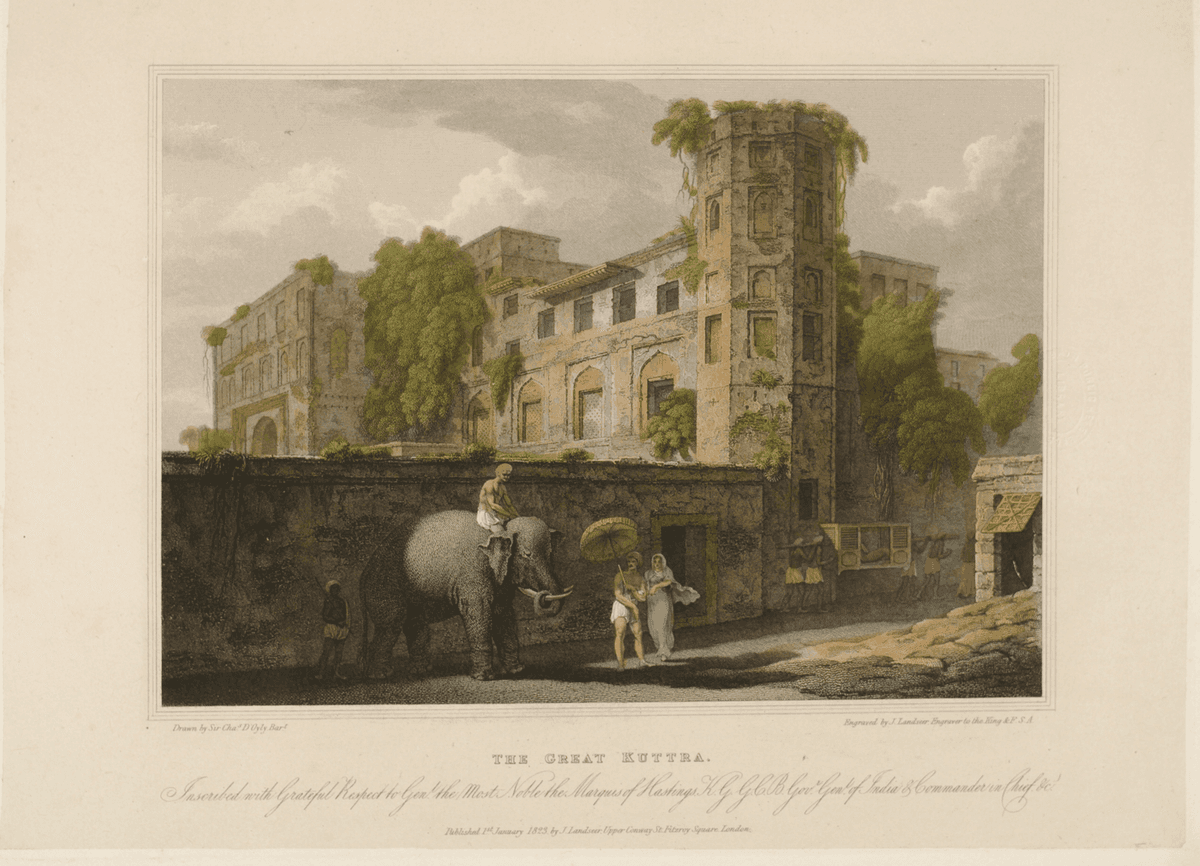
Shuja lost his province in the war of succession for the Mughal throne. Aurangzeb's forces defeated him at Khajwa, on 5 January 1659 by Sarkar's date and 5 January 1658 by Banglapedia's; he abandoned Dhaka on 6 May 1660 and took refuge in Arakan, where he and his family were killed.47 His successor Mir Jumla (Mir Muhammad Said, titled Muazzam Khan and Khan-i-Khanan) became subahdar in 1660, built roads, bridges and forts, and died off Khizrpur on 30 March 1663 by Banglapedia's date or 31 March by Sarkar's.48
Shaista Khan
Shaista Khan (Mirza Abu Talib), son of Asaf Khan and a maternal uncle of the emperor Aurangzeb, governed Bengal in two terms, 1664 to 1678 and 1680 to 1688 by Banglapedia's dates.49 He was appointed in May 1663, reached Rajmahal on 8 March 1664 and Dhaka in December 1664, left in May 1678, returned in January 1680 and left again in about June 1688.50
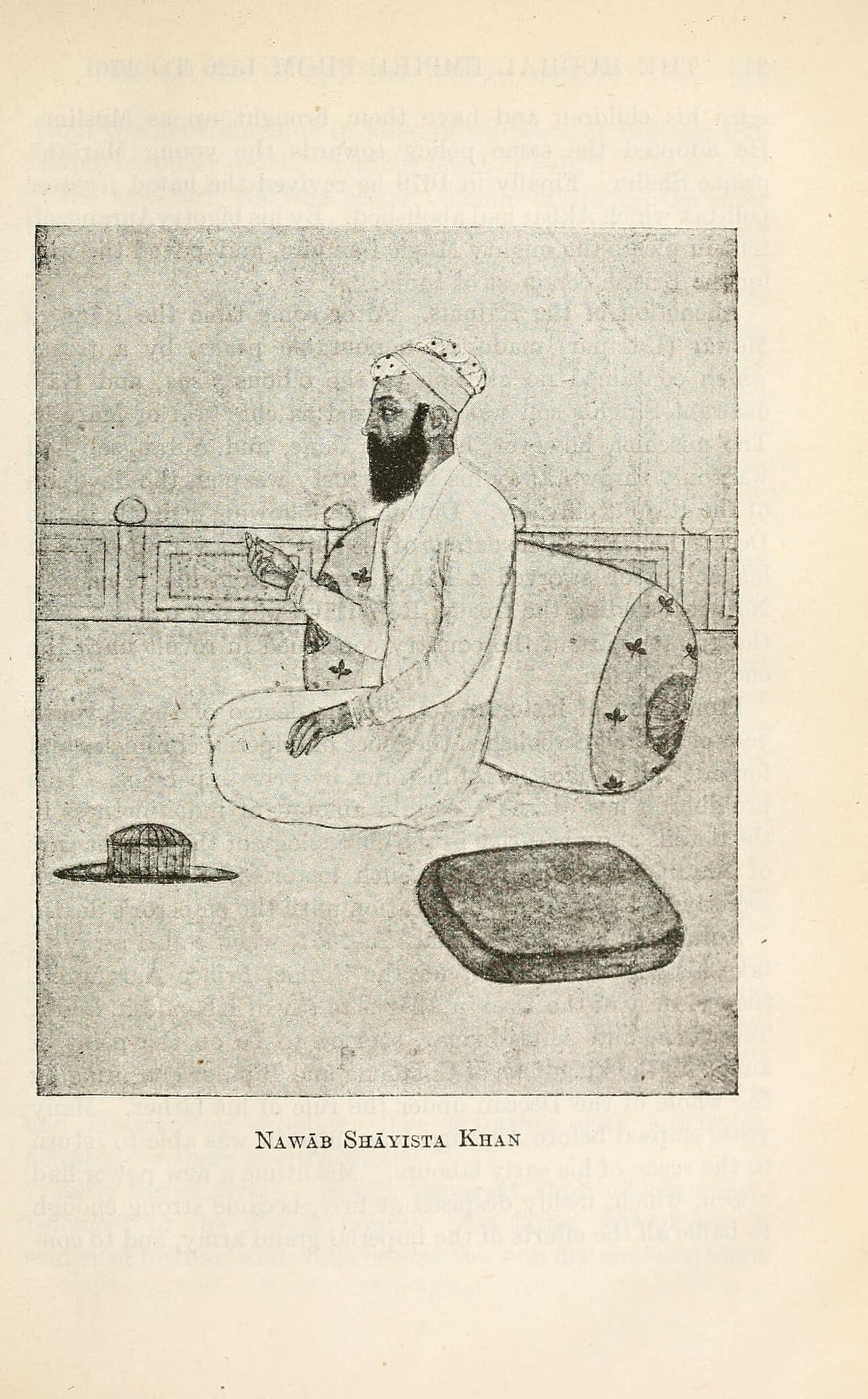
His wealth became a legend while he was still in office. In 1676 the English factor Streynsham Master wrote that in under 13 years Shaista Khan had amassed a treasure "computed by knowing persons at 38 krores of rupees", with an income of two lakh rupees a day.51 An Assamese chronicle gave 17 crore.52 These are reports and rumours, not accounts. A firmer figure comes from the provincial diwan, who reported that by the end of his first term in 1678 Shaista Khan had spent Rs 1 crore 32 lakh beyond his salary assignment, and that by 1688 he had overspent by 52 lakh.53
His second term ended in war with the English. During it the English East India Company fought the Mughal government in Bengal, in the Anglo-Mughal War of 1686 to 1690; the English were driven out, and a later subahdar, Ibrahim Khan, invited them back.54 Job Charnock founded the English settlement at Sutanuti on 24 August 1690.55 Shaista Khan's name is also tied to a famous story about the price of rice, which is examined in the box on reading the numbers below.
Lalbagh Fort
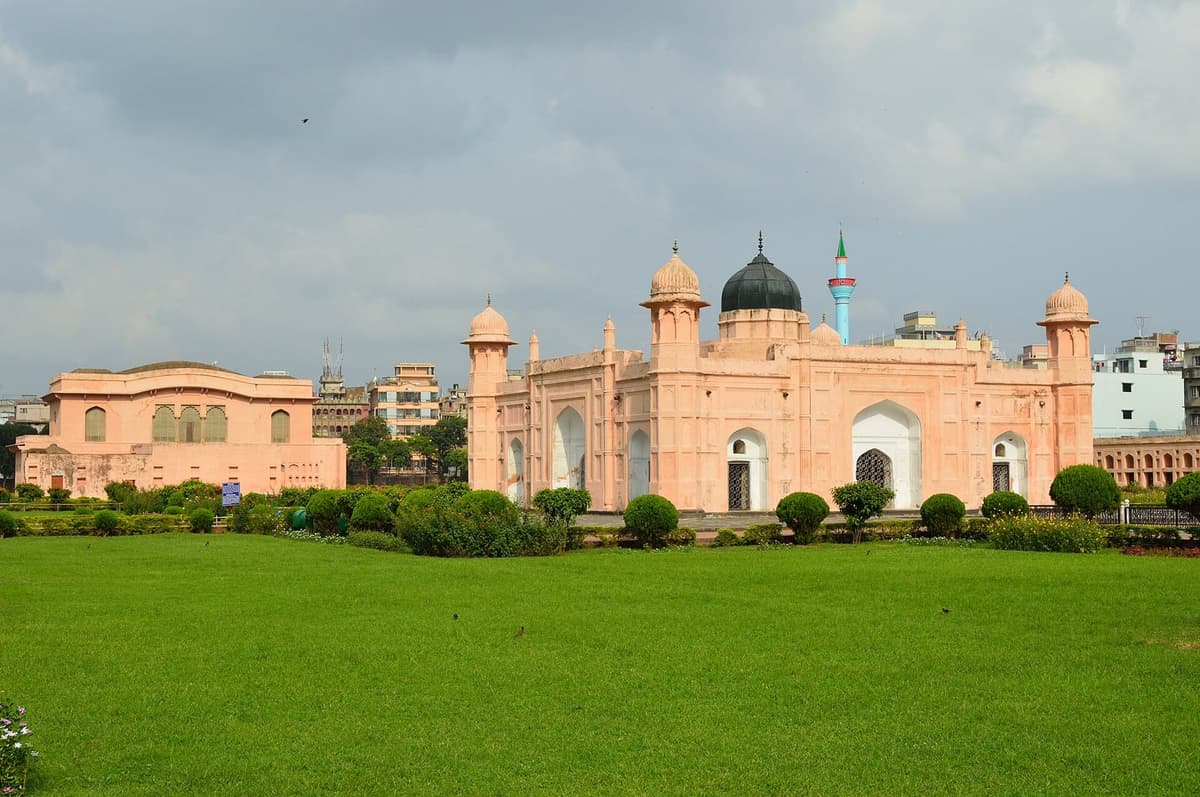
Lalbagh Fort, also called Fort Aurangabad, was begun in 1678 under Prince Muhammad Azam and was never finished.56 Shaista Khan's daughter Bibi Pari died there in 1684, and her tomb stands inside the fort.57 Excavations across the 18-acre site have revealed the remains of 26 or 27 structures, with water supply, sewerage, roof gardens and fountains; the outer face of the southern wall is about 6.10 m high and the inner face 13.72 m.58
How much revenue did Bengal raise, and where did it go?
The most direct measure of Bengal's wealth is what the Mughal state expected to take from its land. The Ain-i-Akbari records: "The Subah of Bengal consists of 24 Sarkars and 787 Mahals. The revenue is 59 crores, 84 lakhs, 59,319 dams".60 At 40 dams to the rupee that is Rs 1,49,61,482, and the total includes the sarkars of Orissa.61 James Grant, a Company official writing in the 1780s, took out the five Orissa sarkars to reach Raja Todar Mal's original assessment for Bengal itself, made around 1582: 42,77,26,082 dams, or Rs 1,06,93,152, "nearly one krore and seven lacks of rupees".62
Later settlements raised the figure. Shah Shuja's "improved" assessment of 1658 covered 34 sarkars and 1,350 parganas and came to Rs 1,31,15,907.63 Murshid Quli Khan's settlement of 1722 divided the province into 13 chaklas and 1,660 parganas and came to Rs 1,42,88,186, of which Rs 1,09,60,709 was khalsa (crown land) and Rs 33,27,477 jagir.64 Shuja-ud-Din's settlement of 1728 was almost the same, at Rs 1,42,45,561.65
Show the numbers
| Year | Assessed revenue |
|---|---|
| Ain-i-Akbari, c. 1595, with Orissa | 14.96 |
| Todar Mal, c. 1582, Bengal only | 10.69 |
| Shah Shuja, 1658 | 13.12 |
| Murshid Quli Khan, 1722 | 14.29 |
| Shuja-ud-Din, 1728 | 14.25 |
Source: Ain-i-Akbari, trans. Jarrett; James Grant's Analysis and John Shore's Minute of 1789, in the Fifth Report, ed. Firminger (1917). The first bar includes Orissa; the second is Grant's figure for Todar Mal's original assessment of Bengal alone.66
| Year | Assessment | Amount | Note |
|---|---|---|---|
| c. 1595 | Ain-i-Akbari, Bengal with Orissa | Rs 1,49,61,482 (59,84,59,319 dams) | 40 dams = Re 1 |
| c. 1582 | Todar Mal's original assessment, Bengal only | Rs 1,06,93,152 | Khalsa 63,44,260; jagir 43,48,892 |
| 1595 | Khalisa (crown) demand, from the Ain (Eaton, after Moosvi) | Rs 6,359,256 | A different reckoning from Shore's 1582 khalsa |
| 1658 | Shah Shuja's improved assessment | Rs 1,31,15,907 | 34 sarkars, 1,350 parganas |
| 1659 | Dastur al-amal-i Alamgiri (Eaton) | Rs 10,313,620 | Eaton calls it khalisa in his table and the provincial jama in a note |
| 1715 (January) | Peshkar's report to Murshid Quli Khan | 1 crore 2 lakh | Sarkar suspects "two lakhs" is a copyist's error for "thirty lakhs" |
| 1722 | Murshid Quli Khan's settlement | Rs 1,42,88,186 | Khalsa 1,09,60,709; jagir 33,27,477 |
| 1728 | Shuja-ud-Din's settlement | Rs 1,42,45,561 | Khalsa 1,09,18,084; jagir 33,27,477 |
| 1763 | Mir Qasim's total, with extra cesses | Rs 2,56,24,223 | After Plassey; for comparison only |
Source: Ain-i-Akbari; Shore and Grant in the Fifth Report; Eaton (1993), ch. 8, table 4 and n. 37; Sarkar (1948).67
Where did the growth come from? Eaton's comparison of the crown demand in 1595 and 1659 shows a rise of 62 per cent overall, from Rs 6,359,256 to Rs 10,313,620, but very unevenly: the north-east of the delta rose 97 per cent and the south-east 117 per cent, while the north-west fell 13 per cent.68 Eaton argues that the eastward shift of the delta and of rice farming, together with the silver flowing in from abroad, drove Bengal's growth in these years; the revenue figures fit that picture.69
What share of the whole empire's revenue did Bengal provide? No verified figure for that is available for this chapter, and none is given here. One contemporary report even cuts against the idea that Bengal paid the most. The French traveller Thevenot heard in 1666 that Bengal's yearly revenue to the emperor was ten million rupees by one account and "hardly ... Nine" by others, "though it be far richer than other Provinces that yield him more".70
The money sent to the emperor
The revenue did not stay in Bengal. Sarkar describes "the regular flow of one kror of rupees every year from Bengal which began in 1702 under Murshid Quli's management of the finances", money that reached Aurangzeb's camp in the Deccan, where salaries were three years in arrears.71 Aurangzeb's letters show the surplus travelling as coin loaded in carts, and Sarkar put the drain at "on an average ... one kror of rupees every year".72
Philip Calkins's figures, as cited by Eaton, tell a similar story in more detail: about 1687 the collected revenue sent to Delhi was Rs 8.6 million, between 1712 and 1727 it averaged Rs 8.9 million a year, and between 1728 and 1739 Rs 9.4 million.73 John Shore, writing for the Company in 1789, recorded that "the sum of eight crores twelve lacs of rupees was actually sent in specie to Delhi, during Sujah Khan's viceroyalty, in a period of ten years and a half".74 Shuja-ud-Din also collected nazars of Rs 1.5 crore from the zamindars and sent the sum to Delhi through the banker Fateh Chand, the Jagat Seth.75
Show the numbers
| Year | Remitted to Delhi |
|---|---|
| c. 1687 | 8.6 |
| 1712 to 1727 | 8.9 |
| 1728 to 1739 | 9.4 |
Source: Philip Calkins's figures, as cited by Eaton, The Rise of Islam and the Bengal Frontier, ch. 8, n. 38. The c. 1687 bar is one year's collected revenue; the other two are yearly averages.76
| Period | Amount | What it is | Source |
|---|---|---|---|
| c. 1666 | "Ten millions" or "hardly ... Nine" | Yearly revenue to the emperor, as Thevenot heard it | Eaton, n. 38 |
| c. 1687 | Rs 8.6 million | Collected revenue sent to Delhi | Calkins, as cited by Eaton |
| From 1702 | About 1 crore a year | Sarkar's estimate of the yearly flow | Sarkar |
| 1712 to 1727 | Rs 8.9 million a year | Average | Calkins, as cited by Eaton |
| 1727 to 1739 (ten and a half years) | 8 crore 12 lakh in all | Sent in coin to Delhi under Shuja-ud-Din | Shore (1789) |
| 1728 to 1739 | Rs 9.4 million a year | Average | Calkins, as cited by Eaton |
| 1740 | "One krore and some lakhs" a year, plus a present of 1 crore | Usual tribute, and Alivardi Khan's promise for his appointment | Sarkar |
Source: Eaton (1993), ch. 8, n. 38; Sarkar (1948); Shore's Minute in the Fifth Report.77
Set beside an assessment of about Rs 1.4 crore, a remittance of close to a crore a year was a very large outflow; in the reading this chapter follows, it means that for decades a great part of what Bengal's cultivators paid in land revenue was carried out of the province. The bankers who moved it were the house of Jagat Seth. Manik Chand received the title Nagar Sheth from the emperor Farrukh Siyar in 1712, and his nephew Fateh Chand the title Jagat Sheth ("banker of the world") in 1723; the house received the revenue, acted as the government's treasurer and remitted the annual payment to Delhi.78
What did Bengal sell to the world?
Bengal sold food, silk and cotton cloth, to Asia and to Europe. Bernier called it "the common storehouse" of cotton and silk "not of Hindoustan or the Empire of the Great Mogol only, but of all the neighbouring kingdoms, and even of Europe".79 Its rice went up the Ganges to Patna and by sea to Masulipatam, Ceylon and the Maldives, and "for a single roupie twenty or more good fowls may be bought".80 Manrique noted in 1629 that over a hundred vessels laden with rice and other foodstuffs left Bengal's ports every year.81
Cloth was the great export, and Dhaka's muslin the finest of it. The muslin produced at Dhaka in the 1740s was valued at Rs 28,50,000 a year, and the English company's yearly export of Dhaka cotton goods in the eighteenth century came to about Rs 30 lakh.82 The story of that cloth, and of how the trade collapsed, is told in the chapter on Dhaka muslin. Silk mattered as much in some decades: in 1650 the Dutch ordered 50,000 lb of raw silk from Bengal, and four years later 200,000 lb.83 Bernier saw the Dutch sometimes employing 700 to 800 people in their silk factory at Kasimbazar.84
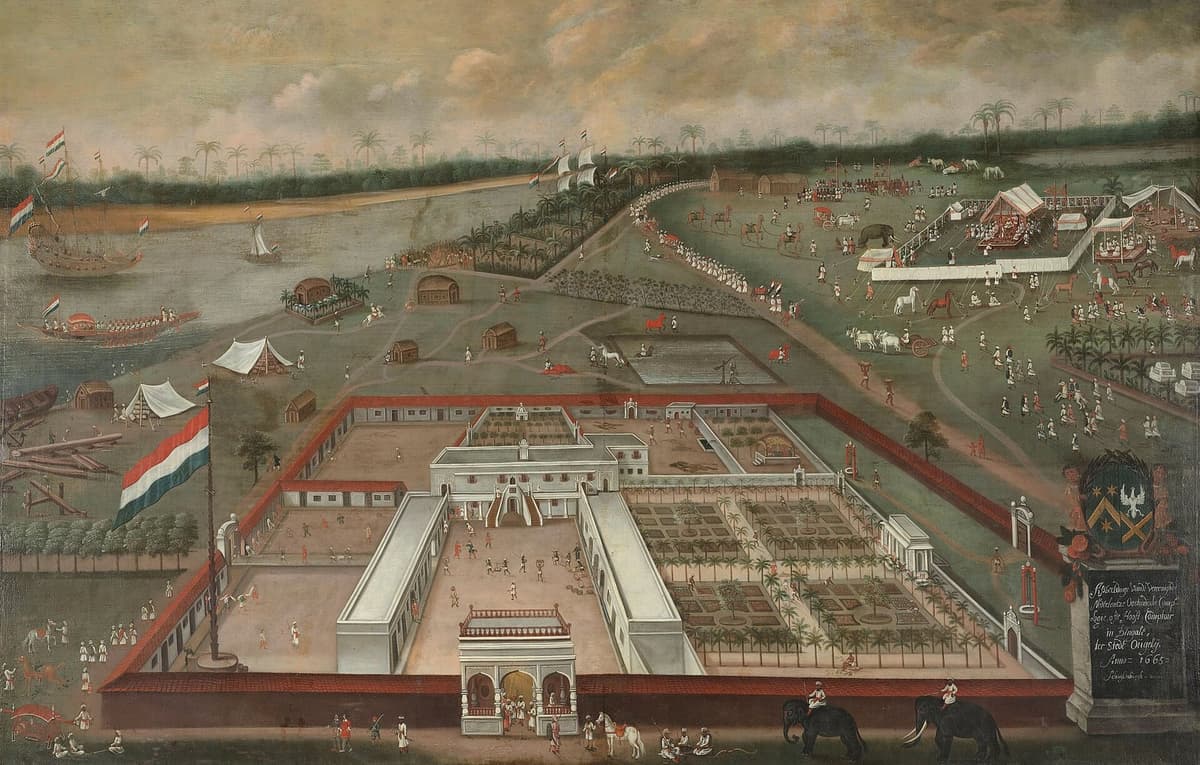
For the Dutch East India Company, Bengal became a very large part of its Asian business. By Om Prakash's figures, as cited by Eaton, silk made up nearly 40 per cent of Dutch exports from Bengal in 1675/76 and 29 per cent in 1701 to 1703, and textiles 22 and 54 per cent in the same years.85 In the early eighteenth century Bengal supplied about 40 per cent of the average yearly value of the Asian goods the Dutch sent home to Holland, and more than half of their textile exports from Asia.86 By the end of the seventeenth century, Eaton writes, drawing on Om Prakash, Bengal had become "Europe's single most important supplier of goods in all of Asia".87 English factors called it "the flower in the Company's garden" and "the choicest jewel".88
Show the numbers
| Year | English company, to Europe | Dutch company, to Europe | Dutch company, to Europe and Asia |
|---|---|---|---|
| 1701 to 1710 | 1,382,595 | 2,315,384 | 3,274,369 |
| 1710 to 1720 | 2,666,764 | 2,650,607 | 3,616,242 |
| 1730 to 1735 | 5,082,453 | 2,020,460 | 3,489,567 |
| 1740 to 1745 | 5,764,284 | 2,390,558 | 3,475,770 |
| 1750 to 1755 | 4,879,785 | 3,417,306 | 4,480,104 |
Source: Aniruddha Ray and Sushil Chaudhury, "Dutch, The", Banglapedia, tables 1 and 2, from K. N. Chaudhuri (English) and Om Prakash and the VOC invoices (Dutch). Exact periods are in the table below.90
| Period | English, to Europe | Dutch, to Europe | Dutch, to Europe and Asia |
|---|---|---|---|
| 1701 to 1710 | 1,382,595 | 2,315,384 | 3,274,369 |
| 1710 to 1720 | 2,666,764 | 2,650,607 | 3,616,242 |
| 1730/31 to 1734/35 | 5,082,453 | 2,020,460 | 3,489,567 |
| 1740/41 to 1744/45 | 5,764,284 | 2,390,558 | 3,475,770 |
| 1750/51 to 1754/55 | 4,879,785 | 3,417,306 | 4,480,104 |
Source: Ray and Chaudhury, "Dutch, The", Banglapedia, tables 1 and 2. For 1701 to 1720 the English figures are from Chaudhuri, Trading World, p. 509, with a one-year lag, and the Dutch from Prakash, Dutch Company, p. 70; from 1730 the English figures are from Chaudhuri, pp. 509-10, and the Dutch from the VOC invoices.91
The table shows the English company's exports to Europe drawing level with the Dutch company's in 1710 to 1720 and, in the 1730s and 1740s, running at more than twice the Dutch exports to Europe and above the Dutch exports to Europe and Asia together. Yet the Europeans were not the biggest buyers. Even in the middle of the eighteenth century Asian merchants exported more from Bengal: about Rs 9 to 10 million of textiles a year against Rs 5 to 6 million by the Europeans, and Rs 5.5 million of raw silk a year in 1749 to 1753, against about Rs 0.98 million by the Europeans.92
Factories and forts
The Dutch came to Bengal in 1630 and settled at Pipli on terms of 3 per cent customs, by Banglapedia's account; Eaton dates Shah Jahan's permission to 1635 and a Dutch station at Hughli to the following year.93 The English set up factories at Hughli in 1651, Kasimbazar in 1658 and Dhaka in 1668.94 The French built a factory at Chandernagore in 1690, and the Danish and Ostend companies also had factories in Bengal.95
The companies turned trading posts into fortified towns with the governors' consent. When the zamindar Shobha Singh revolted in 1695, the English, Dutch and French were allowed to fortify Calcutta, Chinsura and Chandernagore.96 On 10 November 1698 the English company became zamindar of Kalikata, Sutanuti and Govindapur for a payment of Rs 1,300 to the Sabarna Chaudhuri family.97 The English then won a far larger privilege: the Surman embassy obtained from Farrukh Siyar a farman dated 30 December 1716, known as the farman of 1717, granting duty-free trade on dastak, coinage at the Murshidabad mint and rights to 38 villages near Calcutta.98 Murshid Quli Khan obstructed its use, and the abuse of dastaks was still among Siraj ud-Daulah's complaints nearly forty years later.99
Why did silver flow into Bengal?
Silver flowed into Bengal because that is what the Europeans paid with. Precious metals made up 87.5 per cent of the value the Dutch imported into Bengal between 1650 and 1720, and 90 to 94 per cent of English imports in the first two decades of the eighteenth century.100 The Dutch brought an average of 1.28 million florins of treasure a year in the 1660s and 2.87 million in the 1710s, and between 1709 and 1717 the Dutch and English together shipped cargoes averaging Rs 4.15 million a year into Bengal, 85 per cent of it silver.101
That silver went to the mints and came out as rupees. Between 1626 and 1635, by Shireen Moosvi's estimate as cited by Eaton, the imperial mints of Bengal (including Patna) struck an average of 85.76 metric tons of silver coin a year, more than the mints of Gujarat, the north-west or the central provinces.102
| Period | Figure | What it measures | Source |
|---|---|---|---|
| 1626 to 1635 | 85.76 metric tons a year | Silver coin struck in Bengal's imperial mints, including Patna | Moosvi, as cited by Eaton |
| 1650 to 1720 | 87.5% | Share of precious metals in the value of Dutch imports into Bengal | Banglapedia |
| 1660s | 1.28 million florins a year | Treasure imported by the Dutch | Eaton |
| 1700 to 1720 | 90 to 94% | Share of precious metals in English imports | Banglapedia |
| 1709 to 1717 | Rs 4.15 million a year, 85% silver | Dutch and English cargoes into Bengal | Prakash (1976), as cited by Eaton |
| 1710s | 2.87 million florins a year | Treasure imported by the Dutch | Eaton |
Source: Eaton (1993), ch. 8, nn. 29-31; Sushil Chaudhury, "Trade and Commerce", Banglapedia.103
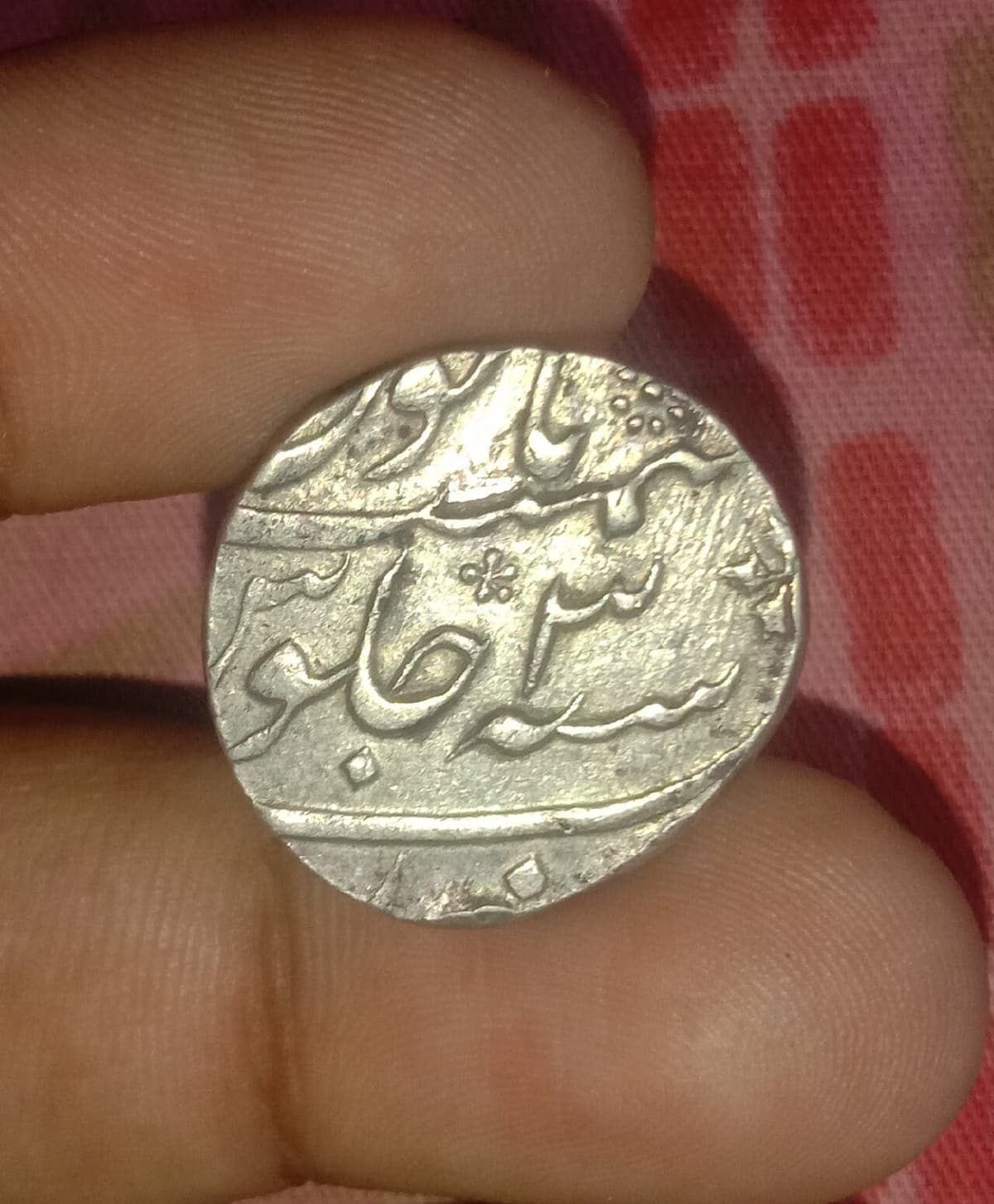
What did all this silver do to prices? Historians disagree. Eaton argues that consumer prices in Bengal stayed stable between about 1650 and 1725 because production and population grew enough to absorb the new money; Dutch records show 100 maunds of rice costing Rs 49 in 1658 and Rs 48 in 1717.105 Sarkar argued for a different mechanism in the eighteenth century: the steady drain of about a crore of silver a year to the emperor, he wrote, kept money scarce and local prices low.106
Murshid Quli Khan and the nawabs
Murshid Quli Khan opened the period in which Bengal's governors took power on their own account and were confirmed by the emperor afterwards, while still paying him.113 Born a Brahman, he was brought up as Muhammad Hadi by Haji Shafi of Isfahan, and came to Bengal as diwan with the title Kartalab Khan, in 1701 by Banglapedia's account.114 Sarkar dates that title to 1697, and the title Murshid Quli Khan to 1703 rather than Banglapedia's 23 December 1702.115
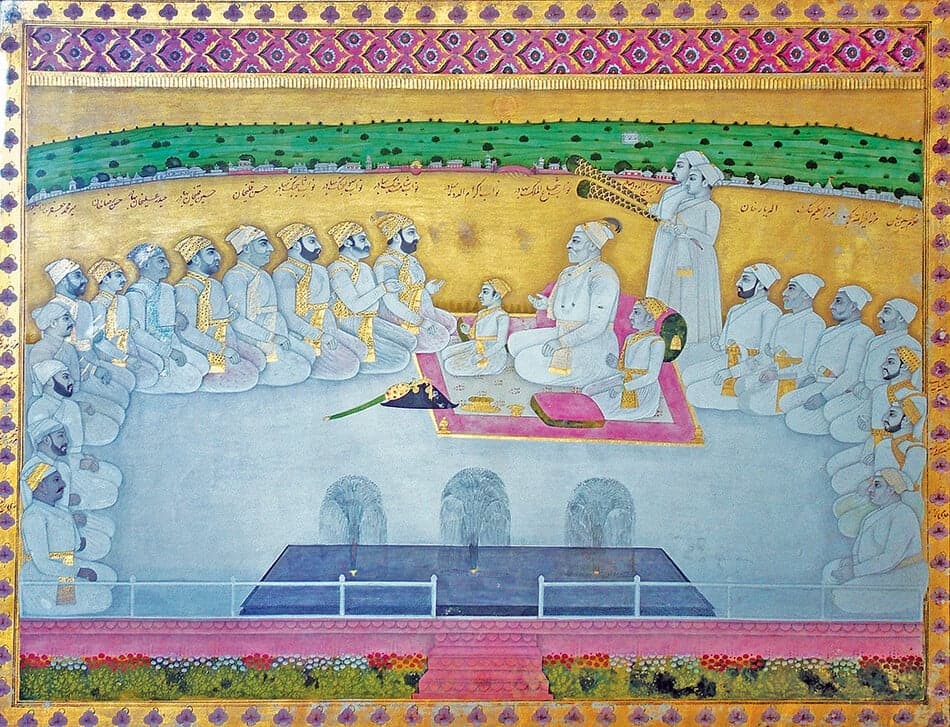
The move of the capital to Murshidabad happened in stages. After a quarrel with the subahdar, Prince Azim-us-Shan, Murshid Quli moved the diwani (revenue) office from Dhaka to Makhsusabad in 1702.116 The town was renamed Murshidabad, in 1704 by Banglapedia's entry on the nawabs, though Sarkar says the renaming came "many years later" than the move; the khalsa records are also said to have moved in 1704.117 The capital itself moved from Dhaka to Murshidabad in 1717.118 Murshid Quli was formally appointed subahdar before August 1717 by Sarkar's account (1716 in other Banglapedia entries) and held office until his death on 30 June 1727.119 Dhaka was not abandoned: from 1716/17 a naib nazim governed eastern Bengal from there, the first being Khan Muhammad Ali Khan, an office formally abolished only in 1843.120
He ran the province tightly. Sarkar reports that he cut the provincial force to 2,000 horsemen and 4,000 infantry.121 In 1722 he made a fresh revenue settlement, turned officers' jagirs into crown land and divided the province into 13 chaklas.122 Sarkar contrasts his modest savings with "Shaista Khan's nine krores in 18 years, Khan Jahan Bahadur Khan's two krores in one year, or Prince Azim's eight krores in 9 years".123 The historian Philip Calkins argued that under Murshid Quli and his successors a Bengal-based ruling group of officials, zamindars and bankers took shape.124
His son-in-law Shuja-ud-Din Muhammad Khan succeeded him in 1727 and ruled until his death on 13 March 1739 (one Banglapedia entry gives 1729 as the start).125 Bihar was added to the Bengal subah under him, in 1732 or 1733 by different entries.126 Sarfaraz Khan succeeded in 1739 and was defeated and killed by Alivardi Khan at Giria, on 6 April 1740 by one Banglapedia entry and 10 April by another; Sarkar dates Sarfaraz's death to 9 April 1740.127 To win the emperor's grant of Bengal, Bihar and Orissa, Alivardi promised the court a present of one crore of rupees "over and above the usual annual tribute amounting to one krore and some lakhs".128
The Maratha raids
Alivardi Khan (Mirza Muhammad Ali, 1676 to 1756) ruled from 1740 to 1756, and for most of that time Bengal was raided by the Marathas almost every year, from 1742 to 1751.129 In Bengal the raiders were called Bargi, from bargir, soldiers whose horses and arms were supplied by the state.130 On 6 May 1742 Bhaskar Pandit's raiders plundered Murshidabad, taking three lakh rupees from the house of Jagat Seth alone.131
On 30 March 1743 Alivardi agreed to pay the chauth for Bengal to Shahu and Rs 22 lakh to the Peshwa for his army's expenses.132 On 31 March 1744, at Mankara, his men killed Bhaskar Pandit and 21 of his captains during a staged negotiation.133 By 1744 Alivardi's yearly defence bill had more than doubled, to one crore eighty lakh rupees.134 Under the treaty of 1751 he agreed to pay Raghuji Bhonsle 12 lakh a year as chauth, and Orissa was in effect ceded to the Marathas.135 Part of the cost was added to the land revenue: among the extra cesses (abwab) imposed by successive nazims was a "chout Marhattah" of Rs 15,31,817 under Alivardi, and the cesses imposed from 1722 reached a net Rs 1,17,91,853 a year by 1763.136
The raids also hit the trade that made Bengal rich. They caused large-scale migration to the east of the Ganges and disrupted silk-rearing and weaving; weaving centres such as the adangs of Birbhum were deserted.137 No reliable count of the people killed in the raids was found for this chapter, and none is given.
Siraj ud-Daulah and the Battle of Plassey
Siraj ud-Daulah lost Bengal to a conspiracy between his own commanders and the English company, sealed on the battlefield at Plassey on 23 June 1757.138 Born in 1733, he was the grandson of Alivardi Khan and the son of Amina Begum and Zainuddin Ahmad Khan, and Alivardi declared him his successor in May 1752.139 Alivardi died on 9 April 1756 by Sarkar's date and the Alivardi entry in Banglapedia, or 10 April by the Siraj ud-Daulah entry.140
His quarrel with the English had three stated causes: the unauthorised fortification of Fort William, the abuse of dastaks and illegal private trade, and the sheltering of officers who had fled him, such as Krishnadas.141 On 20 June 1756 he captured Calcutta and renamed it Alinagar.142 The capture of Calcutta is also the setting of the "Black Hole": John Zephaniah Holwell, its only narrator, wrote that 146 people were confined in a room 18 ft by 14 ft 10 in and 123 died; other accounts said 200, and Banglapedia's entry says the story is now thought largely untrue and greatly exaggerated.143 Robert Clive retook Calcutta on 2 January 1757, and the Alinagar treaty was signed on 9 February.144
The plot was made in the spring. On 1 May 1757 the Calcutta Council agreed to a secret treaty with Mir Jafar, the nawab's bakhshi, and Mir Jafar signed it on 5 June.145 The battle at Plassey (Palashi, the name Banglapedia uses) began at about 8 in the morning of 23 June and was over by about 5 in the afternoon.146 By Sarkar's account the nawab's forces numbered nearly 50,000, but only about 12,000 men and 12 cannon took part, though Siraj had 53 pieces of artillery.147 Clive had 950 European infantry, 150 artillerymen (including 57 sailors) and 2,100 sepoys by Sarkar's count.148
Siraj's commander Mir Madan was killed by a cannon ball around 3 in the afternoon, and about two-thirds of the nawab's army, under Mir Jafar, Yar Latif and Rai Durlabh, did not fight.149 On the British side 7 Europeans and 16 sepoys were killed and 13 Europeans and 36 sepoys wounded; about 500 were killed on the nawab's side.150 Siraj was killed at the instance of Miran, Mir Jafar's son, on the night before 3 July 1757 by Banglapedia's account or on 4 July by Sarkar's.151 Mir Jafar ruled as nawab from 1757 until the company forced him to abdicate in favour of Mir Qasim in October 1760, and again from 1763 until his death in 1765.152 What followed is told in the Colonial Bengal chapter.
Dates the sources give differently
| Event | Versions | Sources |
|---|---|---|
| Dhaka made capital | 1610 (arrival, supported); 1608 circulates popularly (year of appointment) | Banglapedia; Sarkar |
| Battle of Khajwa | 5 January 1659 (Sarkar); 5 January 1658 (Banglapedia) | Sarkar; Banglapedia |
| Death of Mir Jumla | 30 March 1663 (Banglapedia); 31 March 1663 (Sarkar) | Banglapedia; Sarkar |
| Dutch arrival | 1630 at Pipli, Hughli factory 1645 to 1647 (Banglapedia); permission 1635, Hughli 1636 (Eaton) | Banglapedia; Eaton |
| Move to Murshidabad | Revenue office 1702; renaming 1702 (Murshid Quli Khan entry), 1704 (Nawab entry) or "many years later" (Sarkar); khalsa records 1704; capital 1717 | Banglapedia; Sarkar |
| Murshid Quli made subahdar | 1716 or 1717 (before August) | Banglapedia; Sarkar |
| Shuja-ud-Din's reign | 1727 to 1739; 1729 to 1739 in one entry | Banglapedia; Sarkar |
| Bihar joined to Bengal | 1732 or 1733 | Banglapedia |
| Battle of Giria | 6 April or 10 April 1740; Sarfaraz's death 9 April 1740 (Sarkar) | Banglapedia; Sarkar |
| Death of Alivardi Khan | 9 April 1756 or 10 April 1756 | Sarkar and Banglapedia; Banglapedia |
| Death of Siraj ud-Daulah | Night before 3 July 1757; 4 July 1757 | Banglapedia; Sarkar |
Source: Banglapedia entries and Sarkar (1948), as cited in the text.157
Timeline, 1574 to 1757
- 25 September 1574Munim Khan takes Tanda, the Karrani capital.158
- 12 July 1576Battle of Rajmahal; Daud Khan Karrani is captured and executed.159
- c. 1582Todar Mal's revenue settlement of Bengal, Rs 1,06,93,152.160
- 7 November 1595Man Singh moves the capital from Tanda to Rajmahal (Akbarnagar).161
- c. June or July 1610Islam Khan reaches Dhaka and makes it the capital, Jahangirnagar.162
- 15 September 1632Qasim Khan Juyini takes Hughli from the Portuguese.163
- 1651English factory set up at Hughli.164
- 1658Shah Shuja's revenue settlement, Rs 1,31,15,907.165
- 26 January 1666Shaista Khan's forces capture Chittagong.166
- 1678Lalbagh Fort begun under Prince Muhammad Azam.167
- 1686 to 1690Anglo-Mughal War in Bengal.168
- 24 August 1690Job Charnock founds the English settlement at Sutanuti.169
- 1702Revenue office moved to Makhsusabad; about a crore a year begins to flow to the emperor.170
- 30 December 1716Farrukh Siyar's farman to the English, known as the farman of 1717.171
- 1717Murshid Quli Khan formally subahdar; capital moves to Murshidabad.172
- 1722Murshid Quli Khan's revenue settlement, Rs 1,42,88,186.173
- April 1740Alivardi Khan defeats and kills Sarfaraz Khan at Giria.174
- 6 May 1742Maratha raiders plunder Murshidabad.175
- 1751Treaty with the Marathas: chauth of 12 lakh a year.176
- 20 June 1756Siraj ud-Daulah takes Calcutta and renames it Alinagar.177
- 2 January 1757Clive retakes Calcutta.178
- 23 June 1757Battle of Plassey.179
- Early July 1757Siraj ud-Daulah is killed (night before 3 July, or 4 July).180
Wealth that flowed outward
Go back to the figures, and the shape of Mughal Bengal is clear. The revenue the empire assessed rose from about 1.07 crore for Bengal itself under Akbar to about 1.43 crore by 1722.181 The companies' ledgers show Bengal supplying about 40 per cent of what the Dutch shipped home from Asia, with Asian merchants buying even more than the Europeans.182 Between 1626 and 1635, by Moosvi's estimate as cited by Eaton, Bengal's mints struck more silver a year than Gujarat's.183 Bernier's comparison with Egypt was a traveller's impression, but in this chapter's reading the records bear out the wealth he saw.184
The same records show where the money went. For decades before Plassey close to a crore of rupees a year was carted or remitted to the emperor, through the house of Jagat Seth; the Maratha raids then added chauth and a defence bill that reached one crore eighty lakh a year.185 Sushil Chaudhury argues that Bengal's economy stayed prosperous until the middle of the century, and that Asian merchants out-traded the Europeans.186 Before 1757 the companies paid for what they bought, in silver. After 1757 that changed: the influx of bullion stopped completely, and the English company financed its purchases from Bengal's own resources.187
The evidence suggests, then, that Bengal's wealth under the Mughals was the wealth of a productive, trading province that sent much of its surplus away: first to Delhi, as tribute, and after Plassey to the company, as revenue. How that second flow worked, and what it did to Bengal, is the next chapter's story.
Further reading
- Richard M. Eaton, The Rise of Islam and the Bengal Frontier, 1204-1760 (1993): the delta's rice frontier, revenue and silver, with the clearest modern account of Mughal Bengal's economy; free to read online.188
- Om Prakash, The Dutch East India Company and the Economy of Bengal, 1630-1720 (1985): the standard quantitative study of Dutch trade, bullion and prices in Bengal.189
- K. N. Chaudhuri, The Trading World of Asia and the English East India Company, 1660-1760 (1978): the English company's trade series, Bengal included.190
- Jadunath Sarkar, ed., The History of Bengal, vol. 2, Muslim Period, 1200-1757 (1948): the detailed narrative, with dates for every subahdar and a full account of Plassey.191
- Sushil Chaudhury, From Prosperity to Decline: Eighteenth Century Bengal (1995) and The Prelude to Empire: Plassey Revolution of 1757 (2000): the case for a prosperous Bengal and a British-made conspiracy.192
- P. J. Marshall, Bengal: The British Bridgehead: Eastern India, 1740-1828 (1987): includes a chapter on late Mughal Bengal and the road to Company rule.193
Questions students and journalists ask
How rich was Bengal before British rule?
Very rich by the measures that survive. The Ain-i-Akbari assessed Bengal with Orissa at about 1.5 crore rupees around 1595, and the assessment for Bengal reached about 1.43 crore by 1722. In the early eighteenth century Bengal supplied about 40 per cent of the Asian goods the Dutch company shipped to Holland, Europeans paid mostly in silver, and Asian merchants bought even more Bengal cloth and silk than Europeans did.
Who was the first nawab of Bengal?
Murshid Quli Khan is usually called the first nawab. He came to Bengal as diwan, moved the revenue office to Makhsusabad, later Murshidabad, and was formally made subahdar around 1717. Strictly, there was no official post called nawab in Bengal: the governors were addressed as nazim at court, and the word nawab probably spread through officials of the European companies. After Plassey the English gave Mir Jafar the title Nawab.
Who built Lalbagh Fort in Dhaka?
Lalbagh Fort, also called Fort Aurangabad, was begun in 1678 under Prince Muhammad Azam, who governed Bengal from 1678 to 1679, and was never finished. It is closely linked with Shaista Khan, whose daughter Bibi Pari died there in 1684 and is buried in a tomb inside the fort. Excavations on the 18-acre site found remains of 26 or 27 structures, with water supply, sewerage, roof gardens and fountains.
Why was the Battle of Plassey fought, and why does it matter?
Siraj ud-Daulah quarrelled with the English over their unauthorised fortification of Fort William in Calcutta, abuse of dastaks and illegal private trade, and sheltering of his officers, and took Calcutta in June 1756. Clive retook it, and the English made a secret agreement with Mir Jafar. On 23 June 1757 about two-thirds of the nawab's army did not fight. The English installed Mir Jafar as nawab, which opened the way to Company rule in Bengal.
How much money did Bengal send to the Mughal emperor?
Jadunath Sarkar estimated about one crore of rupees a year from 1702, carried as coin in carts to Aurangzeb's camp in the Deccan. Philip Calkins's figures, as cited by Richard Eaton, show about 8.6 million rupees around 1687, an average of 8.9 million a year in 1712 to 1727 and 9.4 million in 1728 to 1739. John Shore recorded 8 crore 12 lakh sent in coin over ten and a half years under Shuja-ud-Din.
Who were the Jagat Seths?
The Jagat Seths were a family of bankers at Murshidabad. Manik Chand received the title Nagar Sheth from the emperor Farrukh Siyar in 1712, and his nephew Fateh Chand the title Jagat Sheth, meaning banker of the world, in 1723. The house received the province's revenue, acted as the government's treasurer and remitted the yearly payment to Delhi. Maratha raiders took three lakh rupees from their house in 1742.
Who were the Bargis?
Bargi was the name used in Bengal for the Maratha raiders who attacked the province almost every year from 1742 to 1751. The word comes from bargir, a soldier whose horse and arms were supplied by the state. They plundered Murshidabad in May 1742. Alivardi Khan paid chauth and in 1751 agreed to 12 lakh rupees a year, ceding Orissa in effect. The raids drove people east of the Ganges and disrupted weaving and silk.
Was rice really 8 maunds a rupee under Shaista Khan?
That figure is a later tradition, not a measured price. Banglapedia repeats it as common knowledge, but Jadunath Sarkar showed that it, and the story of the sealed gate told with it, reach us through Charles Stewart's History of Bengal of 1813, which relied on a Persian history written in 1788. Dutch company records give rice at Rs 49 for 100 maunds in 1658 and Rs 48 in 1717, about 2 maunds a rupee, and the maund itself varied.
When did Dhaka become the capital of Bengal?
Dhaka became the capital in 1610, when the subahdar Islam Khan Chishti reached the city in about June or July and renamed it Jahangirnagar. The year 1608, which is often repeated, is when he was appointed. Dhaka remained the capital for most of the next century, apart from a period under Shah Shuja, until Murshid Quli Khan moved the capital to Murshidabad in 1717.
What did Bengal export to Europe in the 17th and 18th centuries?
Mainly cotton textiles and raw silk. Silk made up nearly 40 per cent of Dutch exports from Bengal in 1675/76, and textiles 54 per cent in 1701 to 1703. Dhaka muslin was the finest cloth: the English company's yearly export of Dhaka cotton goods came to about Rs 30 lakh. Bengal rice, meanwhile, went up the Ganges to Patna and by sea to Masulipatam, Ceylon and the Maldives.
Notes
- Abu'l Fazl Allami, The Ain-i-Akbari, Vol. 2. Translated by H. S. Jarrett (Calcutta: Asiatic Society of Bengal, 1891), 129, https://archive.org/details/in.ernet.dli.2015.32527; , The Fifth Report from the Select Committee of the House of Commons on the Affairs of the East India Company, Dated 28th July, 1812, Vol. 2, Bengal Appendices. Contains John Shore's Minute of 18 June 1789 (with its Appendix No. 1, "Progressive Account of the Settlement of Bengal, from 1582 to 1763") and James Grant's "Historical and Comparative Analysis of the Finances of Bengal" (Calcutta: R. Cambray, 1917), 120, https://archive.org/details/india.history.resource.88740; Aniruddha Ray and Sushil Chaudhury, "Dutch, The," Banglapedia: National Encyclopedia of Bangladesh, 2nd ed., online edition, 2012, https://en.banglapedia.org/index.php/Dutch,_The. ↩
- , The History of Bengal. Vol. 2, Muslim Period, 1200-1757 (Dacca: University of Dacca, 1948), 401, 417, https://archive.org/details/history-of-bengal-2-ed.-jadunath-sarkar-1948; Sushil Chaudhury, "Trade and Commerce," Banglapedia: National Encyclopedia of Bangladesh, Medieval section by Sushil Chaudhury; 2nd ed., online edition, 2012, https://en.banglapedia.org/index.php/Trade_and_Commerce. ↩
- Sirajul Islam, "Subahdar," Banglapedia: National Encyclopedia of Bangladesh, 2nd ed., online edition, 2012, https://en.banglapedia.org/index.php/Subahdar; Mohammad Shah, "Maratha Raids," Banglapedia: National Encyclopedia of Bangladesh, 2nd ed., online edition, 2012, https://en.banglapedia.org/index.php/Maratha_Raids; K. M. Mohsin and Sushil Chaudhury, "Palashi, The Battle of," Banglapedia: National Encyclopedia of Bangladesh, 2nd ed., online edition, 2012, https://en.banglapedia.org/index.php/Palashi,_The_Battle_of. ↩
- Abu'l Fazl Allami, Ain-i-Akbari, 129; , Fifth Report, 181. ↩
- Abdul Karim, "Islam Khan Chisti," Banglapedia: National Encyclopedia of Bangladesh, 2nd ed., online edition, 2012, para. 5, https://en.banglapedia.org/index.php/Islam_Khan_Chisti; Abdul Karim, "Dhaka," Banglapedia: National Encyclopedia of Bangladesh, Entry by Abdul Karim and others; 2nd ed., online edition, 2012, https://en.banglapedia.org/index.php/Dhaka. ↩
- , History of Bengal, vol. 2, 401, 417. ↩
- Ray and Chaudhury, "Dutch, The"; Chaudhury, "Trade and Commerce". ↩
- Richard M. Eaton, The Rise of Islam and the Bengal Frontier, 1204-1760, Online full text without print page numbers; notes cite chapter, table and note numbers (Berkeley: University of California Press, 1993), ch. 8, n. 31, https://doi.org/10.1525/9780520917774. ↩
- Mohsin and Chaudhury, "Palashi, The Battle of"; Sirajul Islam, "Nawab," Banglapedia: National Encyclopedia of Bangladesh, 2nd ed., online edition, 2012, para. 8, https://en.banglapedia.org/index.php/Nawab. ↩
- Abu'l Fazl Allami, Ain-i-Akbari; , Fifth Report; , History of Bengal, vol. 2; Eaton, Rise of Islam; Ray and Chaudhury, "Dutch, The". ↩
- Jean-Baptiste Tavernier, Travels in India, Translated by V. Ball. Vol. 1 (London: Macmillan, 1889), 128-30, https://archive.org/details/travelsinindia01tave. ↩
- Tavernier, Travels in India, 128-30. ↩
- Abdul Karim, "Shaista Khan," Banglapedia: National Encyclopedia of Bangladesh, 2nd ed., online edition, 2012, para. 9, https://en.banglapedia.org/index.php/Shaista_Khan; Eaton, Rise of Islam, ch. 9. ↩
- Francois Bernier, Travels in the Mogul Empire, A.D. 1656-1668, Translated by Archibald Constable (1891). 2nd ed., revised by Vincent A. Smith (London: Humphrey Milford, Oxford University Press, 1916), 437-38, https://archive.org/details/travelsinmogulem00bernuoft. ↩
- , History of Bengal, vol. 2, 417; Eaton, Rise of Islam, ch. 8, n. 38; Chaudhury, "Trade and Commerce". ↩
- Eaton, Rise of Islam, ch. 6. ↩
- A. K. M. Yaqub Husain, "Munim Khan Khan-i-Khanan," Banglapedia: National Encyclopedia of Bangladesh, 2nd ed., online edition, 2012, https://en.banglapedia.org/index.php/Munim_Khan_Khan-i-Khanan; , "Rajmahal, The battle of," Banglapedia: National Encyclopedia of Bangladesh, 2nd ed., online edition, 2012, https://en.banglapedia.org/index.php/Rajmahal,_The_battle_of. ↩
- , "Rajmahal, The battle of". ↩
- , "Mansingh, Raja," Banglapedia: National Encyclopedia of Bangladesh, 2nd ed., online edition, 2012, https://en.banglapedia.org/index.php/Mansingh,_Raja; , History of Bengal, vol. 2, 229. ↩
- , "Mansingh, Raja". ↩
- , History of Bengal, vol. 2, 229; Karim, "Islam Khan Chisti". ↩
- Karim, "Islam Khan Chisti", para. 5; Karim, "Dhaka". ↩
- Karim, "Islam Khan Chisti"; , History of Bengal, vol. 2, 229. ↩
- Karim, "Islam Khan Chisti", paras 5-6. ↩
- Eaton, Rise of Islam, ch. 6. ↩
- Abu'l Fazl Allami, Ain-i-Akbari, 121-22; Chaudhury, "Trade and Commerce". ↩
- Abu'l Fazl Allami, Ain-i-Akbari, 121-22. ↩
- Islam, "Subahdar", para. 3; Islam, "Nawab", para. 2. ↩
- Islam, "Subahdar", para. 1. ↩
- Islam, "Subahdar", para. 3; Islam, "Nawab", para. 2. ↩
- Islam, "Subahdar". ↩
- Islam, "Nawab", paras 2, 5-6. ↩
- Islam, "Nawab", paras 5-6. ↩
- Islam, "Subahdar". ↩
- Islam, "Nawab", para. 8. ↩
- , History of Bengal, vol. 2, 228-31; Islam, "Subahdar". ↩
- Islam, "Subahdar". ↩
- Abdul Karim, "Shah Shuja," Banglapedia: National Encyclopedia of Bangladesh, 2nd ed., online edition, 2012, https://en.banglapedia.org/index.php/Shah_Shuja; Abdul Karim, "Mir Jumla," Banglapedia: National Encyclopedia of Bangladesh, 2nd ed., online edition, 2012, https://en.banglapedia.org/index.php/Mir_Jumla. ↩
- Sharif uddin Ahmed, "Manrique, Sebastien," Banglapedia: National Encyclopedia of Bangladesh, 2nd ed., online edition, 2012, https://en.banglapedia.org/index.php/Manrique,_Sebastien; Karim, "Dhaka". ↩
- Karim, "Dhaka". ↩
- Chaudhury, "Trade and Commerce". ↩
- , "Hughli, City," Banglapedia: National Encyclopedia of Bangladesh, 2nd ed., online edition, 2012, https://en.banglapedia.org/index.php/Hughli,_City; K. M. Karim, "Qasim Khan Jwini," Banglapedia: National Encyclopedia of Bangladesh, 2nd ed., online edition, 2012, https://en.banglapedia.org/index.php/Qasim_Khan_Jwini. ↩
- Karim, "Shah Shuja"; , History of Bengal, vol. 2, 229. ↩
- Sirajul Islam, "East India Company, The," Banglapedia: National Encyclopedia of Bangladesh, 2nd ed., online edition, 2012, https://en.banglapedia.org/index.php/East_India_Company,_The; Mohsin and Chaudhury, "Palashi, The Battle of". ↩
- , "Bara Katra," Banglapedia: National Encyclopedia of Bangladesh, 2nd ed., online edition, 2012, https://en.banglapedia.org/index.php/Bara_Katra. ↩
- , "Bara Katra". ↩
- , History of Bengal, vol. 2, 230; Karim, "Shah Shuja". ↩
- Karim, "Mir Jumla"; , History of Bengal, vol. 2, 230. ↩
- , History of Bengal, vol. 2, 230; Karim, "Shaista Khan"; Islam, "Subahdar". ↩
- , History of Bengal, vol. 2, 230. ↩
- , History of Bengal, vol. 2, 375. ↩
- , History of Bengal, vol. 2, 375. ↩
- , History of Bengal, vol. 2, 386. ↩
- Karim, "Shaista Khan"; Sirajul Islam, "Charnock, Job," Banglapedia: National Encyclopedia of Bangladesh, 2nd ed., online edition, 2012, https://en.banglapedia.org/index.php/Charnock,_Job. ↩
- Islam, "Charnock, Job"; , "Hughli, City". ↩
- Habibur Rahman, "Lalbagh Fort," Banglapedia: National Encyclopedia of Bangladesh, 2nd ed., online edition, 2012, para. 2, https://en.banglapedia.org/index.php/Lalbagh_Fort. ↩
- Rahman, "Lalbagh Fort", para. 2. ↩
- Rahman, "Lalbagh Fort". ↩
- Rahman, "Lalbagh Fort", para. 2. ↩
- Abu'l Fazl Allami, Ain-i-Akbari, 129. ↩
- Abu'l Fazl Allami, Ain-i-Akbari, 129; , Fifth Report, 181. ↩
- , Fifth Report, 181. ↩
- , Fifth Report, 120, 182. ↩
- , Fifth Report, 120, 190-91. ↩
- , Fifth Report, 120, 204. ↩
- Abu'l Fazl Allami, Ain-i-Akbari, 129; , Fifth Report, 120, 181-82, 190-91, 204. ↩
- Abu'l Fazl Allami, Ain-i-Akbari, 129; , Fifth Report, 120-21, 181-82, 190-91, 204; Eaton, Rise of Islam, ch. 8, table 4, n. 37; , History of Bengal, vol. 2, 412 n.. ↩
- Eaton, Rise of Islam, ch. 8, table 4. ↩
- Eaton, Rise of Islam. ↩
- Eaton, Rise of Islam, ch. 8, n. 38. ↩
- , History of Bengal, vol. 2, 401. ↩
- , History of Bengal, vol. 2, 417. ↩
- Eaton, Rise of Islam, ch. 8, n. 38. ↩
- , Fifth Report, 32. ↩
- K. M. Karim, "Shujauddin Muhammad Khan," Banglapedia: National Encyclopedia of Bangladesh, 2nd ed., online edition, 2012, https://en.banglapedia.org/index.php/Shujauddin_Muhammad_Khan; , History of Bengal, vol. 2, 424. ↩
- Eaton, Rise of Islam, ch. 8, n. 38. ↩
- Eaton, Rise of Islam, ch. 8, n. 38; , History of Bengal, vol. 2, 401, 417, 440; , Fifth Report, 32. ↩
- K. M. Mohsin, "Jagat Sheth," Banglapedia: National Encyclopedia of Bangladesh, 2nd ed., online edition, 2012, https://en.banglapedia.org/index.php/Jagat_Sheth; , "Jagat Sheth Family," Banglapedia: National Encyclopedia of Bangladesh, 2nd ed., online edition, 2012, https://en.banglapedia.org/index.php/Jagat_Sheth_Family. ↩
- Bernier, Travels in the Mogul Empire, 439-40. ↩
- Bernier, Travels in the Mogul Empire, 437-38. ↩
- Eaton, Rise of Islam, ch. 8; Chaudhury, "Trade and Commerce". ↩
- Karim, "Dhaka". ↩
- Eaton, Rise of Islam, ch. 8. ↩
- Bernier, Travels in the Mogul Empire, 439-40. ↩
- Eaton, Rise of Islam, ch. 8, n. 25. ↩
- Ray and Chaudhury, "Dutch, The"; Chaudhury, "Trade and Commerce". ↩
- Eaton, Rise of Islam, ch. 8. ↩
- Ray and Chaudhury, "Dutch, The"; Chaudhury, "Trade and Commerce". ↩
- Ray and Chaudhury, "Dutch, The", paras 4-5. ↩
- Ray and Chaudhury, "Dutch, The"; K. N. Chaudhuri, The Trading World of Asia and the English East India Company, 1660-1760 (Cambridge: Cambridge University Press, 1978), https://doi.org/10.1017/CBO9780511563263; Om Prakash, The Dutch East India Company and the Economy of Bengal, 1630-1720 (Princeton: Princeton University Press, 1985), https://doi.org/10.1515/9781400857760. ↩
- Ray and Chaudhury, "Dutch, The"; Chaudhuri, Trading World of Asia, 509-10; Prakash, Dutch East India Company, 70. ↩
- Ray and Chaudhury, "Dutch, The"; Chaudhury, "Trade and Commerce". ↩
- Ray and Chaudhury, "Dutch, The", paras 4-5; Eaton, Rise of Islam, ch. 8. ↩
- Ray and Chaudhury, "Dutch, The"; Islam, "East India Company, The"; , "Hughli, City". ↩
- , "French, The," Banglapedia: National Encyclopedia of Bangladesh, 2nd ed., online edition, 2012, https://en.banglapedia.org/index.php/French,_The; , "Danes, The," Banglapedia: National Encyclopedia of Bangladesh, 2nd ed., online edition, 2012, https://en.banglapedia.org/index.php/Danes,_The; , "Ostend Company," Banglapedia: National Encyclopedia of Bangladesh, 2nd ed., online edition, 2012, https://en.banglapedia.org/index.php/Ostend_Company. ↩
- , "Shobha Singh," Banglapedia: National Encyclopedia of Bangladesh, 2nd ed., online edition, 2012, https://en.banglapedia.org/index.php/Shobha_Singh; Anjali Chatterjee, "Azim-us-Shan," Banglapedia: National Encyclopedia of Bangladesh, 2nd ed., online edition, 2012, https://en.banglapedia.org/index.php/Azim-us-Shan. ↩
- , "Calcutta," Banglapedia: National Encyclopedia of Bangladesh, 2nd ed., online edition, 2012, https://en.banglapedia.org/index.php/Calcutta. ↩
- Islam, "East India Company, The"; Mohsin and Chaudhury, "Palashi, The Battle of". ↩
- Islam, "East India Company, The"; Sushil Chaudhury and K. M. Mohsin, "Sirajuddaula," Banglapedia: National Encyclopedia of Bangladesh, 2nd ed., online edition, 2012, https://en.banglapedia.org/index.php/Sirajuddaula. ↩
- Chaudhury, "Trade and Commerce". ↩
- Eaton, Rise of Islam, ch. 8, nn. 29-30. ↩
- Eaton, Rise of Islam, ch. 8, n. 31. ↩
- Eaton, Rise of Islam, ch. 8, nn. 29-31; Om Prakash, "Bullion for Goods: International Trade and the Economy of Early Eighteenth Century Bengal," Indian Economic and Social History Review 13, no. 2 (1976), https://doi.org/10.1177/001946467601300202; Chaudhury, "Trade and Commerce". ↩
- Islam, "East India Company, The". ↩
- Eaton, Rise of Islam, ch. 8, n. 36. ↩
- , History of Bengal, vol. 2, 417. ↩
- , Fifth Report, 181. ↩
- , Fifth Report; Eaton, Rise of Islam, ch. 8, nn. 37-38. ↩
- Eaton, Rise of Islam, ch. 8, n. 36. ↩
- , History of Bengal, vol. 2, 387; Ahmed, "Manrique, Sebastien". ↩
- , History of Bengal, vol. 2, 386-87; Karim, "Shaista Khan"; Karim, "Dhaka". ↩
- Eaton, Rise of Islam, ch. 8, n. 36. ↩
- Islam, "Subahdar". ↩
- Abdul Karim, "Murshid Quli Khan," Banglapedia: National Encyclopedia of Bangladesh, 2nd ed., online edition, 2012, paras 2-3, https://en.banglapedia.org/index.php/Murshid_Quli_Khan. ↩
- , History of Bengal, vol. 2, 231; Karim, "Murshid Quli Khan". ↩
- , History of Bengal, vol. 2, 403; K. M. Mohsin, "Murshidabad," Banglapedia: National Encyclopedia of Bangladesh, 2nd ed., online edition, 2012, https://en.banglapedia.org/index.php/Murshidabad; Islam, "Nawab". ↩
- Islam, "Nawab"; , History of Bengal, vol. 2, 403; , "Jagat Sheth Family". ↩
- Karim, "Murshid Quli Khan"; Mohsin, "Murshidabad". ↩
- , History of Bengal, vol. 2, 231; Islam, "Nawab"; Mohsin, "Murshidabad"; Karim, "Murshid Quli Khan". ↩
- Islam, "Nawab", para. 9. ↩
- , History of Bengal, vol. 2, 412. ↩
- Karim, "Murshid Quli Khan", para. 5; , Fifth Report, 190-91. ↩
- , History of Bengal, vol. 2, 413. ↩
- Philip B. Calkins, "The Formation of a Regionally Oriented Ruling Group in Bengal, 1700-1740," Journal of Asian Studies 29, no. 4 (1970), https://doi.org/10.2307/2943088. ↩
- Karim, "Shujauddin Muhammad Khan"; , History of Bengal, vol. 2, 231; Islam, "Nawab". ↩
- Mohammad Shah, "Alivardi Khan," Banglapedia: National Encyclopedia of Bangladesh, 2nd ed., online edition, 2012, https://en.banglapedia.org/index.php/Alivardi_Khan; Karim, "Shujauddin Muhammad Khan". ↩
- K. M. Karim, "Sarfaraz Khan," Banglapedia: National Encyclopedia of Bangladesh, 2nd ed., online edition, 2012, https://en.banglapedia.org/index.php/Sarfaraz_Khan; Shah, "Alivardi Khan"; , History of Bengal, vol. 2, 231. ↩
- , History of Bengal, vol. 2, 440. ↩
- Shah, "Alivardi Khan"; Shah, "Maratha Raids". ↩
- Shah, "Maratha Raids", para. 1. ↩
- Shah, "Maratha Raids". ↩
- Shah, "Maratha Raids". ↩
- Shah, "Maratha Raids". ↩
- , History of Bengal, vol. 2, 461. ↩
- Shah, "Alivardi Khan"; Shah, "Maratha Raids". ↩
- , Fifth Report, 120-21. ↩
- Shah, "Maratha Raids". ↩
- Mohsin and Chaudhury, "Palashi, The Battle of"; Mohammad Shah, "Mir Jafar Ali Khan," Banglapedia: National Encyclopedia of Bangladesh, 2nd ed., online edition, 2012, https://en.banglapedia.org/index.php/Mir_Jafar_Ali_Khan. ↩
- Chaudhury and Mohsin, "Sirajuddaula". ↩
- , History of Bengal, vol. 2, 231; Shah, "Alivardi Khan"; Chaudhury and Mohsin, "Sirajuddaula". ↩
- Chaudhury and Mohsin, "Sirajuddaula"; Mohsin and Chaudhury, "Palashi, The Battle of"; Islam, "East India Company, The". ↩
- , "Black Hole Incident," Banglapedia: National Encyclopedia of Bangladesh, 2nd ed., online edition, 2012, https://en.banglapedia.org/index.php/Black_Hole_Incident; Islam, "East India Company, The"; , "Calcutta". ↩
- , "Black Hole Incident". ↩
- Islam, "East India Company, The"; Sushil Chaudhury, "Alinagar Treaty," Banglapedia: National Encyclopedia of Bangladesh, 2nd ed., online edition, 2012, https://en.banglapedia.org/index.php/Alinagar_Treaty. ↩
- Shah, "Mir Jafar Ali Khan"; Mohsin and Chaudhury, "Palashi, The Battle of". ↩
- Mohsin and Chaudhury, "Palashi, The Battle of"; , History of Bengal, vol. 2, 493. ↩
- , History of Bengal, vol. 2, 489. ↩
- , History of Bengal, vol. 2, 489. ↩
- Mohsin and Chaudhury, "Palashi, The Battle of". ↩
- , History of Bengal, vol. 2, 493. ↩
- Chaudhury and Mohsin, "Sirajuddaula"; , History of Bengal, vol. 2, 231. ↩
- Shah, "Mir Jafar Ali Khan". ↩
- Mohsin and Chaudhury, "Palashi, The Battle of"; Chaudhury and Mohsin, "Sirajuddaula". ↩
- Sushil Chaudhury, The Prelude to Empire: Plassey Revolution of 1757 (New Delhi: Manohar, 2000). ↩
- Sushil Chaudhury, "The Road to Plassey," The Daily Star, 21 June 2020, https://www.thedailystar.net/in-focus/news/the-road-plassey-1918161; P. J. Marshall, Bengal: The British Bridgehead: Eastern India, 1740-1828, The New Cambridge History of India II.2 (Cambridge: Cambridge University Press, 1987), https://doi.org/10.1017/CHOL9780521253307. ↩
- Chaudhury, Prelude to Empire; Peter Robb, "Review of The Prelude to Empire: Plassey Revolution of 1757, by Sushil Chaudhury," Bulletin of the School of Oriental and African Studies 64, no. 2 (2001), https://doi.org/10.1017/S0041977X01380163. ↩
- Karim, "Islam Khan Chisti"; Karim, "Dhaka"; Karim, "Shah Shuja"; Karim, "Mir Jumla"; Ray and Chaudhury, "Dutch, The"; Eaton, Rise of Islam, ch. 8; Islam, "Nawab"; Karim, "Murshid Quli Khan"; Mohsin, "Murshidabad"; , "Jagat Sheth Family"; Karim, "Shujauddin Muhammad Khan"; Karim, "Sarfaraz Khan"; Shah, "Alivardi Khan"; Chaudhury and Mohsin, "Sirajuddaula"; , History of Bengal, vol. 2, 229-31, 403. ↩
- Husain, "Munim Khan Khan-i-Khanan". ↩
- , "Rajmahal, The battle of". ↩
- , Fifth Report, 181. ↩
- , "Mansingh, Raja". ↩
- Karim, "Islam Khan Chisti"; Karim, "Dhaka". ↩
- , "Hughli, City". ↩
- Ray and Chaudhury, "Dutch, The"; , "Hughli, City". ↩
- , Fifth Report, 120. ↩
- Karim, "Shaista Khan". ↩
- Rahman, "Lalbagh Fort". ↩
- Islam, "Charnock, Job". ↩
- Islam, "Charnock, Job". ↩
- Mohsin, "Murshidabad"; , History of Bengal, vol. 2, 401-03. ↩
- Islam, "East India Company, The". ↩
- Karim, "Murshid Quli Khan"; , History of Bengal, vol. 2, 231. ↩
- , Fifth Report, 120. ↩
- Karim, "Sarfaraz Khan"; Shah, "Alivardi Khan"; , History of Bengal, vol. 2, 231. ↩
- Shah, "Maratha Raids". ↩
- Shah, "Alivardi Khan". ↩
- , "Black Hole Incident"; Islam, "East India Company, The". ↩
- Islam, "East India Company, The". ↩
- Mohsin and Chaudhury, "Palashi, The Battle of"; , History of Bengal, vol. 2, 493. ↩
- Chaudhury and Mohsin, "Sirajuddaula"; , History of Bengal, vol. 2, 231. ↩
- , Fifth Report, 120, 181. ↩
- Ray and Chaudhury, "Dutch, The"; Chaudhury, "Trade and Commerce". ↩
- Eaton, Rise of Islam, ch. 8, n. 31. ↩
- Bernier, Travels in the Mogul Empire, 437-38. ↩
- , History of Bengal, vol. 2, 401, 417, 461; Mohsin, "Jagat Sheth"; Shah, "Maratha Raids". ↩
- Sushil Chaudhury, From Prosperity to Decline: Eighteenth Century Bengal (New Delhi: Manohar, 1995). ↩
- Chaudhury, "Trade and Commerce". ↩
- Eaton, Rise of Islam. ↩
- Prakash, Dutch East India Company. ↩
- Chaudhuri, Trading World of Asia. ↩
- , History of Bengal, vol. 2. ↩
- Chaudhury, From Prosperity to Decline; Chaudhury, Prelude to Empire. ↩
- Marshall, Bengal: The British Bridgehead. ↩
Bibliography
- . "Bara Katra." Banglapedia: National Encyclopedia of Bangladesh. 2nd ed., online edition. 2012. https://en.banglapedia.org/index.php/Bara_Katra.
- . "Black Hole Incident." Banglapedia: National Encyclopedia of Bangladesh. 2nd ed., online edition. 2012. https://en.banglapedia.org/index.php/Black_Hole_Incident.
- . "Calcutta." Banglapedia: National Encyclopedia of Bangladesh. 2nd ed., online edition. 2012. https://en.banglapedia.org/index.php/Calcutta.
- . "Danes, The." Banglapedia: National Encyclopedia of Bangladesh. 2nd ed., online edition. 2012. https://en.banglapedia.org/index.php/Danes,_The.
- . "French, The." Banglapedia: National Encyclopedia of Bangladesh. 2nd ed., online edition. 2012. https://en.banglapedia.org/index.php/French,_The.
- . "Hughli, City." Banglapedia: National Encyclopedia of Bangladesh. 2nd ed., online edition. 2012. https://en.banglapedia.org/index.php/Hughli,_City.
- . "Jagat Sheth Family." Banglapedia: National Encyclopedia of Bangladesh. 2nd ed., online edition. 2012. https://en.banglapedia.org/index.php/Jagat_Sheth_Family.
- . "Mansingh, Raja." Banglapedia: National Encyclopedia of Bangladesh. 2nd ed., online edition. 2012. https://en.banglapedia.org/index.php/Mansingh,_Raja.
- . "Ostend Company." Banglapedia: National Encyclopedia of Bangladesh. 2nd ed., online edition. 2012. https://en.banglapedia.org/index.php/Ostend_Company.
- . "Rajmahal, The battle of." Banglapedia: National Encyclopedia of Bangladesh. 2nd ed., online edition. 2012. https://en.banglapedia.org/index.php/Rajmahal,_The_battle_of.
- . "Shobha Singh." Banglapedia: National Encyclopedia of Bangladesh. 2nd ed., online edition. 2012. https://en.banglapedia.org/index.php/Shobha_Singh.
- . The Fifth Report from the Select Committee of the House of Commons on the Affairs of the East India Company, Dated 28th July, 1812. Vol. 2, Bengal Appendices. Contains John Shore's Minute of 18 June 1789 (with its Appendix No. 1, "Progressive Account of the Settlement of Bengal, from 1582 to 1763") and James Grant's "Historical and Comparative Analysis of the Finances of Bengal". Calcutta: R. Cambray, 1917. https://archive.org/details/india.history.resource.88740.
- . The History of Bengal. Vol. 2, Muslim Period, 1200-1757. Dacca: University of Dacca, 1948. https://archive.org/details/history-of-bengal-2-ed.-jadunath-sarkar-1948.
- Abu'l Fazl Allami. The Ain-i-Akbari. Vol. 2. Translated by H. S. Jarrett. Calcutta: Asiatic Society of Bengal, 1891. https://archive.org/details/in.ernet.dli.2015.32527.
- Ahmed, Sharif uddin. "Manrique, Sebastien." Banglapedia: National Encyclopedia of Bangladesh. 2nd ed., online edition. 2012. https://en.banglapedia.org/index.php/Manrique,_Sebastien.
- Bernier, Francois. Travels in the Mogul Empire, A.D. 1656-1668. Translated by Archibald Constable (1891). 2nd ed., revised by Vincent A. Smith. London: Humphrey Milford, Oxford University Press, 1916. https://archive.org/details/travelsinmogulem00bernuoft.
- Calkins, Philip B. "The Formation of a Regionally Oriented Ruling Group in Bengal, 1700-1740." Journal of Asian Studies 29, no. 4 (1970): 799-806. https://doi.org/10.2307/2943088.
- Chatterjee, Anjali. "Azim-us-Shan." Banglapedia: National Encyclopedia of Bangladesh. 2nd ed., online edition. 2012. https://en.banglapedia.org/index.php/Azim-us-Shan.
- Chaudhuri, K. N. The Trading World of Asia and the English East India Company, 1660-1760. Cambridge: Cambridge University Press, 1978. https://doi.org/10.1017/CBO9780511563263.
- Chaudhury, Sushil, and K. M. Mohsin. "Sirajuddaula." Banglapedia: National Encyclopedia of Bangladesh. 2nd ed., online edition. 2012. https://en.banglapedia.org/index.php/Sirajuddaula.
- Chaudhury, Sushil. "Alinagar Treaty." Banglapedia: National Encyclopedia of Bangladesh. 2nd ed., online edition. 2012. https://en.banglapedia.org/index.php/Alinagar_Treaty.
- Chaudhury, Sushil. "The Road to Plassey." The Daily Star, 21 June 2020. https://www.thedailystar.net/in-focus/news/the-road-plassey-1918161.
- Chaudhury, Sushil. "Trade and Commerce." Banglapedia: National Encyclopedia of Bangladesh. Medieval section by Sushil Chaudhury; 2nd ed., online edition. 2012. https://en.banglapedia.org/index.php/Trade_and_Commerce.
- Chaudhury, Sushil. From Prosperity to Decline: Eighteenth Century Bengal. New Delhi: Manohar, 1995.
- Chaudhury, Sushil. The Prelude to Empire: Plassey Revolution of 1757. New Delhi: Manohar, 2000.
- Eaton, Richard M. The Rise of Islam and the Bengal Frontier, 1204-1760. Online full text without print page numbers; notes cite chapter, table and note numbers. Berkeley: University of California Press, 1993. https://doi.org/10.1525/9780520917774.
- Husain, A. K. M. Yaqub. "Munim Khan Khan-i-Khanan." Banglapedia: National Encyclopedia of Bangladesh. 2nd ed., online edition. 2012. https://en.banglapedia.org/index.php/Munim_Khan_Khan-i-Khanan.
- Islam, Sirajul. "Charnock, Job." Banglapedia: National Encyclopedia of Bangladesh. 2nd ed., online edition. 2012. https://en.banglapedia.org/index.php/Charnock,_Job.
- Islam, Sirajul. "East India Company, The." Banglapedia: National Encyclopedia of Bangladesh. 2nd ed., online edition. 2012. https://en.banglapedia.org/index.php/East_India_Company,_The.
- Islam, Sirajul. "Nawab." Banglapedia: National Encyclopedia of Bangladesh. 2nd ed., online edition. 2012. https://en.banglapedia.org/index.php/Nawab.
- Islam, Sirajul. "Subahdar." Banglapedia: National Encyclopedia of Bangladesh. 2nd ed., online edition. 2012. https://en.banglapedia.org/index.php/Subahdar.
- Karim, Abdul. "Dhaka." Banglapedia: National Encyclopedia of Bangladesh. Entry by Abdul Karim and others; 2nd ed., online edition. 2012. https://en.banglapedia.org/index.php/Dhaka.
- Karim, Abdul. "Islam Khan Chisti." Banglapedia: National Encyclopedia of Bangladesh. 2nd ed., online edition. 2012. https://en.banglapedia.org/index.php/Islam_Khan_Chisti.
- Karim, Abdul. "Mir Jumla." Banglapedia: National Encyclopedia of Bangladesh. 2nd ed., online edition. 2012. https://en.banglapedia.org/index.php/Mir_Jumla.
- Karim, Abdul. "Murshid Quli Khan." Banglapedia: National Encyclopedia of Bangladesh. 2nd ed., online edition. 2012. https://en.banglapedia.org/index.php/Murshid_Quli_Khan.
- Karim, Abdul. "Shah Shuja." Banglapedia: National Encyclopedia of Bangladesh. 2nd ed., online edition. 2012. https://en.banglapedia.org/index.php/Shah_Shuja.
- Karim, Abdul. "Shaista Khan." Banglapedia: National Encyclopedia of Bangladesh. 2nd ed., online edition. 2012. https://en.banglapedia.org/index.php/Shaista_Khan.
- Karim, K. M. "Qasim Khan Jwini." Banglapedia: National Encyclopedia of Bangladesh. 2nd ed., online edition. 2012. https://en.banglapedia.org/index.php/Qasim_Khan_Jwini.
- Karim, K. M. "Sarfaraz Khan." Banglapedia: National Encyclopedia of Bangladesh. 2nd ed., online edition. 2012. https://en.banglapedia.org/index.php/Sarfaraz_Khan.
- Karim, K. M. "Shujauddin Muhammad Khan." Banglapedia: National Encyclopedia of Bangladesh. 2nd ed., online edition. 2012. https://en.banglapedia.org/index.php/Shujauddin_Muhammad_Khan.
- Marshall, P. J. Bengal: The British Bridgehead: Eastern India, 1740-1828. The New Cambridge History of India II.2. Cambridge: Cambridge University Press, 1987. https://doi.org/10.1017/CHOL9780521253307.
- Mohsin, K. M. "Jagat Sheth." Banglapedia: National Encyclopedia of Bangladesh. 2nd ed., online edition. 2012. https://en.banglapedia.org/index.php/Jagat_Sheth.
- Mohsin, K. M. "Murshidabad." Banglapedia: National Encyclopedia of Bangladesh. 2nd ed., online edition. 2012. https://en.banglapedia.org/index.php/Murshidabad.
- Mohsin, K. M., and Sushil Chaudhury. "Palashi, The Battle of." Banglapedia: National Encyclopedia of Bangladesh. 2nd ed., online edition. 2012. https://en.banglapedia.org/index.php/Palashi,_The_Battle_of.
- Prakash, Om. "Bullion for Goods: International Trade and the Economy of Early Eighteenth Century Bengal." Indian Economic and Social History Review 13, no. 2 (1976): 159-86. https://doi.org/10.1177/001946467601300202.
- Prakash, Om. The Dutch East India Company and the Economy of Bengal, 1630-1720. Princeton: Princeton University Press, 1985. https://doi.org/10.1515/9781400857760.
- Rahman, Habibur. "Lalbagh Fort." Banglapedia: National Encyclopedia of Bangladesh. 2nd ed., online edition. 2012. https://en.banglapedia.org/index.php/Lalbagh_Fort.
- Ray, Aniruddha, and Sushil Chaudhury. "Dutch, The." Banglapedia: National Encyclopedia of Bangladesh. 2nd ed., online edition. 2012. https://en.banglapedia.org/index.php/Dutch,_The.
- Robb, Peter. "Review of The Prelude to Empire: Plassey Revolution of 1757, by Sushil Chaudhury." Bulletin of the School of Oriental and African Studies 64, no. 2 (2001). https://doi.org/10.1017/S0041977X01380163.
- Shah, Mohammad. "Alivardi Khan." Banglapedia: National Encyclopedia of Bangladesh. 2nd ed., online edition. 2012. https://en.banglapedia.org/index.php/Alivardi_Khan.
- Shah, Mohammad. "Maratha Raids." Banglapedia: National Encyclopedia of Bangladesh. 2nd ed., online edition. 2012. https://en.banglapedia.org/index.php/Maratha_Raids.
- Shah, Mohammad. "Mir Jafar Ali Khan." Banglapedia: National Encyclopedia of Bangladesh. 2nd ed., online edition. 2012. https://en.banglapedia.org/index.php/Mir_Jafar_Ali_Khan.
- Tavernier, Jean-Baptiste. Travels in India. Translated by V. Ball. Vol. 1. London: Macmillan, 1889. https://archive.org/details/travelsinindia01tave.
How to cite this page
Free to quote and reuse under CC BY 4.0. Please credit Collective Studio and link to this page. Pick the style your course uses.
Chicago (notes and bibliography)
Rahman, AB. "Mughal Bengal and the Nawabs, 1576 to the Battle of Plassey." Collective Studio, 22 November 2026. https://collectivestudioltd.com/research/bangladesh/mughal-bengal.
Harvard
Rahman, A.B. (2026) Mughal Bengal and the Nawabs, 1576 to the Battle of Plassey. Collective Studio. Available at: https://collectivestudioltd.com/research/bangladesh/mughal-bengal (Accessed: [date you read it]).
APA 7th edition
Rahman, A. B. (2026, November 22). Mughal Bengal and the Nawabs, 1576 to the Battle of Plassey. Collective Studio. https://collectivestudioltd.com/research/bangladesh/mughal-bengal
About the publisher
This guide is written and published by Collective Studio Ltd, a family-run clothing factory in Narayanganj, Bangladesh, as a free public resource about the country we come from. It is not a commercial project: nothing in the chapters promotes our business. Every statement of fact is footnoted to a published source, and where historians disagree, the guide shows each view with its source.