Bangladesh: Land, People and History · Chapter 9 of 16 · 1971
The Bangladesh Liberation War of 1971
The Liberation War ran from 26 March to 16 December 1971, when Pakistan's Eastern Command surrendered in Dhaka to the joint command of the Indian and Bangladesh forces and about 93,000 Pakistani forces, by Banglapedia's count, passed into Indian custody.1 It began with a Pakistani army operation launched on the night of 25 March, and UNHCR estimates that 10 million people fled to India.2 No full count of the dead was ever made, and published figures run from Pakistan's official figure of about 26,000 to the Bangladesh government's 3 million; who declared independence is also still argued over, so this chapter gives every version with the name of whoever holds it.3
- 167 of 169
- National Assembly seats for East Pakistan won by the Awami League in the election of December 19704
- 25 March 1971
- Night on which the Pakistan army launched Operation Searchlight in Dhaka5
- 26 March 1971
- Date of the declaration of independence in the Constitution, and the date from which the Proclamation of Independence is deemed to have taken effect6
- 9,899,305
- Refugees in India on 1 December 1971, by Indian government figures7
- About 93,000
- Pakistani forces who surrendered on 16 December 1971, as Banglapedia gives the number8
- 26,000 to 3 million
- Range of published death-toll figures, from Pakistan's official figure to the Bangladesh government's9
Sources: Banglapedia; the Constitution of Bangladesh; UNHCR (2000); and the sources in the notes.10
Ramna Racecourse, 7 March 1971
On 7 March 1971 Sheikh Mujibur Rahman, leader of the Awami League, addressed a mass meeting at the Ramna Racecourse in Dhaka, the open ground now called Suhrawardy Udyan.11 Nobody measured the crowd: one Banglapedia entry speaks of crowds "to the tune of millions", another of "a million of people".12 Nine months later, on 16 December, the commander of Pakistan's Eastern Command signed the instrument of surrender on the same ground.13
The meeting came out of an election. In polls held from 7 December 1970 to 17 January 1971, the Awami League won 167 of the 169 National Assembly seats allotted to East Pakistan.14 On 13 February President Yahya Khan announced that the National Assembly would meet in Dhaka on 3 March; on 1 March he postponed it.15 How East Bengal reached that point, from the Language Movement to the 1970 vote, is told in the chapter on East Pakistan.
The postponement set off a non-cooperation movement that ran from about 2 to 25 March, and Banglapedia states that in those weeks the civil administration in East Pakistan followed Sheikh Mujib's directives.16 On 2 March student leaders at Dhaka University declared independence, and on 3 March a student body chose Tagore's "Amar Sonar Bangla" as the national anthem.17
In his speech Sheikh Mujib set conditions for attending the Assembly session called for 25 March: martial law withdrawn, troops returned to barracks, an inquiry into the killings, and power transferred to the elected representatives.18 The English translation printed in the Constitution refers to "seventy five million people", the same number the Proclamation of Independence later used for the people of Bangladesh.19 The speech ends:
The struggle this time is a struggle for emancipation. The struggle this time is a struggle for independence. Joi Bangla!
The speech is now one of the state's founding texts. The Constitution (Fifteenth Amendment) Act 2011 set it out in the Fifth Schedule, under Article 150(2).21 On 30 October 2017 UNESCO's Director-General, Irina Bokova, announced at the organisation's Paris headquarters that the speech had been inscribed on the Memory of the World International Register.22
Negotiations continued until the night the army moved. Yahya Khan arrived in Dhaka on 15 March, and talks with Sheikh Mujib began the next day and continued, with breaks, until 25 March.23
What followed is documented unevenly. Some of it survives in exact words and exact numbers: the text of a speech, consular telegrams, a proclamation, a typed instrument of surrender, a refugee table counted to the last person. Some of it was never fully counted, above all the dead. The view taken in this chapter is that the honest way to write about 1971 is to keep those two kinds of evidence apart: to quote the documents exactly, and to give every estimate with its owner's name.
- 7 Dec 1970 to 17 Jan 1971Elections; the Awami League wins 167 of the 169 East Pakistan seats.24
- 1 Mar 1971Yahya Khan postpones the National Assembly.25
- 7 Mar 1971Sheikh Mujibur Rahman's speech at the Ramna Racecourse.26
- 25 Mar 1971Operation Searchlight begins in Dhaka at about 11.30 pm.27
- 26 Mar 1971Sheikh Mujib arrested at about 1.30 am; the declaration set out in the Constitution's Sixth Schedule is dated this day; M.A. Hannan broadcasts from Chittagong.28
- 27 Mar 1971Major Ziaur Rahman broadcasts from Kalurghat "on behalf of Sheikh Mujibur Rahman".29
- 6 Apr 1971The US consulate in Dacca sends its dissent telegram.30
- 10 Apr 1971Proclamation of Independence dated; government formed.31
- 17 Apr 1971Proclamation read and oath taken at Baidyanathtala, renamed Mujibnagar.32
- 13 Jun 1971Anthony Mascarenhas's article "Genocide" appears in the Sunday Times.33
- July 1971Sector commanders' conference divides the country into 11 sectors.34
- 9 Aug 1971Indo-Soviet Treaty of Peace and Friendship.35
- 3 Dec 1971Pakistani air attacks on India; Indian forces enter East Pakistan.36
- 5 or 6 Dec 1971India recognises Bangladesh (the sources differ).37
- 14 Dec 1971Over 200 intellectuals abducted from their homes in Dhaka.38
- 16 Dec 1971Surrender at the Ramna Racecourse.39
- 22 Dec 1971The Mujibnagar government moves to Dhaka.40
- 10 Jan 1972Sheikh Mujib returns to Dhaka.41
- 20 Jul 1973International Crimes (Tribunals) Act 1973.42
- 22 Feb 1974Pakistan recognises Bangladesh.43
- 17 Sep 1974Bangladesh admitted to the United Nations.44
What was Operation Searchlight?
Operation Searchlight was the Pakistan army's name for the military operation it launched in Dhaka on the night of 25 March 1971.45 Banglapedia states that the plan was drawn up by Major General Khadim Hussain Raja and Major General Rao Farman Ali, who wrote the five-page plan, with Lieutenant General Tikka Khan in overall charge.46 Citing Siddiq Salik, a Pakistani army public-relations officer, it states that the operation had been set for 26 March but was brought forward to 11.30 pm on 25 March.47
The planned targets in Dhaka included the headquarters of the East Pakistan Rifles (EPR) at Peelkhana, the Rajarbagh Police Lines, Dhaka University's halls of residence, among them Iqbal Hall and Jagannath Hall, and the Hindu-majority areas of old Dhaka.48 Sheikh Mujibur Rahman was arrested at his house at about 1.30 am on 26 March.49 Banglapedia records that nine Dhaka University teachers were killed that night, and that the offices of the newspapers Ittefaq, Sangbad and The People were set on fire.50 More than 800 EPR men were disarmed and arrested at Peelkhana, and many of them were killed.51
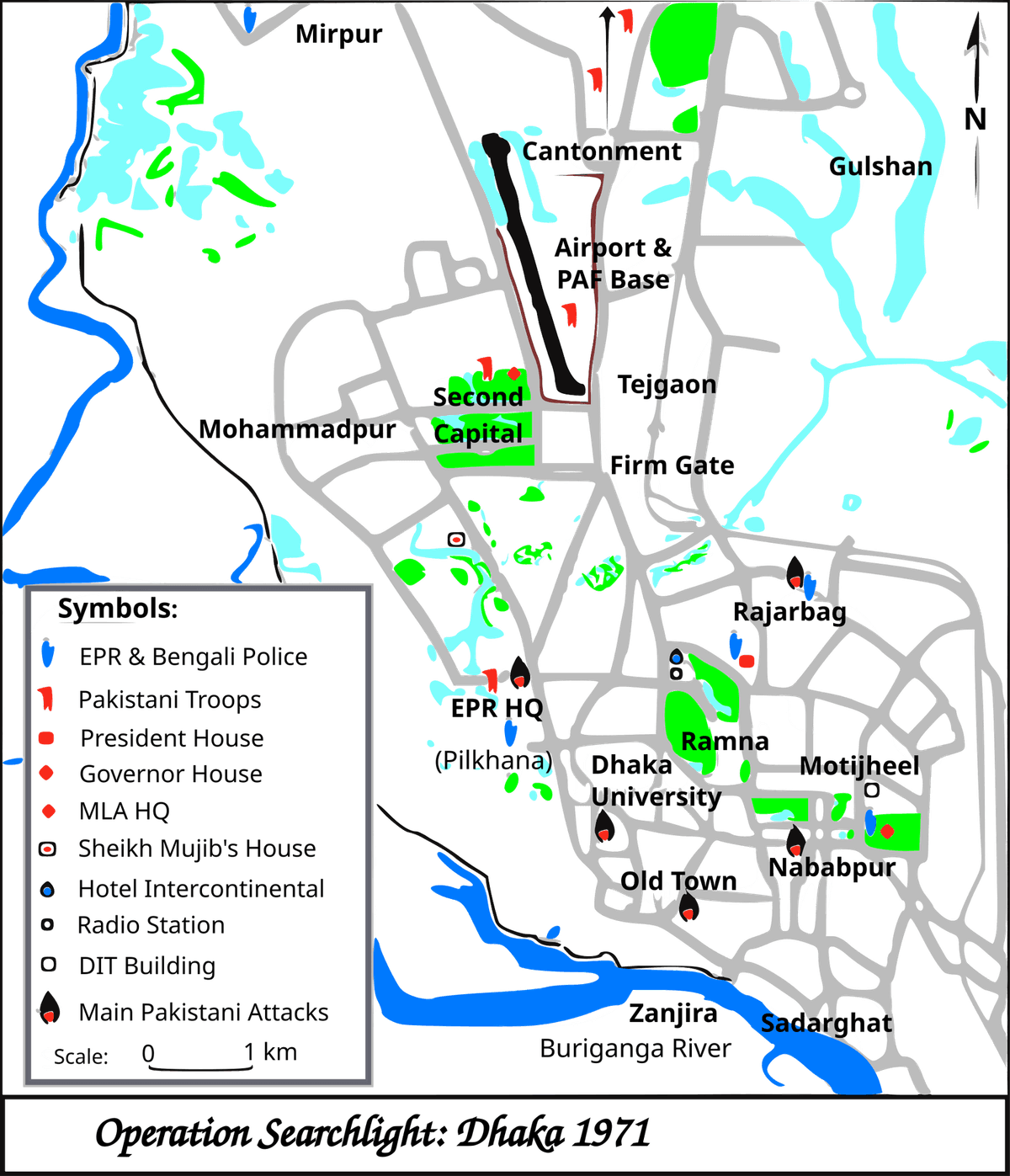
How many people were killed that night is not known. Banglapedia gives 7,000 killed in Dhaka city on the night of 25 March, on the basis of "various home and foreign sources", and more than 50,000 killed in Dhaka, Chittagong, Jessore, Mymensingh, Kushtia and other towns in the first three days.53 It cites a report by the journalist Simon Dring in the Daily Telegraph, which it dates to 29 March, as stating that about 200 students of Iqbal Hall were killed and 700 people burnt to death in old Dhaka.54
Foreign diplomats in the city reported what they saw. On 28 March the US consulate in Dacca cabled Washington under the subject "Selective Genocide": "Here in Dacca we are mute and horrified witnesses to a reign of terror by the Pak military."55 The cable reported that Awami League supporters, student leaders and university faculty were "marked for extinction", and it named faculty members reported killed.56
Pakistan's government gave a different account. Its White Paper of 5 August 1971 claimed that the Awami League had planned an armed revolt for 26 March, and called the military action "inevitable".57 In Bangladesh the night is now marked officially: on 11 March 2017 the Jatiya Sangsad unanimously adopted a resolution, moved by the JSD member Shirin Akter, designating 25 March as Genocide Day.58
Who declared independence?
The Constitution of Bangladesh, the Proclamation of Independence of 10 April 1971 and a High Court ruling of 2009 all state that Sheikh Mujibur Rahman declared independence on 26 March 1971.59 Declarations in Sheikh Mujib's name were also broadcast from Chittagong radio on 26 and 27 March, one by M.A. Hannan and one by Major Ziaur Rahman.60 The historian Sirajul Islam observes that the "declarer of independence changes in the school text books with the change of regime".61 The versions are set out below in the order of the events they describe, each with exactly what its source says.
1. The message dated 26 March 1971 (Constitution, Sixth Schedule)
The Sixth Schedule of the Constitution prints the declaration under the heading "Declaration of Independence by the Father of the Nation, Bangabandhu Sheikh Mujibur Rahman shortly after midnight of 25th March, i.e. early hours of 26th March, 1971".62 The text begins:
This may be my last message, from today Bangladesh is independent. I call upon the people of Bangladesh wherever you might be and with whatever you have, to resist the army of occupation to the last.
It goes on to say that the fight must continue until "the last soldier of the Pakistan occupation army is expelled" and final victory is achieved, and it is signed "Sheikh Mujibur Rahman, 26 March, 1971".64 Article 150(2) of the Constitution calls it "the telegram of the Declaration of Independence of Bangladesh made by Bangabandhu Sheikh Mujibur Rahman ... on the 26th day of March, 1971".65 "Father of the Nation" and "Bangabandhu" are the titles the Constitution uses.66
2. How the message travelled (Banglapedia)
Banglapedia's accounts of how the message left Dhaka are hedged. Its entry on the declaration states that the message "is said to have been made available to EPR shortly after midnight" and was broadcast over the EPR radio system, which was VHF and crystal-controlled, so "not very many people did listen".67 Its entry on the Proclamation states that the message was "reportedly sent to Chittagong shortly after mid night for transmission" over the transmitter of the East Pakistan Rifles.68
3. M.A. Hannan's broadcast from Kalurghat, 26 March
Banglapedia states that on 26 and 27 March two declarations were made in Sheikh Mujib's name from Chittagong Radio, the station later called Swadhin Bangla Betar Kendra: one by M.A. Hannan, general secretary of the Chittagong Awami League, and one by Major Ziaur Rahman.69 Its entry on Hannan says that he "read out and transmitted the Proclamation of Independence by Bangabandhu Sheikh Mujibur Rahman from Kalurghat".70 Mashuqur Rahman and Mahbubur Rahman Jalal, in a study published in The Daily Star in 2014, write that on 26 March "later in the evening M. A. Hannan also broadcast the declaration in a speech"; they give no text of his broadcast.71
4. Major Ziaur Rahman's broadcasts, 27 and 30 March
Major Ziaur Rahman of the 8th East Bengal Regiment, stationed in Chittagong, broadcast from Kalurghat on 27 March.72 Banglapedia gives his text as:
I Major Zia, Provisional Commander-in-Chief of the Bangladesh Liberation Army, hereby proclaims, on behalf of Sheikh Mujibur Rahman, the independence of Bangladesh.
The same text states that "we have already framed a sovereign, legal Government under Sheikh Mujibur Rahman" and appeals to all governments to mobilise public opinion against "the brutal genocide in Bangladesh".74 Banglapedia's entry on the radio station describes Kalurghat as the place where "the declaration of independence was made by ziaur rahman on behalf of bangabandhu sheikh mujibur rahman".75 On 30 March Zia broadcast again, asking the United Nations and the big powers to intervene: "Delay will mean massacre of additional millions."76
Kalurghat was abandoned on 30 March after Pakistani air attacks; the station later moved to Calcutta and from 26 May was called Swadhin Bangla Betar Kendra.77
5. The 2014 study of the press versions
Rahman and Jalal compared the versions of Zia's broadcast recorded at the time.78 They set the official Dalilpatra text, dated 27 March and reading "hereby proclaims, on behalf of Sheikh Mujibur Rahman", beside Indian reports of 27 March of a broadcast by "Major Zia Khan" that did not mention independence, and beside a Times of India report of a broadcast on the morning of 30 March: "hereby proclaim on behalf of Sheikh Mujibur Rahman the independence of Bangla Desh".79 They found no version in which Zia declared independence in his own name.80
6. The Proclamation of Independence, dated 10 April and read on 17 April
The Proclamation of Independence is dated "Mujibnagar, Bangladesh, Dated 10th day of April, 1971".81 Banglapedia states that it was drafted in Kolkata on 10 April by the members of the National and Provincial Assemblies who had gathered there, and read out by Professor M. Yusuf Ali on 17 April 1971 at Baidyanathtala in Meherpur, which was renamed Mujibnagar.82
The Proclamation recites that Sheikh Mujibur Rahman, "the undisputed leader of 75 million of people of Bangladesh", "duly made a declaration of independence at Dacca on March 26, 1971".83 The elected representatives, having "duly constituted ourselves into a Constituent Assembly", "thereby confirm the declaration of independence already made by Bangabandhu Sheikh Mujibur Rahman", and resolve that the Proclamation "shall be deemed to have come into effect from 26th day of March, 1971".84 Since 2011 it has been set out in the Seventh Schedule of the Constitution.85
7. The High Court ruling of 21 June 2009
On 21 June 2009 the High Court, in a bench of Justices ABM Khairul Haque and Mamtazuddin Ahmed, ruled on a public-interest petition by the freedom fighter MA Salam that Sheikh Mujibur Rahman, not Ziaur Rahman, proclaimed independence on 26 March 1971, citing the Proclamation of 10 April 1971.86 The court declared illegal the third volume of the 2004 edition of Swadhinata Juddho: Dalilpatra, which had presented a 27 March declaration by Zia, ordered such books withdrawn, and said that Zia never claimed in his lifetime to be the proclaimer.87
Earlier claims
Several earlier declarations are also recorded. Students declared independence on 2 and 3 March, and Bhashani and Ataur Rahman Khan "declared independence" on 9 March.88 The Awami League paper Jai Bangla, in its issue of 11 May 1971, said that Sheikh Mujib had declared independence on 23 March; Banglapedia adds that "This claim, however, went out of currency later."89
The Mujibnagar government and the Mukti Bahini
A government formed on the border
The government that issued the Proclamation was formed on 10 April, took the oath on 17 April at Baidyanathtala and assigned portfolios on 18 April.90 The Proclamation named Sheikh Mujibur Rahman President and Supreme Commander and Syed Nazrul Islam Vice-President, with the President's powers whenever the President was unable to act, and it appointed "Prof. Yusuf Ali" to administer the oaths.91
Sheikh Mujib was in detention in Pakistan, so Syed Nazrul Islam served as Acting President. Tajuddin Ahmad was Prime Minister and held Defence among other portfolios; Khondakar Mostaq Ahmad held Foreign Affairs and Law; M. Mansur Ali held Finance, Industry and Commerce; and A.H.M. Qamaruzzaman held Home, Relief and Agriculture.92 The headquarters of the Bangladesh forces worked from 8 Theatre Road, Calcutta, from 12 April.93 The government moved to Dhaka on 22 December 1971.94
Four members of this government were killed on the same day in 1975. Tajuddin Ahmad was killed in Dhaka Central Jail on 3 November 1975, and Syed Nazrul Islam, M. Mansur Ali and A.H.M. Qamaruzzaman were killed the same day.95 Their later careers, and those of every head of government since, are in the chapter on the presidents and prime ministers of Bangladesh.
The Mukti Bahini
The armed resistance was first organised by Bengali officers. On 4 April 1971 senior Bengali officers met at Teliapara, the headquarters of the 2nd East Bengal Regiment, divided the country into operational areas among Majors Shafiullah, Khaled Mosharraf, Ziaur Rahman and Abu Osman Chowdhury, and chose Colonel M.A.G. Osmany to command.96 Banglapedia's entry on the Mukti Bahini says that Osmany assumed command on 12 April and was made Commander-in-Chief on 17 April.97
The Mukti Bahini had two parts: regulars, the Niamita Bahini, drawn from the East Bengal Regiment and the EPR, and irregulars, the Gana Bahini, made up of students, peasants, workers and political activists.98 At a conference of sector commanders in July 1971 the territory was divided into 11 sectors; Banglapedia's two entries date the meeting 10 to 17 July and 11 to 17 July.99 Three regular brigades were formed: Z Force under Ziaur Rahman in July, S Force under K.M. Shafiullah in October, and K Force under Khaled Mosharraf.100
| Sector | Area | Commanders | Strength as Banglapedia gives it |
|---|---|---|---|
| 1 | Chittagong, Chittagong Hill Tracts, eastern Noakhali | Ziaur Rahman, then Rafiqul Islam | About 10,000 (about 2,000 regulars) |
| 2 | Dhaka, Comilla, Faridpur, part of Noakhali | Khaled Mosharraf, then ATM Haider | About 35,000 guerrillas (about 6,000 regulars) |
| 3 | Sreemangal, Sylhet and Brahmanbaria | K.M. Shafiullah, then ANM Nuruzzaman | About 30,000 guerrillas by November |
| 4 | Habiganj to Kanaighat | Chittaranjan Datta, then A. Rab | About 9,000 guerrillas, about 4,000 regulars |
| 5 | Durgapur to Dauki, Sunamganj | Mir Shawkat Ali | 800 regulars, 5,000 guerrillas |
| 6 | Rangpur, Thakurgaon | M. Khademul Bashar | About 11,000 by December |
| 7 | Rajshahi, Pabna, Bogra, southern Dinajpur | Nazmul Haq, then others | 2,500 regulars, 12,500 guerrillas |
| 8 | Kushtia, Jessore, Khulna and nearby | Abu Osman Chowdhury, then M.A. Manzur | 3,000 regulars, 25,000 guerrillas |
| 9 | Barisal, Patuakhali, southern Khulna | M.A. Jalil, then others | About 20,000 |
| 10 | Naval commandos (no fixed area) | No fixed sector commander101 | Not given |
| 11 | Tangail, Mymensingh | Abu Taher, then Hamidullah | About 25,000 |
Source: Banglapedia, "War of Liberation, The", section on the sectors.103
Other forces fought alongside them, among them the Mujib Bahini, trained at Dehradun in India, and the 16,000 guerrillas Banglapedia credits Kader Siddiqui with organising in Tangail.104 The Bangladesh Air Force was created on 28 September 1971 at Dimapur in Nagaland, under A.K. Khandker.105 On 14 August, Pakistan's independence day, naval commandos trained in India struck ships at Chittagong, Narayanganj, Daudkandi and Mongla at the same time.106 R.J. Rummel estimated the Mukti Bahini at about 100,000, and the Pakistan army at about the same.107
Peace Committees, Razakars, Al-Badr and Al-Shams
Bodies and forces were also raised to support the Pakistani administration. Peace Committees were formed from 10 April 1971 to assist it, and they dissolved with the surrender.108 The Razakar force was formed in Khulna in May 1971 with 96 first recruits, and the East Pakistan Razakar Ordinance was promulgated on 1 June.109 Al-Badr was formed in September 1971; Banglapedia states that its members were involved in the killing of intellectuals at Rayerbazar.110 Al-Shams was a further paramilitary force, and all of them disintegrated on 16 December.111
Ten million refugees
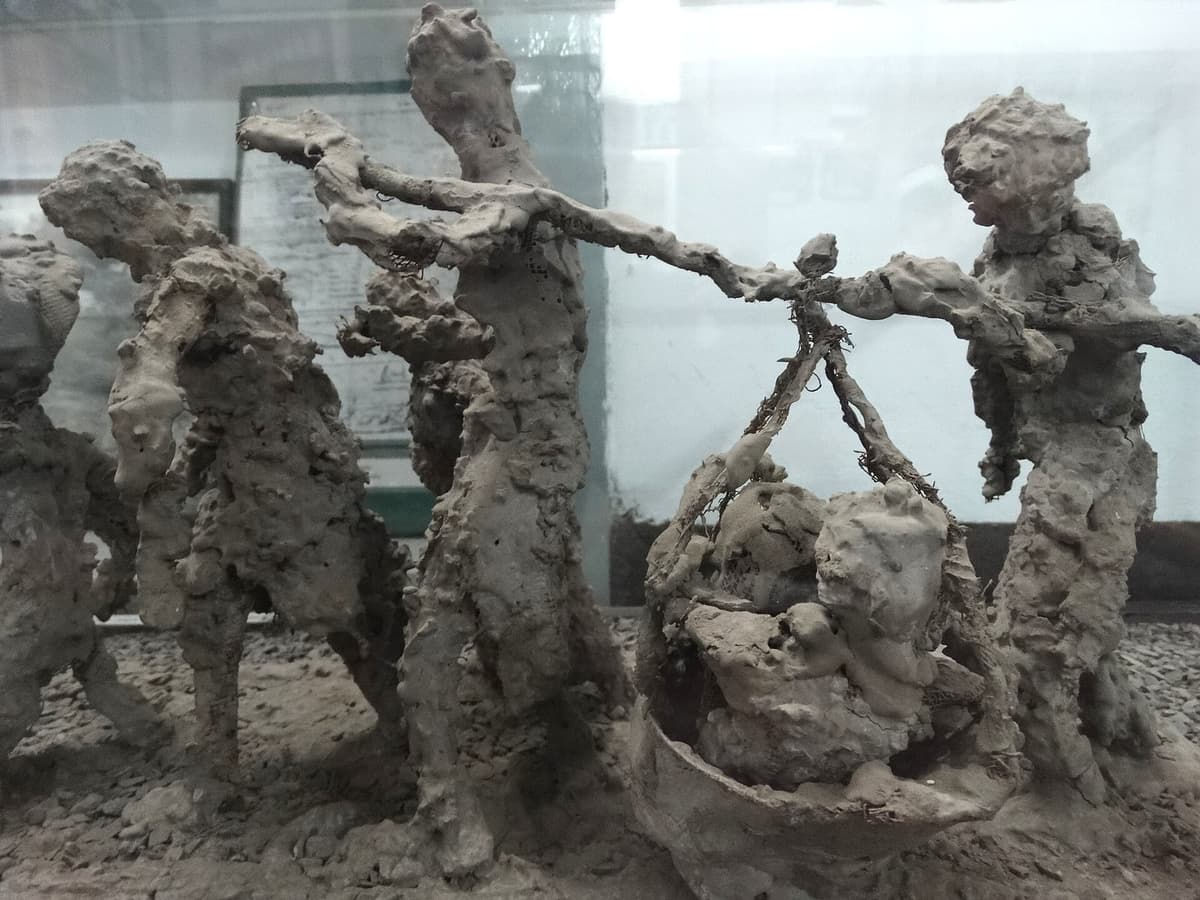
UNHCR describes "an estimated 10 million people leaving what was then East Pakistan for India between April and December 1971" as "the largest single displacement of refugees in the second half of the century".112
The movement began within days of the crackdown. On 29 March 1971 the UNHCR Representative in India, F.L. Pijnacker Hordijk, warned of an impending influx.113 Within a month nearly a million refugees had entered India, and by the end of May more than 100,000 were arriving each day and the total was almost four million.114 By mid-May Prime Minister Indira Gandhi told the Lok Sabha that some 330 camps held four million refugees.115 "By the end of 1971, figures provided by the Indian government to the United Nations indicated that this total had reached 10 million."116
| State | Camps | In camps | With host families | Total |
|---|---|---|---|---|
| West Bengal | 492 | 4,849,786 | 2,386,130 | 7,235,916 |
| Tripura | 276 | 834,098 | 547,551 | 1,381,649 |
| Meghalaya | 17 | 591,520 | 76,466 | 667,986 |
| Assam | 28 | 255,642 | 91,913 | 347,555 |
| Bihar | 8 | 36,732 | Not recorded | 36,732 |
| Madhya Pradesh | 3 | 219,298 | Not recorded | 219,298 |
| Uttar Pradesh | 1 | 10,169 | Not recorded | 10,169 |
| Total | 825 | 6,797,245 | 3,102,060 | 9,899,305 |
Source: UNHCR, The State of the World's Refugees 2000, figure 3.1, citing UN document A/8662/Add.3 of 11 August 1972.118
Show the numbers
| Year | Refugees in India |
|---|---|
| Late Apr 1971 | 1 |
| Mid-May 1971 | 4 |
| End May 1971 | 4 |
| 1 Dec 1971 | 9.9 |
| End 1971 | 10 |
| 25 Mar 1972 | 0.06 |
Source: UNHCR (2000), from Indian government figures. The April and May figures are approximate ("nearly a million", "four million", "almost four million"); the last bar is the Indian government's estimate of refugees still in India on 25 March 1972.119
Disease spread in the camps. Cholera cases were estimated at 9,500 in early June and more than 46,000 by the end of September.120
Most went home soon after the war. India required refugees who had entered after 25 March 1971 to return by the end of February 1972; one million had left India by 6 January 1972, some six million by the end of January, and more than nine million by the end of February.121 On 25 March 1972 the Indian government estimated that only 60,000 refugees remained in India.122
The world takes sides, and India enters the war
The Blood telegram
Criticism of American policy came from inside the US government. On 6 April 1971 the US consulate in Dacca sent Telegram 1138, "Dissent From U.S. Policy Toward East Pakistan", signed by 20 officers of the consulate, USAID and USIS.124 Its first paragraph reads, in part:
Our government has failed to denounce the suppression of democracy. Our government has failed to denounce atrocities.
The telegram went on to say that the government had "evidenced what many will consider moral bankruptcy".126 The Consul General, Archer Blood, added that he subscribed to these views but did not sign as principal officer, and he predicted "a Bengali victory and the consequent establishment of an independent Bangladesh".127 Gary Bass's The Blood Telegram (2013) builds its account of Nixon and Kissinger's support for Pakistan's military government round this dissent.128 Banglapedia states that the United States and China treated the crisis as Pakistan's internal affair.129
Anthony Mascarenhas, a Pakistani journalist from Karachi, was one of eight journalists taken on a ten-day army tour of East Pakistan; after moving his family to London, he published an article headed "Genocide" in the Sunday Times on 13 June 1971.130 The paper's editor, Harold Evans, later recalled Indira Gandhi telling him that the article had set her "on a campaign of personal diplomacy in the European capitals and Moscow to prepare the ground for India's armed intervention".131
India enters the war
On 9 August 1971 India and the Soviet Union signed a 20-year Treaty of Peace and Friendship.132 On 3 December Pakistan launched air attacks on Indian bases on the western front, and Indian forces then entered East Pakistan in force.133 The joint command of the Mukti Bahini and the Indian Army, under Lieutenant General Jagjit Singh Aurora, began operations that evening.134
At the United Nations the Soviet Union vetoed a US-drafted ceasefire resolution in the Security Council (S/10446/Rev.1); the Council then referred the question to the General Assembly by resolution 303 (1971), with 11 votes in favour and 4 abstentions.135 The Assembly's resolution 2793 (XXVI) called for an immediate ceasefire and for cooperation on the refugee crisis.136 India recognised Bangladesh in the first week of December, but the sources differ on the day: UNHCR gives 5 December 1971 and Banglapedia 6 December.137
14 December: the killing of intellectuals
On the night of 14 December 1971, Banglapedia states, more than 200 intellectuals were abducted from their homes in Dhaka; it dates the killing of intellectuals from Operation Searchlight and says it intensified in the days before the surrender.138 The places where they were executed included Rayerbazar and Shialbari in Mirpur.139
Banglapedia states that the plan is "widely believed" to have been orchestrated by Major General Rao Farman Ali, citing a list found in his diary; Farman Ali confirmed that the list existed but denied any genocidal intent.140 Its entry on Al-Badr states that members of that force were involved in the killings at Rayerbazar.141
Banglapedia's table of intellectuals killed across the country, district by district, totals 1,111 people, 991 of them educationists. It calls these the numbers "hitherto traced" and says that the number killed "could not be estimated exactly".142 14 December is observed in Bangladesh as Shaheed Buddhijibi Dibash (শহীদ বুদ্ধিজীবী দিবস), Martyred Intellectuals Day.143
| Profession | Number traced |
|---|---|
| Educationists | 991 |
| Physicians | 49 |
| Lawyers | 42 |
| Journalists | 13 |
| Literature and artists | 9 |
| Engineers | 5 |
| Others | 2 |
| Total | 1,111 |
Source: Banglapedia, "Killing of Intellectuals", table of intellectuals killed by district.145
16 December: the surrender and after
The surrender was signed on 16 December 1971 at the Ramna Racecourse, the ground on which Sheikh Mujib had spoken on 7 March.147 It was signed by Lieutenant General A.A.K. Niazi, commander of Pakistan's Eastern Command, and Lieutenant General Aurora, and Group Captain A.K. Khandker represented the Bangladesh forces.148 UNHCR's head of office in Dhaka, John Kelly, "played a critical intermediary role in ensuring a ceasefire between the two opposing armies".149
The two main sources give the time differently. The heading of the instrument reads "Instrument of Surrender signed at Dacca at 16:31 hours (IST) on 16 Dec 1971".150 Banglapedia gives the time as one minute past 5 pm.151 The instrument's first sentence reads:
The PAKISTAN Eastern Command agree to surrender all PAKISTAN Armed Forces in BANGLA DESH to Lieutenant-General JAGJIT SINGH AURORA, General Officer Commanding in Chief of the Indian and BANGLA DESH forces in the Eastern Theatre.
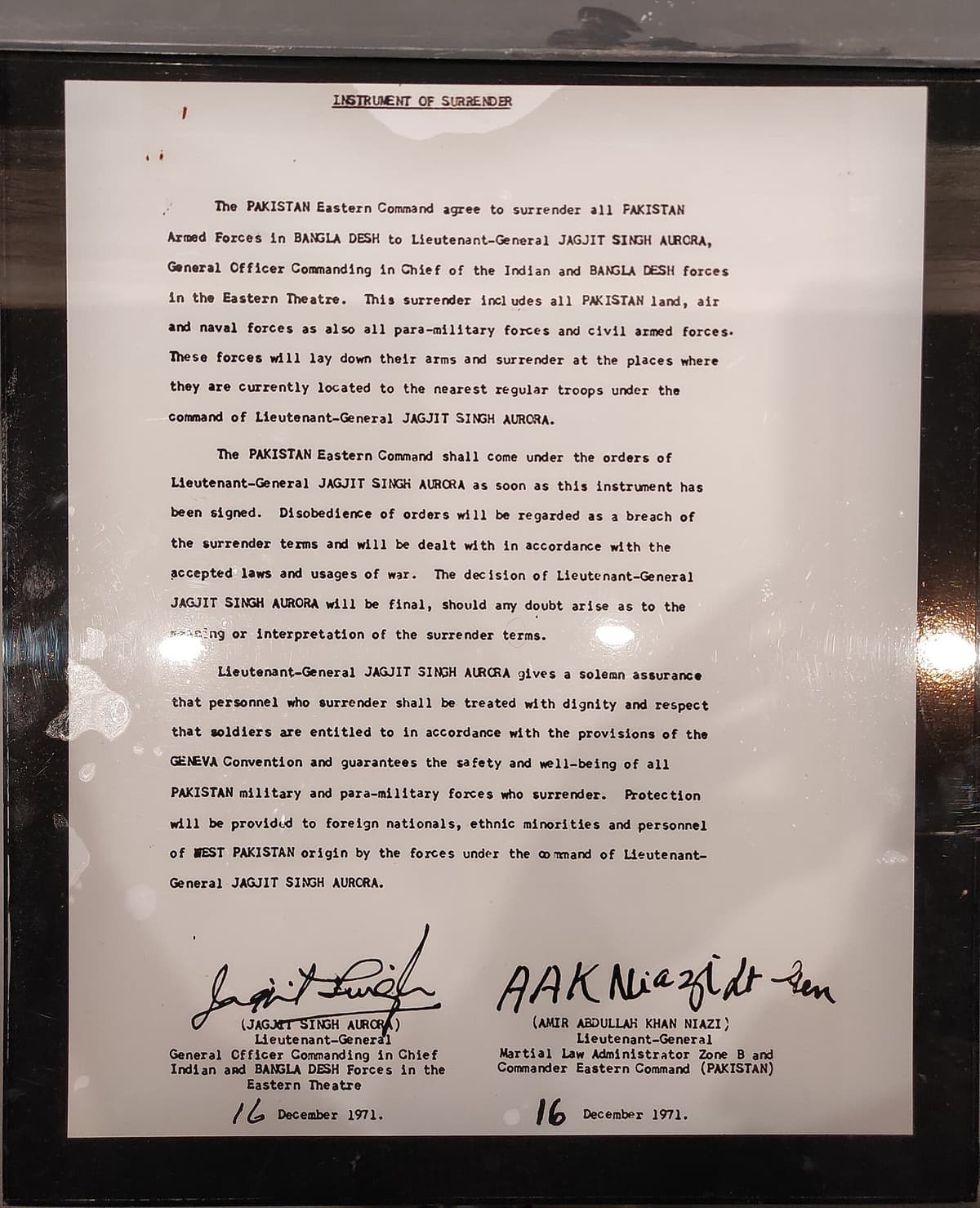
Banglapedia states that the Pakistani forces who surrendered numbered "about 93,000".154 The instrument covered land, air and naval forces as well as paramilitary and civil armed forces, with an assurance of treatment under the Geneva Conventions, and all were taken into Indian custody.155 Banglapedia's entry on national days gives "ninety thousand troops".156 Bangladesh marks 16 December as Victory Day (বিজয় দিবস, Bijoy Dibash) and 26 March as Independence Day.157
Sheikh Mujibur Rahman was released from Pakistan and returned to Dhaka, by way of London, on 10 January 1972.158 Bangladesh identified 195 prisoners for trial for war crimes and mass killing.159 In May 1973 Pakistan took the question of the 195 to the International Court of Justice, which removed the case from its list on 15 December 1973 after Pakistan asked to discontinue it.160
The Simla Agreement between India and Pakistan followed a summit at Simla from 28 June to 2 July 1972.161 The New Delhi Agreement of 28 August 1973, between Bangladesh, India and Pakistan, provided for the simultaneous repatriation of Pakistani prisoners of war and civilian internees in India, Bengalis in Pakistan, and non-Bengalis in Bangladesh who opted for Pakistan.162 Every prisoner was to go home except the 195.163 After the Islamic Summit at Lahore in 1974 and Pakistan's recognition of Bangladesh on 22 February 1974, Bangladesh was persuaded at a tripartite meeting in Delhi to withdraw its demand to try them.164
UNHCR's airlift of September 1973 to July 1974 moved some 231,000 people between the two countries, then the largest emergency airlift of civilians ever organised.165 Bangladesh was admitted to the United Nations on 17 September 1974.166 How the new state rebuilt its economy after the war is told in the chapter on the economy and in the garment guide's chapter on jute, Partition and independence.
War crimes law and trials
Bangladesh's first law against those who had collaborated with the Pakistani forces was the Bangladesh Collaborators (Special Tribunals) Order 1972; Banglapedia states that the 1973 Act replaced it.167 The International Crimes (Tribunals) Act 1973, Act No. XIX of 1973, is dated 20 July 1973.168 Its preamble describes it as "An Act to provide for the detention, prosecution and punishment of persons for genocide, crimes against humanity, war crimes and other crimes under international law."169
As enacted, the Act's genocide clause referred to "a national, ethnic, racial, religious or political group".170 Section 6 allowed the government to set up one or more tribunals, each of a chairman and two to four members, with its seat in Dacca.171 Banglapedia states that although the Act was passed in 1973, it was not implemented after 1975.172
The Act was amended in 2009 by Act No. LV of 2009, which substituted section 3(1) and section 6(2) and inserted a new section 6(2A): "The Tribunal shall be independent in the exercise of its judicial functions and shall ensure fair trial."173 A further amendment, Act No. III of 2013, with effect from 14 July 2009, added the words "or organisation" to section 3(1) and replaced section 21 to give the government and the complainant a right of appeal against acquittal.174 Bangladesh ratified the Rome Statute of the International Criminal Court on 23 March 2010.175
On 25 March 2010 the government announced a three-member tribunal chaired by Justice Nizamul Huq, with Justice ATM Fazle Kabir and the retired District Judge AKM Zahir Ahmed, together with a seven-member investigation agency and a 12-member prosecution team under the Chief Prosecutor, Golam Arif Tipu; the trials were to sit in the old High Court building.176 Banglapedia states that a second tribunal was set up in 2012 and stopped functioning in 2015.177
The conduct of the trials was also questioned.178 Human Rights Watch, which said it had long supported "accountability for the atrocities committed during the 1971 war", stated on 16 August 2013 that the conviction of Ghulam Azam rested on "flawed proceedings", citing the judges' own investigation and allegations of bias that had not been answered.179
How many people died?
Nobody knows how many people were killed in 1971, because no full count was ever made.180 Banglapedia's entry on the killings states that "No definite survey has yet been made", and that immediately after the war the number "was estimated to be as high as three million".181 Every figure below is an estimate, given with whoever made or reported it. They measure different things, and none of them is given here as the number.
| Estimate | Whose | What it counts | Source |
|---|---|---|---|
| 3,000,000 | Government of Bangladesh | People killed in the war | BBC (2011); Banglapedia182 |
| 300,000 to 3,000,000, with "a prudent 1,500,000" | R.J. Rummel, Statistics of Democide (1997) | Deaths caused by the Pakistani state, which he calls "democide" | Rummel183 |
| 300,000 to 500,000 | "Independent researchers", not named, as reported by the BBC | People who died in the war | BBC (2011)184 |
| 269,000 (against 58,000 in the earlier estimates it was compared with) | Ziad Obermeyer, Christopher Murray and Emmanuela Gakidou, BMJ (2008) | Violent war deaths, estimated from sibling histories in the WHO World Health Surveys of 2002 to 2003 | BMJ press release and article185 |
| 50,000 to 100,000 | Sarmila Bose, Dead Reckoning (2011), as summarised by Martin Woollacott | People who died in 1971 | The Guardian (2011)186 |
| About 26,000 | Pakistan's official figure, known here only as reported by Bose and by Naeem Mohaiemen, who identifies it as the estimate of the Hamoodur Rahman Commission | Deaths attributed to the army | Bose (2011); Mohaiemen (2011)187 |
| 150,000 | R.J. Rummel | Non-Bengalis killed, in what he calls a "counter-genocide" | Rummel188 |
Source: BBC (2011); Rummel (1997); BMJ (2008); Woollacott (2011); University of Oxford (2011); Mohaiemen (2011).189
The estimates and their critics
The BBC, reporting the government's three million in 2011, set it beside the view of "independent researchers" that "between 300,000 and 500,000 died".190 Rummel's range covers only deaths caused by the Pakistani state, and he counted non-Bengalis killed separately.191
The 2008 study in the BMJ took a different route. Using sibling histories collected in the WHO World Health Surveys of 2002 to 2003, Obermeyer, Murray and Gakidou estimated 269,000 violent war deaths in Bangladesh, against previous estimates of 58,000.192 In 2009 Michael Spagat and colleagues criticised the method, arguing that its comparison with PRIO data "fails to compare like with like" and rests on a statistically insignificant constant.193
Sarmila Bose's Dead Reckoning (2011) rebuilt events case by case. In Martin Woollacott's review for The Guardian, her "case-by-case arithmetic" leads her to estimate that between 50,000 and 100,000 people died in 1971; Woollacott added: "One cannot say that she absolutely proves this, but her evidence points in that direction."194 Bose herself called Pakistan's official figure of "around 26,000" "absurdly low" and the Bangladeshi "several million" "equally absurdly high".195
Naeem Mohaiemen's critique in the Economic and Political Weekly faulted Bose's reliance on Pakistani officers and on the Pakistani White Paper, her unequal treatment of testimony, and her omission of Bangladeshi scholarship.196 He identified the figure of about 26,000 as the Hamoodur Rahman Commission's estimate and wrote that Bose treats it as "the most reliable"; her own description of it as "absurdly low" differs, and both are recorded here.197 Mohaiemen also noted that the Bangla Academy carried out district surveys between 1996 and 2001 and "found the numbers to be low", and that counts "ranged up to 3 million but as low as 2,00,000", that is, 200,000.198
The word "genocide"
The Bangladeshi state calls the killings of 1971 genocide.202 The US consulate in Dacca used it in the subject line of its cable of 28 March, "Selective Genocide", and the dissent telegram of 6 April spoke of a conflict "in which unfortunately the overworked term genocide is applicable".203 Mascarenhas's Sunday Times article of 13 June was headed "Genocide".204 The Proclamation of Independence uses the term, as does Banglapedia, which has an entry titled "Genocide, 1971"; the 1973 Act lists genocide among the crimes it covers; and in 2017 the Jatiya Sangsad named 25 March Genocide Day.205 Among scholars, Gary Bass uses it in the subtitle of The Blood Telegram: "A Forgotten Genocide".206 Sarmila Bose disputes the term, and set out her argument on genocide and the trials in the Journal of Genocide Research in 2011.207
Sexual violence
The number of women raped during the war is also known only through estimates. Banglapedia records an Italian medical survey's estimate of 40,000 victims and the International Planned Parenthood Federation's of 200,000, and states that "accurate or fairly reliable statistics are not available".208 It also records a government estimate of 300,000, adding: "But the methodology adopted for reaching this figure was not sound."209 On 18 February 1972 the government created the Bangladesh Women's Rehabilitation Board and gave survivors the title Birangana (বীরাঙ্গনা, heroine).210 What happened to these women, and how it has been remembered, is the subject of studies by Yasmin Saikia and Nayanika Mookherjee.211
How the dead are remembered
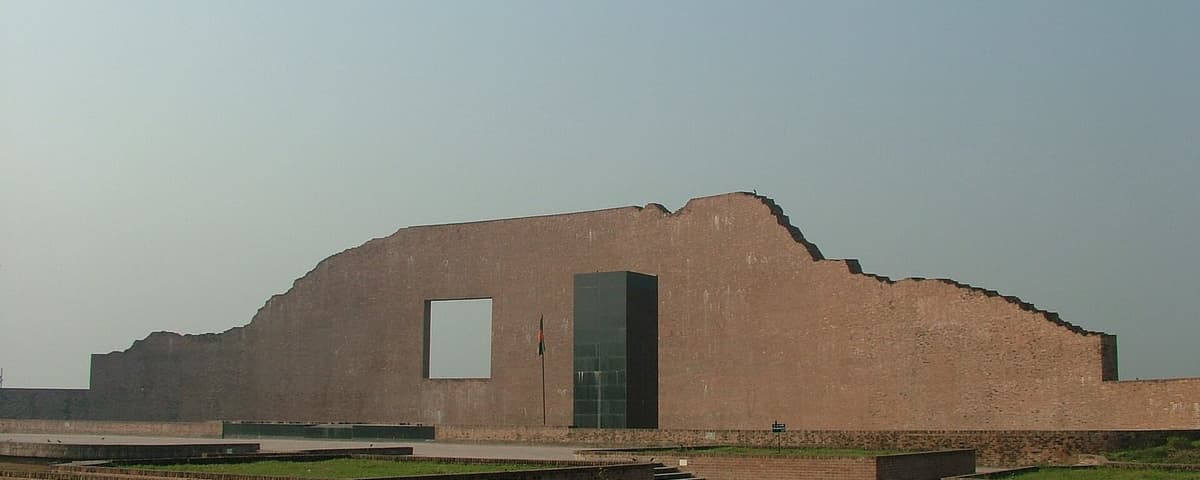
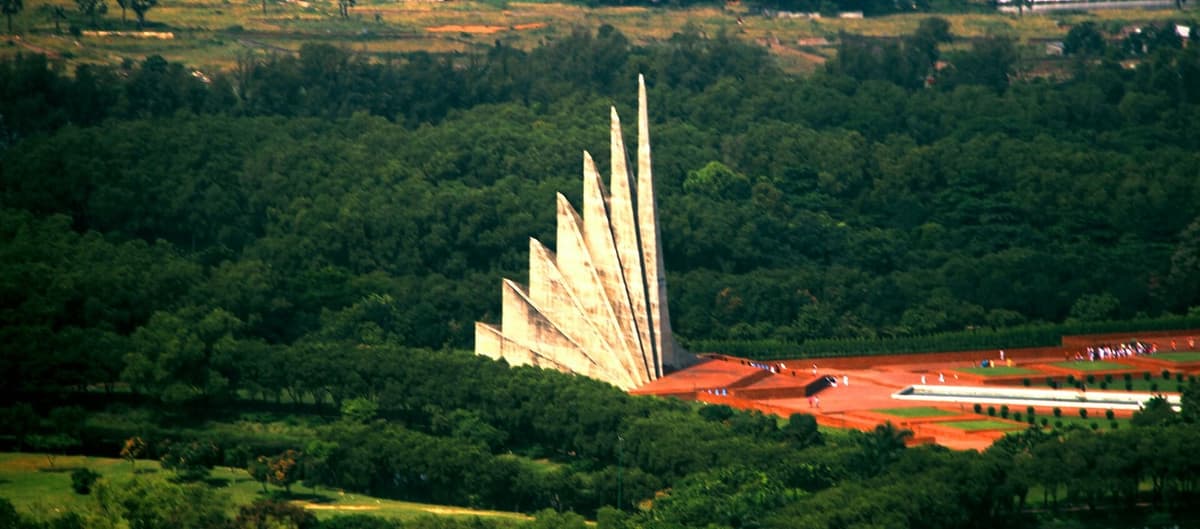
Bangladesh marks the war on four days each year: 25 March as Genocide Day, 26 March as Independence Day, 14 December as Martyred Intellectuals Day and 16 December as Victory Day.212 On Victory Day wreaths are laid at the National Martyrs' Memorial, Jatiyo Smriti Soudho, at Savar.213
The record of 1971 is exact where people wrote things down at the time: the instrument of surrender gives its minute, and the Indian government counted refugees state by state to the last person.215 It is not exact about the dead, and Banglapedia states that no definite survey has yet been made.216 A careful account can quote the documents as they stand, give each estimate with its owner's name, and remember that behind every figure above are people: teachers taken from their homes on 14 December, students in the university halls on 25 March, fighters on every side, and the millions who fled to India and came home.
Further reading
- Srinath Raghavan, 1971: A Global History of the Creation of Bangladesh (2013), which argues that the creation of Bangladesh "was the product of conjuncture and contingency, choice and chance", set in the Cold War.217
- Gary J. Bass, The Blood Telegram: Nixon, Kissinger, and a Forgotten Genocide (2013), on American policy in 1971 and the Dacca consulate's dissent.218
- Richard Sisson and Leo E. Rose, War and Secession: Pakistan, India, and the Creation of Bangladesh (1990), a history of decision-making in the crisis, drawing on interviews.219
- Willem van Schendel, A History of Bangladesh (2009), the standard general history, with chapters on 1971.220
- Yasmin Saikia, Women, War, and the Making of Bangladesh: Remembering 1971 (2011), an oral-history study of women's experience of the war.221
- Sarmila Bose, Dead Reckoning (2011), read with Naeem Mohaiemen's critique "Flying Blind" (2011), for the argument over the death toll from both sides.222
Questions students and journalists ask
Who declared the independence of Bangladesh?
The Constitution of Bangladesh, the Proclamation of Independence of 10 April 1971 and a High Court ruling of 21 June 2009 all state that Sheikh Mujibur Rahman declared independence on 26 March 1971. Declarations in his name were broadcast from Kalurghat in Chittagong by M.A. Hannan on 26 March and by Major Ziaur Rahman on 27 March. Banglapedia gives Zia's text as proclaiming independence "on behalf of Sheikh Mujibur Rahman". The question has long been argued in Bangladeshi politics.
What did the declaration of 26 March 1971 say?
The text printed in the Sixth Schedule of the Constitution begins: "This may be my last message, from today Bangladesh is independent." It calls on the people to resist "the army of occupation" with whatever they have, until the last Pakistani soldier is expelled and final victory is achieved. It is signed "Sheikh Mujibur Rahman, 26 March, 1971". Banglapedia says the message is said to have reached the East Pakistan Rifles shortly after midnight.
How many people were killed in the 1971 Liberation War?
No one knows, because no full count was ever made. The Bangladesh government's figure is 3 million. R.J. Rummel gave a range of 300,000 to 3 million. Researchers cited by the BBC put it at 300,000 to 500,000. A 2008 BMJ survey study estimated 269,000 violent war deaths. Sarmila Bose estimated 50,000 to 100,000, and Pakistan's official figure is about 26,000. The estimates measure different things, and none of them is a complete count.
Where does the figure of 3 million dead come from?
It is the Bangladesh government's figure. Banglapedia says that immediately after the war the number was estimated to be as high as three million, and that no definite survey has been made. Its exact origin is not settled in the sources used for this chapter. Estimates by independent researchers and scholars are lower, though they measure different things, and the figure remains disputed.
What was Operation Searchlight?
Operation Searchlight was the Pakistan army's name for the military operation it launched in Dhaka on the night of 25 March 1971. Its targets included the East Pakistan Rifles headquarters at Peelkhana, the Rajarbagh Police Lines, Dhaka University halls and Hindu-majority areas of old Dhaka. Sheikh Mujibur Rahman was arrested at about 1.30 am on 26 March. Bangladesh now marks 25 March as Genocide Day.
Why is the 7 March 1971 speech important?
On 7 March 1971 Sheikh Mujibur Rahman told a mass meeting at the Ramna Racecourse in Dhaka that "the struggle this time is a struggle for independence", and set conditions for attending the National Assembly. The speech is set out in the Fifth Schedule of the Constitution, and in October 2017 UNESCO inscribed it on its Memory of the World International Register.
What was the Mujibnagar government?
It was the government of Bangladesh during the war, formed on 10 April 1971 and sworn in on 17 April at Baidyanathtala in Meherpur, which was renamed Mujibnagar. Sheikh Mujibur Rahman, then held in Pakistan, was President; Syed Nazrul Islam was Acting President and Tajuddin Ahmad Prime Minister. Its forces were run from 8 Theatre Road in Calcutta, and it moved to Dhaka on 22 December 1971.
How many refugees fled to India in 1971?
UNHCR estimates that about 10 million people fled to India between April and December 1971, the largest single displacement of refugees in the second half of the twentieth century. Indian government figures for 1 December 1971 give 9,899,305: 6,797,245 in 825 camps and 3,102,060 with host families, most of them in West Bengal. Over nine million had returned by the end of February 1972.
What happened on 14 December 1971?
On the night of 14 December 1971, according to Banglapedia, more than 200 intellectuals were abducted from their homes in Dhaka. Execution sites included Rayerbazar and Shialbari in Mirpur. Banglapedia's table traces 1,111 intellectuals killed across the country during the war, 991 of them educationists, but says the full number cannot be estimated exactly. Bangladesh marks the day as Martyred Intellectuals Day.
How many Pakistani soldiers surrendered on 16 December 1971?
Banglapedia gives about 93,000 Pakistani forces, including paramilitary and civil armed forces; another of its entries says ninety thousand troops. They surrendered to the joint command of the Indian and Bangladesh forces at the Ramna Racecourse in Dhaka and were taken into Indian custody. Under the New Delhi Agreement of 1973 they were repatriated, and Bangladesh later withdrew its demand to try 195 of them.
Notes
- Rafiqul Islam and Syeda Momtaz Sheren, "War of Liberation, The," Banglapedia: National Encyclopedia of Bangladesh, Dhaka: Asiatic Society of Bangladesh; online edition, last edited 18 June 2021, accessed 22 November 2026, https://en.banglapedia.org/index.php/War_of_Liberation,_The; "Instrument of Surrender Signed at Dacca at 16:31 Hours (IST) on 16 Dec 1971," Prothom Alo, Chironton 1971, 22 December 2021, https://1971.prothomalo.com/documents/india/instrument-of-surrender-signed-at-dacca-at-1631-hours-ist-on-16-dec-1971; Fazlul Quader Quaderi, "Prisoners of War, Trial of," Banglapedia: National Encyclopedia of Bangladesh, Dhaka: Asiatic Society of Bangladesh; online edition, accessed 22 November 2026, https://en.banglapedia.org/index.php/Prisoners_of_War,_Trial_of. ↩
- Abu Md. Delwar Hossain, "Operation Searchlight," Banglapedia: National Encyclopedia of Bangladesh, Dhaka: Asiatic Society of Bangladesh; online edition, last edited 18 June 2021, accessed 22 November 2026, https://en.banglapedia.org/index.php/Operation_Searchlight; UNHCR, "Rupture in South Asia," in The State of the World's Refugees 2000: Fifty Years of Humanitarian Action (Geneva and New York: UNHCR and Oxford University Press, 2000), 59, http://web.archive.org/web/20160305134849/http://www.unhcr.org/3ebf9bab0.pdf. ↩
- Fazlul Quader Quaderi, "Genocide, 1971," Banglapedia: National Encyclopedia of Bangladesh, Dhaka: Asiatic Society of Bangladesh; online edition, last edited 18 June 2021, accessed 22 November 2026, https://en.banglapedia.org/index.php/Genocide,_1971; University of Oxford, Department of Politics and International Relations, "Dr Sarmila Bose Comments on Her Research on the 1971 Bangladesh War," 22 December 2011, https://www.politics.ox.ac.uk/news/dr-sarmila-bose-comments-her-research-1971-bangladesh-war; Mark Dummett, "Bangladesh War: The Article That Changed History," BBC News, 16 December 2011, https://www.bbc.co.uk/news/world-asia-16207201; Sirajul Islam, "Declaration of Independence," Banglapedia: National Encyclopedia of Bangladesh, Dhaka: Asiatic Society of Bangladesh; online edition, last edited 21 April 2025, accessed 22 November 2026, https://en.banglapedia.org/index.php/Declaration_of_Independence. ↩
- Asiatic Society of Bangladesh, "Rahman, Bangabandhu Sheikh Mujibur," Banglapedia: National Encyclopedia of Bangladesh, Online edition, accessed 22 November 2026, https://en.banglapedia.org/index.php/Rahman,_Bangabandhu_Sheikh_Mujibur. ↩
- Hossain, "Operation Searchlight". ↩
- Government of Bangladesh, Legislative and Parliamentary Affairs Division, The Constitution of the People's Republic of Bangladesh, Schedules (Fourth to Seventh Schedules), PDF. Laws of Bangladesh, Sixth and Seventh Schedules, http://bdlaws.minlaw.gov.bd/upload/act/2022-04-18-13-27-54-Scheudle__367.pdf. ↩
- UNHCR, "Rupture in South Asia", 65. ↩
- Quaderi, "Prisoners of War, Trial". ↩
- University of Oxford, Department of Politics and International Relations, "Dr Sarmila Bose Comments"; Naeem Mohaiemen, "Flying Blind: Waiting for a Real Reckoning on 1971," Economic and Political Weekly 46, no. 36 (2011), https://archive.thedailystar.net/forum/2011/October/flying.htm; Dummett, "Bangladesh War". ↩
- Asiatic Society of Bangladesh, "Rahman, Sheikh Mujibur"; Government of Bangladesh, Legislative and Parliamentary Affairs Division, Constitution, Schedules; UNHCR, "Rupture in South Asia". ↩
- Helal Uddin Ahmed, "Seventh March Address," Banglapedia: National Encyclopedia of Bangladesh, Dhaka: Asiatic Society of Bangladesh; online edition, last edited 20 October 2023, accessed 22 November 2026, https://en.banglapedia.org/index.php/Seventh_March_Address; Asiatic Society of Bangladesh, "Rahman, Sheikh Mujibur". ↩
- Islam, "Declaration of Independence"; Asiatic Society of Bangladesh, "Rahman, Sheikh Mujibur". ↩
- Islam and Sheren, "War of Liberation, The". ↩
- Government of Bangladesh, Legislative and Parliamentary Affairs Division, Constitution, Schedules, Seventh Schedule; Asiatic Society of Bangladesh, "Rahman, Sheikh Mujibur". ↩
- Islam, "Declaration of Independence". ↩
- Asiatic Society of Bangladesh, "Rahman, Sheikh Mujibur". ↩
- Islam, "Declaration of Independence". ↩
- Ahmed, "Seventh March Address"; Government of Bangladesh, Legislative and Parliamentary Affairs Division, Constitution, Schedules, Fifth Schedule. ↩
- Government of Bangladesh, Legislative and Parliamentary Affairs Division, Constitution, Schedules, Fifth and Seventh Schedules. ↩
- Government of Bangladesh, Legislative and Parliamentary Affairs Division, Constitution, Schedules, Fifth Schedule. ↩
- Government of Bangladesh, Legislative and Parliamentary Affairs Division, The Constitution of the People's Republic of Bangladesh, Article 150, "Transitional and temporary provisions", As substituted by the Constitution (Fifteenth Amendment) Act, 2011 (Act XIV of 2011). Laws of Bangladesh, http://bdlaws.minlaw.gov.bd/act-367/section-24715.html; Government of Bangladesh, Legislative and Parliamentary Affairs Division, Constitution, Schedules, Fifth Schedule. ↩
- "Unesco Recognises Bangabandhu's 7th March Speech," The Daily Star (Dhaka), 31 October 2017, https://www.thedailystar.net/politics/unesco-recognises-bangabandhu-sheikh-mujibur-rahman-7th-march-speech-memory-of-the-world-1484356; Ahmed, "Seventh March Address". ↩
- Islam, "Declaration of Independence"; Asiatic Society of Bangladesh, "Rahman, Sheikh Mujibur". ↩
- Government of Bangladesh, Legislative and Parliamentary Affairs Division, Constitution, Schedules, Seventh Schedule; Asiatic Society of Bangladesh, "Rahman, Sheikh Mujibur". ↩
- Islam, "Declaration of Independence". ↩
- Ahmed, "Seventh March Address". ↩
- Hossain, "Operation Searchlight". ↩
- Hossain, "Operation Searchlight"; Government of Bangladesh, Legislative and Parliamentary Affairs Division, Constitution, Schedules, Sixth Schedule; Mashuqur Rahman and Mahbubur Rahman Jalal, "Swadhin Bangla Betar Kendro and Bangladesh's Declaration of Independence," The Daily Star (Dhaka), 25 November 2014, https://www.thedailystar.net/swadhin-bangla-betar-kendro-and-bangladeshs-declaration-of-independence-52001. ↩
- Islam, "Declaration of Independence"; Asiatic Society of Bangladesh, "Rahman, Shahid Ziaur," Banglapedia: National Encyclopedia of Bangladesh, Online edition, accessed 22 November 2026, https://en.banglapedia.org/index.php/Rahman,_Shahid_Ziaur. ↩
- US Consulate General, Dacca, "Telegram From the Consulate General in Dacca to the Department of State, 6 April 1971 (Document 19)," in Foreign Relations of the United States, 1969-1976, vol. 11, South Asia Crisis, 1971, ed. Louis J. Smith (Washington, DC: Government Printing Office, 2005), https://history.state.gov/historicaldocuments/frus1969-76v11/d19. ↩
- Government of Bangladesh, Legislative and Parliamentary Affairs Division, Constitution, Schedules, Seventh Schedule; Mohammad Faiquzzaman, "Mujibnagar Government," Banglapedia: National Encyclopedia of Bangladesh, Dhaka: Asiatic Society of Bangladesh; online edition, last edited 18 June 2021, accessed 22 November 2026, https://en.banglapedia.org/index.php/Mujibnagar_Government. ↩
- Sajahan Miah, "Proclamation of Independence," Banglapedia: National Encyclopedia of Bangladesh, Dhaka: Asiatic Society of Bangladesh; online edition, last edited 17 October 2023, accessed 22 November 2026, https://en.banglapedia.org/index.php/Proclamation_of_Independence; Mohammad Faiquzzaman, "Mujibnagar," Banglapedia: National Encyclopedia of Bangladesh, Dhaka: Asiatic Society of Bangladesh; online edition, accessed 22 November 2026, https://en.banglapedia.org/index.php/Mujibnagar. ↩
- Dummett, "Bangladesh War". ↩
- Islam and Sheren, "War of Liberation, The"; Helal Uddin Ahmed, "Mukti Bahini," Banglapedia: National Encyclopedia of Bangladesh, Dhaka: Asiatic Society of Bangladesh; online edition, last edited 18 June 2021, accessed 22 November 2026, https://en.banglapedia.org/index.php/Mukti_Bahini. ↩
- Islam and Sheren, "War of Liberation, The". ↩
- UNHCR, "Rupture in South Asia", 68; Islam and Sheren, "War of Liberation, The". ↩
- UNHCR, "Rupture in South Asia", 68; M. Siddiqur Rahman, "Swadhin Bangla Betar Kendra," Banglapedia: National Encyclopedia of Bangladesh, Dhaka: Asiatic Society of Bangladesh; online edition, accessed 22 November 2026, https://en.banglapedia.org/index.php/Swadhin_Bangla_Betar_Kendra. ↩
- Muazzam Hussain Khan, "Killing of Intellectuals," Banglapedia: National Encyclopedia of Bangladesh, Dhaka: Asiatic Society of Bangladesh; online edition, last edited 18 June 2021, accessed 22 November 2026, https://en.banglapedia.org/index.php/Killing_of_Intellectuals. ↩
- Islam and Sheren, "War of Liberation, The"; "Instrument of Surrender". ↩
- Rahman, "Swadhin Bangla Betar Kendra". ↩
- Asiatic Society of Bangladesh, "Rahman, Sheikh Mujibur". ↩
- Government of Bangladesh, Legislative and Parliamentary Affairs Division, The International Crimes (Tribunals) Act, 1973 (Act No. XIX of 1973), Ss. 1, 3, 6, 21, with amendment footnotes. Laws of Bangladesh, http://bdlaws.minlaw.gov.bd/act-435.html. ↩
- UNHCR, "Rupture in South Asia", 73. ↩
- United Nations, "Member States," accessed 22 November 2026, https://www.un.org/en/about-us/member-states. ↩
- Hossain, "Operation Searchlight". ↩
- Hossain, "Operation Searchlight"; Islam and Sheren, "War of Liberation, The". ↩
- Hossain, "Operation Searchlight". ↩
- Hossain, "Operation Searchlight". ↩
- Hossain, "Operation Searchlight". ↩
- Hossain, "Operation Searchlight". ↩
- Quaderi, "Genocide, 1971". ↩
- Hossain, "Operation Searchlight"; Siddiq Salik, Witness to Surrender (Karachi: Oxford University Press, 1977). ↩
- Hossain, "Operation Searchlight"; Quaderi, "Genocide, 1971". ↩
- Hossain, "Operation Searchlight". ↩
- US Consulate General, Dacca, "Telegram 959 From the Consulate General in Dacca to the Department of State, 28 March 1971 (Document 125)," in Foreign Relations of the United States, 1969-1976, vol. E-7, Documents on South Asia, 1969-1972, ed. Louis J. Smith (Washington, DC: Government Printing Office, 2005), para. 1, https://history.state.gov/historicaldocuments/frus1969-76ve07/d125. ↩
- US Consulate General, Dacca, "Telegram 959, 28 March 1971", para. 2. ↩
- Hossain, "Operation Searchlight". ↩
- "Mar 25 Now Genocide Day," The Daily Star (Dhaka), 11 March 2017, https://www.thedailystar.net/frontpage/mar-25-now-genocide-day-1374679. ↩
- Government of Bangladesh, Legislative and Parliamentary Affairs Division, Constitution, Article 150; Government of Bangladesh, Legislative and Parliamentary Affairs Division, Constitution, Schedules, Sixth and Seventh Schedules; "It's Bangabandhu, Not Zia: HC Rules Sheikh Mujib Declared Independence," The Daily Star (Dhaka), 21 June 2009, https://www.thedailystar.net/news-detail-93650. ↩
- Miah, "Proclamation of Independence". ↩
- Islam, "Declaration of Independence". ↩
- Government of Bangladesh, Legislative and Parliamentary Affairs Division, Constitution, Schedules, Sixth Schedule. ↩
- Government of Bangladesh, Legislative and Parliamentary Affairs Division, Constitution, Schedules, Sixth Schedule. ↩
- Government of Bangladesh, Legislative and Parliamentary Affairs Division, Constitution, Schedules, Sixth Schedule. ↩
- Government of Bangladesh, Legislative and Parliamentary Affairs Division, Constitution, Article 150. ↩
- Government of Bangladesh, Legislative and Parliamentary Affairs Division, Constitution, Article 150. ↩
- Islam, "Declaration of Independence". ↩
- Miah, "Proclamation of Independence". ↩
- Miah, "Proclamation of Independence". ↩
- Mohammad Mostafa Kamal, "Hannan, MA," Banglapedia: National Encyclopedia of Bangladesh, Dhaka: Asiatic Society of Bangladesh; online edition, accessed 22 November 2026, https://en.banglapedia.org/index.php/Hannan,_MA. ↩
- Rahman and Jalal, "Swadhin Bangla Betar Kendro". ↩
- Asiatic Society of Bangladesh, "Rahman, Shahid Ziaur"; Islam, "Declaration of Independence". ↩
- Islam, "Declaration of Independence"; Asiatic Society of Bangladesh, "Rahman, Shahid Ziaur". ↩
- Islam, "Declaration of Independence"; Asiatic Society of Bangladesh, "Rahman, Shahid Ziaur". ↩
- Rahman, "Swadhin Bangla Betar Kendra". ↩
- Islam, "Declaration of Independence". ↩
- Rahman, "Swadhin Bangla Betar Kendra"; Rahman and Jalal, "Swadhin Bangla Betar Kendro". ↩
- Rahman and Jalal, "Swadhin Bangla Betar Kendro". ↩
- Rahman and Jalal, "Swadhin Bangla Betar Kendro". ↩
- Rahman and Jalal, "Swadhin Bangla Betar Kendro". ↩
- Government of Bangladesh, Legislative and Parliamentary Affairs Division, Constitution, Schedules, Seventh Schedule. ↩
- Miah, "Proclamation of Independence"; Islam, "Declaration of Independence". ↩
- Government of Bangladesh, Legislative and Parliamentary Affairs Division, Constitution, Schedules, Seventh Schedule. ↩
- Government of Bangladesh, Legislative and Parliamentary Affairs Division, Constitution, Schedules, Seventh Schedule. ↩
- Government of Bangladesh, Legislative and Parliamentary Affairs Division, Constitution, Article 150; Government of Bangladesh, Legislative and Parliamentary Affairs Division, Constitution, Schedules, Seventh Schedule. ↩
- "HC Rules Sheikh Mujib Declared Independence". ↩
- "HC Rules Sheikh Mujib Declared Independence". ↩
- Islam, "Declaration of Independence". ↩
- Islam, "Declaration of Independence". ↩
- Faiquzzaman, "Mujibnagar Government". ↩
- Government of Bangladesh, Legislative and Parliamentary Affairs Division, Constitution, Schedules, Seventh Schedule. ↩
- Faiquzzaman, "Mujibnagar Government". ↩
- Islam and Sheren, "War of Liberation, The". ↩
- Rahman, "Swadhin Bangla Betar Kendra"; Sajahan Miah, "Ahmad, Tajuddin," Banglapedia: National Encyclopedia of Bangladesh, Dhaka: Asiatic Society of Bangladesh; online edition, accessed 22 November 2026, https://en.banglapedia.org/index.php/Ahmad,_Tajuddin. ↩
- Miah, "Ahmad, Tajuddin"; Faiquzzaman, "Mujibnagar Government". ↩
- Islam and Sheren, "War of Liberation, The". ↩
- Ahmed, "Mukti Bahini". ↩
- Islam and Sheren, "War of Liberation, The". ↩
- Islam and Sheren, "War of Liberation, The"; Ahmed, "Mukti Bahini". ↩
- Islam and Sheren, "War of Liberation, The"; Ahmed, "Mukti Bahini". ↩
- Faiquzzaman, "Mujibnagar Government". ↩
- Islam and Sheren, "War of Liberation, The". ↩
- Islam and Sheren, "War of Liberation, The". ↩
- Islam and Sheren, "War of Liberation, The"; Ahmed, "Mukti Bahini". ↩
- Islam and Sheren, "War of Liberation, The"; Ahmed, "Mukti Bahini". ↩
- Islam and Sheren, "War of Liberation, The", Sector 10. ↩
- R. J. Rummel, "Statistics of Pakistan's Democide: Estimates, Calculations, and Sources," in Statistics of Democide (1997), https://www.hawaii.edu/powerkills/SOD.CHAP8.HTM. ↩
- Muntassir Mamoon, "Peace Committee," Banglapedia: National Encyclopedia of Bangladesh, Dhaka: Asiatic Society of Bangladesh; online edition, accessed 22 November 2026, https://en.banglapedia.org/index.php/Peace_Committee. ↩
- Muntassir Mamoon, "Razakar," Banglapedia: National Encyclopedia of Bangladesh, Dhaka: Asiatic Society of Bangladesh; online edition, accessed 22 November 2026, https://en.banglapedia.org/index.php/Razakar. ↩
- Muntassir Mamoon, "Al-Badr," Banglapedia: National Encyclopedia of Bangladesh, Dhaka: Asiatic Society of Bangladesh; online edition, accessed 22 November 2026, https://en.banglapedia.org/index.php/Al-Badr. ↩
- Mamoon, "Al-Badr"; Muntassir Mamoon, "Al-Shams," Banglapedia: National Encyclopedia of Bangladesh, Dhaka: Asiatic Society of Bangladesh; online edition, accessed 22 November 2026, https://en.banglapedia.org/index.php/Al-Shams. ↩
- UNHCR, "Rupture in South Asia", 59. ↩
- UNHCR, "Rupture in South Asia", 60. ↩
- UNHCR, "Rupture in South Asia", 61. ↩
- UNHCR, "Rupture in South Asia", 64. ↩
- UNHCR, "Rupture in South Asia", 61. ↩
- UNHCR, "Rupture in South Asia", 65. ↩
- UNHCR, "Rupture in South Asia", 65. ↩
- UNHCR, "Rupture in South Asia", 61, 64, 65, 71. ↩
- UNHCR, "Rupture in South Asia", 64. ↩
- UNHCR, "Rupture in South Asia", 68, 70-71. ↩
- UNHCR, "Rupture in South Asia", 71. ↩
- UNHCR, "Rupture in South Asia", 59. ↩
- US Consulate General, Dacca, "Telegram, 6 April 1971". ↩
- US Consulate General, Dacca, "Telegram, 6 April 1971", para. 1. ↩
- US Consulate General, Dacca, "Telegram, 6 April 1971", para. 1. ↩
- US Consulate General, Dacca, "Telegram, 6 April 1971", paras. 4-6. ↩
- Gary J. Bass, The Blood Telegram: Nixon, Kissinger, and a Forgotten Genocide (New York: Alfred A. Knopf, 2013). ↩
- Islam and Sheren, "War of Liberation, The". ↩
- Dummett, "Bangladesh War". ↩
- Dummett, "Bangladesh War". ↩
- Islam and Sheren, "War of Liberation, The"; UNHCR, "Rupture in South Asia", 68. ↩
- UNHCR, "Rupture in South Asia", 68; Islam and Sheren, "War of Liberation, The". ↩
- Islam and Sheren, "War of Liberation, The". ↩
- United Nations University Centre for Policy Research, "Regular Session: The Situation in the India/Pakistan Subcontinent (Hostilities over Bangladesh) (1971)," Assembly for Peace Handbook, accessed 22 November 2026, https://assemblyforpeace.unu.edu/?p=50. ↩
- United Nations University Centre for Policy Research, "The Situation in the India/Pakistan Subcontinent". ↩
- UNHCR, "Rupture in South Asia", 68; Rahman, "Swadhin Bangla Betar Kendra". ↩
- Khan, "Killing of Intellectuals". ↩
- Khan, "Killing of Intellectuals". ↩
- Khan, "Killing of Intellectuals". ↩
- Mamoon, "Al-Badr". ↩
- Khan, "Killing of Intellectuals". ↩
- Khan, "Killing of Intellectuals". ↩
- Khan, "Killing of Intellectuals". ↩
- Khan, "Killing of Intellectuals". ↩
- Khan, "Killing of Intellectuals". ↩
- Islam and Sheren, "War of Liberation, The". ↩
- Islam and Sheren, "War of Liberation, The"; Ahmed, "Mukti Bahini". ↩
- UNHCR, "Rupture in South Asia", 68. ↩
- "Instrument of Surrender". ↩
- Islam and Sheren, "War of Liberation, The". ↩
- "Instrument of Surrender". ↩
- Islam and Sheren, "War of Liberation, The"; "Instrument of Surrender". ↩
- Quaderi, "Prisoners of War, Trial". ↩
- Quaderi, "Prisoners of War, Trial". ↩
- Helal Uddin Ahmed, "National Days," Banglapedia: National Encyclopedia of Bangladesh, Dhaka: Asiatic Society of Bangladesh; online edition, accessed 22 November 2026, https://en.banglapedia.org/index.php/National_Days. ↩
- Ahmed, "National Days". ↩
- Asiatic Society of Bangladesh, "Rahman, Sheikh Mujibur". ↩
- Quaderi, "Prisoners of War, Trial". ↩
- International Court of Justice, "Trial of Pakistani Prisoners of War (Pakistan v. India)," Case overview, accessed 22 November 2026, https://www.icj-cij.org/case/60. ↩
- Asha Islam, "Simla Agreement," Banglapedia: National Encyclopedia of Bangladesh, Dhaka: Asiatic Society of Bangladesh; online edition, accessed 22 November 2026, https://en.banglapedia.org/index.php/Simla_Agreement. ↩
- UNHCR, "Rupture in South Asia", 72. ↩
- Quaderi, "Prisoners of War, Trial". ↩
- Quaderi, "Prisoners of War, Trial"; UNHCR, "Rupture in South Asia", 73. ↩
- UNHCR, "Rupture in South Asia", 73. ↩
- United Nations, "Member States". ↩
- Mizanur Rahman, "International Crimes (Tribunal) Act, 1973," Banglapedia: National Encyclopedia of Bangladesh, Dhaka: Asiatic Society of Bangladesh; online edition, accessed 22 November 2026, https://en.banglapedia.org/index.php/International_Crimes_(Tribunal)_Act,_1973. ↩
- Government of Bangladesh, Legislative and Parliamentary Affairs Division, International Crimes (Tribunals) Act. ↩
- Government of Bangladesh, Legislative and Parliamentary Affairs Division, International Crimes (Tribunals) Act, preamble. ↩
- Government of Bangladesh, Legislative and Parliamentary Affairs Division, International Crimes (Tribunals) Act, s. 3, n. 5. ↩
- Government of Bangladesh, Legislative and Parliamentary Affairs Division, International Crimes (Tribunals) Act, s. 6. ↩
- Rahman, "International Crimes (Tribunal) Act,". ↩
- Government of Bangladesh, Legislative and Parliamentary Affairs Division, International Crimes (Tribunals) Act, s. 3 n. 1, s. 6 nn. 1-3. ↩
- Government of Bangladesh, Legislative and Parliamentary Affairs Division, International Crimes (Tribunals) Act, s. 3 n. 2, s. 21 n. 1. ↩
- Government of Bangladesh, Legislative and Parliamentary Affairs Division, International Crimes (Tribunals) Act, s. 3(2)(a), Explanation. ↩
- "War Crimes Tribunal Formed," The Financial Express (Dhaka), 26 March 2010, https://today.thefinancialexpress.com.bd/print/war-crimes-tribunal-formed; "Stage Set for War Trial," The Daily Star (Dhaka), 25 March 2010, https://www.thedailystar.net/news-detail-131639. ↩
- Rahman, "International Crimes (Tribunal) Act,". ↩
- Human Rights Watch, "Bangladesh: Azam Conviction Based on Flawed Proceedings," 16 August 2013, https://www.hrw.org/news/2013/08/16/bangladesh-azam-conviction-based-flawed-proceedings. ↩
- Human Rights Watch, "Azam Conviction Based on Flawed Proceedings". ↩
- Quaderi, "Genocide, 1971". ↩
- Quaderi, "Genocide, 1971". ↩
- Dummett, "Bangladesh War"; Quaderi, "Genocide, 1971". ↩
- Rummel, "Statistics of Pakistan's Democide". ↩
- Dummett, "Bangladesh War". ↩
- BMJ Group, "Global War Deaths Have Been Substantially Underestimated," EurekAlert, Press release, 19 June 2008, https://www.eurekalert.org/news-releases/837534; Ziad Obermeyer, Christopher J. L. Murray, and Emmanuela Gakidou, "Fifty Years of Violent War Deaths from Vietnam to Bosnia: Analysis of Data from the World Health Survey Programme," BMJ 336, no. 7659 (2008), https://doi.org/10.1136/bmj.a137. ↩
- Martin Woollacott, "Dead Reckoning by Sarmila Bose: Review," The Guardian, 1 July 2011, https://www.theguardian.com/books/2011/jul/01/dead-reckoning-sarmila-bose-review. ↩
- University of Oxford, Department of Politics and International Relations, "Dr Sarmila Bose Comments"; Mohaiemen, "Flying Blind". ↩
- Rummel, "Statistics of Pakistan's Democide". ↩
- Dummett, "Bangladesh War"; Rummel, "Statistics of Pakistan's Democide"; BMJ Group, "Global War Deaths Have"; Woollacott, "Dead Reckoning by Sarmila"; University of Oxford, Department of Politics and International Relations, "Dr Sarmila Bose Comments"; Mohaiemen, "Flying Blind". ↩
- Dummett, "Bangladesh War". ↩
- Rummel, "Statistics of Pakistan's Democide". ↩
- BMJ Group, "Global War Deaths Have"; Obermeyer, Murray, and Gakidou, "Fifty Years of Violent War Deaths". ↩
- Michael Spagat et al., "Estimating War Deaths: An Arena of Contestation," Journal of Conflict Resolution 53, no. 6 (2009), https://doi.org/10.1177/0022002709346253. ↩
- Woollacott, "Dead Reckoning by Sarmila". ↩
- University of Oxford, Department of Politics and International Relations, "Dr Sarmila Bose Comments". ↩
- Mohaiemen, "Flying Blind". ↩
- Mohaiemen, "Flying Blind"; University of Oxford, Department of Politics and International Relations, "Dr Sarmila Bose Comments". ↩
- Mohaiemen, "Flying Blind". ↩
- Rummel, "Statistics of Pakistan's Democide"; Obermeyer, Murray, and Gakidou, "Fifty Years of Violent War Deaths"; Woollacott, "Dead Reckoning by Sarmila". ↩
- Quaderi, "Genocide, 1971". ↩
- Islam and Sheren, "War of Liberation, The"; Ahmed, "Mukti Bahini". ↩
- Government of Bangladesh, Legislative and Parliamentary Affairs Division, Constitution, Schedules, Seventh Schedule; "Mar 25 Now Genocide". ↩
- US Consulate General, Dacca, "Telegram 959, 28 March 1971"; US Consulate General, Dacca, "Telegram, 6 April 1971", para. 1. ↩
- Dummett, "Bangladesh War". ↩
- Government of Bangladesh, Legislative and Parliamentary Affairs Division, Constitution, Schedules, Seventh Schedule; Quaderi, "Genocide, 1971"; Government of Bangladesh, Legislative and Parliamentary Affairs Division, International Crimes (Tribunals) Act, s. 3(2); "Mar 25 Now Genocide". ↩
- Bass, The Blood Telegram. ↩
- Sarmila Bose, "The Question of Genocide and the Quest for Justice in the 1971 War," Journal of Genocide Research 13, no. 4 (2011), https://doi.org/10.1080/14623528.2011.625750. ↩
- Mustafa Chowdhury, "War-babies," Banglapedia: National Encyclopedia of Bangladesh, Dhaka: Asiatic Society of Bangladesh; online edition, accessed 22 November 2026, https://en.banglapedia.org/index.php/War-babies. ↩
- Chowdhury, "War-babies". ↩
- Chowdhury, "War-babies". ↩
- Yasmin Saikia, Women, War, and the Making of Bangladesh: Remembering 1971 (Durham, NC: Duke University Press, 2011); Nayanika Mookherjee, The Spectral Wound: Sexual Violence, Public Memories, and the Bangladesh War of 1971 (Durham, NC: Duke University Press, 2015). ↩
- "Mar 25 Now Genocide"; Ahmed, "National Days"; Khan, "Killing of Intellectuals". ↩
- Ahmed, "National Days". ↩
- Ahmed, "National Days". ↩
- "Instrument of Surrender"; UNHCR, "Rupture in South Asia", 65. ↩
- Quaderi, "Genocide, 1971". ↩
- Srinath Raghavan, 1971: A Global History of the Creation of Bangladesh (Cambridge, MA: Harvard University Press, 2013). ↩
- Bass, The Blood Telegram. ↩
- Richard Sisson and Leo E. Rose, War and Secession: Pakistan, India, and the Creation of Bangladesh (Berkeley: University of California Press, 1990). ↩
- Willem van Schendel, A History of Bangladesh (Cambridge: Cambridge University Press, 2009). ↩
- Saikia, Women, War, and the Making of Bangladesh. ↩
- Sarmila Bose, Dead Reckoning: Memories of the 1971 Bangladesh War (London: Hurst, 2011); Mohaiemen, "Flying Blind". ↩
Bibliography
- Ahmed, Helal Uddin. "Mukti Bahini." Banglapedia: National Encyclopedia of Bangladesh. Dhaka: Asiatic Society of Bangladesh; online edition, last edited 18 June 2021. Accessed 22 November 2026. https://en.banglapedia.org/index.php/Mukti_Bahini.
- Ahmed, Helal Uddin. "National Days." Banglapedia: National Encyclopedia of Bangladesh. Dhaka: Asiatic Society of Bangladesh; online edition. Accessed 22 November 2026. https://en.banglapedia.org/index.php/National_Days.
- Ahmed, Helal Uddin. "Seventh March Address." Banglapedia: National Encyclopedia of Bangladesh. Dhaka: Asiatic Society of Bangladesh; online edition, last edited 20 October 2023. Accessed 22 November 2026. https://en.banglapedia.org/index.php/Seventh_March_Address.
- Asiatic Society of Bangladesh. "Rahman, Bangabandhu Sheikh Mujibur." Banglapedia: National Encyclopedia of Bangladesh. Online edition. Accessed 22 November 2026. https://en.banglapedia.org/index.php/Rahman,_Bangabandhu_Sheikh_Mujibur.
- Asiatic Society of Bangladesh. "Rahman, Shahid Ziaur." Banglapedia: National Encyclopedia of Bangladesh. Online edition. Accessed 22 November 2026. https://en.banglapedia.org/index.php/Rahman,_Shahid_Ziaur.
- Bass, Gary J. The Blood Telegram: Nixon, Kissinger, and a Forgotten Genocide. New York: Alfred A. Knopf, 2013.
- BMJ Group. "Global War Deaths Have Been Substantially Underestimated." EurekAlert. Press release. 19 June 2008. https://www.eurekalert.org/news-releases/837534.
- Bose, Sarmila. "The Question of Genocide and the Quest for Justice in the 1971 War." Journal of Genocide Research 13, no. 4 (2011): 393-419. https://doi.org/10.1080/14623528.2011.625750.
- Bose, Sarmila. Dead Reckoning: Memories of the 1971 Bangladesh War. London: Hurst, 2011.
- Chowdhury, Mustafa. "War-babies." Banglapedia: National Encyclopedia of Bangladesh. Dhaka: Asiatic Society of Bangladesh; online edition. Accessed 22 November 2026. https://en.banglapedia.org/index.php/War-babies.
- Dummett, Mark. "Bangladesh War: The Article That Changed History." BBC News, 16 December 2011. https://www.bbc.co.uk/news/world-asia-16207201.
- Faiquzzaman, Mohammad. "Mujibnagar Government." Banglapedia: National Encyclopedia of Bangladesh. Dhaka: Asiatic Society of Bangladesh; online edition, last edited 18 June 2021. Accessed 22 November 2026. https://en.banglapedia.org/index.php/Mujibnagar_Government.
- Faiquzzaman, Mohammad. "Mujibnagar." Banglapedia: National Encyclopedia of Bangladesh. Dhaka: Asiatic Society of Bangladesh; online edition. Accessed 22 November 2026. https://en.banglapedia.org/index.php/Mujibnagar.
- Government of Bangladesh, Legislative and Parliamentary Affairs Division. The Constitution of the People's Republic of Bangladesh, Article 150, "Transitional and temporary provisions". As substituted by the Constitution (Fifteenth Amendment) Act, 2011 (Act XIV of 2011). Laws of Bangladesh. Accessed 22 November 2026. http://bdlaws.minlaw.gov.bd/act-367/section-24715.html.
- Government of Bangladesh, Legislative and Parliamentary Affairs Division. The Constitution of the People's Republic of Bangladesh, Schedules (Fourth to Seventh Schedules). PDF. Laws of Bangladesh. Accessed 22 November 2026. http://bdlaws.minlaw.gov.bd/upload/act/2022-04-18-13-27-54-Scheudle__367.pdf.
- Government of Bangladesh, Legislative and Parliamentary Affairs Division. The International Crimes (Tribunals) Act, 1973 (Act No. XIX of 1973). Ss. 1, 3, 6, 21, with amendment footnotes. Laws of Bangladesh. Accessed 22 November 2026. http://bdlaws.minlaw.gov.bd/act-435.html.
- Hossain, Abu Md. Delwar. "Operation Searchlight." Banglapedia: National Encyclopedia of Bangladesh. Dhaka: Asiatic Society of Bangladesh; online edition, last edited 18 June 2021. Accessed 22 November 2026. https://en.banglapedia.org/index.php/Operation_Searchlight.
- Human Rights Watch. "Bangladesh: Azam Conviction Based on Flawed Proceedings." 16 August 2013. https://www.hrw.org/news/2013/08/16/bangladesh-azam-conviction-based-flawed-proceedings.
- International Court of Justice. "Trial of Pakistani Prisoners of War (Pakistan v. India)." Case overview. Accessed 22 November 2026. https://www.icj-cij.org/case/60.
- Islam, Asha. "Simla Agreement." Banglapedia: National Encyclopedia of Bangladesh. Dhaka: Asiatic Society of Bangladesh; online edition. Accessed 22 November 2026. https://en.banglapedia.org/index.php/Simla_Agreement.
- Islam, Rafiqul, and Syeda Momtaz Sheren. "War of Liberation, The." Banglapedia: National Encyclopedia of Bangladesh. Dhaka: Asiatic Society of Bangladesh; online edition, last edited 18 June 2021. Accessed 22 November 2026. https://en.banglapedia.org/index.php/War_of_Liberation,_The.
- Islam, Sirajul. "Declaration of Independence." Banglapedia: National Encyclopedia of Bangladesh. Dhaka: Asiatic Society of Bangladesh; online edition, last edited 21 April 2025. Accessed 22 November 2026. https://en.banglapedia.org/index.php/Declaration_of_Independence.
- Kamal, Mohammad Mostafa. "Hannan, MA." Banglapedia: National Encyclopedia of Bangladesh. Dhaka: Asiatic Society of Bangladesh; online edition. Accessed 22 November 2026. https://en.banglapedia.org/index.php/Hannan,_MA.
- Khan, Muazzam Hussain. "Killing of Intellectuals." Banglapedia: National Encyclopedia of Bangladesh. Dhaka: Asiatic Society of Bangladesh; online edition, last edited 18 June 2021. Accessed 22 November 2026. https://en.banglapedia.org/index.php/Killing_of_Intellectuals.
- Mamoon, Muntassir. "Al-Badr." Banglapedia: National Encyclopedia of Bangladesh. Dhaka: Asiatic Society of Bangladesh; online edition. Accessed 22 November 2026. https://en.banglapedia.org/index.php/Al-Badr.
- Mamoon, Muntassir. "Al-Shams." Banglapedia: National Encyclopedia of Bangladesh. Dhaka: Asiatic Society of Bangladesh; online edition. Accessed 22 November 2026. https://en.banglapedia.org/index.php/Al-Shams.
- Mamoon, Muntassir. "Peace Committee." Banglapedia: National Encyclopedia of Bangladesh. Dhaka: Asiatic Society of Bangladesh; online edition. Accessed 22 November 2026. https://en.banglapedia.org/index.php/Peace_Committee.
- Mamoon, Muntassir. "Razakar." Banglapedia: National Encyclopedia of Bangladesh. Dhaka: Asiatic Society of Bangladesh; online edition. Accessed 22 November 2026. https://en.banglapedia.org/index.php/Razakar.
- Miah, Sajahan. "Ahmad, Tajuddin." Banglapedia: National Encyclopedia of Bangladesh. Dhaka: Asiatic Society of Bangladesh; online edition. Accessed 22 November 2026. https://en.banglapedia.org/index.php/Ahmad,_Tajuddin.
- Miah, Sajahan. "Proclamation of Independence." Banglapedia: National Encyclopedia of Bangladesh. Dhaka: Asiatic Society of Bangladesh; online edition, last edited 17 October 2023. Accessed 22 November 2026. https://en.banglapedia.org/index.php/Proclamation_of_Independence.
- Mohaiemen, Naeem. "Flying Blind: Waiting for a Real Reckoning on 1971." Economic and Political Weekly 46, no. 36 (2011). https://archive.thedailystar.net/forum/2011/October/flying.htm.
- Mookherjee, Nayanika. The Spectral Wound: Sexual Violence, Public Memories, and the Bangladesh War of 1971. Durham, NC: Duke University Press, 2015.
- Obermeyer, Ziad, Christopher J. L. Murray, and Emmanuela Gakidou. "Fifty Years of Violent War Deaths from Vietnam to Bosnia: Analysis of Data from the World Health Survey Programme." BMJ 336, no. 7659 (2008): 1482-86. https://doi.org/10.1136/bmj.a137.
- Prothom Alo, Chironton 1971. "Instrument of Surrender Signed at Dacca at 16:31 Hours (IST) on 16 Dec 1971." 22 December 2021. https://1971.prothomalo.com/documents/india/instrument-of-surrender-signed-at-dacca-at-1631-hours-ist-on-16-dec-1971.
- Quaderi, Fazlul Quader. "Genocide, 1971." Banglapedia: National Encyclopedia of Bangladesh. Dhaka: Asiatic Society of Bangladesh; online edition, last edited 18 June 2021. Accessed 22 November 2026. https://en.banglapedia.org/index.php/Genocide,_1971.
- Quaderi, Fazlul Quader. "Prisoners of War, Trial of." Banglapedia: National Encyclopedia of Bangladesh. Dhaka: Asiatic Society of Bangladesh; online edition. Accessed 22 November 2026. https://en.banglapedia.org/index.php/Prisoners_of_War,_Trial_of.
- Raghavan, Srinath. 1971: A Global History of the Creation of Bangladesh. Cambridge, MA: Harvard University Press, 2013.
- Rahman, M. Siddiqur. "Swadhin Bangla Betar Kendra." Banglapedia: National Encyclopedia of Bangladesh. Dhaka: Asiatic Society of Bangladesh; online edition. Accessed 22 November 2026. https://en.banglapedia.org/index.php/Swadhin_Bangla_Betar_Kendra.
- Rahman, Mashuqur, and Mahbubur Rahman Jalal. "Swadhin Bangla Betar Kendro and Bangladesh's Declaration of Independence." The Daily Star (Dhaka), 25 November 2014. https://www.thedailystar.net/swadhin-bangla-betar-kendro-and-bangladeshs-declaration-of-independence-52001.
- Rahman, Mizanur. "International Crimes (Tribunal) Act, 1973." Banglapedia: National Encyclopedia of Bangladesh. Dhaka: Asiatic Society of Bangladesh; online edition. Accessed 22 November 2026. https://en.banglapedia.org/index.php/International_Crimes_(Tribunal)_Act,_1973.
- Rummel, R. J. "Statistics of Pakistan's Democide: Estimates, Calculations, and Sources." In Statistics of Democide. 1997. https://www.hawaii.edu/powerkills/SOD.CHAP8.HTM.
- Saikia, Yasmin. Women, War, and the Making of Bangladesh: Remembering 1971. Durham, NC: Duke University Press, 2011.
- Salik, Siddiq. Witness to Surrender. Karachi: Oxford University Press, 1977.
- Sisson, Richard, and Leo E. Rose. War and Secession: Pakistan, India, and the Creation of Bangladesh. Berkeley: University of California Press, 1990.
- Spagat, Michael, Andrew Mack, Tara Cooper, and Joakim Kreutz. "Estimating War Deaths: An Arena of Contestation." Journal of Conflict Resolution 53, no. 6 (2009): 934-50. https://doi.org/10.1177/0022002709346253.
- The Daily Star (Dhaka). "It's Bangabandhu, Not Zia: HC Rules Sheikh Mujib Declared Independence." 21 June 2009. https://www.thedailystar.net/news-detail-93650.
- The Daily Star (Dhaka). "Mar 25 Now Genocide Day." 11 March 2017. https://www.thedailystar.net/frontpage/mar-25-now-genocide-day-1374679.
- The Daily Star (Dhaka). "Stage Set for War Trial." 25 March 2010. https://www.thedailystar.net/news-detail-131639.
- The Daily Star (Dhaka). "Unesco Recognises Bangabandhu's 7th March Speech." 31 October 2017. https://www.thedailystar.net/politics/unesco-recognises-bangabandhu-sheikh-mujibur-rahman-7th-march-speech-memory-of-the-world-1484356.
- The Financial Express (Dhaka). "War Crimes Tribunal Formed." 26 March 2010. https://today.thefinancialexpress.com.bd/print/war-crimes-tribunal-formed.
- UNHCR. "Rupture in South Asia." In The State of the World's Refugees 2000: Fifty Years of Humanitarian Action, 59-77. Geneva and New York: UNHCR and Oxford University Press, 2000. http://web.archive.org/web/20160305134849/http://www.unhcr.org/3ebf9bab0.pdf.
- United Nations University Centre for Policy Research. "Regular Session: The Situation in the India/Pakistan Subcontinent (Hostilities over Bangladesh) (1971)." Assembly for Peace Handbook. Accessed 22 November 2026. https://assemblyforpeace.unu.edu/?p=50.
- United Nations. "Member States." Accessed 22 November 2026. https://www.un.org/en/about-us/member-states.
- University of Oxford, Department of Politics and International Relations. "Dr Sarmila Bose Comments on Her Research on the 1971 Bangladesh War." 22 December 2011. https://www.politics.ox.ac.uk/news/dr-sarmila-bose-comments-her-research-1971-bangladesh-war.
- US Consulate General, Dacca. "Telegram 959 From the Consulate General in Dacca to the Department of State, 28 March 1971 (Document 125)." In Foreign Relations of the United States, 1969-1976, vol. E-7, Documents on South Asia, 1969-1972, edited by Louis J. Smith. Washington, DC: Government Printing Office, 2005. https://history.state.gov/historicaldocuments/frus1969-76ve07/d125.
- US Consulate General, Dacca. "Telegram From the Consulate General in Dacca to the Department of State, 6 April 1971 (Document 19)." In Foreign Relations of the United States, 1969-1976, vol. 11, South Asia Crisis, 1971, edited by Louis J. Smith, 45-47. Washington, DC: Government Printing Office, 2005. https://history.state.gov/historicaldocuments/frus1969-76v11/d19.
- van Schendel, Willem. A History of Bangladesh. Cambridge: Cambridge University Press, 2009.
- Woollacott, Martin. "Dead Reckoning by Sarmila Bose: Review." The Guardian, 1 July 2011. https://www.theguardian.com/books/2011/jul/01/dead-reckoning-sarmila-bose-review.
How to cite this page
Free to quote and reuse under CC BY 4.0. Please credit Collective Studio and link to this page. Pick the style your course uses.
Chicago (notes and bibliography)
Rahman, AB. "The Bangladesh Liberation War of 1971." Collective Studio, 22 November 2026. https://collectivestudioltd.com/research/bangladesh/liberation-war-1971.
Harvard
Rahman, A.B. (2026) The Bangladesh Liberation War of 1971. Collective Studio. Available at: https://collectivestudioltd.com/research/bangladesh/liberation-war-1971 (Accessed: [date you read it]).
APA 7th edition
Rahman, A. B. (2026, November 22). The Bangladesh Liberation War of 1971. Collective Studio. https://collectivestudioltd.com/research/bangladesh/liberation-war-1971
About the publisher
This guide is written and published by Collective Studio Ltd, a family-run clothing factory in Narayanganj, Bangladesh, as a free public resource about the country we come from. It is not a commercial project: nothing in the chapters promotes our business. Every statement of fact is footnoted to a published source, and where historians disagree, the guide shows each view with its source.