Bangladesh: Land, People and History · Chapter 2 of 16 · to about 600 CE
Ancient Bengal: Wari-Bateshwar, Mahasthangarh and the First Kingdoms
The land that is now Bangladesh had walled towns by the last centuries BCE: laboratory radiocarbon dates put the main occupation of Wari-Bateshwar at about 400 to 110 BCE, and dates from Mahasthangarh, the ancient city of Pundranagara, reach back to the late 4th century BCE.1 Bengal's earliest inscription, found at Mahasthan in 1931, is a Maurya-period order which its first editor read as relieving distress, apparently from famine, while Greek and Latin writers knew the people of the Ganges mouths as the Gangaridai.2 By the mid-4th century CE most of Bengal was inside the Gupta empire, and in the 6th century southern and eastern Bengal became an independent kingdom of Vanga.3
- 400 to 110 BCE
- Range of the published AMS radiocarbon dates on rice and charcoal from Early Historic Wari-Bateshwar4
- 30 November 1931
- The day the Mahasthan Brahmi inscription, the earliest inscription from Bengal, was found5
- 18
- Building levels recorded at Mahasthangarh by the French and Bangladeshi excavation since 19936
- 1.5 by 1.4 km
- Size of the walled city at Mahasthangarh, by Banglapedia's measurement7
- 506 or 507 CE
- Date of the Gunaighar copper plate of Vainyagupta (Gupta year 188), as converted by its first editor and by Banglapedia8
- 17 May 2023
- The Mahasthan and Karatoya River site placed on UNESCO's Tentative List9
Sources: Rahman et al. (2020); Bhandarkar (1931-32); Bhattacharyya (1930); Banglapedia; UNESCO World Heritage Centre.10
A famine order on a piece of limestone
On 30 November 1931 Baru Fakir, a man from Mahasthangarh village, found a broken piece of hard limestone with writing cut into it.11 G. C. Chandra, Superintendent of the Archaeological Survey's Eastern Circle, acquired it, and the stone went to the Indian Museum in Calcutta.12 The writing was Mauryan Brahmi, closely resembling the script of the emperor Ashoka, and the language was close to that of Ashoka's Pillar Edicts.13
D. R. Bhandarkar, who first edited the stone, read it as an order to the Mahamatra, a senior official, at "Pudanagala", that is Pundranagara.14 People there were in distress, apparently from famine. They were to be helped with an advance of gandaka coins and a distribution of paddy, which were to be paid back to the granary (kothagala) and the treasury (kosa) when plenty returned.15 Banglapedia reads the gandaka as a unit of four cowrie shells.16
The oldest written words from Bengal, in other words, are not a royal boast. They are an administrative note about grain, coins and a granary, sent by a ruler to his official in a provincial town. That small fact sets the theme of this chapter. Read as a whole, the evidence suggests that ancient Bengal mattered because of its rivers: its towns were places of exchange, linked to the Ganges plain and the Bay of Bengal, and outside powers wanted them. It does not, so far, show the great independent empire that some popular accounts describe. That is an interpretation, and the sections below set out the evidence on both sides.
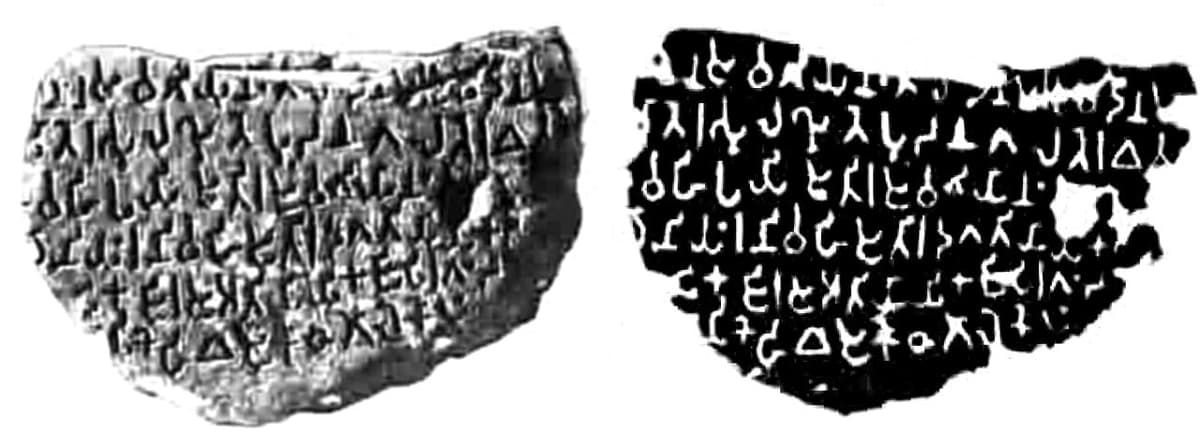
How old is the inscription?
The main authorities all place the inscription in the Maurya period; they differ on the century. Bhandarkar assigned it to the 4th century BCE and called its author a ruler "of the Mauryan period, if not of the Mauryan family".18 He argued that the record "places beyond all doubt" that Mahasthan was Pundranagara.19 Banglapedia dates it on the shape of its letters to the Maurya age, about the 3rd century BCE, and calls it "the earliest epigraphic record in Bengal".20 UNESCO's 2023 description says scholars think it "can be dated to the time of the Emperor Asoka", whose reign Banglapedia gives as 269 to 232 BCE.21
| Question | Bhandarkar (1931-32) | Banglapedia | UNESCO (2023) |
|---|---|---|---|
| Date | 4th century BCE | Maurya age, c. 3rd century BCE | The time of Ashoka |
| Lines | Six lines of writing, with a seventh, partly restored line in his transcript | Seven lines | Not stated |
| Content | Relief of distress by an advance of gandaka coins and a distribution of paddy | Lists oil, tree, paddy and coins | Mentions storing oil and rice |
Source: Bhandarkar (1931-32); Banglapedia, "Mahasthan Brahmi Inscription"; UNESCO World Heritage Centre (2023).22
One reading in the stone is less certain than the rest. Bhandarkar read a people called the "Samvamgiyas" and suggested they were a confederacy of clans from Vanga, but he flagged this as a conjecture.23 It is best treated as one reading among several.
What came before the towns?
Stone tools show that people lived on the higher ground of Bangladesh long before any town, but almost nothing about their settlements is known.24 According to Banglapedia, every reported prehistoric find in Bangladesh comes from the Lalmai hills near Cumilla and the higher ground of Sylhet, Habiganj, Chattogram and the Madhupur Tract, all of it on older Pleistocene alluvium.25 How the delta around these hills was formed is the subject of the chapter on the land and people of Bangladesh.
Most of the tools are made of silicified fossil wood. In 1989 Dilip K. Chakrabarti's team recovered 234 such artefacts from eleven places in the Lalmai hills, and in 1991 the Directorate of Archaeology recovered 240 more from four places in the same range.26 In 1997 a Jahangirnagar University team found fossil-wood tools at the Chaklapunji tea estate in Habiganj, and in 1998 two of the university's students found a typical Acheulian hand axe in the Lalmai hills.27 The assemblages divide into an older group without polished tools (hand axes, cleavers, scrapers, choppers and points) and a Neolithic group with adzes, polished celts and awls; similar tools come from Tripura and from the Irrawaddy valley of Myanmar.28
A trial trench at one Lalmai site in 1991, just 1.5 m by 1 m, gave decayed, undecorated potsherds alongside the fossil-wood tools.29 That is close to the limit of what is known. A 2020 peer-reviewed paper says sites of the early and middle Holocene (the Mesolithic, Neolithic and Chalcolithic) are "largely unknown" in Bangladesh, and puts this down to flooding and the build-up of river silt.30 Claims that Bengal's prehistory goes back ten thousand years should be read in that light: Banglapedia says only that settlement "might have taken place" that long ago and that the time is hard to fix.31
Wari-Bateshwar: a river town of bead makers
Wari-Bateshwar lies in Narsingdi district, and its story as an archaeological site begins with an amateur.32 In 1933, by two later accounts, a hoard of coins was dug up there and the local schoolteacher Hanif Pathan began to collect what turned up; his son Habibulla Pathan carried on the work.33 Archaeological exploration began in 1989, and regular excavation from 2000 under Sufi Mostafizur Rahman of the Department of Archaeology at Jahangirnagar University; a 2013 magazine report puts the start of excavation in the late 1990s.34
The site sits on the bank of a former channel of the Old Brahmaputra.35 Its fortified enclosure has four mud ramparts, once surrounded by a moat that has silted up into paddy fields, and Banglapedia gives its size as 600 m by 600 m.36 An outer earthen rampart to the west and south-west, called Asom Rajar Garh, is about 5.8 km long by Banglapedia's measurement and 5.75 km by the excavators' 2020 paper, which also gives it a much smaller width and height.37 Around 50 archaeological sites are recorded in and around the fort-city.38
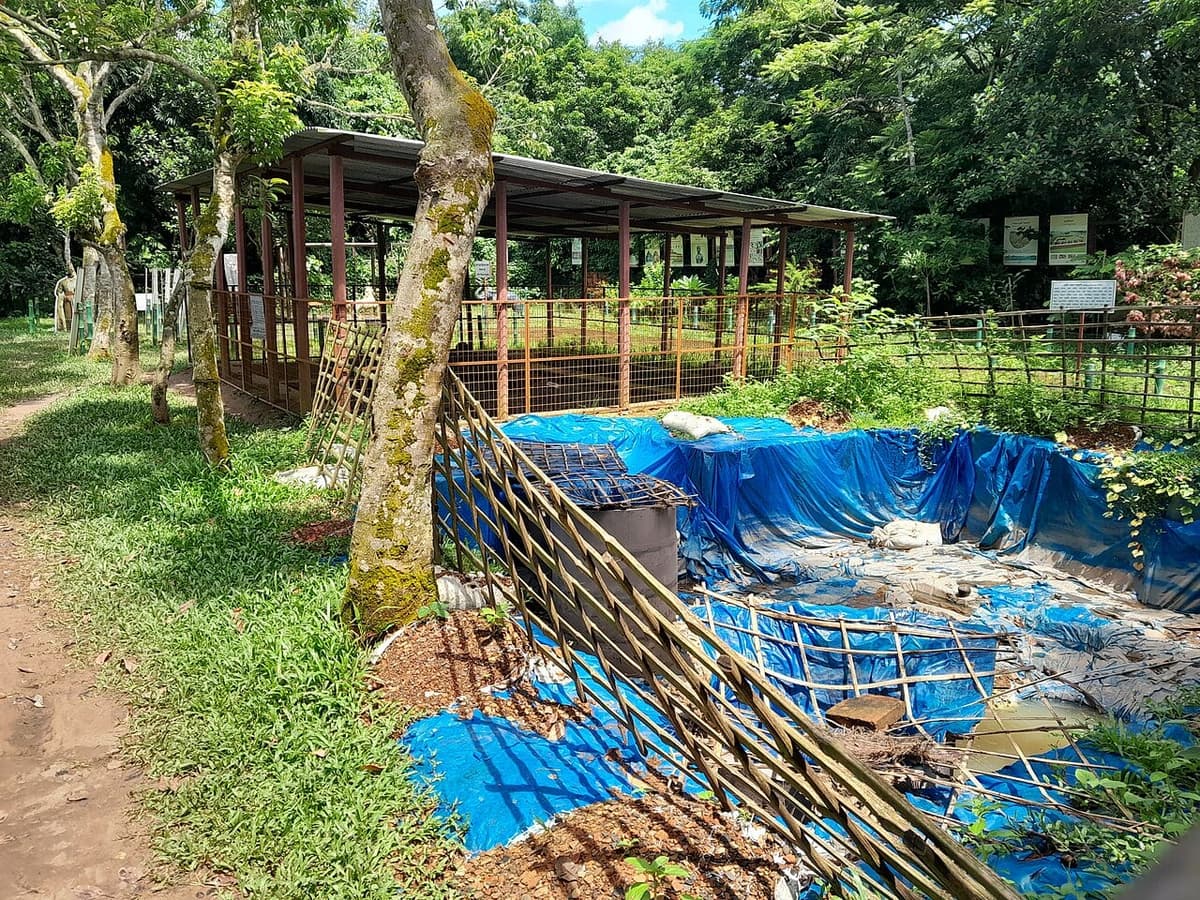
What was found there
What the diggers found points to craft and trade. The main Early Historic levels gave beads of semiprecious stone and glass, punch-marked coins, iron axes and knives, copper bangles, a copper dagger and knobbed vessels of high-tin bronze and of pottery; the pottery includes Northern Black Polished Ware, Rouletted Ware, Knobbed Ware and Black Slipped Ware.40 There are brick structures, rammed floors and streets paved with potsherds, and Banglapedia records a lime-surki road 160 m long with a 31 m side lane; a 2013 magazine report gives the road as 600 by 16 feet.41
The beads were made on the spot: raw stone, chips and flakes from bead-making turned up in excavation.42 The stones include agate, jasper, chalcedony, quartz, carnelian and amethyst, and Banglapedia says the raw materials were imported.43 The excavators link the Rouletted, Knobbed and Black Slipped wares with north and south India and with trade into South-east Asia.44 A town that imported stone and worked it into beads was a town that lived by exchange, and on this chapter's reading that is the strongest single piece of evidence for its argument.
People there ate mainly rice. Flotation of 16 soil samples in 2009, the first systematic study of ancient plant remains in Bangladesh, found that rice dominated, that it was of domesticated type, and that most of it was probably the subspecies japonica.45 Across Wari-Bateshwar and the later site of Vikrampura, studied together, the team also found barley, a possible oat, small numbers of pearl millet, sorghum and foxtail millet, 14 species of pulses, cotton, sesame and mustard.46
Traces both older and younger than the town have been found too. Neolithic celts and shouldered axes have been found in the area, of sandstone, siltstone and fossil wood that do not occur locally, but all are chance finds and no prehistoric settlement has been identified.47 A probable pit-dwelling below the Early Historic levels is interpreted by Sufi Mostafizur Rahman as an earlier, probably Chalcolithic, settlement, but it "remains undated".48 At the other end of time, a brick "Lotus Temple" at Mandirvita, excavated in 2009 to 2010, gave a charcoal date of 730 to 940 CE.49
How old is Wari-Bateshwar?
The firmest dates for the town are AMS radiocarbon results published with their laboratory numbers in a 2020 paper by Mizanur Rahman and colleagues: five results, four of which fall between 400 and 110 BCE (the fifth dates the much later Lotus Temple).50 The paper puts the Early Historic occupation "mainly between 400 and 100 BC".51 The older figures often seen in the press, 450 or 500 BCE, come from news reports, most of them about dated charcoal, and none of those reports gives a laboratory number that can be checked.52
| Lab number | Material | Radiocarbon age (BP) | Calibrated date |
|---|---|---|---|
| Beta-399412 | Rice grain | 2280 ± 30 | 400 to 230 BCE |
| Beta-401552 | Rice grain | 2290 ± 30 | 400 to 255 BCE |
| Beta-352965 | Charcoal, hearth | 2180 ± 30 | 360 to 170 BCE |
| Beta-352969 | Charcoal, structure | 2160 ± 30 | 350 to 110 BCE |
| Beta-352967 | Charcoal, Lotus Temple | 1190 ± 30 | 730 to 940 CE |
Source: Rahman et al. (2020), table 1. A sixth sample, of rice, failed.53
| Claim | Basis given | Where it appears |
|---|---|---|
| Main occupation c. 400 to 110 BCE ("mainly between 400 and 100 BC") | Published AMS dates with laboratory numbers (table above) | Rahman et al. (2020)54 |
| Habitation and industry "in 500 BC" | Charcoal said to be dated at the Centrum voor Isotopen Onderzoek; no laboratory number published | Daily Star news report, 200855 |
| "450 BC" | Charcoal (2010, 2013 reports) or no basis stated (2008); no laboratory number published | Daily Star, 2008 and 2010; Archaeology magazine, 201356 |
| c. 600 to 400 BCE | Typology of pre-Mauryan punch-marked coins, not a direct date | Banglapedia; Daily Star, 200857 |
| "2,500 year old fort-city" | Not stated | Banglapedia58 |
| Earlier Chalcolithic phase, speculated to be 2nd millennium BCE | Pit-dwelling; undated | Rahman et al. (2020), citing Rayhan (2011)59 |
Source: Compiled from the sources in the notes.60
Mahasthangarh: Pundranagara on the Karatoya
Mahasthangarh, on the west bank of the Karatoya north of Bogura, is the ruin of Pundranagara, and Banglapedia calls it the earliest and largest archaeological site in Bangladesh.67 Banglapedia puts it 13 km north of Bogura town; UNESCO gives about 12 km north of the district headquarters.68 Its brick-walled city measures about 1,500 m from north to south and 1,400 m from east to west, with ramparts averaging 6 m above the river.69 UNESCO's figures are 1.52 km by 1.37 km.70
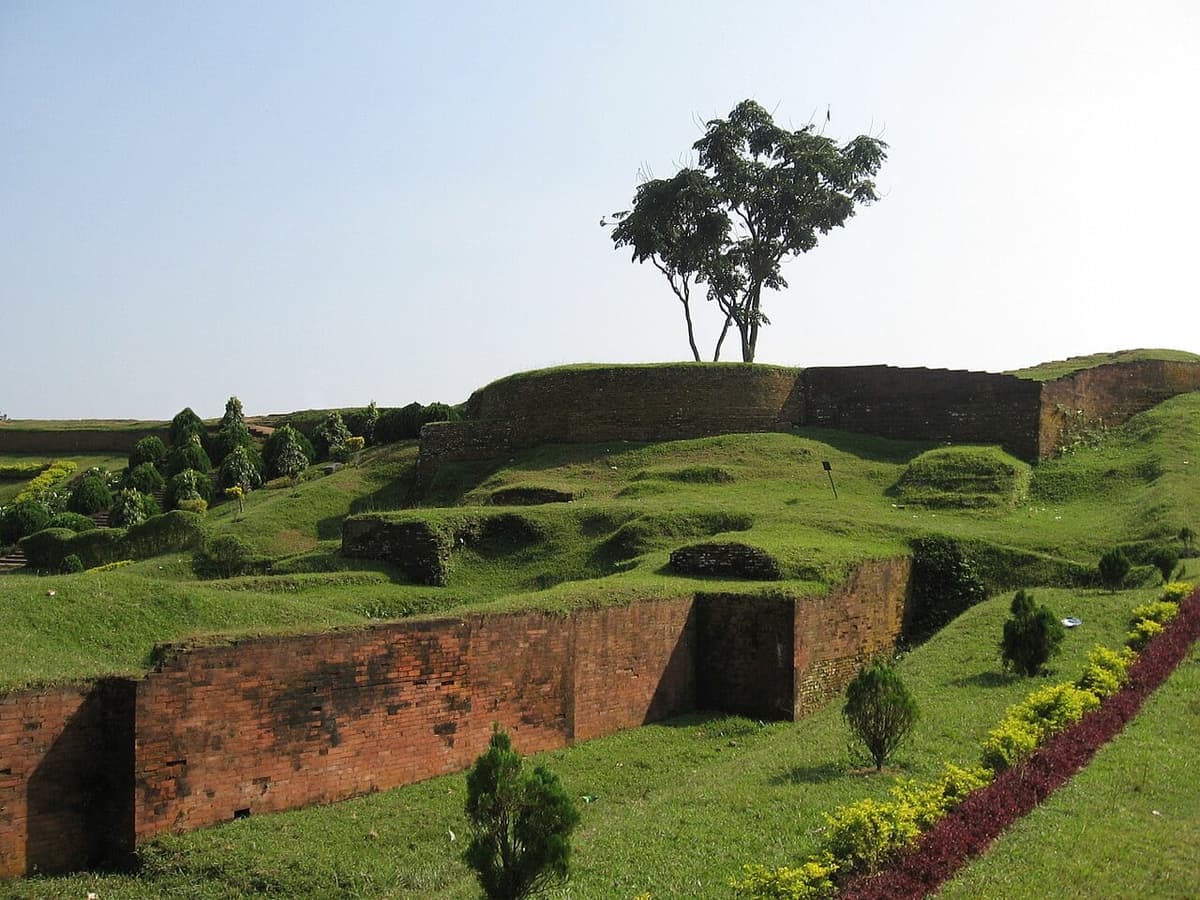
The place has been studied for almost 150 years. Alexander Cunningham identified the ruins as Pundranagara in 1879, and the Archaeological Survey of India under K. N. Dikshit made the first regular excavation in 1928 to 1929.72 Work resumed in the early 1960s and again in 1988 to 1991.73 Under a 1992 agreement between the governments of Bangladesh and France, a joint mission began digging near the middle of the eastern rampart in early 1993; it has recorded 18 building levels and reached virgin soil at several points.74 Its 33rd season, from mid-November to mid-December 2025, worked at five places at Bairagir Bhita under Colin Lefranc and A K M Saifur Rahman and found eight wells, one of them brick-lined and dated to the 7th or 8th century.75
The joint mission's results give Mahasthangarh a sequence of seven periods, from pre-Mauryan to Muslim, with radiocarbon dates for some of them.76 The earliest settlement lies on the Pleistocene surface and has no precise date, but radiocarbon dates from its upper level reach the late 4th century BCE.77
| Period | Phase | Calibrated radiocarbon ranges given |
|---|---|---|
| I | Pre-Mauryan | None for the earliest settlement; some dates from the upper level go back to the late 4th century BCE |
| II | Mauryan | 366 to 162 BCE; 371 to 173 BCE |
| III | Post-Mauryan (Shunga and Kushana) | 197 to 46 BCE; 60 BCE to 172 CE; 40 BCE to 122 CE |
| IV | Kushana and Gupta | None given |
| V | Gupta and late Gupta | Between 361 and 594 CE |
| VI | Pala | None given |
| VII | Muslim | None given |
Source: Shafiqul Alam, "Mahasthan", Banglapedia, from the French and Bangladeshi excavations. Banglapedia gives no laboratory numbers; the primary report (Alam and Salles, 2001) was not consulted for this guide.78
The Mauryan level, Period II, produced what Banglapedia calls the earliest known roof tiles, along with Northern Black Polished Ware, a bronze mirror, cast copper coins, terracotta plaques and beads of semiprecious stone.79 In 1996 to 1997, 93 silver punch-marked coins were recovered in systematic excavation, and 24 more, ploughed up at Yogir Bhita in 1988, are in the Varendra Research Museum in Rajshahi.80 Gold coins of the Kushana king Kanishka I, and one attributed to Vasudeva II, have been reported from Mahasthangarh, as have Brahmi and Brahmi-Kharosthi inscriptions of the 1st century CE.81
Just outside the northern rampart, the mound of Govinda Bhita shows how long the site was in use. Its deep trench gave Mauryan punch-marked coins, Shunga terracotta plaques of the 2nd to 1st century BCE and a 4th-century CE terracotta head of a Bodhisattva; its earliest eastern temple is a late-Gupta square shrine, and its western temple was probably built in the 6th century.82 About 6 km to the west, the monastery of Bhasu Vihara has excavated levels of the 10th to 11th century only, so Cunningham's identification of it with the monastery where the 7th-century pilgrim Xuanzang saw 700 monks "is by no means archaeologically evident yet".83
On 17 May 2023 Bangladesh placed the "Cultural Landscape of Mahasthan and Karatoya River" on its UNESCO World Heritage Tentative List.87 Wari-Bateshwar is not among the country's seven tentative entries.88
Vanga, Pundra, Samatata: the names of ancient Bengal
The early texts know this land as a set of regions, each with its own name.89 Banglapedia describes Vanga, Pundra, Radha and Gauda as janapadas known from later Vedic literature as lands outside the Aryan world, and notes that Samatata is a descriptive name, not the name of a people.90
| Region | Rough location | Earliest mention (as given) |
|---|---|---|
| Pundra, later Pundravardhana | North Bengal, around Mahasthan | Aitareya Brahmana (Banglapedia: c. 8th century BCE)91 |
| Vanga | The delta of south and east Bengal | Aitareya Aranyaka; as a territory, Kautilya's Arthashastra92 |
| Suhma | Generally placed in south-west Bengal | Patanjali, 2nd century BCE93 |
| Gauda | Near the sea, according to the Haraha inscription | Arthashastra; first inscription, Haraha, 554 CE94 |
| Samatata | The Cumilla and Noakhali plain east of the Meghna and the hills of Tripura | Samudragupta's Allahabad pillar inscription, 4th century CE95 |
| Harikela | The Chattogram area, on later evidence | 7th-century writers96 |
Source: Banglapedia entries on each region.97
The Aitareya Brahmana, which Banglapedia dates to about the 8th century BCE, groups the Pundras with the Andhras, Shabaras, Pulindas and Mutibas.98 Vanga first appears as a people in the Aitareya Aranyaka, and the Baudhayana Dharmasutra places the Vangas beyond the Aryan zone, near Kalinga.99 Later texts present Vanga as a land open to the sea: the Milindapanho, of about the 1st to 2nd century CE, lists it among places where ships gathered to trade.100 The poet Kalidasa, whose date Banglapedia gives in one entry as the 4th to 5th century CE and in another as anywhere from the 1st century BCE to the 4th century CE, describes the Vangas as a people skilled with boats.101
Harikela, the name later attached to the Chattogram coast, belongs mostly to the next chapter. The 7th-century Chinese pilgrim I-tsing called it "the eastern limit of eastern India", and its location rests mainly on inscriptions and coins of the 9th century and after.102
Gangaridai: Bengal in Greek and Latin writers
When Greek writers turned to the people of the lower Ganges, what they wrote about was armies. In the late 4th century BCE Alexander of Macedon's campaign in India stopped short of the Ganges, and his historians explained why: beyond the river, they said, lay the Gangaridai and the Prasii, with vast numbers of soldiers and elephants.103
The Greek writer Megasthenes wrote an Indika that is lost; it is known only through later writers such as Diodorus and Pliny who quoted or summarised it.104 Diodorus, drawing on Megasthenes, says the Ganges empties into the ocean "forming the eastern boundary of the Gangaridai, a nation which possesses a vast force of the largest-sized elephants", and that Alexander gave up invading them when he learned they had 4,000 trained war elephants.105
The numbers change with every telling. Diodorus and Curtius give the combined kingdom of the Gangaridai and Prasii 200,000 infantry and 20,000 cavalry, with 4,000 or 3,000 elephants; Plutarch raises the cavalry to 80,000 and the elephants to 6,000.106 Pliny's figures, for the "Gangarides Calingae" alone, are 60,000 foot soldiers, 1,000 horse and 700 elephants.107 The authors do not even agree on what happened: Justin says Alexander conquered the Gangaridae, while Diodorus and Plutarch say he never crossed the Ganges.108
| Author | Infantry | Cavalry | Chariots | Elephants |
|---|---|---|---|---|
| Diodorus II.37 (from Megasthenes) | 4,000 | |||
| Diodorus XVII.93 | 200,000 | 20,000 | 2,000 | 4,000 |
| Curtius IX.2 | 200,000 | 20,000 | 2,000 (four-horse) | 3,000 |
| Plutarch, Alexander 62 | 200,000 | 80,000 | 8,000 | 6,000 |
| Pliny VI.22 (Gangarides Calingae only) | 60,000 | 1,000 | 700 |
Source: McCrindle's translations of Diodorus, Curtius and Plutarch; Pliny in the Bostock and Riley translation.109
Show the numbers
| Year | Elephants |
|---|---|
| Diodorus II.37 | 4,000 |
| Diodorus XVII.93 | 4,000 |
| Curtius IX.2 | 3,000 |
| Plutarch 62 | 6,000 |
| Pliny VI.22 | 700 |
Source: McCrindle's translations; Pliny, Natural History VI.22. Pliny's figure is for the Gangarides Calingae only.110
The king of this alliance is named Xandrames by Diodorus and Agrammes by Curtius, and the translator J. W. McCrindle identified him with the last Nanda king of Magadha.111 If he was right, the army was that of Magadha, and the Gangaridai were its allies or subjects; that is an inference, not something the texts say. The Roman poet Virgil, writing in about 30 BCE by Banglapedia's dating, promised to show "the battle of the Gangaridae" in gold and ivory on temple doors.112
Ptolemy, writing in the 2nd century CE, is the most precise: "All the country about the mouths of the Ganges is occupied by the Gangaridai with this city: Gange, the Royal residence."113 He names five mouths of the Ganges and lists an inland town, Souanagoura, which the scholar Saint-Martin, as reported by McCrindle, identified with Suvarnagrama, or Sonargaon.114
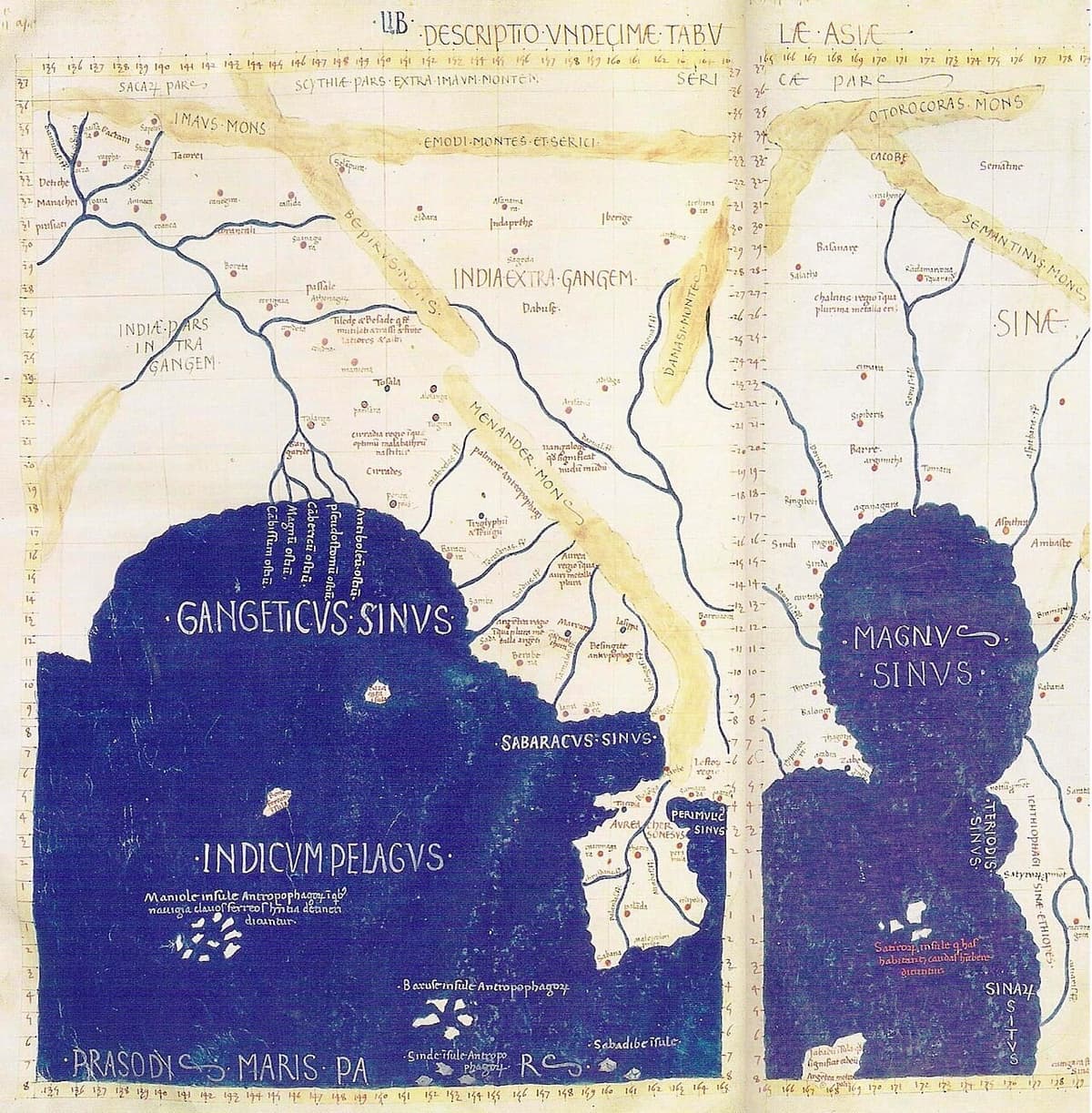
Muslins, pearls and the Periplus: early trade
If the armies are uncertain, the trade is not. The Periplus of the Erythraean Sea, an anonymous Greek merchant's guide of about the middle of the 1st century CE, describes a market town near the Ganges, called Ganges like the river, through which, in Schoff's translation, "are brought malabathrum and Gangetic spikenard and pearls, and muslins of the finest sorts, which are called Gangetic".118 The same text says that silk from China reached south India "by way of the river Ganges".119 The Arthashastra, ascribed to Kautilya, minister of Chandragupta Maurya, though some scholars date its present form three or four centuries later, names Vanga as a source of the finest white, soft cotton fabric, svetam snigdham dukulam.120 The chapter on Dhaka muslin and jamdani follows that cloth into later centuries.
Where Gange stood is unknown. Banglapedia says Chandraketugarh, in West Bengal's North 24 Parganas, may be the Gange of the Periplus and Ptolemy, where layers of about the first three centuries CE gave Rouletted Ware and sherds of amphorae (storage jars); but it adds that the site "still remains to be definitely identified".121 James Wise proposed Kotalipara for the Gangaridai capital, and older suggestions placed it near Diamond Harbour or at the meeting of the Ganges and Brahmaputra.122 No candidate has won agreement.123
Tamralipti, modern Tamluk, was another early port: during his journey of 399 to 414 CE, the Chinese pilgrim Faxian spent two years there and then sailed from it to Sri Lanka.124 Banglapedia identifies it with the Tamalites that Ptolemy lists on the Ganges, and its excavated Period II, of the 3rd to 2nd century BCE, gave Northern Black Polished Ware, beads and punch-marked and cast copper coins.125
Money in ancient Bengal
Coins tell the same story from the ground. The punch-marked coins are small silver pieces stamped with symbols; as many as 172 different symbols are recorded on those from Bengal.126 At Wari-Bateshwar there are two kinds: older "Janapada" coins, which Banglapedia says circulated in the subcontinent in about 600 to 400 BCE, and coins of the Maurya imperial series.127 A third type, half-karshapanas carrying four symbols including a boat, a lobster, a fish and a snail, has been called "Vanga" coinage; when Banglapedia's entry was written it had been found nowhere but Wari-Bateshwar, and only by chance digging.128
| Type | Symbols | Find spots | Weight (g) | Size (mm) |
|---|---|---|---|---|
| Imperial (Mauryan) karshapana | 5 | Mahasthangarh, Wari-Bateshwar, Rajshahi, Mymensingh | 3.4 to 3.5 (half: 1.6 to 1.7) | 16 to 20 |
| Anga | 3, including a ship | Bangarh, Hari Narayanpur, Chandraketugarh | 3.3 to 3.7 (quarter: 0.8 to 0.9) | Not given |
| "Vanga" half-karshapana | 4, including a boat and a lobster | Wari-Bateshwar (chance finds) | 1.7 to 1.9 | 15 to 20 |
Source: Rezaul Karim, "Punch Marked Coins", Banglapedia.129
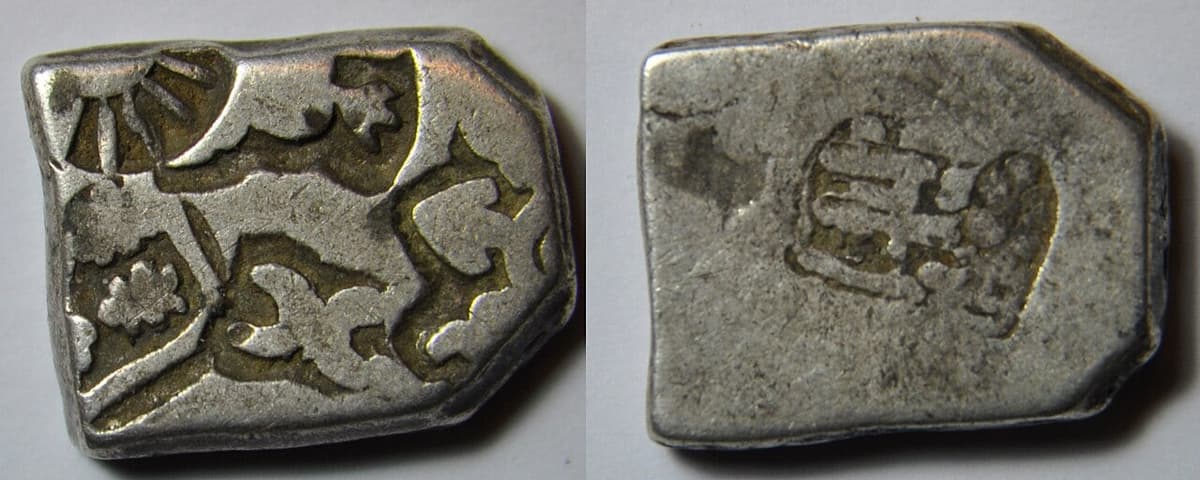
Banglapedia thinks the Mauryan coins at Wari-Bateshwar probably arrived by trade, "because no evidence of Mauryan rule over that area has yet been ascertained".131 Later money shows the same openness to outside systems. Cast copper coins appear in the 2nd to 1st century BCE on stratified evidence, and from about the 1st century BCE or CE to about the 4th century CE local copper imitations of Kushana coins, termed "Kusana-Vanga" and "Kusana-Radha", circulated in parts of Bengal.132 Underneath it all, cowrie shells served as Bengal's base currency "at least from the third century BC", in Banglapedia's words.133
Was Bengal part of the Maurya and Gupta empires?
Parts of it were, but the evidence for the Mauryas is slight, and most of the evidence for the Guptas comes from north Bengal. For the Mauryas the evidence is the Mahasthan inscription, which Banglapedia reads as evidence of Maurya rule in parts of Bengal in the 3rd century BCE, and the Mauryan levels at Mahasthangarh; Banglapedia's entry on Ashoka states that Pundravardhana was a Maurya province or administrative unit.134 There is no such evidence for Wari-Bateshwar.135 Banglapedia also notes an "extreme paucity" of Mauryan terracottas in Bangladesh: Mahasthan has given only two female figurines placed in the period on grounds of style.136
Gupta rule is better recorded. It probably reached Bengal under Chandragupta I or Samudragupta, and by the mid-4th century all of Bengal except Samatata was in the empire.137 Samudragupta's own inscription on the Allahabad pillar lists "the frontier kings of Samatata, Davaka, Kamarupa, Nepala, Kartripura", who paid taxes, obeyed orders and came to do obeisance.138 An inscription on Susunia hill, in Bankura in West Bengal, names a Maharaja Chandravarman of Pushkarana, usually identified with the Chandravarman whom Samudragupta claims to have uprooted.139 The iron pillar at Meherauli, near Delhi, praises a king "Chandra" who defeated a united resistance "in the Vanga countries"; whether he was Chandragupta I or Chandragupta II is unresolved.140
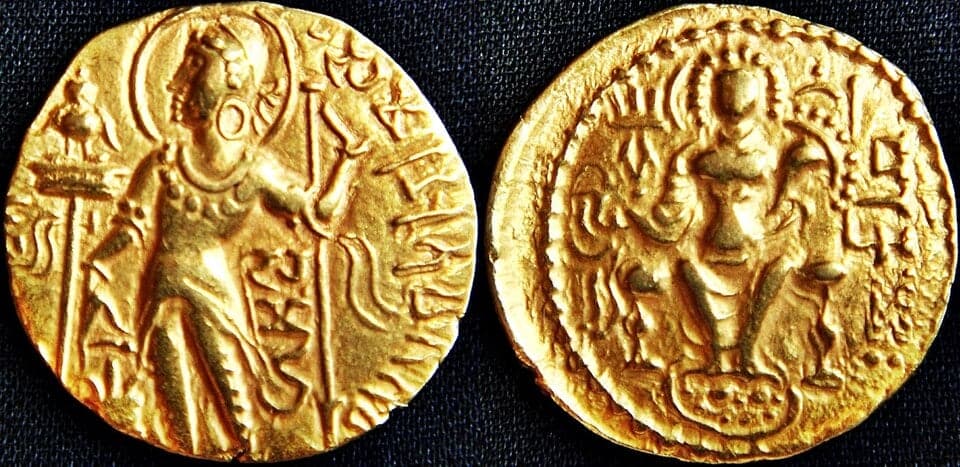
The fullest Gupta evidence is a set of copper plates from north Bengal. Under the Guptas, Pundravardhana was a bhukti, a province governed by an Uparika appointed by the emperor, and nine Gupta-period inscriptions from north Bengal show it divided into smaller units called visayas, vithis and mandalas.142 One plate of the time of Budhagupta names the Himalayas as its northern limit.143 The earliest Gupta copper plate found in Bangladesh, from Dhanaidaha in Rajshahi, is dated in Gupta year 113.144
| Inscription | Ruler named | Gupta era year | CE |
|---|---|---|---|
| Dhanaidaha (Rajshahi) | Kumaragupta I period | 113 | Not given |
| Damodarpur (Dinajpur), earliest | 128 | 448145 | |
| Baigram (Bogura) | 128 | 448146 | |
| Paharpur (Naogaon) | Budhagupta | 159 | 479147 |
| Gunaighar (Cumilla) | Vainyagupta | 188 (current) | 13 December 506 (Bhattacharyya) or 507 (Banglapedia)148 |
| Damodarpur, latest | 224 | 544149 | |
| Haraha (Uttar Pradesh), mentions the Gaudas | Ishanavarman (Maukhari) | 554150 |
Source: Banglapedia; Bhattacharyya (1930). Banglapedia's printed CE equivalent for the Dhanaidaha plate is garbled and is omitted.151
The plates show who mattered in a Gupta district town, and the answer supports the argument of this chapter. At Kotivarsa, a visaya of Pundravardhana named in Damodarpur plates of Gupta years 128 to 224 (448 to 544 CE), the head of the district was advised by a board of four: the president of the guilds (nagara-shreshthi), the chief merchant (prathama-sarthavaha), the chief artisan (prathama-kulika) and the chief scribe (prathama-kayastha).152 Three of the four represented trade and craft.
Gupta Bengal's coinage was mainly gold. From the Baigram plate and a Damodarpur plate of the same year, Gupta year 128, scholars have worked out gold-to-silver ratios of 1:16 and 1:15.153 Imperial Gupta gold coins are found in large numbers in Bengal, silver is rare, and no Gupta copper coins have been found there; gold pieces of Chandragupta II and Skandagupta have come from the Sonakandi fields at Kotalipara.154
Vainyagupta and the Gunaighar plate
A few years before 1930 a villager clearing a tank at Gunaighar, about 18 miles north-west of Comilla, found a copper plate dated in Gupta year 188; its first editor, writing in 1930, said it had been found "about five years ago".155 That editor, Dinesh Chandra Bhattacharyya, converted the date to 13 December 506 CE; Banglapedia gives 507 CE in one entry and 507 to 508 in another.156 The plate records a grant of land by Maharaja Vainyagupta, made from his victory camp at Kripura at the request of his vassal Maharaja Rudradatta, to a community of Mahayana Buddhist monks in a monastery dedicated to Avalokiteshvara that was then being built.157
Vainyagupta's own position is debated. Bhattacharyya thought him a Shaiva, from the bull on his seal, and not directly connected to the imperial Guptas.158 Banglapedia notes that he is styled Maharaja in this plate, Dvadashaditya on a gold coin and Maharajadhiraja on a seal from Nalanda.159 Whatever his status, the plate shows a ruler in eastern Bengal granting land at a vassal's request, with Mahasamanta Maharaja Vijayasena as his royal messenger.160
Faith before 600 CE: Jains, Buddhists and Brahmanical kings
Before 600 CE the three great Indian traditions all had a place in Bengal, and the surviving records show them side by side. Jain tradition, in the Bodhisattvavadanakalpalata, makes Bhadrabahu, compiler of the Kalpasutra, a native of Pundravardhana, and later Jain sub-sects took the names Tamraliptikiya, Kotivarsiya and Pundravardhaniya from Bengali places.161 A copper plate from Paharpur, dated Gupta year 159 (479 CE) in the reign of Budhagupta, records a Jain monastery at Vatagohali.162 Cunningham found a Jain image at Mahasthangarh in 1879.163
The Chinese monk Faxian left China in 399 and returned in 414. On the way he reached Tamralipti, stayed two years copying sutras and drawing images, and then sailed for Sri Lanka.164 In James Legge's translation he records "twenty-two monasteries, at all of which there are monks residing"; Banglapedia gives the number as 24.165
The Gunaighar plate shows how these faiths could mix. Bhattacharyya called it "probably the earliest epigraphic record of a Brahmanic king making a gift of land to a Buddhist monastery".166 In art, Shunga-period terracotta figurines of the 2nd to 1st century BCE have been found at Mahasthan, all of them female, and about thirty Gupta-period terracotta figurines are known from Bangladesh.167 The great Buddhist monasteries of Bengal, such as Somapura at Paharpur, belong to the next chapter.
Vanga's own kings and the end of ancient Bengal
In the first half of the 6th century southern and eastern Bengal became an independent kingdom of Vanga, ruled by local kings.168 Three of them are known from copper plates: Gopachandra (c. 540), Dharmaditya (c. 570) and Samacharadeva (c. end of the 6th century).169 They used titles such as Maharajadhiraja, and their administration was centred at Kotalipara in Gopalganj.170 Banglapedia places Gopachandra "not later than the second quarter of the sixth century" and records his plates from Kotalipara, Mallasarul in Burdwan and Jayrampur in Balasore.171
The plates are a picture of a delta kingdom. They describe the land as navyavakashika, "newly formed land", and use terms for river traffic and boats: naudandaka, navatakseni, nauyana and naughata.172 The ruined fort at Kotalipara, known as Chandravarmankot, covered about 19 square km.173 Samacharadeva struck gold coins on the suvarna standard of 144 grains, but in debased gold.174
Meanwhile another region was coming into view. The Haraha inscription of the Maukhari king Ishanavarman, dated 554 CE, says he defeated the Gaudas "who live near the sea", their first mention in an inscription.175 By the end of the century Gauda was rising under Shashanka, and that is where the story of the kingdoms of Bengal begins.176 The rulers of every later period are listed in the rulers of Bengal.
- c. 8th century BCEThe Pundras are named in the Aitareya Brahmana (Banglapedia's date for the text).177
- c. 600 to 400 BCECirculation period Banglapedia gives for the pre-Mauryan punch-marked coins found at Wari-Bateshwar.178
- c. 400 to 110 BCERange of the published AMS radiocarbon dates from Early Historic Wari-Bateshwar.179
- Late 4th century BCEEarliest radiocarbon dates from Mahasthangarh; Alexander's campaign in India, whose later historians report the Gangaridai and Prasii beyond the Ganges.180
- 4th or 3rd century BCEThe Mahasthan Brahmi inscription, the earliest inscription from Bengal.181
- 2nd century BCEPatanjali mentions Suhma with Vanga and Pundranagara.182
- Mid-1st century CEThe Periplus describes the market town of Gange and its "Gangetic" muslins.183
- 2nd century CEPtolemy's Geography places the Gangaridai and their royal city, Gange, at the mouths of the Ganges.184
- Mid-4th century CESamudragupta's Allahabad inscription names Samatata as a frontier kingdom; most of Bengal is in the Gupta empire.185
- 399 to 414 CEFaxian's journey; he spends two years at Tamralipti.186
- 448 CEDamodarpur and Baigram copper plates, Gupta year 128.187
- 479 CEPaharpur plate records a Jain monastery at Vatagohali.188
- 506 or 507 CEGunaighar plate of Vainyagupta grants land to a Mahayana monastery.189
- c. 540 CEGopachandra, the first known independent king of Vanga.190
- 554 CEHaraha inscription records Ishanavarman's defeat of the Gaudas.191
- c. end of the 6th centurySamacharadeva rules Vanga; Gauda rises under Shashanka.192
- 1879Cunningham identifies Mahasthan as Pundranagara.193
- 30 November 1931Baru Fakir finds the Mahasthan inscription.194
- 1993French and Bangladeshi joint excavation begins at Mahasthangarh.195
- 2000Regular excavation begins at Wari-Bateshwar.196
- 2020First AMS dates and plant remains from Wari-Bateshwar published.197
- 17 May 2023The Mahasthan and Karatoya River site placed on UNESCO's Tentative List.198
Put together, the evidence for Bengal before 600 CE is thin but consistent. The firmest facts are not kings or battles. They are rice grains dated to the 4th or 3rd century BCE, bead workshops using imported stone, Mauryan coins that probably arrived by trade, an order to relieve distress, apparently famine, sent to a provincial official, and copper plates in which merchants and artisans sit on a district board.199 The Gangaridai of the Greeks may one day be tied to a site on the ground; until then, the evidence suggests that ancient Bengal's importance came from its rivers and its trade, and that its first great kingdoms belong to the centuries that followed.
Further reading
Dilip K. Chakrabarti's Ancient Bangladesh (1992) is the standard survey of the archaeological evidence for ancient Bangladesh, and the first volume of The History of Bengal edited by R. C. Majumdar (1943) is the classic multi-author political and cultural history of pre-Muslim Bengal.200 Niharranjan Ray's History of the Bengali People (1994), the English version of Bangalir Itihas: Adiparva, is a social and cultural history of ancient Bengal.201 Barrie M. Morrison's Political Centers and Cultural Regions in Early Bengal (1970) uses copper-plate evidence to map political centres and regions.202 For the newest scientific evidence, read the open-access paper by Mizanur Rahman and colleagues on Wari-Bateshwar (2020); for the Periplus, Lionel Casson's critical edition and commentary (1989).203
Questions students and journalists ask
Where is Wari-Bateshwar, and how old is it?
Wari-Bateshwar is in Narsingdi district, on a former channel of the Old Brahmaputra. The firmest dates, AMS radiocarbon results published with their laboratory numbers in 2020, place its main Early Historic occupation at about 400 to 110 BCE. Figures of 450 or 500 BCE appear in news reports, but those reports give no laboratory numbers that can be checked. An earlier, possibly Chalcolithic, phase has been suggested but is undated.
What is the history of Mahasthangarh?
Mahasthangarh, north of Bogura, is the ruin of Pundranagara, an ancient city of north Bengal. Its earliest settlement has no precise date, but radiocarbon dates from the upper part of that first period reach the late 4th century BCE, and the site was occupied through the Maurya, Gupta and Pala periods into the Sultanate. Cunningham identified it in 1879, a French and Bangladeshi team has dug there since 1993, and it was placed on UNESCO's Tentative List in 2023.
What does the Mahasthan Brahmi inscription say?
In its first editor's reading, it is an order to a senior official at Pundranagara to relieve people in distress, apparently from famine, with an advance of coins and a distribution of paddy, to be repaid to the granary and treasury when plenty returned. Found in 1931, it is the earliest inscription from Bengal. Its date is given as the 4th century BCE, about the 3rd century BCE, or the time of Ashoka.
What was the Gangaridai kingdom, and who was its king?
The Gangaridai were a people at the mouths of the Ganges named by Greek and Latin writers. Alexander's historians say they and the Prasii had huge armies, though the numbers differ by author. Diodorus calls their king Xandrames and Curtius calls him Agrammes; the translator McCrindle identified him with the last Nanda king of Magadha. No local source confirms a powerful Gangaridai kingdom in Bengal.
What was the capital of the Vanga kingdom?
In the early texts Vanga appears first as a people and then as a region of the delta. When an independent kingdom of Vanga appears in the 6th century CE, under kings such as Gopachandra, Dharmaditya and Samacharadeva, its centre of administration was Kotalipara in present-day Gopalganj, the site of a large ruined fort.
What was Pundravardhana bhukti?
Pundravardhana was the old land of the Pundras in north Bengal, around Mahasthan. Under the Gupta empire it became a bhukti, or province, governed by an official called an Uparika appointed by the emperor. Gupta-period copper plates show it divided into smaller units called visayas, vithis and mandalas, and one plate names the Himalayas as its northern limit.
Where was Samatata?
Samatata was the region east of the Meghna river: the plain of present-day Cumilla and Noakhali and the neighbouring hills of Tripura, from the Sylhet border to the sea. Its name describes the country, not a people. It is first named in Samudragupta's Allahabad pillar inscription of the 4th century CE as a frontier kingdom whose kings paid taxes to Samudragupta and obeyed his orders.
Where was Harikela?
Harikela was a region of eastern Bengal first named by writers of the 7th century CE; the Chinese pilgrim I-tsing called it the eastern limit of eastern India. Its location in the Chattogram area rests mainly on inscriptions and coins of the 9th century and later, so Harikela and its coins belong mostly to the period after ancient Bengal.
What is the oldest archaeological site in Bangladesh?
Among towns, the two with the earliest dates are Wari-Bateshwar and Mahasthangarh. Wari-Bateshwar has published AMS dates from about 400 BCE, and Mahasthangarh has radiocarbon dates reaching the late 4th century BCE; Banglapedia calls Mahasthangarh the earliest and largest archaeological site in Bangladesh. Older stone tools from the Lalmai hills and Habiganj show people were present earlier, but no prehistoric settlement has been dated.
Was Bengal part of the Mauryan empire?
Parts of it were. The Mahasthan inscription, an order to an official at Pundranagara, is read as evidence of Maurya rule in parts of Bengal, and Mahasthangarh has Mauryan building levels. Banglapedia describes Pundravardhana as a Maurya province or administrative unit. There is no evidence of Maurya rule at Wari-Bateshwar, where Mauryan coins probably arrived through trade.
Notes
- Mizanur Rahman et al., "Agricultural Systems in Bangladesh: The First Archaeobotanical Results from Early Historic Wari-Bateshwar and Early Medieval Vikrampura," Archaeological and Anthropological Sciences 12, no. 1 (2020): abstract, table 1, https://doi.org/10.1007/s12520-019-00991-5; Shafiqul Alam, "Mahasthan," Banglapedia: National Encyclopedia of Bangladesh, 2nd ed. (2012), online edition. Dhaka: Asiatic Society of Bangladesh, accessed 22 November 2026, https://en.banglapedia.org/index.php/Mahasthan. ↩
- D. R. Bhandarkar, "Mauryan Brahmi Inscription of Mahasthan," Epigraphia Indica 21 (1931-32): 83, 87, https://archive.org/details/in.ernet.dli.2015.56981; Sarita Khettry, "Mahasthan Brahmi Inscription," Banglapedia: National Encyclopedia of Bangladesh, 2nd ed. (2012), online edition. Dhaka: Asiatic Society of Bangladesh, accessed 22 November 2026, https://en.banglapedia.org/index.php/Mahasthan_Brahmi_Inscription; J. W. McCrindle, Ancient India as Described by Ptolemy, Translation (Calcutta: Thacker, Spink; London: Trübner, 1885), 173, https://archive.org/details/ancientindiaasd00mccrgoog. ↩
- Aksadul Alam, "Gupta Rule," Banglapedia: National Encyclopedia of Bangladesh, 2nd ed. (2012), online edition. Dhaka: Asiatic Society of Bangladesh, accessed 22 November 2026, https://en.banglapedia.org/index.php/Gupta_Rule; A. M. Chowdhury, "History," Banglapedia: National Encyclopedia of Bangladesh, Section "Ancient Period". 2nd ed. (2012), online edition. Dhaka: Asiatic Society of Bangladesh, accessed 22 November 2026, https://en.banglapedia.org/index.php/History. ↩
- Rahman et al., "Agricultural Systems in Bangladesh", table 1. ↩
- Bhandarkar, "Mauryan Brahmi Inscription of", 83; Khettry, "Mahasthan Brahmi Inscription". ↩
- Alam, "Mahasthan". ↩
- Alam, "Mahasthan". ↩
- Dinesh Chandra Bhattacharyya, "A Newly Discovered Copperplate from Tippera [The Gunaighar Grant of Vainyagupta: The Year 188 Current (Gupta Era)]," Indian Historical Quarterly 6, no. 1 (1930): 48, https://buddhism.lib.ntu.edu.tw/FULLTEXT/JR-ENG/bhanew.htm; Sharif Ahmed, "Inscriptions," Banglapedia: National Encyclopedia of Bangladesh, Pre-Muslim section. 2nd ed. (2012), online edition. Dhaka: Asiatic Society of Bangladesh, accessed 22 November 2026, https://en.banglapedia.org/index.php/Inscriptions. ↩
- UNESCO World Heritage Centre, "Cultural Landscape of Mahasthan and Karatoya River," World Heritage Convention, Tentative Lists, Ref. 6671, submitted 17 May 2023 by the Permanent Delegation of Bangladesh to UNESCO, 2023, https://whc.unesco.org/en/tentativelists/6671/. ↩
- Rahman et al., "Agricultural Systems in Bangladesh"; Bhandarkar, "Mauryan Brahmi Inscription of"; Bhattacharyya, "A Newly Discovered Copperplate"; Alam, "Mahasthan"; UNESCO World Heritage Centre, "Cultural Landscape of Mahasthan". ↩
- Bhandarkar, "Mauryan Brahmi Inscription of", 83. ↩
- Bhandarkar, "Mauryan Brahmi Inscription of", 83. ↩
- Bhandarkar, "Mauryan Brahmi Inscription of", 83-84. ↩
- Bhandarkar, "Mauryan Brahmi Inscription of", 84-87. ↩
- Bhandarkar, "Mauryan Brahmi Inscription of", 84-87. ↩
- Khettry, "Mahasthan Brahmi Inscription". ↩
- Bhandarkar, "Mauryan Brahmi Inscription of", 88; Khettry, "Mahasthan Brahmi Inscription". ↩
- Bhandarkar, "Mauryan Brahmi Inscription of", 87-88. ↩
- Bhandarkar, "Mauryan Brahmi Inscription of", 88. ↩
- Khettry, "Mahasthan Brahmi Inscription". ↩
- UNESCO World Heritage Centre, "Cultural Landscape of Mahasthan"; Sirajul Islam, "Ashoka," Banglapedia: National Encyclopedia of Bangladesh, 2nd ed. (2012), online edition. Dhaka: Asiatic Society of Bangladesh, accessed 22 November 2026, https://en.banglapedia.org/index.php/Ashoka. ↩
- Bhandarkar, "Mauryan Brahmi Inscription of", 84-88; Khettry, "Mahasthan Brahmi Inscription"; UNESCO World Heritage Centre, "Cultural Landscape of Mahasthan". ↩
- Bhandarkar, "Mauryan Brahmi Inscription of", 85. ↩
- Syed Mohammad Kamrul Ahsan, "Prehistory," Banglapedia: National Encyclopedia of Bangladesh, 2nd ed. (2012), online edition. Dhaka: Asiatic Society of Bangladesh, accessed 22 November 2026, https://en.banglapedia.org/index.php/Prehistory; Rahman et al., "Agricultural Systems in Bangladesh", 2. ↩
- Ahsan, "Prehistory". ↩
- Ahsan, "Prehistory". ↩
- Ahsan, "Prehistory". ↩
- Ahsan, "Prehistory". ↩
- M. M. Hoque, "Lalmai," Banglapedia: National Encyclopedia of Bangladesh, 2nd ed. (2012), online edition. Dhaka: Asiatic Society of Bangladesh, accessed 22 November 2026, https://en.banglapedia.org/index.php/Lalmai. ↩
- Rahman et al., "Agricultural Systems in Bangladesh", 2. ↩
- Chowdhury, "History". ↩
- Rahman et al., "Agricultural Systems in Bangladesh", 3. ↩
- Reema Islam, "A Family's Passion," Archaeology, November/December 2013, https://archaeology.org/issues/november-december-2013/letters-from/wari-bateshwar-ptolemy-sounagoura-indo-pacific-beads/; Emran Hossain, "Wari-Bateshwar One of Earliest Kingdoms," The Daily Star (Dhaka), 18 March 2008, https://www.thedailystar.net/news-detail-28431; Sufi Mostafizur Rahman et al., "Wari-Bateshwar," Banglapedia: National Encyclopedia of Bangladesh, 2nd ed. (2012), online edition. Dhaka: Asiatic Society of Bangladesh, accessed 22 November 2026, https://en.banglapedia.org/index.php/Wari-Bateshwar. ↩
- Rahman et al., "Wari-Bateshwar"; Nadia Sarwat, "Wari-Bateshwar: In Search of Origins," The Daily Star (Dhaka), 17 August 2008, https://www.thedailystar.net/news-detail-50746; Islam, "A Family's Passion". ↩
- Rahman et al., "Agricultural Systems in Bangladesh", 3. ↩
- Rahman et al., "Wari-Bateshwar". ↩
- Rahman et al., "Wari-Bateshwar"; Rahman et al., "Agricultural Systems in Bangladesh", 3. ↩
- Rahman et al., "Wari-Bateshwar". ↩
- Rahman et al., "Wari-Bateshwar". ↩
- Rahman et al., "Agricultural Systems in Bangladesh", 3-4. ↩
- Rahman et al., "Agricultural Systems in Bangladesh", 4; Rahman et al., "Wari-Bateshwar"; Islam, "A Family's Passion". ↩
- Rahman et al., "Wari-Bateshwar". ↩
- Rahman et al., "Wari-Bateshwar". ↩
- Rahman et al., "Agricultural Systems in Bangladesh", 4. ↩
- Rahman et al., "Agricultural Systems in Bangladesh", abstract, 5. ↩
- Rahman et al., "Agricultural Systems in Bangladesh", abstract, 5. ↩
- Ahsan, "Prehistory"; Rahman et al., "Agricultural Systems in Bangladesh", 3; Rahman et al., "Wari-Bateshwar". ↩
- Rahman et al., "Agricultural Systems in Bangladesh", 4. ↩
- Emran Hossain, "Lotus Temple Excavated," The Daily Star (Dhaka), 20 March 2010, https://www.thedailystar.net/news-detail-130929; Rahman et al., "Agricultural Systems in Bangladesh", table 1. ↩
- Rahman et al., "Agricultural Systems in Bangladesh", table 1. ↩
- Rahman et al., "Agricultural Systems in Bangladesh", abstract. ↩
- Hossain, "Wari-Bateshwar One of Earliest"; Sarwat, "Wari-Bateshwar"; Hossain, "Lotus Temple Excavated"; Islam, "A Family's Passion". ↩
- Rahman et al., "Agricultural Systems in Bangladesh", table 1. ↩
- Rahman et al., "Agricultural Systems in Bangladesh", abstract, table 1. ↩
- Hossain, "Wari-Bateshwar One of Earliest". ↩
- Sarwat, "Wari-Bateshwar"; Hossain, "Lotus Temple Excavated"; Islam, "A Family's Passion". ↩
- Rahman et al., "Wari-Bateshwar"; Hossain, "Wari-Bateshwar One of Earliest". ↩
- Rahman et al., "Wari-Bateshwar". ↩
- Rahman et al., "Agricultural Systems in Bangladesh", 4. ↩
- Rahman et al., "Agricultural Systems in Bangladesh"; Hossain, "Wari-Bateshwar One of Earliest"; Sarwat, "Wari-Bateshwar"; Hossain, "Lotus Temple Excavated"; Islam, "A Family's Passion"; Rahman et al., "Wari-Bateshwar". ↩
- Rahman et al., "Agricultural Systems in Bangladesh", table 1; Hossain, "Wari-Bateshwar One of Earliest"; Sarwat, "Wari-Bateshwar". ↩
- Rahman et al., "Wari-Bateshwar"; Islam, "A Family's Passion"; McCrindle, Ancient India as Described by Ptolemy, 226-28. ↩
- "Wari-Bateshwar Civilisation Getting Recognition of World History," Prothom Alo (English), 12 October 2022, https://en.prothomalo.com/bangladesh/nms9dhesb6. ↩
- McCrindle, Ancient India as Described by Ptolemy, 173; A. M. Chowdhury, "Gangaridai," Banglapedia: National Encyclopedia of Bangladesh, 2nd ed. (2012), online edition. Dhaka: Asiatic Society of Bangladesh, accessed 22 November 2026, https://en.banglapedia.org/index.php/Gangaridai. ↩
- Rahman et al., "Wari-Bateshwar"; Islam, "A Family's Passion". ↩
- Hossain, "Wari-Bateshwar One of Earliest"; Emran Hossain, "Fresh Discoveries Show Signs of Ancient City," The Daily Star (Dhaka), 20 April 2009, https://www.thedailystar.net/news-detail-84953. ↩
- Alam, "Mahasthan"; UNESCO World Heritage Centre, "Cultural Landscape of Mahasthan". ↩
- Alam, "Mahasthan"; UNESCO World Heritage Centre, "Cultural Landscape of Mahasthan". ↩
- Alam, "Mahasthan". ↩
- UNESCO World Heritage Centre, "Cultural Landscape of Mahasthan". ↩
- Alam, "Mahasthan". ↩
- Alam, "Mahasthan". ↩
- Alam, "Mahasthan". ↩
- Alam, "Mahasthan". ↩
- "Commercial Urban Centre Dating 2,500 Years Back Unearthed," The Financial Express (Dhaka), 12 April 2026, https://today.thefinancialexpress.com.bd/print/commercial-urban-centre-dating-2500-years-back-unearthed-1775922140. ↩
- Alam, "Mahasthan". ↩
- Alam, "Mahasthan". ↩
- Alam, "Mahasthan". ↩
- Alam, "Mahasthan". ↩
- Rezaul Karim, "Punch Marked Coins," Banglapedia: National Encyclopedia of Bangladesh, 2nd ed. (2012), online edition. Dhaka: Asiatic Society of Bangladesh, accessed 22 November 2026, https://en.banglapedia.org/index.php/Punch_Marked_Coins. ↩
- Ranabir Chakravarti, "Coins," Banglapedia: National Encyclopedia of Bangladesh, 2nd ed. (2012), online edition. Dhaka: Asiatic Society of Bangladesh, accessed 22 November 2026, https://en.banglapedia.org/index.php/Coins; Ahmed, "Inscriptions". ↩
- Ayub Khan, "Govinda Bhita," Banglapedia: National Encyclopedia of Bangladesh, 2nd ed. (2012), online edition. Dhaka: Asiatic Society of Bangladesh, accessed 22 November 2026, https://en.banglapedia.org/index.php/Govinda_Bhita. ↩
- S. S. Mostafizur Rahman, "Bhasu Vihara," Banglapedia: National Encyclopedia of Bangladesh, 2nd ed. (2012), online edition. Dhaka: Asiatic Society of Bangladesh, accessed 22 November 2026, https://en.banglapedia.org/index.php/Bhasu_Vihara. ↩
- Alam, "Mahasthan". ↩
- UNESCO World Heritage Centre, "Cultural Landscape of Mahasthan". ↩
- "Commercial Urban Centre Dating 2,500 Years"; Alam, "Mahasthan". ↩
- UNESCO World Heritage Centre, "Cultural Landscape of Mahasthan". ↩
- UNESCO World Heritage Centre, "Bangladesh," World Heritage Convention, States Parties, Tentative List section, accessed 22 November 2026, https://whc.unesco.org/en/statesparties/bd. ↩
- Chowdhury, "History"; Suchandra Ghosh, "Pundravardhana," Banglapedia: National Encyclopedia of Bangladesh, 2nd ed. (2012), online edition. Dhaka: Asiatic Society of Bangladesh, accessed 22 November 2026, https://en.banglapedia.org/index.php/Pundravardhana; A. M. Chowdhury, "Vanga," Banglapedia: National Encyclopedia of Bangladesh, 2nd ed. (2012), online edition. Dhaka: Asiatic Society of Bangladesh, accessed 22 November 2026, https://en.banglapedia.org/index.php/Vanga; A. M. Chowdhury, "Samatata," Banglapedia: National Encyclopedia of Bangladesh, 2nd ed. (2012), online edition. Dhaka: Asiatic Society of Bangladesh, accessed 22 November 2026, https://en.banglapedia.org/index.php/Samatata. ↩
- Chowdhury, "History"; Chowdhury, "Samatata". ↩
- Ghosh, "Pundravardhana". ↩
- Chowdhury, "Vanga". ↩
- Rupendra Kumar Chattopadhyay, "Suhma," Banglapedia: National Encyclopedia of Bangladesh, 2nd ed. (2012), online edition. Dhaka: Asiatic Society of Bangladesh, accessed 22 November 2026, https://en.banglapedia.org/index.php/Suhma. ↩
- Suchandra Ghosh, "Gauda, Janapada," Banglapedia: National Encyclopedia of Bangladesh, 2nd ed. (2012), online edition. Dhaka: Asiatic Society of Bangladesh, accessed 22 November 2026, https://en.banglapedia.org/index.php/Gauda,_Janapada. ↩
- Chowdhury, "Samatata". ↩
- M. Harunar Rashid, "Harikela," Banglapedia: National Encyclopedia of Bangladesh, 2nd ed. (2012), online edition. Dhaka: Asiatic Society of Bangladesh, accessed 22 November 2026, https://en.banglapedia.org/index.php/Harikela. ↩
- Ghosh, "Pundravardhana"; Chowdhury, "Vanga"; Chowdhury, "Samatata"; Rashid, "Harikela"; Ghosh, "Gauda, Janapada"; Chattopadhyay, "Suhma". ↩
- Ghosh, "Pundravardhana". ↩
- Chowdhury, "Vanga". ↩
- Chowdhury, "Vanga"; Chowdhury, "History". ↩
- Chowdhury, "Vanga"; Sambaru Chandra Mohanta, "Kalidasa," Banglapedia: National Encyclopedia of Bangladesh, 2nd ed. (2012), online edition. Dhaka: Asiatic Society of Bangladesh, accessed 22 November 2026, https://en.banglapedia.org/index.php/Kalidasa. ↩
- Rashid, "Harikela". ↩
- J. W. McCrindle, The Invasion of India by Alexander the Great as Described by Arrian, Q. Curtius, Diodoros, Plutarch and Justin, Translation, new edition (Westminster: Archibald Constable, 1896), 221-22, 281-82, 310, https://archive.org/details/invasionofindiab00mccr. ↩
- J. W. McCrindle, Ancient India as Described by Megasthenês and Arrian, Translation (Calcutta: Thacker, Spink; London: Trübner, 1877), 33-34, https://archive.org/details/ancientindiaasd02mccrgoog; McCrindle, Invasion of India by Alexander, 364-65. ↩
- McCrindle, Ancient India as Described by Megasthenês, 33-34. ↩
- McCrindle, Invasion of India by Alexander, 221-22, 281-82, 310. ↩
- Pliny the Elder, The Natural History, Translated by John Bostock and H. T. Riley. Book 6, chapter 22. Perseus Digital Library (London: Taylor and Francis, 1855), bk 6, ch. 22, https://www.perseus.tufts.edu/hopper/text?doc=Perseus:text:1999.02.0137:book=6:chapter=22. ↩
- McCrindle, Invasion of India by Alexander, 310, 323-24; McCrindle, Ancient India as Described by Megasthenês, 33-34. ↩
- McCrindle, Ancient India as Described by Megasthenês, 33-34; McCrindle, Invasion of India by Alexander, 221-22, 281-82, 310; Pliny the Elder, The Natural History, bk 6, ch. 22. ↩
- McCrindle, Ancient India as Described by Megasthenês, 33-34; McCrindle, Invasion of India by Alexander, 221-22, 281-82, 310; Pliny the Elder, The Natural History, bk 6, ch. 22. ↩
- McCrindle, Invasion of India by Alexander, 221-22, 281-82, Biographical Appendix. ↩
- Vergil, Georgicon, Edited by J. B. Greenough. Book 3, lines 26-27. Perseus Digital Library (Boston: Ginn, 1900), 3.26-27, https://www.perseus.tufts.edu/hopper/text?doc=Perseus:text:1999.02.0059:book=3:card=1; Chowdhury, "Gangaridai". ↩
- McCrindle, Ancient India as Described by Ptolemy, 173. ↩
- McCrindle, Ancient India as Described by Ptolemy, VII.1.18, 226-28. ↩
- McCrindle, Invasion of India by Alexander, Biographical Appendix; McCrindle, Ancient India as Described by Megasthenês, 33-34. ↩
- Chowdhury, "Gangaridai". ↩
- Chowdhury, "Gangaridai". ↩
- Wilfred H. Schoff, The Periplus of the Erythraean Sea: Travel and Trade in the Indian Ocean by a Merchant of the First Century, Translation. Digitised with notes from Casson by Lance Jenott, Silk Road Seattle, University of Washington, 2004 (New York: Longmans, Green, 1912), introduction, sec. 63, https://depts.washington.edu/silkroad/texts/periplus/periplus.html. ↩
- Schoff, Periplus of the Erythraean Sea, sec. 64. ↩
- Chowdhury, "Vanga"; A. M. Chowdhury, "Arthashastra," Banglapedia: National Encyclopedia of Bangladesh, 2nd ed. (2012), online edition. Dhaka: Asiatic Society of Bangladesh, accessed 22 November 2026, https://en.banglapedia.org/index.php/Arthashastra. ↩
- Amita Ray, "Chandraketugarh," Banglapedia: National Encyclopedia of Bangladesh, 2nd ed. (2012), online edition. Dhaka: Asiatic Society of Bangladesh, accessed 22 November 2026, https://en.banglapedia.org/index.php/Chandraketugarh. ↩
- Jesmin Sultana, "Kotalipara," Banglapedia: National Encyclopedia of Bangladesh, 2nd ed. (2012), online edition. Dhaka: Asiatic Society of Bangladesh, accessed 22 November 2026, https://en.banglapedia.org/index.php/Kotalipara; McCrindle, Ancient India as Described by Ptolemy. ↩
- Chowdhury, "Gangaridai". ↩
- James Legge, A Record of Buddhistic Kingdoms: Being an Account by the Chinese Monk Fâ-hien of His Travels in India and Ceylon (A.D. 399-414), Translation. Chapter 37 (Oxford: Clarendon Press, 1886), ch. 37, 100, https://archive.org/details/arecordbuddhist00legggoog; Haraprasad Ray, "Fa-hien," Banglapedia: National Encyclopedia of Bangladesh, 2nd ed. (2012), online edition. Dhaka: Asiatic Society of Bangladesh, accessed 22 November 2026, https://en.banglapedia.org/index.php/Fa-hien. ↩
- McCrindle, Ancient India as Described by Ptolemy, VII.1.73; Amita Ray and Kaushik Gangopadhyay, "Tamralipti," Banglapedia: National Encyclopedia of Bangladesh, 2nd ed. (2012), online edition. Dhaka: Asiatic Society of Bangladesh, accessed 22 November 2026, https://en.banglapedia.org/index.php/Tamralipti. ↩
- Chakravarti, "Coins". ↩
- Rahman et al., "Wari-Bateshwar"; Karim, "Punch Marked Coins". ↩
- Karim, "Punch Marked Coins". ↩
- Karim, "Punch Marked Coins". ↩
- Karim, "Punch Marked Coins". ↩
- Karim, "Punch Marked Coins". ↩
- Chakravarti, "Coins". ↩
- Chakravarti, "Coins". ↩
- Chowdhury, "History"; Alam, "Mahasthan"; Islam, "Ashoka". ↩
- Karim, "Punch Marked Coins". ↩
- Saifuddin Chowdhury, "Terracotta Art," Banglapedia: National Encyclopedia of Bangladesh, 2nd ed. (2012), online edition. Dhaka: Asiatic Society of Bangladesh, accessed 22 November 2026, https://en.banglapedia.org/index.php/Terracotta_Art. ↩
- Alam, "Gupta Rule". ↩
- John Faithfull Fleet, Inscriptions of the Early Gupta Kings and Their Successors, Corpus Inscriptionum Indicarum 3. No. 1, Allahabad pillar inscription of Samudragupta (Calcutta: Superintendent of Government Printing, 1888), no. 1, 14, https://archive.org/details/in.ernet.dli.2015.49403. ↩
- Alam, "Gupta Rule"; Ahmed, "Inscriptions". ↩
- Alam, "Gupta Rule". ↩
- Chakravarti, "Coins". ↩
- Ghosh, "Pundravardhana". ↩
- Ghosh, "Pundravardhana". ↩
- Ahmed, "Inscriptions". ↩
- Suchandra Ghosh, "Kotivarsa," Banglapedia: National Encyclopedia of Bangladesh, 2nd ed. (2012), online edition. Dhaka: Asiatic Society of Bangladesh, accessed 22 November 2026, https://en.banglapedia.org/index.php/Kotivarsa. ↩
- Chakravarti, "Coins". ↩
- Ahmed, "Inscriptions". ↩
- Bhattacharyya, "A Newly Discovered Copperplate", 48; Ahmed, "Inscriptions". ↩
- Ghosh, "Kotivarsa". ↩
- Ghosh, "Gauda, Janapada". ↩
- Ahmed, "Inscriptions"; Ghosh, "Kotivarsa"; Chakravarti, "Coins"; Bhattacharyya, "A Newly Discovered Copperplate"; Ghosh, "Gauda, Janapada". ↩
- Ghosh, "Kotivarsa"; Alam, "Gupta Rule". ↩
- Chakravarti, "Coins". ↩
- Chakravarti, "Coins"; Sultana, "Kotalipara". ↩
- Bhattacharyya, "A Newly Discovered Copperplate", 45-46. ↩
- Bhattacharyya, "A Newly Discovered Copperplate", 48; Ahmed, "Inscriptions"; Aksadul Alam, "Gopachandra," Banglapedia: National Encyclopedia of Bangladesh, 2nd ed. (2012), online edition. Dhaka: Asiatic Society of Bangladesh, accessed 22 November 2026, https://en.banglapedia.org/index.php/Gopachandra. ↩
- Bhattacharyya, "A Newly Discovered Copperplate", 49-50. ↩
- Bhattacharyya, "A Newly Discovered Copperplate", 51. ↩
- Alam, "Gupta Rule". ↩
- Bhattacharyya, "A Newly Discovered Copperplate", 49-50. ↩
- Gopal Krishna Das, "Jainism," Banglapedia: National Encyclopedia of Bangladesh, 2nd ed. (2012), online edition. Dhaka: Asiatic Society of Bangladesh, accessed 22 November 2026, https://en.banglapedia.org/index.php/Jainism. ↩
- Ahmed, "Inscriptions"; Das, "Jainism". ↩
- Das, "Jainism". ↩
- Legge, Record of Buddhistic Kingdoms, ch. 37, 100; Ray, "Fa-hien". ↩
- Legge, Record of Buddhistic Kingdoms, ch. 37, 100; Ray, "Fa-hien". ↩
- Bhattacharyya, "A Newly Discovered Copperplate", 51. ↩
- Chowdhury, "Terracotta Art". ↩
- Chowdhury, "History". ↩
- Sultana, "Kotalipara". ↩
- Sultana, "Kotalipara". ↩
- Alam, "Gopachandra". ↩
- Sultana, "Kotalipara". ↩
- Sultana, "Kotalipara". ↩
- Chakravarti, "Coins". ↩
- Ghosh, "Gauda, Janapada". ↩
- Chowdhury, "History". ↩
- Ghosh, "Pundravardhana". ↩
- Rahman et al., "Wari-Bateshwar"; Karim, "Punch Marked Coins". ↩
- Rahman et al., "Agricultural Systems in Bangladesh", table 1. ↩
- Alam, "Mahasthan"; McCrindle, Invasion of India by Alexander, 221-22, 281-82. ↩
- Bhandarkar, "Mauryan Brahmi Inscription of", 88; Khettry, "Mahasthan Brahmi Inscription". ↩
- Chattopadhyay, "Suhma". ↩
- Schoff, Periplus of the Erythraean Sea, sec. 63. ↩
- McCrindle, Ancient India as Described by Ptolemy, 173; Chowdhury, "Gangaridai". ↩
- Fleet, Inscriptions of the Early Gupta Kings, no. 1, 14; Alam, "Gupta Rule". ↩
- Legge, Record of Buddhistic Kingdoms, ch. 37, 100; Ray, "Fa-hien". ↩
- Ghosh, "Kotivarsa"; Chakravarti, "Coins". ↩
- Ahmed, "Inscriptions"; Das, "Jainism". ↩
- Bhattacharyya, "A Newly Discovered Copperplate", 48; Ahmed, "Inscriptions". ↩
- Sultana, "Kotalipara". ↩
- Ghosh, "Gauda, Janapada". ↩
- Sultana, "Kotalipara"; Chowdhury, "History". ↩
- Alam, "Mahasthan". ↩
- Bhandarkar, "Mauryan Brahmi Inscription of", 83. ↩
- Alam, "Mahasthan". ↩
- Rahman et al., "Wari-Bateshwar"; Sarwat, "Wari-Bateshwar". ↩
- Rahman et al., "Agricultural Systems in Bangladesh". ↩
- UNESCO World Heritage Centre, "Cultural Landscape of Mahasthan". ↩
- Rahman et al., "Agricultural Systems in Bangladesh", table 1; Rahman et al., "Wari-Bateshwar"; Karim, "Punch Marked Coins"; Bhandarkar, "Mauryan Brahmi Inscription of", 87; Ghosh, "Kotivarsa". ↩
- Dilip K. Chakrabarti, Ancient Bangladesh: A Study of the Archaeological Sources (Delhi: Oxford University Press, 1992); R. C. Majumdar, The History of Bengal, Edited volume, vol. 1 (Dacca: University of Dacca, 1943). ↩
- Niharranjan Ray, History of the Bengali People (Calcutta: Orient Longman, 1994). ↩
- Barrie M. Morrison, Political Centers and Cultural Regions in Early Bengal (Tucson: University of Arizona Press for the Association for Asian Studies, 1970). ↩
- Rahman et al., "Agricultural Systems in Bangladesh"; Lionel Casson, The Periplus Maris Erythraei: Text with Introduction, Translation, and Commentary (Princeton: Princeton University Press, 1989). ↩
Bibliography
- Ahmed, Sharif. "Inscriptions." Banglapedia: National Encyclopedia of Bangladesh. Pre-Muslim section. 2nd ed. (2012), online edition. Dhaka: Asiatic Society of Bangladesh. Accessed 22 November 2026. https://en.banglapedia.org/index.php/Inscriptions.
- Ahsan, Syed Mohammad Kamrul. "Prehistory." Banglapedia: National Encyclopedia of Bangladesh. 2nd ed. (2012), online edition. Dhaka: Asiatic Society of Bangladesh. Accessed 22 November 2026. https://en.banglapedia.org/index.php/Prehistory.
- Alam, Aksadul. "Gopachandra." Banglapedia: National Encyclopedia of Bangladesh. 2nd ed. (2012), online edition. Dhaka: Asiatic Society of Bangladesh. Accessed 22 November 2026. https://en.banglapedia.org/index.php/Gopachandra.
- Alam, Aksadul. "Gupta Rule." Banglapedia: National Encyclopedia of Bangladesh. 2nd ed. (2012), online edition. Dhaka: Asiatic Society of Bangladesh. Accessed 22 November 2026. https://en.banglapedia.org/index.php/Gupta_Rule.
- Alam, Shafiqul. "Mahasthan." Banglapedia: National Encyclopedia of Bangladesh. 2nd ed. (2012), online edition. Dhaka: Asiatic Society of Bangladesh. Accessed 22 November 2026. https://en.banglapedia.org/index.php/Mahasthan.
- Bhandarkar, D. R. "Mauryan Brahmi Inscription of Mahasthan." Epigraphia Indica 21 (1931-32): 83-91. https://archive.org/details/in.ernet.dli.2015.56981.
- Bhattacharyya, Dinesh Chandra. "A Newly Discovered Copperplate from Tippera [The Gunaighar Grant of Vainyagupta: The Year 188 Current (Gupta Era)]." Indian Historical Quarterly 6, no. 1 (1930): 45-60. https://buddhism.lib.ntu.edu.tw/FULLTEXT/JR-ENG/bhanew.htm.
- Casson, Lionel. The Periplus Maris Erythraei: Text with Introduction, Translation, and Commentary. Princeton: Princeton University Press, 1989.
- Chakrabarti, Dilip K. Ancient Bangladesh: A Study of the Archaeological Sources. Delhi: Oxford University Press, 1992.
- Chakravarti, Ranabir. "Coins." Banglapedia: National Encyclopedia of Bangladesh. 2nd ed. (2012), online edition. Dhaka: Asiatic Society of Bangladesh. Accessed 22 November 2026. https://en.banglapedia.org/index.php/Coins.
- Chattopadhyay, Rupendra Kumar. "Suhma." Banglapedia: National Encyclopedia of Bangladesh. 2nd ed. (2012), online edition. Dhaka: Asiatic Society of Bangladesh. Accessed 22 November 2026. https://en.banglapedia.org/index.php/Suhma.
- Chowdhury, A. M. "Arthashastra." Banglapedia: National Encyclopedia of Bangladesh. 2nd ed. (2012), online edition. Dhaka: Asiatic Society of Bangladesh. Accessed 22 November 2026. https://en.banglapedia.org/index.php/Arthashastra.
- Chowdhury, A. M. "Gangaridai." Banglapedia: National Encyclopedia of Bangladesh. 2nd ed. (2012), online edition. Dhaka: Asiatic Society of Bangladesh. Accessed 22 November 2026. https://en.banglapedia.org/index.php/Gangaridai.
- Chowdhury, A. M. "History." Banglapedia: National Encyclopedia of Bangladesh. Section "Ancient Period". 2nd ed. (2012), online edition. Dhaka: Asiatic Society of Bangladesh. Accessed 22 November 2026. https://en.banglapedia.org/index.php/History.
- Chowdhury, A. M. "Samatata." Banglapedia: National Encyclopedia of Bangladesh. 2nd ed. (2012), online edition. Dhaka: Asiatic Society of Bangladesh. Accessed 22 November 2026. https://en.banglapedia.org/index.php/Samatata.
- Chowdhury, A. M. "Vanga." Banglapedia: National Encyclopedia of Bangladesh. 2nd ed. (2012), online edition. Dhaka: Asiatic Society of Bangladesh. Accessed 22 November 2026. https://en.banglapedia.org/index.php/Vanga.
- Chowdhury, Saifuddin. "Terracotta Art." Banglapedia: National Encyclopedia of Bangladesh. 2nd ed. (2012), online edition. Dhaka: Asiatic Society of Bangladesh. Accessed 22 November 2026. https://en.banglapedia.org/index.php/Terracotta_Art.
- Das, Gopal Krishna. "Jainism." Banglapedia: National Encyclopedia of Bangladesh. 2nd ed. (2012), online edition. Dhaka: Asiatic Society of Bangladesh. Accessed 22 November 2026. https://en.banglapedia.org/index.php/Jainism.
- Fleet, John Faithfull. Inscriptions of the Early Gupta Kings and Their Successors. Corpus Inscriptionum Indicarum 3. No. 1, Allahabad pillar inscription of Samudragupta. Calcutta: Superintendent of Government Printing, 1888. https://archive.org/details/in.ernet.dli.2015.49403.
- Ghosh, Suchandra. "Gauda, Janapada." Banglapedia: National Encyclopedia of Bangladesh. 2nd ed. (2012), online edition. Dhaka: Asiatic Society of Bangladesh. Accessed 22 November 2026. https://en.banglapedia.org/index.php/Gauda,_Janapada.
- Ghosh, Suchandra. "Kotivarsa." Banglapedia: National Encyclopedia of Bangladesh. 2nd ed. (2012), online edition. Dhaka: Asiatic Society of Bangladesh. Accessed 22 November 2026. https://en.banglapedia.org/index.php/Kotivarsa.
- Ghosh, Suchandra. "Pundravardhana." Banglapedia: National Encyclopedia of Bangladesh. 2nd ed. (2012), online edition. Dhaka: Asiatic Society of Bangladesh. Accessed 22 November 2026. https://en.banglapedia.org/index.php/Pundravardhana.
- Hoque, M. M. "Lalmai." Banglapedia: National Encyclopedia of Bangladesh. 2nd ed. (2012), online edition. Dhaka: Asiatic Society of Bangladesh. Accessed 22 November 2026. https://en.banglapedia.org/index.php/Lalmai.
- Hossain, Emran. "Fresh Discoveries Show Signs of Ancient City." The Daily Star (Dhaka), 20 April 2009. https://www.thedailystar.net/news-detail-84953.
- Hossain, Emran. "Lotus Temple Excavated." The Daily Star (Dhaka), 20 March 2010. https://www.thedailystar.net/news-detail-130929.
- Hossain, Emran. "Wari-Bateshwar One of Earliest Kingdoms." The Daily Star (Dhaka), 18 March 2008. https://www.thedailystar.net/news-detail-28431.
- Islam, Reema. "A Family's Passion." Archaeology, November/December 2013. https://archaeology.org/issues/november-december-2013/letters-from/wari-bateshwar-ptolemy-sounagoura-indo-pacific-beads/.
- Islam, Sirajul. "Ashoka." Banglapedia: National Encyclopedia of Bangladesh. 2nd ed. (2012), online edition. Dhaka: Asiatic Society of Bangladesh. Accessed 22 November 2026. https://en.banglapedia.org/index.php/Ashoka.
- Karim, Rezaul. "Punch Marked Coins." Banglapedia: National Encyclopedia of Bangladesh. 2nd ed. (2012), online edition. Dhaka: Asiatic Society of Bangladesh. Accessed 22 November 2026. https://en.banglapedia.org/index.php/Punch_Marked_Coins.
- Khan, Ayub. "Govinda Bhita." Banglapedia: National Encyclopedia of Bangladesh. 2nd ed. (2012), online edition. Dhaka: Asiatic Society of Bangladesh. Accessed 22 November 2026. https://en.banglapedia.org/index.php/Govinda_Bhita.
- Khettry, Sarita. "Mahasthan Brahmi Inscription." Banglapedia: National Encyclopedia of Bangladesh. 2nd ed. (2012), online edition. Dhaka: Asiatic Society of Bangladesh. Accessed 22 November 2026. https://en.banglapedia.org/index.php/Mahasthan_Brahmi_Inscription.
- Legge, James. A Record of Buddhistic Kingdoms: Being an Account by the Chinese Monk Fâ-hien of His Travels in India and Ceylon (A.D. 399-414). Translation. Chapter 37. Oxford: Clarendon Press, 1886. https://archive.org/details/arecordbuddhist00legggoog.
- Majumdar, R. C. The History of Bengal. Edited volume, vol. 1. Dacca: University of Dacca, 1943.
- McCrindle, J. W. Ancient India as Described by Megasthenês and Arrian. Translation. Calcutta: Thacker, Spink; London: Trübner, 1877. https://archive.org/details/ancientindiaasd02mccrgoog.
- McCrindle, J. W. Ancient India as Described by Ptolemy. Translation. Calcutta: Thacker, Spink; London: Trübner, 1885. https://archive.org/details/ancientindiaasd00mccrgoog.
- McCrindle, J. W. The Invasion of India by Alexander the Great as Described by Arrian, Q. Curtius, Diodoros, Plutarch and Justin. Translation, new edition. Westminster: Archibald Constable, 1896. https://archive.org/details/invasionofindiab00mccr.
- Mohanta, Sambaru Chandra. "Kalidasa." Banglapedia: National Encyclopedia of Bangladesh. 2nd ed. (2012), online edition. Dhaka: Asiatic Society of Bangladesh. Accessed 22 November 2026. https://en.banglapedia.org/index.php/Kalidasa.
- Morrison, Barrie M. Political Centers and Cultural Regions in Early Bengal. Tucson: University of Arizona Press for the Association for Asian Studies, 1970.
- Pliny the Elder. The Natural History. Translated by John Bostock and H. T. Riley. Book 6, chapter 22. Perseus Digital Library. London: Taylor and Francis, 1855. https://www.perseus.tufts.edu/hopper/text?doc=Perseus:text:1999.02.0137:book=6:chapter=22.
- Prothom Alo (English). "Wari-Bateshwar Civilisation Getting Recognition of World History." 12 October 2022. https://en.prothomalo.com/bangladesh/nms9dhesb6.
- Rahman, Mizanur, Cristina Cobo Castillo, Charlene Murphy, Sufi Mostafizur Rahman, and Dorian Q. Fuller. "Agricultural Systems in Bangladesh: The First Archaeobotanical Results from Early Historic Wari-Bateshwar and Early Medieval Vikrampura." Archaeological and Anthropological Sciences 12, no. 1 (2020): 37. https://doi.org/10.1007/s12520-019-00991-5.
- Rahman, S. S. Mostafizur. "Bhasu Vihara." Banglapedia: National Encyclopedia of Bangladesh. 2nd ed. (2012), online edition. Dhaka: Asiatic Society of Bangladesh. Accessed 22 November 2026. https://en.banglapedia.org/index.php/Bhasu_Vihara.
- Rahman, Sufi Mostafizur, Habibulla Pathan, Mizanur Rahman, Shamima Akhter, and Morshed Rayhan. "Wari-Bateshwar." Banglapedia: National Encyclopedia of Bangladesh. 2nd ed. (2012), online edition. Dhaka: Asiatic Society of Bangladesh. Accessed 22 November 2026. https://en.banglapedia.org/index.php/Wari-Bateshwar.
- Rashid, M. Harunar. "Harikela." Banglapedia: National Encyclopedia of Bangladesh. 2nd ed. (2012), online edition. Dhaka: Asiatic Society of Bangladesh. Accessed 22 November 2026. https://en.banglapedia.org/index.php/Harikela.
- Ray, Amita, and Kaushik Gangopadhyay. "Tamralipti." Banglapedia: National Encyclopedia of Bangladesh. 2nd ed. (2012), online edition. Dhaka: Asiatic Society of Bangladesh. Accessed 22 November 2026. https://en.banglapedia.org/index.php/Tamralipti.
- Ray, Amita. "Chandraketugarh." Banglapedia: National Encyclopedia of Bangladesh. 2nd ed. (2012), online edition. Dhaka: Asiatic Society of Bangladesh. Accessed 22 November 2026. https://en.banglapedia.org/index.php/Chandraketugarh.
- Ray, Haraprasad. "Fa-hien." Banglapedia: National Encyclopedia of Bangladesh. 2nd ed. (2012), online edition. Dhaka: Asiatic Society of Bangladesh. Accessed 22 November 2026. https://en.banglapedia.org/index.php/Fa-hien.
- Ray, Niharranjan. History of the Bengali People. Calcutta: Orient Longman, 1994.
- Sarwat, Nadia. "Wari-Bateshwar: In Search of Origins." The Daily Star (Dhaka), 17 August 2008. https://www.thedailystar.net/news-detail-50746.
- Schoff, Wilfred H. The Periplus of the Erythraean Sea: Travel and Trade in the Indian Ocean by a Merchant of the First Century. Translation. Digitised with notes from Casson by Lance Jenott, Silk Road Seattle, University of Washington, 2004. New York: Longmans, Green, 1912. https://depts.washington.edu/silkroad/texts/periplus/periplus.html.
- Sultana, Jesmin. "Kotalipara." Banglapedia: National Encyclopedia of Bangladesh. 2nd ed. (2012), online edition. Dhaka: Asiatic Society of Bangladesh. Accessed 22 November 2026. https://en.banglapedia.org/index.php/Kotalipara.
- The Financial Express (Dhaka). "Commercial Urban Centre Dating 2,500 Years Back Unearthed." 12 April 2026. https://today.thefinancialexpress.com.bd/print/commercial-urban-centre-dating-2500-years-back-unearthed-1775922140.
- UNESCO World Heritage Centre. "Bangladesh." World Heritage Convention, States Parties. Tentative List section. Accessed 22 November 2026. https://whc.unesco.org/en/statesparties/bd.
- UNESCO World Heritage Centre. "Cultural Landscape of Mahasthan and Karatoya River." World Heritage Convention, Tentative Lists. Ref. 6671, submitted 17 May 2023 by the Permanent Delegation of Bangladesh to UNESCO. 2023. https://whc.unesco.org/en/tentativelists/6671/.
- Vergil. Georgicon. Edited by J. B. Greenough. Book 3, lines 26-27. Perseus Digital Library. Boston: Ginn, 1900. https://www.perseus.tufts.edu/hopper/text?doc=Perseus:text:1999.02.0059:book=3:card=1.
How to cite this page
Free to quote and reuse under CC BY 4.0. Please credit Collective Studio and link to this page. Pick the style your course uses.
Chicago (notes and bibliography)
Rahman, AB. "Ancient Bengal: Wari-Bateshwar, Mahasthangarh and the First Kingdoms." Collective Studio, 22 November 2026. https://collectivestudioltd.com/research/bangladesh/ancient-bengal.
Harvard
Rahman, A.B. (2026) Ancient Bengal: Wari-Bateshwar, Mahasthangarh and the First Kingdoms. Collective Studio. Available at: https://collectivestudioltd.com/research/bangladesh/ancient-bengal (Accessed: [date you read it]).
APA 7th edition
Rahman, A. B. (2026, November 22). Ancient Bengal: Wari-Bateshwar, Mahasthangarh and the First Kingdoms. Collective Studio. https://collectivestudioltd.com/research/bangladesh/ancient-bengal
About the publisher
This guide is written and published by Collective Studio Ltd, a family-run clothing factory in Narayanganj, Bangladesh, as a free public resource about the country we come from. It is not a commercial project: nothing in the chapters promotes our business. Every statement of fact is footnoted to a published source, and where historians disagree, the guide shows each view with its source.