Bangladesh: Land, People and History · Chapter 13 of 16
The Culture of Bangladesh: Language, Literature, Music, Festivals and Food
The culture of Bangladesh is Bengali culture as it is lived in the eastern half of the delta: a literature that runs from the Charyapada, the earliest surviving Bangla poems, to Rabindranath Tagore, Kazi Nazrul Islam and the novelist Humayun Ahmed, a music of mystic Baul songs and Tagore songs, and a year that opens on Pahela Baishakh, 14 April.1 UNESCO lists six of its living traditions, among them Baul songs, jamdani weaving and the Pahela Baishakh procession, and three of its places as World Heritage.2 Its national symbols are fixed in Article 4 of the Constitution: Tagore's "Amar Sonar Bangla" as the anthem, a red circle on green as the flag, and the shapla water lily at the centre of the emblem.3
- 6
- Bangladeshi elements on UNESCO's intangible heritage list, from Baul songs (2008) to the Tangail saree (2025)4
- 3
- UNESCO World Heritage properties: Bagerhat, Paharpur and the Sundarbans5
- 1913
- Year Rabindranath Tagore, author of the national anthem, won the Nobel Prize in Literature6
- 47
- Verses by 23 poets in the Charyapada manuscript, the earliest surviving Bangla poems7
- 14 April
- Pahela Baishakh, the first day of the Bangla year, in the calendar revised in 20198
- 21 February
- International Mother Language Day, proposed by Bangladesh and approved by UNESCO in 19999
Sources: UNESCO; NobelPrize.org; the Constitution of Bangladesh; Banglapedia; bdnews24.com.10
A song under the banyan tree at Ramna
In Dhaka the Bangla new year begins with a song. On Pahela Baishakh the music society Chhayanaut opens the day under the banyan tree in Ramna Park with Tagore's "Esho he Baishakh".11 Chhayanaut was founded at the end of 1961, after the debate over marking Tagore's birth centenary, with Sufia Kamal as its founding president; Banglapedia says Tagore's music was at that time "particularly discouraged" by the Pakistan government.12
That one morning holds most of this chapter in small. A Tagore song, sung by a society founded when his music was out of official favour, opens a calendar that Banglapedia attributes to the Mughal emperor Akbar, in a country whose Constitution makes Islam the state religion while promising equal status to the Hindu, Buddhist, Christian and other religions.13
The argument of this chapter, and it is an interpretation rather than a finding, is that culture in Bangladesh has done two jobs at once. It is a shared inheritance that has long crossed the lines between faiths: the Baul songs, the salutations that open the old mangal-kavya poems and Lalon's lyrics all draw on more than one religion.14 And it has repeatedly been the ground on which people argued about who they are, from the police firing on language campaigners on 21 February 1952 to the adoption of a Tagore song as the anthem in 1971 and the changing name of a new year's procession.15 That second job explains why so many of its dates and names are disputed, and why this chapter gives each version with its source.
A thousand years of Bangla writing: from the Charyapada to Alaol
The oldest surviving Bangla poems are the Charyapada, Buddhist songs dating to at least the 9th century.16 Their survival was luck. In 1907 the scholar Haraprasad Shastri found a palm-leaf manuscript of them in the library of the royal court of Nepal, and the Vangiya Sahitya Parishad published it in 1916 as Hajar Bachharer Purana Bangala Bhasay Bauddhagan O Doha.17
The manuscript holds 47 verses by 23 poets.18 They were Buddhist siddhacharya mystics of the sahajiya doctrine, writing in what is called sandhya bhasa, "twilight language", and every verse names the raga and tal to which it is to be sung.19 Bangla literature, in other words, begins as song, and much of what follows in this chapter stays close to music. The date is argued over: the verses are usually placed in the 9th to 11th centuries, while Muhammad Shahidullah dated them to the 7th or 8th.20 How the language itself grew out of the speech of the delta is told in The land and people of Bangladesh.
From about the 15th to the 18th century the main form was the mangal-kavya, "poems of well-being": long narrative poems in three main strands, centred on the deities Manasa, Chandi and Dharma Thakur.21 Vijay Gupta's Manasamangal of 1494, which tells the story of Behula, is "perhaps the most popular"; Mukundaram, in the 16th century, "is regarded as the greatest of the mangalkavya poets"; and Bharatchandra wrote the Annadamangal.22 Each poem opens with a vandana, a salutation to deities and revered figures "irrespective of their religion or caste".23
Alaol's life reads like one of his own romances. Probably born in 1607 at Jalalpur in Faridpur, he was travelling by boat with his father when Portuguese pirates attacked; his father was killed and Alaol was taken to Arakan, where he became a court poet.24 There he wrote Padmavati (1648), considered his masterpiece, based on Malik Muhammad Jayasi's Hindi Padmavat, and later Saptapaykar (1665) and Sikandarnama (1673), which draw on the Persian poet Nizami Ganjavi.25 A captive turned court poet, reworking a Hindi poem and drawing on Persian ones in Bangla: few careers show the reach of the language so well.
Lalon, the Bauls and the music of the delta
The Bauls are the mystic minstrels of rural Bangladesh and West Bengal, and their songs were the first Bangladeshi tradition UNESCO recognised: proclaimed in 2005 and inscribed on the Representative List of the Intangible Cultural Heritage of Humanity in 2008.26 UNESCO describes singers who play the ektara, the dotara and the dubki drum, and who draw on Hinduism, Buddhism, Vaishnavism and Sufi Islam while rejecting organised religion and caste.27
Banglapedia describes secret devotional rites built on the belief "that the human body is the seat of all truths", a fusion of sahajiya and Sufi ideas in which Sufism predominates, and notes that Bauls do not attend mosques or temples.28 How old the songs are is uncertain. UNESCO dates them to the 15th century, and Banglapedia's entry on the Bauls says the sect had appeared by then; Banglapedia's entry on music suggests instead that Baul song "perhaps dates back to the 18th century", with written versions from the 19th.29
In one district, at least, the numbers have grown: Banglapedia counts 252 ascetic Bauls in Kushtia district in 1976, 905 in 1982-83 and about 5,000 in 2000, although it does not say where the counts come from.30
Show the numbers
| Year | Ascetic Bauls |
|---|---|
| 1976 | 252 |
| 1982-83 | 905 |
| 2000 | 5,000 |
Source: Banglapedia, "Baul". Banglapedia does not give the source of the counts, and the figure for 2000 is approximate.31
Who was Lalon?
Lalon Shah is also called Lalon Fakir. Banglapedia calls him "preceptor of baul asceticism, composer and singer of Baul songs" and dates him to 1774 to 1890.32 He founded his akhda, a monastery, at Chheuriya in Kushtia, on the Kaliganga river, and Banglapedia credits him with "nearly two thousand five hundred" songs; Bauls themselves put the number at about 2,000.33 No manuscript of his songs has been found. Rabindranath Tagore had 298 songs copied from a manuscript kept at the Chheuriya akhda and published 20 of them in four issues of the magazine Prabasi, and those copies are seen as the most authentic record.34
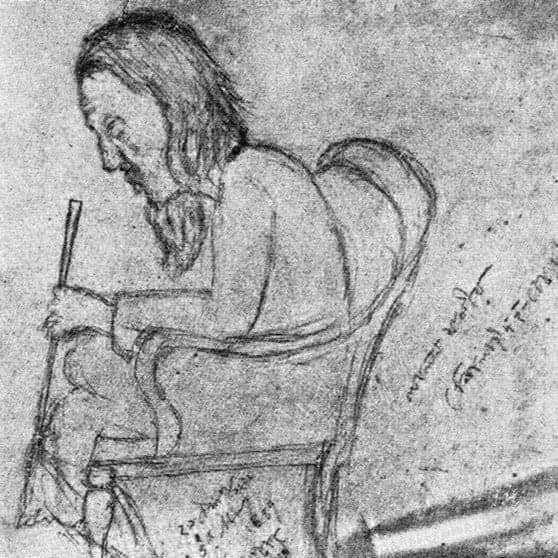
His songs refuse caste. "Everyone asks what caste Lalon belongs to" runs one of them, Sab lokey koi Lalon ki jat samsare.36 They draw on Hindu and Buddhist teaching, the Vaishnava Sahajiya doctrine and Sufism, and Banglapedia says they are "simultaneously popular to the people from both the Hindu and Muslim communities".37 The akhda at Chheuriya holds an annual three-day gathering, which Banglapedia's entry on the Bauls places at the full moon of Falgun; its entry on Lalon also describes gatherings at dolyatra (March to April) and on his death anniversary.38
Boatmen's songs and Tagore songs
Bhatiyali is the boatmen's song of eastern Bengal, known for its long-drawn notes and popular especially in Mymensingh and Sylhet.43
Tagore and Nazrul were composers as well as poets: Rabindra Sangeet, Tagore's own song form, blends Eastern and Western influences and "became immensely popular".44 Nazrul composed ghazals and drew on both Hindu and Muslim traditions, and the shyama sangeet tradition of songs to the goddess influenced both men.45 HMV issued the first gramophone record of Nazrul's songs in 1925.46
Tagore, Nazrul and the modern writers
Rabindranath Tagore was born in Calcutta on 7 May 1861 and died there on 7 August 1941.47 In 1913 he won the Nobel Prize in Literature, "because of his profoundly sensitive, fresh and beautiful verse, by which, with consummate skill, he has made his poetic thought, expressed in his own English words, a part of the literature of the West".48 Banglapedia calls him "the first Asian to be honoured with the Nobel Prize".49 His English Gitanjali was published by the India Society with a preface by W. B. Yeats.50
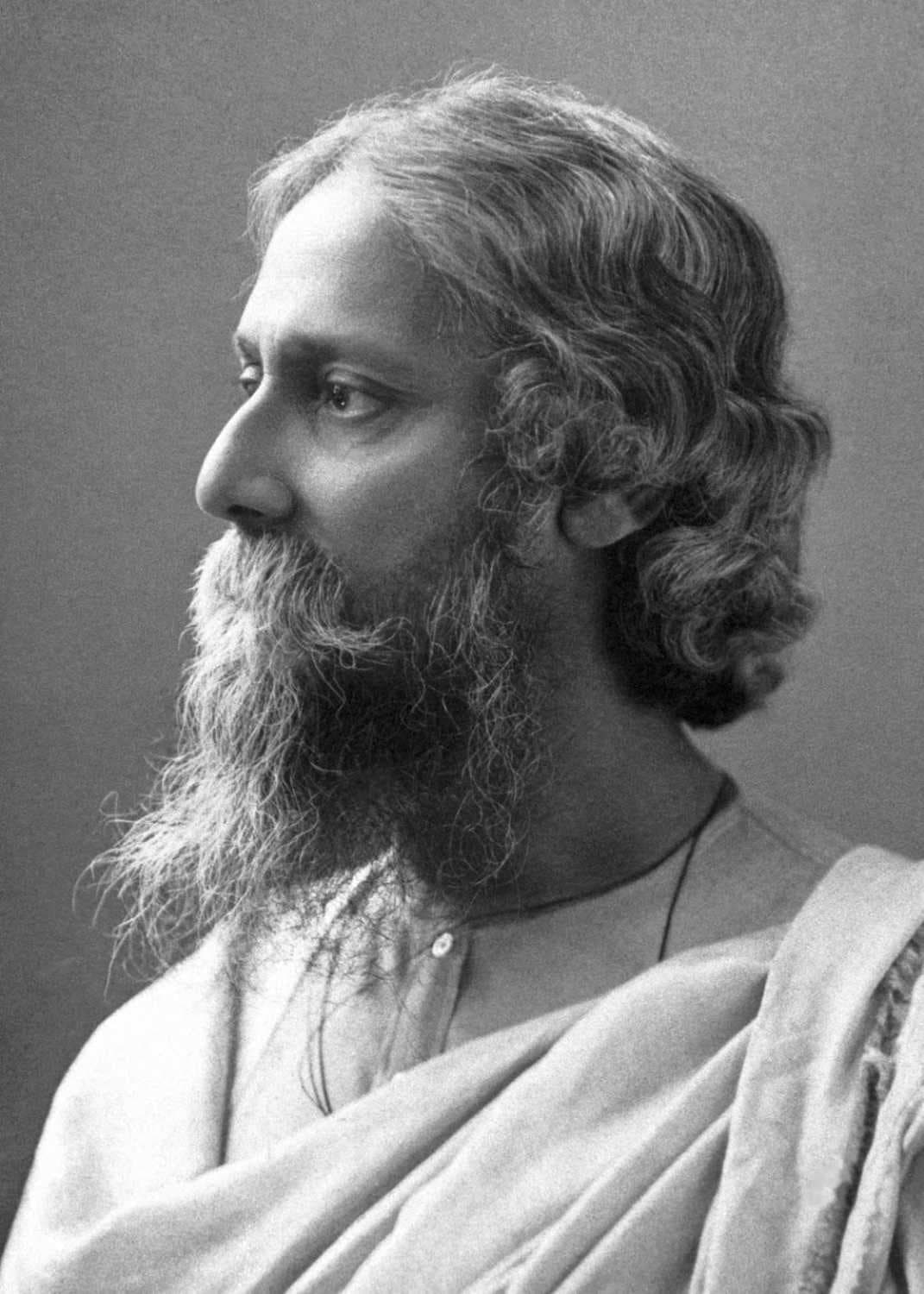
Tagore belongs to Bangladesh as well as to India, and not only through the anthem. From 1890 he managed his father's estates at Shelidah, Shahzadpur, Patisar and Kaligram, all in what is now Bangladesh, and rural life there shaped the stories of Galpaguchchha and the letters published as Chhinnapatra.52 He founded a school at Santiniketan in 1901.53 He was knighted in 1915 and gave up the knighthood in 1919 in protest at the Jallianwala Bagh firing of 13 April 1919.54 Two of his patriotic songs were chosen as the national anthems of Bangladesh and India.55
Kazi Nazrul Islam was born on 24 May 1899 at Churulia in Burdwan, in today's West Bengal; his father was the imam of a mosque and the caretaker of a mausoleum.56 He wrote "Vidrohi" ("The Rebel") after returning to Kolkata in December 1921, and it appeared in his collection Agni-vina (1922); on 12 August 1922 he launched the periodical Dhumketu.57 Banglapedia calls him "singularly non-communal".58
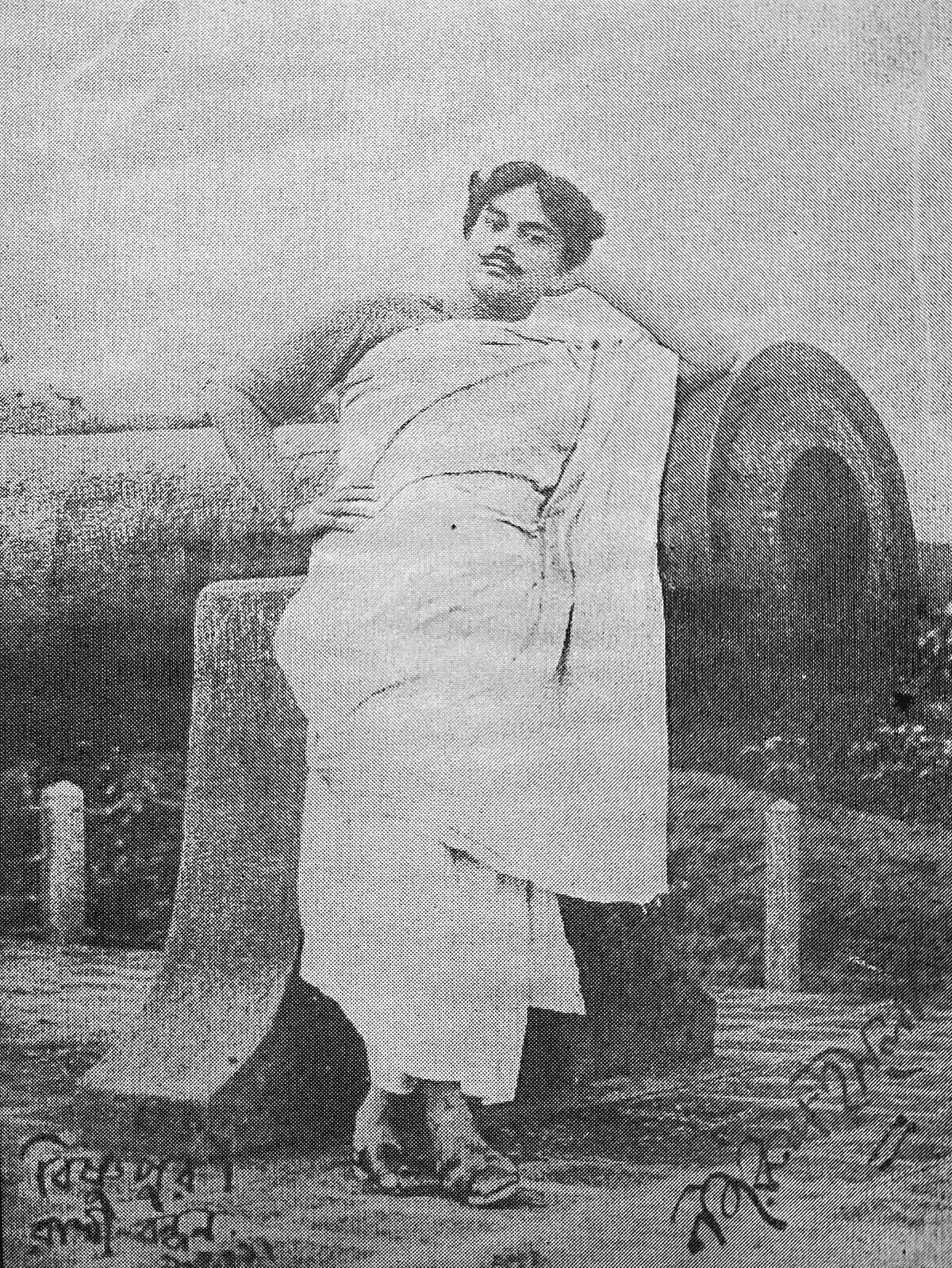
His working life ended early: from July 1942 he lost his voice and memory.60 He was brought to Bangladesh on 24 May 1972, received Bangladeshi citizenship in January 1976 and died in Dhaka on 29 August 1976; he is buried beside the Dhaka University mosque.61 A government gazette issued by the Ministry of Cultural Affairs, formally recognising him as the national poet "effective from the date of his arrival in Bangladesh on 24 May, 1972", was reported on 3 January 2025.62
Jibanananda Das was born in Barisal on 17 February 1899 and died on 22 October 1954, after a tram accident in Kolkata.63 His books include Dhusar Pandulipi (1936), Banalata Sen (1942), Mahaprithivi (1944) and Ruposi Bangla, published in 1984, long after his death; he is called Rupasi Banglar Kavi, "Poet of Beautiful Bengal".64
Humayun Ahmed (1948 to 2012), born at Mohanganj in Netrokona, published his first novel, Nondito Noroke, in 1972 and taught chemistry at Dhaka University from 1974.65 He created the recurring characters Himu and Misir Ali, wrote television serials including Kothao Keu Nei, and made films from Aguner Parashmoni (1995) to Ghetuputra Kamola (2012).66 He died in New York on 19 July 2012.67
The flag and national symbols of Bangladesh
Bangladesh's three main national symbols are set out in Article 4 of the Constitution. The anthem is "the first ten lines of 'Amar Sonar Bangla'"; the flag is "a circle, coloured red throughout its area, resting on a green background"; and the emblem is the national flower, the shapla, resting on water, with an ear of paddy on each side and three joined jute leaves above it, flanked by two stars on each side.68 The detail is in the Bangladesh National Anthem, Flag and Emblem Order, 1972 (President's Order No. 130 of 1972), dated 31 October 1972, which also keeps in force the Flag Rules and the National Emblem Rules of 1972.69 A 2010 amendment added penalties of up to one year's imprisonment, a fine, or both for breaking them.70
| Symbol | What it is | Basis |
|---|---|---|
| Anthem | The first ten lines of "Amar Sonar Bangla" by Rabindranath Tagore | Constitution, art. 4(1); President's Order No. 130 of 197271 |
| Flag | A red circle on a bottle-green field, in the proportion 10:6 | Constitution, art. 4(2); Flag Rules, 197272 |
| Emblem | The shapla on water, between two ears of paddy, under three jute leaves and four stars | Constitution, art. 4(3)73 |
| National flower | The shapla (water lily): Nymphaea nouchali in the Constitution; Banglapedia names the white N. pubescens | Constitution, art. 4(3); Banglapedia74 |
| National fruit | Jackfruit | Banglapedia; no legal instrument found75 |
| National animal | Bengal tiger (Panthera tigris tigris), known as the Royal Bengal Tiger | Banglapedia; no legal instrument found76 |
| National bird | Magpie-robin, or doel (Copsychus saularis) | Banglapedia; no legal instrument found77 |
| National fish | Hilsa, or ilish (Tenualosa ilisha) | Banglapedia; no legal instrument found78 |
| National tree | Mango tree | Cabinet decision, 15 November 201079 |
| National game | Kabaddi (ha-du-du) | Named in 197280 |
Source: Constitution of Bangladesh, art. 4; President's Order No. 130 of 1972; Banglapedia; bdnews24.com; The Financial Express.81
The flag
As Banglapedia summarises the Flag Rules of 1972, the flag is bottle green and rectangular, in the proportion 10:6, with a red circle whose radius is one-fifth of the flag's length; the centre of the circle lies on the horizontal centre line, on a perpendicular drawn at nine-twentieths of the length.82 The Flag Rules even name the dyes: green is "Procion Brilliant Green H-2RS 50 parts per 1000" and red "Procion Brilliant Orange H-2RS 60 parts per 1000".83 The flag flies at half-mast on Shaheed Day, 21 February.84

The first version looked different. Banglapedia records that "initially the flag had the map of Bangladesh in the centre, which was withdrawn later", and that the Mujibnagar government adopted the pattern of the flag unfurled by student leaders at Dhaka University on 2 March 1971.86 This guide found no official source that names its designers. The fullest account comes from one participant. According to A.S.M. Abdur Rob, then vice-president of DUCSU, the Dhaka University students' union, who hoisted that flag on 2 March 1971, the design of a bottle-green field and red disc with a gold map of East Pakistan was agreed collectively by student activists in 1970, and Shib Narayan Das, then president of the Comilla Chhatra League, painted the map.87 In the same account, the artist Quamrul Hassan (1921 to 1988) was asked in 1972 to redesign the flag without the map, because the southern islands made the map hard to place inside the circle.88
When the present design was formally adopted is less certain than many websites suggest. Dates for it circulate widely, but this guide found none confirmed in an official or scholarly source. The law that fixes the design is the Order of 31 October 1972.89
The anthem
The anthem is the first ten lines of Tagore's "Amar Sonar Bangla" (আমার সোনার বাংলা).90 The sources disagree on when he wrote it. Banglapedia dates it to 1906.91 Niaz Zaman, writing in The Daily Star, and Peter D. McDonald, in a 2024 academic chapter, date it to 1905, the year of the Partition of Bengal; Zaman places it among Tagore's songs of protest against the partition and says it first appeared in the September 1905 issue of Bangadarshan.92 Banglapedia says it was sung during the Swadeshi movement against the partition.93
Zaman and McDonald both say the tune comes from a Baul song, Gagan Harkara's "Ami Kothay Pabo Tare".94 If they are right, the country's anthem rests on the same folk tradition that UNESCO later listed, a small sign of how close the art song and the village song have stood. McDonald adds that Tagore's original song had five verses and that the anthem reworks the first two.95
The song became the anthem in stages. It was played at a meeting at Paltan Maidan on 3 March 1971 and before Sheikh Mujibur Rahman's address of 7 March; the Mujibnagar government adopted it as the national anthem, and Swadhin Bangla Betar Kendra broadcast it throughout the war.96 (The 7 March speech and the war are covered in The Bangladesh Liberation War of 1971.) Zaman writes that it was "officially recognized" on 13 January 1972, McDonald that it was formally adopted in 1972, and the legal text is the Order of 31 October 1972.97 The first ten lines are sung and the first four are used for instrumental performance; the official English translation is by Syed Ali Ahsan.98
The emblem, the shapla and the other symbols

Banglapedia reads the emblem as a picture of the country: water, paddy and jute stand for its countryside and its economy, and the stars "symbolise aims and ambition of the nation".100 Even the flower carries a disagreement. The Constitution and the 1972 Order name it as Nymphaea nouchali.101 Banglapedia notes that two water lilies grow in Bangladesh, the blue N. nouchali and the white N. pubescens, and says it is the white N. pubescens that "has been designated as the national flower".102 This guide follows the Constitution and records Banglapedia's version beside it.
Four other symbols rest on a single source: Banglapedia describes jackfruit as the national fruit, the Bengal tiger as the national animal, the magpie-robin, or doel, as the national bird and the hilsa as the national fish; this guide found no legal instrument or official government page naming any of them, so for these four Banglapedia is the only authority.103 The mango tree is the exception with a date. The cabinet declared it the national tree on 15 November 2010, on a proposal from the Ministry of Environment and Forests, and the press secretary explained: "We had no national tree."104
Pahela Baishakh, Ekushey and the festival year
Pahela Baishakh, the first day of the Bangla calendar, is a national holiday.105 Banglapedia attributes the calendar to the Mughal emperor Akbar: devised by the astronomer Fathullah Shirazi, it was introduced on 10 or 11 March 1584 and counted from Akbar's accession on 5 November 1556.106 A key custom of the day is commercial: halkhata, the opening of a new account book, which jewellers and grocers still keep.107 Under a revision announced in October 2019 on the recommendations of a Bangla Academy committee, the calendar keeps the new year on 14 April.108
The procession and its names
In Dhaka the day also brings a street procession, organised by students and teachers of the Faculty of Fine Art at the University of Dhaka. UNESCO inscribed it in 2016 on its Representative List of the Intangible Cultural Heritage of Humanity, under the name "Mangal Shobhajatra on Pahela Baishakh".109 UNESCO says it began in 1989, when students "frustrated with military rule" wanted to give hope, and that the masks and floats are made over about a month.110
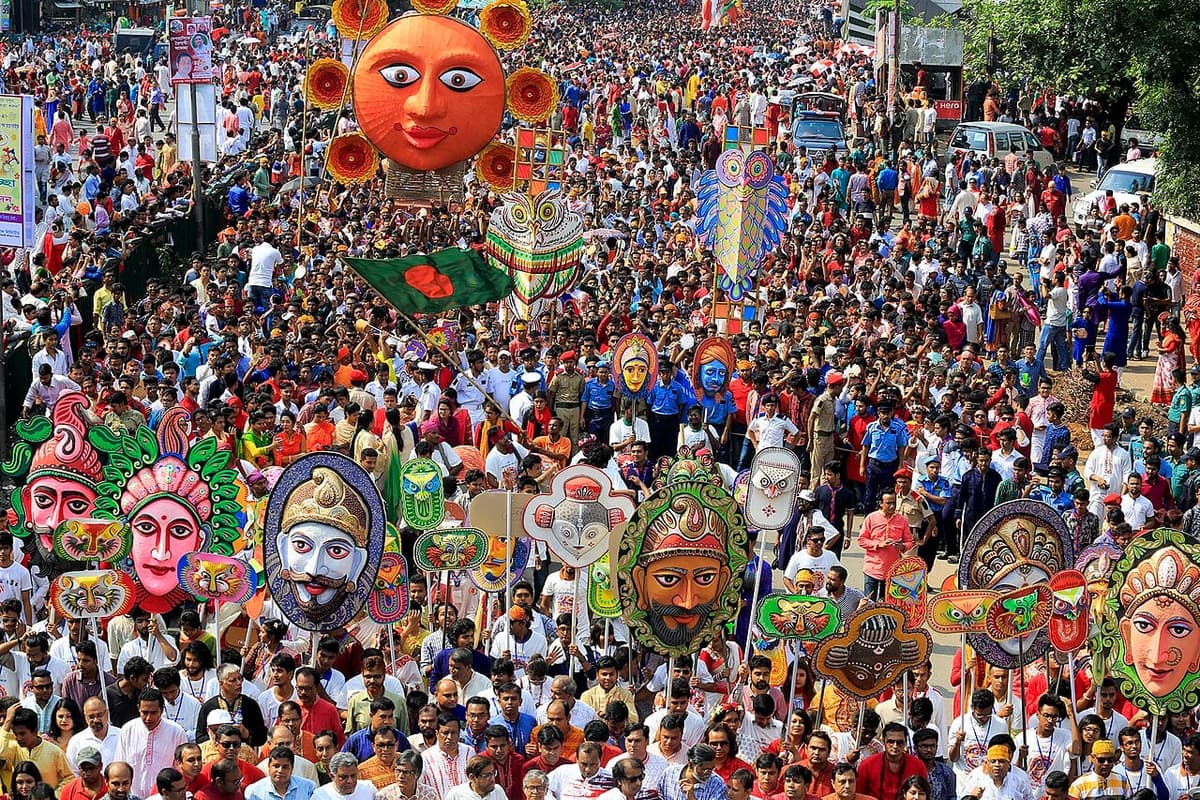
Its name has changed more than once. It started in 1989 as "Ananda Shobhajatra".112 When "Mangal" replaced "Ananda" is disputed: Prothom Alo dates the change to 1990, Al Jazeera to 1996.113 On 11 April 2025 the Faculty of Fine Arts announced that the 2025 procession would be called "Borshoboron Ananda Shobhajatra" (also spelled Barshabaran); its dean, Azharul Islam Sheikh, called this "a reversion to the parade's original name", and some student groups and critics objected.114 On 5 April 2026 the Culture Minister, Nitai Roy Chowdhury, announced that the procession would be called "Baishakhi Shobhajatra", saying: "We want an end to the controversy over the name of the Pahela Baishakh procession."115
UNESCO's listing keeps the name under which the procession was inscribed. Its page still shows "Mangal Shobhajatra on Pahela Baishakh", with no alternative, and according to bdnews24.com a change on the list needs a formal request from Bangladesh; the minister said UNESCO would be informed.116
- 1989Students and teachers of the Faculty of Fine Art, University of Dhaka, hold the first procession, as "Ananda Shobhajatra".117
- 1990 or 1996The name becomes "Mangal Shobhajatra": Prothom Alo gives 1990, Al Jazeera 1996.118
- 2016UNESCO inscribes "Mangal Shobhajatra on Pahela Baishakh" on its Representative List.119
- 11 April 2025The Faculty of Fine Arts announces the name "Borshoboron Ananda Shobhajatra" for that year's procession.120
- 5 April 2026The Culture Minister announces the name "Baishakhi Shobhajatra".121
- 22 November 2026UNESCO's page still lists the element as "Mangal Shobhajatra on Pahela Baishakh".122
The day has also known violence. On 14 April 2001 two bombs exploded at Chhayanaut's Pahela Baishakh gathering at Ramna Batamul, killing 10 people.123 A Dhaka court sentenced 8 people to death and 6 to life imprisonment in June 2014, and as of April 2025 the High Court's verdict was still awaited.124
Ekushey: 21 February
The other great day of the cultural year is a day of mourning. On 21 February 1952 (8 Falgun 1359) police fired on students in Dhaka who were campaigning for Bangla to be a state language of Pakistan; among those killed were Abul Barkat, Rafiq Uddin Ahmed and Abdul Jabbar, and Abdus Salam died later in hospital.125 The movement is told in full in East Pakistan, 1947 to 1971.
Students of Dhaka Medical College built the first Shaheed Minar, a memorial to the dead, on 23 February 1952, and police demolished it on 26 February.126 Hamidur Rahman designed the larger monument, and building began in 1957.127 The Bangla Academy, founded on 3 December 1955 at Burdwan House in Dhaka as an outcome of the Language Movement, holds its book fair every February.128 The day reached the world in 1999. On Bangladesh's proposal at the UNESCO General Conference in Paris on 17 November 1999, 21 February became International Mother Language Day, first observed on 21 February 2000; UNESCO calls it "the initiative of Bangladesh".129
Eid, Durga Puja, Buddha Purnima and Christmas
The religious festivals follow each community's calendar. Eid-ul-Fitr is a three-day government holiday, and Banglapedia puts the country's biggest Eid congregation, at Sholakia in Kishoreganj, at "about half a million" people.130 Eid-ul-Azha is popularly called Kurbanir Eid or Bakra Eid.131 Durga Puja is "the most popular religious festival" of Bengali Hindus. It falls in October or November; its tenth day, dashami, is a public holiday; and an open-to-all sarvajanin puja is held at the Dhakeshwari temple in Dhaka.132 Buddha Purnima is a public holiday, with celebrations of up to three days at Buddhist viharas, and Christmas carols are sung in churches from the first week of December.133
Faith, saints and shared shrines
Bangladesh is a Muslim-majority country whose Constitution pairs a state religion with equal rights for other faiths. Article 2A reads: "The state religion of the Republic is Islam, but the State shall ensure equal status and equal right in the practice of the Hindu, Buddhist, Christian and other religions."134 That wording dates from the Fifteenth Amendment of 2011, which also gave Article 12 its present text on secularism and added Article 23A, protecting the culture of "tribes, minor races, ethnic sects and communities".135
The preliminary report of the 2022 census counted about 91 per cent of the population as Muslim, 7.95 per cent as Hindu, down from 8.54 per cent in 2011, and 0.61 per cent as Buddhist.136 The final figures, and the country's other peoples, are in The land and people of Bangladesh.
The historian Richard Eaton, in The Rise of Islam and the Bengal Frontier, 1204-1760 (1993), explains Islam's spread in the eastern delta through agrarian expansion and the cults of saints.137 Banglapedia dates the arrival of Sufism in Bengal to the mid-11th century and says Sufis' tombs are visited "by people from all walks of life".138
Shah Jalal's shrine in Sylhet is one of them: a Persian inscription of 1512 records the first Muslim conquest of Sylhet in 1303, under Sultan Shamsuddin Firuz Shah, and Shah Jalal is linked with that conquest; his dargah is visited daily.139 The traveller Ibn Battuta visited him and stayed three days, in 1346 according to Banglapedia's entry on Shah Jalal and in 1345 according to its entry on Sufism.140 Ibn Battuta's wider journey through Bengal is described in The Bengal Sultanate.
Read together, the Baul songs, Lalon's lyrics, the salutations of the mangal-kavya and Nazrul's songs, which drew on Hindu and Muslim traditions, suggest a culture in which crossing between faiths was ordinary rather than exceptional. That is an interpretation, and it comes with cautions. Asim Roy reads Bengali Muslim literature as a cultural mediation between Islam and local tradition, which supports it; Jeanne Openshaw's fieldwork questions the romantic image of the Bauls on which much of it rests.141
Rice, fish and pitha: food and dress
Rice and fish dominate the diet.142 Panta, soaked rice, is a labourer's breakfast; everyday meals bring bhorta, bhaji, dopeaji, jhol and dal; feasts may serve biryani, polao and borhani; and desserts run from zarda and firni-payesh to rasgolla, rasmalai and sweetened yoghurt, dahi.143
The national fish, the hilsa or ilish (Tenualosa ilisha), lives between river and sea: it migrates up rivers to breed, and the young fish, jatka, are caught on their way down to the sea.144 Banglapedia puts hilsa at nearly 16.4 per cent of national fish production, without giving a year.145 It became Bangladesh's second Geographical Indication in 2017, and The Daily Star, citing WorldFish, says Bangladesh produces "over 60 percent" of the world's hilsa.146
Pitha are home-made rice cakes, loved most in winter with date-palm molasses. An exhibition at the Shishu Academy in 1991 displayed 106 kinds, and common ones include chitoi, patishapta, bhapa and nakshi pitha.147
UNESCO calls the sari "the main dress of Bengali women at home and abroad".148 Banglapedia lists jamdani, Tangail and tant saris, and notes that katan silk and Benarasi saris made by weavers who came from Uttar Pradesh in the 1940s became evening wear.149 For men it calls the lungi and genji, a sewn sarong and a cotton vest, "the unofficial national dress of Bengal for centuries"; the panjabi with pyjama is common at cultural functions.150 Since the 1990s the salwar-kameez has been widely adopted by students and working women.151
Crafts: jamdani, shital pati, nakshi kantha and rickshaw art
UNESCO describes jamdani as woven around Dhaka with a discontinuous-weft technique, passed mainly from parents to children, and calls the jamdani sari "a symbol of identity, dignity and self-recognition".152 In November 2016 jamdani became Bangladesh's first Geographical Indication, registered by the Department of Patents, Designs and Trademarks on an application by the BSCIC.153 Banglapedia names its core villages, among them Noapara, Tarabo and Sultanbagh, with parts of Sonargaon upazila, and notes that a jamdani village was set up at Demra near Dhaka after independence.154 Its history, and that of Dhaka muslin before it, is told in Dhaka Muslin and Jamdani.
The Tangail saree, inscribed in 2025, is practised by the Basak (Hindu) and Jhola (Muslim) communities, one more craft that two faiths hold in common.155
Shital pati mats are woven from a green cane, murta, mainly in greater Sylhet, and women do most of the weaving.156 Murta is Schumannianthus dichotoma, and the Forestry Master Plan of 1982 estimated that about 8,000 people worked in making the mats.157
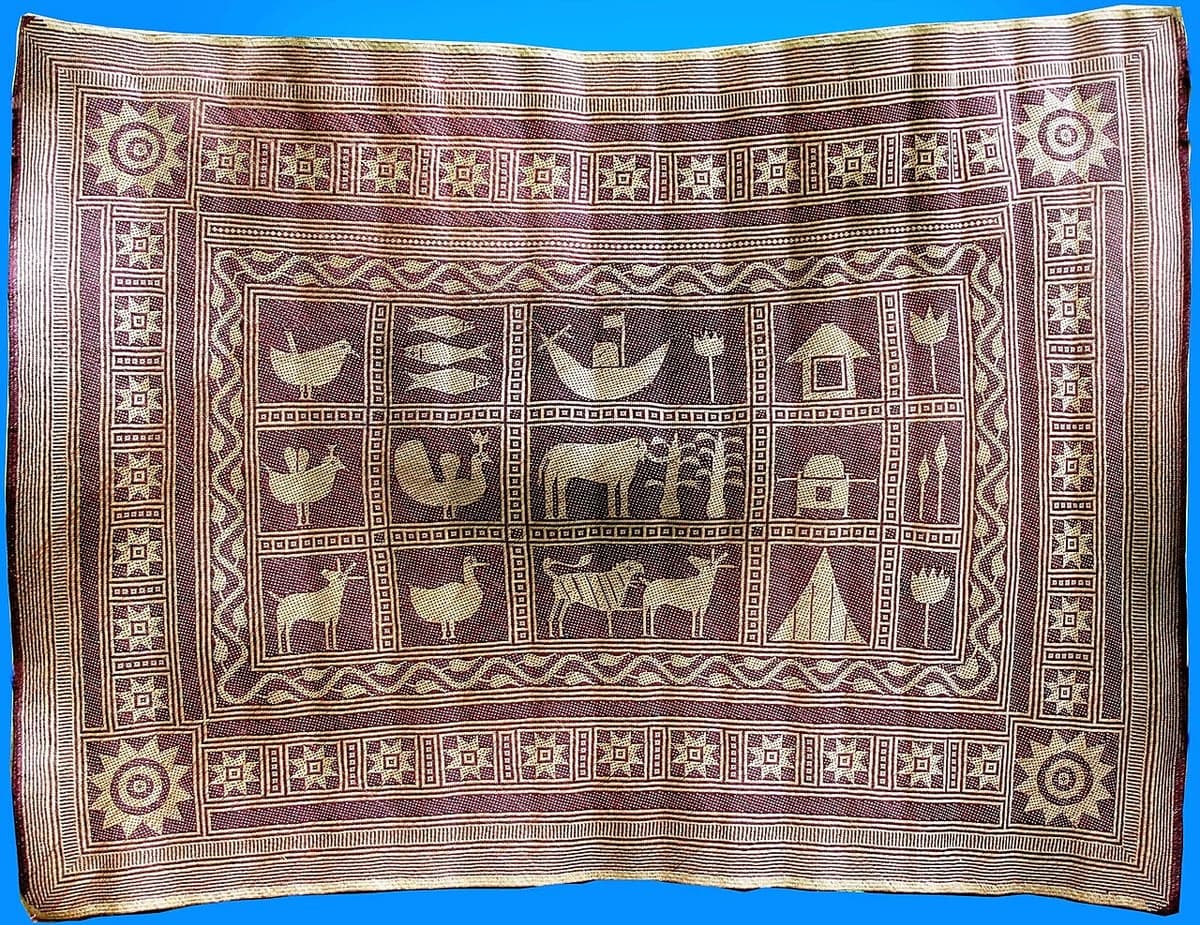
A nakshi kantha is three to seven layers of old saris quilted together with running stitch.159 The name became popular after Jasimuddin's poem Naksi Kanthar Math (1929).160
One of these crafts moves through traffic. European jute exporters in Narayanganj and Netrokona brought cycle rickshaws from Calcutta in 1938, and Dhaka had 37 rickshaws in 1941 and 181 in 1947.161 Their painting "perhaps dates back to the 1950s"; many of the painters had painted cinema billboards, and the skill passes from ustad, master, to apprentice.162 UNESCO, which inscribed "Rickshaws and rickshaw painting in Dhaka" in 2023, calls the rickshaws "a roving exhibition" and notes that the craftsmen who build them are all men, while the painters include both men and women.163
Terracotta, mosques and the three World Heritage sites
Bangladesh has three World Heritage properties: two cultural sites inscribed in 1985 and one natural site inscribed in 1997.164 The Historic Mosque City of Bagerhat, formerly Khalifatabad, was founded, in UNESCO's words, by "the Turkish general Ulugh Khan Jahan in the 15th century".165 Its Shatgumbad, or Sixty Dome, Mosque is the largest Sultanate mosque in Bangladesh. It has 81 domes and vaults in all, 70 over the side wings, 7 chau-chala vaults over the nave and 4 on the corner towers, and 60 pillars, and it is ascribed to Khan Jahan, who died in 1459.166
The Ruins of the Buddhist Vihara at Paharpur are the remains of Somapura Mahavihara, founded by Dharmapala at the end of the 8th century: a monastery measuring 274.15 metres from north to south and 273.70 metres from east to west, with 177 monastic cells.167 UNESCO calls it "a renowned intellectual centre until the 12th century" that "influenced Buddhist architecture as far away as Cambodia".168 The third property, the Sundarbans, covers 139,500 hectares on the Bangladesh side; India's Sundarbans National Park is a separate property, inscribed in 1987.169
| Listing | Name as UNESCO gives it | Year | Detail |
|---|---|---|---|
| World Heritage | Historic Mosque City of Bagerhat | 1985 | Cultural, criterion (iv)170 |
| World Heritage | Ruins of the Buddhist Vihara at Paharpur | 1985 | Cultural, criteria (i) and (ii)171 |
| World Heritage | The Sundarbans | 1997 | Natural, criteria (ix) and (x), 139,500 ha172 |
| Intangible heritage | Baul songs | 2008 (proclaimed 2005) | Representative List173 |
| Intangible heritage | Traditional art of Jamdani weaving | 2013 | Representative List174 |
| Intangible heritage | Mangal Shobhajatra on Pahela Baishakh | 2016 | Representative List175 |
| Intangible heritage | Traditional art of Shital Pati weaving of Sylhet | 2017 | Representative List176 |
| Intangible heritage | Rickshaws and rickshaw painting in Dhaka | 2023 | Representative List177 |
| Intangible heritage | Traditional Saree weaving art of Tangail | 2025 | Representative List178 |
| Memory of the World | The Historic 7th March Speech of Bangabandhu Sheikh Mujibur Rahman | 2017 (submitted 2016) | Videos and films179 |
| International day | International Mother Language Day (21 February) | Approved 1999; observed since 2000 | UNESCO General Conference180 |
Source: UNESCO World Heritage List (open data), UNESCO Intangible Cultural Heritage and Memory of the World pages; Banglapedia.181
The Memory of the World entry is quoted under the title UNESCO gives it. UNESCO says the speech "effectively declared the independence of Bangladesh" and was "extempore", with "no written script".182
Moulded and carved terracotta plaques decorated Bengal's temples and later its mosques, among them the Adina mosque of 1375, and terracotta revived on Hindu temples from the 16th century.183 One example is the Kantanagar, or Kantajew, temple near Dinajpur, begun about 1722 by Maharaja Prannath and completed in 1752 by Maharaja Ramnath; it lost its nine spires in the earthquake of 1897 and is famous for its terracotta.184
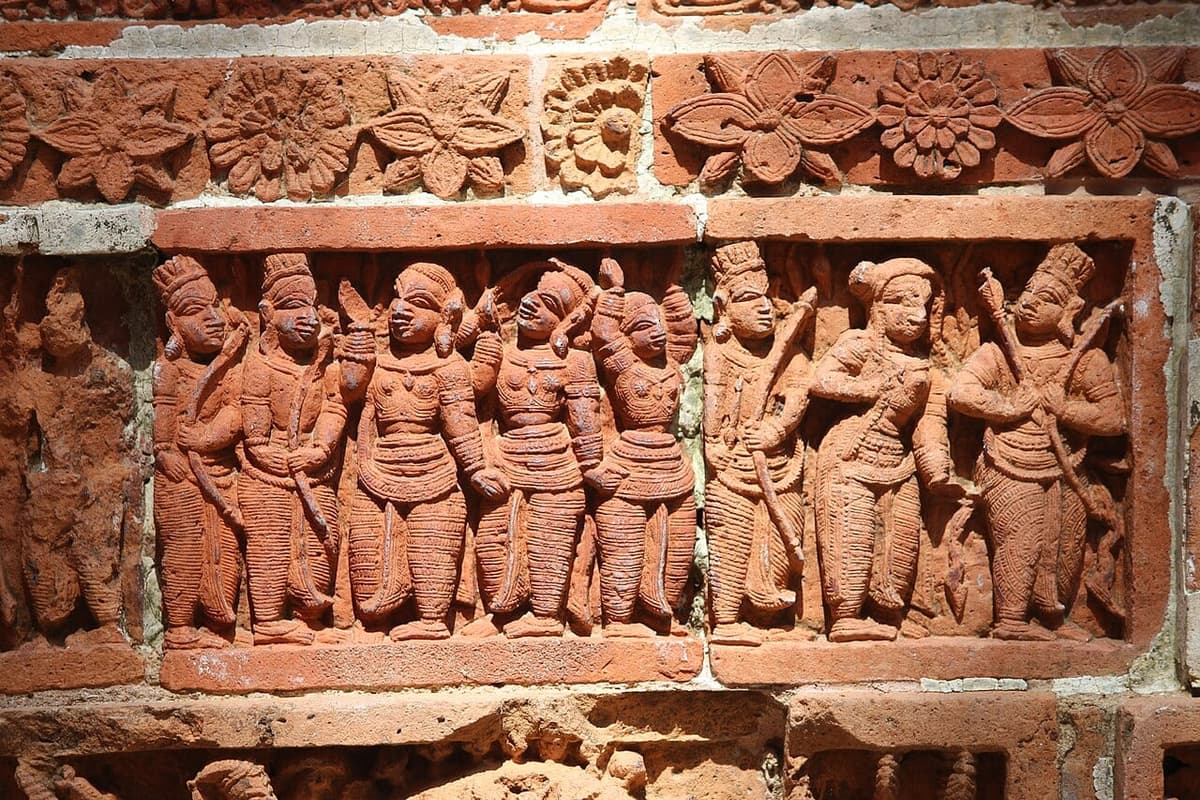
Other landmarks belong to every community. The Shiva temple at Puthia was built by Rani Bhuvan Mohini Devi in 1823.186 The Star Mosque in Armanitola, Dhaka, dates from the first half of the 19th century and was clad in tiles in 1926.187 The Dhakeshwari temple, "the most prominent temple of Dhaka", is linked by legend to Ballal Sena, though Banglapedia calls its style Mughal.188
Cinema and sport
The first feature film made in East Bengal, Mukh O Mukhosh, directed by Abdul Jabbar Khan, was released on 3 August 1956, and the East Pakistan Film Development Corporation was set up on 3 April 1957.189 Zahir Raihan (1935 to 1971) directed Jibon Theke Neya and the 1971 documentary Stop Genocide; he disappeared on 30 December 1971 while searching for his brother, Shahidullah Kaiser.190
Tareque Masud (1956 to 2011) made Muktir Gaan and Matir Moina (The Clay Bird, 2002).191 Matir Moina won the FIPRESCI international critics' prize in the Directors' Fortnight at Cannes in 2002, the first Bangladeshi film recognised at Cannes.192 It is often called an Oscar nominee, including by Banglapedia, but it was not one. The five nominees for Best Foreign Language Film at the 75th Academy Awards in 2003 were Nowhere in Africa, which won, El Crimen del Padre Amaro, Hero, The Man without a Past and Zus & Zo.193
Kabaddi, also called ha-du-du, was named the national game in 1972.194 In cricket, Bangladesh first played the ICC Trophy in 1979 and won it in 1997, beating Kenya in the final; that year it received one-day international status and qualified for the 1999 World Cup.195 It was awarded Test status as the 10th Test team on 26 June 2000.196 The first Test began in Dhaka on 10 November 2000 against India, who won by nine wickets.197 The first Test win came in 2005, against Zimbabwe.198
Further reading
- Krishna Dutta and Andrew Robinson, Rabindranath Tagore: The Myriad-Minded Man (1995), a full English-language biography.206
- Carol Salomon (trans.), City of Mirrors: Songs of Lālan Sā̃i (2017), annotated English translations of Lalon's songs.207
- Jeanne Openshaw, Seeking Bāuls of Bengal (2002), a fieldwork study that questions the romantic image of the Bauls.208
- Henry Glassie, Art and Life in Bangladesh (1997), on potters, weavers, painters and other living crafts.209
- Perween Hasan, Sultans and Mosques: The Early Muslim Architecture of Bangladesh (2007), the standard survey, including Bagerhat.210
- Willem van Schendel, A History of Bangladesh (2009), a general history with chapters on culture and identity.211
Questions students and journalists ask
What are the UNESCO World Heritage Sites in Bangladesh?
There are three. The Historic Mosque City of Bagerhat and the Ruins of the Buddhist Vihara at Paharpur were inscribed in 1985 as cultural sites, and the Sundarbans was inscribed in 1997 as a natural site of 139,500 hectares. Bangladesh also has six living traditions on UNESCO's intangible heritage list, from Baul songs to the Tangail saree, and the 7 March 1971 speech on the Memory of the World register.
Who wrote the national anthem of Bangladesh?
Rabindranath Tagore. The anthem is the first ten lines of his song "Amar Sonar Bangla", as the Constitution states. Banglapedia dates the song to 1906, while other writers date it to 1905, the year of the Partition of Bengal. Two sources say its tune comes from a Baul song by Gagan Harkara. The first ten lines are sung and the first four are used for instrumental versions.
Did Rabindranath Tagore write the anthems of both India and Bangladesh?
Yes. Banglapedia says two of Tagore's patriotic songs were chosen as the national anthems of Bangladesh and India. Bangladesh's anthem is the first ten lines of "Amar Sonar Bangla". Tagore also has close ties to the land that is now Bangladesh: from 1890 he managed his family's estates at Shelidah, Shahzadpur, Patisar and Kaligram, and rural life there shaped his short stories.
Who is the national poet of Bangladesh?
Kazi Nazrul Islam (1899 to 1976), author of the poem "Vidrohi" ("The Rebel") and of many songs and ghazals. He was brought to Bangladesh on 24 May 1972, received citizenship in 1976 and died in Dhaka that year. A government gazette formally recognising him as the national poet, effective from his arrival on 24 May 1972, was reported on 3 January 2025.
What does the flag of Bangladesh look like, and who designed it?
It is a red circle on a bottle-green field in the proportion 10:6, with the circle's centre set at nine-twentieths of the flag's length. An earlier version carried a map in the circle. This guide found no official source naming the designers. According to A.S.M. Abdur Rob, who hoisted the flag at Dhaka University on 2 March 1971, students designed it collectively, Shib Narayan Das painted the map, and the artist Quamrul Hassan was asked in 1972 to redesign it without the map.
What are the national symbols of Bangladesh?
The Constitution sets the anthem ("Amar Sonar Bangla"), the flag and the emblem, whose centre is the shapla water lily, the national flower. Banglapedia lists jackfruit as the national fruit, the Bengal tiger as the national animal, the magpie-robin (doel) as the national bird and the hilsa as the national fish; no law or official page naming these four was found. The mango tree was declared the national tree in 2010, and kabaddi was named the national game in 1972.
What is Pohela Boishakh and why is it celebrated on 14 April?
Pohela Boishakh, also spelled Pahela Baishakh, is the first day of the Bangla calendar and a national holiday. Banglapedia attributes the calendar to the Mughal emperor Akbar, who introduced it in 1584. A revised calendar announced in October 2019 keeps the new year fixed on 14 April. The day brings songs under the banyan tree at Ramna in Dhaka, new account books for traders and a street procession.
Why was the Mangal Shobhajatra procession renamed?
The procession began in 1989 as "Ananda Shobhajatra" and later became "Mangal Shobhajatra". In 2025 Dhaka University's Faculty of Fine Arts called it "Borshoboron Ananda Shobhajatra", which its dean described as a return to the original name. In April 2026 the Culture Minister announced the name "Baishakhi Shobhajatra", saying he wanted to end the controversy over the name. UNESCO's list still uses "Mangal Shobhajatra on Pahela Baishakh".
What is Baul music, and who was Lalon Fakir?
Bauls are mystic minstrels of rural Bangladesh and West Bengal who sing with the ektara, dotara and dubki drum, drawing on Hindu, Buddhist, Vaishnava and Sufi ideas while rejecting caste and organised religion. UNESCO inscribed Baul songs in 2008. Banglapedia calls Lalon Shah, or Lalon Fakir, the preceptor of Baul asceticism and dates him to 1774 to 1890, though other sources differ, and his akhda is at Chheuriya in Kushtia.
Is there a real portrait of Lalon?
The image usually reproduced is a sketch by Jyotirindranath Tagore, Rabindranath Tagore's brother. Banglapedia reproduces it, and The Daily Star has called it the only authentic image of Lalon. A year and a place are often attached to it, but these could not be confirmed in a museum or academic source, and The Daily Star notes that it is not clear how Jyotirindranath met him.
Notes
- Azhar Islam, "Charyapada," Banglapedia: National Encyclopedia of Bangladesh, Edited by Sirajul Islam et al. Dhaka: Asiatic Society of Bangladesh; online edition, accessed 22 November 2026, https://en.banglapedia.org/index.php?title=Charyapada; Shahida Akhter, "Tagore, Rabindranath," Banglapedia: National Encyclopedia of Bangladesh, Edited by Sirajul Islam et al. Dhaka: Asiatic Society of Bangladesh; online edition, accessed 22 November 2026, https://en.banglapedia.org/index.php?title=Tagore,_Rabindranath; Rafiqul Islam, "Islam, Kazi Nazrul," Banglapedia: National Encyclopedia of Bangladesh, Edited by Sirajul Islam et al. Dhaka: Asiatic Society of Bangladesh; online edition, accessed 22 November 2026, https://en.banglapedia.org/index.php?title=Islam,_Kazi_Nazrul; Shahida Akhter, "Ahmed, Humayun," Banglapedia: National Encyclopedia of Bangladesh, Edited by Sirajul Islam et al. Dhaka: Asiatic Society of Bangladesh; online edition, accessed 22 November 2026, https://en.banglapedia.org/index.php?title=Ahmed,_Humayun; UNESCO Intangible Cultural Heritage, "Baul Songs," Nomination file no. 00107, 2008, https://ich.unesco.org/en/RL/baul-songs-00107; "Bangladesh Reworks Bangla Calendar to Match National Days with West," bdnews24.com, 17 October 2019, https://bdnews24.com/lifestyle/bangladesh-reworks-bangla-calendar-to-match-national-days-with-west. ↩
- UNESCO Intangible Cultural Heritage, "Bangladesh," 2026, https://ich.unesco.org/en/state/bangladesh-BD; UNESCO World Heritage Centre, World Heritage List, Dataset whc001, records 321, 322, 452 and 798 (Paris: UNESCO, 2026), https://data.unesco.org/explore/dataset/whc001/. ↩
- Government of the People's Republic of Bangladesh, The Constitution of the People's Republic of Bangladesh, Articles 2A, 3, 4, 12, 23 and 23A; Laws of Bangladesh online (Art. 4: /act-367/section-24551.html) (Dhaka: Legislative and Parliamentary Affairs Division, Ministry of Law, Justice and Parliamentary Affairs), art. 4, http://bdlaws.minlaw.gov.bd/act-367.html. ↩
- UNESCO Intangible Cultural Heritage, "UNESCO ICH, Bangladesh"; UNESCO Intangible Cultural Heritage, "Baul Songs"; UNESCO Intangible Cultural Heritage, "Traditional Saree Weaving Art of Tangail," Nomination file no. 02322, 2025, https://ich.unesco.org/en/RL/traditional-saree-weaving-art-of-tangail-02322. ↩
- UNESCO World Heritage Centre, World Heritage List. ↩
- Nobel Prize Outreach, "Rabindranath Tagore: Facts," NobelPrize.org, See also "The Nobel Prize in Literature 1913", https://www.nobelprize.org/prizes/literature/1913/summary/, 2026, https://www.nobelprize.org/prizes/literature/1913/tagore/facts/; Government of Bangladesh, The Bangladesh National Anthem, Flag and Emblem Order, 1972, President's Order No. 130 of 1972, 31 October 1972, as amended 2010. Laws of Bangladesh online (1972), art. 2, https://bdlaws.minlaw.gov.bd/act-details-418.html. ↩
- Islam, "Charyapada". ↩
- Sambaru Chandra Mohanta, "Pahela Baishakh," Banglapedia: National Encyclopedia of Bangladesh, Edited by Sirajul Islam et al. Dhaka: Asiatic Society of Bangladesh; online edition, accessed 22 November 2026, https://en.banglapedia.org/index.php?title=Pahela_Baishakh; "Bangladesh Reworks Bangla Calendar". ↩
- Sirajul Islam, "International Mother Language Day," Banglapedia: National Encyclopedia of Bangladesh, Edited by Sirajul Islam et al. Dhaka: Asiatic Society of Bangladesh; online edition, accessed 22 November 2026, https://en.banglapedia.org/index.php?title=International_Mother_Language_Day; UNESCO, "International Mother Language Day," 2026, https://www.unesco.org/en/days/mother-language. ↩
- UNESCO World Heritage Centre, World Heritage List; UNESCO Intangible Cultural Heritage, "UNESCO ICH, Bangladesh"; Nobel Prize Outreach, "Rabindranath Tagore"; Government of the People's Republic of Bangladesh, Constitution of Bangladesh; Islam, "Charyapada"; "Bangladesh Reworks Bangla Calendar". ↩
- Mohanta, "Pahela Baishakh". ↩
- Mohammad Abdul Hye, "Chhayanaut," Banglapedia: National Encyclopedia of Bangladesh, Edited by Sirajul Islam et al. Dhaka: Asiatic Society of Bangladesh; online edition, accessed 22 November 2026, https://en.banglapedia.org/index.php?title=Chhayanaut. ↩
- Hye, "Chhayanaut"; Syed Ashraf Ali, "Bangabda," Banglapedia: National Encyclopedia of Bangladesh, Edited by Sirajul Islam et al. Dhaka: Asiatic Society of Bangladesh; online edition, accessed 22 November 2026, https://en.banglapedia.org/index.php?title=Bangabda; Government of the People's Republic of Bangladesh, Constitution of Bangladesh, art. 2A. ↩
- UNESCO Intangible Cultural Heritage, "Baul Songs"; Dulal Bhowmik, "Mangalkavya," Banglapedia: National Encyclopedia of Bangladesh, Edited by Sirajul Islam et al. Dhaka: Asiatic Society of Bangladesh; online edition, accessed 22 November 2026, https://en.banglapedia.org/index.php?title=Mangalkavya; Wakil Ahmed and Anwarul Karim, "Lalon Shah," Banglapedia: National Encyclopedia of Bangladesh, Edited by Sirajul Islam et al. Dhaka: Asiatic Society of Bangladesh; online edition, accessed 22 November 2026, https://en.banglapedia.org/index.php?title=Lalon_Shah. ↩
- Ahmed Rafique, "Ekushey February," Banglapedia: National Encyclopedia of Bangladesh, Edited by Sirajul Islam et al. Dhaka: Asiatic Society of Bangladesh; online edition, accessed 22 November 2026, https://en.banglapedia.org/index.php?title=Ekushey_February; AKM Farooq, "National Anthem," Banglapedia: National Encyclopedia of Bangladesh, Edited by Sirajul Islam et al. Dhaka: Asiatic Society of Bangladesh; online edition, revision 4415, accessed 22 November 2026, https://en.banglapedia.org/index.php?title=National_Anthem; "Not Anondo or Mangal, Bangla New Year Event to Be Renamed 'Baishakhi Shobhajatra'," bdnews24.com, 5 April 2026, https://bdnews24.com/bangladesh/086bfcce6ce0. ↩
- Islam, "Charyapada". ↩
- Islam, "Charyapada". ↩
- Islam, "Charyapada". ↩
- Islam, "Charyapada". ↩
- Islam, "Charyapada". ↩
- Bhowmik, "Mangalkavya". ↩
- Bhowmik, "Mangalkavya". ↩
- Bhowmik, "Mangalkavya". ↩
- Wakil Ahmed, "Alaol," Banglapedia: National Encyclopedia of Bangladesh, Edited by Sirajul Islam et al. Dhaka: Asiatic Society of Bangladesh; online edition, accessed 22 November 2026, https://en.banglapedia.org/index.php?title=Alaol. ↩
- Ahmed, "Alaol". ↩
- UNESCO Intangible Cultural Heritage, "Baul Songs". ↩
- UNESCO Intangible Cultural Heritage, "Baul Songs". ↩
- Anwarul Karim, "Baul," Banglapedia: National Encyclopedia of Bangladesh, Edited by Sirajul Islam et al. Dhaka: Asiatic Society of Bangladesh; online edition, accessed 22 November 2026, https://en.banglapedia.org/index.php?title=Baul. ↩
- UNESCO Intangible Cultural Heritage, "Baul Songs"; Karim, "Baul"; Mridul Kanti Chakrobarty, "Music," Banglapedia: National Encyclopedia of Bangladesh, Edited by Sirajul Islam et al. Dhaka: Asiatic Society of Bangladesh; online edition, accessed 22 November 2026, https://en.banglapedia.org/index.php?title=Music. ↩
- Karim, "Baul". ↩
- Karim, "Baul". ↩
- Ahmed and Karim, "Lalon Shah". ↩
- Ahmed and Karim, "Lalon Shah"; Mannan Mashhur Zarif, "The Real Lalon," The Daily Star, 13 April 2019, https://www.thedailystar.net/node/1729753. ↩
- Ahmed and Karim, "Lalon Shah"; Zarif, "The Real Lalon". ↩
- Akhter, "Tagore, Rabindranath"; Ahmed and Karim, "Lalon Shah"; Zarif, "The Real Lalon"; Wikimedia Commons, "File:Fakir Lalon Shah.jpg," accessed 22 November 2026, https://commons.wikimedia.org/wiki/File:Fakir_Lalon_Shah.jpg. ↩
- Ahmed and Karim, "Lalon Shah". ↩
- Ahmed and Karim, "Lalon Shah". ↩
- Karim, "Baul"; Ahmed and Karim, "Lalon Shah". ↩
- Ahmed and Karim, "Lalon Shah"; Chakrobarty, "Music"; "Fakir Lalon Shai ...123 Years On," The Daily Star, 18 October 2013, https://www.thedailystar.net/news/fakir-lalon-shai-123-years-on. ↩
- Ahmed and Karim, "Lalon Shah". ↩
- Zarif, "The Real Lalon". ↩
- Wikimedia Commons, "File". ↩
- Sambaru Chandra Mohanta, "Bhatiyali," Banglapedia: National Encyclopedia of Bangladesh, Edited by Sirajul Islam et al. Dhaka: Asiatic Society of Bangladesh; online edition, accessed 22 November 2026, https://en.banglapedia.org/index.php?title=Bhatiyali. ↩
- Akhter, "Tagore, Rabindranath". ↩
- Islam, "Islam, Kazi Nazrul"; Chakrobarty, "Music". ↩
- Islam, "Islam, Kazi Nazrul". ↩
- Nobel Prize Outreach, "Rabindranath Tagore". ↩
- Nobel Prize Outreach, "Rabindranath Tagore". ↩
- Akhter, "Tagore, Rabindranath". ↩
- Akhter, "Tagore, Rabindranath". ↩
- Nobel Prize Outreach, "Rabindranath Tagore". ↩
- Akhter, "Tagore, Rabindranath". ↩
- Nobel Prize Outreach, "Rabindranath Tagore". ↩
- Nobel Prize Outreach, "Rabindranath Tagore: Biographical," NobelPrize.org, 2026, https://www.nobelprize.org/prizes/literature/1913/tagore/biographical/; Akhter, "Tagore, Rabindranath". ↩
- Akhter, "Tagore, Rabindranath". ↩
- Islam, "Islam, Kazi Nazrul". ↩
- Islam, "Islam, Kazi Nazrul". ↩
- Islam, "Islam, Kazi Nazrul". ↩
- Islam, "Islam, Kazi Nazrul". ↩
- Islam, "Islam, Kazi Nazrul". ↩
- Islam, "Islam, Kazi Nazrul". ↩
- "Kazi Nazrul Islam Officially Recognised as National Poet," Prothom Alo English, 3 January 2025, https://en.prothomalo.com/bangladesh/zoogq5cu7n. ↩
- Begum Aktar Kamal, "Das, Jibanananda," Banglapedia: National Encyclopedia of Bangladesh, Edited by Sirajul Islam et al. Dhaka: Asiatic Society of Bangladesh; online edition, accessed 22 November 2026, https://en.banglapedia.org/index.php?title=Das,_Jibanananda. ↩
- Kamal, "Das, Jibanananda". ↩
- Akhter, "Ahmed, Humayun". ↩
- Akhter, "Ahmed, Humayun". ↩
- Akhter, "Ahmed, Humayun". ↩
- Government of the People's Republic of Bangladesh, Constitution of Bangladesh, art. 4. ↩
- Government of Bangladesh, National Anthem, Flag and Emblem Order, arts 2-4, 4A. ↩
- Government of Bangladesh, National Anthem, Flag and Emblem Order, art. 6. ↩
- Government of the People's Republic of Bangladesh, Constitution of Bangladesh, art. 4(1); Government of Bangladesh, National Anthem, Flag and Emblem Order, art. 2. ↩
- Government of the People's Republic of Bangladesh, Constitution of Bangladesh, art. 4(2); A.K.M. Farooq, "National Flag," Banglapedia: National Encyclopedia of Bangladesh, Edited by Sirajul Islam et al. Dhaka: Asiatic Society of Bangladesh; online edition, revision 4435, accessed 22 November 2026, https://en.banglapedia.org/index.php/National_Flag. ↩
- Government of the People's Republic of Bangladesh, Constitution of Bangladesh, art. 4(3). ↩
- Government of the People's Republic of Bangladesh, Constitution of Bangladesh, art. 4(3); Banglapedia, "Water Lily," Banglapedia: National Encyclopedia of Bangladesh, Edited by Sirajul Islam et al. Dhaka: Asiatic Society of Bangladesh; online edition, revision 6534, accessed 22 November 2026, https://en.banglapedia.org/index.php/Water_Lily. ↩
- Banglapedia, "Jackfruit," Banglapedia: National Encyclopedia of Bangladesh, Edited by Sirajul Islam et al. Dhaka: Asiatic Society of Bangladesh; online edition, revision 3061, accessed 22 November 2026, https://en.banglapedia.org/index.php/Jackfruit. ↩
- Md Anwarul Islam, "Bengal Tiger," Banglapedia: National Encyclopedia of Bangladesh, Edited by Sirajul Islam et al. Dhaka: Asiatic Society of Bangladesh; online edition, revision 971, accessed 22 November 2026, https://en.banglapedia.org/index.php/Bengal_Tiger. ↩
- Md Nazrul Haque, "Magpie-robin," Banglapedia: National Encyclopedia of Bangladesh, Edited by Sirajul Islam et al. Dhaka: Asiatic Society of Bangladesh; online edition, revision 3831, accessed 22 November 2026, https://en.banglapedia.org/index.php/Magpie-robin. ↩
- SM Humayun Kabir, "Hilsa," Banglapedia: National Encyclopedia of Bangladesh, Edited by Sirajul Islam et al. Dhaka: Asiatic Society of Bangladesh; online edition, revision 2791, accessed 22 November 2026, https://en.banglapedia.org/index.php?title=Hilsa. ↩
- "Mango tree, national tree," bdnews24.com, 15 November 2010, https://bdnews24.com/bangladesh/mango-tree-national-tree; "Jail terms, fines increased for felling trees illegally," The Financial Express (Dhaka), November 2010, https://today.thefinancialexpress.com.bd/print/jail-terms-fines-increased-for-felling-trees-illegally. ↩
- Gofran Faroqi, "Kabadi," Banglapedia: National Encyclopedia of Bangladesh, Edited by Sirajul Islam et al. Dhaka: Asiatic Society of Bangladesh; online edition, accessed 22 November 2026, https://en.banglapedia.org/index.php?title=Kabadi. ↩
- Government of the People's Republic of Bangladesh, Constitution of Bangladesh, art. 4; Government of Bangladesh, National Anthem, Flag and Emblem Order; Farooq, "National Flag"; Banglapedia, "Water Lily"; "Mango tree, national tree". ↩
- Farooq, "National Flag". ↩
- Farooq, "National Flag". ↩
- Farooq, "National Flag". ↩
- Government of the People's Republic of Bangladesh, Constitution of Bangladesh, art. 4(2); Farooq, "National Flag". ↩
- Farooq, "National Flag". ↩
- Fayeka Zabeen Siddiqua, "The man who raised the flag first," The Daily Star, 17 December 2015, https://www.thedailystar.net/node/188632. ↩
- Siddiqua, "The man who raised"; Banglapedia, "Hassan, Quamrul," Banglapedia: National Encyclopedia of Bangladesh, Edited by Sirajul Islam et al. Dhaka: Asiatic Society of Bangladesh; online edition, revision 2747, accessed 22 November 2026, https://en.banglapedia.org/index.php/Hassan,_Quamrul. ↩
- Government of Bangladesh, National Anthem, Flag and Emblem Order. ↩
- Government of the People's Republic of Bangladesh, Constitution of Bangladesh, art. 4(1). ↩
- Farooq, "National Anthem". ↩
- Niaz Zaman, "Rabindranath Tagore and the creation of national identity," The Daily Star, 12 May 2024, https://www.thedailystar.net/node/3608701; Peter D. McDonald, "Rabindranath Tagore's সমাজ/Samaj/Communities of Song," in Rethinking Lyric Communities, ed. Irene Fantappiè, Francesco Giusti, and Laura Scuriatti (Berlin: ICI Berlin Press, 2024), 97-112, https://doi.org/10.37050/ci-30_04. ↩
- Farooq, "National Anthem". ↩
- Zaman, "Tagore and the creation of national identity"; McDonald, "Tagore's Communities of Song", 97-112. ↩
- McDonald, "Tagore's Communities of Song", 97-112. ↩
- Farooq, "National Anthem". ↩
- Zaman, "Tagore and the creation of national identity"; McDonald, "Tagore's Communities of Song", 97-112; Government of Bangladesh, National Anthem, Flag and Emblem Order, art. 2. ↩
- Farooq, "National Anthem". ↩
- Government of the People's Republic of Bangladesh, Constitution of Bangladesh, art. 4(3). ↩
- Sirajul Islam, "National Emblem," Banglapedia: National Encyclopedia of Bangladesh, Edited by Sirajul Islam et al. Dhaka: Asiatic Society of Bangladesh; online edition, revision 4433, accessed 22 November 2026, https://en.banglapedia.org/index.php/National_Emblem. ↩
- Government of the People's Republic of Bangladesh, Constitution of Bangladesh, art. 4(3); Government of Bangladesh, National Anthem, Flag and Emblem Order, art. 4. ↩
- Banglapedia, "Water Lily"; Islam, "National Emblem". ↩
- Banglapedia, "Jackfruit"; Islam, "Bengal Tiger"; Haque, "Magpie-robin"; Kabir, "Hilsa". ↩
- "Mango tree, national tree"; "Jail terms, fines increased". ↩
- Mohanta, "Pahela Baishakh". ↩
- Ali, "Bangabda". ↩
- Mohanta, "Pahela Baishakh". ↩
- "Bangladesh Reworks Bangla Calendar". ↩
- UNESCO Intangible Cultural Heritage, "Mangal Shobhajatra on Pahela Baishakh," Nomination file no. 01091, 2016, https://ich.unesco.org/en/RL/mangal-shobhajatra-on-pahela-baishakh-01091. ↩
- UNESCO Intangible Cultural Heritage, "Mangal Shobhajatra on Pahela". ↩
- UNESCO Intangible Cultural Heritage, "Mangal Shobhajatra on Pahela". ↩
- "Name of Mangal Shobhajatra Changed," Prothom Alo English, 11 April 2025, https://en.prothomalo.com/bangladesh/ihwqbto5sz; Moudud Ahmmed Sujan, "Why Bangladesh's Renamed New Year Parade Set Off a Controversy," Al Jazeera, 16 April 2025, https://www.aljazeera.com/news/2025/4/16/why-bangladeshs-renamed-new-year-parade-set-off-a-controversy. ↩
- "Name of Mangal Shobhajatra"; Sujan, "Renamed New Year Parade". ↩
- "Name of Mangal Shobhajatra"; Sujan, "Renamed New Year Parade". ↩
- "Bangla New Year Event Renamed". ↩
- UNESCO Intangible Cultural Heritage, "Mangal Shobhajatra on Pahela"; "Bangla New Year Event Renamed". ↩
- UNESCO Intangible Cultural Heritage, "Mangal Shobhajatra on Pahela"; "Name of Mangal Shobhajatra". ↩
- "Name of Mangal Shobhajatra"; Sujan, "Renamed New Year Parade". ↩
- UNESCO Intangible Cultural Heritage, "Mangal Shobhajatra on Pahela". ↩
- "Name of Mangal Shobhajatra". ↩
- "Bangla New Year Event Renamed". ↩
- UNESCO Intangible Cultural Heritage, "Mangal Shobhajatra on Pahela". ↩
- "Ramna Batamul Bombing: 24 Years On, Justice Still Eludes Victims," The Daily Star, 11 April 2025, https://thedailystar.net/node/3869281. ↩
- "Ramna Batamul Bombing". ↩
- Rafique, "Ekushey February". ↩
- Ahmed Rafique, "Shaheed Minar," Banglapedia: National Encyclopedia of Bangladesh, Edited by Sirajul Islam et al. Dhaka: Asiatic Society of Bangladesh; online edition, accessed 22 November 2026, https://en.banglapedia.org/index.php?title=Shaheed_Minar. ↩
- Rafique, "Shaheed Minar". ↩
- Bashir Al Helal, "Bangla Academy," Banglapedia: National Encyclopedia of Bangladesh, Edited by Sirajul Islam et al. Dhaka: Asiatic Society of Bangladesh; online edition, accessed 22 November 2026, https://en.banglapedia.org/index.php?title=Bangla_Academy. ↩
- Islam, "International Mother Language Day"; UNESCO, "International Mother Language Day". ↩
- Shabbir Ahmed and Syed Ashraf Ali, "Eid-ul Fitr," Banglapedia: National Encyclopedia of Bangladesh, Edited by Sirajul Islam et al. Dhaka: Asiatic Society of Bangladesh; online edition, accessed 22 November 2026, https://en.banglapedia.org/index.php?title=Eid-ul_Fitr. ↩
- Shabbir Ahmed and Syed Ashraf Ali, "Eid-ul Azha," Banglapedia: National Encyclopedia of Bangladesh, Edited by Sirajul Islam et al. Dhaka: Asiatic Society of Bangladesh; online edition, accessed 22 November 2026, https://en.banglapedia.org/index.php?title=Eid-ul_Azha. ↩
- Dulal Bhowmik, "Durga Puja," Banglapedia: National Encyclopedia of Bangladesh, Edited by Sirajul Islam et al. Dhaka: Asiatic Society of Bangladesh; online edition, accessed 22 November 2026, https://en.banglapedia.org/index.php?title=Durga_Puja. ↩
- Sukomal Barua, "Buddha Purnima," Banglapedia: National Encyclopedia of Bangladesh, Edited by Sirajul Islam et al. Dhaka: Asiatic Society of Bangladesh; online edition, accessed 22 November 2026, https://en.banglapedia.org/index.php?title=Buddha_Purnima; Selmon H. Dio, "Christmas," Banglapedia: National Encyclopedia of Bangladesh, Edited by Sirajul Islam et al. Dhaka: Asiatic Society of Bangladesh; online edition, accessed 22 November 2026, https://en.banglapedia.org/index.php?title=Christmas. ↩
- Government of the People's Republic of Bangladesh, Constitution of Bangladesh, art. 2A. ↩
- Government of the People's Republic of Bangladesh, Constitution of Bangladesh, arts 2A, 12, 23A. ↩
- "Bangladesh Sees Fall in Hindu Population," Prothom Alo English, 27 July 2022, https://en.prothomalo.com/bangladesh/at87h01ocn. ↩
- Richard M. Eaton, The Rise of Islam and the Bengal Frontier, 1204-1760 (Berkeley: University of California Press, 1993). ↩
- ANM Raisuddin, "Sufism," Banglapedia: National Encyclopedia of Bangladesh, Edited by Sirajul Islam et al. Dhaka: Asiatic Society of Bangladesh; online edition, accessed 22 November 2026, https://en.banglapedia.org/index.php?title=Sufism. ↩
- Abdul Karim, "Shah Jalal (R)," Banglapedia: National Encyclopedia of Bangladesh, Edited by Sirajul Islam et al. Dhaka: Asiatic Society of Bangladesh; online edition, accessed 22 November 2026, https://en.banglapedia.org/index.php?title=Shah_Jalal_(R). ↩
- Karim, "Shah Jalal (R)"; Raisuddin, "Sufism". ↩
- Asim Roy, The Islamic Syncretistic Tradition in Bengal (Princeton: Princeton University Press, 1983); Jeanne Openshaw, Seeking Bāuls of Bengal (Cambridge: Cambridge University Press, 2002). ↩
- Enamul Haq, "Food Habits," Banglapedia: National Encyclopedia of Bangladesh, Edited by Sirajul Islam et al. Dhaka: Asiatic Society of Bangladesh; online edition, accessed 22 November 2026, https://en.banglapedia.org/index.php?title=Food_Habits. ↩
- Haq, "Food Habits". ↩
- Kabir, "Hilsa". ↩
- Kabir, "Hilsa". ↩
- "Recognition for Hilsa," The Daily Star, 7 August 2017, https://www.thedailystar.net/frontpage/recognition-hilsa-1445266. ↩
- Abu Sayeed Khan, "Pitha," Banglapedia: National Encyclopedia of Bangladesh, Edited by Sirajul Islam et al. Dhaka: Asiatic Society of Bangladesh; online edition, accessed 22 November 2026, https://en.banglapedia.org/index.php?title=Pitha. ↩
- UNESCO Intangible Cultural Heritage, "Traditional Art of Jamdani Weaving," Nomination file no. 00879, 2013, https://ich.unesco.org/en/RL/traditional-art-of-jamdani-weaving-00879. ↩
- Shawal Khan, "Sari," Banglapedia: National Encyclopedia of Bangladesh, Edited by Sirajul Islam et al. Dhaka: Asiatic Society of Bangladesh; online edition, accessed 22 November 2026, https://en.banglapedia.org/index.php?title=Sari. ↩
- Parvin Ahmed and Zinat Mahrukh Banu, "Dress," Banglapedia: National Encyclopedia of Bangladesh, Edited by Sirajul Islam et al. Dhaka: Asiatic Society of Bangladesh; online edition, accessed 22 November 2026, https://en.banglapedia.org/index.php?title=Dress. ↩
- Ahmed and Banu, "Dress". ↩
- UNESCO Intangible Cultural Heritage, "Traditional Art of Jamdani". ↩
- "Jamdani Finally Gets Recognition," The Daily Star, 17 November 2016, https://www.thedailystar.net/frontpage/jamdani-finally-gets-recognition-1316581; Mahua Zahur, "The Geographical Indication Act 2013: Protection of Traditional Knowledge in Bangladesh with Special Reference to Jamdani," in Geographical Indications at the Crossroads of Trade, Development, and Culture, ed. Irene Calboli and Wee Loon Ng-Loy (Cambridge: Cambridge University Press, 2017), https://doi.org/10.1017/9781316711002.019. ↩
- Zinat Mahrukh Banu and Masood Reza, "Jamdani," Banglapedia: National Encyclopedia of Bangladesh, Edited by Sirajul Islam et al. Dhaka: Asiatic Society of Bangladesh; online edition, accessed 22 November 2026, https://en.banglapedia.org/index.php?title=Jamdani. ↩
- UNESCO Intangible Cultural Heritage, "Traditional Saree Weaving Art". ↩
- UNESCO Intangible Cultural Heritage, "Traditional Art of Shital Pati Weaving of Sylhet," Nomination file no. 01112, 2017, https://ich.unesco.org/en/RL/traditional-art-of-shital-pati-weaving-of-sylhet-01112. ↩
- M Khairul Alam, "Murta," Banglapedia: National Encyclopedia of Bangladesh, Edited by Sirajul Islam et al. Dhaka: Asiatic Society of Bangladesh; online edition, accessed 22 November 2026, https://en.banglapedia.org/index.php?title=Murta. ↩
- UNESCO Intangible Cultural Heritage, "Traditional Art of Shital". ↩
- Niaz Zaman, "Nakshi Kantha," Banglapedia: National Encyclopedia of Bangladesh, Edited by Sirajul Islam et al. Dhaka: Asiatic Society of Bangladesh; online edition, accessed 22 November 2026, https://en.banglapedia.org/index.php?title=Nakshi_Kantha. ↩
- Zaman, "Nakshi Kantha". ↩
- Sirajul Islam and Niaz Zaman, "Rickshaw," Banglapedia: National Encyclopedia of Bangladesh, Edited by Sirajul Islam et al. Dhaka: Asiatic Society of Bangladesh; online edition, including "Rickshaw Art", accessed 22 November 2026, https://en.banglapedia.org/index.php?title=Rickshaw. ↩
- Islam and Zaman, "Rickshaw". ↩
- UNESCO Intangible Cultural Heritage, "Rickshaws and Rickshaw Painting in Dhaka," Nomination file no. 01589, 2023, https://ich.unesco.org/en/RL/rickshaws-and-rickshaw-painting-in-dhaka-01589. ↩
- UNESCO World Heritage Centre, World Heritage List. ↩
- UNESCO World Heritage Centre, World Heritage List, record 321. ↩
- MA Bari, "Shatgumbad Mosque," Banglapedia: National Encyclopedia of Bangladesh, Edited by Sirajul Islam et al. Dhaka: Asiatic Society of Bangladesh; online edition, accessed 22 November 2026, https://en.banglapedia.org/index.php?title=Shatgumbad_Mosque. ↩
- Md Shafiqul Alam, "Paharpur," Banglapedia: National Encyclopedia of Bangladesh, Edited by Sirajul Islam et al. Dhaka: Asiatic Society of Bangladesh; online edition, accessed 22 November 2026, https://en.banglapedia.org/index.php?title=Paharpur. ↩
- UNESCO World Heritage Centre, World Heritage List, record 322. ↩
- UNESCO World Heritage Centre, World Heritage List, records 798, 452. ↩
- UNESCO World Heritage Centre, World Heritage List, record 321. ↩
- UNESCO World Heritage Centre, World Heritage List, record 322. ↩
- UNESCO World Heritage Centre, World Heritage List, record 798. ↩
- UNESCO Intangible Cultural Heritage, "Baul Songs". ↩
- UNESCO Intangible Cultural Heritage, "Traditional Art of Jamdani". ↩
- UNESCO Intangible Cultural Heritage, "Mangal Shobhajatra on Pahela". ↩
- UNESCO Intangible Cultural Heritage, "Traditional Art of Shital". ↩
- UNESCO Intangible Cultural Heritage, "Rickshaws and Rickshaw Painting". ↩
- UNESCO Intangible Cultural Heritage, "Traditional Saree Weaving Art". ↩
- UNESCO Memory of the World, "The Historic 7th March Speech of Bangabandhu Sheikh Mujibur Rahman," 2017, https://www.unesco.org/en/memory-world/historic-7th-march-speech-bangabandhu-sheikh-mujibur-rahman. ↩
- UNESCO, "International Mother Language Day"; Islam, "International Mother Language Day". ↩
- UNESCO World Heritage Centre, World Heritage List; UNESCO Intangible Cultural Heritage, "UNESCO ICH, Bangladesh"; UNESCO Memory of the World, "Historic 7th March Speech"; UNESCO, "International Mother Language Day"; Islam, "International Mother Language Day". ↩
- UNESCO Memory of the World, "Historic 7th March Speech". ↩
- Saifuddin Chowdhury, "Terracotta Art," Banglapedia: National Encyclopedia of Bangladesh, Edited by Sirajul Islam et al. Dhaka: Asiatic Society of Bangladesh; online edition, accessed 22 November 2026, https://en.banglapedia.org/index.php?title=Terracotta_Art. ↩
- Nazimuddin Ahmed, "Kantanagar Temple," Banglapedia: National Encyclopedia of Bangladesh, Edited by Sirajul Islam et al. Dhaka: Asiatic Society of Bangladesh; online edition, accessed 22 November 2026, https://en.banglapedia.org/index.php?title=Kantanagar_Temple. ↩
- Ahmed, "Kantanagar Temple". ↩
- Mostafizur Rahman, "Puthia," Banglapedia: National Encyclopedia of Bangladesh, Edited by Sirajul Islam et al. Dhaka: Asiatic Society of Bangladesh; online edition, accessed 22 November 2026, https://en.banglapedia.org/index.php?title=Puthia. ↩
- Ayesha Begum, "Star Mosque," Banglapedia: National Encyclopedia of Bangladesh, Edited by Sirajul Islam et al. Dhaka: Asiatic Society of Bangladesh; online edition, accessed 22 November 2026, https://en.banglapedia.org/index.php?title=Star_Mosque. ↩
- M Muktadir Arif Mozammel, "Dhakeshwari Temple," Banglapedia: National Encyclopedia of Bangladesh, Edited by Sirajul Islam et al. Dhaka: Asiatic Society of Bangladesh; online edition, accessed 22 November 2026, https://en.banglapedia.org/index.php?title=Dhakeshwari_Temple. ↩
- Anupam Hayat, "Film, Feature," Banglapedia: National Encyclopedia of Bangladesh, Edited by Sirajul Islam et al. Dhaka: Asiatic Society of Bangladesh; online edition, accessed 22 November 2026, https://en.banglapedia.org/index.php?title=Film,_Feature. ↩
- Abu Sayeed Khan, "Raihan, Zahir," Banglapedia: National Encyclopedia of Bangladesh, Edited by Sirajul Islam et al. Dhaka: Asiatic Society of Bangladesh; online edition, accessed 22 November 2026, https://en.banglapedia.org/index.php?title=Raihan,_Zahir. ↩
- Fahmidul Haq, "Masud, Tareque," Banglapedia: National Encyclopedia of Bangladesh, Edited by Sirajul Islam et al. Dhaka: Asiatic Society of Bangladesh; online edition, accessed 22 November 2026, https://en.banglapedia.org/index.php?title=Masud,_Tareque. ↩
- Zarin Tasnim, "Tareque Masud: The Clay Bird Carried On the Quintessence of Life," The Business Standard, 13 August 2024, https://www.tbsnews.net/splash/tareque-masud-clay-bird-carried-quintessence-life-915741. ↩
- Haq, "Masud, Tareque"; Academy of Motion Picture Arts and Sciences, "The 75th Academy Awards (2003)," accessed 22 November 2026, https://www.oscars.org/oscars/ceremonies/2003. ↩
- Faroqi, "Kabadi". ↩
- Mohammad Zahirul Islam Bhuiyan, "Cricket," Banglapedia: National Encyclopedia of Bangladesh, Edited by Sirajul Islam et al. Dhaka: Asiatic Society of Bangladesh; online edition, accessed 22 November 2026, https://en.banglapedia.org/index.php?title=Cricket; "On This Day: Bangladesh Gained Test Status in 2000," The Business Standard, 26 June 2021, https://www.tbsnews.net/sports/day-bangladesh-gained-test-status-2000-266497. ↩
- "On This Day". ↩
- "On This Day". ↩
- Bhuiyan, "Cricket". ↩
- Farooq, "National Anthem"; Zaman, "Tagore and the creation of national identity"; McDonald, "Tagore's Communities of Song", 97-112. ↩
- Siddiqua, "The man who raised". ↩
- Government of the People's Republic of Bangladesh, Constitution of Bangladesh, art. 4(3); Banglapedia, "Water Lily". ↩
- Islam, "Charyapada". ↩
- UNESCO Intangible Cultural Heritage, "Baul Songs"; Chakrobarty, "Music". ↩
- "Name of Mangal Shobhajatra"; Sujan, "Renamed New Year Parade". ↩
- Karim, "Shah Jalal (R)"; Raisuddin, "Sufism". ↩
- Krishna Dutta and Andrew Robinson, Rabindranath Tagore: The Myriad-Minded Man (London: Bloomsbury, 1995). ↩
- Carol Salomon, City of Mirrors: Songs of Lālan Sā̃i, Translated by Carol Salomon; edited by Keith Cantú and Saymon Zakaria (New York: Oxford University Press, 2017). ↩
- Openshaw, Seeking Bāuls of Bengal. ↩
- Henry Glassie, Art and Life in Bangladesh (Bloomington: Indiana University Press, 1997). ↩
- Perween Hasan, Sultans and Mosques: The Early Muslim Architecture of Bangladesh (London: I.B. Tauris, 2007). ↩
- Willem van Schendel, A History of Bangladesh (Cambridge: Cambridge University Press, 2009). ↩
Bibliography
- Academy of Motion Picture Arts and Sciences. "The 75th Academy Awards (2003)." Accessed 22 November 2026. https://www.oscars.org/oscars/ceremonies/2003.
- Ahmed, Nazimuddin. "Kantanagar Temple." Banglapedia: National Encyclopedia of Bangladesh. Edited by Sirajul Islam et al. Dhaka: Asiatic Society of Bangladesh; online edition. Accessed 22 November 2026. https://en.banglapedia.org/index.php?title=Kantanagar_Temple.
- Ahmed, Parvin, and Zinat Mahrukh Banu. "Dress." Banglapedia: National Encyclopedia of Bangladesh. Edited by Sirajul Islam et al. Dhaka: Asiatic Society of Bangladesh; online edition. Accessed 22 November 2026. https://en.banglapedia.org/index.php?title=Dress.
- Ahmed, Shabbir, and Syed Ashraf Ali. "Eid-ul Azha." Banglapedia: National Encyclopedia of Bangladesh. Edited by Sirajul Islam et al. Dhaka: Asiatic Society of Bangladesh; online edition. Accessed 22 November 2026. https://en.banglapedia.org/index.php?title=Eid-ul_Azha.
- Ahmed, Shabbir, and Syed Ashraf Ali. "Eid-ul Fitr." Banglapedia: National Encyclopedia of Bangladesh. Edited by Sirajul Islam et al. Dhaka: Asiatic Society of Bangladesh; online edition. Accessed 22 November 2026. https://en.banglapedia.org/index.php?title=Eid-ul_Fitr.
- Ahmed, Wakil, and Anwarul Karim. "Lalon Shah." Banglapedia: National Encyclopedia of Bangladesh. Edited by Sirajul Islam et al. Dhaka: Asiatic Society of Bangladesh; online edition. Accessed 22 November 2026. https://en.banglapedia.org/index.php?title=Lalon_Shah.
- Ahmed, Wakil. "Alaol." Banglapedia: National Encyclopedia of Bangladesh. Edited by Sirajul Islam et al. Dhaka: Asiatic Society of Bangladesh; online edition. Accessed 22 November 2026. https://en.banglapedia.org/index.php?title=Alaol.
- Akhter, Shahida. "Ahmed, Humayun." Banglapedia: National Encyclopedia of Bangladesh. Edited by Sirajul Islam et al. Dhaka: Asiatic Society of Bangladesh; online edition. Accessed 22 November 2026. https://en.banglapedia.org/index.php?title=Ahmed,_Humayun.
- Akhter, Shahida. "Tagore, Rabindranath." Banglapedia: National Encyclopedia of Bangladesh. Edited by Sirajul Islam et al. Dhaka: Asiatic Society of Bangladesh; online edition. Accessed 22 November 2026. https://en.banglapedia.org/index.php?title=Tagore,_Rabindranath.
- Al Helal, Bashir. "Bangla Academy." Banglapedia: National Encyclopedia of Bangladesh. Edited by Sirajul Islam et al. Dhaka: Asiatic Society of Bangladesh; online edition. Accessed 22 November 2026. https://en.banglapedia.org/index.php?title=Bangla_Academy.
- Alam, M Khairul. "Murta." Banglapedia: National Encyclopedia of Bangladesh. Edited by Sirajul Islam et al. Dhaka: Asiatic Society of Bangladesh; online edition. Accessed 22 November 2026. https://en.banglapedia.org/index.php?title=Murta.
- Alam, Md Shafiqul. "Paharpur." Banglapedia: National Encyclopedia of Bangladesh. Edited by Sirajul Islam et al. Dhaka: Asiatic Society of Bangladesh; online edition. Accessed 22 November 2026. https://en.banglapedia.org/index.php?title=Paharpur.
- Ali, Syed Ashraf. "Bangabda." Banglapedia: National Encyclopedia of Bangladesh. Edited by Sirajul Islam et al. Dhaka: Asiatic Society of Bangladesh; online edition. Accessed 22 November 2026. https://en.banglapedia.org/index.php?title=Bangabda.
- Banglapedia. "Hassan, Quamrul." Banglapedia: National Encyclopedia of Bangladesh. Edited by Sirajul Islam et al. Dhaka: Asiatic Society of Bangladesh; online edition, revision 2747. Accessed 22 November 2026. https://en.banglapedia.org/index.php/Hassan,_Quamrul.
- Banglapedia. "Jackfruit." Banglapedia: National Encyclopedia of Bangladesh. Edited by Sirajul Islam et al. Dhaka: Asiatic Society of Bangladesh; online edition, revision 3061. Accessed 22 November 2026. https://en.banglapedia.org/index.php/Jackfruit.
- Banglapedia. "Water Lily." Banglapedia: National Encyclopedia of Bangladesh. Edited by Sirajul Islam et al. Dhaka: Asiatic Society of Bangladesh; online edition, revision 6534. Accessed 22 November 2026. https://en.banglapedia.org/index.php/Water_Lily.
- Banu, Zinat Mahrukh, and Masood Reza. "Jamdani." Banglapedia: National Encyclopedia of Bangladesh. Edited by Sirajul Islam et al. Dhaka: Asiatic Society of Bangladesh; online edition. Accessed 22 November 2026. https://en.banglapedia.org/index.php?title=Jamdani.
- Bari, MA. "Shatgumbad Mosque." Banglapedia: National Encyclopedia of Bangladesh. Edited by Sirajul Islam et al. Dhaka: Asiatic Society of Bangladesh; online edition. Accessed 22 November 2026. https://en.banglapedia.org/index.php?title=Shatgumbad_Mosque.
- Barua, Sukomal. "Buddha Purnima." Banglapedia: National Encyclopedia of Bangladesh. Edited by Sirajul Islam et al. Dhaka: Asiatic Society of Bangladesh; online edition. Accessed 22 November 2026. https://en.banglapedia.org/index.php?title=Buddha_Purnima.
- bdnews24.com. "Bangladesh Reworks Bangla Calendar to Match National Days with West." 17 October 2019. https://bdnews24.com/lifestyle/bangladesh-reworks-bangla-calendar-to-match-national-days-with-west.
- bdnews24.com. "Mango tree, national tree." 15 November 2010. https://bdnews24.com/bangladesh/mango-tree-national-tree.
- bdnews24.com. "Not Anondo or Mangal, Bangla New Year Event to Be Renamed 'Baishakhi Shobhajatra'." 5 April 2026. https://bdnews24.com/bangladesh/086bfcce6ce0.
- Begum, Ayesha. "Star Mosque." Banglapedia: National Encyclopedia of Bangladesh. Edited by Sirajul Islam et al. Dhaka: Asiatic Society of Bangladesh; online edition. Accessed 22 November 2026. https://en.banglapedia.org/index.php?title=Star_Mosque.
- Bhowmik, Dulal. "Durga Puja." Banglapedia: National Encyclopedia of Bangladesh. Edited by Sirajul Islam et al. Dhaka: Asiatic Society of Bangladesh; online edition. Accessed 22 November 2026. https://en.banglapedia.org/index.php?title=Durga_Puja.
- Bhowmik, Dulal. "Mangalkavya." Banglapedia: National Encyclopedia of Bangladesh. Edited by Sirajul Islam et al. Dhaka: Asiatic Society of Bangladesh; online edition. Accessed 22 November 2026. https://en.banglapedia.org/index.php?title=Mangalkavya.
- Bhuiyan, Mohammad Zahirul Islam. "Cricket." Banglapedia: National Encyclopedia of Bangladesh. Edited by Sirajul Islam et al. Dhaka: Asiatic Society of Bangladesh; online edition. Accessed 22 November 2026. https://en.banglapedia.org/index.php?title=Cricket.
- Chakrobarty, Mridul Kanti. "Music." Banglapedia: National Encyclopedia of Bangladesh. Edited by Sirajul Islam et al. Dhaka: Asiatic Society of Bangladesh; online edition. Accessed 22 November 2026. https://en.banglapedia.org/index.php?title=Music.
- Chowdhury, Saifuddin. "Terracotta Art." Banglapedia: National Encyclopedia of Bangladesh. Edited by Sirajul Islam et al. Dhaka: Asiatic Society of Bangladesh; online edition. Accessed 22 November 2026. https://en.banglapedia.org/index.php?title=Terracotta_Art.
- Dio, Selmon H. "Christmas." Banglapedia: National Encyclopedia of Bangladesh. Edited by Sirajul Islam et al. Dhaka: Asiatic Society of Bangladesh; online edition. Accessed 22 November 2026. https://en.banglapedia.org/index.php?title=Christmas.
- Dutta, Krishna, and Andrew Robinson. Rabindranath Tagore: The Myriad-Minded Man. London: Bloomsbury, 1995.
- Eaton, Richard M. The Rise of Islam and the Bengal Frontier, 1204-1760. Berkeley: University of California Press, 1993.
- Farooq, A.K.M. "National Flag." Banglapedia: National Encyclopedia of Bangladesh. Edited by Sirajul Islam et al. Dhaka: Asiatic Society of Bangladesh; online edition, revision 4435. Accessed 22 November 2026. https://en.banglapedia.org/index.php/National_Flag.
- Farooq, AKM. "National Anthem." Banglapedia: National Encyclopedia of Bangladesh. Edited by Sirajul Islam et al. Dhaka: Asiatic Society of Bangladesh; online edition, revision 4415. Accessed 22 November 2026. https://en.banglapedia.org/index.php?title=National_Anthem.
- Faroqi, Gofran. "Kabadi." Banglapedia: National Encyclopedia of Bangladesh. Edited by Sirajul Islam et al. Dhaka: Asiatic Society of Bangladesh; online edition. Accessed 22 November 2026. https://en.banglapedia.org/index.php?title=Kabadi.
- Glassie, Henry. Art and Life in Bangladesh. Bloomington: Indiana University Press, 1997.
- Government of Bangladesh. The Bangladesh National Anthem, Flag and Emblem Order, 1972. President's Order No. 130 of 1972, 31 October 1972, as amended 2010. Laws of Bangladesh online. 1972. https://bdlaws.minlaw.gov.bd/act-details-418.html.
- Government of the People's Republic of Bangladesh. The Constitution of the People's Republic of Bangladesh. Articles 2A, 3, 4, 12, 23 and 23A; Laws of Bangladesh online (Art. 4: /act-367/section-24551.html). Dhaka: Legislative and Parliamentary Affairs Division, Ministry of Law, Justice and Parliamentary Affairs. Accessed 22 November 2026. http://bdlaws.minlaw.gov.bd/act-367.html.
- Haq, Enamul. "Food Habits." Banglapedia: National Encyclopedia of Bangladesh. Edited by Sirajul Islam et al. Dhaka: Asiatic Society of Bangladesh; online edition. Accessed 22 November 2026. https://en.banglapedia.org/index.php?title=Food_Habits.
- Haq, Fahmidul. "Masud, Tareque." Banglapedia: National Encyclopedia of Bangladesh. Edited by Sirajul Islam et al. Dhaka: Asiatic Society of Bangladesh; online edition. Accessed 22 November 2026. https://en.banglapedia.org/index.php?title=Masud,_Tareque.
- Haque, Md Nazrul. "Magpie-robin." Banglapedia: National Encyclopedia of Bangladesh. Edited by Sirajul Islam et al. Dhaka: Asiatic Society of Bangladesh; online edition, revision 3831. Accessed 22 November 2026. https://en.banglapedia.org/index.php/Magpie-robin.
- Hasan, Perween. Sultans and Mosques: The Early Muslim Architecture of Bangladesh. London: I.B. Tauris, 2007.
- Hayat, Anupam. "Film, Feature." Banglapedia: National Encyclopedia of Bangladesh. Edited by Sirajul Islam et al. Dhaka: Asiatic Society of Bangladesh; online edition. Accessed 22 November 2026. https://en.banglapedia.org/index.php?title=Film,_Feature.
- Hye, Mohammad Abdul. "Chhayanaut." Banglapedia: National Encyclopedia of Bangladesh. Edited by Sirajul Islam et al. Dhaka: Asiatic Society of Bangladesh; online edition. Accessed 22 November 2026. https://en.banglapedia.org/index.php?title=Chhayanaut.
- Islam, Azhar. "Charyapada." Banglapedia: National Encyclopedia of Bangladesh. Edited by Sirajul Islam et al. Dhaka: Asiatic Society of Bangladesh; online edition. Accessed 22 November 2026. https://en.banglapedia.org/index.php?title=Charyapada.
- Islam, Md Anwarul. "Bengal Tiger." Banglapedia: National Encyclopedia of Bangladesh. Edited by Sirajul Islam et al. Dhaka: Asiatic Society of Bangladesh; online edition, revision 971. Accessed 22 November 2026. https://en.banglapedia.org/index.php/Bengal_Tiger.
- Islam, Rafiqul. "Islam, Kazi Nazrul." Banglapedia: National Encyclopedia of Bangladesh. Edited by Sirajul Islam et al. Dhaka: Asiatic Society of Bangladesh; online edition. Accessed 22 November 2026. https://en.banglapedia.org/index.php?title=Islam,_Kazi_Nazrul.
- Islam, Sirajul, and Niaz Zaman. "Rickshaw." Banglapedia: National Encyclopedia of Bangladesh. Edited by Sirajul Islam et al. Dhaka: Asiatic Society of Bangladesh; online edition, including "Rickshaw Art". Accessed 22 November 2026. https://en.banglapedia.org/index.php?title=Rickshaw.
- Islam, Sirajul. "International Mother Language Day." Banglapedia: National Encyclopedia of Bangladesh. Edited by Sirajul Islam et al. Dhaka: Asiatic Society of Bangladesh; online edition. Accessed 22 November 2026. https://en.banglapedia.org/index.php?title=International_Mother_Language_Day.
- Islam, Sirajul. "National Emblem." Banglapedia: National Encyclopedia of Bangladesh. Edited by Sirajul Islam et al. Dhaka: Asiatic Society of Bangladesh; online edition, revision 4433. Accessed 22 November 2026. https://en.banglapedia.org/index.php/National_Emblem.
- Kabir, SM Humayun. "Hilsa." Banglapedia: National Encyclopedia of Bangladesh. Edited by Sirajul Islam et al. Dhaka: Asiatic Society of Bangladesh; online edition, revision 2791. Accessed 22 November 2026. https://en.banglapedia.org/index.php?title=Hilsa.
- Kamal, Begum Aktar. "Das, Jibanananda." Banglapedia: National Encyclopedia of Bangladesh. Edited by Sirajul Islam et al. Dhaka: Asiatic Society of Bangladesh; online edition. Accessed 22 November 2026. https://en.banglapedia.org/index.php?title=Das,_Jibanananda.
- Karim, Abdul. "Shah Jalal (R)." Banglapedia: National Encyclopedia of Bangladesh. Edited by Sirajul Islam et al. Dhaka: Asiatic Society of Bangladesh; online edition. Accessed 22 November 2026. https://en.banglapedia.org/index.php?title=Shah_Jalal_(R).
- Karim, Anwarul. "Baul." Banglapedia: National Encyclopedia of Bangladesh. Edited by Sirajul Islam et al. Dhaka: Asiatic Society of Bangladesh; online edition. Accessed 22 November 2026. https://en.banglapedia.org/index.php?title=Baul.
- Khan, Abu Sayeed. "Pitha." Banglapedia: National Encyclopedia of Bangladesh. Edited by Sirajul Islam et al. Dhaka: Asiatic Society of Bangladesh; online edition. Accessed 22 November 2026. https://en.banglapedia.org/index.php?title=Pitha.
- Khan, Abu Sayeed. "Raihan, Zahir." Banglapedia: National Encyclopedia of Bangladesh. Edited by Sirajul Islam et al. Dhaka: Asiatic Society of Bangladesh; online edition. Accessed 22 November 2026. https://en.banglapedia.org/index.php?title=Raihan,_Zahir.
- Khan, Shawal. "Sari." Banglapedia: National Encyclopedia of Bangladesh. Edited by Sirajul Islam et al. Dhaka: Asiatic Society of Bangladesh; online edition. Accessed 22 November 2026. https://en.banglapedia.org/index.php?title=Sari.
- McDonald, Peter D. "Rabindranath Tagore's সমাজ/Samaj/Communities of Song." In Rethinking Lyric Communities, edited by Irene Fantappiè, Francesco Giusti, and Laura Scuriatti, 97-112. Berlin: ICI Berlin Press, 2024. https://doi.org/10.37050/ci-30_04.
- Mohanta, Sambaru Chandra. "Bhatiyali." Banglapedia: National Encyclopedia of Bangladesh. Edited by Sirajul Islam et al. Dhaka: Asiatic Society of Bangladesh; online edition. Accessed 22 November 2026. https://en.banglapedia.org/index.php?title=Bhatiyali.
- Mohanta, Sambaru Chandra. "Pahela Baishakh." Banglapedia: National Encyclopedia of Bangladesh. Edited by Sirajul Islam et al. Dhaka: Asiatic Society of Bangladesh; online edition. Accessed 22 November 2026. https://en.banglapedia.org/index.php?title=Pahela_Baishakh.
- Mozammel, M Muktadir Arif. "Dhakeshwari Temple." Banglapedia: National Encyclopedia of Bangladesh. Edited by Sirajul Islam et al. Dhaka: Asiatic Society of Bangladesh; online edition. Accessed 22 November 2026. https://en.banglapedia.org/index.php?title=Dhakeshwari_Temple.
- Nobel Prize Outreach. "Rabindranath Tagore: Biographical." NobelPrize.org. 2026. https://www.nobelprize.org/prizes/literature/1913/tagore/biographical/.
- Nobel Prize Outreach. "Rabindranath Tagore: Facts." NobelPrize.org. See also "The Nobel Prize in Literature 1913", https://www.nobelprize.org/prizes/literature/1913/summary/. 2026. https://www.nobelprize.org/prizes/literature/1913/tagore/facts/.
- Openshaw, Jeanne. Seeking Bāuls of Bengal. Cambridge: Cambridge University Press, 2002.
- Prothom Alo English. "Bangladesh Sees Fall in Hindu Population." 27 July 2022. https://en.prothomalo.com/bangladesh/at87h01ocn.
- Prothom Alo English. "Kazi Nazrul Islam Officially Recognised as National Poet." 3 January 2025. https://en.prothomalo.com/bangladesh/zoogq5cu7n.
- Prothom Alo English. "Name of Mangal Shobhajatra Changed." 11 April 2025. https://en.prothomalo.com/bangladesh/ihwqbto5sz.
- Rafique, Ahmed. "Ekushey February." Banglapedia: National Encyclopedia of Bangladesh. Edited by Sirajul Islam et al. Dhaka: Asiatic Society of Bangladesh; online edition. Accessed 22 November 2026. https://en.banglapedia.org/index.php?title=Ekushey_February.
- Rafique, Ahmed. "Shaheed Minar." Banglapedia: National Encyclopedia of Bangladesh. Edited by Sirajul Islam et al. Dhaka: Asiatic Society of Bangladesh; online edition. Accessed 22 November 2026. https://en.banglapedia.org/index.php?title=Shaheed_Minar.
- Rahman, Mostafizur. "Puthia." Banglapedia: National Encyclopedia of Bangladesh. Edited by Sirajul Islam et al. Dhaka: Asiatic Society of Bangladesh; online edition. Accessed 22 November 2026. https://en.banglapedia.org/index.php?title=Puthia.
- Raisuddin, ANM. "Sufism." Banglapedia: National Encyclopedia of Bangladesh. Edited by Sirajul Islam et al. Dhaka: Asiatic Society of Bangladesh; online edition. Accessed 22 November 2026. https://en.banglapedia.org/index.php?title=Sufism.
- Roy, Asim. The Islamic Syncretistic Tradition in Bengal. Princeton: Princeton University Press, 1983.
- Salomon, Carol. City of Mirrors: Songs of Lālan Sā̃i. Translated by Carol Salomon; edited by Keith Cantú and Saymon Zakaria. New York: Oxford University Press, 2017.
- Siddiqua, Fayeka Zabeen. "The man who raised the flag first." The Daily Star, 17 December 2015. https://www.thedailystar.net/node/188632.
- Sujan, Moudud Ahmmed. "Why Bangladesh's Renamed New Year Parade Set Off a Controversy." Al Jazeera, 16 April 2025. https://www.aljazeera.com/news/2025/4/16/why-bangladeshs-renamed-new-year-parade-set-off-a-controversy.
- Tasnim, Zarin. "Tareque Masud: The Clay Bird Carried On the Quintessence of Life." The Business Standard, 13 August 2024. https://www.tbsnews.net/splash/tareque-masud-clay-bird-carried-quintessence-life-915741.
- The Business Standard. "On This Day: Bangladesh Gained Test Status in 2000." 26 June 2021. https://www.tbsnews.net/sports/day-bangladesh-gained-test-status-2000-266497.
- The Daily Star. "Fakir Lalon Shai ...123 Years On." 18 October 2013. https://www.thedailystar.net/news/fakir-lalon-shai-123-years-on.
- The Daily Star. "Jamdani Finally Gets Recognition." 17 November 2016. https://www.thedailystar.net/frontpage/jamdani-finally-gets-recognition-1316581.
- The Daily Star. "Ramna Batamul Bombing: 24 Years On, Justice Still Eludes Victims." 11 April 2025. https://thedailystar.net/node/3869281.
- The Daily Star. "Recognition for Hilsa." 7 August 2017. https://www.thedailystar.net/frontpage/recognition-hilsa-1445266.
- The Financial Express (Dhaka). "Jail terms, fines increased for felling trees illegally." November 2010. https://today.thefinancialexpress.com.bd/print/jail-terms-fines-increased-for-felling-trees-illegally.
- UNESCO Intangible Cultural Heritage. "Bangladesh." 2026. https://ich.unesco.org/en/state/bangladesh-BD.
- UNESCO Intangible Cultural Heritage. "Baul Songs." Nomination file no. 00107. 2008. https://ich.unesco.org/en/RL/baul-songs-00107.
- UNESCO Intangible Cultural Heritage. "Mangal Shobhajatra on Pahela Baishakh." Nomination file no. 01091. 2016. https://ich.unesco.org/en/RL/mangal-shobhajatra-on-pahela-baishakh-01091.
- UNESCO Intangible Cultural Heritage. "Rickshaws and Rickshaw Painting in Dhaka." Nomination file no. 01589. 2023. https://ich.unesco.org/en/RL/rickshaws-and-rickshaw-painting-in-dhaka-01589.
- UNESCO Intangible Cultural Heritage. "Traditional Art of Jamdani Weaving." Nomination file no. 00879. 2013. https://ich.unesco.org/en/RL/traditional-art-of-jamdani-weaving-00879.
- UNESCO Intangible Cultural Heritage. "Traditional Art of Shital Pati Weaving of Sylhet." Nomination file no. 01112. 2017. https://ich.unesco.org/en/RL/traditional-art-of-shital-pati-weaving-of-sylhet-01112.
- UNESCO Intangible Cultural Heritage. "Traditional Saree Weaving Art of Tangail." Nomination file no. 02322. 2025. https://ich.unesco.org/en/RL/traditional-saree-weaving-art-of-tangail-02322.
- UNESCO Memory of the World. "The Historic 7th March Speech of Bangabandhu Sheikh Mujibur Rahman." 2017. https://www.unesco.org/en/memory-world/historic-7th-march-speech-bangabandhu-sheikh-mujibur-rahman.
- UNESCO World Heritage Centre. World Heritage List. Dataset whc001, records 321, 322, 452 and 798. Paris: UNESCO, 2026. https://data.unesco.org/explore/dataset/whc001/.
- UNESCO. "International Mother Language Day." 2026. https://www.unesco.org/en/days/mother-language.
- van Schendel, Willem. A History of Bangladesh. Cambridge: Cambridge University Press, 2009.
- Wikimedia Commons. "File:Fakir Lalon Shah.jpg." Accessed 22 November 2026. https://commons.wikimedia.org/wiki/File:Fakir_Lalon_Shah.jpg.
- Zahur, Mahua. "The Geographical Indication Act 2013: Protection of Traditional Knowledge in Bangladesh with Special Reference to Jamdani." In Geographical Indications at the Crossroads of Trade, Development, and Culture, edited by Irene Calboli and Wee Loon Ng-Loy, 439-60. Cambridge: Cambridge University Press, 2017. https://doi.org/10.1017/9781316711002.019.
- Zaman, Niaz. "Nakshi Kantha." Banglapedia: National Encyclopedia of Bangladesh. Edited by Sirajul Islam et al. Dhaka: Asiatic Society of Bangladesh; online edition. Accessed 22 November 2026. https://en.banglapedia.org/index.php?title=Nakshi_Kantha.
- Zaman, Niaz. "Rabindranath Tagore and the creation of national identity." The Daily Star, 12 May 2024. https://www.thedailystar.net/node/3608701.
- Zarif, Mannan Mashhur. "The Real Lalon." The Daily Star, 13 April 2019. https://www.thedailystar.net/node/1729753.
How to cite this page
Free to quote and reuse under CC BY 4.0. Please credit Collective Studio and link to this page. Pick the style your course uses.
Chicago (notes and bibliography)
Rahman, AB. "The Culture of Bangladesh: Language, Literature, Music, Festivals and Food." Collective Studio, 22 November 2026. https://collectivestudioltd.com/research/bangladesh/culture.
Harvard
Rahman, A.B. (2026) The Culture of Bangladesh: Language, Literature, Music, Festivals and Food. Collective Studio. Available at: https://collectivestudioltd.com/research/bangladesh/culture (Accessed: [date you read it]).
APA 7th edition
Rahman, A. B. (2026, November 22). The Culture of Bangladesh: Language, Literature, Music, Festivals and Food. Collective Studio. https://collectivestudioltd.com/research/bangladesh/culture
About the publisher
This guide is written and published by Collective Studio Ltd, a family-run clothing factory in Narayanganj, Bangladesh, as a free public resource about the country we come from. It is not a commercial project: nothing in the chapters promotes our business. Every statement of fact is footnoted to a published source, and where historians disagree, the guide shows each view with its source.