Bangladesh: Land, People and History · Chapter 4 of 16 · 1204 to 1576
The Bengal Sultanate: Wealth, Trade and Power, 1204 to 1576
The Bengal Sultanate was the line of independent Muslim rulers who held Bengal from the middle of the 14th century until 1538, followed by Afghan sultans whose rule ended at the battle of Rajmahal on 12 July 1576.1 On the evidence of its coins and of the people who visited it, its wealth rested on rice, fine cotton cloth, a silver coin called the tanka and trade by sea.2 Contemporaries from Morocco to China noticed it: Ibn Battuta in 1346, Ming envoys and Ma Huan in the first half of the 15th century, and Portuguese writers in the early 16th.3
- 1352
- Ilyas Shah takes Sonargaon and brings the whole of Bengal under one ruler4
- 25 Dihli pounds
- Rice Ibn Battuta saw sold for one silver dinar (8 dirhams) in 1346, a price locals called high5
- At least 8
- Embassies from Bengal to the Ming court before 14206
- 80,000 to 90,000
- Cruzados' worth of goods carried by each Bengal junk to Malacca, according to Tomé Pires (c. 1512 to 1515)7
- 8,960
- Cowrie shells to one silver tanka, by Pires's reckoning8
- 12 July 1576
- Battle of Rajmahal, where the last Karrani sultan, Daud Khan, was captured9
Sources: Eaton (1993); Ibn Battuta, trans. Gibb and Beckingham; Sen (2016); Pires, trans. Cortesão; Banglapedia; and the sources in the notes.10
A silver coin from Sonargaon
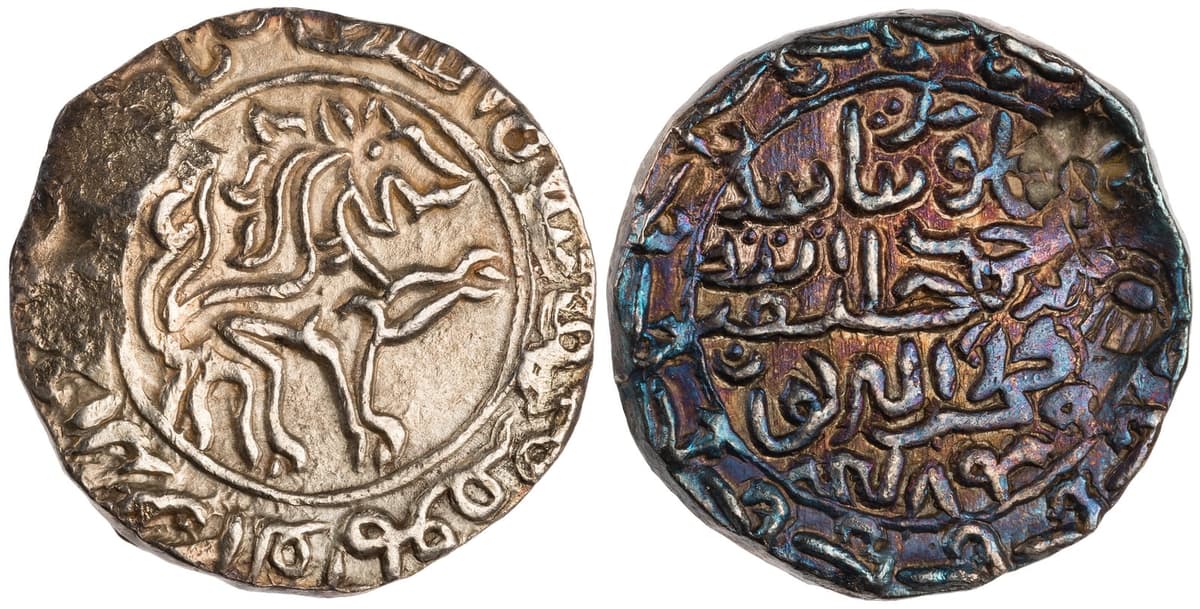
In 754 AH, the Islamic year that fell across 1353 and 1354, a silver coin was struck in the name of Shamsuddin Ilyas Shah at the mint of Sonargaon, as the American Numismatic Society describes the example it holds.11 The Society gives that coin as 25 millimetres across and 10.52 grams.12 Sonargaon, about 27 km south-east of today's Dhaka, had been the capital of a breakaway sultan, Fakhruddin Mubarak Shah, since 1338.13 In 1352 Ilyas Shah defeated Fakhruddin's successor there and brought the whole of Bengal under one ruler.14 His coins called him "the second Alexander, the right hand of the caliphate".15
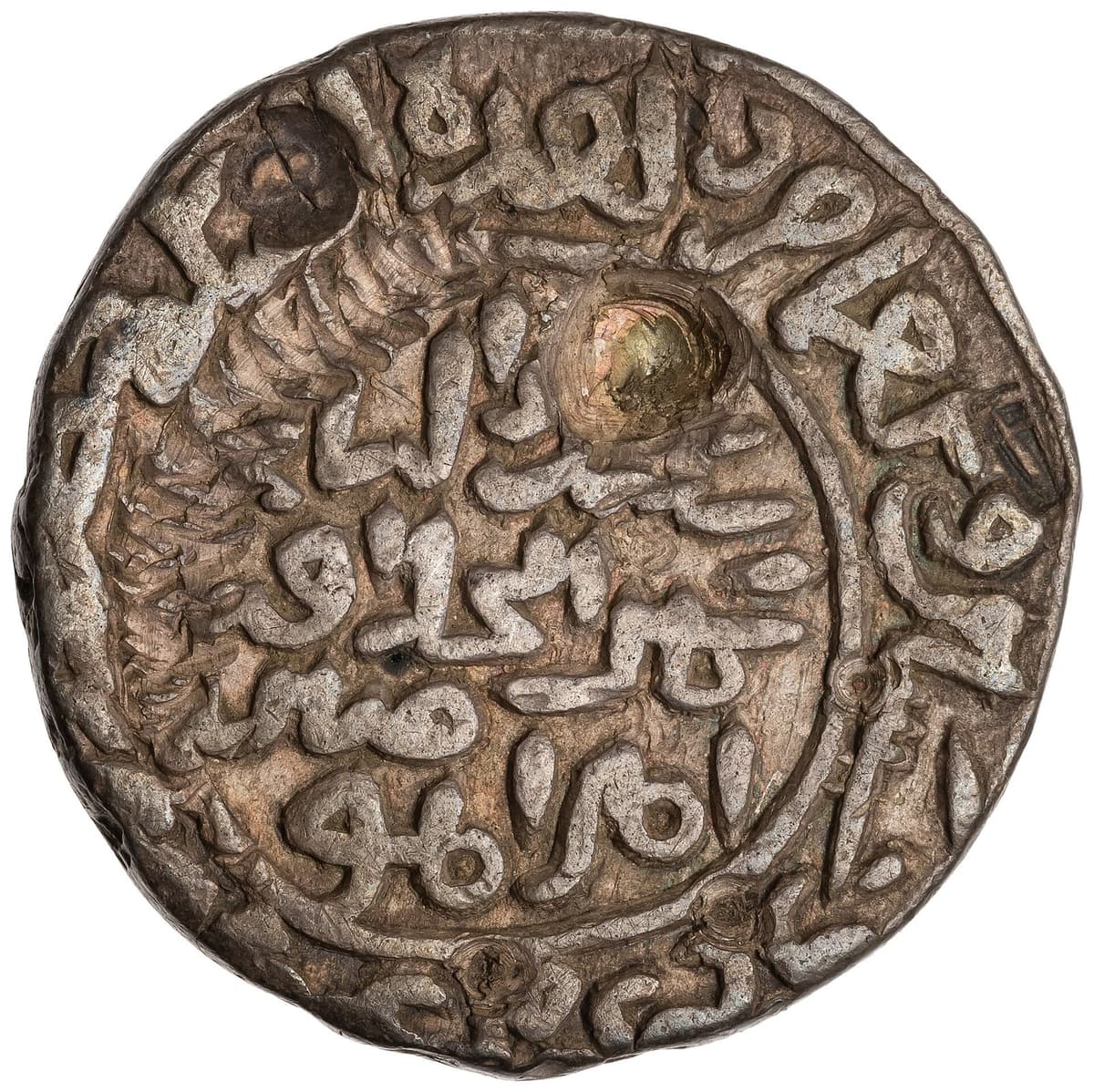
A coin like this was not a royal keepsake. About eighty years later a Chinese interpreter, Ma Huan, wrote that the king of Bengal cast a silver coin called the t'ang-ch'ieh, the tanka, and that "in every purchase and sale they all use this coin".17 The word outlived the sultans. Taka (টাকা), the name of Bangladesh's currency, comes from the Sanskrit tanka.18
This chapter follows that coin and the people who watched it change hands. Its argument, which follows the historian Richard Eaton's reading of the evidence, is that the sultanate was rich because the delta grew rice in surplus, wove cloth that sold across Asia, paid for things in silver it did not mine, and sent its goods out by sea.19 Contemporaries noticed. A Moroccan found food cheaper than anywhere else he had been; Chinese envoys described a court that gave away gold bowls; a Portuguese writer priced Bengal's cloth in the market of Malacca.20 Their testimony has limits, and the chapter marks them as it goes. But it points the same way as the hardest evidence there is: the coins.
From Delhi's governors to Bengal's own sultans, 1204 to 1352
Muslim rule in Bengal began as a province of the Delhi Sultanate. The only near-contemporary account of Muhammad Bakhtiyar's capture of the Sena capital in 1204 is by the chronicler Minhaj al-Siraj, who visited Bengal about forty years later.21 Minhaj says Bakhtiyar left "Nudiah" (Nadia) "in desolation", made Lakhnauti his seat of government, and instituted the khutba (the Friday sermon in the ruler's name) and "the coining of money".22 The raid itself is told in Kingdoms of Bengal.
Money came first, almost literally. In 601 AH (1204 to 1205) Bakhtiyar struck a gold coin in the name of his overlord, Muhammad Ghuri, showing a horseman with a mace and the Sanskrit words Gauḍa vijaye, "On the conquest of Gaur".23 Banglapedia calls it the first Muslim coin of Bengal and notes that Bakhtiyar's own name is not on it.24
Delhi's governors did not stay obedient for long. Ghiyasuddin Iwaz declared independence in 1213 and styled himself defender (nasir) of the caliph in Baghdad, which Eaton calls the first time any ruler in India claimed a direct link with the caliph; the armies of Sultan Iltutmish defeated him in 1227.25 Within a week of Sultan Balban's death in 1287, his son Bughra Khan, left behind as governor, declared independence too.26 Lakhnauti was a market town too: the historian Abdul Karim notes that Barani describes a market there a mile long, with shops on each side.27
In 1324 Sultan Ghiyasuddin Tughluq divided Muslim Bengal into three units, Lakhnauti, Satgaon and Sonargaon.28 When Bahram Khan, governor of Sonargaon, died in 1338, his armour-bearer (silahdar) Fakhruddin proclaimed himself sultan at Sonargaon; his coins run from 737 to 750 AH.29 In 1339 Ali Mubarak did the same at Lakhnauti as Alauddin Ali Shah, and moved his capital from Lakhnauti to Pandua.30
The man who joined the pieces was Shamsuddin Ilyas Shah. Banglapedia's account is that he became master of Satgaon in 1338, fought Alauddin Ali Shah from 1339 to 1342, took the throne of Lakhnauti in 1342, and in 1352 defeated Ikhtiyaruddin Ghazi Shah at Sonargaon.31 Eaton puts the decisive moment in 1342, when Ilyas Shah "wrested Bengal free from Delhi's grip" and founded the first of several dynasties that stayed independent of North India for about two and a half centuries.32
With Ilyas Shah the name of the country changes too. Banglapedia says he called the united territory "Bangalah", and that the contemporary historian Shams-i Siraj Afif called him Shah-i-Bangalah, Shah-i-Bangaliyan and Sultan-i-Bangalah.33 Eaton calls Afif's "sultan of the Bengalis" and "king of Bengal" "our first indigenous reference to 'Bengal'".34
Delhi tried twice to take Bengal back. In 1353 Sultan Firuz Tughluq invaded with a large army and briefly drove Ilyas Shah out of Pandua, which Banglapedia says Ilyas renamed Firuzabad that year; Eaton reports the Delhi court's claim that he "slew up to 180,000 Bengalis", a chronicler's figure rather than a count.35 A second invasion in 1359, against Ilyas Shah's successor Sikandar Shah, also failed, and after it no North Indian army disturbed Bengal for nearly two centuries.36
Who ruled, and when?
Reign dates for the sultans come mainly from their coins and inscriptions, and the two most-used lists differ by one to three years in many places. The table gives the main sultans in both. For every ruler, with a line on each, see Rulers of Bengal.
| Sultan | Eaton (1993) | Banglapedia |
|---|---|---|
| Fakhruddin Mubarak Shah (Sonargaon) | 1338 to 1349 | 1338 to 1349 |
| Alauddin Ali Shah (Lakhnauti) | 1341 to 1342 | 1339 to 1342 |
| Shamsuddin Ilyas Shah | 1342 to 1357 | 1342 to 1358 |
| Sikandar Shah | 1357 to 1389 | 1358 to 1390 |
| Ghiyasuddin Azam Shah | 1389 to 1410 | 1389 to 1410 (another article: 1390 to 1410) |
| Saifuddin Hamza Shah | 1410 to 1411 | 1410 to 1412 |
| Shihabuddin Bayazid Shah | 1411 to 1414 | 1413 to 1414 (another article: 1411/12 to 1414) |
| Jalaluddin Muhammad Shah | 1415 to 1432 | 1415 to 1416 and 1418 to 1433 |
| Shamsuddin Ahmad Shah | 1432 to 1433 | 1433 to 1435 |
| Nasiruddin Mahmud Shah I | 1433 to 1459 | 1435 to 1459 (coins article: 1434 to 1459) |
| Ruknuddin Barbak Shah | 1459 to 1474 | 1459 to 1474 (coins article: 1459 to 1476) |
| Jalaluddin Fath Shah | 1481 to 1486 | 1481 to 1487 |
| Abyssinian (Habshi) sultans | 1486 to 1493 | 1487 to 1493 |
| Alauddin Husain Shah | 1493 to 1519 | 1494 to 1519 (coins article: 1493 to 1519) |
| Nasiruddin Nusrat Shah | 1519 to 1532 | 1519 to 1532 |
| Ghiyasuddin Mahmud Shah | 1532 to 1538 | 1533 to 1538 |
| Sulaiman Karrani | 1565 to 1572 | 1563 to 1572 |
| Daud Khan Karrani | 1572 to 1575 | 1573 to 1576 |
Source: Eaton, appendix "Principal Muslim Rulers of Bengal"; Banglapedia articles on each sultan, its "Coins" and "History" articles.41
Ibn Battuta's "hell full of blessings", 1346
Ibn Battuta, the Moroccan traveller, reached Bengal in the summer of 1346.42 Banglapedia dates his entry at Sudkawan to 9 July 1346 and his departure from Sonargaon to 14 August, a stay of under two months.43 Where Sudkawan was is disputed: Chittagong for some scholars, including his translator Gibb and Banglapedia, and Satgaon for others.44 Eaton's text places the visit in 1345.45 Read what follows as one traveller's testimony: his own editors, Gibb and Beckingham, doubt parts of his Bengal chapter (see the box below).46 His first impression was of food.
It is a spacious country, producing rice in abundance. Nowhere in the world have I seen cheaper produce than there, but it is gloomy ...
The people of Khurasan, he went on, called Bengal "a hell full of blessings", which Banglapedia gives in Persian as dozakh-i-pur az n'imat.48 Then he gave prices. "I have seen rice sold in the bazaars there at twenty-five Dihli pounds for a silver dinar, which is eight dirhams ... I have heard them say that it was a high price."49 A man from the Maghrib told him he had bought a year's provisions for three people for eight dirhams.50
| Item | Quantity | Price |
|---|---|---|
| Husked rice | 25 Dihli pounds | 1 silver dinar (8 dirhams); locals called this "a high price" |
| Rice in the husk (an informant's earlier price) | 80 Dihli pounds | 8 dirhams |
| A year's provisions for three people (informant) | 1 year | 8 dirhams |
| Milch cow (buffalo) | 1 | 3 silver dinars |
| Fat hens | 8 | 1 dirham |
| Pigeon squabs | 15 | 1 dirham |
| Fat ram | 1 | 2 dirhams |
| Sugar | 1 Dihli pound | 4 dirhams |
| Julep (rose syrup) | 1 Dihli pound | 8 dirhams |
| Ghee | 1 Dihli pound | 4 dirhams |
| Sesame oil | 1 Dihli pound | 2 dirhams |
| Fine, high-quality cotton cloth | 1 piece, 30 cubits | 2 dinars |
Source: Ibn Battuta, trans. Gibb and Beckingham. By his own reckoning a silver dinar was 8 dirhams and a Dihli pound 20 Maghribi pounds; where the translation gives no unit, dirhams are implied. Banglapedia and Karim convert these prices into 20th-century paisa and taka, but those conversions rest on their own assumptions and are not Ibn Battuta's figures.51
Not everything on his list is comfortable to read. He also recorded the price of people: a young woman sold as a slave for one gold dinar, a boy for two.52 Nor was cheap food the same thing as an easy life for the farmers who grew it. Near Habanq, he says, Hindu cultivators paid "half of their produce and dues in addition"; a Chinese writer of 1349, Wang Ta-yüan, put the land-revenue demand at one-fifth.53
His most vivid picture is of the rivers. Leaving Habanq by boat, "We travelled on this river for fifteen days among villages and orchards as if we were walking through a bazaar. There were innumerable ships on the river and on each ship there was a drum."54 At Sonargaon he boarded a junk bound for what he called al-Jāwa, which his editors identify as Sumatra, forty days' sail away.55 The ruler there, Fakhruddin, he called "an excellent Sultan, a lover of strangers and specially of faqirs and sufis".56 Bengal's rice reached even the Maldives, whose people sold cowrie shells "in exchange for rice to the people of Bengal, who also use them as money".57
Pandua's builders: from Sikandar Shah to Jalaluddin, 1357 to 1433
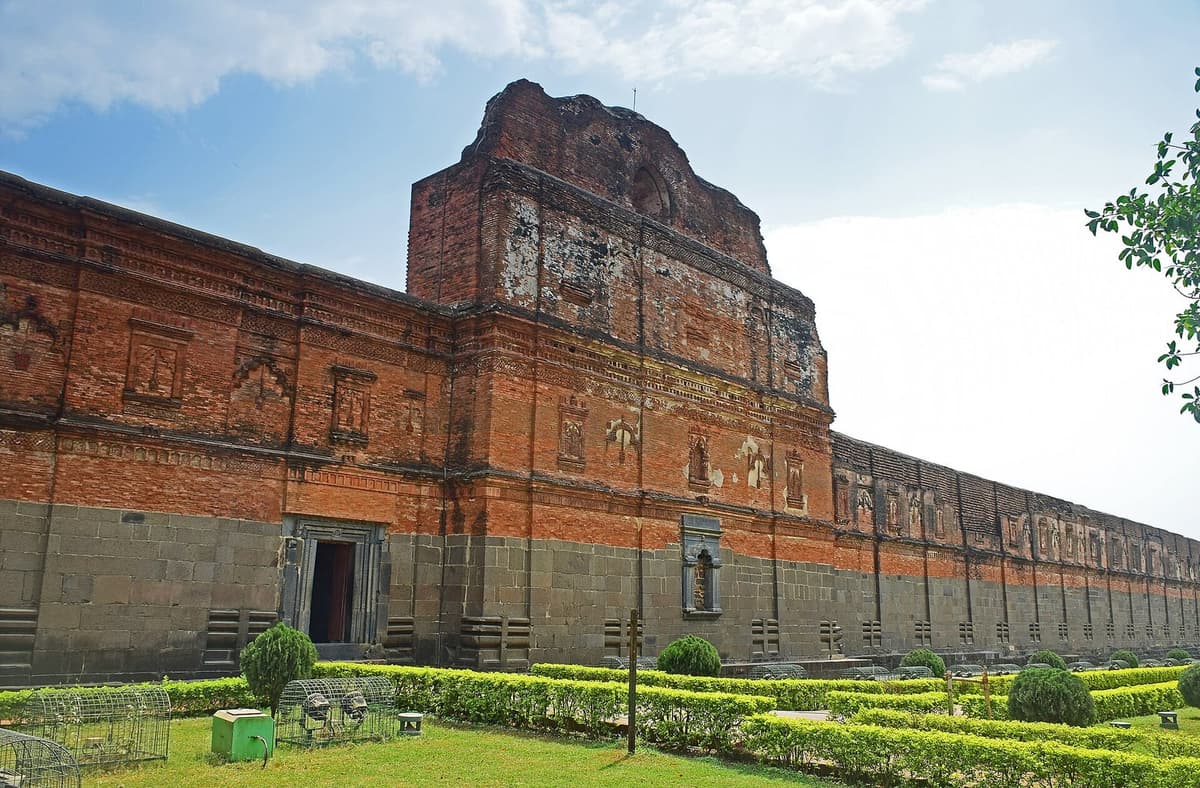
The Ilyas Shahi sultans spent their wealth on buildings meant to be seen from far away. Sikandar Shah's Adina mosque at Pandua measures 565 by 317 feet outside, with a courtyard of 445 by 168 feet and 370 domed bays.61 Eaton dates its completion to 1375 and says it "remains the largest mosque ever built in the Indian subcontinent"; Banglapedia reads an inscription on its back wall as giving 1373.62 Its western facade calls Sikandar "the most perfect of the Sultans of Arabia and Persia".63
Sikandar's successor, Ghiyasuddin Azam Shah, looked even further west. He sponsored religious colleges (madrasas) in Mecca and Medina and tried, without success, to persuade the poet Hafiz of Shiraz to come to his court.65 Banglapedia adds that he sent 30,000 gold mithqals to repair the water channel at Arafa, and sent ambassadors to China in 1405, 1408 and 1409.66 A sultan who could send that much gold abroad had money to spare. Eaton's wider point is that these early sultans sought their legitimacy abroad, in Persian kingship and the caliphate, and only later in Bengal itself.67
Raja Ganesha and the convert sultan
That turn towards Bengal came out of a crisis. In the early 15th century the real power at court passed to Raja Ganesha (also called Ganesh or Kans), described in a contemporary letter as "a landholder of four hundred years' standing".68 Whether he ever took the throne is disputed. Firishta (d. 1623) says he seized it and ruled "three years and several months"; Nizam al-Din Ahmad (d. 1594) says only that he "acquired power and dominion" for seven years.69 Banglapedia's articles say he usurped the throne in 1414 and ruled again from 1416 or 1417 to 1418.70 Coins of Muslim sultans run without a break from 1410 to 1417, which Eaton reads as a sign that Ganesha ruled "but did not reign", through puppet sultans.71
The Chishti shaikh of Pandua, Nur Qutb-i Alam, urged Sultan Ibrahim Sharqi of Jaunpur to invade Bengal against him.72 Banglapedia says Ganesha "followed a policy of persecuting and eliminating the Muslims"; Eaton notes that the persecution is reported by Sufi sources that are "naturally partial", and that Firishta records Ganesha making peace with Muslim nobles.73
In 1415 Ganesha's son Jadu, aged twelve according to a later source, converted to Islam and took the throne as Sultan Jalaluddin Muhammad Shah; coins in his name were issued at once from Pandua, Chittagong, Sonargaon and Satgaon.74 His coins name him "bin Kans Rāo", son of Raja Ganesha.75 Then came a strange interval. For 820 AH (February 1417 to February 1418) no sultanate coins are known; instead two Hindu kings, Danujamardanadeva and his son Mahendradeva, issued coins from Chittagong, Sonargaon and "Pandunagara", inscribed "devoted to the feet of Goddess Chandi".76
Who were they? Banglapedia says Danujamardanadeva was a title taken by Raja Ganesha himself, and that Mahendra was his younger son.77 Eaton, following the historian A. H. Dani, treats them as Deva kings of Chandradwip who rose against the sultanate and were put down by Ganesha.78 The question is unresolved. On either reading, Jalaluddin was back on the throne by 1418, and Banglapedia counts his reign in two phases, 1415 to 1416 and 1418 to 1433, where Eaton gives 1415 to 1432.79
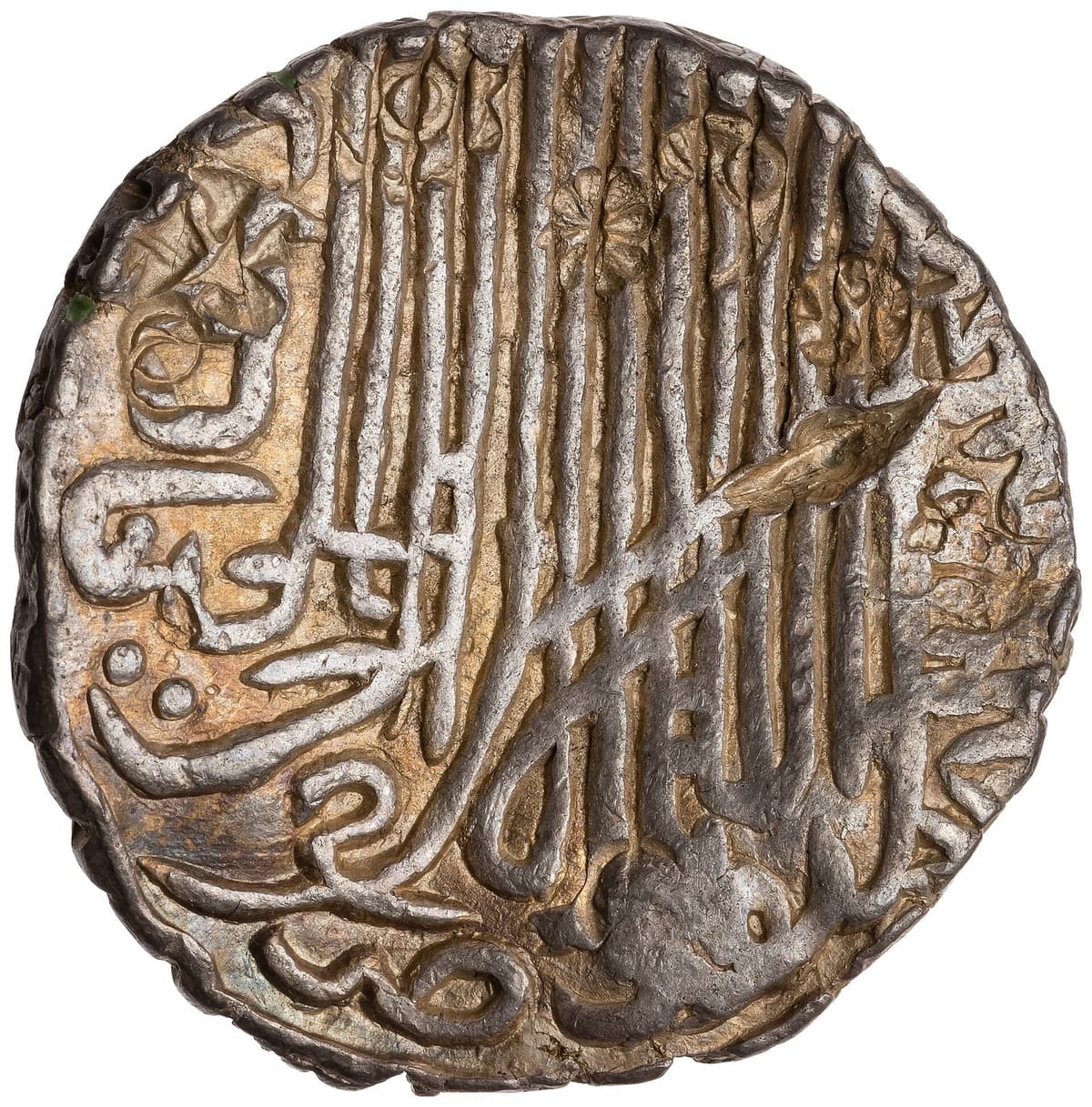
The convert sultan proved an ambitious one. Jalaluddin restored the Muslim confession of faith (the kalima) to Bengal's coins after about two centuries, and took the title "caliph of Allah" (Khalifat Allah), first in a mosque inscription of 1427 and three years later on his coins.80 In 1421 his mint at Pandua struck a commemorative silver coin weighing 105 grams and 6.7 cm across, which Eaton calls "perhaps the largest and heaviest coin ever struck in India"; the numismatist G. S. Farid argued it was made as a present for the emperor of China.81
His tomb, by tradition, is the Eklakhi mausoleum at Pandua, dated to about 1432 or 1433 from the year of his death rather than by any inscription.83 Its square plan, single dome, brick walls, curved cornice and terracotta decoration became the prototype of the Bengali-style mosque.84 The name, Banglapedia says, comes from a tradition that it cost one lakh (100,000) of tankas.85 Whether or not the story is true, people remembered the building by its price.
Ming embassies, a giraffe and Ma Huan, 1404 to 1439
In the early 15th century Bengal's sultans looked east as well as west, to Ming China.86 The historian Tansen Sen counts "at least eight embassies" from Bengal to the Ming court before 1420, and judges that "Bengal seems to have been a leading trading partner of the Ming court".87
Bengal sold cotton, textiles, gems and kingfisher feathers, and took back gold and silver objects, silk, blue-and-white porcelain, copper coins, musk, vermilion, quicksilver and pepper.88 The contact left a trace in language: a 16th-century Ming work, the Siyi guang ji, records more than 200 Bengali words in Chinese transcription.89
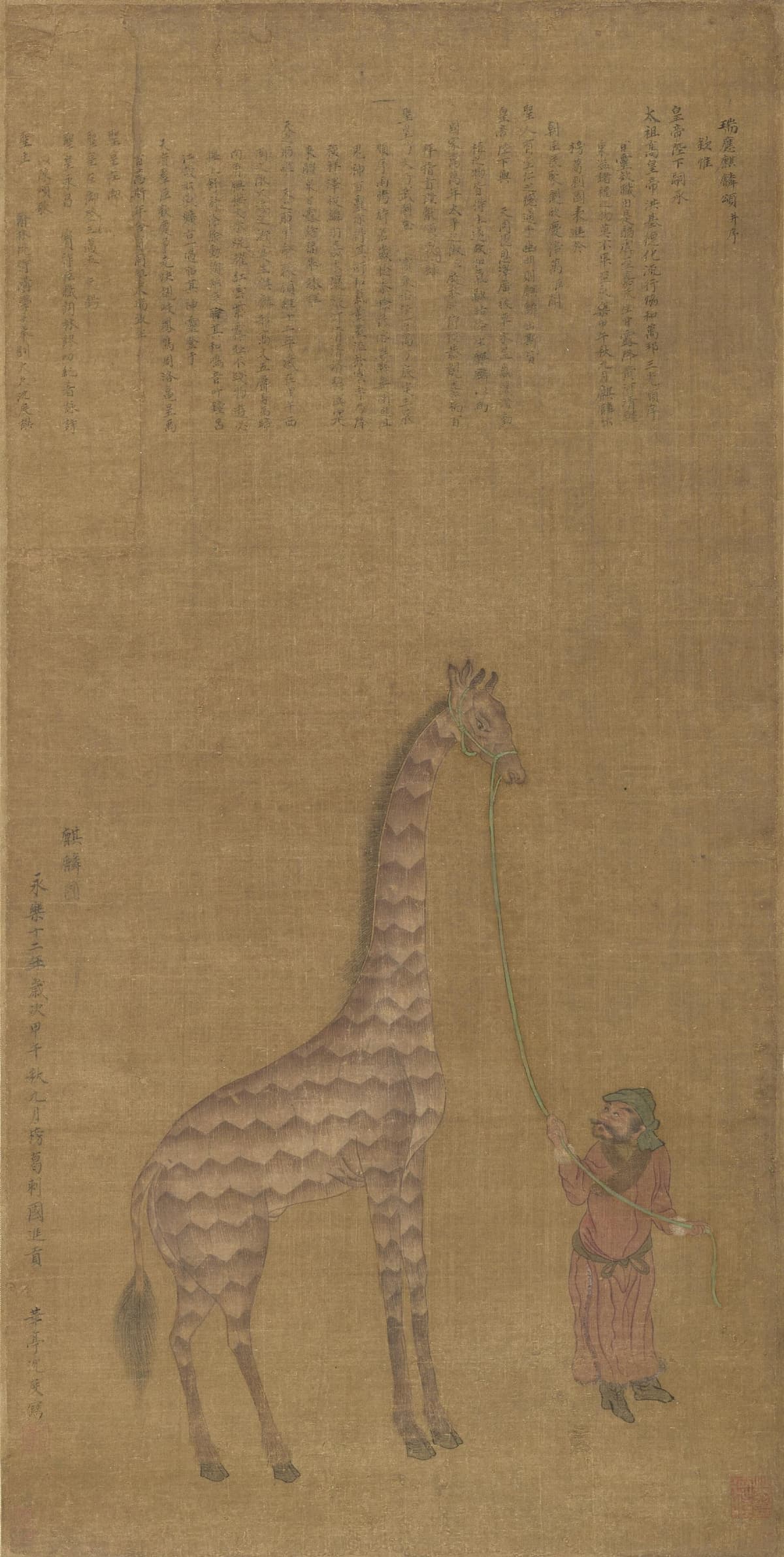
On 20 September 1414 the Ming court's Veritable Records noted a remarkable gift.90 In Geoff Wade's translation the entry reads: "The envoy who had been sent by Sai-fu-ding, the king of the country of Bengal, presented a memorial and a giraffe and offered tribute of fine horses and local products."91 A second giraffe from Bengal reached the court in 1438.92
The Chinese also came to Bengal, though not in the way often told. Zheng He's great fleets sailed between 1405 and 1433, but Sen notes that Bengal was among the places "he did not travel to personally"; detachments of the fleet and separate Ming embassies went instead.98 The eunuch envoy Hou Xian visited in 1415 and again in 1420, after the king of Bengal complained to the Yongle emperor about raids from Jaunpur; Hou Xian carried orders that both sides should "cultivate good relations with their neighbours", and the ruler of Bengal gave his soldiers silver coins.99
A member of the 1415 embassy left the most dazzling description of the court at Pandua; the words below are from Rockhill's translation of 1915, quoted in Eaton.100 The palace was of brick, its pillars "plated with brass ornamented with figures of flowers and animals", and the envoys saw "over a thousand men in shining armour", "hundreds of soldiers mounted on elephants" and a king on "a high throne inlaid with precious stones".101 After the banquet the sultan gave them "gold basins, gold girdles, gold flagons, and gold bowls".102 Of Pandua's merchants the envoy wrote, again as quoted in Eaton: "Everyone of them is engaged in business, the value of which may be ten thousand pieces of gold."103
Ma Huan's survey
The fullest Chinese description is by Ma Huan, an interpreter on three of Zheng He's voyages.104 His translator J. V. G. Mills dates his visit to Bengal to 1432, with the seventh expedition; Banglapedia's article on him says the missions came to Bengal on all three of his voyages, of 1413 to 1415, 1421 to 1423 and 1431 to 1433.105 He came in by Chittagong and Sonargaon and travelled 35 stages to the capital.106
The territory of the country is extensive, products abound, and the population is dense ... Wealthy individuals who build ships and go to various foreign countries to trade are quite numerous.
He noticed the coin: "The king of the country uses silver to cast a coin named a t'ang-ch'ieh; each coin weighs three ch'ien ... in every purchase and sale they all use this coin", with cowries for petty sums.108 He noticed the harvests: "The rice and grain ripen twice in a year."109 Market streets had "bathing-establishments, wine-shops, food-shops, sweetmeat-shops".110 The land produced "five or six kinds of fine cloths", one of which "is as fine as starched paper", as well as silks.111 And he noticed the sea: "The king also sends men to travel on board ship to the various foreign countries to trade."112 The later history of Bengal's fine cotton cloth is told in Dhaka Muslin and Jamdani.
Ma Huan also heard Bengali. "As the language of the country they all adopt Pang-ko-li, which constitutes an independent tongue, though there are also some people who speak the Pa-erh-hsi [Persian] language."113 His editor Mills, writing in 1970, summed up: "At the time of Ma Huan's visit in 1432, Bengal was an independent, powerful, and rich state."114 That is a modern judgement, not Ma Huan's. Another Chinese account, quoted in the historian Abdul Karim's social history, goes further: "the seasons of heaven have scattered the wealth of the Earth over this kingdom".115
Gaur, Bagerhat and the Abyssinian sultans, 1433 to 1493
The restored Ilyas Shahi sultans built a new capital and let a frontier lord build a city of his own. Banglapedia credits Nasiruddin Mahmud Shah with laying the foundations of the citadel and palace at Gaur; the city's first inscription, of December 1457, is on a bridge he built.116 Eaton dates the successive capitals as "Lakhnauti from 1204, Pandua from about 1342, and Gaur from about 1432"; Banglapedia's Gaur article gives Gaur as capital "from c. 1450 AD to 1565 AD".117
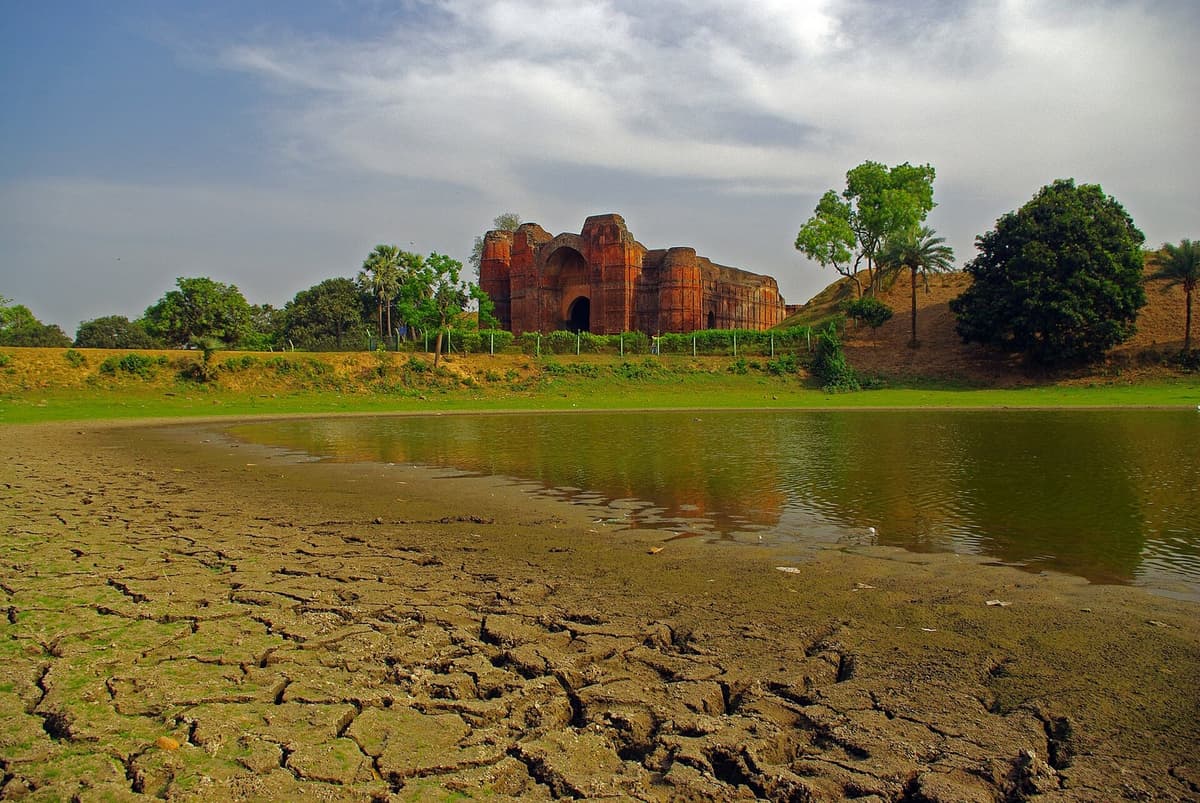
In the far south, in Nasiruddin Mahmud Shah's time, a commander called Khan Jahan ruled Khalifatabad, today's Bagerhat; his tomb gives him the titles Ulugh Khan and Khan-i-Azam, and he died on 25 October 1459.119 UNESCO, which says the city was "founded by the Turkish general Ulugh Khan Jahan in the 15th century", inscribed it on the World Heritage List in 1985.120 The city extended over 50 km², in two zones 6.5 km apart around the Shait-Gumbad mosque and Khan Jahan's mausoleum, and was overgrown by jungle after his death.121
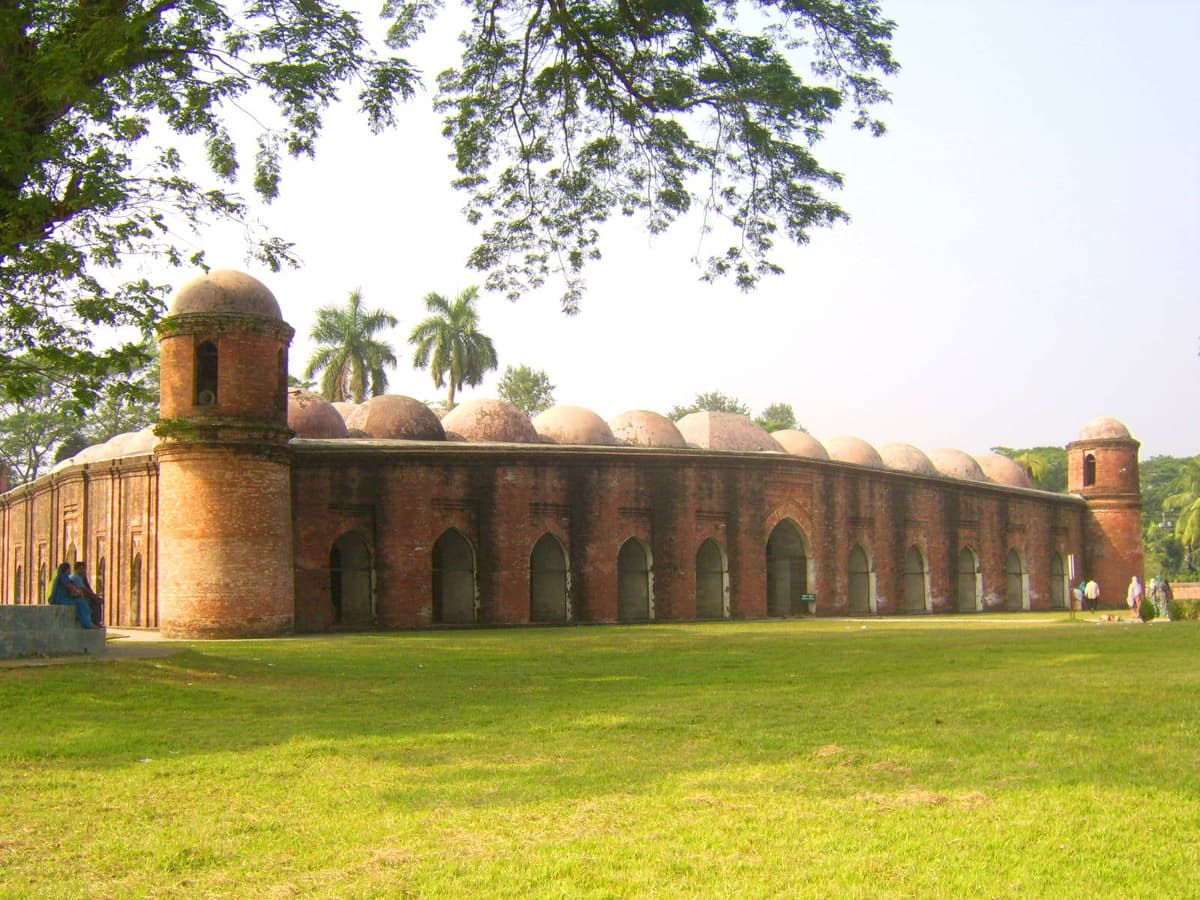
Its great building is the Shatgumbad, or Sixty Dome, Mosque, which Banglapedia dates to about 1450, although no foundation inscription has been quoted.122 It measures 48.77 m north to south and 32.92 m east to west outside, and rests on 60 pillars.123 Despite its name it has 81 domes: 70 over the side wings, 7 chau-chala vaults over the central nave and 4 on the corner towers.124
Back at court, the sultans' wealth bought soldiers, and the soldiers took over. In the 1460s and 1470s Abyssinian (Habshi) slaves were recruited into military and civil service; Banglapedia says Ruknuddin Barbak Shah is "known to have recruited about eight thousand".128 In 1486 a coup ended the Ilyas Shahi line, followed by seven years of palace coups; Banglapedia counts the Habshi period as about six years (1487 to 1493) under four rulers.129 Tomé Pires, writing some twenty years later, heard that in Bengal "whoever kills the king becomes king", and that "the people who govern the kingdom are Abyssinians".130
Husain Shah's Bengal through foreign eyes, 1493 to 1538
Four of the foreign accounts in this chapter come from the reigns of a single dynasty. Alauddin Husain Shah (also spelt Hussain or Husayn), described by Eaton as "a Meccan Arab" who had been chief minister under an Abyssinian ruler, took power in a palace coup and founded the Husain Shahi dynasty.131 His coins call him "Sultan Husain Shah bin Saiyid Ashraf-ul-Husaini".132 Eaton notes that the reigns of Husain Shah (1493 to 1519) and his son Nusrat Shah (1519 to 1532) "are generally regarded as the 'golden age' of the Bengal sultanate".133
The court was more Bengali than ever. Under Husain Shah the chief minister, the chief of the bodyguard, the master of the mint, the governor of Chittagong, the private physician and the private secretary were Bengali Hindus.134 In 1494 he annexed Kamata (Kuch Bihar) and Kamrup (western Assam), and his commemorative coins proclaim him conqueror of "Kamrup and Kamta and Jajnagar and Orissa".135 He and Nusrat Shah patronised Bengali literature, from the Padma-Purana of Vijaya Gupta to Bengali versions of parts of the Mahabharata.136
What the Italians and Portuguese saw
The Italian traveller Ludovico di Varthema, in Gaur between 1503 and 1508, wrote, as quoted in Eaton, that "fifty ships are laden every year in this place with cotton and silk stuffs", and that it had "the richest merchants I have ever met with".137 The Portuguese writer Tomé Pires, who wrote his Suma Oriental between 1512 and 1515, measured Bengal's trade against Malacca's.138 "The Bengalees are merchants with large fortunes, men who sail in junks," he wrote, and "the land is very rich".139 Parsees, Turks, Arabs and merchants from Chaul, Dabhol and Goa lived among them.140
Pires put numbers on the trade. Four or five ships a year sailed from Bengal to Malacca and Pase, each carrying "from eighty to ninety thousand cruzados worth" of fine white cloths, bed-canopies, wall hangings and sugar preserves.141 "Bengali cloth fetches a high price in Malacca, because it is a merchandise all over the East."142 A merchant going to Bengal paid "three on every eight", but made a profit of two and a half to three times on the goods he sold.143 He reckoned the "City of Bengal", which his editor Cortesão identifies as Gaur, at forty thousand inhabitants, and Satgaon at ten thousand, "a good city and rich, where there are many merchants".144
Duarte Barbosa, whose book was finished about 1518, wrote from merchants' and sailors' reports rather than his own visit.145 His "city of Bengala", whose identity is disputed, had "many cotton-fields, patches of sugar-cane, of ginger and long pepper".146 Its weavers made "very fine and coloured cloths" and "white sorts for sale in various countries. They are very precious"; of the kinds he names, he ranks the sinabafas first, "which latter are the best of all".147 The cloth was spun on wheels and woven by men, and sold cheaply at home.148 Its merchants, he says, "are luxurious, eat well and spend freely", and the king "is a great and rich Lord over wide and thickly-peopled lands".149 He also records merchants buying boys to castrate and sell as eunuchs, another reminder that this trade economy dealt in people.150
| What | Figure | Writer |
|---|---|---|
| Ships laden every year at Gaur with cotton and silk cloth | 50 | Varthema (in Gaur 1503 to 1508), quoted by Eaton |
| Ships a year from Bengal to Malacca and Pase | 4 to 5 | Pires |
| Value of goods on each Bengal junk to Malacca | 80,000 to 90,000 cruzados | Pires |
| Duty at Malacca on Bengal goods | 6 per cent | Pires |
| Charge on a merchant going to Bengal | 3 in every 8 | Pires |
| Profit on goods sold in Bengal | 2.5 to 3 times | Pires |
| One piece of Bengal cloth | 23 to 24 Portuguese yards | Barbosa |
| A quintal of Bengal sugar in Malabar | 1,300 reis | Barbosa |
| A good chautar cloth in Malabar | 600 reis | Barbosa |
| A sinabafa cloth in Malabar | 2 cruzados | Barbosa |
Source: Pires, trans. Cortesão; Barbosa, trans. Dames; Eaton, quoting Varthema.151
Portuguese ships reached Chittagong in about 1516 to 1518; Banglapedia dates the arrival of João de Silveira's fleet to 9 May 1518.152 The first European mission known to have reached the sultan's court came in 1521, and Eaton calls it "the earliest-known European mission to Bengal".153 A Portuguese account of 1521, quoted in Eaton, describes Gaur as "very big, stretching for four leagues along the river", with brick-paved streets, where "the market is everywhere and everything ... is in plentiful supply and very cheap".154 The mission's anonymous interpreter, also quoted in Eaton, watched the sultan's alms: 150 cartloads of cooked rice and money "to the value of six hundred thousand of our tangas" thrown to four or five thousand people.155
The golden age ended in war. Nusrat Shah sheltered Afghans defeated by Babur in 1526, and later suffered reverses against Babur's army at the battle of the Ghogra.156 Then the Afghan Sher Khan, later Sher Shah Sur, besieged Gaur, which fell in April 1538; Ghiyasuddin Mahmud Shah died soon after, and Banglapedia dates the end of the independent sultanate to that year.157 After Sher Shah's attack, Mahmud Shah had let the Portuguese build factories and customs houses at Chittagong and Satgaon.158
Silver, cowries and a money economy
Behind every traveller's impression sits a harder kind of evidence: the coins. Eaton's argument is that "it was under Muslim rule, too, that Bengal's economy first became thoroughly monetized".159 In Pala and Sena times most of the delta "is not known to have used metal coinage at all", but "from the thirteenth century to the seventeenth, the Muslim rulers' silver coin, the tanka, circulated uninterrupted throughout the region".160 The economy Eaton describes is one that ran on money and exports: "Clearly, Bengal had become a major center of Asian trade and manufacture".161
The silver came from outside. None was mined in the delta; it came from the border region of Burma and Yunnan.162 Drawing on John Deyell's work on silver supply, Eaton shows that each conquest, from Kaikaus in 1291 through Fakhruddin's Sonargaon, Sikandar's in Kamrup in 1358 and Jalaluddin's in 1420 to Husain Shah's in 1494, was followed by more silver coinage, minted from captured silver.163 Trade brought more. In 1569 the traveller Cesare Federici wrote, as quoted in Eaton, that "Silver and Gold ... from Pegu they carrie to Bengala, and no other kind of Merchandize".164 Pires's figures point the same way: gold, he says, was worth a sixth more in Bengal than in Malacca, and silver a fifth less.165
The coin itself kept to a standard. Banglapedia says the sultans' silver coins were full tankas of roughly one tola, at first on Delhi's standard of 177 grains (11.6 g) and later reduced to 166 grains (10.8 g).166 Ma Huan weighed the tanka at three ch'ien, which Mills converts to 172.68 grains, and Pires at half a tael.167
Small change was a shell. Cowries came from the Maldives, as Ibn Battuta recorded, and Ma Huan says they were used for petty sums.168 Pires gives the chain: one tanqat was 7 cahon, a cahon 16 pon and a pon 80 cowries, so one silver tanka was worth 8,960 shells.169 Banglapedia records the Bengali count, from 4 cowries to a ganda up to 10 kahans to a rupee or tanka.170
| What | Figure | Source |
|---|---|---|
| Early sultanate standard | 177 grains (11.6 g) | Banglapedia |
| Later sultanate standard | 166 grains (10.8 g) | Banglapedia |
| Weight in 1432 | 3 ch'ien (Mills: 172.68 grains) | Ma Huan |
| Diameter in 1432 | 1 ts'un 2 fen (Mills: 1.4 inches) | Ma Huan |
| Weight, c. 1512 to 1515 | Half a tael | Pires |
| Value in cowries, c. 1512 to 1515 | 8,960 | Pires |
| Silver in Bengal compared with Malacca | One-fifth cheaper | Pires |
| Jalaluddin's commemorative coin, Pandua, 1421 | 105 g; 6.7 cm across | Eaton |
| Mints named on sultanate coins | 27 names, about 16 places | Banglapedia |
Source: Banglapedia, "Coins"; Ma Huan, trans. Mills; Pires, trans. Cortesão; Eaton.172
Not every historian sees the same plenty of metal. Banglapedia's article on the currency system says gold and silver stayed scarce until the Husain Shahi sultans, while its article on coins says silver coins of all the sultans are found "abundantly".173 Eaton's numismatic argument is the fuller one, but it is an argument from surviving coins and mint names, not from any count of how much money circulated. For Bengal's economy over the longer run, see The economy of Bengal and Bangladesh.
Afghans, Rajmahal and the Baro-Bhuiyans, 1538 to 1612
After 1538 Bengal changed hands between Afghan and Mughal armies, and the Mughal emperor Humayun held Gaur for about nine months, before its Afghan rulers made themselves sultans again.174 In 1553 the Sur governor Muhammad Khan Sur declared independence as Sultan Shamsuddin Muhammad Shah Ghazi, and his line ruled until 1563.175 That year Taj Khan Karrani took Gaur, and his brother Sulaiman Karrani moved the capital to Tanda, which Banglapedia's Gaur article dates to 1565.176 Sulaiman conquered Orissa in 1567, but outwardly accepted the emperor Akbar's overlordship, reading the khutba and striking coins in Akbar's name.177
His son Daud Khan Karrani dropped the pretence and read the khutba and struck coins in his own name.178 Akbar's armies came: after the battle of Tukaroi on 3 March 1575 and the treaty of Katak on 12 April, the decisive battle was fought at Rajmahal on 12 July 1576 (15 Rabi II 984 AH).179 Daud was captured when his horse stuck in a quagmire, and was executed on the order of the Mughal commander Khan-i-Jahan (Husain Quli Beg).180
Rajmahal ended the sultanate but not resistance. In the low-lying country of Bhati, in parts of greater Dhaka, Mymensingh, Tippera and Sylhet, local chiefs whom Abul Fazl in the Akbarnama and Mirza Nathan in the Baharistan-i-Ghaibi both describe with the word for "twelve", the Baro-Bhuiyans (বারো ভূঁইয়া), held out.181 Their leader, Isa Khan, took the title Masnad-i-Ala and made his capital at Katrabo on the Lakhya river; in September 1597 he defeated a Mughal flotilla, killing Durjan Singh, son of Man Singh, and he died in September 1599.182 The Baro-Bhuiyans finally submitted to the Mughal governor Islam Khan Chishti, who moved the capital to Dhaka, and by 1612 all of Bengal except Chittagong was under Mughal control.183 What followed is told in Mughal Bengal and the Nawabs.
The sultanate in dates
- 1204Muhammad Bakhtiyar takes Nadia and makes Lakhnauti his seat of government.184
- 1204 to 1205 (601 AH)The first Muslim coin of Bengal, inscribed "Gauḍa vijaye".185
- 1338Fakhruddin Mubarak Shah declares independence at Sonargaon.186
- 1342Ilyas Shah takes Lakhnauti.187
- 9 July to 14 August 1346Ibn Battuta in Bengal (Banglapedia's dates).188
- 1352Ilyas Shah takes Sonargaon; Bengal is united under one ruler.189
- 1353 and 1359Firuz Tughluq's two invasions fail to retake Bengal.190
- 1373 or 1375Adina mosque built at Pandua.191
- 20 September 1414A giraffe from Bengal is presented at the Ming court.192
- 1415Jalaluddin Muhammad Shah, son of Raja Ganesha, takes the throne; Hou Xian's first mission.193
- 1432Ma Huan in Bengal, by Mills's dating.194
- 25 October 1459Death of Khan Jahan of Bagerhat.195
- 1486 or 1487A coup ends the Ilyas Shahi dynasty; the Abyssinian sultans follow.196
- 1493 or 1494Alauddin Husain Shah takes the throne.197
- 1512 to 1515Tomé Pires writes the Suma Oriental.198
- 1521First European mission known to reach the sultan's court.199
- April 1538Gaur falls to Sher Khan; end of the independent sultanate in Banglapedia's count.200
- 12 July 1576Battle of Rajmahal; Daud Khan Karrani is captured and executed.201
- September 1599Death of Isa Khan.202
- 1612All Bengal except Chittagong under Mughal control.203
How rich was the sultanate, really?
Rich enough that nearly every visitor quoted in this chapter remarked on its plenty. Ibn Battuta found locals calling 25 Dihli pounds of rice for a silver dinar a high price; Ming envoys were handed gold bowls; Pires valued a single junk's cargo at up to 90,000 cruzados.204
Those witnesses need to be weighed, not just quoted. Ibn Battuta's editors doubt parts of his Bengal chapter; Barbosa wrote from other people's reports; the Chinese envoy's "ten thousand pieces of gold" is an impression of merchants' fortunes, not an audit; and Pires's "hundred thousand mounted men" is hearsay.205 They saw wealth as a merchant or an envoy sees it, in markets, ports and courts. They say little about the farmers who paid a fifth, or half, of their harvest in revenue.206
The evidence suggests, all the same, that the visitors were right about the sources of the wealth. Rice ripened twice a year in a densely peopled land.207 Cloth was "a merchandise all over the East".208 Silver, which the delta did not mine, came in by conquest and by trade, and the sultans turned it into a coin that everyone used.209 And Bengal's own merchants and its kings sent ships out to sell.210 That coin, the tanka, is the best witness of all. One was struck at Sonargaon in 754 AH (1353 to 1354); Ma Huan recorded its weight on his visit of 1432; Pires counted it in cowries some eighty years later; and its name lives on in the money of Bangladesh.211
Further reading
Richard Eaton's The Rise of Islam and the Bengal Frontier, 1204-1760 (1993) is the standard modern account, and the source of the argument about silver and a money economy followed here.212 Abdul Karim's Social History of the Muslims in Bengal (down to A.D. 1538) (1959) collects the Chinese and Portuguese testimony on prices and trade.213 Momtazur Rahman Tarafdar's Husain Shahi Bengal, 1494-1538 A.D. (1965) is the standard study of that dynasty.214 On China, Tansen Sen's chapter in Ming China: Courts and Contacts 1400-1450 (2016) and Mahmood Kooria's open-access article in the Journal of the Economic and Social History of the Orient (2021) are the best starting points.215 Perween Hasan's "Sultanate Mosques and Continuity in Bengal Architecture" (1989) links the square brick mosques of the sultans to Bengal's Buddhist temple tradition, and Sanjay Subrahmanyam's "Notes on the Sixteenth Century Bengal Trade" (1987) covers the Portuguese era.216 The travellers themselves are best read in the Hakluyt Society translations of Ibn Battuta, Ma Huan, Pires and Barbosa.217
Questions students and journalists ask
Who was the first independent sultan of Bengal?
It depends on what counts as independent. Fakhruddin Mubarak Shah declared independence at Sonargaon in 1338, and Banglapedia starts the independent sultanate then. Richard Eaton starts it in 1342, when Shamsuddin Ilyas Shah took Lakhnauti and broke free of Delhi. Ilyas Shah united all of Bengal in 1352 by taking Sonargaon, and Banglapedia calls him the real founder of the sultanate.
Who was the last independent sultan of Bengal?
Ghiyasuddin Mahmud Shah, the last Husain Shahi sultan, lost Gaur to Sher Shah in April 1538, and Banglapedia ends the independent sultanate there. But Afghan rulers declared independence again from 1553. The last of them, Daud Khan Karrani, was captured and executed after the Mughal victory at Rajmahal on 12 July 1576, which ended Afghan rule in Bengal.
What was the capital of the Bengal Sultanate?
The capital moved several times. Lakhnauti was the seat of government from 1204; Pandua, also called Firuzabad, from about 1342; and Gaur from the 15th century, about 1432 according to Eaton or about 1450 according to Banglapedia. Sonargaon was the capital of Fakhruddin's eastern sultanate from 1338 to 1352. The Karrani sultans moved the capital from Gaur to Tanda in the 1560s.
When did Ibn Battuta visit Bengal, and what did he say about it?
Ibn Battuta spent under two months in Bengal in 1346, from July to August by Banglapedia's dates, leaving by sea from Sonargaon. He called it a spacious country producing rice in abundance, with the cheapest food he had seen anywhere, but gloomy; people from Khurasan called it a hell full of blessings. He listed prices for rice, cattle, hens, sugar and cloth. His editors warn that parts of his Bengal account cannot be true.
What was the tanka, and what did Bengal Sultanate coins look like?
The tanka was the sultans' silver coin, weighing about 10.5 to 11.6 grams and carrying Arabic legends with the ruler's name and titles. Some later coins show a lion. The Chinese visitor Ma Huan, who came in 1432, wrote that everyone used it to buy and sell, with cowrie shells for small sums. Richard Eaton argues it circulated without a break from the 13th to the 17th century. Bangladesh's currency, the taka, takes its name from it.
Who was Raja Ganesha, and who was his son?
Raja Ganesha was a Hindu landholder who became the real power in Bengal in the early 15th century. Sources disagree on whether he took the throne himself or ruled through puppet sultans. His son Jadu converted to Islam and became Sultan Jalaluddin Muhammad Shah in 1415. Historians also disagree on whether Danujamardanadeva, a Hindu king who struck coins in 1417 to 1418, was Ganesha himself or a separate rebel king.
What is the difference between the Ilyas Shahi and Husain Shahi dynasties?
The Ilyas Shahi dynasty was founded by Shamsuddin Ilyas Shah, who united Bengal in 1352. It ruled until about 1415, was interrupted by Raja Ganesha's house, and was restored from about 1433 until a coup in 1486 or 1487. The Husain Shahi dynasty was founded by Alauddin Husain Shah in 1493 or 1494 and ruled until 1538. The reigns of Husain Shah and his son Nusrat Shah are generally regarded as the sultanate's golden age.
Who built the Sixty Dome Mosque in Bagerhat?
The Shatgumbad, or Sixty Dome, Mosque stands in the city of Khalifatabad, today's Bagerhat, founded in the 15th century by Khan Jahan, also called Ulugh Khan, who died in 1459. Banglapedia dates the mosque to about 1450, though no foundation inscription has been quoted. Despite its name it has 81 domes and 60 pillars. The mosque city has been a UNESCO World Heritage Site since 1985.
Why did Bengal send a giraffe to China?
In 1414 an envoy from Bengal presented a giraffe to the Yongle emperor of Ming China, together with horses and local products, as part of a busy exchange of embassies; Bengal sent at least eight before 1420. The Ming record names the sender as Sai-fu-ding, king of Bengal, while Banglapedia credits Shihabuddin Bayazid Shah, so the sender is uncertain. A second giraffe from Bengal reached the Ming court in 1438.
Who were the Baro-Bhuiyans, and who was Isa Khan?
The Baro-Bhuiyans, the "twelve" chiefs, were local rulers of Bhati, the low-lying country around greater Dhaka, Mymensingh, Tippera and Sylhet, who resisted the Mughals after 1576. Their leader, Isa Khan, took the title Masnad-i-Ala, ruled from Katrabo on the Lakhya river and defeated a Mughal flotilla in 1597. He died in 1599, and the Baro-Bhuiyans later submitted to the Mughal governor Islam Khan.
Notes
- Richard M. Eaton, The Rise of Islam and the Bengal Frontier, 1204-1760, UC Press E-Books Collection; the online edition has no page numbers, so notes cite chapter, section or appendix (Berkeley: University of California Press, 1993), ch. 2, https://publishing.cdlib.org/ucpressebooks/view?docId=ft067n99v9; Delwar Hussain et al., "History," Banglapedia: National Encyclopedia of Bangladesh, Sections on the Delhi governors, Iliyas Shahi period, Habshi rule, Husain Shahi rule, Afghan rule and the Mughal period. Dhaka: Asiatic Society of Bangladesh, accessed 22 November 2026, https://en.banglapedia.org/index.php/History; Muhammad Ansar Ali, "Rajmahal, The Battle of," Banglapedia: National Encyclopedia of Bangladesh, Dhaka: Asiatic Society of Bangladesh, accessed 22 November 2026, https://en.banglapedia.org/index.php/Rajmahal,_The_battle_of. ↩
- Eaton, Rise of Islam, ch. 4; Ma Huan, Ying-yai Sheng-lan: "The Overall Survey of the Ocean's Shores" [1433], Translated from the Chinese text edited by Feng Ch'eng-chün, with introduction, notes and appendices by J. V. G. Mills. Hakluyt Society Extra Series 42 (Cambridge: Cambridge University Press for the Hakluyt Society, 1970), 160-63; Tomé Pires, The Suma Oriental of Tomé Pires. Vol. 1, Translated and edited by Armando Cortesão. Hakluyt Society, 2nd ser., no. 89 (London: Hakluyt Society, 1944), 88-92. ↩
- Ibn Battuta, The Travels of Ibn Battuta, A.D. 1325-1354. Vol. 4, Translated by H. A. R. Gibb; translation completed with annotations by C. F. Beckingham. Works Issued by the Hakluyt Society, 2nd ser., no. 178 (London: Hakluyt Society, 1994), 867-68; Ma Huan, Ying-yai Sheng-lan, 160-61; Pires, Suma Oriental, 88-89; Duarte Barbosa, The Book of Duarte Barbosa: An Account of the Countries Bordering on the Indian Ocean and Their Inhabitants. Vol. 2, Translated and edited by Mansel Longworth Dames (London: Hakluyt Society, 1921), 145-48. ↩
- ABM Shamsuddin Ahmed, "Iliyas Shah," Banglapedia: National Encyclopedia of Bangladesh, Dhaka: Asiatic Society of Bangladesh, accessed 22 November 2026, https://en.banglapedia.org/index.php/Iliyas_Shah; Hussain et al., "History". ↩
- Ibn Battuta, Travels of Ibn Battuta, 867. ↩
- Tansen Sen, "Diplomacy, Trade and the Quest for the Buddha's Tooth: The Yongle Emperor and Ming China's South Asian Frontier," in Ming China: Courts and Contacts 1400-1450, ed. Craig Clunas, Jessica Harrison-Hall, and Luk Yu-ping (London: British Museum, 2016), 29, https://britishmuseum.iro.bl.uk/concern/books/97c3f2e8-57bd-4b38-be78-5b84c9d264fb. ↩
- Pires, Suma Oriental, 92. ↩
- Pires, Suma Oriental, 93-94. ↩
- Ali, "Rajmahal, The Battle of". ↩
- Eaton, Rise of Islam; Ibn Battuta, Travels of Ibn Battuta; Sen, "Diplomacy, Trade and the Quest"; Pires, Suma Oriental; Hussain et al., "History". ↩
- American Numismatic Society, "Silver Tanka of Shams al-Din Ilyas Shah, Bengal, 754 H.," Collection object 1974.26.1660; description as published with the image on Wikimedia Commons, accessed 22 November 2026, http://numismatics.org/collection/1974.26.1660. ↩
- American Numismatic Society, "Silver Tanka of Ilyas Shah". ↩
- Muazzam Hussain Khan, "Sonargaon," Banglapedia: National Encyclopedia of Bangladesh, Dhaka: Asiatic Society of Bangladesh, accessed 22 November 2026, https://en.banglapedia.org/index.php/Sonargaon. ↩
- Ahmed, "Iliyas Shah"; Hussain et al., "History". ↩
- Eaton, Rise of Islam, ch. 2. ↩
- American Numismatic Society, "Silver Tanka of Ilyas Shah"; Ahmed, "Iliyas Shah". ↩
- Ma Huan, Ying-yai Sheng-lan, 161. ↩
- Sirajul Islam, "Taka," Banglapedia: National Encyclopedia of Bangladesh, Dhaka: Asiatic Society of Bangladesh, accessed 22 November 2026, https://en.banglapedia.org/index.php/Taka. ↩
- Eaton, Rise of Islam, ch. 4; Ibn Battuta, Travels of Ibn Battuta, 867; Pires, Suma Oriental, 92. ↩
- Ibn Battuta, Travels of Ibn Battuta, 867; Eaton, Rise of Islam, ch. 2; Pires, Suma Oriental, 92. ↩
- Eaton, Rise of Islam, ch. 2. ↩
- Eaton, Rise of Islam, ch. 2. ↩
- Eaton, Rise of Islam, ch. 2. ↩
- Md Rezaul Karim, "Coins," Banglapedia: National Encyclopedia of Bangladesh, Sections "Sultani coins" and "Pathan (Afghan) coins". Dhaka: Asiatic Society of Bangladesh, accessed 22 November 2026, https://en.banglapedia.org/index.php/Coins. ↩
- Eaton, Rise of Islam, ch. 2. ↩
- Eaton, Rise of Islam, ch. 2. ↩
- Abdul Karim, Social History of the Muslims in Bengal (down to A.D. 1538) (Dacca: Asiatic Society of Pakistan, 1959), 182. ↩
- Hussain et al., "History". ↩
- Hussain et al., "History"; Muazzam Hussain Khan, "Fakhruddin Mubarak Shah," Banglapedia: National Encyclopedia of Bangladesh, Dhaka: Asiatic Society of Bangladesh, accessed 22 November 2026, https://en.banglapedia.org/index.php/Fakhruddin_Mubarak_Shah; Karim, "Coins". ↩
- ABM Shamsuddin Ahmed, "Alauddin Ali Shah," Banglapedia: National Encyclopedia of Bangladesh, Dhaka: Asiatic Society of Bangladesh, accessed 22 November 2026, https://en.banglapedia.org/index.php/Alauddin_Ali_Shah. ↩
- Ahmed, "Iliyas Shah"; Hussain et al., "History". ↩
- Eaton, Rise of Islam, ch. 2. ↩
- Ahmed, "Iliyas Shah". ↩
- Eaton, Rise of Islam, ch. 2. ↩
- Eaton, Rise of Islam, ch. 2; Md Akhtaruzzaman, "Pandua," Banglapedia: National Encyclopedia of Bangladesh, Dhaka: Asiatic Society of Bangladesh, accessed 22 November 2026, https://en.banglapedia.org/index.php/Pandua. ↩
- Eaton, Rise of Islam, ch. 2. ↩
- Hussain et al., "History"; Khan, "Fakhruddin Mubarak Shah". ↩
- Eaton, Rise of Islam, ch. 2; Hussain et al., "History". ↩
- Ahmed, "Iliyas Shah"; Hussain et al., "History". ↩
- Hussain et al., "History"; Ali, "Rajmahal, The Battle of". ↩
- Eaton, Rise of Islam, app.; Khan, "Fakhruddin Mubarak Shah"; Ahmed, "Alauddin Ali Shah"; Ahmed, "Iliyas Shah"; MA Taher, "Sikandar Shah," Banglapedia: National Encyclopedia of Bangladesh, Dhaka: Asiatic Society of Bangladesh, accessed 22 November 2026, https://en.banglapedia.org/index.php/Sikandar_Shah; ABM Shamsuddin Ahmed, "Ghiyasuddin Azam Shah," Banglapedia: National Encyclopedia of Bangladesh, Dhaka: Asiatic Society of Bangladesh, accessed 22 November 2026, https://en.banglapedia.org/index.php/Ghiyasuddin_Azam_Shah; MA Taher, "Saifuddin Hamza Shah," Banglapedia: National Encyclopedia of Bangladesh, Dhaka: Asiatic Society of Bangladesh, accessed 22 November 2026, https://en.banglapedia.org/index.php/Saifuddin_Hamza_Shah; MA Taher, "Shihabuddin Bayazid Shah," Banglapedia: National Encyclopedia of Bangladesh, Dhaka: Asiatic Society of Bangladesh, accessed 22 November 2026, https://en.banglapedia.org/index.php/Shihabuddin_Bayazid_Shah; MA Taher, "Jalaluddin Muhammad Shah," Banglapedia: National Encyclopedia of Bangladesh, Dhaka: Asiatic Society of Bangladesh, accessed 22 November 2026, https://en.banglapedia.org/index.php/Jalaluddin_Muhammad_Shah; MA Taher, "Shamsuddin Ahmad Shah," Banglapedia: National Encyclopedia of Bangladesh, Dhaka: Asiatic Society of Bangladesh, accessed 22 November 2026, https://en.banglapedia.org/index.php/Shamsuddin_Ahmad_Shah; ABM Shamsuddin Ahmed, "Nasiruddin Mahmud Shah," Banglapedia: National Encyclopedia of Bangladesh, Dhaka: Asiatic Society of Bangladesh, accessed 22 November 2026, https://en.banglapedia.org/index.php/Nasiruddin_Mahmud_Shah; ABM Shamsuddin Ahmed, "Ruknuddin Barbak Shah," Banglapedia: National Encyclopedia of Bangladesh, Dhaka: Asiatic Society of Bangladesh, accessed 22 November 2026, https://en.banglapedia.org/index.php/Ruknuddin_Barbak_Shah; ABM Shamsuddin Ahmed, "Jalaluddin Fath Shah," Banglapedia: National Encyclopedia of Bangladesh, Dhaka: Asiatic Society of Bangladesh, accessed 22 November 2026, https://en.banglapedia.org/index.php/Jalaluddin_Fath_Shah; AM Chowdhury, "Husain Shah," Banglapedia: National Encyclopedia of Bangladesh, Dhaka: Asiatic Society of Bangladesh, accessed 22 November 2026, https://en.banglapedia.org/index.php/Husain_Shah; AM Chowdhury, "Nusrat Shah," Banglapedia: National Encyclopedia of Bangladesh, Dhaka: Asiatic Society of Bangladesh, accessed 22 November 2026, https://en.banglapedia.org/index.php/Nusrat_Shah; ABM Shamsuddin Ahmed, "Ghiyasuddin Mahmud Shah," Banglapedia: National Encyclopedia of Bangladesh, Dhaka: Asiatic Society of Bangladesh, accessed 22 November 2026, https://en.banglapedia.org/index.php/Ghiyasuddin_Mahmud_Shah; ABM Shamsuddin Ahmed, "Sulaiman Karrani," Banglapedia: National Encyclopedia of Bangladesh, Dhaka: Asiatic Society of Bangladesh, accessed 22 November 2026, https://en.banglapedia.org/index.php/Sulaiman_Karrani; ABM Shamsuddin Ahmed, "Daud Khan Karrani," Banglapedia: National Encyclopedia of Bangladesh, Dhaka: Asiatic Society of Bangladesh, accessed 22 November 2026, https://en.banglapedia.org/index.php/Daud_Khan_Karrani; Karim, "Coins"; Hussain et al., "History". ↩
- Muazzam Hussain Khan, "Ibn Battuta," Banglapedia: National Encyclopedia of Bangladesh, Dhaka: Asiatic Society of Bangladesh, accessed 22 November 2026, https://en.banglapedia.org/index.php/Ibn_Battuta. ↩
- Khan, "Ibn Battuta". ↩
- Ibn Battuta, Travels of Ibn Battuta, 868 n. 3; Khan, "Ibn Battuta". ↩
- Eaton, Rise of Islam, ch. 4. ↩
- Ibn Battuta, Travels of Ibn Battuta, 867 n. 1. ↩
- Ibn Battuta, Travels of Ibn Battuta, 867. ↩
- Ibn Battuta, Travels of Ibn Battuta, 867; Khan, "Ibn Battuta". ↩
- Ibn Battuta, Travels of Ibn Battuta, 867. ↩
- Ibn Battuta, Travels of Ibn Battuta, 867. ↩
- Ibn Battuta, Travels of Ibn Battuta, 867-68; Khan, "Ibn Battuta"; Karim, Social History of the Muslims, 197-98. ↩
- Ibn Battuta, Travels of Ibn Battuta, 868. ↩
- Ibn Battuta, Travels of Ibn Battuta, 872; Eaton, Rise of Islam, ch. 4, n. 1. ↩
- Ibn Battuta, Travels of Ibn Battuta, 872. ↩
- Ibn Battuta, Travels of Ibn Battuta, 873 and n. 18. ↩
- Ibn Battuta, Travels of Ibn Battuta, 868. ↩
- Ibn Battuta, Travels of Ibn Battuta, 827. ↩
- Ibn Battuta, Travels of Ibn Battuta, 867 n. 1. ↩
- Ibn Battuta, Travels of Ibn Battuta, 870 n. 14. ↩
- Ibn Battuta, Travels of Ibn Battuta, 867-68. ↩
- Eaton, Rise of Islam, ch. 2. ↩
- Eaton, Rise of Islam, ch. 2; ABM Husain, "Adina Mosque," Banglapedia: National Encyclopedia of Bangladesh, Dhaka: Asiatic Society of Bangladesh, accessed 22 November 2026, https://en.banglapedia.org/index.php/Adina_Mosque. ↩
- Eaton, Rise of Islam, ch. 2. ↩
- Eaton, Rise of Islam, ch. 2; Husain, "Adina Mosque". ↩
- Eaton, Rise of Islam, ch. 2. ↩
- Ahmed, "Ghiyasuddin Azam Shah". ↩
- Eaton, Rise of Islam, ch. 2. ↩
- Eaton, Rise of Islam, ch. 2. ↩
- Eaton, Rise of Islam, ch. 2. ↩
- MA Taher, "Raja Ganesha," Banglapedia: National Encyclopedia of Bangladesh, Dhaka: Asiatic Society of Bangladesh, accessed 22 November 2026, https://en.banglapedia.org/index.php/Raja_Ganesha; Hussain et al., "History". ↩
- Eaton, Rise of Islam, ch. 2. ↩
- Eaton, Rise of Islam, ch. 2; Taher, "Raja Ganesha". ↩
- Taher, "Raja Ganesha"; Eaton, Rise of Islam, ch. 2 and n. 63. ↩
- Eaton, Rise of Islam, ch. 2. ↩
- Eaton, Rise of Islam, ch. 2. ↩
- Eaton, Rise of Islam, ch. 2. ↩
- Taher, "Raja Ganesha"; Hussain et al., "History". ↩
- Eaton, Rise of Islam, ch. 2. ↩
- Taher, "Jalaluddin Muhammad Shah"; Eaton, Rise of Islam, app.. ↩
- Eaton, Rise of Islam, ch. 2; Karim, "Coins". ↩
- Eaton, Rise of Islam, ch. 2. ↩
- American Numismatic Society, "Silver Tanka of Jalal al-Din Muhammad Shah, Bengal, 832 H.," Collection object 1920.153.405; description as published with the image on Wikimedia Commons, accessed 22 November 2026, http://numismatics.org/collection/1920.153.405; Eaton, Rise of Islam, ch. 2. ↩
- Eaton, Rise of Islam, ch. 2; ABM Husain, "Eklakhi Mausoleum," Banglapedia: National Encyclopedia of Bangladesh, Dhaka: Asiatic Society of Bangladesh, accessed 22 November 2026, https://en.banglapedia.org/index.php/Eklakhi_Mausoleum. ↩
- Eaton, Rise of Islam, ch. 2; Husain, "Eklakhi Mausoleum". ↩
- Husain, "Eklakhi Mausoleum". ↩
- Sen, "Diplomacy, Trade and the Quest", 29; Ahmed, "Ghiyasuddin Azam Shah". ↩
- Sen, "Diplomacy, Trade and the Quest", 29, 32. ↩
- Sen, "Diplomacy, Trade and the Quest", 32. ↩
- Sen, "Diplomacy, Trade and the Quest", 32. ↩
- Geoff Wade, "Yong-le: Year 12, Month 9, Day 7 [20 September 1414]," Southeast Asia in the Ming Shi-lu: An Open Access Resource, Translated by Geoff Wade from the Ming Veritable Records. Source: Tai-zong shilu, juan 155.1a. Singapore: Asia Research Institute and the Singapore E-Press, National University of Singapore, accessed 22 November 2026, http://epress.nus.edu.sg/msl/reign/yong-le/year-12-month-9-day-7. ↩
- Wade, "Yong-le: Year 12". ↩
- Sen, "Diplomacy, Trade and the Quest", 30. ↩
- Philadelphia Museum of Art, "Tribute Giraffe with Attendant," Collection object 181783, accessed 22 November 2026, https://philamuseum.org/collection/object/181783. ↩
- Wade, "Yong-le: Year 12". ↩
- Eaton, Rise of Islam, app.; Taher, "Saifuddin Hamza Shah". ↩
- Abu Imam and Haraprasad Ray, "Chinese Accounts," Banglapedia: National Encyclopedia of Bangladesh, Medieval section. Dhaka: Asiatic Society of Bangladesh, accessed 22 November 2026, https://en.banglapedia.org/index.php/Chinese_Accounts; Taher, "Shihabuddin Bayazid Shah". ↩
- Sally K. Church, "The Giraffe of Bengal: A Medieval Encounter in Ming China," Medieval History Journal 7, no. 1 (2004), https://doi.org/10.1177/097194580400700101. ↩
- Sen, "Diplomacy, Trade and the Quest", 26. ↩
- Sen, "Diplomacy, Trade and the Quest", 29. ↩
- Eaton, Rise of Islam, ch. 2. ↩
- Eaton, Rise of Islam, ch. 2, quoting the envoy as translated by Rockhill. ↩
- Eaton, Rise of Islam, ch. 2, quoting the same. ↩
- Eaton, Rise of Islam, ch. 4, quoting Rockhill. ↩
- Haraprasad Ray, "Ma Huan," Banglapedia: National Encyclopedia of Bangladesh, Dhaka: Asiatic Society of Bangladesh, accessed 22 November 2026, https://en.banglapedia.org/index.php/Ma_Huan. ↩
- Ma Huan, Ying-yai Sheng-lan, 160 n. 5; Ray, "Ma Huan". ↩
- Ma Huan, Ying-yai Sheng-lan, 159-60. ↩
- Ma Huan, Ying-yai Sheng-lan, 160. ↩
- Ma Huan, Ying-yai Sheng-lan, 161. ↩
- Ma Huan, Ying-yai Sheng-lan, 161. ↩
- Ma Huan, Ying-yai Sheng-lan, 161. ↩
- Ma Huan, Ying-yai Sheng-lan, 162-63. ↩
- Ma Huan, Ying-yai Sheng-lan, 165. ↩
- Ma Huan, Ying-yai Sheng-lan, 161. ↩
- Ma Huan, Ying-yai Sheng-lan, 159 n. 3. ↩
- Karim, Social History of the Muslims, 198, quoting a Chinese account printed in Visva-Bharati Annals 1 (1945): 99. ↩
- Ahmed, "Nasiruddin Mahmud Shah"; Aniruddha Ray, "Gaur, City," Banglapedia: National Encyclopedia of Bangladesh, Dhaka: Asiatic Society of Bangladesh, accessed 22 November 2026, https://en.banglapedia.org/index.php/Gaur,_City. ↩
- Eaton, Rise of Islam, ch. 4; Ray, "Gaur, City". ↩
- Eaton, Rise of Islam, ch. 4, fig. 14; ABM Husain, "Dakhil Darwaza," Banglapedia: National Encyclopedia of Bangladesh, Dhaka: Asiatic Society of Bangladesh, accessed 22 November 2026, https://en.banglapedia.org/index.php/Dakhil_Darwaza. ↩
- Muazzam Hussain Khan, "Khan Jahan," Banglapedia: National Encyclopedia of Bangladesh, Dhaka: Asiatic Society of Bangladesh, accessed 22 November 2026, https://en.banglapedia.org/index.php/Khan_Jahan. ↩
- UNESCO World Heritage Centre, "Historic Mosque City of Bagerhat," World Heritage List, no. 321, Paris: UNESCO, accessed 22 November 2026, https://whc.unesco.org/en/list/321/. ↩
- UNESCO World Heritage Centre, "Historic Mosque City of Bagerhat". ↩
- Khan, "Khan Jahan". ↩
- MA Bari, "Shatgumbad Mosque," Banglapedia: National Encyclopedia of Bangladesh, Dhaka: Asiatic Society of Bangladesh, accessed 22 November 2026, https://en.banglapedia.org/index.php/Shatgumbad_Mosque. ↩
- Bari, "Shatgumbad Mosque". ↩
- UNESCO World Heritage Centre, "Historic Mosque City of Bagerhat"; Bari, "Shatgumbad Mosque". ↩
- UNESCO World Heritage Centre, "Historic Mosque City of Bagerhat". ↩
- Sen, "Diplomacy, Trade and the Quest", 26. ↩
- Eaton, Rise of Islam, ch. 2; Ahmed, "Ruknuddin Barbak Shah". ↩
- Eaton, Rise of Islam, ch. 2; Hussain et al., "History". ↩
- Pires, Suma Oriental, 88-89. ↩
- Eaton, Rise of Islam, ch. 2. ↩
- Chowdhury, "Husain Shah". ↩
- Eaton, Rise of Islam, ch. 2. ↩
- Eaton, Rise of Islam, ch. 2. ↩
- Eaton, Rise of Islam, ch. 2; Karim, "Coins"; Chowdhury, "Husain Shah". ↩
- Eaton, Rise of Islam, ch. 2. ↩
- Eaton, Rise of Islam, ch. 4, quoting Varthema, trans. Jones. ↩
- Pires, Suma Oriental, 88-93; Shirin Akhtar, "Tome Pires," Banglapedia: National Encyclopedia of Bangladesh, Dhaka: Asiatic Society of Bangladesh, accessed 22 November 2026, https://en.banglapedia.org/index.php/Tome_Pires. ↩
- Pires, Suma Oriental, 88-89. ↩
- Pires, Suma Oriental, 88. ↩
- Pires, Suma Oriental, 92. ↩
- Pires, Suma Oriental, 92. ↩
- Pires, Suma Oriental, 93. ↩
- Pires, Suma Oriental, 90-91 and n.. ↩
- Aniruddha Ray, "Barbosa, Duarte," Banglapedia: National Encyclopedia of Bangladesh, Dhaka: Asiatic Society of Bangladesh, accessed 22 November 2026, https://en.banglapedia.org/index.php/Barbosa,_Duarte; Barbosa, Book of Duarte Barbosa, editor's note. ↩
- Barbosa, Book of Duarte Barbosa, 145; Ray, "Barbosa, Duarte". ↩
- Barbosa, Book of Duarte Barbosa, 145-46. ↩
- Barbosa, Book of Duarte Barbosa, 146. ↩
- Barbosa, Book of Duarte Barbosa, 147-48. ↩
- Barbosa, Book of Duarte Barbosa, 147. ↩
- Pires, Suma Oriental, 92-93; Barbosa, Book of Duarte Barbosa, 146-47; Eaton, Rise of Islam, ch. 4. ↩
- Aniruddha Ray, "Portuguese, The," Banglapedia: National Encyclopedia of Bangladesh, Dhaka: Asiatic Society of Bangladesh, accessed 22 November 2026, https://en.banglapedia.org/index.php/Portuguese,_The; Barbosa, Book of Duarte Barbosa, 136-37 n.. ↩
- Eaton, Rise of Islam, ch. 2. ↩
- Eaton, Rise of Islam, ch. 4, quoting the 1521 account. ↩
- Eaton, Rise of Islam, ch. 2, quoting the 1521 account. ↩
- Eaton, Rise of Islam, ch. 2; Hussain et al., "History". ↩
- Hussain et al., "History". ↩
- Ray, "Portuguese, The". ↩
- Eaton, Rise of Islam, ch. 4. ↩
- Eaton, Rise of Islam, ch. 4. ↩
- Eaton, Rise of Islam, ch. 4. ↩
- Eaton, Rise of Islam, ch. 4, n. 2. ↩
- Eaton, Rise of Islam, ch. 4. ↩
- Eaton, Rise of Islam, ch. 4, quoting Federici. ↩
- Pires, Suma Oriental, 93. ↩
- Karim, "Coins". ↩
- Ma Huan, Ying-yai Sheng-lan, 161 and n. 4; Pires, Suma Oriental, 93. ↩
- Ibn Battuta, Travels of Ibn Battuta, 827; Ma Huan, Ying-yai Sheng-lan, 161. ↩
- Pires, Suma Oriental, 93-94. ↩
- Sirajul Islam, "Currency System," Banglapedia: National Encyclopedia of Bangladesh, Dhaka: Asiatic Society of Bangladesh, accessed 22 November 2026, https://en.banglapedia.org/index.php/Currency_System; Sirajul Islam, "Cowrie," Banglapedia: National Encyclopedia of Bangladesh, Dhaka: Asiatic Society of Bangladesh, accessed 22 November 2026, https://en.banglapedia.org/index.php/Cowrie. ↩
- American Numismatic Society, "Silver Tanka of Nasir al-Din Mahmud Shah, Bengal, 849 H.," Collection object 1992.62.1; description as published with the image on Wikimedia Commons, https://commons.wikimedia.org/wiki/File:Silver_Tanka_of_Nasir_al-Din_Mahmud_Shah,_Bengal,_849_H._1992.62.1.png, . ↩
- Karim, "Coins"; Ma Huan, Ying-yai Sheng-lan, 161 and nn. 4-5; Pires, Suma Oriental, 93-94; Eaton, Rise of Islam, ch. 2. ↩
- Islam, "Currency System"; Karim, "Coins". ↩
- Karim, "Coins"; Hussain et al., "History". ↩
- Hussain et al., "History". ↩
- Hussain et al., "History"; ABM Shamsuddin Ahmed, "Karrani Rule," Banglapedia: National Encyclopedia of Bangladesh, Dhaka: Asiatic Society of Bangladesh, accessed 22 November 2026, https://en.banglapedia.org/index.php/Karrani_Rule; Ray, "Gaur, City". ↩
- Hussain et al., "History"; Ahmed, "Karrani Rule". ↩
- Hussain et al., "History"; Karim, "Coins". ↩
- Hussain et al., "History"; Ali, "Rajmahal, The Battle of". ↩
- Ali, "Rajmahal, The Battle of". ↩
- Abdul Karim, "Bara-Bhuiyans, The," Banglapedia: National Encyclopedia of Bangladesh, Dhaka: Asiatic Society of Bangladesh, accessed 22 November 2026, https://en.banglapedia.org/index.php/Bara-Bhuiyans,_The. ↩
- ABM Shamsuddin Ahmed, "Isa Khan," Banglapedia: National Encyclopedia of Bangladesh, Dhaka: Asiatic Society of Bangladesh, accessed 22 November 2026, https://en.banglapedia.org/index.php/Isa_Khan; Hussain et al., "History". ↩
- Hussain et al., "History". ↩
- Eaton, Rise of Islam, ch. 2. ↩
- Eaton, Rise of Islam, ch. 2; Karim, "Coins". ↩
- Khan, "Fakhruddin Mubarak Shah"; Hussain et al., "History". ↩
- Eaton, Rise of Islam, ch. 2; Ahmed, "Iliyas Shah". ↩
- Khan, "Ibn Battuta". ↩
- Ahmed, "Iliyas Shah"; Hussain et al., "History". ↩
- Eaton, Rise of Islam, ch. 2. ↩
- Husain, "Adina Mosque"; Eaton, Rise of Islam, ch. 2. ↩
- Wade, "Yong-le: Year 12". ↩
- Eaton, Rise of Islam, ch. 2; Sen, "Diplomacy, Trade and the Quest", 29. ↩
- Ma Huan, Ying-yai Sheng-lan, 160 n. 5. ↩
- Khan, "Khan Jahan". ↩
- Eaton, Rise of Islam, ch. 2; Hussain et al., "History". ↩
- Eaton, Rise of Islam, ch. 2; Chowdhury, "Husain Shah". ↩
- Pires, Suma Oriental; Akhtar, "Tome Pires". ↩
- Eaton, Rise of Islam, ch. 2. ↩
- Hussain et al., "History". ↩
- Ali, "Rajmahal, The Battle of". ↩
- Ahmed, "Isa Khan". ↩
- Hussain et al., "History". ↩
- Ibn Battuta, Travels of Ibn Battuta, 867; Eaton, Rise of Islam, ch. 2; Pires, Suma Oriental, 92. ↩
- Ibn Battuta, Travels of Ibn Battuta, 867 n. 1; Pires, Suma Oriental, 89; Ray, "Barbosa, Duarte"; Eaton, Rise of Islam, ch. 4. ↩
- Ibn Battuta, Travels of Ibn Battuta, 872; Eaton, Rise of Islam, ch. 4, n. 1. ↩
- Ma Huan, Ying-yai Sheng-lan, 160-61. ↩
- Pires, Suma Oriental, 92. ↩
- Eaton, Rise of Islam, ch. 4; Ma Huan, Ying-yai Sheng-lan, 161. ↩
- Ma Huan, Ying-yai Sheng-lan, 160, 165; Pires, Suma Oriental, 88. ↩
- American Numismatic Society, "Silver Tanka of Ilyas Shah"; Ma Huan, Ying-yai Sheng-lan, 161, 160 n. 5; Pires, Suma Oriental, 93-94; Islam, "Taka". ↩
- Eaton, Rise of Islam. ↩
- Karim, Social History of the Muslims. ↩
- Momtazur Rahman Tarafdar, Husain Shahi Bengal, 1494-1538 A.D.: A Socio-Political Study (Dacca: Asiatic Society of Pakistan, 1965). ↩
- Sen, "Diplomacy, Trade and the Quest"; Mahmood Kooria, "Regimes of Diplomacy and Law: Bengal-China Encounters in the Early Fifteenth Century," Journal of the Economic and Social History of the Orient 64, no. 3 (2021), https://doi.org/10.1163/15685209-12341536. ↩
- Perween Hasan, "Sultanate Mosques and Continuity in Bengal Architecture," Muqarnas 6 (1989), https://doi.org/10.2307/1602281; Sanjay Subrahmanyam, "Notes on the Sixteenth Century Bengal Trade," Indian Economic and Social History Review 24, no. 3 (1987), https://doi.org/10.1177/001946468702400302. ↩
- Ibn Battuta, Travels of Ibn Battuta; Ma Huan, Ying-yai Sheng-lan; Pires, Suma Oriental; Barbosa, Book of Duarte Barbosa. ↩
Bibliography
- Ahmed, ABM Shamsuddin. "Alauddin Ali Shah." Banglapedia: National Encyclopedia of Bangladesh. Dhaka: Asiatic Society of Bangladesh. Accessed 22 November 2026. https://en.banglapedia.org/index.php/Alauddin_Ali_Shah.
- Ahmed, ABM Shamsuddin. "Daud Khan Karrani." Banglapedia: National Encyclopedia of Bangladesh. Dhaka: Asiatic Society of Bangladesh. Accessed 22 November 2026. https://en.banglapedia.org/index.php/Daud_Khan_Karrani.
- Ahmed, ABM Shamsuddin. "Ghiyasuddin Azam Shah." Banglapedia: National Encyclopedia of Bangladesh. Dhaka: Asiatic Society of Bangladesh. Accessed 22 November 2026. https://en.banglapedia.org/index.php/Ghiyasuddin_Azam_Shah.
- Ahmed, ABM Shamsuddin. "Ghiyasuddin Mahmud Shah." Banglapedia: National Encyclopedia of Bangladesh. Dhaka: Asiatic Society of Bangladesh. Accessed 22 November 2026. https://en.banglapedia.org/index.php/Ghiyasuddin_Mahmud_Shah.
- Ahmed, ABM Shamsuddin. "Iliyas Shah." Banglapedia: National Encyclopedia of Bangladesh. Dhaka: Asiatic Society of Bangladesh. Accessed 22 November 2026. https://en.banglapedia.org/index.php/Iliyas_Shah.
- Ahmed, ABM Shamsuddin. "Isa Khan." Banglapedia: National Encyclopedia of Bangladesh. Dhaka: Asiatic Society of Bangladesh. Accessed 22 November 2026. https://en.banglapedia.org/index.php/Isa_Khan.
- Ahmed, ABM Shamsuddin. "Jalaluddin Fath Shah." Banglapedia: National Encyclopedia of Bangladesh. Dhaka: Asiatic Society of Bangladesh. Accessed 22 November 2026. https://en.banglapedia.org/index.php/Jalaluddin_Fath_Shah.
- Ahmed, ABM Shamsuddin. "Karrani Rule." Banglapedia: National Encyclopedia of Bangladesh. Dhaka: Asiatic Society of Bangladesh. Accessed 22 November 2026. https://en.banglapedia.org/index.php/Karrani_Rule.
- Ahmed, ABM Shamsuddin. "Nasiruddin Mahmud Shah." Banglapedia: National Encyclopedia of Bangladesh. Dhaka: Asiatic Society of Bangladesh. Accessed 22 November 2026. https://en.banglapedia.org/index.php/Nasiruddin_Mahmud_Shah.
- Ahmed, ABM Shamsuddin. "Ruknuddin Barbak Shah." Banglapedia: National Encyclopedia of Bangladesh. Dhaka: Asiatic Society of Bangladesh. Accessed 22 November 2026. https://en.banglapedia.org/index.php/Ruknuddin_Barbak_Shah.
- Ahmed, ABM Shamsuddin. "Sulaiman Karrani." Banglapedia: National Encyclopedia of Bangladesh. Dhaka: Asiatic Society of Bangladesh. Accessed 22 November 2026. https://en.banglapedia.org/index.php/Sulaiman_Karrani.
- Akhtar, Shirin. "Tome Pires." Banglapedia: National Encyclopedia of Bangladesh. Dhaka: Asiatic Society of Bangladesh. Accessed 22 November 2026. https://en.banglapedia.org/index.php/Tome_Pires.
- Akhtaruzzaman, Md. "Pandua." Banglapedia: National Encyclopedia of Bangladesh. Dhaka: Asiatic Society of Bangladesh. Accessed 22 November 2026. https://en.banglapedia.org/index.php/Pandua.
- Ali, Muhammad Ansar. "Rajmahal, The Battle of." Banglapedia: National Encyclopedia of Bangladesh. Dhaka: Asiatic Society of Bangladesh. Accessed 22 November 2026. https://en.banglapedia.org/index.php/Rajmahal,_The_battle_of.
- American Numismatic Society. "Silver Tanka of Jalal al-Din Muhammad Shah, Bengal, 832 H.." Collection object 1920.153.405; description as published with the image on Wikimedia Commons. Accessed 22 November 2026. http://numismatics.org/collection/1920.153.405.
- American Numismatic Society. "Silver Tanka of Nasir al-Din Mahmud Shah, Bengal, 849 H.." Collection object 1992.62.1; description as published with the image on Wikimedia Commons, https://commons.wikimedia.org/wiki/File:Silver_Tanka_of_Nasir_al-Din_Mahmud_Shah,_Bengal,_849_H._1992.62.1.png.
- American Numismatic Society. "Silver Tanka of Shams al-Din Ilyas Shah, Bengal, 754 H.." Collection object 1974.26.1660; description as published with the image on Wikimedia Commons. Accessed 22 November 2026. http://numismatics.org/collection/1974.26.1660.
- Barbosa, Duarte. The Book of Duarte Barbosa: An Account of the Countries Bordering on the Indian Ocean and Their Inhabitants. Vol. 2. Translated and edited by Mansel Longworth Dames. London: Hakluyt Society, 1921.
- Bari, MA. "Shatgumbad Mosque." Banglapedia: National Encyclopedia of Bangladesh. Dhaka: Asiatic Society of Bangladesh. Accessed 22 November 2026. https://en.banglapedia.org/index.php/Shatgumbad_Mosque.
- Chowdhury, AM. "Husain Shah." Banglapedia: National Encyclopedia of Bangladesh. Dhaka: Asiatic Society of Bangladesh. Accessed 22 November 2026. https://en.banglapedia.org/index.php/Husain_Shah.
- Chowdhury, AM. "Nusrat Shah." Banglapedia: National Encyclopedia of Bangladesh. Dhaka: Asiatic Society of Bangladesh. Accessed 22 November 2026. https://en.banglapedia.org/index.php/Nusrat_Shah.
- Church, Sally K. "The Giraffe of Bengal: A Medieval Encounter in Ming China." Medieval History Journal 7, no. 1 (2004): 1-37. https://doi.org/10.1177/097194580400700101.
- Eaton, Richard M. The Rise of Islam and the Bengal Frontier, 1204-1760. UC Press E-Books Collection; the online edition has no page numbers, so notes cite chapter, section or appendix. Berkeley: University of California Press, 1993. https://publishing.cdlib.org/ucpressebooks/view?docId=ft067n99v9.
- Hasan, Perween. "Sultanate Mosques and Continuity in Bengal Architecture." Muqarnas 6 (1989): 58-74. https://doi.org/10.2307/1602281.
- Husain, ABM. "Adina Mosque." Banglapedia: National Encyclopedia of Bangladesh. Dhaka: Asiatic Society of Bangladesh. Accessed 22 November 2026. https://en.banglapedia.org/index.php/Adina_Mosque.
- Husain, ABM. "Dakhil Darwaza." Banglapedia: National Encyclopedia of Bangladesh. Dhaka: Asiatic Society of Bangladesh. Accessed 22 November 2026. https://en.banglapedia.org/index.php/Dakhil_Darwaza.
- Husain, ABM. "Eklakhi Mausoleum." Banglapedia: National Encyclopedia of Bangladesh. Dhaka: Asiatic Society of Bangladesh. Accessed 22 November 2026. https://en.banglapedia.org/index.php/Eklakhi_Mausoleum.
- Hussain, Delwar, ABM Shamsuddin Ahmed, AM Chowdhury, and Mohammad Ibrahim. "History." Banglapedia: National Encyclopedia of Bangladesh. Sections on the Delhi governors, Iliyas Shahi period, Habshi rule, Husain Shahi rule, Afghan rule and the Mughal period. Dhaka: Asiatic Society of Bangladesh. Accessed 22 November 2026. https://en.banglapedia.org/index.php/History.
- Ibn Battuta. The Travels of Ibn Battuta, A.D. 1325-1354. Vol. 4. Translated by H. A. R. Gibb; translation completed with annotations by C. F. Beckingham. Works Issued by the Hakluyt Society, 2nd ser., no. 178. London: Hakluyt Society, 1994.
- Imam, Abu, and Haraprasad Ray. "Chinese Accounts." Banglapedia: National Encyclopedia of Bangladesh. Medieval section. Dhaka: Asiatic Society of Bangladesh. Accessed 22 November 2026. https://en.banglapedia.org/index.php/Chinese_Accounts.
- Islam, Sirajul. "Cowrie." Banglapedia: National Encyclopedia of Bangladesh. Dhaka: Asiatic Society of Bangladesh. Accessed 22 November 2026. https://en.banglapedia.org/index.php/Cowrie.
- Islam, Sirajul. "Currency System." Banglapedia: National Encyclopedia of Bangladesh. Dhaka: Asiatic Society of Bangladesh. Accessed 22 November 2026. https://en.banglapedia.org/index.php/Currency_System.
- Islam, Sirajul. "Taka." Banglapedia: National Encyclopedia of Bangladesh. Dhaka: Asiatic Society of Bangladesh. Accessed 22 November 2026. https://en.banglapedia.org/index.php/Taka.
- Karim, Abdul. "Bara-Bhuiyans, The." Banglapedia: National Encyclopedia of Bangladesh. Dhaka: Asiatic Society of Bangladesh. Accessed 22 November 2026. https://en.banglapedia.org/index.php/Bara-Bhuiyans,_The.
- Karim, Abdul. Social History of the Muslims in Bengal (down to A.D. 1538). Dacca: Asiatic Society of Pakistan, 1959.
- Karim, Md Rezaul. "Coins." Banglapedia: National Encyclopedia of Bangladesh. Sections "Sultani coins" and "Pathan (Afghan) coins". Dhaka: Asiatic Society of Bangladesh. Accessed 22 November 2026. https://en.banglapedia.org/index.php/Coins.
- Khan, Muazzam Hussain. "Fakhruddin Mubarak Shah." Banglapedia: National Encyclopedia of Bangladesh. Dhaka: Asiatic Society of Bangladesh. Accessed 22 November 2026. https://en.banglapedia.org/index.php/Fakhruddin_Mubarak_Shah.
- Khan, Muazzam Hussain. "Ibn Battuta." Banglapedia: National Encyclopedia of Bangladesh. Dhaka: Asiatic Society of Bangladesh. Accessed 22 November 2026. https://en.banglapedia.org/index.php/Ibn_Battuta.
- Khan, Muazzam Hussain. "Khan Jahan." Banglapedia: National Encyclopedia of Bangladesh. Dhaka: Asiatic Society of Bangladesh. Accessed 22 November 2026. https://en.banglapedia.org/index.php/Khan_Jahan.
- Khan, Muazzam Hussain. "Sonargaon." Banglapedia: National Encyclopedia of Bangladesh. Dhaka: Asiatic Society of Bangladesh. Accessed 22 November 2026. https://en.banglapedia.org/index.php/Sonargaon.
- Kooria, Mahmood. "Regimes of Diplomacy and Law: Bengal-China Encounters in the Early Fifteenth Century." Journal of the Economic and Social History of the Orient 64, no. 3 (2021): 217-50. https://doi.org/10.1163/15685209-12341536.
- Ma Huan. Ying-yai Sheng-lan: "The Overall Survey of the Ocean's Shores" [1433]. Translated from the Chinese text edited by Feng Ch'eng-chün, with introduction, notes and appendices by J. V. G. Mills. Hakluyt Society Extra Series 42. Cambridge: Cambridge University Press for the Hakluyt Society, 1970.
- Philadelphia Museum of Art. "Tribute Giraffe with Attendant." Collection object 181783. Accessed 22 November 2026. https://philamuseum.org/collection/object/181783.
- Pires, Tomé. The Suma Oriental of Tomé Pires. Vol. 1. Translated and edited by Armando Cortesão. Hakluyt Society, 2nd ser., no. 89. London: Hakluyt Society, 1944.
- Ray, Aniruddha. "Barbosa, Duarte." Banglapedia: National Encyclopedia of Bangladesh. Dhaka: Asiatic Society of Bangladesh. Accessed 22 November 2026. https://en.banglapedia.org/index.php/Barbosa,_Duarte.
- Ray, Aniruddha. "Gaur, City." Banglapedia: National Encyclopedia of Bangladesh. Dhaka: Asiatic Society of Bangladesh. Accessed 22 November 2026. https://en.banglapedia.org/index.php/Gaur,_City.
- Ray, Aniruddha. "Portuguese, The." Banglapedia: National Encyclopedia of Bangladesh. Dhaka: Asiatic Society of Bangladesh. Accessed 22 November 2026. https://en.banglapedia.org/index.php/Portuguese,_The.
- Ray, Haraprasad. "Ma Huan." Banglapedia: National Encyclopedia of Bangladesh. Dhaka: Asiatic Society of Bangladesh. Accessed 22 November 2026. https://en.banglapedia.org/index.php/Ma_Huan.
- Sen, Tansen. "Diplomacy, Trade and the Quest for the Buddha's Tooth: The Yongle Emperor and Ming China's South Asian Frontier." In Ming China: Courts and Contacts 1400-1450, edited by Craig Clunas, Jessica Harrison-Hall, and Luk Yu-ping, 26-36. London: British Museum, 2016. https://britishmuseum.iro.bl.uk/concern/books/97c3f2e8-57bd-4b38-be78-5b84c9d264fb.
- Subrahmanyam, Sanjay. "Notes on the Sixteenth Century Bengal Trade." Indian Economic and Social History Review 24, no. 3 (1987): 265-89. https://doi.org/10.1177/001946468702400302.
- Taher, MA. "Jalaluddin Muhammad Shah." Banglapedia: National Encyclopedia of Bangladesh. Dhaka: Asiatic Society of Bangladesh. Accessed 22 November 2026. https://en.banglapedia.org/index.php/Jalaluddin_Muhammad_Shah.
- Taher, MA. "Raja Ganesha." Banglapedia: National Encyclopedia of Bangladesh. Dhaka: Asiatic Society of Bangladesh. Accessed 22 November 2026. https://en.banglapedia.org/index.php/Raja_Ganesha.
- Taher, MA. "Saifuddin Hamza Shah." Banglapedia: National Encyclopedia of Bangladesh. Dhaka: Asiatic Society of Bangladesh. Accessed 22 November 2026. https://en.banglapedia.org/index.php/Saifuddin_Hamza_Shah.
- Taher, MA. "Shamsuddin Ahmad Shah." Banglapedia: National Encyclopedia of Bangladesh. Dhaka: Asiatic Society of Bangladesh. Accessed 22 November 2026. https://en.banglapedia.org/index.php/Shamsuddin_Ahmad_Shah.
- Taher, MA. "Shihabuddin Bayazid Shah." Banglapedia: National Encyclopedia of Bangladesh. Dhaka: Asiatic Society of Bangladesh. Accessed 22 November 2026. https://en.banglapedia.org/index.php/Shihabuddin_Bayazid_Shah.
- Taher, MA. "Sikandar Shah." Banglapedia: National Encyclopedia of Bangladesh. Dhaka: Asiatic Society of Bangladesh. Accessed 22 November 2026. https://en.banglapedia.org/index.php/Sikandar_Shah.
- Tarafdar, Momtazur Rahman. Husain Shahi Bengal, 1494-1538 A.D.: A Socio-Political Study. Dacca: Asiatic Society of Pakistan, 1965.
- UNESCO World Heritage Centre. "Historic Mosque City of Bagerhat." World Heritage List, no. 321. Paris: UNESCO. Accessed 22 November 2026. https://whc.unesco.org/en/list/321/.
- Wade, Geoff. "Yong-le: Year 12, Month 9, Day 7 [20 September 1414]." Southeast Asia in the Ming Shi-lu: An Open Access Resource. Translated by Geoff Wade from the Ming Veritable Records. Source: Tai-zong shilu, juan 155.1a. Singapore: Asia Research Institute and the Singapore E-Press, National University of Singapore. Accessed 22 November 2026. http://epress.nus.edu.sg/msl/reign/yong-le/year-12-month-9-day-7.
How to cite this page
Free to quote and reuse under CC BY 4.0. Please credit Collective Studio and link to this page. Pick the style your course uses.
Chicago (notes and bibliography)
Rahman, AB. "The Bengal Sultanate: Wealth, Trade and Power, 1204 to 1576." Collective Studio, 22 November 2026. https://collectivestudioltd.com/research/bangladesh/bengal-sultanate.
Harvard
Rahman, A.B. (2026) The Bengal Sultanate: Wealth, Trade and Power, 1204 to 1576. Collective Studio. Available at: https://collectivestudioltd.com/research/bangladesh/bengal-sultanate (Accessed: [date you read it]).
APA 7th edition
Rahman, A. B. (2026, November 22). The Bengal Sultanate: Wealth, Trade and Power, 1204 to 1576. Collective Studio. https://collectivestudioltd.com/research/bangladesh/bengal-sultanate
About the publisher
This guide is written and published by Collective Studio Ltd, a family-run clothing factory in Narayanganj, Bangladesh, as a free public resource about the country we come from. It is not a commercial project: nothing in the chapters promotes our business. Every statement of fact is footnoted to a published source, and where historians disagree, the guide shows each view with its source.