Knit vs Woven Fabric: The Difference and How to Tell Them Apart
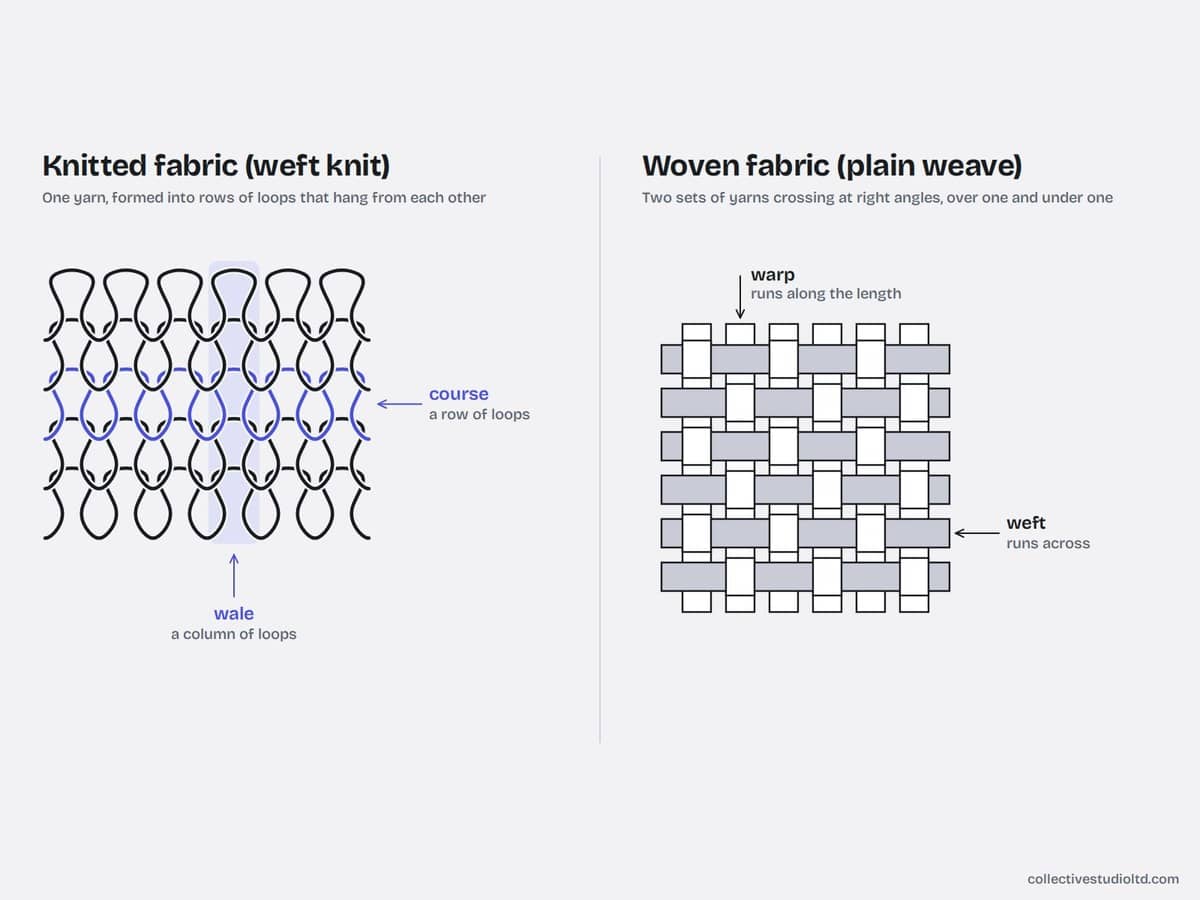
Knit vs woven comes down to how the yarn is held together. A knitted fabric is made from one yarn, or one set of yarns, formed into loops that are pulled through each other, so the cloth stretches easily. A woven fabric is made from two sets of yarns, the warp and the weft, crossing over and under each other at right angles, so the cloth holds its shape and hardly stretches. T-shirts and hoodies are knits; shirts and jeans are wovens.
We are Collective Studio, a family-run knitwear factory in Narayanganj, Bangladesh. Our fabric is knitted and dyed at partner mills, then cut and sewn on our sewing floor, and whether a cloth is knitted or woven decides how we cut and stitch it. The drawings are our own. Use them in coursework or in a brief to any factory, with credit.
The short version
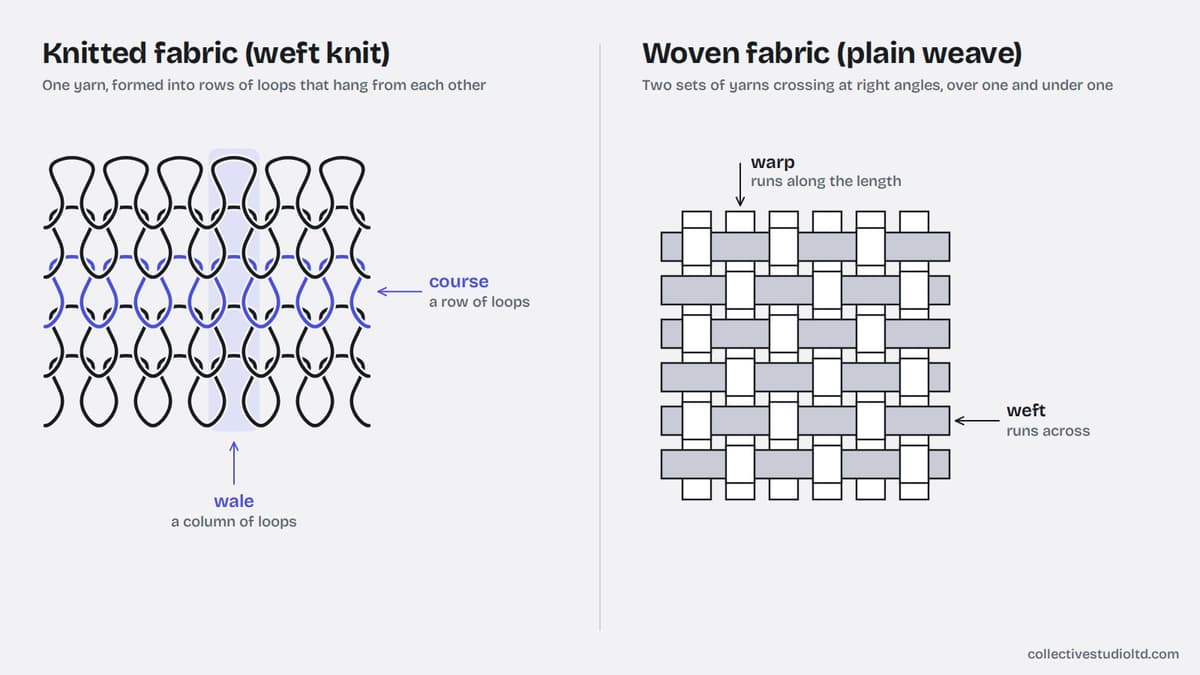
- A knit is rows of interlocking loops. A row of loops is a course. A column of loops is a wale.
- A woven is two sets of yarns interlaced at right angles. The lengthwise yarns are the warp. The crosswise yarns are the weft.
- Knits stretch because their loops can open out. Wovens barely stretch along the warp or the weft, and give a little only on the diagonal.
- Knits are sewn with stitches that stretch, such as overlock and coverstitch. Wovens are mostly lockstitched, and their seams need finishing because a cut edge frays.
- Both are weighed the same way, in GSM: grams per square metre.
- We make knitted garments only, so we do not make woven shirts or denim.
What is knit fabric?
Knit fabric is cloth made by drawing loops of yarn through other loops, row after row. Each new loop is pulled through the loop beneath it, so the whole cloth is one connected mesh of loops rather than a grid of crossing threads.
A course is a row of loops running across the width of the fabric. A wale is a column of loops running down its length. On the face of plain jersey the wales show as neat columns of small V shapes, the legs of each loop. The international standard that defines basic knitting terms such as these is ISO 4921, Knitting. Basic concepts. Vocabulary.
What is woven fabric?
Woven fabric is cloth made on a loom by interlacing two sets of yarns at right angles. The warp yarns run along the length of the cloth and are held under tension on the loom. The weft yarns are passed across them one at a time, going over some warp yarns and under others.
Weavers also call warp yarns ends, and weft yarns picks or filling. The firm edge along each long side of a woven cloth, running parallel to the warp, is the selvedge. The warp is usually the stronger and more tightly twisted of the two sets.
Why knits stretch and wovens mostly do not
A knit stretches because each loop is a curve of yarn that can open out when pulled and close again when released. A woven barely stretches because its yarns run almost straight and are held at every crossing.
In a weft knit most of the give is across the width, along the courses. A woven gives most on the bias, the diagonal at 45 degrees to the warp and weft, and very little along either set of yarns. Adding elastane to the yarn makes either kind stretch further. A sewing guide from the University of Kentucky sorts knits by stretch: stable knits stretch about 10 percent or less across the width, moderate knits about 25 to 35 percent, and two-way and super-stretch knits, which get their extra stretch from elastane, 50 percent or more in both directions.
How to tell knit and woven apart: three tests
You need a scrap of cloth and a minute. The second test usually settles it.
- 1. Look closely. Use a magnifying glass or a phone camera. A knit shows columns of small V shapes on one side and rows of loops on the other. A woven shows a grid of yarns going over and under, or fine diagonal lines if it is a twill such as denim.
- 2. Pull it. Fold back about 10 cm of the cloth along the width, so you are not pulling on a cut edge, and stretch it gently. A knit gives noticeably and springs back. A woven hardly moves when pulled straight along the warp or weft, then gives a little when pulled on the diagonal.
- 3. Check a cut edge. Snip the edge and rub it. A woven frays: loose yarns come away and leave a fringe. A knit does not fray into a fringe. Single jersey rolls up at the edge instead, and on a weft knit you may be able to pull one yarn out along a row, or start a ladder running down a wale.
Which garments are knits and which are wovens
Clothes that pull on and move with the body are mostly knits. Clothes with crisp lines and buttoned fronts are mostly wovens.
- Knits: T-shirts, polo shirts, hoodies, sweatshirts, joggers, leggings, sports bras, jumpers and socks.
- Wovens: dress shirts, jeans, chinos, suits, blazers and most trousers.
A polo shirt is a knit even though it has a collar and a buttoned placket: its body is piqué, a knitted structure. Jumpers are knits too, often made on flat-bed knitting machines.
Weft knitting and warp knitting
Weft knitting builds the cloth across its width: a yarn travels along the needles, which knit it one after another into a course. A circular machine has many yarn feeds, so each turn knits one course per feed, and the cloth comes off as a continuous tube. Warp knitting feeds hundreds or thousands of parallel yarns lengthwise from a beam, at least one for every needle, and all the needles knit at the same moment. Each yarn loops into two neighbouring wales in turn, so it zigzags down the fabric and ties the columns together.
Warp knits such as tricot and raschel do not curl or fray when cut across, and they can be knitted very fine, so they are used for swimwear, activewear, lingerie and hosiery. The jersey, rib, interlock, piqué and French terry in everyday T-shirts, polos and hoodies are weft knits.
Common knits and common weaves
A few structures in each family cover most clothing. Our guides go deeper on each knit.
- Jersey: the plain single knit of most T-shirts, with V-shaped stitches on the face and loops behind.
- Rib: columns of loops alternate between the two faces, giving vertical ridges and strong stretch across the width. Used for cuffs, collars and waistbands.
- Interlock: a double knit made on two sets of needles, like two fine rib fabrics knitted into each other, so both faces look alike and a cut edge does not curl.
- Piqué: tuck stitches raise a small honeycomb texture. Used for most polo shirts.
- French terry: a flat-faced knit with a looped back, heavier than jersey. The usual sweatshirt and hoodie cloth.
- Fleece: a looped-back knit whose loops have been brushed into a soft, warm nap.
There are three basic weaves, plain, twill and satin, and every other weave is built from them.
- Plain weave: each warp yarn goes over one weft yarn and under the next. The simplest, most stable weave. Canvas, chambray and broadcloth are plain weaves.
- Twill: each yarn floats over two or more yarns of the other set, and each crossing sits one step along from the one in the row before, so the crossings form a diagonal line. Denim, chino and gabardine are heavy twills, often 3/1: each warp yarn goes over three weft yarns, then under one.
- Satin: long floats with the crossings spread out so no diagonal forms. Smooth, shiny and fluid, but it snags. Woven from cotton or any fibre other than silk, it is called sateen.
Lists of types of fabric run to dozens of names, but nearly every one is woven, knitted or nonwoven, such as felt, which is matted fibre rather than yarn.
Knit vs woven compared
| Knitted fabric | Woven fabric | |
|---|---|---|
| Structure | Rows of interlocking loops (courses and wales) | Warp and weft crossing at right angles |
| Stretch | Natural give, mostly across the width in a weft knit | Very little, except on the bias or with elastane |
| Fraying | Does not fray; jersey curls, and a weft knit can ladder | Frays, so seams need a finish |
| Creasing | Sheds creases well | Creases more and often needs pressing |
| Drape | Soft and pliable; follows the body | From stiff plain weaves to fluid satins |
| Typical machine | Circular knitting machine | Loom (weaving machine) |
| Typical garments | T-shirts, polos, hoodies, sweatshirts, joggers, leggings, socks | Dress shirts, jeans, chinos, suits, blazers |
| Typical seam stitches | Overlock and coverstitch | Lockstitch, with overlocked or flat-felled seams |
| Weight measured in | GSM, grams per square metre | GSM, grams per square metre |
How knits and wovens are cut and sewn
A knit needs stitches that stretch as far as the fabric does. A woven needs firm seams with finished edges so they cannot fray.
On a knit line the overlocker does most of the joining. In one pass it cuts the edge clean, stitches the layers together and binds the raw edge in thread, and because its threads are looped rather than locked, the seam gives when the fabric does. The coverstitch machine sews hems, with two or three parallel rows on the outside and a looper thread covering the raw edge inside. Knit needles have a rounded ballpoint tip that pushes between the loops instead of piercing the yarn.
A woven is mostly joined with a lockstitch, the straight stitch of an ordinary sewing machine, where the needle thread and the bobbin thread lock together inside the cloth. It is firm with little give: right for a shirt seam, wrong for a jersey seam that has to stretch, because the locked threads snap. Woven seams also need a finish, either an overlocked edge or an enclosed seam such as the flat-felled seam.
Both are cut on the grain, with each pattern piece lined up to the warp of a woven or the wales of a knit, or the garment hangs crooked and the hem sags. A knit must also be spread flat and relaxed, without being pulled, or the pieces spring back short. Our guide to types of stitches covers each stitch in detail, and our glossary explains other trade terms.
How fabric is made, from fibre to finished cloth
Knits and wovens go through the same four stages. They part ways at the third.
- Fibre. Cotton is harvested and taken to a gin, which separates the fibre from the seed, cleans it and packs it into bales.
- Yarn. At the spinning mill the fibre is cleaned and straightened into a soft rope called sliver, drawn out thinner and twisted into yarn by ring, rotor or air-jet spinning. The yarn is wound onto cones, ready for knitting or weaving.
- Cloth. The yarn is knitted or woven. A circular knitting machine can be fed straight from cones on a creel. A loom first needs every warp yarn wound side by side onto a beam, usually coated with size, a film often made of starch that protects it during weaving, and then drawn through the loom one yarn at a time.
- Finishing. Cloth straight off the machine, called greige, is washed, dyed and finished. Knitting yarn is waxed so it runs smoothly through the needles, weaving warp is sized, and finishing removes both. For our knits the mill also compacts the cloth so it shrinks less, brushes the back if it is to become fleece, and sets it to an agreed width.
Our garment manufacturing process guide picks up from there.
Weight: GSM for both
Knits and wovens are both weighed in GSM, the weight in grams of one square metre of cloth. On a knit the weight is set at the knitting machine, by the yarn and the stitch length, which is the length of yarn in each loop, and it changes again when the cloth is dyed and finished. Our fabric and GSM guide shows how to measure it and gives ranges for the knits we sew.
A worked example from our sewing floor
Say a founder sends us a T-shirt, a hoodie and a woven overshirt.
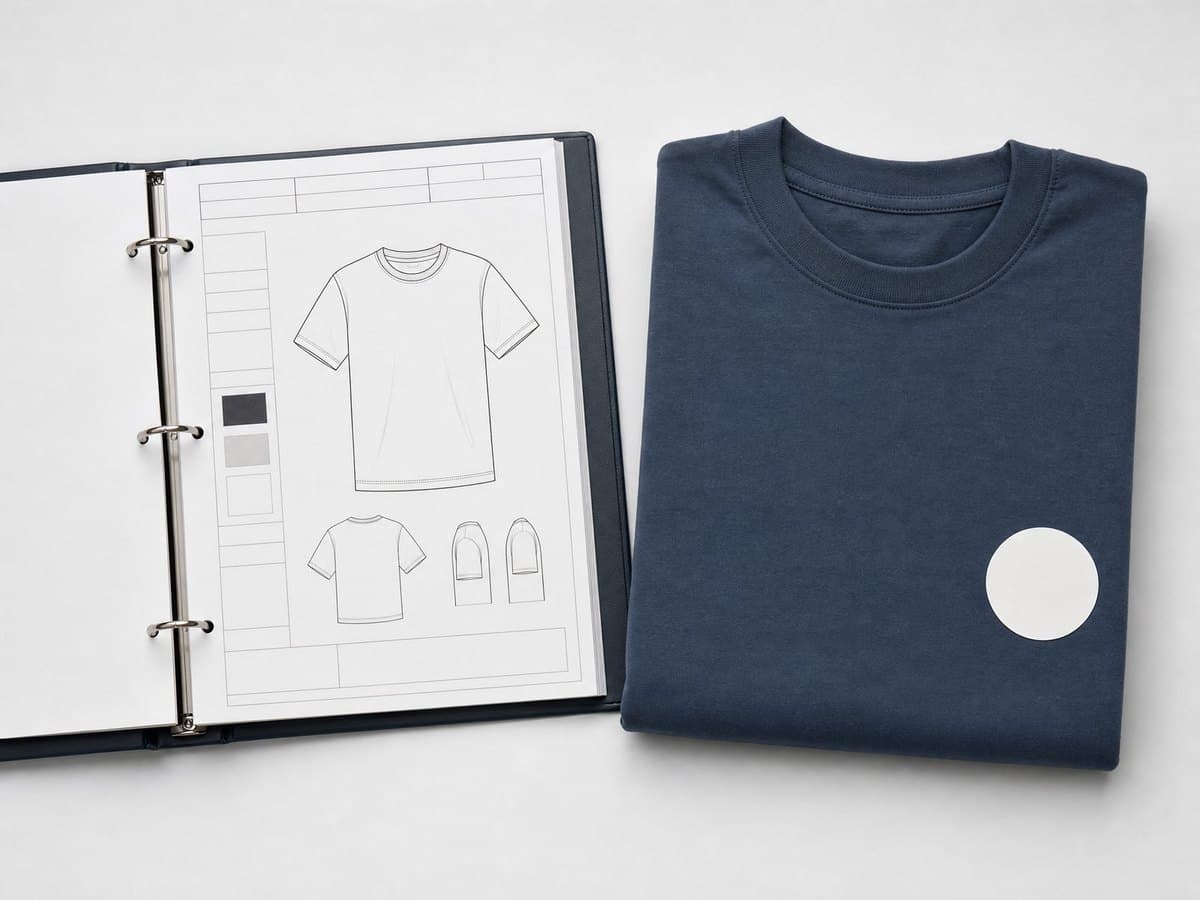
- The T-shirt is single jersey, knitted on a circular machine at a partner mill, at 140 to 180 GSM for an everyday tee. A typical tech pack construction is four-thread overlock at the shoulders and side seams, a tape across the back neck, a rib neckband, and coverstitch at the hem and sleeve openings. We side-seam our tees rather than using a tubular body, which helps hold the body straight after washing.
- The hoodie is French terry or fleece. Its rib cuffs and hem band are cut shorter than the openings and overlocked on under stretch, so they grip.
- The overshirt is a woven, and we would say so before any sampling. We make knitted garments only, so a woven shirt needs a factory that weaves and sews wovens.
If you are having knitwear made
We make knitted garments, from T-shirts, polos and hoodies to joggers, leggings and loungewear, from 150 pieces per style and per colour. Our knitwear manufacturing page shows what we make, and you can send us your range to find out which pieces fit our sewing floor.
Frequently asked questions
Is jersey knit or woven?
Jersey is a knit. It is made on a knitting machine by looping yarn into rows, so there is no warp and no weft, and the cloth has natural stretch across its width. You can check it by eye: the face shows columns of small V shapes, called wales, and the back shows rows of loops. Cut it and the edge rolls up rather than fraying. Most T-shirts are cut from it. A woven cotton such as poplin can look similar from a distance, but under a magnifying glass it shows a grid of crossing yarns instead of loops.
Is denim knit or woven?
Denim is a woven fabric. It is a twill, commonly a 3/1 twill in which each warp yarn passes over three weft yarns and then under one. That stepped pattern of crossings makes the fine diagonal lines you can see on the face of a pair of jeans. Because it is woven, denim has little stretch unless elastane is added to the yarn, and its cut edges fray, so the seams of jeans are overlocked or folded in and topstitched. Chino and gabardine are heavy twills of the same kind. We make knitted garments and do not make denim.
What is the difference between knitted and woven fabric?
The difference is the structure. Knitted fabric is made from one yarn, or one set of yarns, formed into rows of interlocking loops. Woven fabric is made from two sets of yarns, the warp along the length and the weft across it, crossing over and under each other at right angles. Everything else follows from that. Knits stretch, shed creases and do not fray, so they are sewn with stretchy overlock and coverstitch seams. Wovens hold their shape, crease more and fray at a cut edge, so they are mostly lockstitched with finished seams. T-shirts and hoodies are knits; shirts and jeans are wovens.
What is knit fabric?
Knit fabric is cloth made by pulling loops of yarn through other loops, row after row, on knitting needles or a knitting machine. A row of loops across the fabric is called a course, and a column of loops down its length is called a wale. Because each loop can open out and close again, knit fabric stretches, mostly across its width, and recovers. Most knitted clothing is weft knitted, often on circular machines that produce a continuous tube of cloth. Common knits include jersey for T-shirts, rib for cuffs, piqué for polos and French terry for hoodies and sweatshirts.
What is woven fabric?
Woven fabric is cloth made on a loom by interlacing two sets of yarns at right angles. The warp yarns run along the length of the cloth and are held under tension on the loom, while the weft yarns are passed across them, over some and under others. The pattern of overs and unders gives the three basic weaves: plain weave, twill and satin. Woven fabric is firm and stable, stretches very little except on the diagonal, and frays at a cut edge. It is used for dress shirts, jeans, chinos, suits and bed sheets.
How is cotton made into fabric?
Cotton becomes fabric in four stages. First the cotton is harvested and ginned: the gin separates the fibre from the seed, cleans it and packs it into bales. Second, at a spinning mill, the fibre is cleaned and straightened into a soft rope called sliver, drawn out thinner and twisted into yarn. Third, the yarn is either knitted into loops, for T-shirt and sweatshirt fabrics, or woven on a loom, for shirting and denim. Fourth, the raw cloth is washed, dyed and finished, for example compacted so it shrinks less, before it is cut and sewn into garments.
How can you tell if a fabric is knit or woven?
Three quick tests will tell you. First, look closely with a magnifying glass: a knit shows columns of small V shapes or rows of loops, and a woven shows a grid of yarns crossing over and under. Second, fold back about 10 cm and pull it gently across the width: a knit gives and springs back, while a woven hardly moves except on the diagonal. Third, snip the edge and rub it: a woven frays into a fringe, while a knit does not, and single jersey curls up instead. A firm double knit stretches little, so trust the close look if the tests disagree.
Where this applies
The manufacturing pages this guide relates to, if you are costing a real run.
Free tools & guides for this
Sources & further reading
- Cotton Incorporated, CottonWorks: Knitting (knit basics, courses and wales, weft and warp knitting)
- Cotton Incorporated, CottonWorks: Weaving basics
- Cotton Incorporated, CottonWorks: Basic woven fabric designs
- Cotton Incorporated, CottonWorks: Yarn spinning
- Cotton Incorporated, CottonWorks: Cotton Fiber Growth, Harvesting & Ginning
- University of Kentucky Cooperative Extension: Sewing with Knit Fabric (CT-MMB.165, PDF)
- University of Kentucky Cooperative Extension: Understanding Fabric Grain (CT-MMB.210, PDF)
- NSAI Standards shop: ISO 4921:2000, Knitting. Basic concepts. Vocabulary (catalogue listing)
Cite this guide
For journalists, writers, researchers and students.
Quoting this guide? Please credit Collective Studio and link to this page.
Reference
Homaira Jashim, Collective Studio. "Knit vs Woven Fabric: The Difference and How to Tell Them Apart." 19 November 2026. https://collectivestudioltd.com/journal/knit-vs-woven-fabric
Writing about us? Our press kit has our facts, logos and photos, free to use with credit.
Have an idea? Let’s make it.
We manufacture from 150 pieces per style and colour, with organic cotton options from our GOTS-certified facility and photos at every stage. Send a sketch or a sentence — we’ll reply within one business day.