What Is Fleece Fabric? Polar Fleece vs Sweatshirt Fleece
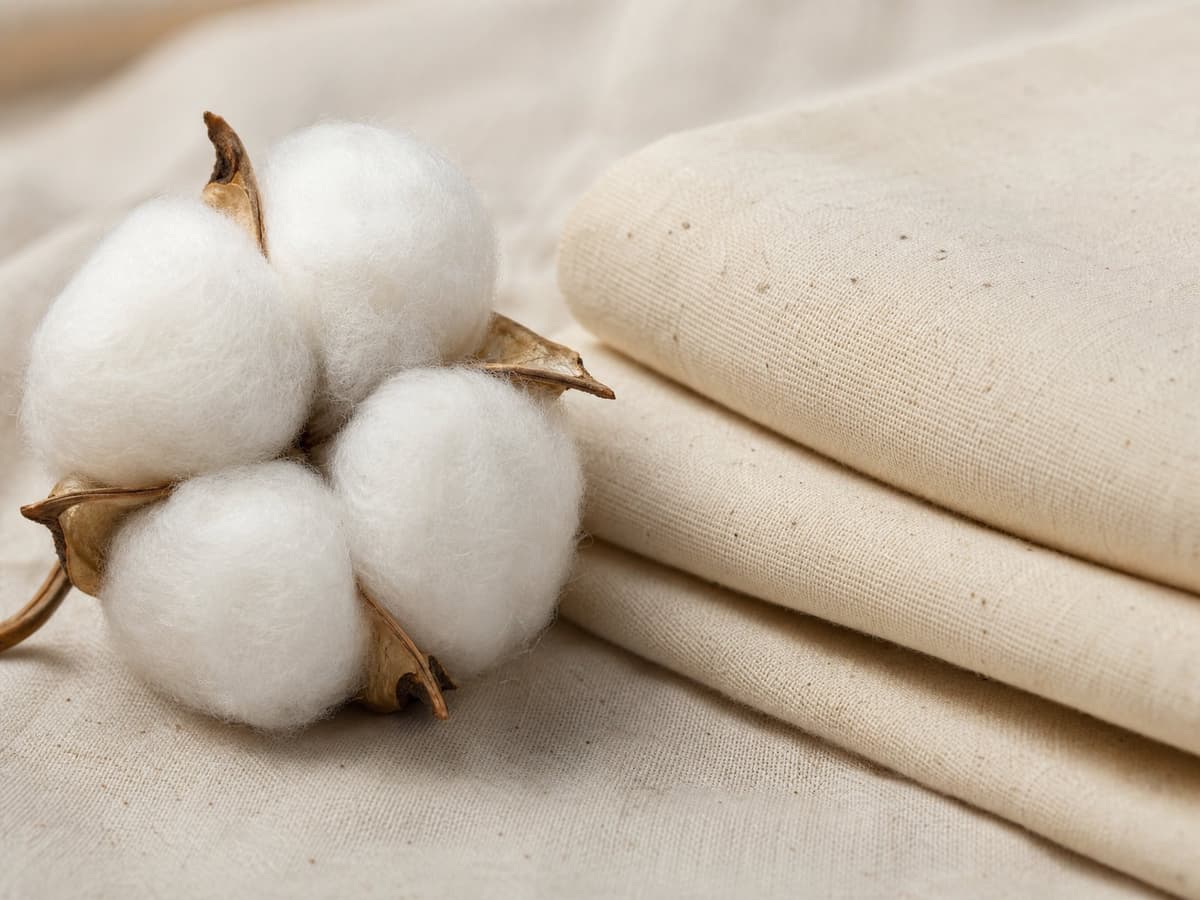
Fleece fabric is a knitted cloth whose surface has been brushed up into a soft, fuzzy layer of fibre, called a nap, that holds air and keeps you warm. The word covers two different cloths. Polyester fleece, most often sold as polar fleece, is a polyester knit napped into a pile, usually on both sides, and it is used for fleece jackets, linings and blankets. Sweatshirt fleece, also called brushed-back fleece, is cotton or cotton and polyester: smooth on the outside, with loops on the inside brushed into a nap. It is what hoodies, sweatshirts and joggers are made from.
We are Collective Studio, a family-run knitwear factory in Narayanganj, Bangladesh. We cut and sew sweatshirt fleece into hoodies, sweatshirts and joggers on our sewing floor, so this guide explains the cloth the way it looks from our cutting table. The drawings are our own. Use them in coursework or in a brief to any factory, with credit.
The short version
- "Fleece" names two cloths: polyester fleece for jackets and blankets, and cotton or cotton-blend sweatshirt fleece for hoodies, sweatshirts and joggers.
- Both are knits, and both get their softness from napping: rollers covered in fine wire pull fibres out of the yarn to raise a fuzzy surface.
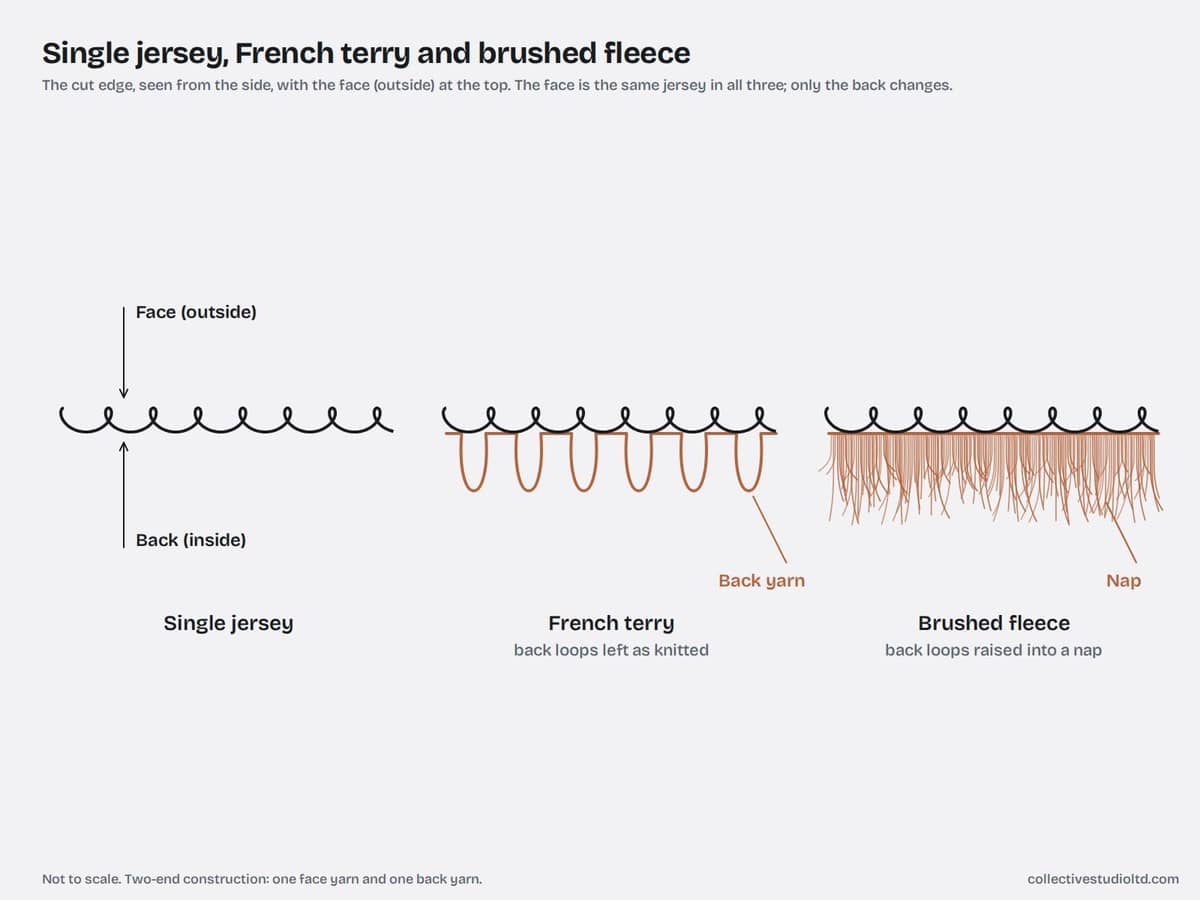
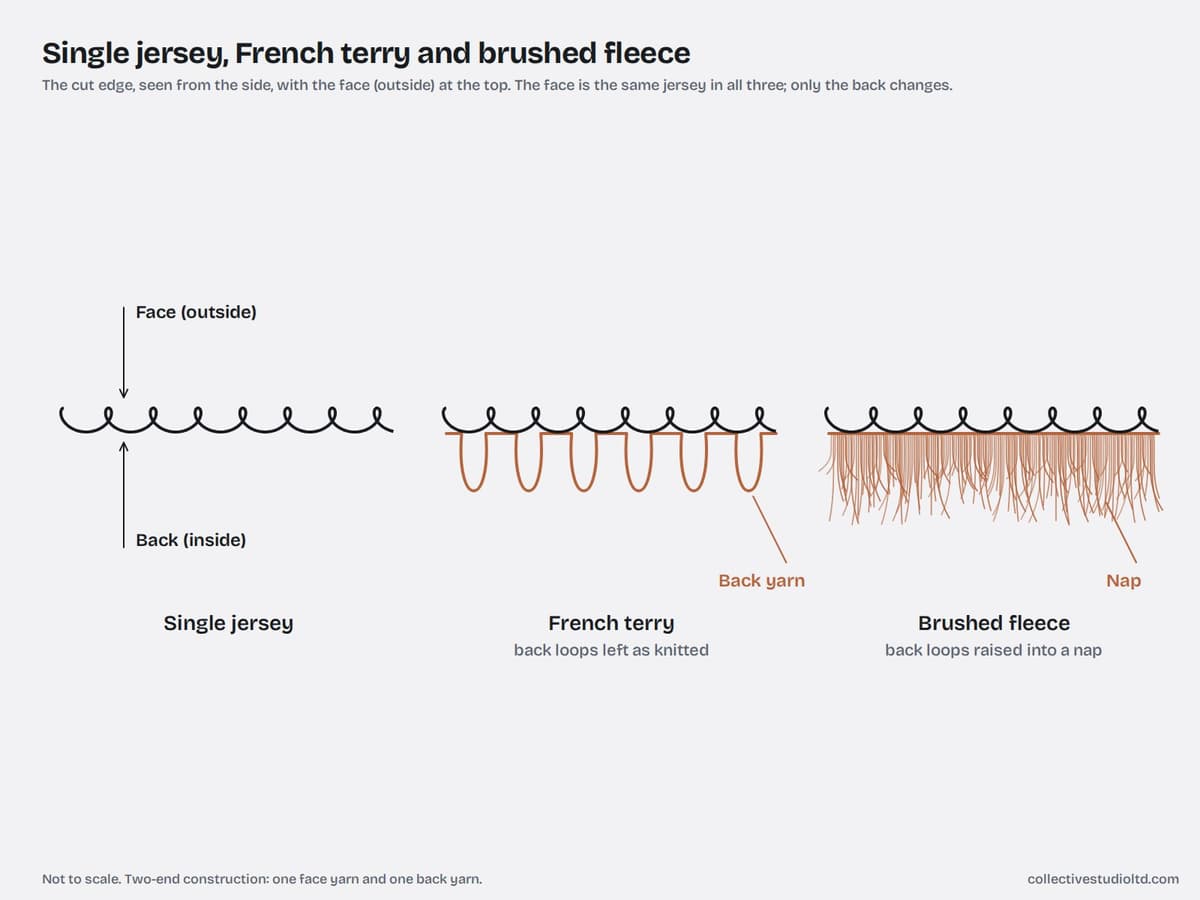
- French terry and two-end sweatshirt fleece are the same knit. Leave the loops on the back as knitted and it is French terry; brush them and it is fleece.
- Cotton fleece for hoodies runs from about 280 to 500 GSM, and most brands settle on 320 to 360. Joggers run from 280 to 450.
- The nap makes fleece warm and soft, and it is also where pilling starts, so the yarn on the back matters.
- In a 2018 laboratory study, polyester fleece shed significantly more fibres in the wash than the other knits tested.
Polyester fleece: polar fleece, microfleece and sherpa
Polyester fleece is a knitted polyester fabric whose surface has been napped into a pile. A 2021 laboratory study of microplastic shedding describes the two polar fleeces it tested, a length of fabric and a pair of blankets, as single jersey knitted from polyester, with raised, looped piles on both sides. Worked out from the area and mass the study reports, those two samples weighed about 220 and 140 GSM. That is two samples, not a range for polar fleece in general, so ask a supplier for the weight in writing.
You will also see two more names in shops. Microfleece is the name shops use for a thinner, lighter polyester fleece. Sherpa is usually sold as a polyester fleece with a deep, curly pile on one face, meant to look like sheepskin, and it is mostly seen as a lining. Neither name tells you the weight or the exact construction, so read the fibre label and ask for the GSM.
Sweatshirt fleece: cotton with a brushed back
Sweatshirt fleece is a circular knit with a smooth jersey face and an extra yarn held on the back, and that back yarn is napped into a soft layer. Cotton Incorporated's technical bulletin on napping calls fleece the most common knitted cotton construction for napping, and names sweat garments and bathrobes as its uses. The back yarn is usually coarser and lower in twist than the face yarn, because loosely twisted fibres are easier for the napping wires to pull free.
The trade names describe how many yarns go in. Two-end fleece uses a face yarn and a back yarn. Three-end fleece uses three: a face or ground yarn, a tie-in yarn and a pile yarn. Cotton Incorporated's knitting guide calls three-end the most stable and fullest fleece, used for cold-weather garments. Brushed-back fleece or fleece-back simply means the inside has been napped.
Fleece types compared
| Fabric | Usual fibre | Which side is brushed | Typical weight | Used for |
|---|---|---|---|---|
| Polar fleece | Polyester | Usually both sides | No set weight; two samples in one 2021 study weighed about 140 and 220 GSM | Fleece jackets and pullovers, blankets |
| Microfleece | Polyester | Napped, like polar fleece | Sold as thinner and lighter than polar fleece; no set weight | Usually sold for light layers and linings |
| Sherpa | Polyester | Usually one face, with a deep, curly pile | No set weight | Usually sold as a lining for jackets and hoods, and for blankets |
| Cotton fleece (brushed back) | Cotton, or cotton and polyester | The back only; the face stays smooth | 280 to 500 GSM for hoodies, 280 to 450 for joggers | Hoodies, sweatshirts, joggers, winter loungewear |
| French terry | Usually cotton | Neither; the loops on the back are left as knitted | 240 to 500 GSM | Sweatshirts, hoodies, joggers, year-round loungewear |
French terry vs fleece
French terry and two-end sweatshirt fleece are the same knitted cloth, separated by one finishing step. Leave the loops on the back as they came off the knitting machine and you have French terry; nap them into a soft pile and you have fleece. Cotton Incorporated's knitting guide puts it plainly: French terry is technically an un-napped fleece.
Fleece is warmer and softer against the skin; French terry breathes, holds a cleaner line and pills less. Our French terry guide sets the two side by side in a table.
How fleece is made
Fleece is made in four main steps at the mill: knit, dye, nap and shear. Cotton fleece is then compacted.
- Knit. On a circular knitting machine, a fine yarn knits the smooth jersey face while a softer yarn is laid into the back in loops.
- Dye. The knitted cloth is dyed. Cuff and hem rib should be dyed in the same lot as the body.
- Nap. The cloth runs over a cylinder of rollers wound with fine steel wire, whose points pull fibres out of the back loops into a nap. Cotton Incorporated's bulletin gives between 14 and 24 of these rollers on a knit napping machine, and lists raising as another name for napping. Factories call it brushing.
- Shear. A spiral blade trims the raised fibres to an even height. This levels the pile and cuts back the stray fibres that would otherwise start pills.
- Compact. Cotton fleece is mechanically pre-shrunk, so the garment does not lose a size in its first hot wash.
The order can change: Cotton Incorporated notes that cotton can be napped before dyeing, when its natural wax helps the fibres slide. Napping also costs strength, because the fibres pulled into the nap no longer hold the cloth together.
Is fleece cotton or polyester? What fleece is made of
Fleece can be cotton, polyester or a blend of the two, and the word on its own does not tell you which. Cotton Incorporated's knitting guide says fleece comes in all cotton, cotton and polyester blends, or all synthetic fibres. As a rough guide, fleece sold for jackets and blankets, under names such as polar fleece, microfleece or sherpa, is usually polyester, while a fleece hoodie, sweatshirt or jogger is usually cotton or a cotton-rich blend. The fibre content label is the only reliable answer.
Cotton fleece feels dry and soft, breathes, and shrinks unless it is compacted. Adding polyester makes it shrink less, but a blend pills more than 100% cotton.
Fleece weights in GSM for hoodies and joggers
Sweatshirt fleece is specified by weight in GSM, grams per square metre. For hoodies we work from 280 to 500 GSM. A hoodie is at its lightest at 280, most brands settle on 320 to 360, and true heavyweight starts at about 400. For joggers the range is 280 to 450, most often 320 to 400.
Two things to know about the number. First, "heavyweight" is not a standard; for hoodies it usually means 350 GSM and up, and our guide to choosing GSM for hoodies and t-shirts explains how to choose and test it. Second, brushing changes the feel at the same weight: a 350 GSM fleece lofts up and feels thicker than a 350 GSM French terry. The GSM converter gives ounces per square yard, and the fabric and GSM guide covers the other knits.
Is fleece warm?
Yes. The nap is a layer of fine, loose fibres that holds still air next to the body, and still air is what keeps heat in. Cotton Incorporated's napping bulletin credits napped cotton cloths such as flannel and fleece with an inherent warmth and softness, and its knitting guide says fleece fabrics tend to be heavier and suit cold-weather garments.
Within cotton fleece, warmth follows weight and loft, so a 400 GSM fleece hoodie is a winter garment and a 280 GSM one suits cool evenings.
Pilling: the price of a soft back
Fleece pills more than an unbrushed knit, and the brushed side pills worst. Pills are small balls of tangled fibre, and napping loosens the very fibre ends that roll up into them. Cotton Incorporated's pilling guide shows this on a two-end cotton and polyester fleece: after a 30-minute random tumble test the smooth face rated 3.0, medium pilling, and the fleece side rated 1.0, extreme pilling, on a scale where 5 means no pilling.
Blends pill more than 100% cotton, the same guide explains, because the strong polyester fibre anchors each pill to the cloth. Three things help. Shearing after napping trims the stray fibres. A smoother yarn on the back, such as combed ring-spun cotton, pills more slowly than open-end yarn. And a pilling test on the sample, to ASTM D3512 (random tumble) or ASTM D4970 (Martindale), shows the problem before bulk.
Does fleece shrink?
Cotton fleece shrinks, mostly in length, unless the mill compacts it before cutting. Polyester resists shrinking, so a cotton and polyester blend shrinks less than 100% cotton. Every fleece we cut is compacted at the partner mill first, and we wash the pre-production sample and measure it again, so the size chart you approve already allows for any shrinkage left in the cloth.
Printing and embroidery on fleece
On sweatshirt fleece the decoration goes on the smooth jersey face, and the nap stays inside, so it takes print and embroidery much like any heavy sweatshirt cloth. Puff print, a raised screen print, works well on heavyweight fleece. For embroidery, firmer fleece can take a tearaway stabiliser behind the stitching. A large DTF print is a film on the surface, and on fleece you can feel it. Sublimation needs polyester, so it does not work on a cotton fleece hoodie.
Polar fleece is usually napped on both sides, so there is no smooth face and any decoration sits on the pile; judge it on a sample.
Fleece and the US flammability rule
In the US, clothing textiles must meet a flammability standard, 16 CFR Part 1610. It defines a raised surface textile as any fabric with an intentionally raised fibre or yarn surface, such as a pile or a nap, so sweatshirt fleece and polar fleece both count. In the test a raised surface fabric is brushed first, and its class depends on the burn time and on whether the flame ignites or fuses the base fabric. Fabrics made entirely of polyester, acrylic, modacrylic, nylon, olefin or wool are exempt from testing to support a guaranty, whatever their surface; a cotton or cotton and polyester fleece is not. Our guide to importing clothing into the US covers what to ask before shipping.
How to care for fleece
Wash fleece cool with similar clothes and keep it out of a hot dryer, which shrinks cotton fleece.
Polyester fleece sheds plastic fibres in the wash. In a 2018 laboratory study from the University of Gothenburg and the Swedish School of Textiles, polyester fleece and microfleece shed significantly more fibres than the other knits tested. Scaling up from small samples, the authors estimated that one polyester fleece garment could release about 110,000 fibres in a wash. The European Environment Agency's 2022 briefing on textiles notes that most microplastics from textiles are released in the first few washes, and that washing machines do not retain the fibres: they are discharged with the waste water.
What we would choose for a winter hoodie
Say a brand asks us for a winter pullover hoodie that is soft inside and keeps its looks for several seasons. We would put it on cotton brushed-back fleece at about 340 GSM, inside the 320 to 360 band most brands settle on, with a 400 GSM swatch beside it if the fit is boxy. We would ask the mill for ring-spun yarn on the back, because a poor back yarn is the first to pill once it is brushed.
The cuffs and hem would be 2x2 rib with elastane, dyed in the same lot as the body so the shade matches. As with every fleece we cut, the cloth is compacted before cutting and the washed sample is measured before you sign off the size chart. A small chest logo would be embroidered with a tearaway stabiliser, and a large back graphic screen printed on the smooth face. If it must also sell in spring, French terry at the same weight is the alternative.
If you are having fleece garments made
We make hoodies, sweatshirts and joggers in brushed fleece and French terry, from 150 pieces per style and per colour, and organic versions use organic cotton, made in our GOTS-certified facility (RSC 9687). If you have a garment whose fleece you like, tell us about it through our contact page: we can work from a garment to match, so we match its weight and its back rather than guess at them.
Frequently asked questions
What is fleece made of?
Fleece is made of polyester, cotton or a blend of the two, knitted and then brushed so the surface becomes a soft nap. Fleece sold as polar fleece, microfleece or sherpa is usually a polyester knit with a raised pile, and polar fleece is usually napped on both sides. Sweatshirt fleece, used for hoodies, sweatshirts and joggers, is usually cotton or cotton with polyester: a smooth jersey face with an extra, softer yarn on the back that is napped. The fibre decides how it behaves, so check the content label: cotton breathes and shrinks unless compacted, while polyester resists shrinking and sheds plastic fibres in the wash.
Is fleece cotton or polyester?
It can be either, so read the label. Anything sold as polar fleece, microfleece or sherpa is usually polyester, and a fleece jacket or blanket usually is too. A fleece hoodie, sweatshirt or jogger is usually cotton or a cotton-rich blend with polyester, known as sweatshirt or brushed-back fleece. Cotton Incorporated's knitting guide says fleece comes in all cotton, cotton and polyester blends, or all synthetic fibres. A quick check by hand: polar fleece is usually fluffy on both sides, while cotton sweatshirt fleece is smooth outside and brushed only on the inside.
Is fleece warm?
Yes, fleece is warm because its brushed nap is a layer of fine, loose fibres that holds still air against the body. Cotton Incorporated describes napped cotton cloths such as flannel and fleece as having an inherent warmth and softness. How warm a particular fleece feels depends on its weight, its loft and its fibre. A 400 GSM cotton fleece hoodie is a winter garment, while a 280 GSM fleece suits cool evenings. French terry, the same knit left unbrushed, is cooler and breathes more.
What is the difference between French terry and fleece?
French terry and two-end sweatshirt fleece are the same knitted cloth, and the only difference is whether the loops on the back have been brushed. French terry keeps them as knitted, so it breathes, holds a clean line and pills less. Fleece has them napped into a soft pile, so it is warmer and softer but bulkier and more prone to pilling. Cotton Incorporated's knitting guide calls French terry technically an un-napped fleece. Both are sold by weight in GSM, roughly 240 to 500 for French terry and 280 to 500 for hoodie fleece. Polyester polar fleece is a different cloth altogether.
What is brushed cotton?
Brushed cotton usually means a woven cotton cloth, such as flannel or a brushed twill, whose surface has been napped to make it soft and warm. It is a different thing from cotton sweatshirt fleece. Brushed cotton is woven, so it is firm and has little stretch, and it is used for shirts and bed sheets. Sweatshirt fleece is knitted, stretches, and is brushed only on the inside, for hoodies and joggers. Both are made soft by the same process, napping, which Cotton Incorporated describes for woven flannels and knitted fleece alike. If a supplier says brushed cotton, ask whether they mean a woven or a knit.
What does heavyweight cotton mean?
Heavyweight cotton means a cotton fabric heavier than usual for its garment, but no standard defines the word, so always ask for the weight in GSM. For hoodies and sweatshirts it usually means about 350 GSM and up, with true heavyweight from about 400 to 500 GSM, in cotton fleece or French terry. For T-shirts it is far lighter: around 240 GSM is the top of single jersey. Heavier cloth holds a boxy shape and feels substantial, but it dries slowly and makes heavier cartons. One supplier's heavyweight can be lighter than another's regular weight, so put the number in your tech pack.
Does fleece shrink?
Cotton fleece shrinks, mostly in length, unless it is compacted, a mechanical pre-shrinking done at the mill before the cloth is cut. Polyester resists shrinking, so a cotton and polyester blend shrinks less than 100% cotton. Heat makes cotton shrinkage worse, so wash a cotton fleece hoodie cool and dry it on low heat. If you are having fleece garments made, ask whether the fabric is compacted, then wash your own sample and measure it before and after, so the size chart is set from the washed measurements.
Where this applies
The manufacturing pages this guide relates to, if you are costing a real run.
Free tools & guides for this
Sources & further reading
- Cotton Incorporated: TRI 3006, Napping of Cotton Fabrics (technical bulletin, 1994)
- Cotton Incorporated (CottonWorks): Single and Double Knits
- Cotton Incorporated (CottonWorks): Fabric Defects 101, Understanding and Overcoming Pilling
- Environmental Science and Pollution Research: Kärkkäinen and Sillanpää, Quantification of different microplastic fibres discharged from textiles in machine wash and tumble drying (2021)
- Environmental Science and Pollution Research: Carney Almroth et al., Quantifying shedding of synthetic fibers from textiles (2018)
- European Environment Agency: Microplastics from textiles, towards a circular economy for textiles in Europe (2022)
- eCFR: 16 CFR Part 1610, Standard for the Flammability of Clothing Textiles
Cite this guide
For journalists, writers, researchers and students.
Quoting this guide? Please credit Collective Studio and link to this page.
Reference
Homaira Jashim, Collective Studio. "What Is Fleece Fabric? Polar Fleece vs Sweatshirt Fleece." 19 November 2026. https://collectivestudioltd.com/journal/what-is-fleece-fabric
Writing about us? Our press kit has our facts, logos and photos, free to use with credit.
Have an idea? Let’s make it.
We manufacture from 150 pieces per style and colour, with organic cotton options from our GOTS-certified facility and photos at every stage. Send a sketch or a sentence — we’ll reply within one business day.