Best Clothing Factory in Bangladesh: How to Choose the Right Manufacturer (2026)
Bangladesh is the world's second-largest clothing exporter, with decades of expertise in knitwear and a deep, skilled workforce — which is exactly why so many founders search for the best clothing factory in Bangladesh to make their products, or simply for a clothing manufacturer in Bangladesh they can deal with directly. But here's the honest truth: the best clothing factory isn't a single place. It's the one that fits your brand's size, values, and ambitions. Here's how to find it.
The four kinds of factory you will actually find
“Factory” covers four quite different businesses in Bangladesh, and most disappointment comes from contracting with one while believing you are dealing with another. Work out which you are talking to before you discuss price.
| What it is | Typical minimum | Best for | |
|---|---|---|---|
| Large export factory | Thousands of machines, long-running programmes for global retailers | 500–1,000+ per style and colour | Established brands ordering at volume |
| Mid-size cut-and-sew | Own floor, own patterns, works directly with brands | 100–300 per style and colour | Growing brands that need real construction at a reachable minimum |
| Small CMT unit | Cuts and sews fabric and trims you supply | Low, but you buy the materials | Brands who already source their own fabric |
| Buying house / agent | Places your order with a factory you may never meet | Varies — they set it | Sourcing many product types across several factories at once |
Why brands choose a clothing factory in Bangladesh
A few reasons it's a top choice: a workforce highly skilled in cotton knits (tees, hoodies, joggers), competitive pricing, vertically integrated mills that handle yarn-to-finished-garment under one roof, and duty-free or low-duty access to the EU and many other markets. For knitwear especially, it's hard to beat on quality-for-price.
What makes the best clothing factory in Bangladesh for a new brand
If you're launching or scaling a young label, the biggest factory or the cheapest quote is usually the wrong choice. The best partner for you is one that will happily take a small order, talk to you like a collaborator, and deliver the same quality on your fiftieth piece as your first. Look for:
- A low minimum — ask for the MOQ per style, per colour (not a headline number).
- Transparency — photos at each production stage, and a name behind the work.
- Certifications you can verify — GOTS-certified organic, OEKO-TEX, and the documents to prove it.
- Fast, clear communication — the quality of their first reply previews the whole relationship.
- Fair, safe working conditions — increasingly, your customers care as much as you do.
The best factory for a 100-piece launch is rarely the one chasing 100,000-piece contracts. Fit matters more than size.
How to verify what a factory tells you
Every claim on this list is checkable by you, in an afternoon, without the factory’s cooperation. That is the point — a claim you can only confirm by asking the person making it is not evidence.
- Certification: ask for the certificate number, not the logo. GOTS certificates are searchable on the GOTS public certificate database; ours is RSC 9687. A supplier who sends a logo but not a number is telling you something.
- The address: put it into Google Maps and look at the satellite view. A production address should look like a factory. A Dhaka office address frequently belongs to an agent rather than a floor.
- Association membership: BGMEA and BKMEA both maintain member directories. Membership is checkable independently.
- The floor itself: ask for a live video call during a working shift, not an edited film. Anyone can produce a polished factory video; far fewer will point a phone at their line on a Tuesday morning.
- Social compliance: ask for current BSCI, Sedex/SMETA or WRAP documentation with dates on it. An expired audit is not an audit.
If a supplier gives you a certificate number, an address that resolves, and a live look at the floor, you have learned more in one afternoon than a month of emails will tell you.
What a realistic first conversation looks like
A good factory will ask you as many questions as you ask them, because they are working out whether your order is a fit for their floor. Expect to be asked what you are making, roughly what quantity, what you intend to sell it for, and when you need it. A supplier who quotes without asking any of that is quoting a guess.
Be wary of the opposite failure too: a factory that says yes to everything. Knitwear, denim, tailoring, leather goods, hardware, at any quantity, on any timeline, is not a capability list — it is a sales pitch, and it usually means the work is being subcontracted somewhere you cannot see. The better answer is a clear scope with honest limits attached.
Red flags to avoid
- Vague or shifting MOQs, or pressure to order far more than you need.
- No sampling step — you should always approve a physical sample before bulk.
- Evasive answers about certifications, factory conditions, or who does quality control.
- Slow, unclear replies during the quote stage — it rarely improves once you've paid.
Questions to ask before you commit
- What's your real minimum order, per style and per colour?
- What does your sampling process look like, and how long does it take?
- Who runs quality control, and will I get photos during production?
- Which certifications do you hold, and can I see them?
- Do you ship DDP (duties paid), and can I visit the factory?
Where Collective Studio fits
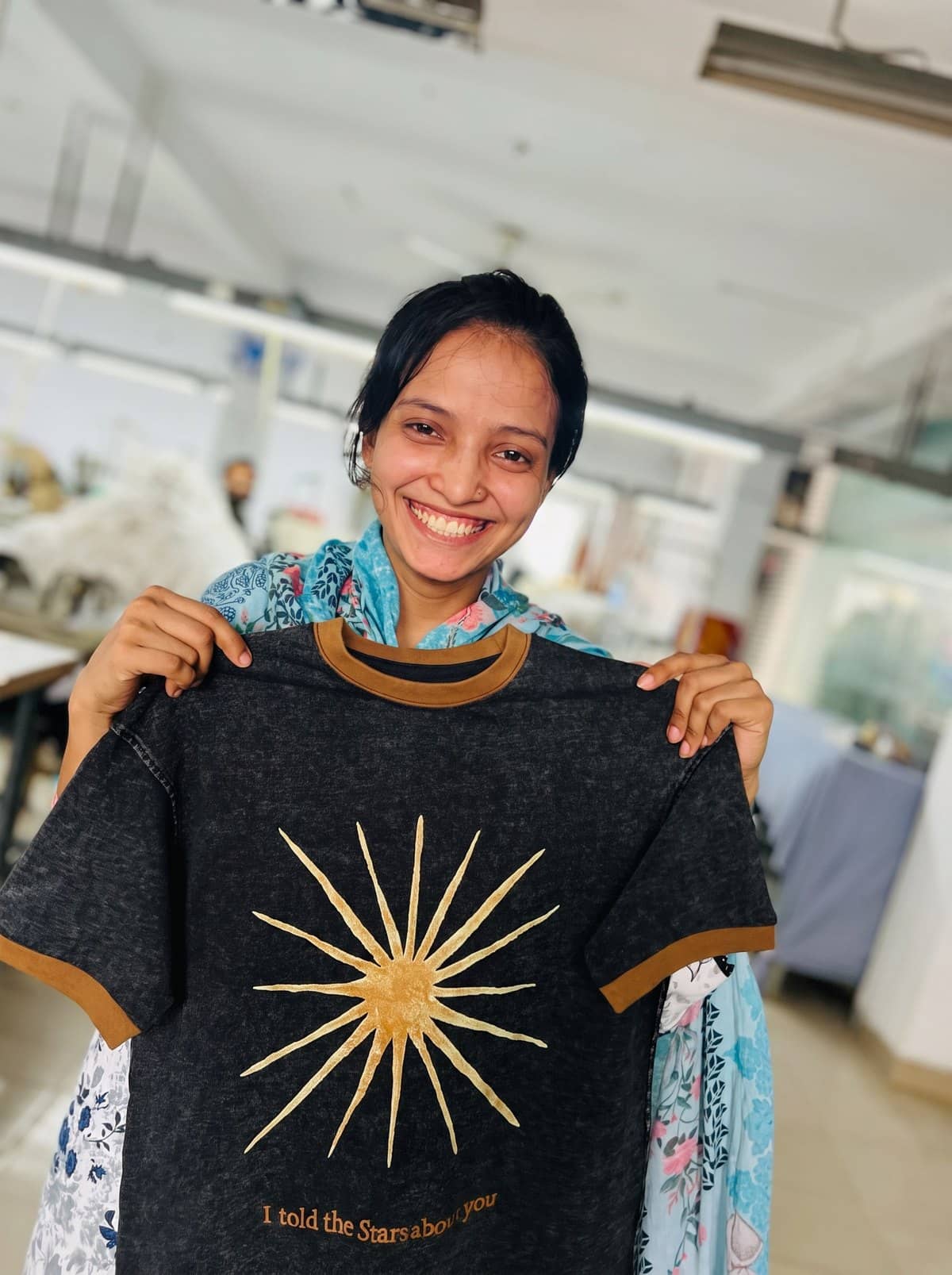
We're a family-run knitwear manufacturer in Narayanganj, Bangladesh, with a brand office in Amsterdam. We make from 100 pieces per style, offer GOTS-certified organic options, send photos at every stage, ship DDP worldwide, and our founders answer enquiries personally. If that sounds like the partner you're after, read our story or tell us what you're making.
New to sourcing? Start with how to find a clothing manufacturer and how to start a brand with 100 pieces.
Frequently asked questions
What is the best clothing factory in Bangladesh?
The question does not have a general answer, and any source giving one is ranking on something other than fit for your order. Factories specialise: some run high-volume basics efficiently and are poorly suited to varied programmes, others handle complexity at lower volume. A factory excellent for a hundred-thousand-piece basics order is often the wrong choice for a three-hundred-piece launch, and the reverse holds equally. The answerable version is which factory suits a specified requirement — product category, quantity, certification needs, target market and lead time. Against those criteria the selection narrows quickly and can be assessed on verifiable evidence: certificate numbers, association membership, inspection records and demonstrated capability in the relevant product type.
How do I choose a clothing manufacturer in Bangladesh?
Define the requirement before evaluating suppliers, because most selection errors originate in an unspecified brief. Fix the product category, quantity per style and colour, certification requirement, destination market and required delivery date. Then filter on verifiable evidence rather than presentation: certificate numbers checkable in the GOTS public certificate database or the equivalent body, association membership confirmable in BGMEA or BKMEA's own directory, and a current safety inspection record. Then test capability with a sample — the pre-production sample is the only reliable predictor of bulk output and is the point at which most mismatches surface. Physical verification remains the strongest signal available: willingness to name the address and accommodate a visit or live floor call separates manufacturers from intermediaries more reliably than any document.
Why manufacture clothing in Bangladesh?
For knit categories specifically, the case rests on vertical integration rather than on labour cost alone. Spinning, knitting, dyeing, trims and sewing are all present domestically within a concentrated geography, so a knit garment is made end to end without crossing a border — which compresses lead time and removes a class of coordination failure. Unit costs sit below China and Vietnam. Capacity is fragmented across many mid-sized factories rather than concentrated, so minimum quantities are more negotiable than in consolidated markets. Duty-free access to the UK, EU, Canada and Australia under LDC schemes has been a further advantage, though graduation on 24 November 2026 changes that and transition arrangements differ by market. Where the country is weaker is complex woven outerwear.
Where this applies
The manufacturing pages this guide relates to, if you are costing a real run.
Free tools & guides for this
Sources & further reading
Have an idea? Let’s make it.
We manufacture from 100 pieces per style, with GOTS-certified organic options and photos at every stage. Send a sketch or a sentence — we’ll reply within a day.