Best GSM for Hoodies and T-Shirts: 140 to 500 GSM Explained
For most brands the best GSM for a t-shirt is about 180 GSM for an everyday tee and 200 to 240 GSM for a structured or boxy one, and the best GSM for a hoodie is 320 to 360 GSM, with 280 the lightest that still reads as a hoodie and 400 to 500 for true heavyweight streetwear. A 350 GSM hoodie, about 10.3 oz per square yard, sits where a standard hoodie turns heavy: substantial, warm and structured, without the stiffness and drying time of the heaviest cloth. Choose the weight for the fit, the season you sell into and where the product should sit on price, then confirm it on a swatch, because GSM measures weight and nothing else.
This guide is the decision, not the definition: our fabric and GSM guide explains what GSM means, and the GSM to oz converter translates every figure here into ounces. What follows is which weight to choose, what changes the feel at the same weight, how to check it and how to write it on a tech pack.
The weight chart: which GSM for which garment
| Garment | Typical GSM | Feel | Best for | Watch out for |
|---|---|---|---|---|
| Lightweight tee | 140–160 | Light and soft; drapes close to the body | Summer drops, hot markets, layering, fitted fashion tees | Shows through in pale colours, and a heavy plastisol print can feel like a plastic panel on it |
| Everyday tee | About 180 | Opaque, comfortable, familiar | Core basics, merch, a first run | At this weight the yarn decides the feel more than the number does |
| Premium, structured tee | 200–220 | Holds its shape and sits away from the body | Premium basics, boxy and oversized cuts, large prints | Warmer to wear, and more cloth in every piece |
| Heavyweight tee | About 240 | Dense and firm: the boxy streetwear hand | Oversized streetwear tees | The top of single jersey; heavier than this it feels dense rather than substantial |
| Lightweight sweatshirt | 240–280 (French terry) | Drapey; a heavy tee rather than a true sweat | Spring and summer crews, layering pieces | Too light for a hoodie in our range, which starts at 280 |
| Standard hoodie | 280–350 (most brands settle on 320–360) | The familiar hoodie weight; moves well | Year-round hoodies and sweatshirts | At the bottom of the band it drapes softly but will not read as premium |
| Heavyweight hoodie | 350–500 (true heavyweight from about 400) | Structured and boxy; at the top it almost stands up on its own | Heavyweight streetwear, winter ranges, cold markets | Slow to dry, heavier cartons, and too warm for hot climates |
| Joggers | 280–450 (320–400 most often) | Matched to the hoodie they sell beside | Sets, lounge, streetwear and gym ranges | Below 280 it is a lounge pant; above 450 it is a winter garment that is slow to dry |
T-shirts: choosing between 140 and 240 GSM
The tee range is narrower than most people expect. We cut and sew t-shirts from 140 to 240 GSM: our lightest summer tees at 140–160, the everyday weight at 180, structured premium tees at 200–220 and heavyweight tees at 240. All of them are single jersey, so the difference between them is how much cloth sits in every square metre.
Start with the fit. A fitted tee is meant to follow the body, and a lighter jersey of 150–180 GSM does that; if it has to recover at the neck and the side seams, 3–5% elastane helps more than extra weight. A boxy or oversized cut is the opposite problem. It needs the cloth to hold a square shape away from the body, and that usually takes 200–220 GSM, or 240 for the stiff, dropped-shoulder streetwear tee. A boxy pattern on 150 GSM jersey collapses into folds.
Then the season and the market. A tee sold into heat should be lighter than one sold into a northern autumn. For hot markets such as Australia, 140–180 GSM generally works better than the 200-plus weights that read premium in cooler places.
Then the price position. Jersey is bought by the kilo, so weight is the cleanest lever on unit cost: a 220 GSM tee uses over half as much cloth again as a 140 GSM tee cut from the same pattern. But weight is not the only route to a premium feel. A combed ring-spun tee at 180 GSM can feel more expensive than an open-end tee at 220, which is why the yarn belongs on the spec beside the weight.
Why we stop at about 240. Above that, single jersey starts to feel dense rather than substantial. If you want more weight and structure in a top, interlock or a light French terry will usually get you there more comfortably than heavier jersey.
Hoodies: choosing between 280 and 500 GSM
We make hoodies across the full 280–500 GSM range, in French terry or brushed fleece. Around 280 the hoodie drapes softly and suits warm climates, and we do not go lighter because thinner fleece starts to feel cheap. 320–360 GSM is the everyday streetwear standard and the sensible place to start; 400–500 gives the boxy, structured heavyweight feel.
Fit decides more than it does on a tee. A regular-fit hoodie with set-in sleeves wears well at 300–350 GSM. A cropped, boxy hoodie with a dropped shoulder needs 400 GSM or more, because the shape comes from the cloth holding itself away from the body; at a lighter weight the same pattern simply hangs.
Season matters most of all. A heavy brushed-fleece hoodie sells hard from September and sits still in June. French terry moves all year, which is usually the better first choice when you are carrying the stock yourself.
Price position. A hoodie carries far more cloth than a tee: a pullover hoodie in 300–400 GSM fleece uses roughly 0.65–0.85 kg of fabric in a size M, against roughly 0.18–0.23 kg for a tee, because the hood and the pouch pocket are extra panels on top of the heavier cloth. So moving from 280 to 400 GSM raises the fabric cost of every unit and the weight of every carton. The fabric consumption calculator shows the kilos for your own pattern and weight.
What a 350 GSM hoodie is like
350 GSM is about 10.3 oz per square yard. In our chart it is both the top of the standard hoodie band and the start of heavyweight, and that is a fair description of how it wears: heavy enough to hold the shape of a hood and a deep rib, to carry dense embroidery without puckering and to feel substantial on the hanger, but still light enough to wear indoors, without the drying time of the heaviest cloth. That makes it a sensible target for a brand that wants a heavyweight feel without committing to the heaviest cloth.
Whether a 350 GSM hoodie feels mid-weight or heavy depends mostly on two things. In French terry it feels dense and smooth, drapes cleanly and wears from spring to autumn. In brushed fleece the same weight lofts up, feels thicker and warmer, and belongs in an autumn and winter range. If the silhouette in your mood board stands away from the body on its own, ask for a swatch at 400 as well as 350 and compare them in your hand.
French terry or brushed fleece at the same GSM
Fleece is French terry with the back loops brushed into a nap, and that one step makes two fabrics at the same weight behave differently, so name the fabric as well as the number.
| At the same GSM | French terry (loopback) | Brushed fleece |
|---|---|---|
| Inside face | Loops, left as knitted | Loops raised into a soft nap |
| Thickness and warmth | Flatter, moderate warmth, breathes | Lofts up and holds more air, so it feels thicker and warmer |
| Drape | Drapes and holds a clean line | Bulkier, softer and rounder in shape |
| Pilling | Less prone; the surface is stable | More prone, because brushing loosens fibre ends; a poor base yarn shows it first |
| Season | Year round | Autumn and winter |
| At the mill | Knitted, dyed and compacted | The same, plus a brushing pass, so it costs a little more per metre |
Why "heavyweight" is not a standard
No standards body defines a heavyweight tee or a heavyweight hoodie. The test methods for fabric weight, such as ASTM D3776 and EN 12127, say how to measure mass per unit area; none of them says what weight earns the word. In practice some suppliers call a tee heavyweight from around 180 to 220 GSM, while others sell tees well above 220 under the same label, so one supplier's heavyweight tee can be lighter than another's regular one. For hoodies it usually means 350 GSM and up.
The word also hides the stage of measurement: fabric changes weight when it is dyed and compacted, so a knitted weight and a finished weight are different numbers, and ounces per linear yard are not ounces per square yard. Ask for the finished GSM and the construction, and the word stops mattering.
What changes the feel at the same GSM
GSM is weight per square metre and nothing more. Five other things change how a fabric at a given weight feels and wears, and each belongs in the conversation with your factory.
- Yarn count. In the English cotton system, written Ne or as 30/1 or 30s, the count is the number of 840-yard lengths in a pound of yarn, so a higher number is a finer yarn. The count and the weight travel together: a 160 GSM single jersey is commonly knitted from a 30s yarn on a 24-gauge machine, and heavier tees from coarser, lower counts. Combed ring-spun yarn is also smoother and slower to pill than open-end, as our guide to cotton yarns explains.
- Knit structure. Single jersey, interlock, French terry and fleece behave differently at identical weight. Loft and structure change how much air the cloth holds, so thickness and warmth vary at the same weight.
- Stitch length and gauge. The weight is set at the knitting machine, by the yarn and the stitch length. A tighter stitch with the same yarn gives a heavier, firmer cloth, and a looser one a lighter, softer cloth, so two mills can reach the same weight by different routes.
- Shrinkage. Cotton knits shrink unless they are compacted before cutting, and a well-finished cotton tee should show only about 3–5% residual shrinkage. Shrinkage also moves the number: when a fabric shrinks its area falls while its mass stays almost the same, so its GSM rises. That is why the finished weight, after dyeing and compacting, is the one to specify.
- Drape. Heavier cloth gives structure and lighter cloth gives drape. Above roughly 400 GSM a hoodie stops draping and starts holding a shape; a long-sleeve tee needs a little more weight than a short-sleeve one to hang right.
How weight changes the print and the embroidery
The decoration and the weight should be chosen together. In screen printing, plastisol ink sits on top of the fabric as a layer you can feel; on a 200–240 GSM tee a large plastisol print looks at home, while the same print on a 140 GSM tee can feel like a plastic panel. Water-based ink dyes the fibre and suits lighter tees and light colours.
Embroidery needs a stabiliser behind the stitching, and the type follows the fabric: stretchy jersey needs a cutaway that stays in the garment, while firmer fleece can take tearaway. A heavier hoodie carries a dense logo well; a dense logo on a light tee pulls at the cloth and is more likely to pucker, so on lightweight tees keep embroidery small or save it for the heavier pieces in the range. DTF prints on cotton, polyester and blends, so it leaves the weight choice open. Sublimation only works on polyester or high-polyester fabric, so it is not an option on a cotton heavyweight at any GSM.
How to test GSM yourself
You need two things: a GSM cutter, a round cutter that takes a sample of exactly 100 square centimetres, and a scale that reads to 0.01 g. Cut the sample, weigh it in grams and multiply by 100. A 100 cm² circle that weighs 3.42 g is a 342 GSM fabric.
- Let the fabric settle first. Never weigh fabric damp or warm from a dryer. Laboratories condition samples first; ISO 139 sets the standard atmosphere at 20°C and 65% relative humidity.
- Take several samples. Weight varies slightly across the width and along a roll, so cut samples from different places, away from the edges, and average them. One reading can mislead.
- No cutter? A 10 × 10 cm square cut with a ruler and a rotary cutter is also 100 cm², and the same multiply-by-100 applies.
- A garment you will not cut up. Weighing it whole on a kitchen scale and comparing it with a garment of known weight in the same size and style gives a rough comparison, not a GSM, because rib, labels, print and seams all add grams.
If you want a weight written into a contract, cite a test method. ASTM D3776/D3776M covers mass per unit area of fabric, with Option C for a small swatch sent to a laboratory; its results apply to the sample tested, not automatically to the whole lot. BS EN 12127 covers small samples of woven and knitted fabrics. ISO 3801 is often quoted for fabric weight, but it is written for woven fabrics, so a knit specification usually cites one of the other two.
Tolerance: how close is close enough
A GSM figure is a target, because knitted fabric varies a little from roll to roll. The test methods tell you how to measure; they do not set a pass mark. The tolerance is something you and the factory agree, and it belongs in writing on the tech pack and the order before the fabric is knitted. For example, 330 GSM ±5% accepts finished fabric between about 314 and 347 GSM.
Make the tolerance specific. Say that it applies to the finished weight after dyeing and compacting, name the test method, and say that it applies to bulk fabric as well as to the swatch. Then check it twice: on the pre-production sample, and on pieces from bulk, because those are the garments you describe to customers.
What to write on your tech pack
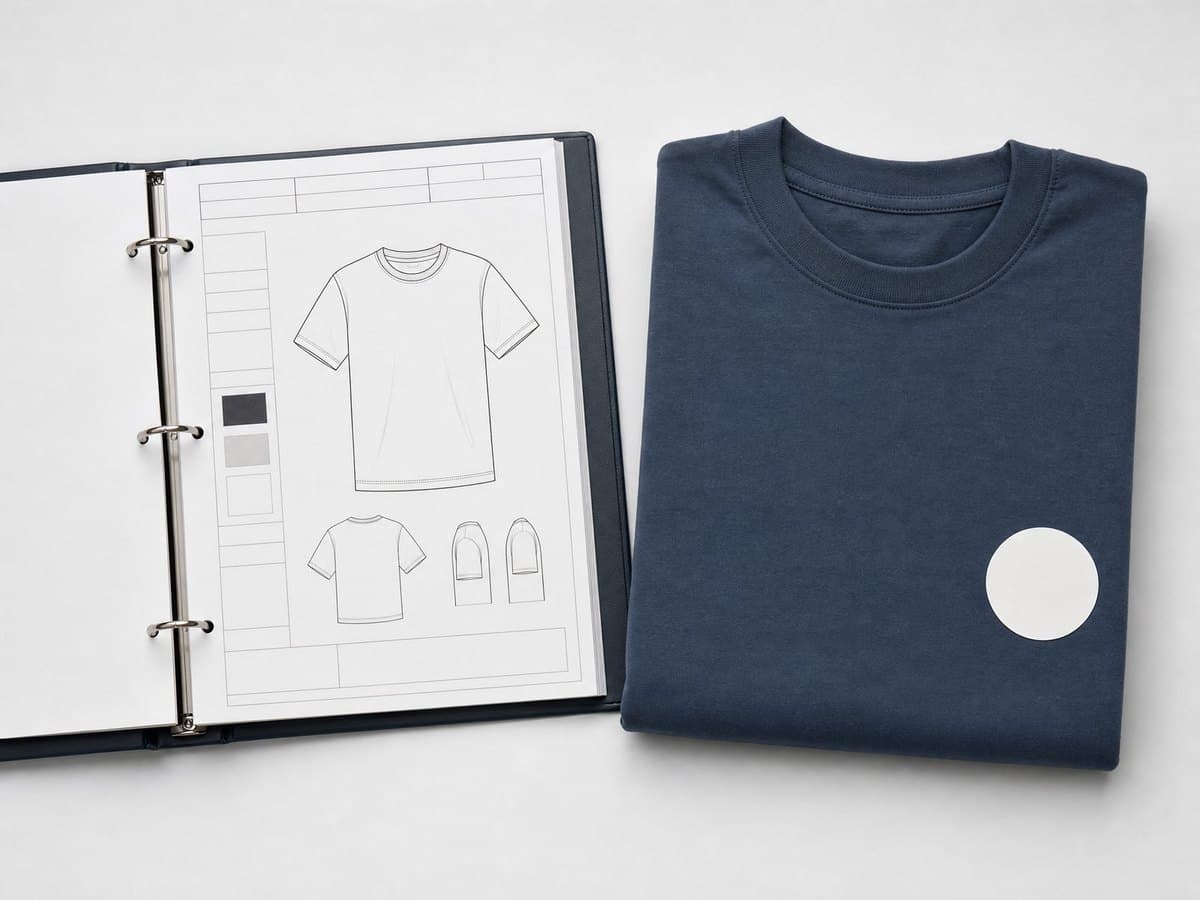
A fabric line a factory can quote and test against looks like this:
- Construction and composition: for example "100% combed cotton single jersey" for a tee, or "100% combed cotton French terry (loopback)" or "brushed fleece" for a hoodie.
- Yarn, if you know it: the spinning (combed ring-spun or open-end) and the count.
- Finished weight with a tolerance and a method: for example "180 GSM ±5%, finished weight, ASTM D3776 Option C". Add the ounce figure in brackets if your team thinks in ounces.
- The rib, separately: rib is usually heavier than the body so it grips. Our templates use a 1x1 rib of 95% cotton and 5% elastane at 220 GSM for a tee neckband, and a 2x2 rib at 380 GSM for hoodie cuffs and waistband.
- The hood lining, if there is one: our hoodie example uses 180 GSM single jersey.
- A shrinkage limit and its test: for example a maximum residual shrinkage after washing, tested to ISO 5077 with an ISO 6330 wash cycle, or AATCC TM135 if your market works to US methods.
- A reference garment whose weight and feel you like. It settles more than the numbers do.
Both of our templates have these lines laid out with a filled-in example: the T-shirt tech pack template uses a 180 GSM combed cotton single jersey, and the hoodie tech pack template uses 330 GSM French terry.
A quick way to decide
- Fit first. Fitted tee: 150–180 GSM. Regular tee: about 180. Boxy or oversized tee: 200–240. Regular hoodie: 300–350. Boxy heavyweight hoodie: 400–500.
- Then the season and the market. Lighter for heat and for spring and summer drops; brushed fleece and the heavier bands for autumn, winter and cold markets.
- Then the price position. Choose the lightest band that gives the feel you want; every step up adds cloth and freight weight.
- Then the decoration. A big plastisol print or dense embroidery is an argument for a heavier base.
- Then sample two weights. Order swatches or samples at two weights in the same fabric.
We cut and sew tees and hoodies on our own floor in Narayanganj, with the jersey, French terry and fleece knitted to our specification at partner mills, from a minimum of 150 pieces per style and per colour. Organic cotton versions are made in our GOTS-certified facility (RSC 9687). Send a reference garment with your enquiry and we weigh it, swatch the weight we think matches and tell you what you trade away at either end. Sampling takes about 10 days and production 40–50 days after you approve the sample: about 70 days from order to your door by air.
Frequently asked questions
Is 350 GSM good for a hoodie?
Yes. 350 GSM is a good hoodie weight for most brands: heavy enough to feel substantial, hold the shape of the hood and carry dense embroidery, and still light enough to wear indoors without the drying time of the heaviest cloth. It sits at the top of the standard hoodie band, which runs from about 280 to 350 GSM, and at the start of heavyweight, which runs on to about 500. In US terms it is about 10.3 oz per square yard. In French terry a 350 GSM hoodie feels dense and smooth and wears from spring to autumn; in brushed fleece the same weight lofts up and feels warmer, so it suits an autumn and winter range. If your reference is a very boxy streetwear hoodie that stands away from the body, compare a 350 swatch with a 400 one before you decide, because that silhouette usually needs the heavier cloth.
What GSM is a heavyweight hoodie?
A heavyweight hoodie usually means 350 GSM and up, and the true heavyweight streetwear hoodie sits at about 400 to 500 GSM. There is no official definition, though. No standards body says what weight earns the word, so one supplier's heavyweight can be another's standard, and the only safe way to compare is by the number. At 400 GSM and above the hoodie stops draping and starts holding a boxy shape of its own, which is the look heavyweight streetwear is buying. The trade-offs are real: more cloth in every piece raises the unit cost, the extra weight adds to every carton you ship, and the garment takes noticeably longer to dry, which customers in hot climates notice. Ask for the finished GSM, whether the fabric is French terry or brushed fleece, and a swatch you can hold.
What GSM is a heavyweight t-shirt?
In our range a heavyweight tee is about 240 GSM, with structured premium tees at 200 to 220 GSM just below it. Across the market the word is used loosely: some suppliers call a tee heavyweight from around 180 to 220 GSM, while others sell tees above 240 under the same name, so always ask for the number. Weight is only part of what makes a tee feel heavy. The yarn matters too: a combed ring-spun tee at 200 GSM can feel more substantial than an open-end tee at 220. We stop at about 240 GSM in single jersey because above that the cloth starts to feel dense rather than substantial. If you want even more structure in a top, interlock or a light French terry usually gets there more comfortably than heavier jersey. A swatch at 220 and one at 240 makes the choice obvious.
Should an oversized tee be heavier than a fitted one?
Usually, yes. A fitted tee is meant to follow the body, and a lighter jersey of about 150 to 180 GSM does that well, especially with 3 to 5% elastane so the neck and sides recover. An oversized or boxy tee works the other way: the shape comes from the cloth holding itself away from the body, which usually takes 200 to 220 GSM, or about 240 for a stiff, dropped-shoulder streetwear tee. Put a boxy pattern on light jersey and it collapses into soft folds; put a fitted pattern on heavy jersey and it feels stiff and warm. The weight also changes the size chart, because heavier jersey drapes less, so a boxy pattern should be fitted on a sample in the weight you will actually produce. Decide the silhouette first, then choose the weight that supports it, and confirm both on one sample.
How can I check the GSM of a garment I already own?
Cut a sample with a GSM cutter, weigh it and multiply by 100. A GSM cutter takes a circle of exactly 100 square centimetres, so a sample weighing 1.80 g is a 180 GSM fabric. You need a scale that reads to 0.01 g. A 10 by 10 cm square cut carefully with a ruler and a rotary cutter works too. Weigh the fabric dry and at room conditions, never damp or warm from the dryer, and take samples from more than one place, away from seams and rib. If you do not want to cut the garment, weighing it whole only gives a rough comparison with another garment of the same size and style, because rib, labels, print and seams add grams. The simplest option is to send the garment with your enquiry: we weigh it, match the fabric and send you a swatch of the weight we propose.
What GSM tolerance should I accept?
Agree a tolerance in writing before the fabric is knitted, for example plus or minus 5%, and say exactly what it applies to. Knitted fabric varies slightly from roll to roll, so a GSM figure is a target rather than an exact value, and the test methods, such as ASTM D3776 and EN 12127, tell you how to measure weight but do not set a pass mark. That part is agreed between you and the factory. On a 330 GSM hoodie fabric, plus or minus 5% accepts about 314 to 347 GSM. Make it specific: the finished weight after dyeing and compacting, the test method, and that it applies to bulk fabric as well as the swatch. Then check the weight on the pre-production sample and again on pieces from bulk, because those are the garments you will describe to your customers.
French terry or brushed fleece for a heavyweight hoodie?
Choose French terry for a year-round hoodie and brushed fleece for an autumn and winter one. Fleece is French terry with the loops on the back brushed into a soft nap, so at the same GSM it lofts up, holds more air and feels thicker, warmer and softer. French terry keeps its loops as knitted: it feels flatter and denser, breathes better, drapes more cleanly and pills less, because brushing loosens fibre ends. Brushing is also an extra mill process, so fleece costs a little more per metre. For a first run that you carry as stock yourself, terry is often the safer choice, because it sells in June as well as December. If your customers buy the hoodie for its softness or you sell into a cold market, fleece earns its place. Either way, write the fabric beside the GSM on the tech pack, because the number alone does not say which one you mean.
Does fabric weight affect printing and embroidery on t-shirts and hoodies?
Yes: fabric weight and the decoration method should be chosen together, because a print or logo that suits one weight can look wrong on another. Plastisol screen-print ink sits on top of the fabric as a layer you can feel, so a large plastisol print looks at home on a 200 to 240 GSM tee but can feel like a plastic panel on a 140 GSM one. Water-based ink dyes into the fibre and suits lighter tees and light colours. Embroidery needs a stabiliser behind the stitching: stretchy jersey needs a cutaway that stays in the garment, while firmer fleece can take tearaway. A heavy hoodie carries a dense logo well, but the same logo on a light tee pulls at the cloth and is more likely to pucker. DTF prints on cotton, polyester and blends, while sublimation only works on polyester or high-polyester fabric, so it is not an option on cotton at any GSM.
What GSM t-shirt is best for hot weather?
For hot weather, a t-shirt of about 140 to 180 GSM generally works best, because lighter single jersey feels cooler than the 200-plus weights that read as premium in colder places. At the lighter end, 140 to 160 GSM suits summer tees and fitted styles that follow the body, while around 180 GSM is the everyday weight that still feels substantial without being warm. For a fitted tee that needs to recover at the neck and side seams, 3 to 5 percent elastane helps more than extra weight. The trade-off comes with boxy or oversized cuts, which need roughly 200 to 220 GSM to hold their shape away from the body, so a range for a hot market may need a lighter fabric and a less structured silhouette. Yarn matters as much as weight: a combed ring-spun tee at 180 GSM can feel more expensive than an open-end tee at 220.
Where this applies
The manufacturing pages this guide relates to, if you are costing a real run.
Free tools & guides for this
Sources & further reading
- ASTM D3776/D3776M: Standard Test Methods for Mass Per Unit Area (Weight) of Fabric (Options A to D; Option C, small swatch)
- BSI: BS EN 12127:1998, Textiles. Fabrics. Determination of mass per unit area using small samples (woven and knitted fabrics)
- ISO 3801:1977, Textiles. Woven fabrics. Determination of mass per unit length and mass per unit area
- ISO 139:2005, Textiles. Standard atmospheres for conditioning and testing (20 °C, 65% relative humidity)
- BSI: BS EN ISO 5077:2008, Textiles. Determination of dimensional change in washing and drying
- AATCC TM135: Test Method for Dimensional Changes of Fabrics after Home Laundering
- NIST Special Publication 811: Guide for the Use of the International System of Units (1 oz/yd² = 33.90575 g/m²)
- Cotton Incorporated glossary: English cotton count (Ne), 840-yard lengths per pound
- Online Clothing Study: relationship between yarn count, machine gauge and fabric GSM in knits (160 GSM single jersey from 30s on 24 gauge)
- Online Clothing Study: what a GSM cutter is (100 square centimetre specimen, weight x 100)
Cite this guide
For journalists, writers, researchers and students.
Quoting this guide? Please credit Collective Studio and link to this page.
Reference
Homaira Jashim, Collective Studio. "Best GSM for Hoodies and T-Shirts: 140 to 500 GSM Explained." 4 November 2026. https://collectivestudioltd.com/journal/best-gsm-for-hoodies-and-t-shirts
Writing about us? Our press kit has our facts, logos and photos, free to use with credit.
Have an idea? Let’s make it.
We manufacture from 150 pieces per style and colour, with organic cotton options from our GOTS-certified facility and photos at every stage. Send a sketch or a sentence — we’ll reply within one business day.