Hoodie Tech Pack Template
A tech pack built for one garment: the pullover hoodie. The hood, the rib, the drawcord and the kangaroo pocket each get their own lines, with fourteen points of measure and a complete filled-in example. Free as a PDF or an Excel file, with no email required.
Our general tech pack template works for any garment. This version is for hoodies only: the size chart lists the 14 points a hoodie is measured on, and the materials, construction, label and packaging tables already name the parts of a hoodie, so you fill in values rather than work out what to ask for. The sections and their order are the same, so any factory reads it the usual way.
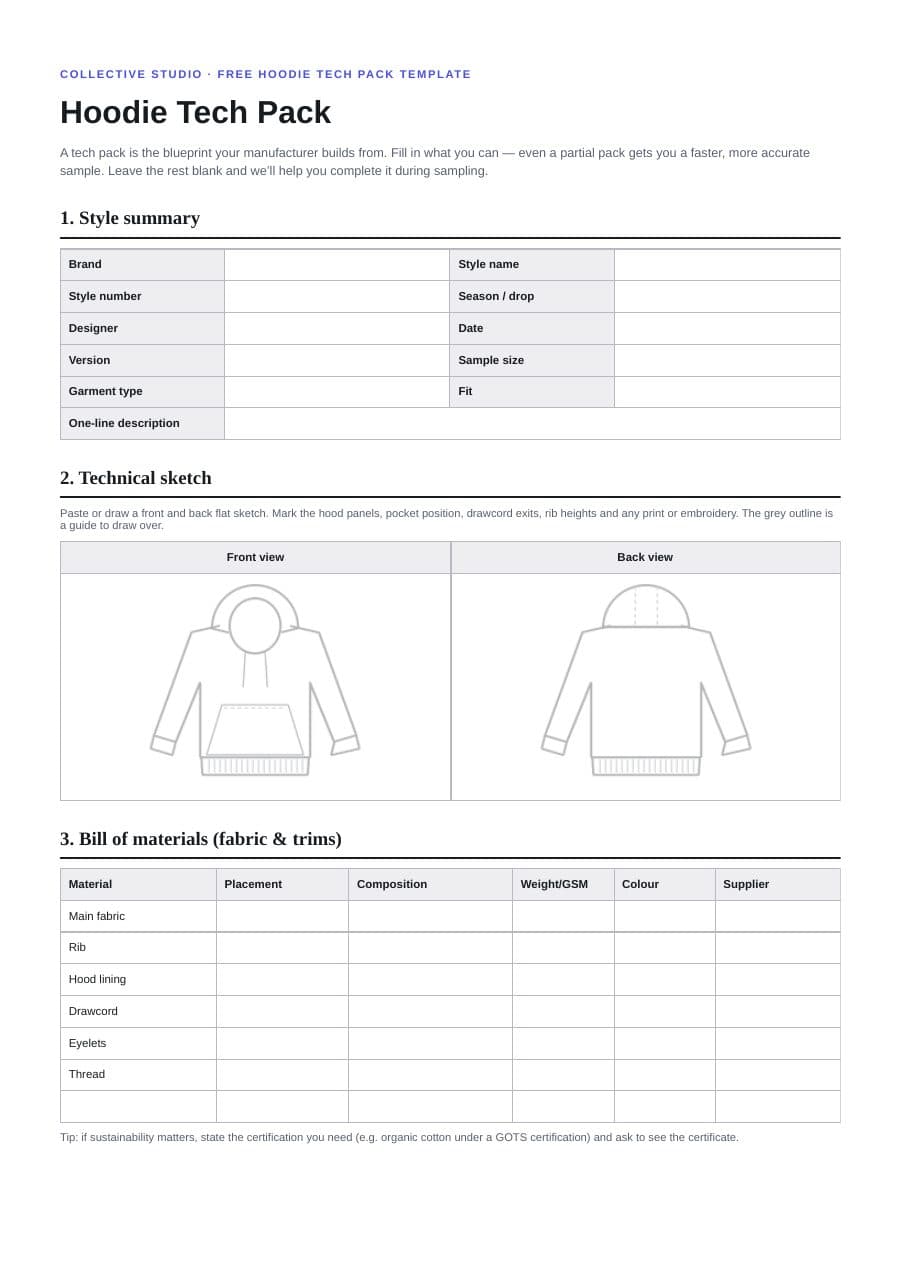
The PDF is the blank form, three A4 pages to print and fill in by hand, with a light outline of a hoodie in the sketch boxes to draw over. The Excel file is the same form with every box already filled in for an invented brand, in grey italics to type over. We publish it as a factory that reads these documents every week; our hoodie manufacturing page covers fabrics and minimums.
What the template looks like
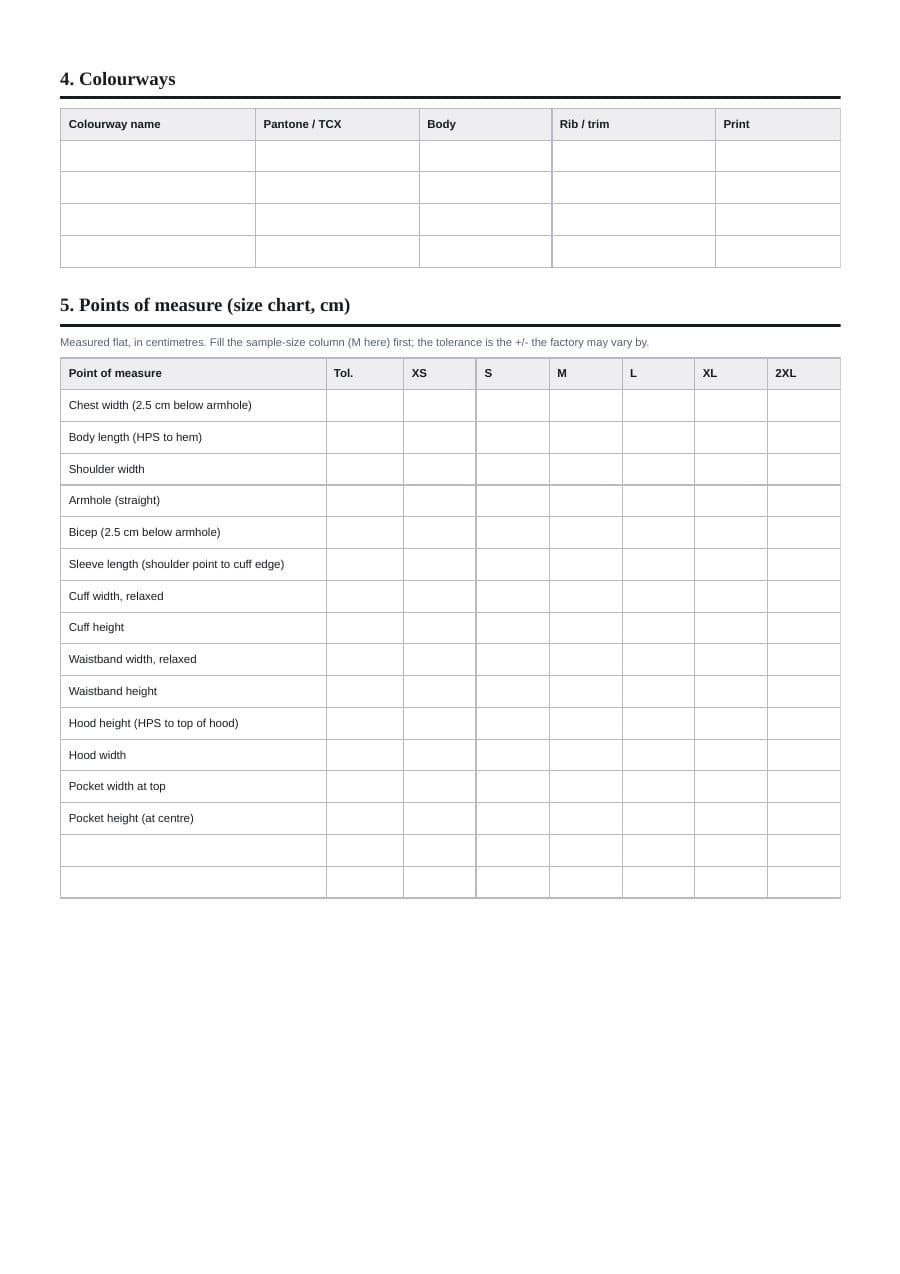
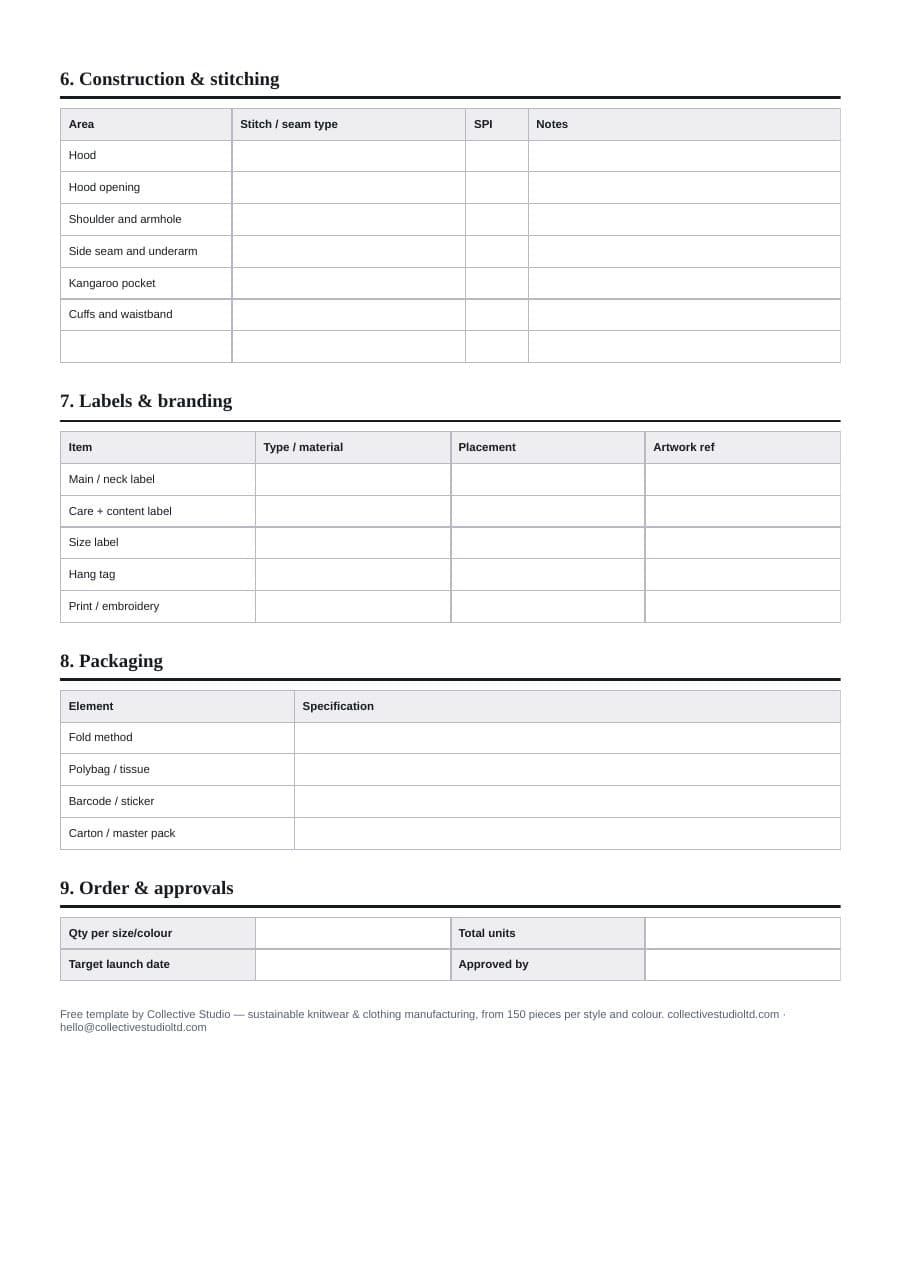
Three A4 pages, shown here in full. Nothing is hidden behind a form.
Hoodie size chart example
The example in the Excel version is a relaxed pullover hoodie with a lined three-panel hood, kangaroo pocket and 2x2 rib cuffs and waistband. Here is the part a factory reads most closely, graded from XS to 2XL. The brand and the numbers are invented to show the level of detail; measure a hoodie you like and use your own.
| Point of measure | Tol. (+/-) | XS | S | M | L | XL | 2XL |
|---|---|---|---|---|---|---|---|
| Chest width (2.5 cm below armhole) | 1 | 58 | 60.5 | 63 | 65.5 | 68 | 70.5 |
| Body length (HPS to hem) | 1 | 66 | 68 | 70 | 72 | 74 | 76 |
| Shoulder width | 1 | 54 | 56 | 58 | 60 | 62 | 64 |
| Armhole (straight) | 1 | 25 | 26 | 27 | 28 | 29 | 30 |
| Bicep (2.5 cm below armhole) | 0.5 | 22 | 23 | 24 | 25 | 26 | 27 |
| Sleeve length (shoulder point to cuff edge) | 1 | 54 | 55 | 56 | 57 | 58 | 59 |
| Cuff width, relaxed | 0.5 | 9 | 9.5 | 10 | 10.5 | 11 | 11.5 |
| Cuff height | 0.5 | 7 | 7 | 7 | 7 | 7 | 7 |
| Waistband width, relaxed | 1 | 50 | 52.5 | 55 | 57.5 | 60 | 62.5 |
| Waistband height | 0.5 | 7 | 7 | 7 | 7 | 7 | 7 |
| Hood height (HPS to top of hood) | 1 | 35 | 35.5 | 36 | 36.5 | 37 | 37.5 |
| Hood width | 1 | 25 | 25.5 | 26 | 26.5 | 27 | 27.5 |
| Pocket width at top | 0.5 | 28 | 29 | 30 | 31 | 32 | 33 |
| Pocket height (at centre) | 0.5 | 20 | 20.5 | 21 | 21.5 | 22 | 22.5 |
Measured flat, in centimetres. Fill the sample-size column (M here) first; the tolerance is the +/- the factory may vary by.
How to measure each point
Lay the garment flat, smooth it without stretching it, and measure with a soft tape in centimetres. The grade is how much each point grows from one size to the next in this example.
- Chest width (2.5 cm below armhole)
- Straight across from side seam to side seam, 2.5 cm below the bottom of the armhole.ExampleM 63 cm · ±1 cm · grade 2.5 cm a size
- Body length (HPS to hem)
- From the high point of the shoulder, where the shoulder seam meets the hood, straight down to the bottom edge of the waistband.ExampleM 70 cm · ±1 cm · grade 2 cm a size
- Shoulder width
- Straight across the back from one shoulder point to the other. On a dropped shoulder, the shoulder point is the seam where the sleeve joins, wherever it falls.ExampleM 58 cm · ±1 cm · grade 2 cm a size
- Armhole (straight)
- In a straight line from the shoulder point down to the bottom of the armhole, along the sleeve seam.ExampleM 27 cm · ±1 cm · grade 1 cm a size
- Bicep (2.5 cm below armhole)
- Across the sleeve, at right angles to its top fold, 2.5 cm below the bottom of the armhole.ExampleM 24 cm · ±0.5 cm · grade 1 cm a size
- Sleeve length (shoulder point to cuff edge)
- From the shoulder point along the top fold of the sleeve to the bottom edge of the cuff, cuff included.ExampleM 56 cm · ±1 cm · grade 1 cm a size
- Cuff width, relaxed
- Straight across the cuff at its bottom edge, laid flat and not stretched.ExampleM 10 cm · ±0.5 cm · grade 0.5 cm a size
- Cuff height
- From the cuff seam to the bottom edge of the cuff.ExampleM 7 cm · ±0.5 cm · same in every size
- Waistband width, relaxed
- Straight across the bottom edge of the waistband, laid flat and not stretched.ExampleM 55 cm · ±1 cm · grade 2.5 cm a size
- Waistband height
- From the waistband seam to the bottom edge of the waistband.ExampleM 7 cm · ±0.5 cm · same in every size
- Hood height (HPS to top of hood)
- With the hood laid flat, from the high point of the shoulder straight up to the top of the hood.ExampleM 36 cm · ±1 cm · grade 0.5 cm a size
- Hood width
- With the hood laid flat, across its widest point, from the front opening edge to the back of the hood.ExampleM 26 cm · ±1 cm · grade 0.5 cm a size
- Pocket width at top
- Straight across the top edge of the kangaroo pocket, from one side to the other.ExampleM 30 cm · ±0.5 cm · grade 1 cm a size
- Pocket height (at centre)
- At centre front, from the bottom edge of the pocket to its top edge.ExampleM 21 cm · ±0.5 cm · grade 0.5 cm a size
Materials and construction example
The bill of materials and the construction table from the same example. A factory buys fabric against composition and weight, and sews to the stitch named for each seam, so these two tables decide most of the price and most of the finish.
| Material | Placement | Composition | Weight |
|---|---|---|---|
| Main fabric | Body, sleeves, hood outer, pocket | 100% combed cotton French terry (loopback) | 330 GSM |
| Rib | Cuffs and waistband | 95% cotton, 5% elastane, 2x2 rib | 380 GSM |
| Hood lining | Inside of hood | 100% combed cotton single jersey | 180 GSM |
| Drawcord | Hood opening | Flat cotton cord, 1.2 cm wide, 140 cm long, silicone-dipped tips | — |
| Eyelets | Hood front, drawcord exits | Embroidered eyelets, no metal | — |
| Thread | All seams | 100% polyester, core-spun | — |
| Area | Stitch / seam | Notes |
|---|---|---|
| Hood | Three-panel hood, 4-thread overlock, lined, 12 SPI | Centre panel seams topstitched with a 2-needle coverstitch |
| Hood opening | Lining turned and twin-needle topstitched, 12 SPI | 3 cm drawcord channel; drawcord exits through two embroidered eyelets |
| Shoulder and armhole | 4-thread overlock, 12 SPI | Shoulder seam taped |
| Side seam and underarm | 4-thread overlock, 12 SPI | Sewn in one run, sleeve hem to waistband |
| Kangaroo pocket | Edges turned 1 cm, twin-needle topstitched, 12 SPI | Bartacks at both corners of each pocket mouth; pocket 6 cm above the waistband seam |
| Cuffs and waistband | Rib attached with 4-thread overlock, 12 SPI | 7 cm finished height; rib cut shorter than the opening so it grips |
SPI is stitches per inch. Labels: main / neck label (centre back neck, sewn into the hood seam); care + content label (left side seam, 10 cm above the waistband seam); size label (under the main label); hang tag (looped through the main label); print / embroidery (left chest, 18 cm below the HPS and 9 cm from centre front).
What a hoodie tech pack needs that a T-shirt one doesn't
The hood is a garment of its own
Say how many panels it has (two-panel hoods have one seam over the crown; three-panel hoods add a centre strip and sit rounder), whether it is lined and in what, and give its height and width. Hood height is measured with the hood flat, from the high point of the shoulder to the top. A hood that is a centimetre or two short pulls at the neck, and it is the most common fit complaint on a first hoodie sample.
Rib: weight, structure and finished height
Cuffs and waistbands are usually a heavier rib than the body fabric so they grip. Name the rib (1x1 or 2x2), its composition and weight, its finished height, and the relaxed width of each cuff and the waistband. If the hem should blouse over the waistband, the rib must be cut shorter than the body opening, so say what look you want.
Drawcord and eyelets
Give the cord's shape (flat or round), width, length and tip finish, and the eyelet type: embroidered eyelets carry no metal, while metal eyelets need choosing for colour and are worth checking against needle detection if your buyer asks for it. If the hoodie is for children, see the drawcord question below before you add one.
Pocket size and position
A kangaroo pocket needs its width at the top, its height at centre front and its distance above the waistband seam. Say how the mouths are finished and where the bartacks go, because the pocket corners take the strain when hands go in and out.
French terry or brushed fleece, and the weight
French terry has soft loops on the inside; brushed fleece has those loops raised into a fluffier, warmer face. Both are bought by weight. About 280 to 350 GSM is the standard hoodie range; heavier fleece suits a winter range but costs more in cloth and freight. Write the weight as a number.
Measured before or after washing
Heavy cotton terry and fleece can shrink on the first wash, in length more than in width. Say whether your chart is the garment as it leaves the factory or after a wash, and whether you want a garment wash or enzyme wash, which softens the hand and takes much of the shrinkage out before it reaches your customer.
For the fabric side, read what French terry is and rib knit for cuffs and waistbands. To work out how much fabric an order needs, try the fabric consumption calculator.
Templates for other garments
- T-shirt tech pack template
- Jogger tech pack template
- General tech pack template, for any other garment
- Tech pack checklist, if you prefer a tick-list
Frequently asked questions
What should a hoodie tech pack include?
The nine standard sections, with the parts that make a hoodie a hoodie filled in properly. A style summary with the fit and sample size. A front and back flat sketch marking the hood panels, the pocket and the drawcord exits. A bill of materials listing the body fabric by composition and weight, such as 100% combed cotton French terry at 330 GSM, plus the rib for cuffs and waistband, the hood lining, the drawcord, the eyelets and the thread. Colourways with Pantone TCX references. A size chart: ours has fourteen points, including hood height and width, cuff and waistband height, relaxed rib widths and pocket size, because a chart with only chest and length leaves the hood and rib to guesswork. Then construction for each seam, label and embroidery placement, packaging, and the order split by size and colour. Fill in what you have decided and send it.
How do you measure a hood for a tech pack?
Lay the hoodie flat, face up, with the hood flat and smoothed so it is not folded or stretched. For hood height, measure from the high point of the shoulder, where the shoulder seam meets the hood, straight up to the top of the hood. For hood width, measure straight across the hood at its widest point, from the front opening edge to the back of the hood. Our example uses 36 cm and 26 cm in size M. Write both in centimetres, and state whether the hood is two-panel or three-panel and whether it is lined, because the same numbers sit differently on each construction. If you have a hoodie whose hood you like, measure that one. A hood that is too short pulls the neckline back when the wearer looks down, and it is the fit point we see corrected most often between first and second samples.
What fabric weight should a hoodie tech pack specify?
A number in GSM, with the fabric type beside it, because heavyweight means something different to every supplier. About 280 to 350 GSM is the standard range for a hoodie. Towards the lower end the hoodie drapes and layers easily; towards the top it feels substantial and holds embroidery well, which is why our example uses 330 GSM French terry. For a genuine winter range, heavier brushed fleece is warmer, but it uses more cloth, which is bought by the kilo, and adds weight to every carton you ship. State whether you want French terry, which has soft loops inside, or brushed fleece, where those loops are raised for warmth. Name the rib for cuffs and waistband separately. If you are not sure of the weight, send us a hoodie you like and we will weigh it and work from the real thing.
Can a children's hoodie have a drawcord?
Usually not in the hood, and your tech pack should say so. In Europe the safety standard EN 14682 does not allow drawcords or functional cords in the hood and neck area of clothing for young children up to the age of seven, and it limits them for older children up to fourteen. In the United States, federal rules at 16 CFR part 1120 treat drawstrings at the hood or neck of children's upper outerwear in sizes 2T to 12 as a substantial product hazard. Toggles and cord ends are restricted too. The simple answer for children's hoodies is to leave the drawcord out, or to fit a fixed decorative detail with no free cord, and to mark that clearly on the sketch and in the bill of materials. Check the rules for every market you sell into before you sign off a sample, because a recall costs far more than a missing cord.
Sources
- US Consumer Product Safety Commission: Drawstrings in children's upper outerwear (16 CFR part 1120)
- BSI: EN 14682, Safety of children's clothing — cords and drawstrings on children's clothing — specifications
Download the hoodie template (PDF)Download the Excel version (.xlsx)Send us your tech pack