Types of Stitches in Clothing: Overlock, Coverstitch and Flatlock
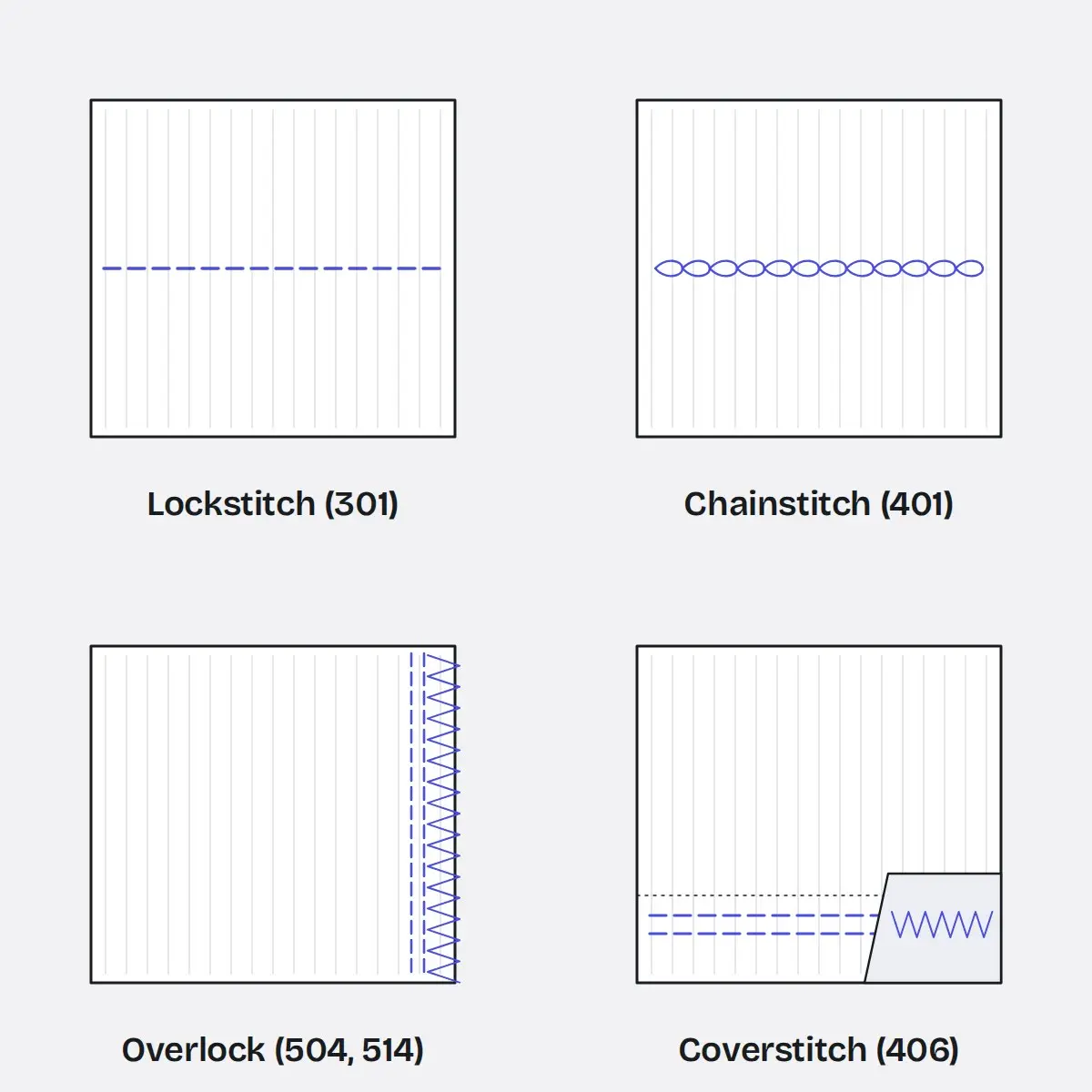
The types of stitches used to make clothing are named and numbered in the international standard ISO 4915, which sorts them into six classes from 100 to 600 and gives every stitch a three-digit number. Knitwear is built mostly from four of them: the overlock (504 or 514) that joins seams, the coverstitch (406) that hems, the flatlock (607) that makes a seam with no ridge, and the lockstitch (301), a straight stitch for places that should not stretch. Chainstitch, bartack and blind stitch do smaller jobs.
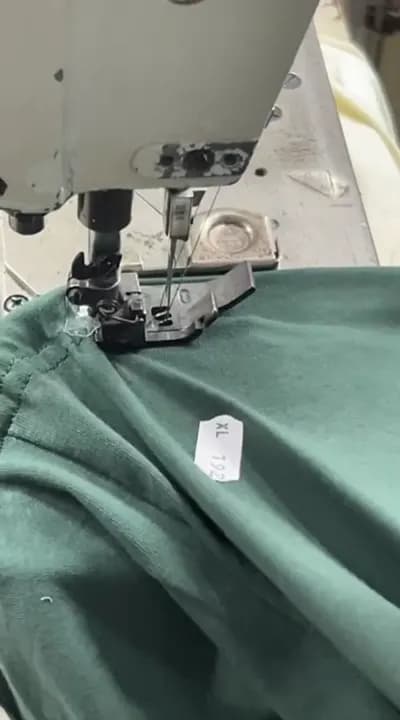
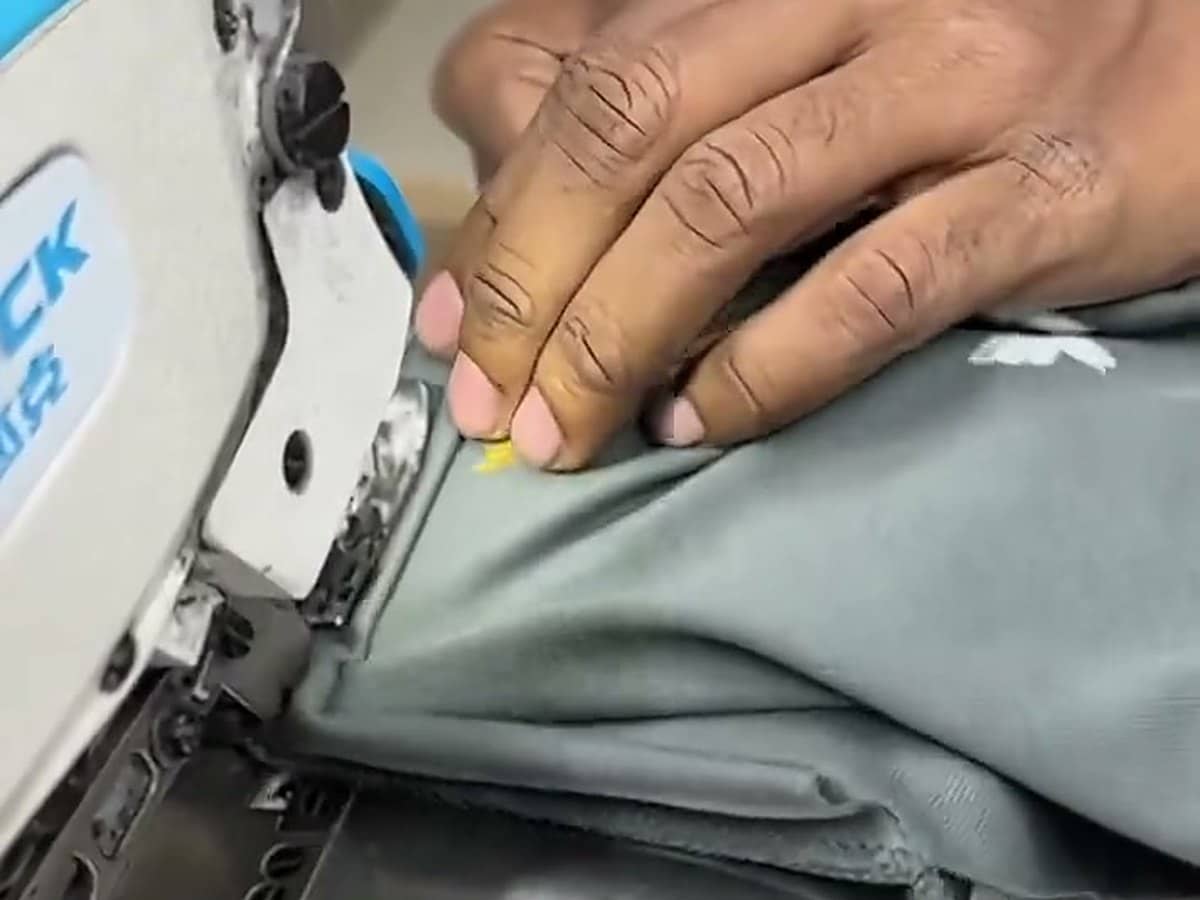
We are Collective Studio, a family-run knitwear factory in Narayanganj, Bangladesh. Every T-shirt, hoodie and pair of leggings we make is put together with these stitches on our sewing floor, and the clips on this page were filmed there. The drawings are our own. Use them in coursework or in a brief to any factory, with credit.
The short version
- Overlock (504, 514): sews two layers together, trims them and wraps the cut edge, all at once. Used on the side seams of a T-shirt.
- Coverstitch (406): two straight rows on the outside and a looper thread underneath. Used on the hems of a T-shirt.
- Flatlock (607): a flat seam with thread across both faces and nothing raised on the inside. Used on the seams of training leggings.
- Lockstitch (301) and chainstitch (401): straight stitches. Lockstitch barely stretches; chainstitch stretches a little more.
- Bartack and blind stitch: a dense bar that strengthens a corner, and a hem stitch that hardly shows on the outside.
- At home: an overlock machine is called a serger, and a coverstitch is sewn on a cover hem machine.
The six stitch classes in ISO 4915
ISO 4915 sorts stitches into six classes, and the first digit of a stitch number tells you its class: 301 is a class 300 stitch, 504 a class 500 stitch. The current edition was published in 1991. ISO last reviewed and confirmed it in 2021, and opened a new review in July 2026, so check the ISO page before you cite the edition. The American practice ASTM D6193 covers the same ground for stitches and seams.
Two words come up in every class. A needle thread is the thread the needle carries down through the fabric. A looper is a hooked part under the fabric that catches that thread and loops another thread through it. A home sewing machine has a bobbin instead of loopers, which is why it can sew a lockstitch but not a true overlock.
| Class | Name | On knitwear |
|---|---|---|
| 100 | Chainstitches formed by needle threads alone, such as the single-thread chainstitch 101 and the blind stitch 103 | Blind hems; rare on knits |
| 200 | Hand stitches | Hardly used in production |
| 300 | Lockstitches | Labels, plackets, zips, topstitching |
| 400 | Multi-thread chainstitches, including the bottom coverstitch 406 | Hems, elastic, the chain part of a safety stitch |
| 500 | Overedge (overlock) stitches | Almost every joining seam |
| 600 | Covering chainstitches, with a cover thread on top as well as underneath | Flat seams and bindings |
A point that is easy to miss: the everyday T-shirt hem, 406, is a class 400 stitch, not class 600. Stitch 602 is the same stitch with one more thread laid across the top face, and that extra cover thread is what puts the 600 stitches in a class of their own.
Stitch numbers used on knitwear
These are the stitch numbers you will meet on a knitwear tech pack, with what each looks like and where it goes on a T-shirt, a hoodie or a pair of leggings. Thread counts include the needle, looper and cover threads.
| Stitch | Class | Name and threads | What it looks like | Where it goes | Does it stretch? |
|---|---|---|---|---|---|
| 103 | 100 | Blindstitch, 1 thread | Nothing on the outside; small loops inside | Blind hems; rare on knits | Not used for seams |
| 301 | 300 | Lockstitch, 2 threads (needle and bobbin) | The same straight line on both sides | Labels, plackets, zips, patch pocket topstitching | Very little |
| 304 | 300 | Zigzag lockstitch, 2 threads | An even zigzag | Bartacks; some activewear and lingerie seams | Yes, until the zigzag pulls straight |
| 401 | 400 | Chainstitch, 2 threads (needle and looper) | A straight line on top, a chain of loops underneath | Main seams on wovens; in several rows, waistband elastic; the chain line of a 516 | More than a lockstitch |
| 406 | 400 | Two-needle bottom coverstitch, 3 threads | Two parallel rows on top, a looper zigzag underneath | T-shirt body and sleeve hems; elastic and bindings | Yes |
| 503 | 500 | Two-thread overedge, 2 threads | Thread wrapped over one cut edge | Neatening a single layer; some T-shirt hems | Not for joining seams |
| 504 | 500 | Three-thread overlock, 3 threads | One needle line, the edge wrapped in looped thread | Side, shoulder and sleeve seams of tees and hoodies | Yes, well |
| 514 | 500 | Four-thread overlock, 4 threads | Two needle lines and a wider wrapped edge | The same seams where a wider seam with more stretch is wanted | Yes, more than 504 |
| 516 | 500 | Five-thread safety stitch, 5 threads | A chainstitch line beside a three-thread overlock | Seaming wovens and knits | Limited by the chainstitch line, which takes the load |
| 602 | 600 | Two-needle coverstitch with top cover, 4 threads | Two rows with thread laced across the top | Bindings on vests and babywear | Yes |
| 605 | 600 | Three-needle coverstitch with top cover, 5 threads | Three rows, covered on both faces | Lap seams and bindings on stretch knits | Yes, highly |
| 607 | 600 | Four-needle flatseam (flatlock), 6 threads | Four rows, covered on both faces, lying flat | Inseams, rise and side seams of training leggings; knit underwear; fleece | Yes, highly |
Lockstitch and chainstitch: the straight stitches
A lockstitch (301) is made by a needle thread and a bobbin thread that lock together in the middle of the fabric, so it looks identical on both sides. A chainstitch (401) uses a needle thread and a looper thread that forms a chain of loops on the underside; it gives more stretch than a lockstitch, but it can run undone if the looper thread is pulled from the end.
On knitwear the lockstitch goes where a seam should keep its length: a label, a placket, a zip. The chainstitch is used for main seams on woven fabrics, and on knitwear it has two jobs. Sewn in several rows at once it can hold elastic in a waistband, and a single row of it runs beside the overlock in the five-thread safety stitch, 516, where it carries the load while the overlock covers the edge.
What is an overlock stitch?
An overlock stitch is formed by loopers carrying thread over the edge of the fabric, just behind a knife that trims the edge straight, so two layers are joined and their raw edge is enclosed at the same moment. It is the stretch seam that holds knitted garments together: the sides, shoulders and sleeves of a T-shirt, and the body and sleeves of a hoodie.
The two common versions differ by one needle. Stitch 504 has one needle and two loopers, three threads in all. Stitch 514 adds a second needle, which gives a wider seam with more stretch. American & Efird names these two as the overedge stitches most used for seaming knits, and notes that the wider 514 can feel bulky in underwear, where a narrow 504 is often preferred.
The home-sewing name is a serger, or an overlocker in the UK and Australia, and "serging" means overlocking. The "overlock stitch" on a domestic sewing machine is an imitation: the machine has a needle and a bobbin but no loopers and no knife, so it sews a zigzag-style pattern over the edge rather than a looped overedge.
What is a coverstitch?
A coverstitch is a hemming and topstitching stitch: two or three needles sew straight parallel rows on the outside, while one looper underneath zigzags between them over the raw edge. It has no knife and does not join two edges together; it holds a folded hem or a band flat and still lets it stretch.
The standard knit hem is 406, the two-needle bottom coverstitch, on the body and sleeves of a T-shirt. The gap between the needles matters. In American & Efird's technical bulletin a quarter-inch spacing (about 6 mm) stretched further than an eighth of an inch (about 3 mm), because each stitch holds more thread. When the gap must be narrow on a very stretchy fabric, the answer is more stitches per inch.
The home-sewing name is a coverstitch machine, often sold as a cover hem machine, or a serger that converts to cover stitching. Its three-thread, two-needle cover stitch has the same make-up as the factory 406: two needle threads and one looper.
What is a flatlock stitch?
A flatlock stitch joins two pieces of fabric edge to edge, or with a small overlap, and covers the join with thread on both faces, so the seam lies flat against the body. In a factory it is stitch 607: four needles, one looper underneath and one cover thread on top, six threads in all.
With six threads it uses more thread than an overlock. It runs on its own machine and is slower to sew than an overlock, so it is kept for seams that press on the skin while the body moves, on leggings, knit underwear and close-fitting sportswear. Coats notes that the older 606 flatlock has largely been replaced by 607, which it calls a flatseam; the number on the tech pack removes the doubt.
The home-sewing name is also flatlock, but on a home serger it is usually a two-thread overlock that is sewn and then pulled open flat. It looks similar from the outside, but it is an overedge stitch opened out, not the six-thread 607.
Overlock vs coverstitch
An overlock joins seams and a coverstitch hems. The overlock trims and wraps the edges of two layers as it sews them together; the coverstitch sews straight rows through a folded hem while its looper covers the raw edge underneath. A T-shirt needs both, and on a factory line they are two separate machines.
| Overlock | Coverstitch | |
|---|---|---|
| Main job | Joining seams and neatening edges | Hems, topstitching and bands |
| Knife | Yes, trims the edge as it sews | None |
| Seen from outside | Only the seam line; the stitch sits inside | Two or three straight rows |
| Underneath | Looped thread wrapped over the cut edge | A looper thread zigzagging between the rows |
| ISO numbers | 504, 514 (class 500) | 406 (class 400); 602 and 605 (class 600) |
| Home machine | Serger or overlocker | Coverstitch or cover hem machine |
Bartack and blind stitch
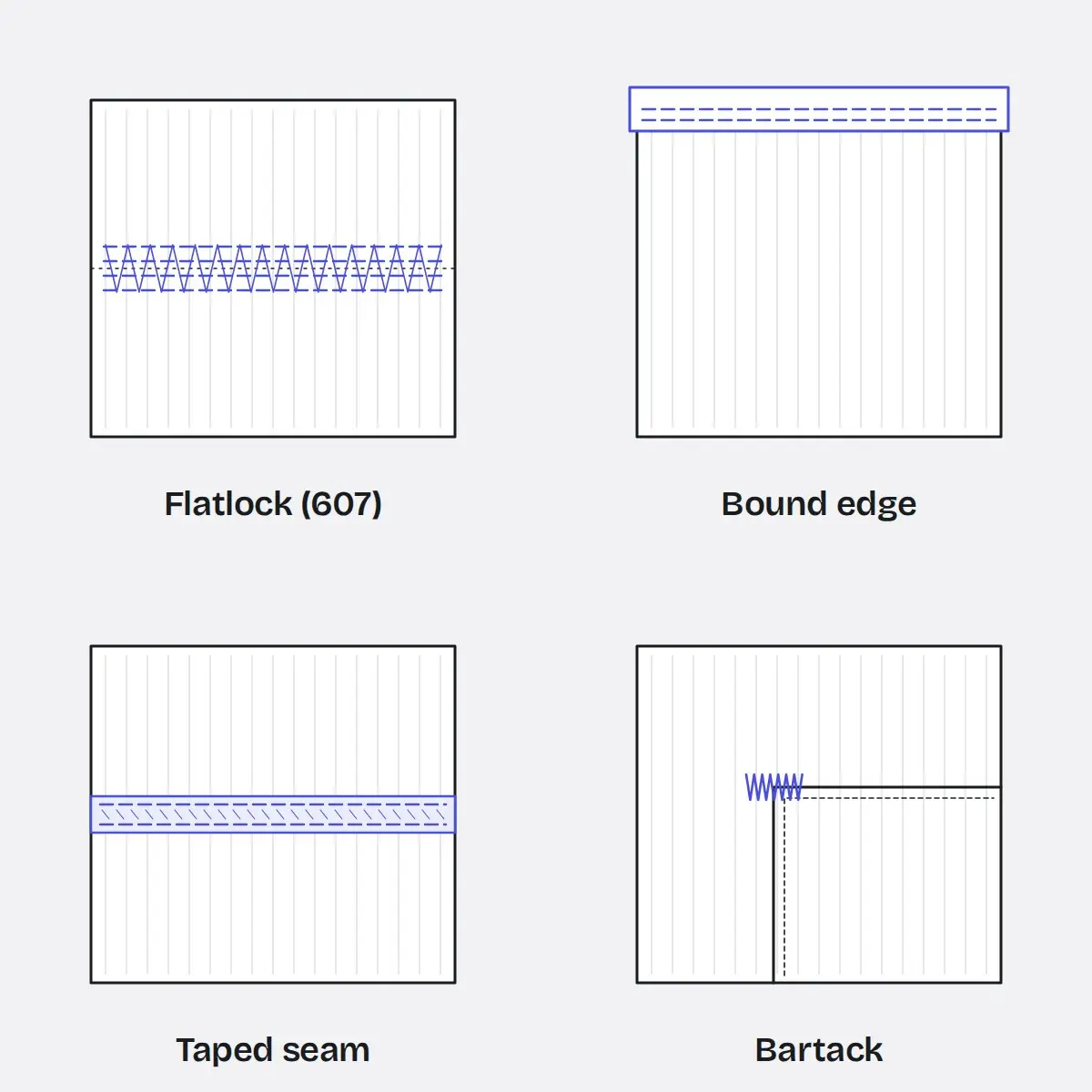
A bartack is a short bar of dense zigzag stitches that reinforces a point under strain. Thread makers file it under the zigzag lockstitch, 304, or the single-thread chainstitch, 101. On knitwear you find it at both corners of each kangaroo pocket opening and at the bottom of a zip.
A blind stitch is a hem stitch that does not show on the outside. In stitch 103 the needle catches only part of the thickness of the garment layer, so no thread reaches the face; thread makers list it for blind hemming and felling. On a knitted top the two-thread overedge, 503, can be set up as a blind hem, and Coats lists it for hemming T-shirts. Coats also warns that 503 is not suitable for joining a seam.
Types of seams and stitches: the difference
A stitch is the pattern the threads make; a seam is the way the pieces of fabric are laid together before they are stitched. Seams have their own standard, ISO 4916, with eight classes: superimposed (pieces laid on top of each other, as in an overlocked side seam), lapped, bound, flat, decorative, edge finishing, attaching separate items, and single-ply construction.
A full seam code is a five-digit seam number followed by the stitch number, so the same 514 overlock can appear in different seams. Our guide to types of pockets and seams draws the seams you meet on knitwear, including bound edges and taped necks, and the pockets that go with them.
Which stitch goes where on a T-shirt, hoodie and leggings
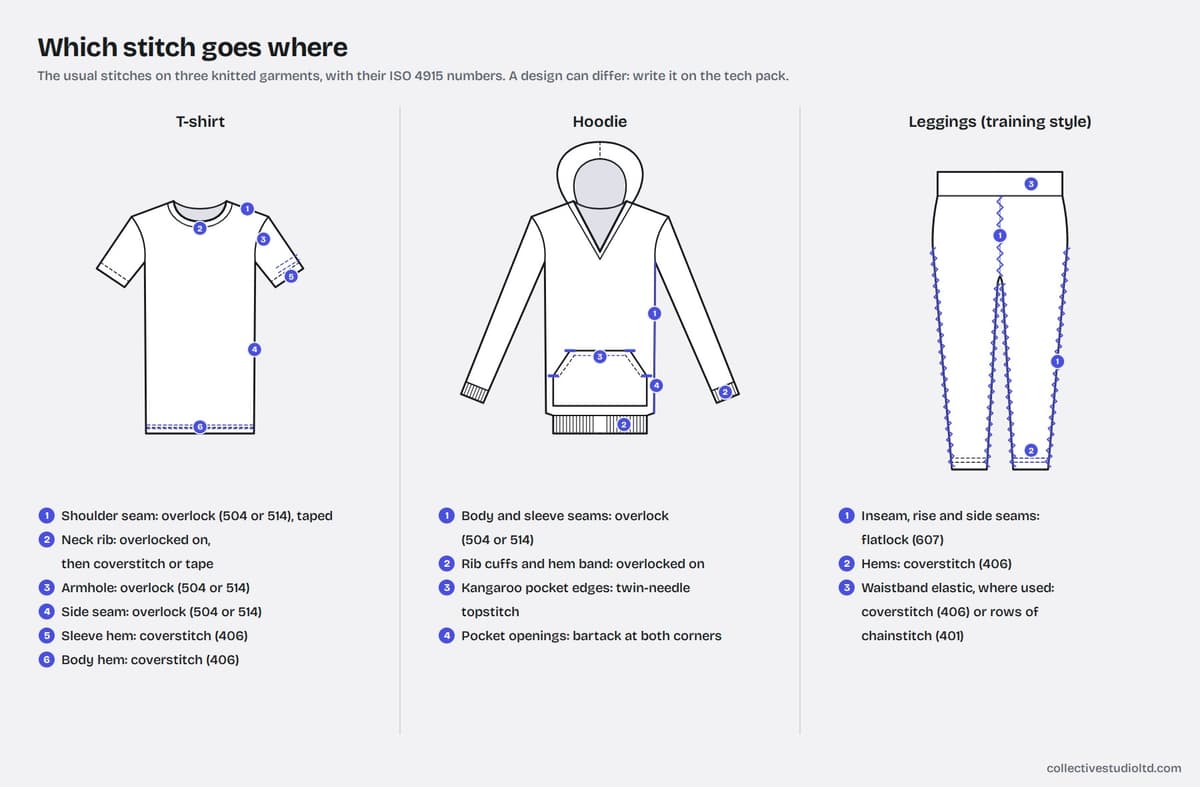
- T-shirt: overlock at the shoulders, armholes and sides; coverstitch at the body and sleeve hems; the neck rib overlocked on, then held flat with a coverstitch or covered with tape. The filled-in example in our T-shirt tech pack template uses a four-thread overlock for every joining seam and a two-needle coverstitch at both hems. Our guide to types of necklines shows the neck finishes.
- Hoodie: overlock for the body and sleeves; the rib cuffs and hem band overlocked on. In our hoodie tech pack template the kangaroo pocket edges are turned under and twin-needle topstitched, with a bartack at both corners of each opening. Twin-needle topstitching can be sewn as two rows of lockstitch or as a 406 coverstitch; most factories choose by the machine and the look.
- Leggings: flatlock on the inseams, rise and side seams of a training pair; coverstitch at the hems. Where a waistband has elastic in it, the elastic is usually sewn with a coverstitch or with several rows of chainstitch.
On our sewing floor: two pairs of leggings
Take two pairs of leggings cut from the same fabric, one for training and one for everyday wear. For the training pair we put flatlock on the inseams, the rise and the side seams, with coverstitch hems, because those long seams move against the skin with every stride, and an overlocked seam leaves a ridge inside that rubs. The everyday pair keeps the coverstitch hems, and overlock can replace flatlock on the seams where that style can take it. Flatlock needs its own machine and takes longer per seam than an overlock, so a style that is not worn for exercise saves those minutes.
The choice is made seam by seam and written into the tech pack before the sample is sewn, so the sample shows exactly what the bulk order will be.
What to write on a tech pack
- The stitch number with the name, for example "side seams: 514 overlock". Names change between countries and machine makers; the numbers do not.
- For a coverstitch, the needle spacing and the depth of the hem.
- Stitches per inch (SPI) for each seam. American & Efird gives 14 to 18 stitches per inch (about 5.5 to 7 per centimetre) for stretch knits, because too few stitches crack when the fabric is pulled, and the more the fabric stretches, the more stitches it needs. Our T-shirt and hoodie template examples, in cotton jersey and cotton French terry, use 12 SPI.
- Thread colour, matched to the body or to a trim, where the stitching shows.
Our free tech pack template has a construction table with a column for stitch type and SPI, and the manufacturing glossary on our resources page explains the other terms. Sewing is one stage of nine in our step-by-step guide to garment manufacturing. At the end of the line, an open seam counts as a major defect; our guide to quality control and AQL explains how faults are classed.
If you are having this made
We work from a tech pack, a sketch or a garment to match, and the stitch for each seam is settled on the sample, which takes about 10 days, before bulk fabric is cut. Our minimum is 150 pieces per style and per colour. Start with the T-shirt, hoodie or leggings page, or send us your brief.
Frequently asked questions
What are the different types of stitches?
The international standard ISO 4915 sorts machine and hand stitches into six classes: 100 chainstitches made from needle threads alone, 200 hand stitches, 300 lockstitches, 400 multi-thread chainstitches, 500 overedge or overlock stitches and 600 covering chainstitches. Each stitch has a three-digit number whose first digit is its class. On knitted clothing four stitches do most of the work: the overlock (504 or 514) for joining seams, the coverstitch (406) for hems, the flatlock (607) for flat seams on leggings and sportswear, and the lockstitch (301) for labels, plackets and zips. Bartacks and blind stitches do small jobs, such as strengthening pocket corners and hiding a hem.
What is the difference between an overlock and a coverstitch?
An overlock joins seams and a coverstitch hems. An overlock machine has a knife that trims the edges of two layers while its loopers wrap thread around them, so the seam is sewn and its edges finished in a single step; it is the seam on the sides and shoulders of a T-shirt. A coverstitch machine has no knife. Its two or three needles sew parallel rows through a folded hem while a looper underneath covers the raw edge, which is the double row you see on a T-shirt hem. In the standard the overlock is 504 or 514 and the coverstitch is 406. A T-shirt needs both machines.
Is a flatlock the same as a coverstitch?
No. The coverstitch on a T-shirt hem, 406, sews through a folded hem or band, with straight rows on top and a looper thread underneath, and it covers only the underside. A flatlock joins two separate pieces of fabric edge to edge and covers the join on both faces, so the seam is flat and has no ridge inside. In ISO 4915 the T-shirt coverstitch is in class 400, and the factory flatlock, 607, is in class 600, with four needles and six threads. Thread makers call both cover stitches, but a flatlock needs its own machine with four needles and a top cover thread.
Can a normal sewing machine do an overlock stitch?
Not a true one. A domestic sewing machine forms stitches with a needle and a bobbin, while an overlock machine, or serger, uses loopers instead of a bobbin and has a knife that trims the edge as it sews. The "overlock stitch" on a sewing machine dial is an imitation: a zigzag-style pattern sewn over the edge with no trimming. It neatens an edge well enough for home sewing, but it does not trim the edge, and it does not make the looped edge of a factory 504 or 514. Factories sew these seams on dedicated overlock machines.
What do stitch numbers like 301, 406 and 504 mean?
They are stitch type numbers from the international standard ISO 4915. The first digit gives the class and the other two pick out one stitch within it. So 301 is the basic lockstitch of class 300, 401 the two-thread chainstitch of class 400, 406 the two-needle bottom coverstitch, 504 the three-thread overlock of class 500, and 607 the four-needle flatseam of class 600. Factories, thread makers and machine makers all use these numbers, which is why they belong on a tech pack: a name like "cover hem" or "flatlock" can mean different things in different places, but the number means one stitch.
What is the difference between a seam and a stitch?
A stitch is the pattern the threads make; a seam is how the pieces of fabric are arranged before they are sewn. Stitches are classified in ISO 4915 and seams in ISO 4916, which has eight seam classes: superimposed, lapped, bound, flat, decorative, edge finishing, attaching separate items and single-ply construction. A complete specification gives both, the five-digit seam number followed by the stitch number, because the same stitch can be used in different seams. For example, an ordinary T-shirt side seam is a superimposed seam sewn with an overlock, while a legging seam is a flat seam sewn with a 607 flatlock.
What stitch is used on leggings?
Training leggings are usually sewn with a flatlock seam, stitch 607, on the inseams, rise and side seams, because it lies flat and does not rub the skin as the legs move. The hems are coverstitched, and waistband elastic, where used, is usually sewn in with a coverstitch or rows of chainstitch. Leggings meant for everyday wear can be overlocked instead, which is quicker to sew but leaves a small ridge inside the seam. Whatever the choice, the stitches need to stretch as far as the fabric does, so factories use overlock and cover stitches with enough stitches per inch, rather than a lockstitch that would crack when pulled.
Where this applies
The manufacturing pages this guide relates to, if you are costing a real run.
Free tools & guides for this
Sources & further reading
- ISO: ISO 4915:1991, Textiles: Stitch types: Classification and terminology (confirmed 2021)
- Amann: Industrial stitch types, sewing thread consumption and ISO 4915
- Coats: Basic stitch types
- Coats: Seam types (ISO 4916 seam classes)
- American & Efird: ISO Stitch Terminology (2006)
- American & Efird: Technical bulletin, Sewing Stretch Knit Fabrics
- University of Kentucky Cooperative Extension: Cover or Chain Stitching, CT-JB.001 (2020)
- New Mexico State University Extension: Selecting an Overlock Sewing Machine, Guide C-218 (2019)
Cite this guide
For journalists, writers, researchers and students.
Quoting this guide? Please credit Collective Studio and link to this page.
Reference
Homaira Jashim, Collective Studio. "Types of Stitches in Clothing: Overlock, Coverstitch and Flatlock." 19 November 2026. https://collectivestudioltd.com/journal/types-of-stitches
Writing about us? Our press kit has our facts, logos and photos, free to use with credit.
Have an idea? Let’s make it.
We manufacture from 150 pieces per style and colour, with organic cotton options from our GOTS-certified facility and photos at every stage. Send a sketch or a sentence — we’ll reply within one business day.