The EU Digital Product Passport for Clothing: What Brands Must Do, and When
One EU regulation is going to reach further into how clothing is made than anything since REACH, and most brands we speak to know it only as three letters. ESPR — the Ecodesign for Sustainable Products Regulation — is already in force. One of its obligations began applying five weeks before this was published. Another, the Digital Product Passport, will eventually require you to know things about your garment that today live in a spreadsheet at your supplier's mill, if they exist at all.
This is written from the factory side of that supply chain, because that is where most of the data you will be asked for actually sits. What follows is what is decided, what is not, and what a brand can usefully do in 2026 rather than in a panic in 2028.
What ESPR is, in one paragraph
ESPR entered into force on 18 July 2024. It is a framework: it does not by itself set rules for t-shirts. Instead it gives the European Commission the power to set ecodesign requirements product group by product group, through delegated acts. On 16 April 2025 the Commission adopted the first ESPR and Energy Labelling Working Plan covering 2025–2030, which names the product groups it will tackle and roughly when. Textiles and apparel are on that list.
Two things flow from ESPR that a clothing brand needs to care about: a ban on destroying unsold stock, which is already live, and the Digital Product Passport, which is not yet.
The part that is already law: you cannot destroy unsold clothes
Since 19 July 2026, destroying unsold apparel, clothing accessories and footwear has been prohibited in the EU. This is not a proposal or a consultation. It applies now.
| Company size | When the ban applies | Notes |
|---|---|---|
| Large companies | From 19 July 2026 — in force now | Destruction permitted only in narrowly defined cases, and it must be documented and justified |
| Medium-sized companies | Expected 2030 | A transition period rather than an exemption |
| Micro and small enterprises | Exempt | Exempt from the ban itself, not from other ESPR obligations that may follow |
The practical effect on a brand is not really legal, it is commercial. If you cannot write off a bad buy by destroying it, then over-ordering becomes materially more expensive: you have to store it, discount it, donate it or recycle it, and each of those has a cost. The cheapest response to this regulation is to buy closer to demand — which is an argument for lower minimums and repeat orders rather than one enormous annual buy.
We would be foolish not to point out that this is the argument we have been making for other reasons for years. A 100-piece minimum exists so a brand can test a style before committing to thousands. ESPR has now given that a regulatory edge as well as a cash-flow one.
The Digital Product Passport: what it is
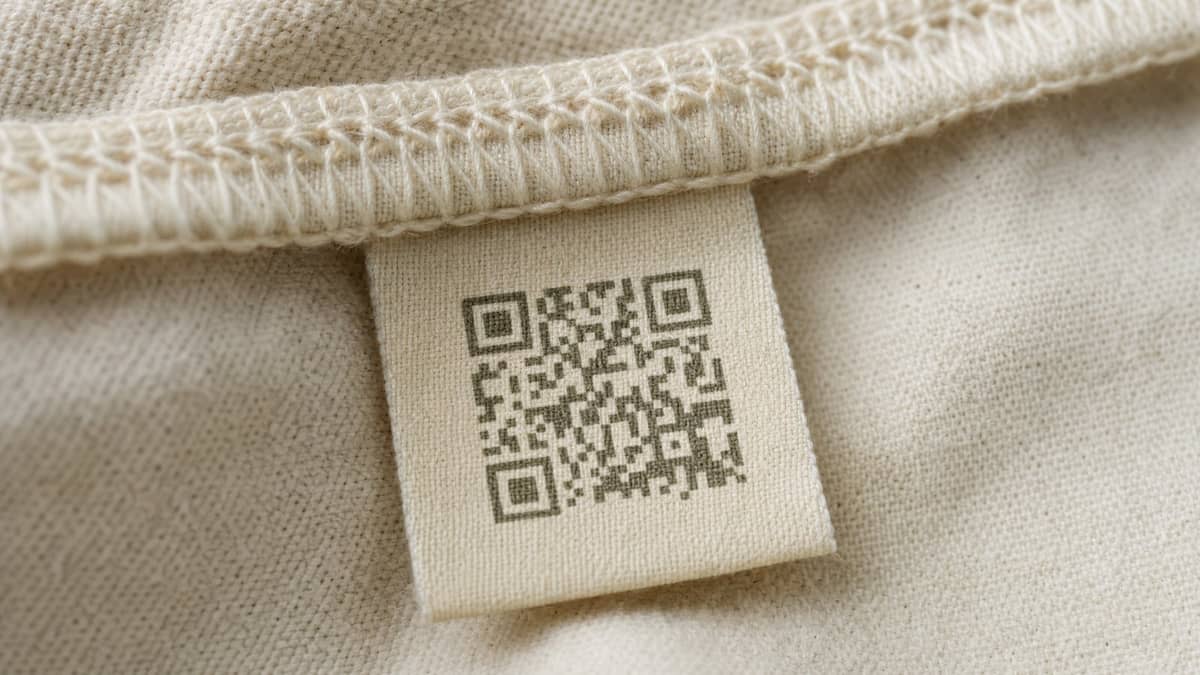
The Commission describes the DPP as a digital identity card for a product — a record, reachable from the item itself, usually by scanning a QR code, that carries information about what it is made of, where it came from, how it can be repaired and how it should be recycled. Different audiences see different levels of it: a shopper sees a subset, while recyclers, regulators and customs can see more.
For textiles, pilot work has identified in the region of 126 candidate data points, of which only about 25 to 30 are expected to be consumer-facing. That ratio is the whole story. The visible passport is small. The machinery behind it — fibre composition by weight, country of each processing stage, chemical and certification records, recycled content, care and durability data — is the part that has to come from your supply chain.
The dates, and how firm they are
| Date | What happens | How certain |
|---|---|---|
| 18 July 2024 | ESPR entered into force | Settled — in force |
| 16 April 2025 | First ESPR Working Plan 2025–2030 adopted; textiles named as a priority group | Settled — adopted |
| 19 July 2026 | Ban on destroying unsold apparel and footwear applies to large companies | Settled — in force now |
| Expected 2027 | Delegated act for textiles and apparel, setting the actual requirements | Indicative — the working plan signals timing, not a legal deadline |
| Roughly 18 months after that act | Compliance obligations bite, so late 2028 into 2029 on current signals | Estimated — depends on the act's own transition period |
| 2030 | Unsold-goods ban extends to medium-sized companies | Signalled |
We want to be careful here, because a great deal of consultancy marketing presents 2027 as a hard deadline. It is not. The textile delegated act has not been adopted at the time of writing, and until it is, nobody — including anyone selling you DPP software — knows the final data list. What is reasonable is to say the direction of travel is fixed and the timing is approximate.
What your factory will need to be able to tell you
Almost every hard data point in a garment passport originates upstream of the brand. This is the list we would expect a knitwear brand to have to produce, and where each piece actually comes from.
| Data point | Who actually holds it | Can you get it today? |
|---|---|---|
| Fibre composition by weight | Spinner and mill | Yes — it is on the fabric specification |
| Country of each processing stage | Factory, from its own mill records | Yes, if the factory keeps mill declarations |
| Recycled content and its evidence | Spinner, with a certificate such as GRS or RCS | Only if the material was bought as certified |
| Organic fibre certification | Certification body, via a scope and transaction certificate | Yes for GOTS-certified goods — the paperwork already exists |
| Chemical compliance records | Dye house and mill | Usually, but often not in a form a brand can publish |
| Care, durability and repair information | Brand, informed by the factory | Yes, though rarely written down formally |
The uncomfortable observation from inside a factory is this: a brand that has been buying on price alone, through an agent, from a supplier it has never visited, will struggle. Not because the data is secret, but because nobody in that chain has any incentive to compile it, and the brand has no relationship through which to insist.
Why GOTS certification is a genuine head start
If you already buy GOTS-certified organic cotton, a meaningful slice of the passport is effectively pre-built. GOTS is a chain-of-custody standard: certified goods travel with scope certificates for each facility and transaction certificates for each shipment, naming who processed what and where. That is precisely the shape of evidence a product passport wants.
It is not the whole passport — GOTS does not cover durability or repairability, and it only covers the organic portion of your range. But it means the traceability plumbing exists rather than having to be invented. Our own certificate is RSC 9687, and we will send the scope certificate to any brand that asks, in advance of any order.
The broader point applies whether or not you buy organic: standards with real chain-of-custody documentation — GOTS, GRS, OEKO-TEX — are the cheapest route to passport-ready data, because someone else has already built the audit trail.
What to do in 2026
- Check whether the unsold-goods ban applies to you now. If you are a large company selling into the EU, it does, as of 19 July 2026 — and destruction now requires documented justification.
- Ask your factory for mill declarations on your current styles. Not for compliance yet; to find out whether they can produce them at all. The answer tells you how much work 2028 will be.
- Write down what you already know. Fibre composition, mill country, dye house, certifications. Most brands have this scattered across emails and tech packs rather than in one place.
- Buy certified where it is close to free. If organic or recycled material is already in your range, buying it certified rather than uncertified costs little and produces documentation you will later need.
- Do not buy DPP software yet. The data list is not final. Getting your supply chain to document itself is useful under any final rule; a platform chosen before the delegated act may be solving the wrong problem.
- Re-read this when the textile act is adopted. That is the moment the requirements become real, and we will update this page then.
The honest summary
One obligation is live: large companies cannot destroy unsold clothing in the EU, as of 19 July 2026. One is coming but not yet defined: the Digital Product Passport for textiles, expected to be set out in a delegated act around 2027 with compliance roughly eighteen months later. Between those two dates, the useful work is not software. It is knowing where your cloth was made and being able to prove it.
That is a supply-chain relationship question more than a technology one, and it is decided by who you buy from and how directly. If you want to test that with a real order, our minimum is 100 pieces per style, and we ship DDP into the EU.
Sources
- European Commission — Ecodesign for Sustainable Products Regulation (ESPR)
- European Commission — Ban on destruction of unsold clothes and shoes enters into application
- EU Circular Economy Stakeholder Platform — New EU rules to stop the destruction of unsold clothes and shoes
- EUR-Lex — Regulation (EU) 2024/1781 (ESPR), full text
- Global Organic Textile Standard — scope and transaction certificates
This page states the position as at 26 August 2026 and marks which dates are settled and which are indicative. The textile delegated act had not been adopted on that date. Verify against the primary sources above before making a compliance decision.
Collective Studio is a family-run knitwear manufacturer in Narayanganj, Bangladesh — our own cut-and-sew floor, GOTS-certified under certificate RSC 9687, from 100 pieces per style. We are a 100% export factory, shipping DDP to brands abroad rather than supplying the domestic market.
Have an idea? Let’s make it.
We manufacture from 100 pieces per style, with GOTS-certified organic options and photos at every stage. Send a sketch or a sentence — we’ll reply within a day.