Types of Pockets and Seams on Knitwear: 16 Drawings With Names
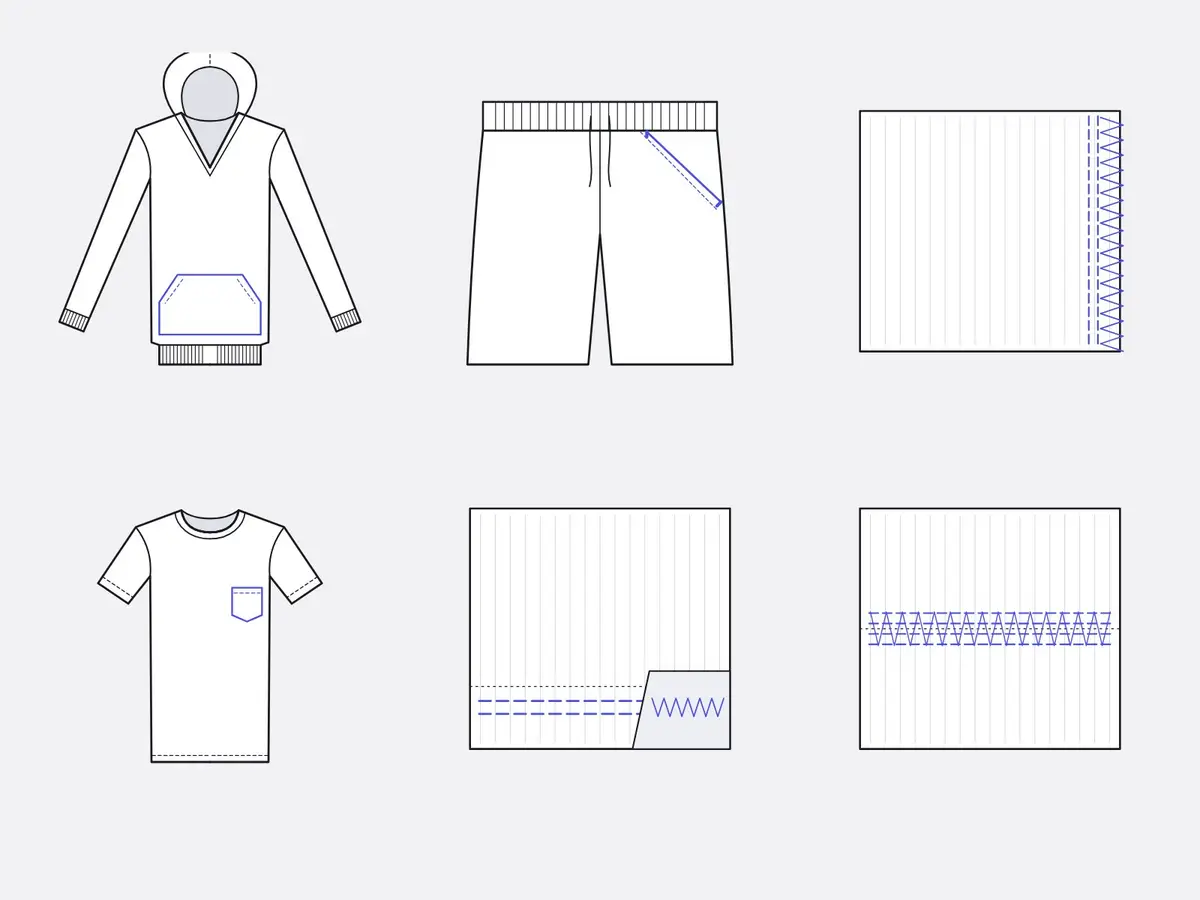
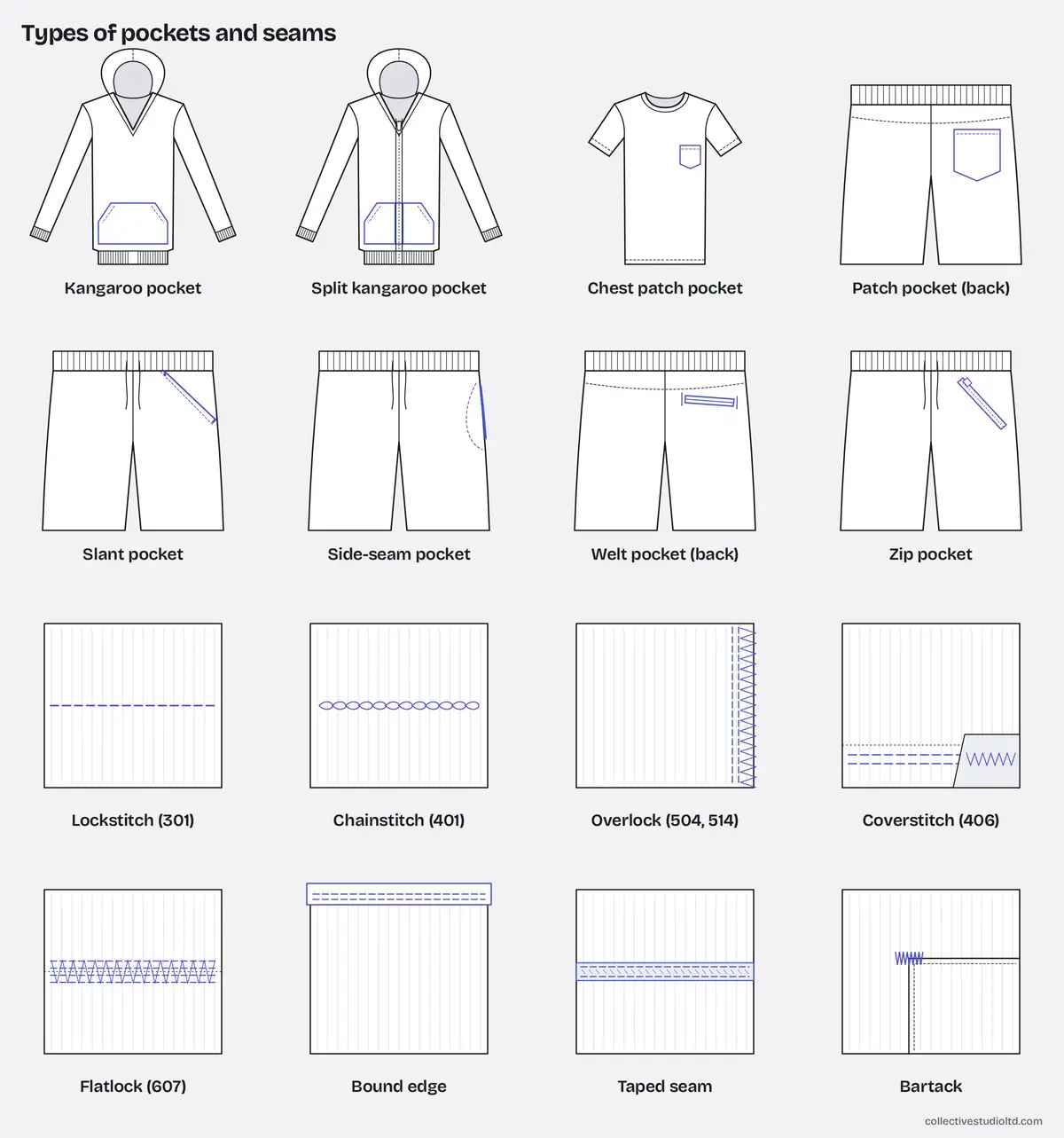
The types of pockets on knitted clothing come in two families: patch pockets, sewn on top of the garment, and set-in pockets, cut into it with a pocket bag behind. The types of seams are fewer than they look, because a T-shirt, a hoodie and a pair of joggers are all built from the same handful of stitches. This guide draws eight pockets and eight stitches and seams, and gives each the name a factory will recognise.
We are Collective Studio, a family-run knitwear factory in Narayanganj, Bangladesh, making T-shirts, hoodies, joggers and activewear for brands in the UK, Europe and Australia. The drawings are our own. Use them in a brief to any factory.
The short version
- Patch pockets: kangaroo, split kangaroo, chest patch, back patch.
- Set-in pockets: slant, side-seam, welt, zip.
- Joining stitches: overlock for most seams on a knit, lockstitch and chainstitch where a seam must not stretch.
- Hems and topstitching: coverstitch.
- Flat, edge and strength: flatlock, bound edges, taped seams and bartacks.
Patch pockets: sewn on top
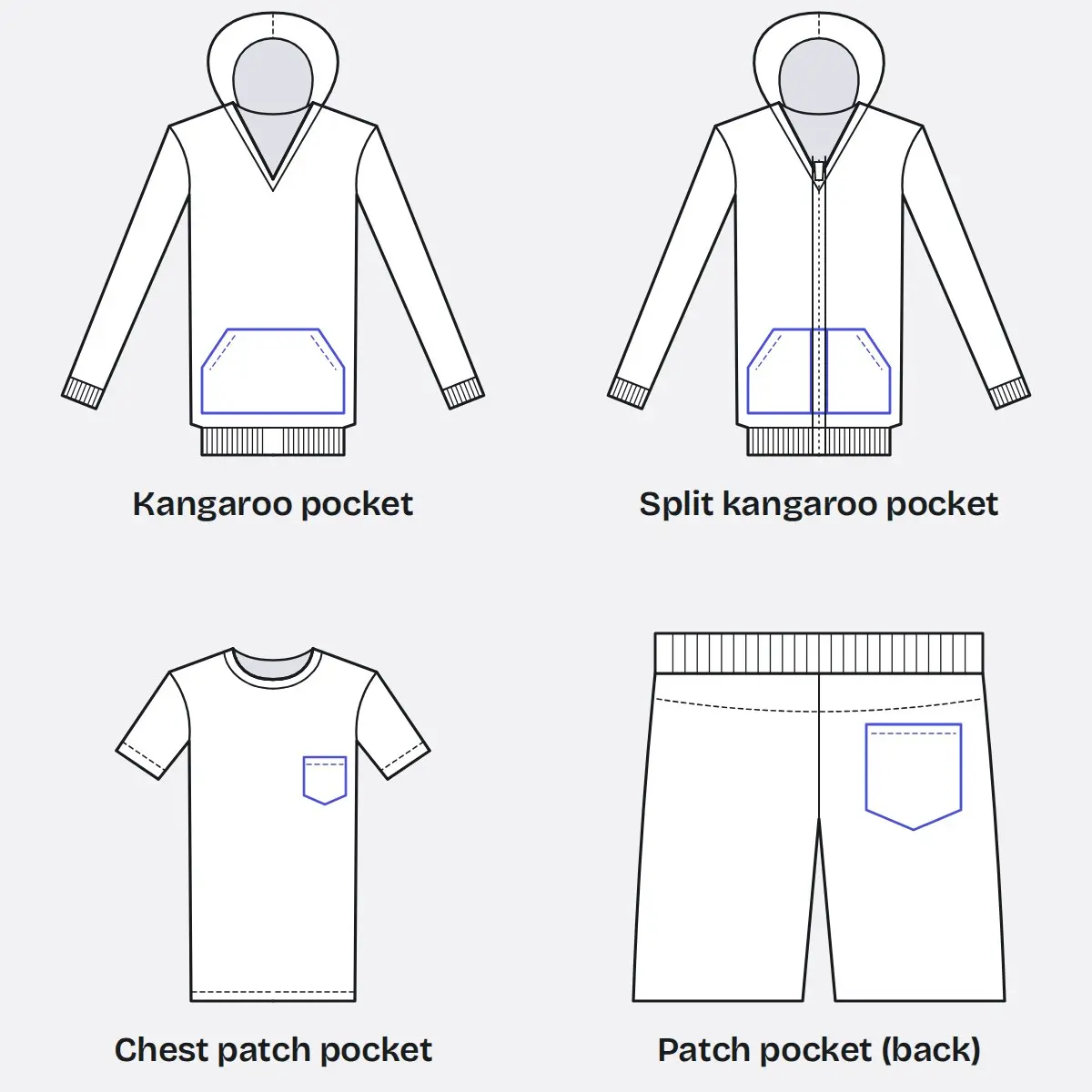
A patch pocket is a shaped piece of fabric stitched onto the outside of the garment. It is the simplest pocket to make and the easiest to place wrongly, so its position belongs on the tech pack as measurements, not as a picture alone.
Kangaroo pocket. The single wide pocket on the front of a pullover hoodie, open at both sides so the hands meet in the middle. It is a patch pocket sewn along its top and bottom edges. Give its width at the top and bottom, its height, the length of each opening and its distance above the hem rib.
Split kangaroo pocket. On a zip-up hoodie the zip divides the pocket into two. Each half is closed along the zip side, and the two halves must sit level across the zip, which is the thing to check on the sample.
Chest patch pocket. The small pocket on the left chest of a pocket T-shirt. Jersey stretches as it is sewn, so the pocket is usually pressed and its top edge hemmed before it is attached.
Back patch pocket. A patch pocket on the seat of shorts or joggers, normally on the wearer's right. It carries weight, so the top corners are reinforced.
Set-in pockets: cut into the garment
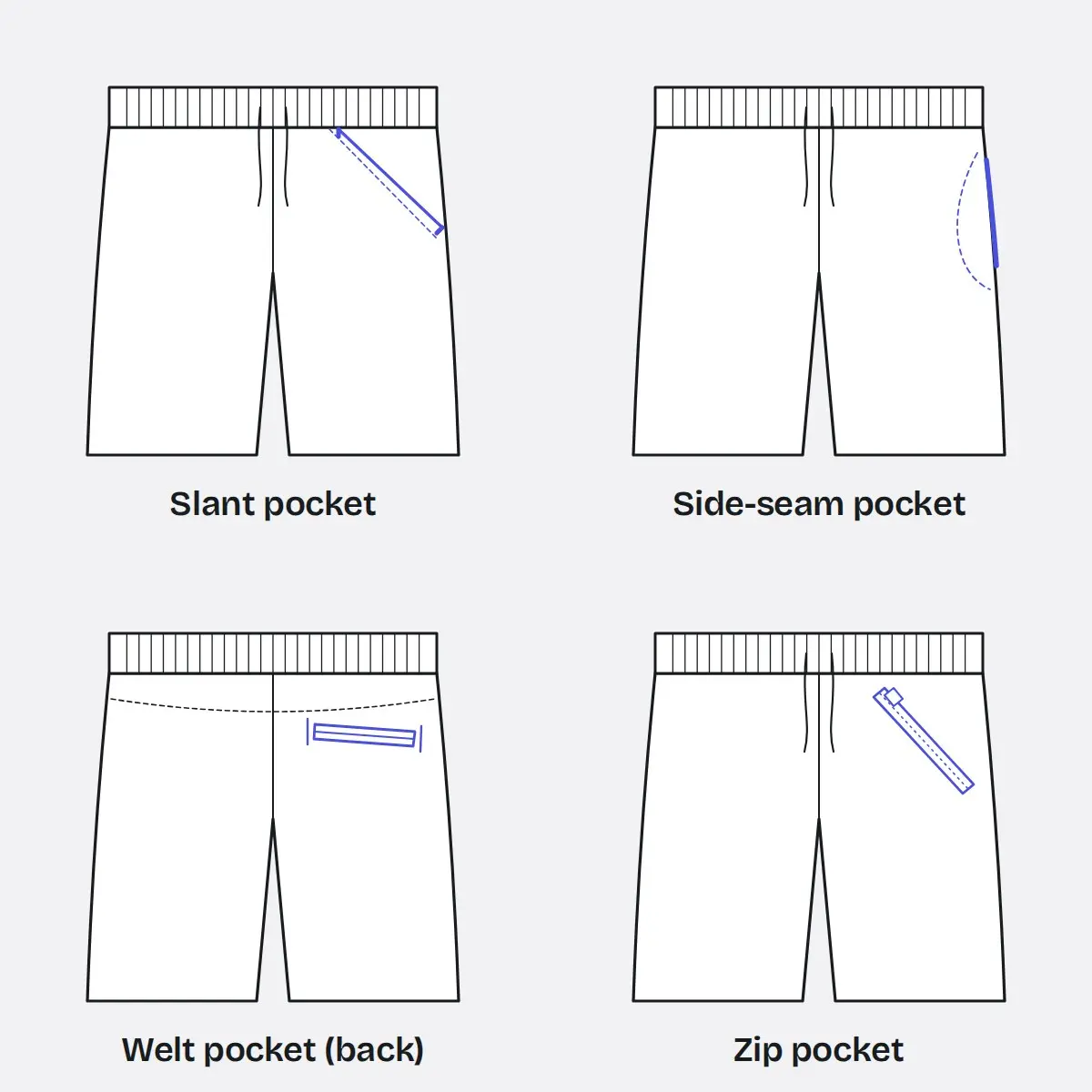
A set-in pocket has an opening in the garment and a pocket bag hidden inside. The bag is a second fabric to choose: the body fabric, or a lighter jersey or mesh that adds less bulk at the hip.
Slant pocket. The angled front pocket on joggers and shorts, running from the waistband towards the side seam. The opening edge is turned and topstitched, and sometimes bound or trimmed in rib.
Side-seam pocket. Also called an in-seam pocket. The opening is a gap left in the side seam itself, so the pocket is almost invisible from the outside. It is the neatest choice for a clean, minimal garment.
Welt pocket. A slit in the fabric finished with one or two narrow folded strips, the welts, across the opening. It is the usual back pocket on smarter joggers. A welt is cut into the cloth and cannot be undone, so it is the slowest pocket here to sew well.
Zip pocket. Any set-in pocket closed with a zip, common on activewear and training shorts. The zip may be exposed, or hidden under a fold. Name the zip type, its length and its puller.
Stitches that join and hem
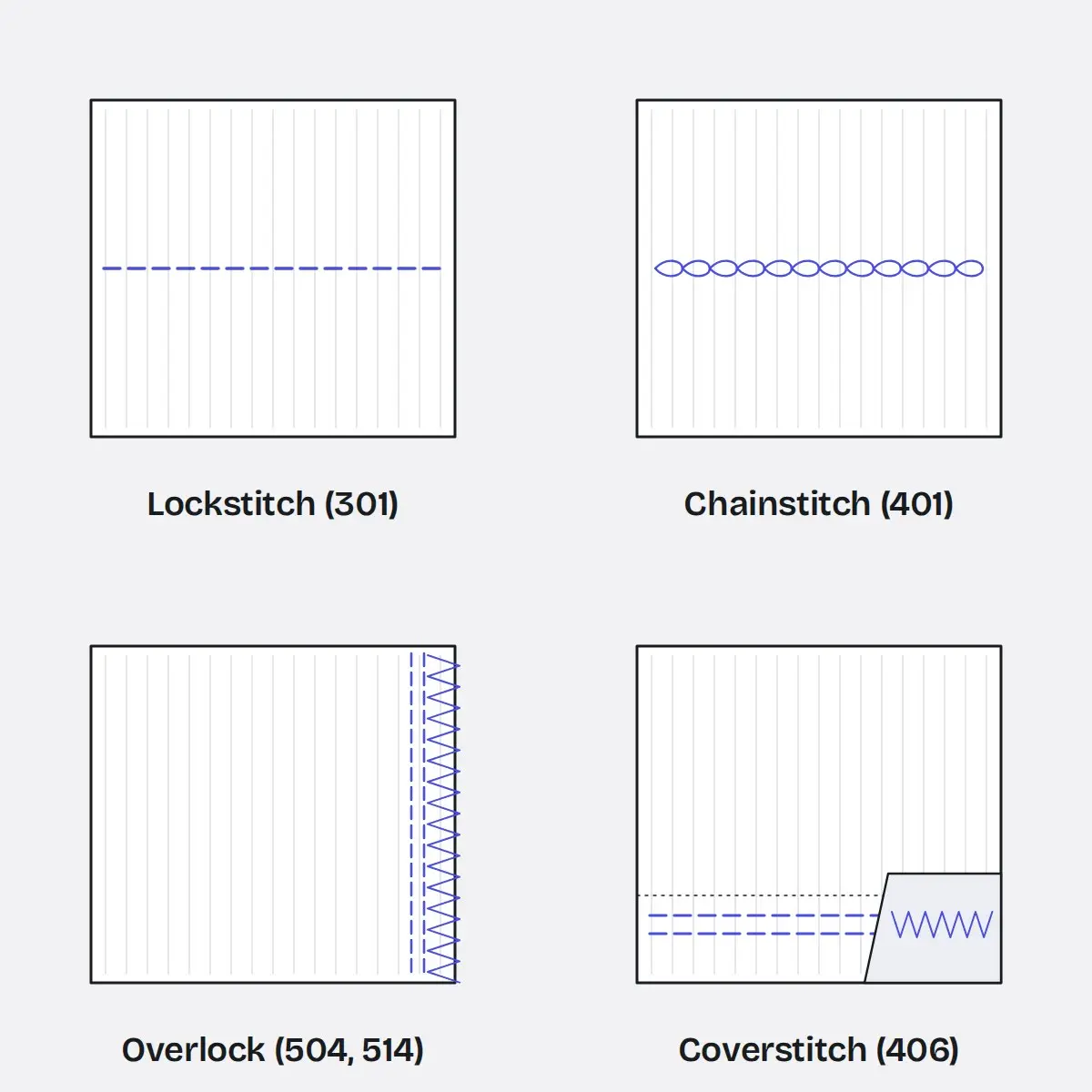
Stitches have numbers as well as names. The international standard ISO 4915 sorts them into six classes, numbered 100 to 600, and factories use its three-digit stitch types on tech packs. Seam shapes have their own standard, ISO 4916. The American standard is ASTM D6193. The uses given below follow the published stitch charts of two thread makers, American & Efird and Coats.
Lockstitch (301). The straight stitch of a domestic sewing machine: a needle thread and a bobbin thread locked together in the cloth. It is neat and secure but has little stretch, so on knitwear it is kept for parts that should not stretch, such as labels, plackets, zips and pocket edges.
Chainstitch (401). Two threads looped into a chain on the underside. It stretches more than a lockstitch. On knitwear it is used in rows to attach elastic at a waistband, and as one half of the five-thread safety stitch.
Overlock (504 and 514). Threads wrap around the cut edge while the machine trims it, so the seam is joined and the edge is neatened in one pass. This is the seam on the sides, shoulders and sleeves of almost every T-shirt and sweatshirt, because it stretches with the fabric. Type 504 uses three threads and 514 uses four.
Coverstitch (406). Two rows of straight stitching on the outside and a looped thread underneath that covers the raw edge. It is the hem on a T-shirt and a sleeve, shown as a dashed line on the drawings in this series. It stretches, which a lockstitched hem on a knit would not. Some basic T-shirts are hemmed with a blind hem (503) instead, which shows almost no stitching on the outside.
For every stitch number, what it looks like and where it goes on a T-shirt, a hoodie or leggings, see our guide to the types of stitches.
Flat seams, edges and reinforcement
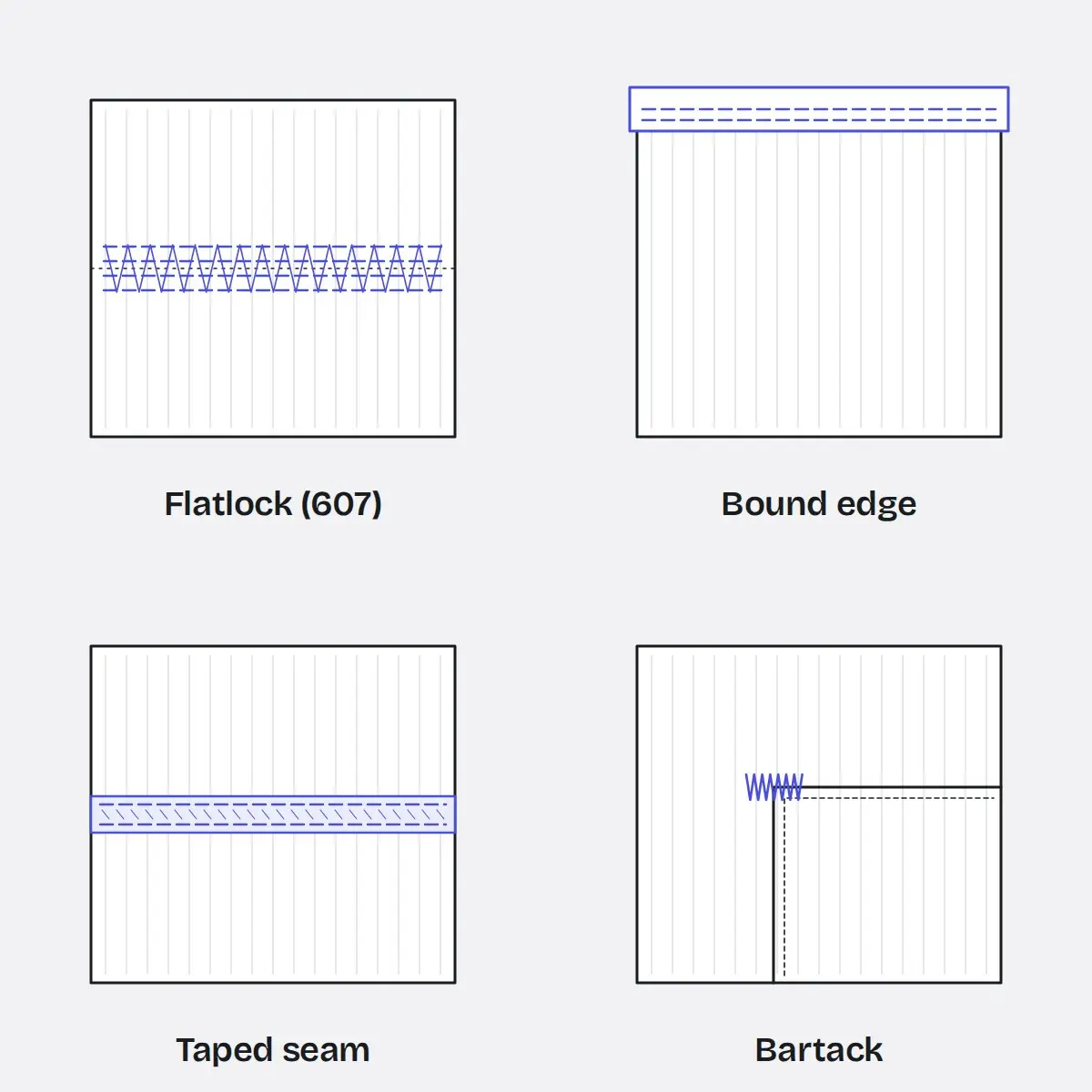
Flatlock (607). Also called a flat seam. The two pieces of fabric are butted or lapped together and held by stitching that covers both sides, so there is no ridge inside. It is used on leggings and base layers where a raised seam would rub.
Bound edge. A strip of fabric is folded over a raw edge and stitched through. Necks and armholes on tanks are finished this way; our guide to types of necklines shows where.
Taped seam. A narrow tape is stitched over a seam on the inside. On a T-shirt it runs along the back neck and often shoulder to shoulder. It covers the seam so it does not rub, and it stops the shoulders stretching under the weight of the garment.
Bartack. A short, dense bar of stitching that reinforces a point under strain: the corners of a pocket opening, the end of a zip, the base of a placket. It is small, and it is the difference between a pocket that lasts and one that tears at the corner.
Where each one goes
| Part of the garment | Usual stitch or seam | Why |
|---|---|---|
| Side, shoulder and sleeve seams | Overlock (504 or 514) | Joins and neatens in one pass, and stretches |
| Hems on body and sleeves | Coverstitch (406) | A flat hem that stretches |
| Neck rib or binding | Overlock, then coverstitch or tape | Holds the seam flat against the body |
| Back neck and shoulders | Tape | Comfort, and stops the shoulders stretching |
| Leggings and base layers | Flatlock (607) | No ridge against the skin |
| Labels, plackets, zips | Lockstitch (301) | A neat stitch where no stretch is wanted |
| Pocket corners, zip ends | Bartack | Strength at points of strain |
What to put on a tech pack
- For each pocket: its type, width, height, opening length, its position from two fixed points, the pocket bag fabric, and any bartacks.
- For each seam: the stitch type where it matters, for example flatlock on a legging or tape at the neck. Where you have no preference, leave it to the factory and check it on the sample.
- For topstitching: the number of rows, the distance from the edge and the thread colour.
Our free tech pack template has a construction and stitching section for exactly this, and the hoodie template gives the kangaroo pocket measurements in its filled-in example. There is a jogger template too. For how a whole garment goes together, see our step-by-step guide to garment manufacturing.
Making it with us
We make knit garments to your own pattern from 150 pieces per style and colour. Sampling takes about 10 days, and the sample is where pockets are placed, seams are checked inside and out, and corrections are made before bulk fabric is cut. Start with the hoodie or joggers pages, or send us your brief.
What clients say
Wonderful people to work with — very professional and knowledgeable, also accommodating to the needs of their customers.
Collective Studio is up and coming. Very hard working people who want to please their customers and grow partnerships together. Homaira is very knowledgeable in the knit industry and always willing to learn more. We are looking to grow our business with them.
Frequently asked questions
What are the main types of pockets on hoodies and joggers?
On hoodies the main pocket is the kangaroo pocket, one wide patch pocket across the front that is open at both sides. A zip-up hoodie has a split kangaroo pocket, divided in two by the zip. On joggers and shorts the main front pockets are the slant pocket, which runs at an angle from the waistband towards the side seam, and the side-seam pocket, which is an opening left in the side seam. At the back there is usually one patch pocket or one welt pocket. Zip pockets appear on training and travel styles where the contents must stay put. Patch pockets are sewn onto the outside and are quicker to make. Slant, side-seam, welt and zip pockets are set into the garment with a pocket bag inside, which adds a second fabric and more sewing.
What is the difference between a patch pocket and a welt pocket?
A patch pocket is a piece of fabric stitched onto the outside of the garment, so the whole pocket is visible. A welt pocket is a slit cut into the garment and finished with one or two narrow folded strips, called welts, across the opening, with the pocket bag hanging inside. Only the opening shows. The difference matters in three ways. A patch pocket is faster to sew and can be moved on the next sample if it sits in the wrong place. A welt pocket is cut into the cloth, so its position is final once it is cut, and it takes more skill to keep the corners sharp. A welt gives a cleaner, more tailored look. On knitted fabric a welt also needs a light interlining behind it, because jersey stretches and the slit would otherwise open up.
What stitch is used on T-shirt seams?
A T-shirt is normally sewn with two stitches. The side seams, shoulder seams and sleeve seams are joined with an overlock, which wraps thread around the cut edge as it sews, so the seam is joined and neatened in one pass and stretches with the fabric. The body hem and the sleeve hems are finished with a coverstitch, which shows as two parallel rows on the outside and a looped thread on the inside. The neck rib is attached with an overlock and then held flat with a coverstitch or covered with a tape along the back neck. A plain lockstitch, the straight stitch of a home sewing machine, is used only where stretch is not wanted, such as attaching labels. In the international standard for stitches the overlock is type 504 or 514 and the coverstitch is type 406.
What is the difference between overlock, coverstitch and flatlock?
All three are stretch stitches for knitted fabric, and each does a different job. An overlock joins two pieces along their cut edges and trims and wraps those edges at the same time. It leaves a small ridge on the inside and is the standard seam on T-shirts, sweatshirts and hoodies. A coverstitch does not join edges. It hems or topstitches, with two or three straight rows on the outside and a looped thread underneath that covers the raw edge. A flatlock joins two pieces so that they lie flat against each other with stitching visible on both sides and no ridge at all, which is why it is used on leggings, base layers and other close-fitting garments. Flatlock is slower to sew, so use it where the seam touches the skin under pressure and not everywhere.
Do I need to name every seam on my tech pack?
No. Name the seams and stitches that matter to your design and leave the rest to the factory, then check them on the sample. A factory that makes knitwear every day will join side seams with an overlock and hem with a coverstitch without being told. What it cannot guess is anything that differs from the usual: flatlock seams on a legging, tape along the shoulders, a contrast thread, two rows of topstitching and how far they sit from the edge, or bartacks at pocket corners. Write those down and mark them on the flat drawing. For pockets, always give the type, the size, the position from two fixed points and the fabric for the pocket bag. When the sample arrives, turn it inside out. The inside tells you more about how a garment was made than the outside does.
Where this applies
The manufacturing pages this guide relates to, if you are costing a real run.
Free tools & guides for this
Sources & further reading
- ISO 4915:1991, Textiles: Stitch types: Classification and terminology
- ISO 4916:1991, Textiles: Seam types: Classification and terminology
- ASTM D6193-16(2025), Standard Practice for Stitches and Seams
- Amann: Industrial stitch types and ISO 4915 (the six stitch classes)
- American & Efird: ISO Stitch Terminology matrix (301, 401, 406, 503, 504, 514, 516, 607 and their uses)
- American & Efird: Seams Drawings Index (T-shirt hems, taping, cuffs, flatseaming, patch pocket setting)
- American & Efird: Sewing Stretch Knit Fabrics
- Coats: Basic stitch types
- US patent 5,371,904, Sara Lee Corporation: tape sewn over the collar seam to cover the raw edge
- New Mexico State University Extension, Guide C-210: tape in shoulder seams to stabilise them
- American Heritage Dictionary: patch pocket
Cite this guide
For journalists, writers, researchers and students.
Quoting this guide? Please credit Collective Studio and link to this page.
Reference
Homaira Jashim, Collective Studio. "Types of Pockets and Seams on Knitwear: 16 Drawings With Names." 12 November 2026. https://collectivestudioltd.com/journal/types-of-pockets-and-seams
Writing about us? Our press kit has our facts, logos and photos, free to use with credit.
Have an idea? Let’s make it.
We manufacture from 150 pieces per style and colour, with organic cotton options from our GOTS-certified facility and photos at every stage. Send a sketch or a sentence — we’ll reply within one business day.