Types of Necklines: 16 Shapes With Drawings, From Crew Neck to Cowl
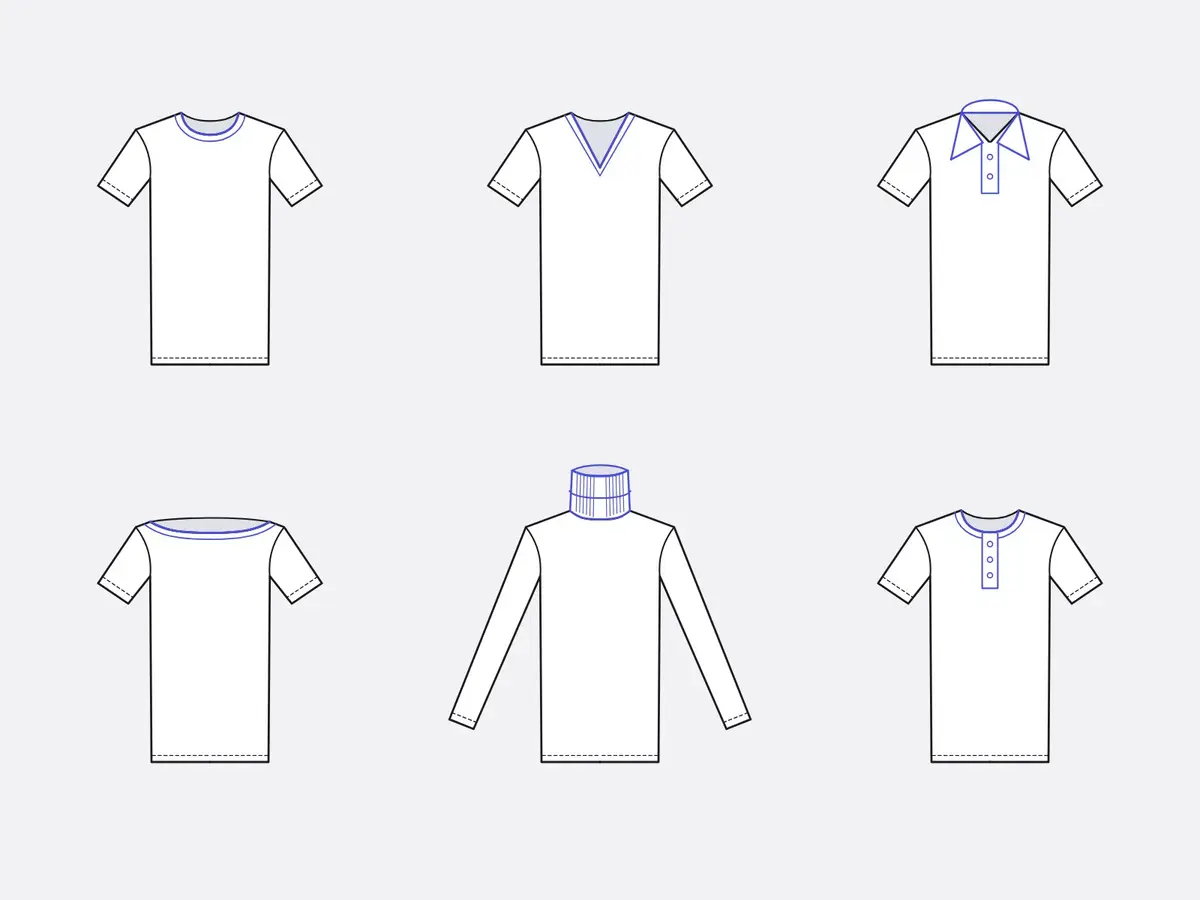
There are sixteen types of necklines you are likely to meet on knitted clothing, and this guide sorts them into four groups: round and open shapes, V and shaped fronts, plackets, collars and high necks, and funnel, draped or bare-shoulder styles. This guide draws each one, gives it its usual name, and says how it is finished in a factory and what to write on a tech pack so the sample comes back the shape you meant.
We are Collective Studio, a family-run knitwear factory in Narayanganj, Bangladesh. We cut and sew T-shirts, polos, tanks, sweatshirts and hoodies for brands in the UK, Europe and Australia, so the examples lean towards jersey and rib. The drawings are our own. Use them freely in a brief to any factory.
The short version
- Round and open: crew neck, scoop neck, boat neck, square neck.
- V and shaped: V-neck, wrap neck, sweetheart, keyhole.
- Plackets, collars and high necks: henley, polo collar, mock neck, turtleneck.
- Funnel, draped and bare-shoulder: funnel neck, cowl neck, halter neck, off the shoulder.
- On a tech pack: a neckline is three measurements and one finish: neck width, front neck drop, back neck drop, and how the edge is made.
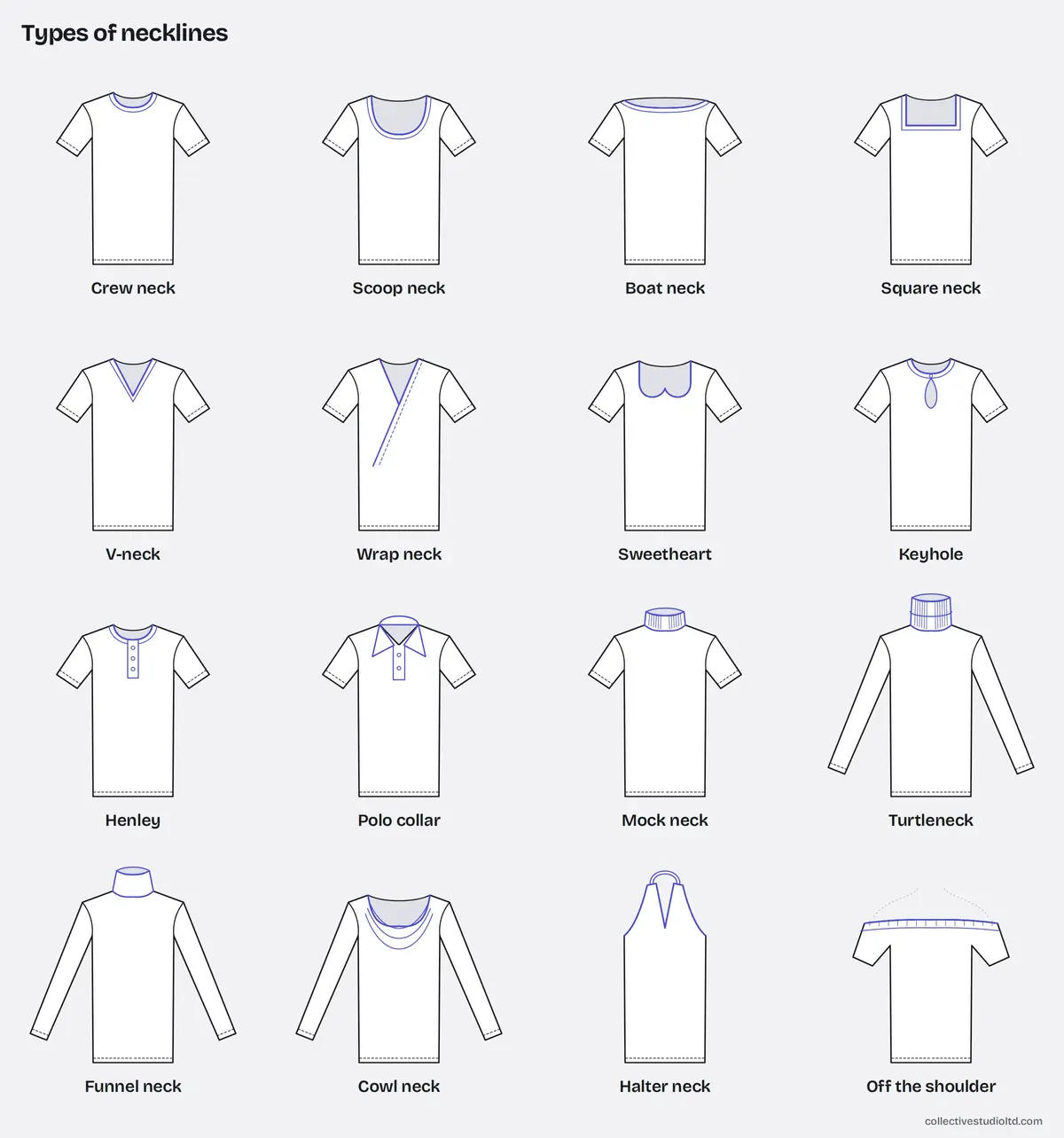
How to describe a neckline on a tech pack
A name is not enough. Two people can both say "scoop neck" and mean openings that differ by several centimetres. A factory cuts from numbers, so give the name and then the measurements on the flat garment. Our free T-shirt tech pack template lists neck width, front and back neck drop and neckband width in its filled-in example.
- Neck width: straight across the opening, from seam to seam, at the highest point of the shoulder.
- Front neck drop: from an imaginary line joining the two high shoulder points, straight down to the edge of the front neck.
- Back neck drop: the same measurement at the back. It is small on most tops, and it is what stops a garment sliding backwards.
- Band or collar height: the finished height of the rib, binding or collar.
- The finish: rib band, self-fabric binding, turned and topstitched, faced, or a collar and placket.
- Stretch: on a pull-on top with no opening, the neck has to pass over the head. Ask for the stretched neck measurement to be checked on the sample.
Round and open necklines
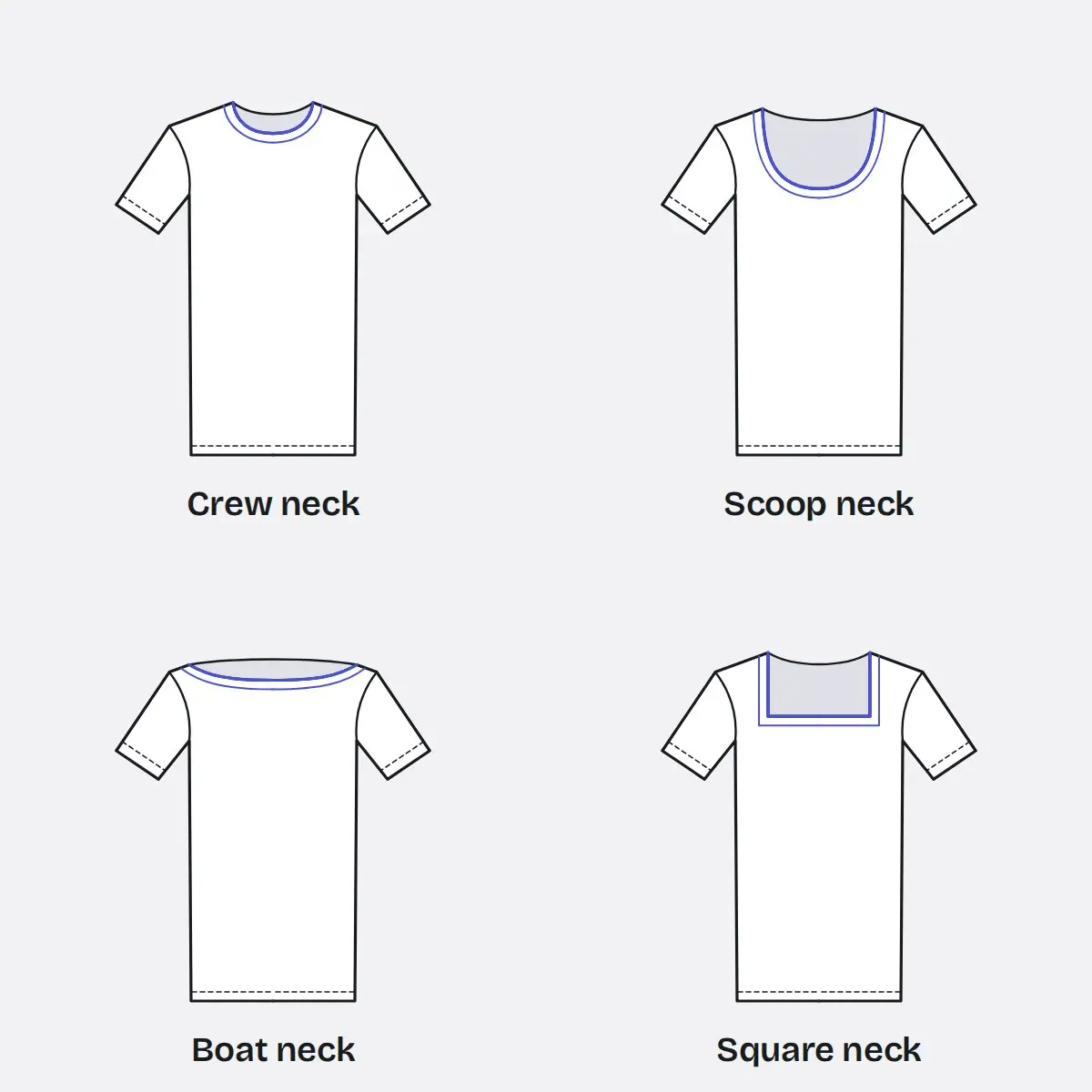
Crew neck. A close, round opening that sits at the base of the neck, finished with a band of rib. It is the default on T-shirts and sweatshirts because rib stretches to pass over the head and then closes again. Specify the rib height and whether the rib has elastane in it, since rib without recovery is what causes a wavy collar after a few washes.
Scoop neck. A deeper, wider round opening. The edge is usually bound with a narrow strip of the body fabric or finished with a slim rib. Because more of the edge is on the bias of the fabric, a scoop can stretch during sewing, so ask for the neck to be measured on the sample both flat and after a wash.
Boat neck. Also called a bateau neckline. A wide, shallow opening that runs almost from shoulder to shoulder and sits high at the front. The shoulder seams are short, so the garment relies on the neck edge for stability. A turned and topstitched edge or a narrow binding keeps it flat.
Square neck. Straight sides and a straight base, with two corners. The corners are the difficult part in a knit: they need to be mitred or faced, and a light interlining behind them stops them rounding off. It is more common on fitted rib and interlock tops than on loose jersey.
V and shaped necklines
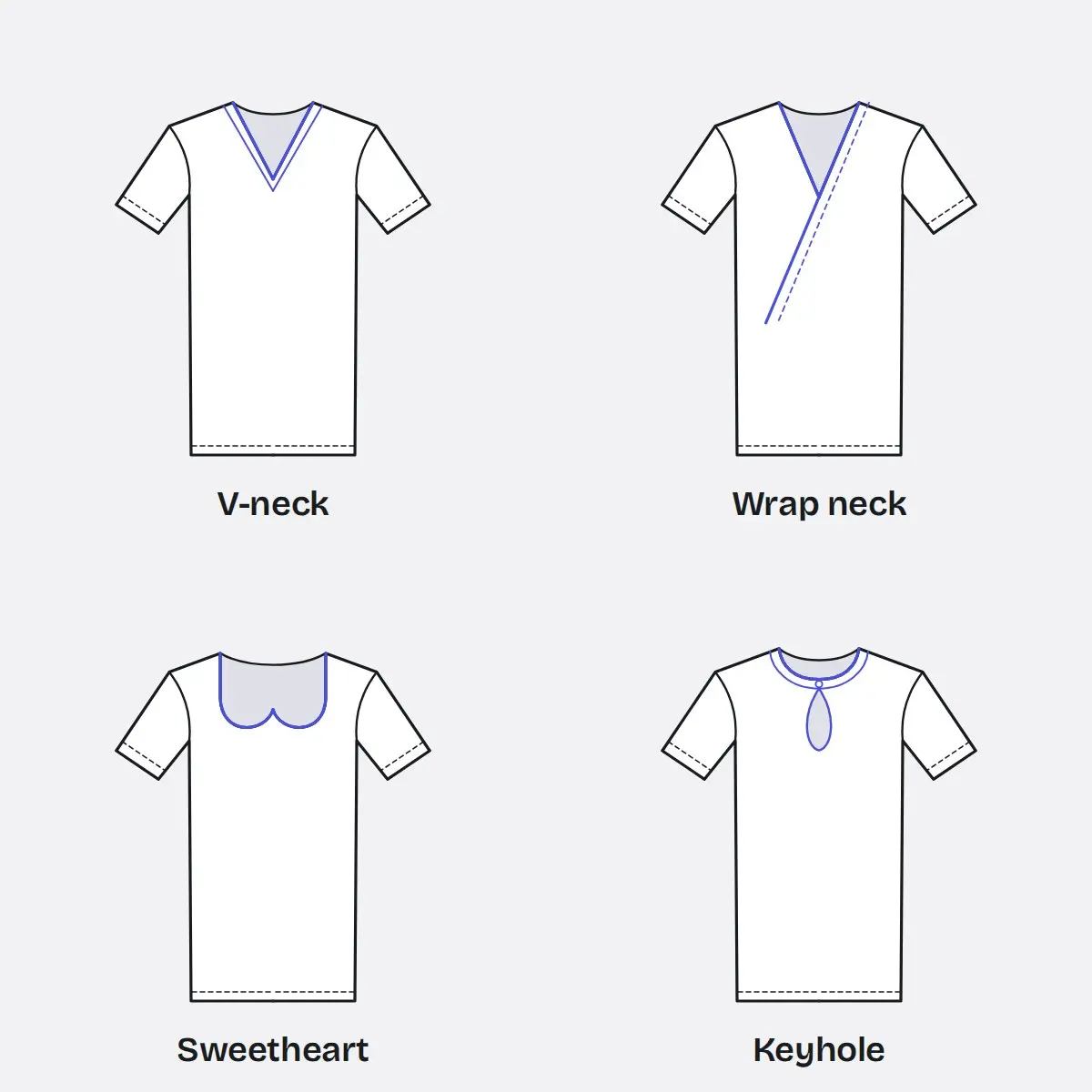
V-neck. Two straight edges meeting at a point on the centre front. The point is finished in one of two ways: a mitred V, where the band is joined at an angle so the point is sharp, or an overlapped V, where one end of the band lies over the other. State which you want, and give the front neck drop to the point.
Wrap neck. Also called a surplice neck. One front panel crosses over the other, so the V is made by two overlapping edges and not by a seam. It needs a stitch or a snap where the layers cross, or it gapes. On a tech pack, show where the overlap ends on the side seam.
Sweetheart. A low front with two curves that meet in a point at the centre, like the top of a heart. It appears on fitted tops and dresses in rib or a jersey with elastane. The curves are usually faced or lined so the edge holds its shape.
Keyhole. A round neck with a teardrop opening below it, closed at the top with a button and loop or a tie. It lets a close neck pass over the head without a zip. The opening is bound, and its length is the measurement to give.
Collars, plackets and high necks
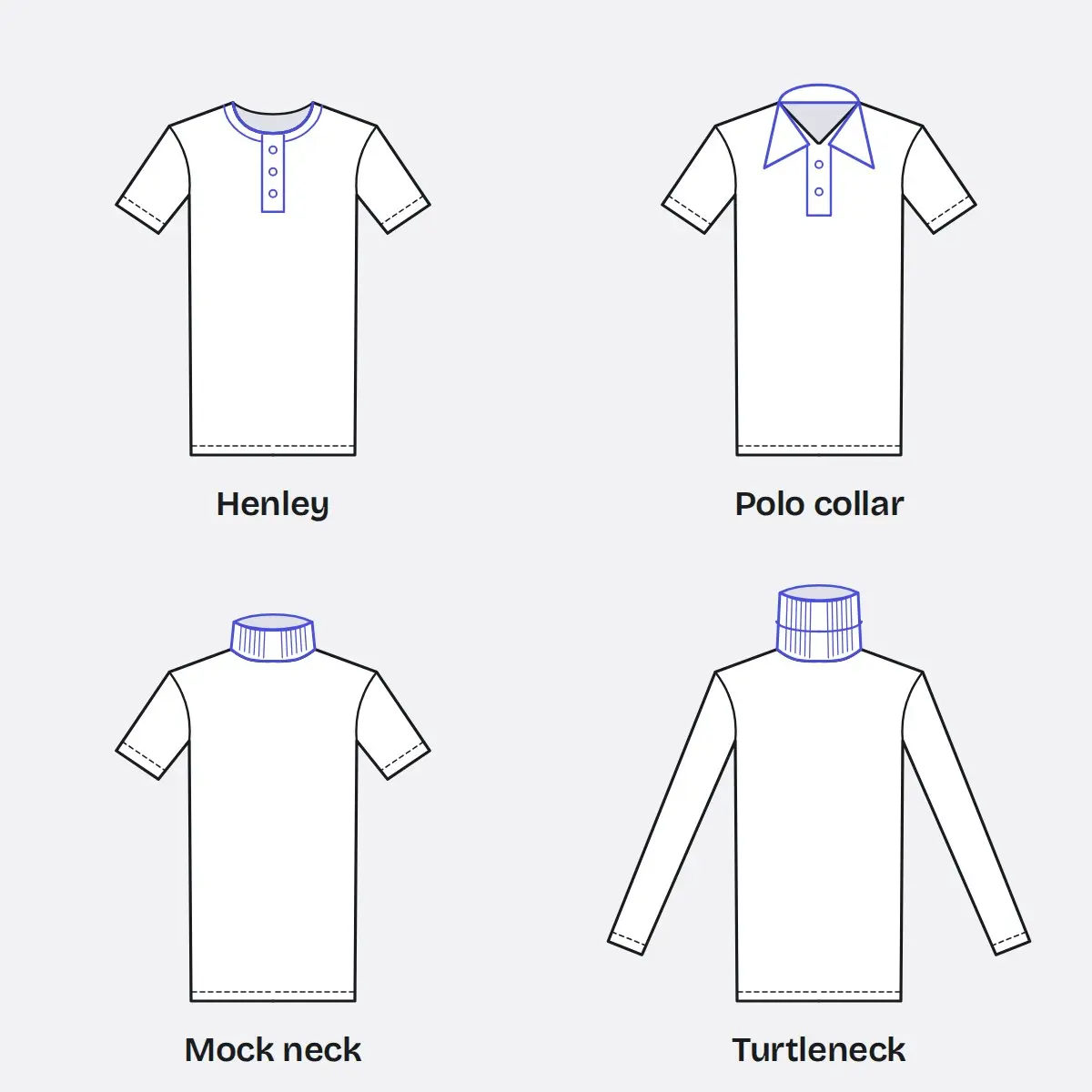
Henley. A round neck with a short buttoned placket and no collar. The placket is a separate strip, usually backed with a light interlining so the buttonholes do not stretch. Give the placket length and width and the number of buttons.
Polo collar. A flat knitted collar above a two or three button placket, as on a polo shirt. The collar is knitted to size as a separate piece, which is why collars and cuffs on a polo are ordered together with the body fabric. Say whether the collar is plain or tipped with a stripe.
Mock neck. A short band that stands up from the neck without folding over. It is cut from rib or from the body fabric with elastane, and it must stretch enough to pull on. It reads as a neater, lower version of a turtleneck.
Turtleneck. A tall, close tube that folds down on itself. In British English the same thing is a polo neck or roll neck: the Longman Dictionary gives turtleneck as the American word for a polo neck. Use a drawing with the name if your factory and your customers are in different countries.
Funnel, cowl and bare-shoulder necklines
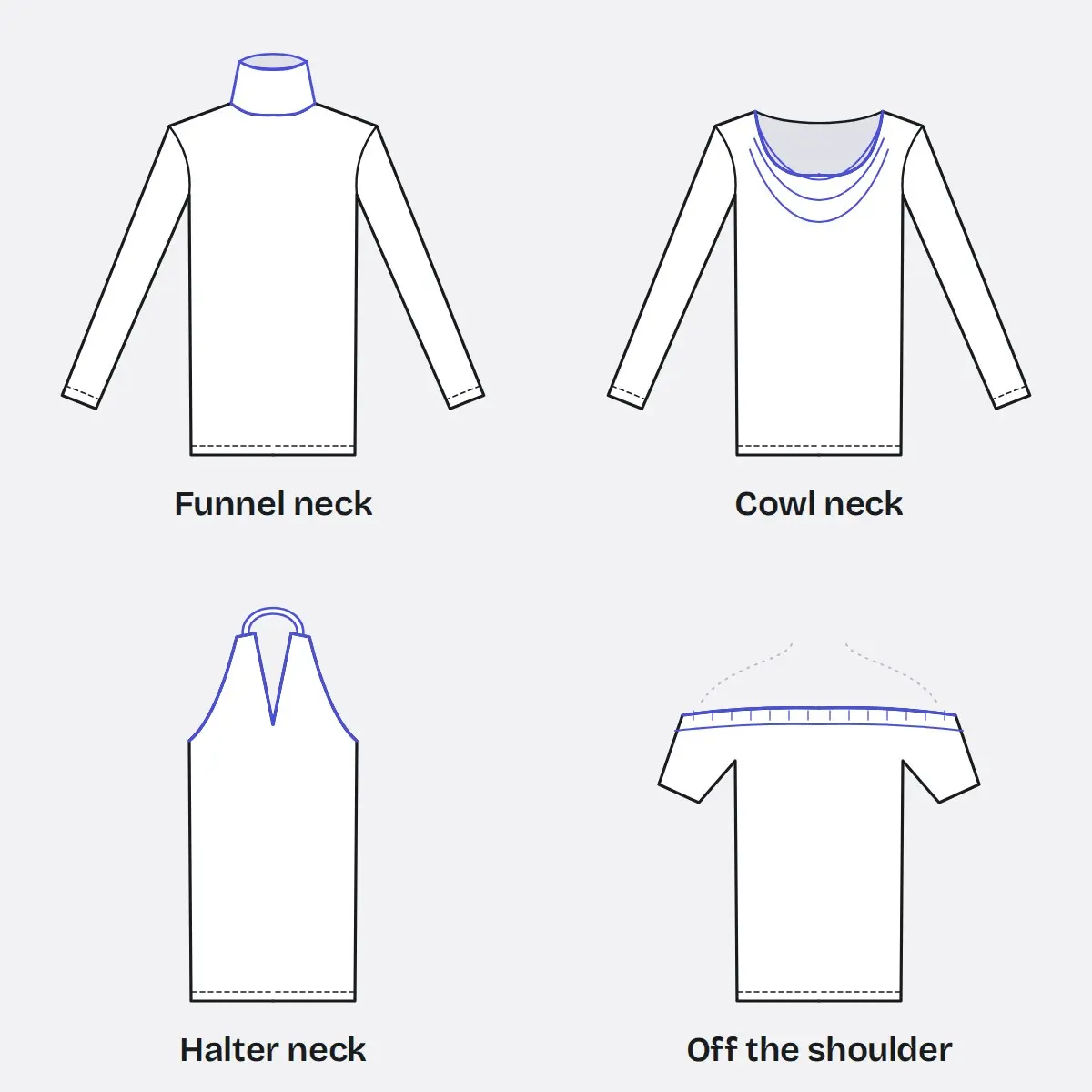
Funnel neck. A high neck that rises straight out of the body and shoulders with no separate band, so there is no seam around the base. It suits heavier fabrics such as fleece and French terry that can stand up on their own.
Cowl neck. Extra fabric at the front falls in soft folds below the neck. It needs a fabric with drape, such as a modal or viscose jersey; a stiff jersey will stand away from the body. See our guide to modal fabric for why.
Halter neck. The front is held up by a strap or band that passes behind the neck, leaving the shoulders and upper back bare. The edges are bound, often with elastic inside the binding so they sit against the body.
Off the shoulder. The top edge runs straight across the chest and upper arms, below the shoulders, and is held in place by elastic in a channel. The elastic length is the key measurement: too long and the top slips, too short and it rides up.
Which neckline for which garment
| Neckline | Usual finish | Common on | Check on the sample |
|---|---|---|---|
| Crew neck | Rib band | T-shirts, sweatshirts | Rib recovery after washing |
| V-neck | Rib band, mitred or overlapped | T-shirts, knit tops | Sharpness of the point |
| Scoop neck | Binding or slim rib | Tanks, fitted tops | Neck width after washing |
| Boat neck | Turned and topstitched | Long-sleeve tops | That it sits flat on the shoulder |
| Henley | Rib band and placket | Long-sleeve tees | Placket lies flat, buttonholes firm |
| Polo collar | Knitted collar and placket | Polo shirts | Collar shade matches the body |
| Mock neck | Stand-up band | Fitted tops, activewear | Stretch over the head |
| Turtleneck | Folded tube | Rib and interlock tops | Height when folded |
| Funnel neck | Cut in one with the body | Fleece tops, half-zips | That it stands without collapsing |
| Cowl neck | Self-faced drape | Drapey jersey tops | How the folds fall |
How necklines are sewn on knitwear
Most knit necklines are made in two steps. The band or binding is joined to the neck edge with a stretch seam, then the seam is held flat with a second row of stitching or covered with tape on the inside. The thread maker American & Efird lists both as standard operations on T-shirts in its chart of seam types. Our guide to pockets and seams shows the stitches by name.
The neck is also where children's clothing has its strictest rules, because of cords and small openings. If you are making kidswear, read our guide to children's clothing safety rules by market before you choose a neckline with a tie or a drawcord.
This is the V-neck being sewn: the rib band is fed round under the needle a little at a time, and the point of the V is where the band changes direction.
Making your neckline with us
We make knit garments to your own pattern from 150 pieces per style and colour. For a neckline the quickest brief is a reference garment and the measurements above. Sampling takes about 10 days, and the sample is where the neck is tried on, measured and corrected before any bulk fabric is cut. Start with the T-shirt, tank top or sweatshirt pages, or send us your brief.
What clients say
Best supplier! On time, reliable and perfect craft.
Wonderful people to work with — very professional and knowledgeable, also accommodating to the needs of their customers.
Frequently asked questions
What are the main types of necklines?
The main types of necklines fall into four groups. Round and open necklines are the crew neck, scoop neck, boat neck and square neck. V and shaped necklines are the V-neck, wrap neck, sweetheart and keyhole. Necklines with a placket, a collar or a high band are the henley, polo collar, mock neck, turtleneck and funnel neck. Draped and bare-shoulder necklines are the cowl neck, halter neck and off the shoulder. On knitted clothing such as T-shirts, polos, sweatshirts and fitted tops, the crew neck, V-neck, scoop neck and polo collar account for most of what is made, because they can be finished with a rib band or a binding that stretches over the head. The other shapes are used when a design calls for them, and each one needs its own measurements on the tech pack so the factory can cut it correctly.
What is the difference between a crew neck and a scoop neck?
A crew neck is a close, round opening that sits at the base of the neck. A scoop neck is the same round shape cut deeper and wider, so it shows the collarbone and part of the chest. The difference on a tech pack is two numbers: the neck width, measured straight across the opening from seam to seam, and the front neck drop, measured down from the line that joins the two high shoulder points. A crew neck has a small front neck drop and is almost always finished with a rib band. A scoop neck has a larger one and is usually bound with a narrow strip of the body fabric. Because a scoop exposes more of the edge, it can stretch in sewing, so measure the sample flat and again after one wash.
What is the difference between a mock neck, a turtleneck and a funnel neck?
All three are high necklines, and the difference is height and construction. A mock neck is a short band that stands up from the neck and does not fold. A turtleneck is a taller tube that folds down on itself, and in British English it is called a polo neck or roll neck. A funnel neck is not a separate band at all: the body and shoulders continue upwards into the neck, so there is no seam around its base. Mock necks and turtlenecks are usually cut from rib or a fabric with elastane, because they must stretch over the head and close again. Funnel necks are more common in heavier fabrics such as fleece, which can stand up without support. When you brief a factory, give the finished height and say whether the neck folds.
How do I write a neckline on a tech pack?
Give the name, a flat drawing and four measurements. The first is neck width, taken straight across the opening from seam to seam at the high point of the shoulder. The second is front neck drop, from the line joining the two high shoulder points down to the edge of the front neck. The third is back neck drop, measured the same way at the back. The fourth is the finished height of the band, binding or collar. Then state the finish: rib band, self-fabric binding, turned and topstitched edge, facing, or collar with placket. For a rib band, say what the rib is made of and whether it contains elastane. For a pull-on garment, ask for the stretched neck measurement to be checked on the sample, because the head has to pass through it.
Why does a T-shirt neckline go wavy or stretch out?
A wavy neckline, sometimes called a bacon neck, comes from a band that has been stretched and has not recovered. There are three usual causes. The rib may have no elastane, so it loses its spring after washing. The band may have been cut too long for the opening, so it never pulled the edge in. Or the band may have been stretched unevenly while it was sewn on. The fix is made at the sample stage, not after bulk production. Specify the rib, including its elastane content, give the finished band height, and ask for the neck to be measured before and after a wash test. A tape or a second row of stitching along the back neck and shoulders also helps, because it stops the weight of the garment pulling the opening wider.
Where this applies
The manufacturing pages this guide relates to, if you are costing a real run.
Free tools & guides for this
Sources & further reading
- Longman Dictionary of Contemporary English: polo neck (British), turtleneck (American)
- Dictionary.com (Random House and Collins): boat neck, also called bateau neckline
- American & Efird: Seams Drawings Index (collarettes, seaming then coverseaming, taping the shoulder and neck of T-shirts)
- Coats: Seam types (bound seams on T-shirt necklines)
- American Heritage Dictionary: crew neck
- American Heritage Dictionary: henley
Cite this guide
For journalists, writers, researchers and students.
Quoting this guide? Please credit Collective Studio and link to this page.
Reference
Homaira Jashim, Collective Studio. "Types of Necklines: 16 Shapes With Drawings, From Crew Neck to Cowl." 12 November 2026. https://collectivestudioltd.com/journal/types-of-necklines
Writing about us? Our press kit has our facts, logos and photos, free to use with credit.
Have an idea? Let’s make it.
We manufacture from 150 pieces per style and colour, with organic cotton options from our GOTS-certified facility and photos at every stage. Send a sketch or a sentence — we’ll reply within one business day.