Types of Sleeves: 12 Shapes With Drawings, From Set-In to Raglan
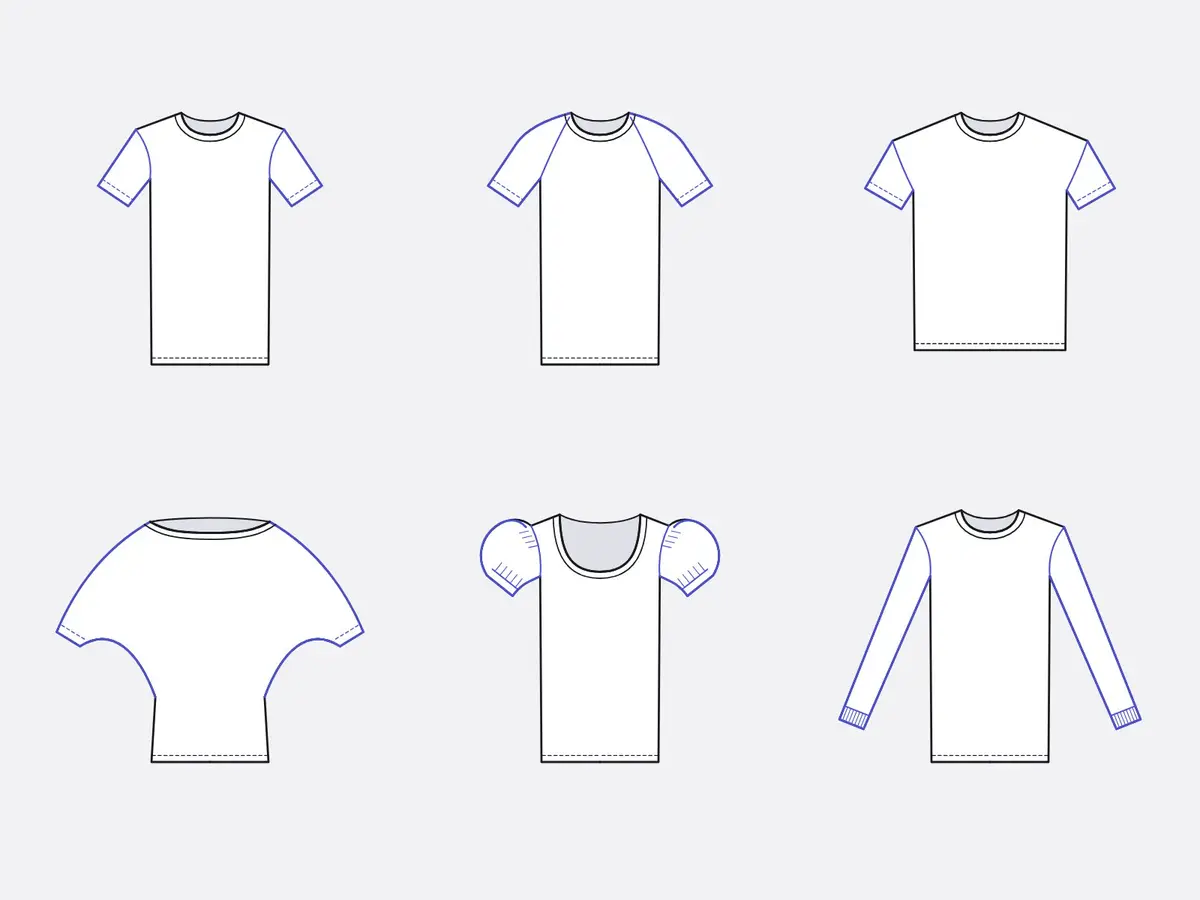
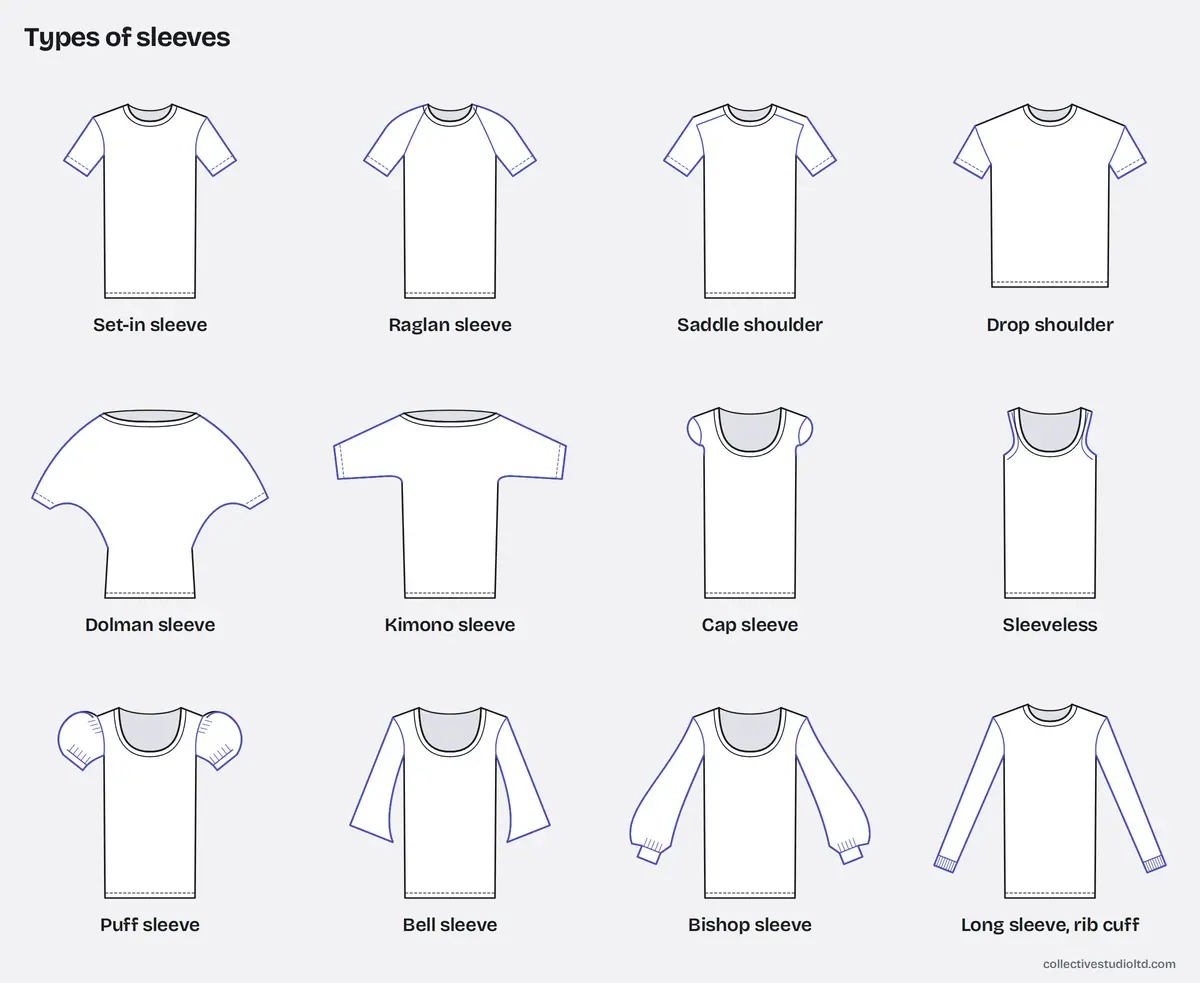
The types of sleeves on knitted clothing differ in two ways: how the sleeve joins the body, and what shape it takes below the shoulder. This guide draws twelve of them, from the set-in sleeve on a classic T-shirt to the raglan, drop shoulder, dolman and puff sleeve, names five sleeve lengths, and lists the measurements a factory needs for each.
We are Collective Studio, a family-run knitwear factory in Narayanganj, Bangladesh, making T-shirts, sweatshirts, hoodies and activewear for brands in the UK, Europe and Australia. The drawings are our own. Use them in a brief to any factory.
The short version
- Joined at the armhole: set-in sleeve, drop shoulder.
- Joined at the neck: raglan sleeve, saddle shoulder.
- Cut in one with the body: dolman sleeve, kimono sleeve.
- Short or none: cap sleeve, sleeveless.
- Shaped below the shoulder: puff sleeve, bell sleeve, bishop sleeve, long sleeve with a rib cuff.
- Lengths: cap, short, elbow, three-quarter and long.
How the sleeve joins the body
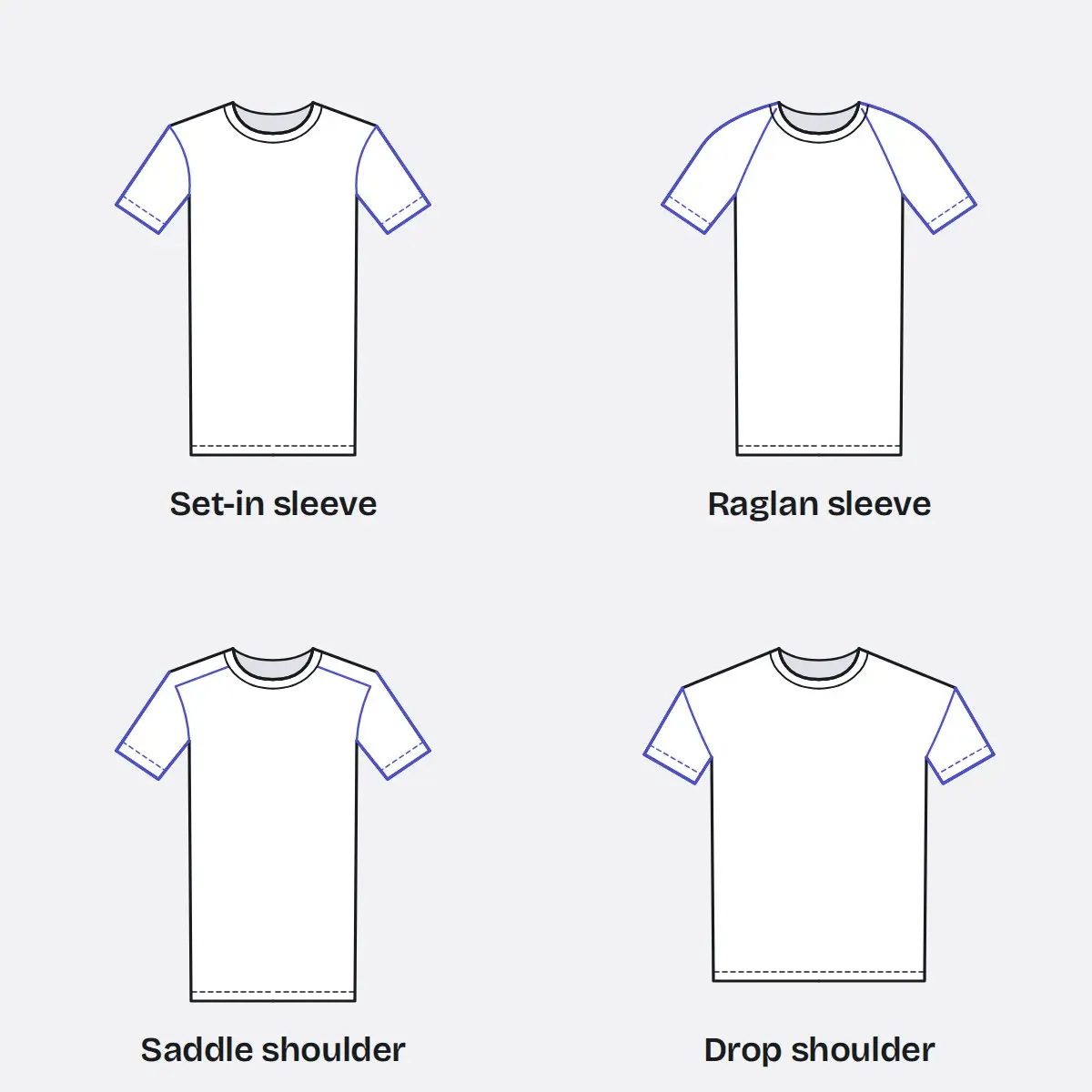
Set-in sleeve. The sleeve is sewn into an armhole that follows the natural edge of the shoulder, so the seam runs over the shoulder point and down under the arm. It is the standard sleeve on T-shirts and polos. It gives the neatest fit, and it is the one most size charts assume.
Raglan sleeve. The sleeve runs all the way up to the neckline, so there is no shoulder seam. Instead two diagonal seams go from the underarm to the neck, front and back. A raglan gives more room to move, which is why it is common on sweatshirts, baseball tees and activewear. It also lets the sleeve be a different colour from the body with no extra seam.
Saddle shoulder. A cousin of the raglan. A strip of the sleeve runs along the top of the shoulder to the neck, then the seam turns down around the armhole. It gives the clean shoulder line of a set-in sleeve with some of the ease of a raglan.
Drop shoulder. The shoulder seam is longer than the shoulder itself, so the armhole seam sits part of the way down the upper arm. The body is cut wider and the top of the sleeve is flatter. This is the cut behind most oversized and boxy T-shirts and hoodies.
Cut in one, and short sleeves
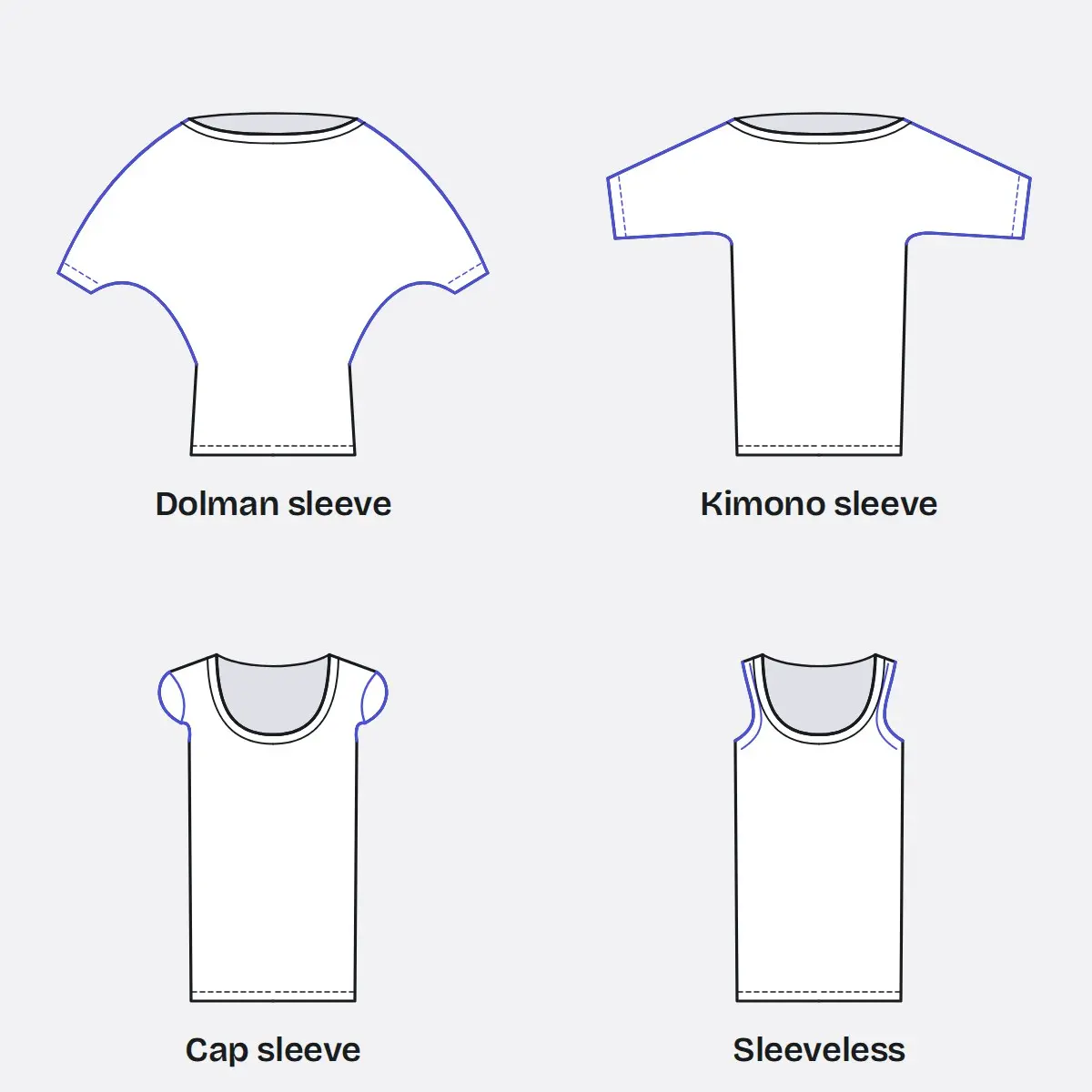
Dolman sleeve. Also called a batwing. The sleeve is cut as part of the body, with a very deep armhole that narrows towards the wrist. There is no armhole seam at all. The pattern pieces are large, so a dolman uses more fabric per garment than a set-in sleeve; our fabric consumption calculator shows how that changes an order.
Kimono sleeve. Also cut in one with the body, but wide and straight, at a right angle to the side seam. It is simple to sew and hangs well in a fabric with drape. The underarm takes the strain, so that seam is often reinforced.
Cap sleeve. A very short sleeve that covers only the top of the shoulder and does not reach under the arm. It finishes in a clean hem and is common on fitted tops.
Sleeveless. No sleeve: the armhole is the edge. On a tank top or muscle tee the armhole is finished with a binding, a slim rib or a turned hem. The armhole depth is the measurement that matters, because it decides how much of the side of the body shows.
Sleeves shaped below the shoulder
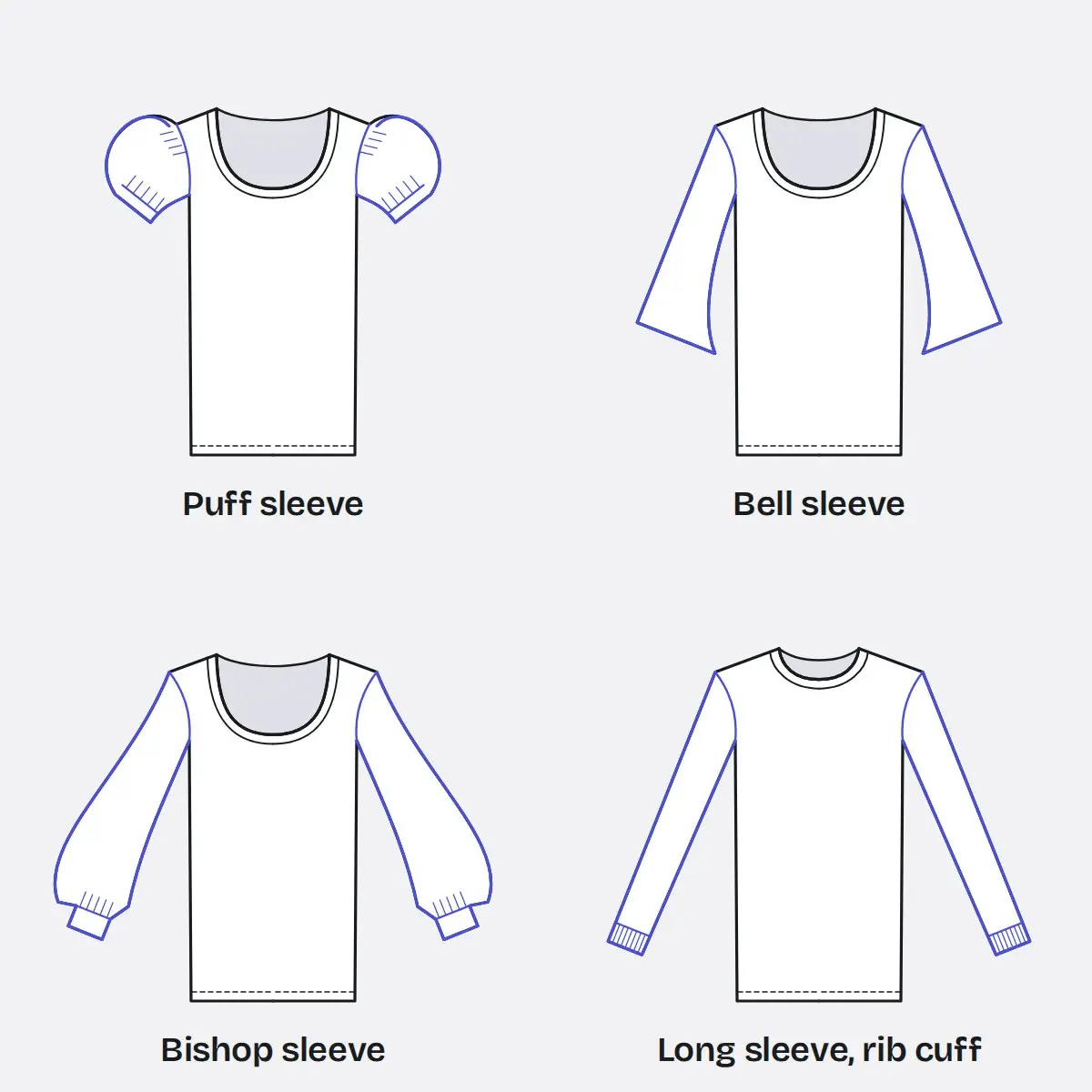
Puff sleeve. Fabric is gathered where the sleeve meets the armhole and again at the hem, so the sleeve stands out in a rounded shape. The fullness is set by how much longer the sleeve edge is than the seam it is gathered into. Give that as a ratio or ask for it to be agreed on the sample.
Bell sleeve. Fitted at the top and flaring out towards the hem, like a bell. The sleeve opening is the measurement to give.
Bishop sleeve. Full through the lower arm and gathered into a narrow cuff at the wrist. It needs a light fabric with drape.
Long sleeve with a rib cuff. The sleeve on a sweatshirt or hoodie. A band of rib is sewn to the end of the sleeve to close it at the wrist. Give the cuff height and the relaxed cuff width, and say whether the rib contains elastane so it recovers.
Sleeve lengths
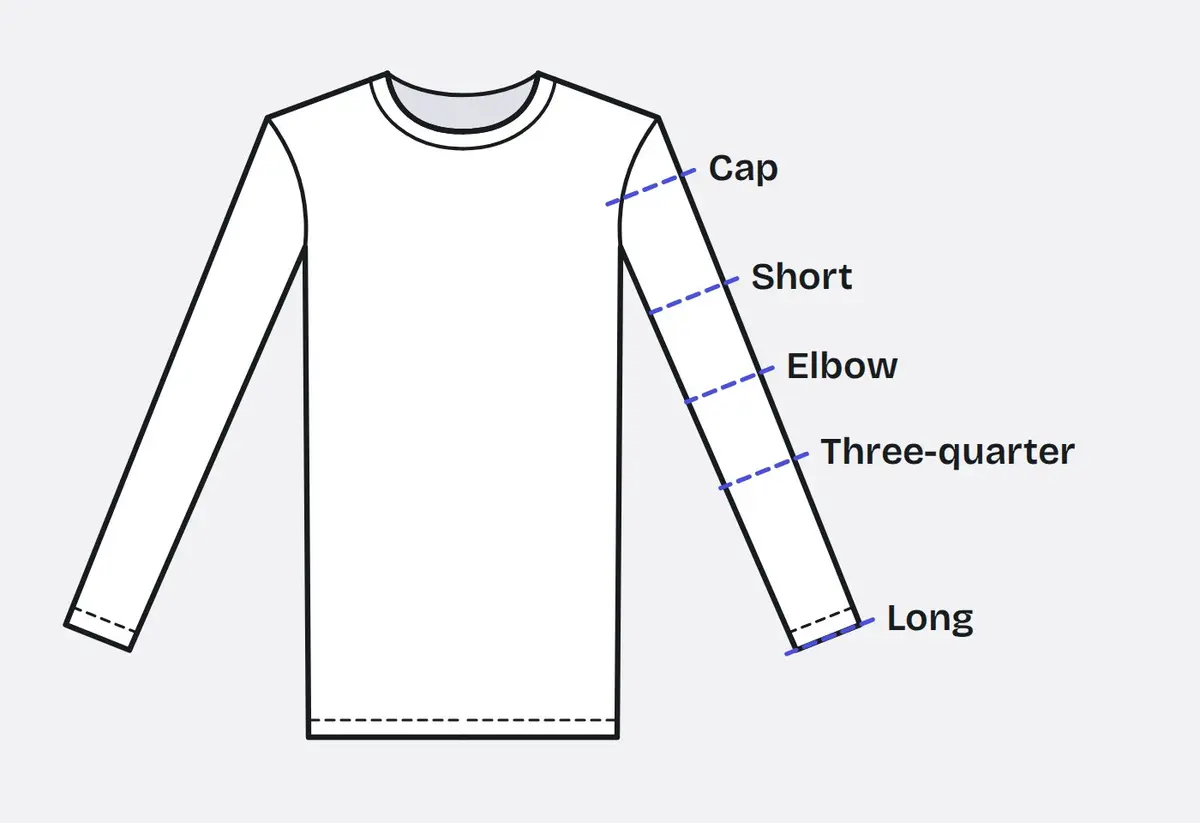
The names are loose, so a tech pack gives a measurement as well. On a set-in sleeve, sleeve length is measured from the shoulder point, where the shoulder seam meets the armhole, to the sleeve hem. A raglan has no shoulder point, so its sleeve is measured from the centre of the back neck to the hem.
What to put on a tech pack
| Measurement | Where it is taken | Why it matters |
|---|---|---|
| Sleeve length | Shoulder point to hem, or centre back neck to hem on a raglan | Sets where the sleeve ends on the arm |
| Armhole | Shoulder point to underarm, measured straight | Controls room under the arm |
| Bicep (upper arm width) | Across the sleeve just below the armhole | Decides whether the sleeve is slim or relaxed |
| Sleeve opening | Across the hem or cuff, relaxed | A tight opening restricts movement, a loose one flares |
| Cuff height | Top of the cuff to its edge | Only where there is a rib cuff or band |
| Shoulder drop | How far the armhole seam sits below the shoulder | Only on drop-shoulder styles |
Add the hem finish as well. Most knit sleeves are hemmed with a coverstitch, shown by the dashed line on the drawings; our guide to pockets and seams explains it. For necks, see types of necklines. The free tech pack template puts all of it on one page.
Making your sleeve with us
We make knit garments to your own pattern from 150 pieces per style and colour. Send a reference garment or a flat drawing with the measurements above. Sampling takes about 10 days, and the sample is where the sleeve is tried on and corrected before bulk fabric is cut. Start with the T-shirt, hoodie or sweatshirt pages, or send us your brief.
What clients say
Nice supplier that is looking to develop new buyers and products.
I have had a very good experience with this company. They are very friendly, professional, and provide fast service. They speak fluent English, which makes communication very easy. The quality of their manufacturing is excellent. I have no doubt in recommending this company to anyone looking for a reliable manufacturing partner in Bangladesh.
Frequently asked questions
What are the main types of sleeves?
The main types of sleeves on knitted clothing can be sorted by how they join the body. A set-in sleeve is sewn into an armhole at the natural shoulder and is the standard on T-shirts and polos. A raglan sleeve runs up to the neckline with diagonal seams, and a saddle shoulder is a variation of it. A drop shoulder has its armhole seam part of the way down the upper arm and gives a boxy fit. Dolman and kimono sleeves are cut as one piece with the body and have no armhole seam. Below the shoulder, sleeves are shaped as cap, puff, bell or bishop sleeves, or finished with a rib cuff as on a sweatshirt. Lengths are named cap, short, elbow, three-quarter and long, and a tech pack gives each one as a measurement.
What is the difference between a raglan sleeve and a set-in sleeve?
A set-in sleeve is joined to the body at an armhole that goes over the shoulder point, so the garment has a shoulder seam and a round seam where the sleeve begins. A raglan sleeve has no shoulder seam. The sleeve continues up to the neckline, and two diagonal seams run from the underarm to the neck at the front and the back. The practical differences are fit and measuring. A set-in sleeve gives a closer, more defined shoulder and suits fitted styles. A raglan gives more room across the shoulders and is forgiving on different body shapes, which is why sweatshirts and sports tops often use it. Sleeve length on a set-in sleeve is measured from the shoulder point. On a raglan it is measured from the centre of the back neck, because there is no shoulder point to start from.
What is a drop shoulder?
A drop shoulder is a cut in which the shoulder seam is made longer than the wearer's shoulder, so the seam joining the sleeve to the body sits on the upper arm and not at the shoulder point. The body is cut wider to match, and the top of the sleeve is flatter than on a set-in sleeve. The result is the relaxed, boxy outline of most oversized T-shirts and hoodies. On a tech pack a drop shoulder needs three numbers that a regular fit does not stress: the shoulder width across the back, which will be larger than body shoulder width, the amount of drop, and the sleeve length measured from the dropped seam. Because the sleeve starts lower on the arm, a drop-shoulder sleeve is shorter than a set-in sleeve that ends at the same place.
What is the difference between a dolman sleeve and a kimono sleeve?
Both are cut in one piece with the body, so neither has an armhole seam, and that is where the likeness ends. A dolman sleeve, also called a batwing, has a very deep armhole that starts near the waist and narrows towards the wrist, so the fabric under the arm forms a wing shape. A kimono sleeve is wide and straight, sitting at a right angle to the side seam, with a square underarm. A dolman drapes close at the wrist and loose at the body. A kimono sleeve hangs as a wide rectangle. Both use large pattern pieces, which means more fabric per garment than a set-in sleeve and wider fabric to cut them from. Both look best in a fabric with drape, and both need the underarm seam checked on the sample because it takes the strain.
How is sleeve length measured?
On a garment with a set-in sleeve, sleeve length is measured from the shoulder point, where the shoulder seam meets the armhole seam, in a straight line along the top of the sleeve to the edge of the hem or cuff. On a raglan, dolman or kimono sleeve there is no shoulder point, so the measurement starts at the centre of the back neck and runs over the shoulder to the hem. Always say which method you are using, because the two numbers for the same sleeve differ by roughly half the shoulder width. Measure the garment lying flat and relaxed, not stretched. If the sleeve ends in a rib cuff, state whether the length includes the cuff. A tech pack should also give the upper arm width and the sleeve opening, since length alone does not describe how the sleeve fits.
Where this applies
The manufacturing pages this guide relates to, if you are costing a real run.
Free tools & guides for this
Sources & further reading
Cite this guide
For journalists, writers, researchers and students.
Quoting this guide? Please credit Collective Studio and link to this page.
Reference
Homaira Jashim, Collective Studio. "Types of Sleeves: 12 Shapes With Drawings, From Set-In to Raglan." 12 November 2026. https://collectivestudioltd.com/journal/types-of-sleeves
Writing about us? Our press kit has our facts, logos and photos, free to use with credit.
Have an idea? Let’s make it.
We manufacture from 150 pieces per style and colour, with organic cotton options from our GOTS-certified facility and photos at every stage. Send a sketch or a sentence — we’ll reply within one business day.