Cotton vs Polyester: Which Fabric Is Better for Clothing?
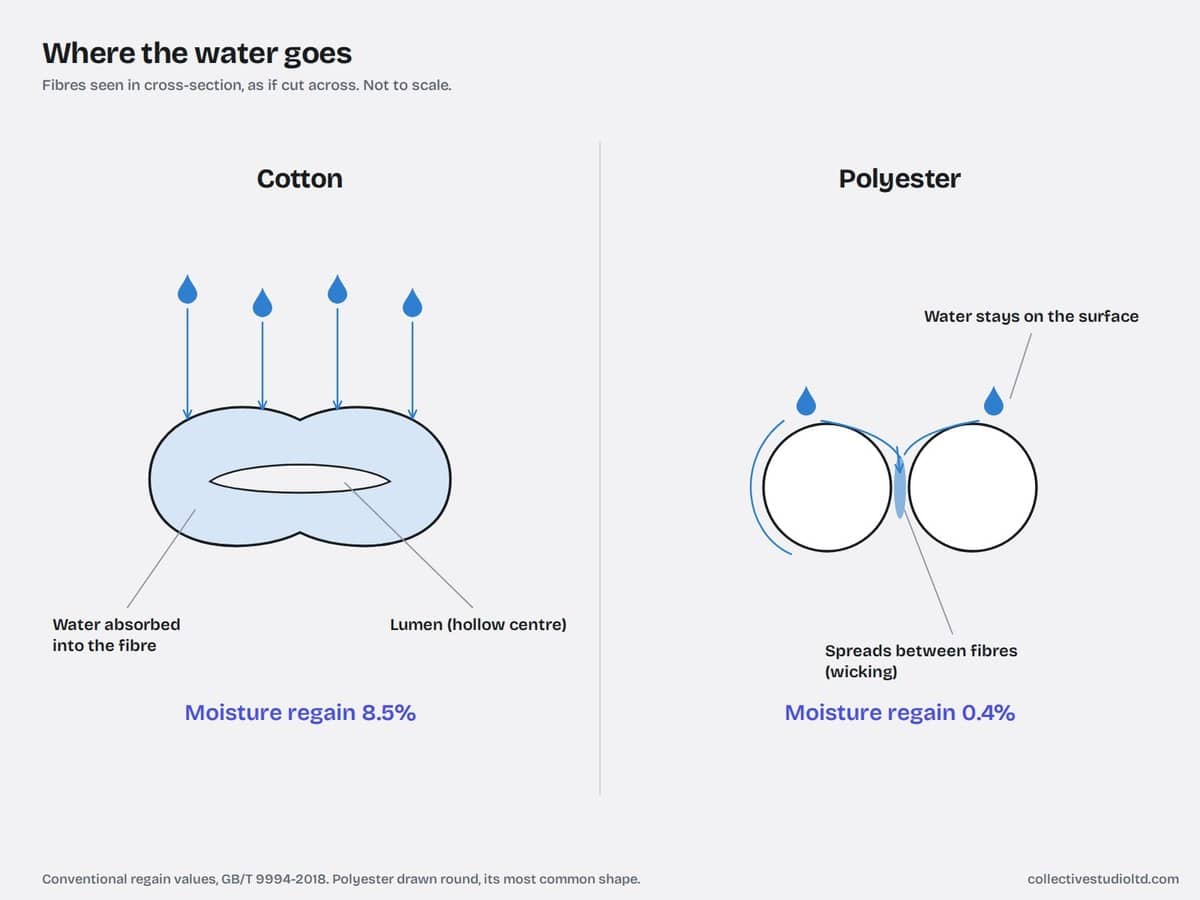
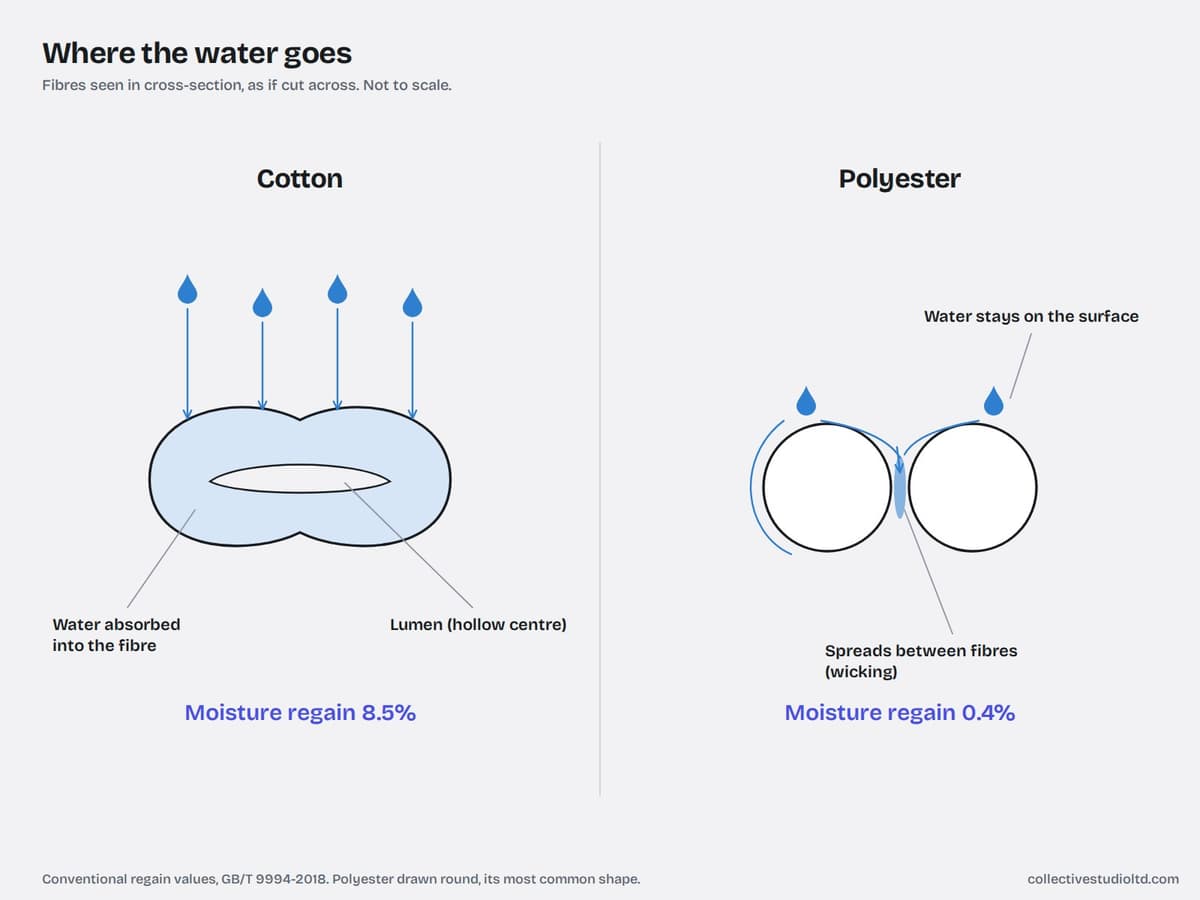
Cotton vs polyester comes down to water. Cotton is a plant fibre that takes moisture into the fibre, so it absorbs sweat and feels soft, but it shrinks, creases and dries slowly. Polyester is a plastic fibre that absorbs almost no water, so it dries fast and keeps its shape, but it can smell stronger after exercise and its pills cling. Neither is better overall: an everyday T-shirt usually suits cotton, a training top suits polyester, and many hoodies are a blend.
We are Collective Studio, a family-run knitwear factory in Narayanganj, Bangladesh. We cut and sew garments in cotton, polyester and blends on our sewing floor, so the choice of fibre comes up on almost every new style. The drawing is our own. Use it in coursework or in a brief to any factory, with credit.
The short version
- Cotton is plant cellulose. Polyester is a synthetic polymer, PET, mostly made from fossil-based chemicals.
- Cotton takes water into the fibre; polyester hardly does. Conventional trade moisture regain: cotton 8.5%, polyester 0.4%.
- Cotton absorbs sweat but stays wet once soaked. Polyester dries faster, shrinks and creases less, and suits sport.
- Breathability depends on the knit, weight and finish as much as on the fibre.
- In a blend such as 60/40 or 80/20, the label names the larger share first.
- Sublimation needs polyester. DTG works best on 100% cotton. Screen printing and embroidery work on both.
What cotton and polyester are
Cotton is a natural fibre made of cellulose, the material plant cell walls are built from. Each fibre is a single plant cell with a hollow channel down its middle, called the lumen, and it dries into a flat ribbon. Cellulose attracts water, so cotton is hydrophilic, which means water-loving. The fibres are short, so they are twisted together, or spun, into yarn.
Polyester is a manufactured fibre. In clothing it is usually polyethylene terephthalate, or PET, the same plastic as drinks bottles. US rules define polyester as a long-chain synthetic polymer that is at least 85% by weight an ester of a substituted aromatic carboxylic acid, such as terephthalate (16 CFR 303.7). The melted polymer is pushed through fine holes, called melt spinning. Polyester is hydrophobic, water-avoiding: water cannot get into its tightly packed chains.
Polyester is now the world's main fibre. Textile Exchange's Materials Market Report 2025 puts it at 59% of global fibre production in 2024, 78 million tonnes out of 132 million, against 19% for cotton. Most recycled polyester still comes from plastic bottles, not old clothes.
Cotton vs polyester, side by side
Cotton absorbs far more water and smelled less after exercise in one study; polyester dries faster, holds its shape and resists creasing. Moisture regain is the water a dry fibre takes up from the air, as a percentage of its dry weight. The figures below are conventional values from trade standards (China's GB/T 9994-2018; the US table is ASTM D1909), used to set the fair weight of fibre when it is sold. ASTM calls such values defined, not measured, and they are not a measure of breathability.
| Property | Cotton | Polyester |
|---|---|---|
| Feel | Soft and matt, with a dry handle | Smooth; from slick to soft, depending on yarn and finish |
| Moisture absorption | Absorbs water into the fibre; conventional regain 8.5% | Absorbs almost none; conventional regain 0.4% |
| Wicking | Wicks, but holds much of what it absorbs | Wicks; sweat spreads over the fibres and evaporates |
| Air flow and warmth | Set by knit, weight and finish more than by fibre | Set by knit, weight and finish more than by fibre |
| Drying time | Slow: it holds more water, some of it inside the fibre | Fast |
| Shrinkage | Knits shrink unless compacted; worst in a hot dryer | Resists shrinking; high heat can distort it |
| Creasing | Creases | Resists creasing |
| Pilling | Pills, but the pills tend to wear off | Strong fibres anchor pills, so they stay |
| Strength | Strong, slightly stronger when wet | Strong; holds its shape |
| Odour | Smelled more pleasant and less intense after exercise in a 26-person study | Smelled stronger and less pleasant in the same study |
| Heat | Does not melt; takes a hot iron | Thermoplastic: softens and melts, so iron on a low setting |
| Printing | Screen print, DTG, DTF, embroidery. Not sublimation | Sublimation, screen print, DTF, embroidery; a poor fit for DTG |
| Care | 30 or 40°C wash; avoid a hot dryer | Warm wash, low-heat drying |
| Recycling | Recycling shortens the fibre, so recycled cotton is mixed with new | About 98% of recycled polyester is made from plastic bottles, not old clothes |
Is polyester breathable?
Yes, a polyester fabric can be breathable, even though the fibre absorbs almost no water. "Breathable" covers three different things, tested separately: air permeability, how easily air passes through the fabric; moisture absorption, how much water the fibre itself takes up; and wicking, how fast liquid sweat spreads along and between the fibres so it can evaporate. Polyester is low on absorption and good at wicking. Air permeability is decided mostly by the fabric, not the fibre.
A 2024 paper in the Textile Research Journal, reviewing earlier studies, reports that polyester fabrics showed better moisture management, a lab measure of how a fabric moves liquid sweat, than cellulose fabrics such as cotton, because they absorb little and wick more. Fabric structure matters as much as the fibre, and the same paper lists it as a main factor: a tight fabric holds back water vapour, open and mesh fabrics let it through easily, and thickness changes air permeability and drying. An open polyester mesh and a dense, heavy polyester fleece behave very differently.
Is cotton more breathable than polyester?
Not as a rule, because breathability is not a property of the fibre alone. An open cotton jersey and an open polyester mesh both let air through; a tight, heavy fabric of either does not. What differs is what happens to sweat. Cotton Incorporated, the US cotton industry's research and marketing body, has written that cotton fabrics generally wick well but absorb much more moisture than synthetic fibres, which has held cotton back in activewear. Soaked cotton dries slowly; polyester absorbs almost none, so sweat spreads and evaporates. So training tops are usually polyester, and for light everyday wear the choice is mostly about feel.
Does cotton shrink?
Yes. Cotton knitwear shrinks, mostly in its first washes and most of all in a hot tumble dryer, unless the fabric was relaxed and compacted at the mill before cutting. Cotton Incorporated notes that knits of every fibre shrink more readily than wovens, and that the amount depends on how the fabric was knitted, the tension it was processed under and how it was relaxed and finished. Compacting presses the loops together along the cloth, so they have less to give back.
Polyester resists shrinking in normal washing, though heat that softens it can distort it, and a cotton and polyester blend generally shrinks less than pure cotton. Our jersey fabric guide covers compacting.
Printing on cotton and polyester
Sublimation needs polyester, because its dye bonds into polyester fibre and not into cotton; our sublimation guide explains why. DTG works best on 100% cotton. Screen printing, DTF and embroidery work on both, with one catch on coloured polyester: press heat can draw dye into a pale print, called dye migration, so it is tested first. Our print methods guide compares the options.
Blends: what 60/40, 80/20 and 50/50 mean
A blend ratio gives each fibre's share by weight: 80/20 is 80% of one fibre and 20% of the other, and 50/50 is equal parts. The ratio alone does not say which fibre is which, so ask for the fibre names with the figures, such as 60% cotton, 40% polyester.
The label settles it. In the UK and the EU, every fibre must be named with its percentage by weight, in descending order, so the larger share comes first (Regulation (EU) No 1007/2011, Article 9). US rules also list fibres in descending order of weight, name each fibre of 5% or more, show smaller shares as "other fiber" unless they have a clear purpose such as stretch, and allow a 3% tolerance (FTC). Our clothing labelling guide covers each market. A blend behaves somewhere between its two fibres: a cotton-rich blend keeps most of the cotton feel but shrinks less and dries faster.
What is polycotton? CVC and TC explained
Polycotton is the everyday name for any blend of polyester and cotton. It is not a name a label may use: in the UK and the EU only the fibre names listed in the regulation are allowed (Article 5), so the label gives figures such as 65% polyester, 35% cotton. Only a single-fibre fabric may be called 100% or pure (Article 7).
Mills often use two shorthand terms on quotes. CVC, chief value cotton, means cotton is the larger share, for example 60/40. TC, also written PC, means polyester is the larger share, for example 65/35. Neither is a legal term and the split varies by mill, so ask for the percentages.
Why hoodies are often a cotton and polyester blend
Many hoodies use a cotton-rich blend such as 80/20, because the two fibres share the work. Cotton gives the soft feel and a good print surface. Polyester helps the fleece keep its size and shape, fades less and cuts drying time, which matters because heavier fleece takes longer to dry. The trade-off: a blended fleece that pills keeps its pills, has a less dry handle and is harder to recycle, while 100% cotton fleece must be compacted to control shrinkage. Our fleece fabric guide explains how fleece is made.
Which to choose, garment by garment
Start from how the garment will be worn and washed, then pick the fibre.
| Garment | Usual choice | Why | Watch for |
|---|---|---|---|
| T-shirt | 100% cotton jersey, or a cotton-rich blend such as 60/40 | Soft, dry feel; takes every print method except sublimation | Cotton must be compacted; a blend pills more stubbornly and suits DTG less well |
| Hoodie or sweatshirt | 100% cotton fleece or French terry, or an 80/20 or 50/50 blend | Cotton for feel and print; polyester for size, shape and drying | Heavy cotton fleece dries slowly; blended fleece keeps its pills |
| Sportswear | Polyester or nylon with elastane | Wicks and dries fast; polyester takes sublimation | Can smell stronger after exercise than cotton; opacity depends on fabric weight |
| Kidswear | Cotton jersey or interlock | Soft, absorbent; interlock stands up to frequent hot washing | US children's sleepwear in sizes above 9 months must be flame-resistant or snug-fitting (16 CFR Parts 1615 and 1616) |
| Workwear (knitted uniforms) | Cotton or polycotton polos and tees | A polyester share holds size and colour through repeated washing | Heat or flame hazards need certified protective clothing, not ordinary knitwear; polyester melts |
Worked example: choosing the fleece for a hoodie
Say a brand asks us for a midweight pullover hoodie for a UK and European autumn range, with a screen-printed chest graphic. This is how the fibre would be settled.
- Weight first. 320 to 360 GSM is the everyday streetwear hoodie in brushed fleece, so that is the starting point; our fabric and GSM guide lists the ranges.
- Fibre second. 100% cotton brushed fleece is a common starting point for this brief: soft inside, clean under a screen print, and available as organic cotton, made in our GOTS-certified facility (RSC 9687).
- Shrinkage. Cotton fleece must be compacted before cutting, or the hoodie can lose a size in its first hot wash, so the sample is measured again after washing.
- Yarn. Brushed fleece pills sooner on open-end yarn than on ring-spun, and our yarn guide explains the difference.
- When a blend wins. For team kit or merchandise that will be tumble-dried often, a factory will usually sample a cotton-rich blend such as 80/20 beside the cotton, because it holds its size and dries faster.
- When polyester wins. An all-over sublimated print needs polyester fabric, so the choice starts again from the fabric.
Production starts only after the brand approves the sample, so feel, print and fit are settled before bulk is cut.
Which is better for the environment?
The sources give no simple winner, because each fibre's impact depends on how it is grown or made. Cotton is a farmed crop; our sustainable fabrics guide compares organic, recycled and conventional options. For polyester, Textile Exchange counts about 88% of 2024 production as fossil-based, and recycled polyester at 6.9% of all fibre produced that year.
Microfibres are the issue most tied to synthetics. The European Environment Agency says the wearing and washing of synthetic textiles is one recognised source of microplastics, that most are released in the first few washes, and that about 8% of microplastics released to European oceans come from synthetic textiles. It adds that natural fibres also shed microfibres through wear and tear.
Recycling is hard for both, and hardest for blends. Less than 1% of the world's fibre comes from recycled textiles. A 2021 study for the European Commission found that mechanical recycling cannot separate the fibres in a blend, and that processes to separate polycotton were still in development.
If you are having this made
Tell us the garment and how it will be worn and washed, and we will suggest a fabric and sample it, from 150 pieces per style and per colour. See our hoodie manufacturing page, or send us your brief.
Frequently asked questions
Is polyester or cotton better?
Neither is better for every garment; each wins at different jobs. Cotton suits everyday wear: it feels soft, absorbs moisture, smelled less than polyester after exercise in a university study, and takes almost every print method. Polyester suits a garment that gets soaked, washed hard or must keep its shape: it absorbs almost no water, dries fast, resists shrinking and creasing, and is the fabric sublimation printing needs. That is why most T-shirts are cotton, most training tops are polyester, and many hoodies are a blend of the two. Choose by how the garment will be worn and washed.
Polyester vs cotton: what is the main difference?
The main difference is how each fibre treats water. Cotton is cellulose from a plant, and it draws water into the fibre: its conventional moisture regain, the trade figure for how much water it holds from the air, is 8.5%. Polyester is a plastic, PET, and its figure is 0.4%, so water stays on the surface. Much else follows from that. Cotton absorbs sweat but stays wet once soaked, shrinks more and dries slowly. Polyester wicks sweat and dries fast but can smell stronger after exercise. Polyester also melts under high heat, while cotton does not.
Does polyester shrink?
Polyester barely shrinks in normal washing, because the fibre absorbs almost no water. Heat is its weak point. Polyester is thermoplastic, which means it softens as it gets hot, so a very hot wash, a hot tumble dryer or a hot iron can distort or shrink it. Follow the care label, which for polyester usually means a cool or warm wash, low-heat drying and a cool iron. A polyester and cotton blend shrinks less than 100% cotton, but the cotton share can still shrink if the fabric was not compacted.
Is polycotton better than 100% cotton?
Polycotton is better for some jobs and worse for others. Adding polyester to cotton makes a fabric that shrinks less, creases less, dries faster and fades less, which is why it is common in uniforms, workwear and hoodies. It gives up some of cotton's character: it absorbs less sweat, has a less dry handle, and pills more stubbornly, because the strong polyester fibres hold the pills on the surface. It is also harder to recycle than a single fibre. For a T-shirt chosen for feel, many brands pick 100% cotton; for a garment washed hard, polycotton often makes more sense.
Which is better for printing, cotton or polyester?
It depends on the print method. Cotton suits the widest range: screen printing, DTG, DTF and embroidery all work well, and DTG works best on 100% cotton because the ink goes into the fibres. Polyester is the fabric sublimation needs, since the dye bonds into polyester and will not take on cotton, so for bright all-over prints on sportswear polyester is the answer. Screen printing, DTF and embroidery also work on polyester, but on coloured polyester the heat of printing can pull dye into a pale design, called dye migration, so it should be tested on the actual fabric before bulk.
Which lasts longer, cotton or polyester?
Polyester usually lasts longer as a fabric, because it is a strong fibre that holds its shape, resists creasing and fades less in sunlight. Cotton is strong too, and even gets slightly stronger when wet, but a cotton garment can lose its shape and size if the fabric was not compacted. Polyester has one durability weakness: its pills stay anchored to the surface, so a polyester or blended fabric that pills keeps looking pilled. How long a garment really lasts depends as much on the yarn, the fabric weight and the sewing as on the fibre.
Where this applies
The manufacturing pages this guide relates to, if you are costing a real run.
Free tools & guides for this
Sources & further reading
- Textile Exchange: Materials Market Report 2025 (September 2025, data for 2024)
- Code of China: GB/T 9994-2018, Conventional moisture regains of textile materials
- Journal of Design and Textiles, University of Management and Technology: Hussain and Khan, Anti-Pilling Properties of Polyester-Cotton Blend using Plasma and Chemical Finish (2024)
- Textile Research Journal, Kaunas University of Technology: Asfand, Petraitiene and Daukantiene, Linear regression analysis of properties related to moisture management using cotton-polyester knitted fabrics (2024)
- Cotton Incorporated: Technical Bulletin TRI 3011, Wet Processing of 100% Cotton Knitted Fabrics (1999)
- Applied and Environmental Microbiology (Ghent University): Callewaert et al., Microbial odor profile of polyester and cotton clothes after a fitness session (2014)
- European Environment Agency: Microplastics from textiles, towards a circular economy for textiles in Europe (2022)
- legislation.gov.uk: Regulation (EU) No 1007/2011 on textile fibre names and labelling, Chapter 2
Cite this guide
For journalists, writers, researchers and students.
Quoting this guide? Please credit Collective Studio and link to this page.
Reference
Homaira Jashim, Collective Studio. "Cotton vs Polyester: Which Fabric Is Better for Clothing?" 19 November 2026. https://collectivestudioltd.com/journal/cotton-vs-polyester
Writing about us? Our press kit has our facts, logos and photos, free to use with credit.
Have an idea? Let’s make it.
We manufacture from 150 pieces per style and colour, with organic cotton options from our GOTS-certified facility and photos at every stage. Send a sketch or a sentence — we’ll reply within one business day.