How Much Does a T-Shirt Weigh? T-Shirt and Hoodie Weights in Grams
How much does a T-shirt weigh? A size M adult T-shirt in 180 GSM cotton jersey weighs about 170 grams (6.0 oz). In our range a size M tee runs from about 150 g (5.3 oz) in light 160 GSM jersey to about 255 g (9.0 oz) in a boxy 240 GSM heavyweight. A size M hoodie in 320 GSM fleece with a jersey-lined hood weighs about 580 g (20.5 oz), or about 530 to 700 g from 280 to 400 GSM. These are our estimates from garment measurements and fabric weight, worked out below; weigh the real garment before you rely on one.
We are Collective Studio, a family-run knitwear factory in Narayanganj, Bangladesh. We cut and sew T-shirts, hoodies and sweatshirts on our own sewing floor, and the weight of the fabric decides both how much cloth an order needs and how heavy its cartons are. The drawings are our own. Use them in coursework or in a brief to any factory, with credit.
The short version
- Size M T-shirt: about 150 g in 160 GSM, 170 g in 180 GSM, 205 g in 220 GSM.
- Size M hoodie with a jersey-lined hood: about 530 g in 280 GSM, 580 g in 320 GSM, 700 g in 400 GSM.
- The method: fabric area in the garment (m²) × GSM, plus rib and trims.
- A garment weighs less than the fabric bought for it: cutting waste and offcuts stay behind.
- Each size up adds about 7% to a T-shirt.
- About six mid-weight T-shirts, or fewer than two hoodies, make a kilo.
The formula: fabric area times GSM
Garment weight is roughly the fabric area in the garment, in square metres, times the fabric weight in GSM, plus rib and trims. GSM means grams per square metre, measured in laboratories by methods such as ASTM D3776: 0.9 m² of 180 GSM jersey weighs about 162 g. Rib is the stretchy knit used for necks, cuffs and waistbands, with its own GSM. Trims are everything else: thread, labels, drawcord, zip, buttons and print.
Thread is light. The thread maker Coats gives about 45 metres for a T-shirt and 150 metres for a polo shirt, and lists threads from tex 18 to 30 for knitted tees and up to tex 35 for polos. Tex is the weight in grams of 1,000 metres, so a T-shirt carries about 1 g of thread and a polo about 3 to 5 g.
Why a garment weighs less than the fabric bought for it
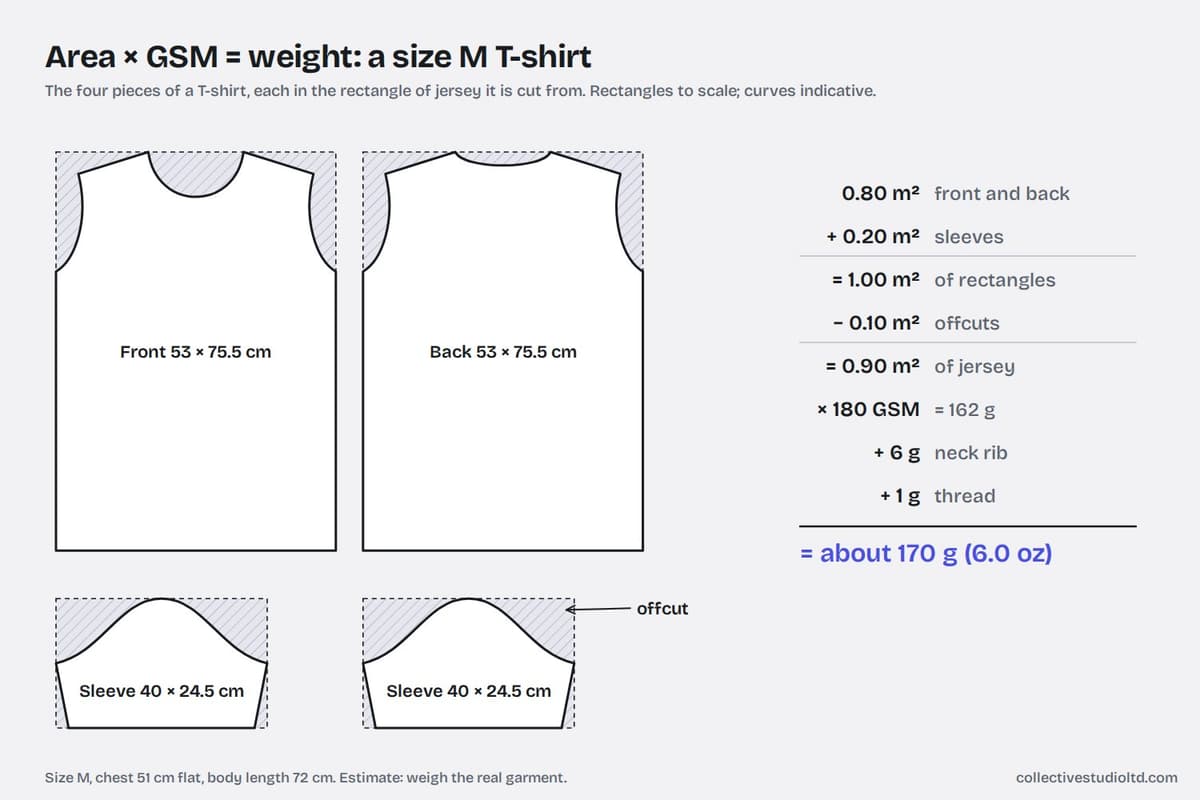
A garment weighs less than the fabric bought for it because some of the cloth never reaches it. Each piece is cut from a rectangle, and the neck scoop, the armhole curves and the corners above each sleeve cap (the rounded top of a sleeve) become offcuts: about a tenth of the rectangles on our T-shirt pattern. Seam and hem allowances stay in, folded inside the seams. Our fabric consumption guide gives about 0.18 to 0.23 kg of fabric for a size M T-shirt, because it adds 10 to 12% cutting waste on top.
For a similar size M tee in 180 GSM, our fabric consumption calculator books about 207 g of fabric with 10% wastage; the finished shirt weighs about 170 g. Quick consumption formulas give more again, often around 240 g of cloth for the same tee before wastage. They count every piece as a full rectangle, so the offcuts are inside the figure, they take the sleeves at the full width of the body, and their allowances are generous on purpose, because they are made for buying cloth, where running short is worse than having a little left. Buy cloth on those numbers; plan shipping on the finished weight.
Worked example: a size M T-shirt in 160, 180 and 220 GSM
We use the size M measurements from our T-shirt tech pack template: chest 51 cm flat, body length 72 cm, sleeve 21 cm, bicep 19 cm, with 1 cm seam and 2.5 cm hem allowances, as in our calculator.
- Front and back: 2 × 53 × 75.5 cm = 0.80 m².
- Sleeves: 2 × 40 × 24.5 cm = 0.20 m².
- Cut away for the neck, shoulder slope, armholes and sleeve caps: about 0.10 m², leaving about 0.90 m² of jersey.
- Neckband: 48 × 6 cm of 220 GSM rib, folded, 0.029 m², about 6 g.
- Thread: about 1 g.
| Body fabric | Jersey in the shirt | Rib and thread | T-shirt, size M |
|---|---|---|---|
| 160 GSM | 0.90 × 160 = 144 g | About 7 g | About 150 g (5.3 oz) |
| 180 GSM | 0.90 × 180 = 162 g | About 7 g | About 170 g (6.0 oz) |
| 220 GSM | 0.90 × 220 = 198 g | About 7 g | About 205 g (7.2 oz) |
Worked example: a size M hoodie in 280, 320 and 400 GSM
The size M measurements come from our hoodie tech pack template: chest 63 cm, body length 70 cm including a 7 cm waistband, sleeve 56 cm including a 7 cm cuff, a hood of 36 × 26 cm lined in 180 GSM jersey, as the template specifies, and a kangaroo pocket 30 cm across and 21 cm deep. The template names French terry; fleece of the same GSM gives the same weight.
- Front and back: 2 × 65 × 65 cm = 0.85 m². Sleeves: 2 × 51 × 50 cm = 0.51 m².
- Hood: 2 × 38 × 28 cm = 0.21 m². Pouch pocket: about 0.08 m².
- Cut away for the neck, armholes, sleeve caps, sleeve taper and hood curve: about 0.24 m², leaving about 1.41 m² of fleece.
- Hood lining: the same two hood pieces in 180 GSM jersey, 0.18 m², about 33 g.
- Cuffs and waistband in 380 GSM 2×2 rib, folded: 0.25 m², about 95 g.
- Thread: about 4 g. Coats gives no figure for a hoodie, so we use its polo figure of about 150 metres as an allowance. A hoodie has more seams than a polo, so the real figure may be a little higher.
| Shell fabric | Fleece in the hoodie | Rib, hood lining and thread | Hoodie, size M |
|---|---|---|---|
| 280 GSM | 1.41 × 280 = 395 g | About 131 g | About 530 g (18.7 oz) |
| 320 GSM | 1.41 × 320 = 451 g | About 131 g | About 580 g (20.5 oz) |
| 400 GSM | 1.41 × 400 = 564 g | About 131 g | About 700 g (24.7 oz) |
The rib surprises people: about a sixth of the hoodie's weight sits in the cuffs and waistband, because each 7 cm band is cut 16 cm deep, folded double, in a rib heavier than the body.
How much do other garments weigh?
This table applies the same method to our other tech pack templates and calculator presets. Every figure is approximate, size M, without packaging, labels, print or hardware such as buttons, elastic and drawcords.
| Garment | Fabric weight | Approximate weight | In ounces |
|---|---|---|---|
| T-shirt, light | 160 GSM single jersey | About 150 g | About 5.3 oz |
| T-shirt, mid-weight | 180 GSM single jersey | About 170 g | About 6.0 oz |
| T-shirt, heavyweight, boxy fit | 240 GSM single jersey | About 255 g | About 9.0 oz |
| Long-sleeve T-shirt | 180 GSM single jersey | About 215 g | About 7.6 oz |
| Polo shirt | 210 GSM piqué, flat-knit collar and cuffs | About 215 g | About 7.6 oz |
| Crew-neck sweatshirt | 340 GSM French terry, 380 GSM rib | About 460 g | About 16.2 oz |
| Hoodie, mid-weight | 320 GSM fleece, 380 GSM rib, jersey-lined hood | About 580 g | About 20.5 oz |
| Hoodie, heavyweight | 400 GSM fleece, 380 GSM rib, jersey-lined hood | About 700 g | About 24.7 oz |
| Joggers | 340 GSM French terry, rib cuffs | About 470 g | About 16.6 oz |
| Sweat shorts | 330 GSM French terry | About 275 g | About 9.7 oz |
How size changes the weight
Each size up adds about 12 g, or 7%, to a 180 GSM T-shirt, because on our template the chest grows 2.5 cm and the length 2 cm a step. XS is about 145 g, S 155 g, M 170 g, L 180 g, XL 190 g and 2XL 205 g. Our guide on how to measure a T-shirt shows where each of those measurements is taken.
Fit matters as much as size: the boxy tee in the table, with a 58 cm chest instead of 51 cm, has about 15% more fabric in the same size M. A weight quoted without a size and a fit cannot be compared with another.
GSM, ounces per square yard and garment ounces
Ounces per square yard is GSM in imperial units: 1 oz/yd² is 33.906 g/m², the factor published by NIST, the US national measurement institute. So 180 GSM is about 5.3 oz/yd², 240 GSM about 7.1 and 320 GSM about 9.4. Our GSM to oz converter works both ways, and our fabric and GSM guide explains how GSM is measured.
Keep the two kinds of ounce apart. A whole garment is weighed in plain ounces of 28.35 g. So when a T-shirt is sold as 6 oz, ask which is meant: fabric of 6 oz/yd² is about 203 GSM, while a shirt weighing 6 oz is about 170 g, which happens to be a size M tee in 180 GSM.
What is a heavyweight T-shirt?
A heavyweight T-shirt is cut from heavier jersey than an everyday tee. No standards body defines where heavyweight starts, so the word is trade usage, not a measurement: some suppliers use it from somewhere around 180 to 220 GSM, others keep it for 240 GSM and up. On our sewing floor heavyweight tees are 240 GSM, the heaviest in our 140 to 240 GSM range, and a size M boxy tee in it weighs about 255 g against 170 g for an everyday 180 GSM tee. Our guide to the best GSM for hoodies and T-shirts covers how each weight feels.
Why garment weight matters to a brand
Weight decides how heavy each carton is, how freight is charged and which courier step a parcel falls into. Our tech pack templates use 50 tees or 20 hoodies per carton as examples: about 8.5 kg of size M tees, or 11.5 kg of hoodies, before bags and box.
Air freight is charged on what the trade calls chargeable weight: the greater of the actual weight and a volumetric weight worked out from the carton's size. IATA, the airlines' trade body, gives as its general rule the volume in cubic centimetres divided by 6,000, so a 60 × 40 × 40 cm carton counts as 16 kg even if it weighs less. Our CBM calculator works out both, and the courier divisors.
Parcels to customers come in weight steps too. Australia Post, for example, bases postage on a parcel's weight or its cubic weight, whichever is greater, with one set of rules up to 5 kg and another from 5 to 22 kg, its maximum within Australia (checked 19 November 2026). For EU sales, our textile EPR guide explains why to ask for a net weight per style, colour and size.
How to weigh a garment properly
Weigh the real garment on a digital scale, because any estimate, ours included, can be several per cent out. A kitchen scale reading to 1 g will do.
- Zero the scale, then lay the garment on it folded, nothing hanging over the edge.
- Weigh it dry, at room temperature, never warm from a dryer or a steamer. Laboratories condition fabric in a standard atmosphere, or oven-dry it, first; BS EN 12127 allows either.
- Weigh several pieces per size and average them: fabric varies a little from roll to roll.
- Weigh it bare for net weight, then fully packed for shipping.
- Write the size and GSM beside every weight.
Note the approved sample's weight on your tech pack beside the GSM. If you send us a garment to match, we weigh it and work from the real thing.
Weight with packaging
Packaging adds weight to every piece: a polybag, a size and barcode sticker and often a swing tag. Card is sold in grams per square metre too, so the same sum works: a 5 × 9 cm swing tag on 350 g/m² card is 0.0045 m² × 350, about 1.6 g before its string. Weigh one bag of the kind your factory will use, multiply each item by the pieces in a carton, then add the carton.
Worked example from our sewing floor: 150 tees in two weights
Say a brand orders our minimum of 150 pieces per style and per colour of a T-shirt, and is choosing between a regular fit in 180 GSM jersey and a boxy fit in our 240 GSM heavyweight. In size M, 150 regular tees weigh about 25.5 kg and 150 boxy tees about 38 kg, half as much again. On our sewing floor each piece is folded and sealed in its own polybag, then counted into cartons. At 50 to a carton both fill three cartons, but the heavier ones weigh more.
We ship DDP, with duty, clearance and freight handled to the buyer's door, and that freight is worked out on the weight and size of those cartons. A size mix weighted towards L and XL pushes both up.
If you are having this made
We cut and sew T-shirts, hoodies and sweatshirts from 150 pieces per style and per colour, with the jersey, French terry and fleece knitted and dyed to our specification at partner mills. Tell us the garment, the GSM and your size mix, and we will work out the weights from your measurements.
Frequently asked questions
How much does a hoodie weigh?
A size M pullover hoodie in 320 GSM fleece with a jersey-lined hood weighs about 580 g, or 20.5 oz, by our estimate. In 280 GSM fleece it is about 530 g, and in a 400 GSM heavyweight about 700 g. Most of the weight is the body, sleeves, hood and pocket, about 1.41 square metres of fleece in a size M, and about a sixth sits in the folded rib cuffs and waistband. An unlined hood is about 33 g lighter; a zip, drawcord and labels add weight. The size, the fit and the fabric all move the figure, so weigh the actual sample before you plan shipping.
How heavy is a T-shirt in kg?
A size M adult T-shirt in 180 GSM jersey weighs about 0.17 kg. A light 160 GSM tee is about 0.15 kg, a 220 GSM tee about 0.205 kg and a boxy 240 GSM heavyweight tee about 0.255 kg. Size moves the figure by about 7% a step, so a 180 GSM XS is about 0.145 kg and a 2XL about 0.205 kg. These figures are the finished garment without packaging. The fabric bought to make the shirt is heavier, about 0.18 to 0.23 kg for a size M, because cutting waste and offcuts stay behind on the cutting table.
How many ounces is a T-shirt?
A size M T-shirt in 180 GSM jersey weighs about 6 oz, since one ounce is 28.35 g and the shirt weighs about 170 g. A light 160 GSM tee is about 5.3 oz and a boxy 240 GSM heavyweight about 9.0 oz. Be careful with catalogue figures: a 6 oz T-shirt may mean fabric of 6 oz per square yard, about 203 GSM, rather than a shirt that weighs 6 oz. Fabric ounces are per square yard; garment ounces are the whole shirt on a scale. Ask the supplier which one they mean before you compare blanks.
How many T-shirts are in 1 kg?
About six size M T-shirts in 180 GSM jersey make a kilo, because each weighs about 170 g. Light 160 GSM tees come to about six and a half per kilo, and 220 GSM tees to about five. A boxy 240 GSM heavyweight tee weighs about 255 g, so fewer than four make a kilo. By comparison, a 320 GSM hoodie weighs about 580 g, so fewer than two make a kilo. These counts leave out polybags, stickers and swing tags, so a kilo of packed garments holds a little less than a kilo of bare ones.
How much does a sweatshirt weigh?
A size M crew-neck sweatshirt in 340 GSM French terry weighs about 460 g, or 16.2 oz, by our estimate. In 280 GSM it is about 395 g, and in 400 GSM about 520 g. That includes the neck, cuff and hem rib, which in a 380 GSM 2x2 rib adds about 90 g on its own. A sweatshirt weighs less than a hoodie in the same fabric because it has no hood and no pouch pocket. Print, embroidery and labels add a little more, so weigh the approved sample for an exact figure.
What is a heavyweight T-shirt?
A heavyweight T-shirt is cut from heavier jersey than an everyday tee. No standards body defines where heavyweight starts, so the word is trade usage: some suppliers use it from around 180 to 220 GSM, others only from 240 GSM, and one supplier's heavyweight can be lighter than another's. On our sewing floor heavyweight tees are 240 GSM, about 7.1 oz per square yard, against 180 GSM for an everyday tee. A size M boxy tee in 240 GSM weighs about 255 g, roughly half as much again as a regular 180 GSM tee. Ask for the GSM in writing rather than the word.
Where this applies
The manufacturing pages this guide relates to, if you are costing a real run.
Free tools & guides for this
Sources & further reading
- NIST: Guide for the Use of the International System of Units (SP 811), Appendix B.8, factors for units listed alphabetically (oz/yd² to kg/m², ounce to gram)
- ASTM International: ASTM D3776/D3776M-20(2025), Standard Test Methods for Mass Per Unit Area (Weight) of Fabric
- BSI: BS EN 12127:1998, Textiles. Fabrics. Determination of mass per unit area using small samples
- Coats: T-shirts, thread and stitch recommendations for menswear (approximate thread consumption 45 metres)
- Coats: Polo shirts, thread and stitch recommendations for menswear (approximate thread consumption 150 metres)
- AMANN Knowledge Hub: Tex, Nm and denier explained (tex is the weight in grams of 1,000 metres)
- IATA Knowledge Hub: Air cargo tariffs and rules, what you need to know (volumetric weight, divide by 6,000)
- Australia Post: Size and weight guidelines for parcels and letters
Cite this guide
For journalists, writers, researchers and students.
Quoting this guide? Please credit Collective Studio and link to this page.
Reference
Homaira Jashim, Collective Studio. "How Much Does a T-Shirt Weigh? T-Shirt and Hoodie Weights in Grams." 19 November 2026. https://collectivestudioltd.com/journal/how-much-does-a-t-shirt-weigh
Writing about us? Our press kit has our facts, logos and photos, free to use with credit.
Have an idea? Let’s make it.
We manufacture from 150 pieces per style and colour, with organic cotton options from our GOTS-certified facility and photos at every stage. Send a sketch or a sentence — we’ll reply within one business day.