Tech pack example: a filled-in hoodie tech pack
A finished tech pack looks like this: a short form with every box filled in, from the style summary and the sketch to the size chart, the stitching, the labels and the order. This one is for a pullover hoodie. It is three pages long and free to download as a PDF.
Want the blank version? It is the free hoodie tech pack template. For any other garment, use the general tech pack template.
The example is our hoodie template with all 226 boxes typed in for one style: a relaxed pullover hoodie in 330 GSM French terry, in two colours, 150 pieces of each. The printed headings and labels are the form. Everything in blue was typed in, and the two sketches were drawn over the outline the blank form carries.
The brand, the style and every number are invented. They show the level of detail a factory needs, so read them as a guide and use your own measurements. No box is left empty: a spare row that the style does not need says “Not used”, and a decision still open says “Factory to advise”.
The tech pack example, page by page
Each picture below is one page of the PDF, shown in full. Under it, block by block, is what the filled-in boxes tell the factory, the values in this example, and the gap a factory sees most often in that block. Select a picture to open it full size.
Page 1: style summary, sketch and bill of materials
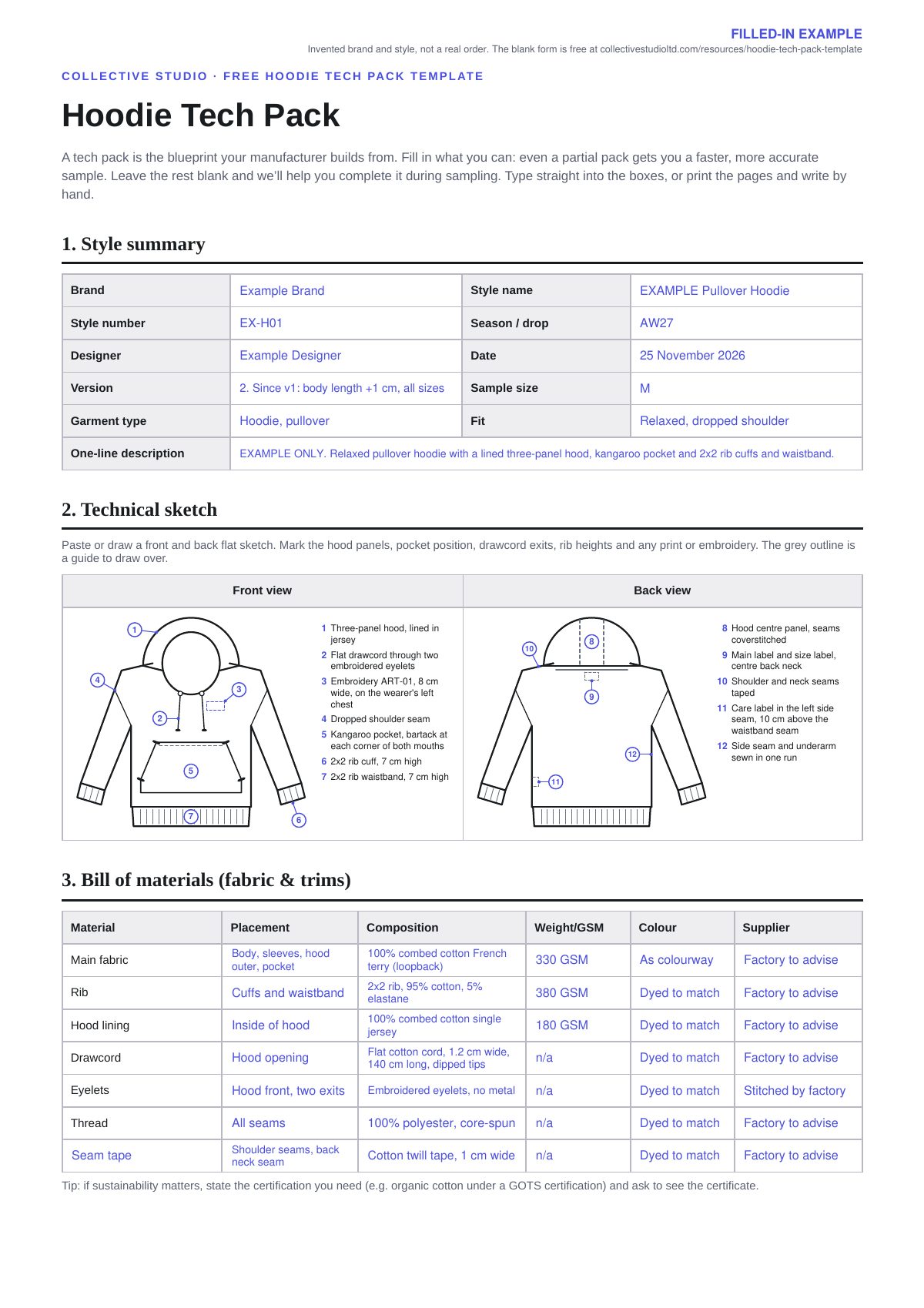
- 1. Style summary
- Everyone in the factory reads this box first. The style number, version and date show which pack is the current one. The sample size names the size the first sample is cut in, and the one-line description tells the pattern maker the fit before they open the sketch.In the exampleEX-H01 · version 2 (body length +1 cm since version 1) · 25 November 2026 · sample size M · relaxed, dropped shoulderThe gap a factory sees: No sample size. A size range is graded from one base size, so if the pack does not name it, the factory has to pick one. The other gap is a change made to an old copy: raise the version number and the date with every change.
- 2. Technical sketch
- A flat drawing of the front and the back, as if the hoodie were lying on a table. The pattern maker drafts the pattern from it and from the measurements, and everyone else uses it to find the part a note refers to. Each numbered callout points at one seam, trim, label or piece of artwork. A hand drawing, photographed, does the same job.In the example12 callouts: hood panels and lining, drawcord and eyelets, embroidery, dropped shoulder seam, pocket bartacks, rib cuff and waistband, labels, taped seamsThe gap a factory sees: A front view with no back, which hides the back neck label and the hood seams. A sketch also shows the shape and says nothing about the size, so it never replaces the size chart on page 2.
- 3. Bill of materials
- One row for each fabric and trim: where it goes, what it is made of, its weight and its colour. Sourcing buys the fabric and trims from this table before sewing can start. Fabric is bought against composition and weight, so both are written as a fibre and a number in GSM.In the exampleBody: 100% combed cotton French terry (loopback), 330 GSM · Rib: 2x2, 95% cotton, 5% elastane, 380 GSM · Hood lining: single jersey, 180 GSM · Drawcord: flat cotton, 1.2 cm wide, 140 cm longThe gap a factory sees: Fabric described by feel. Heavyweight and soft mean something different to every supplier. An empty box is the second gap, because it reads as not decided yet. Here the supplier column says factory to advise, and a trim with no weight says n/a.
Page 2: colourways and the size chart
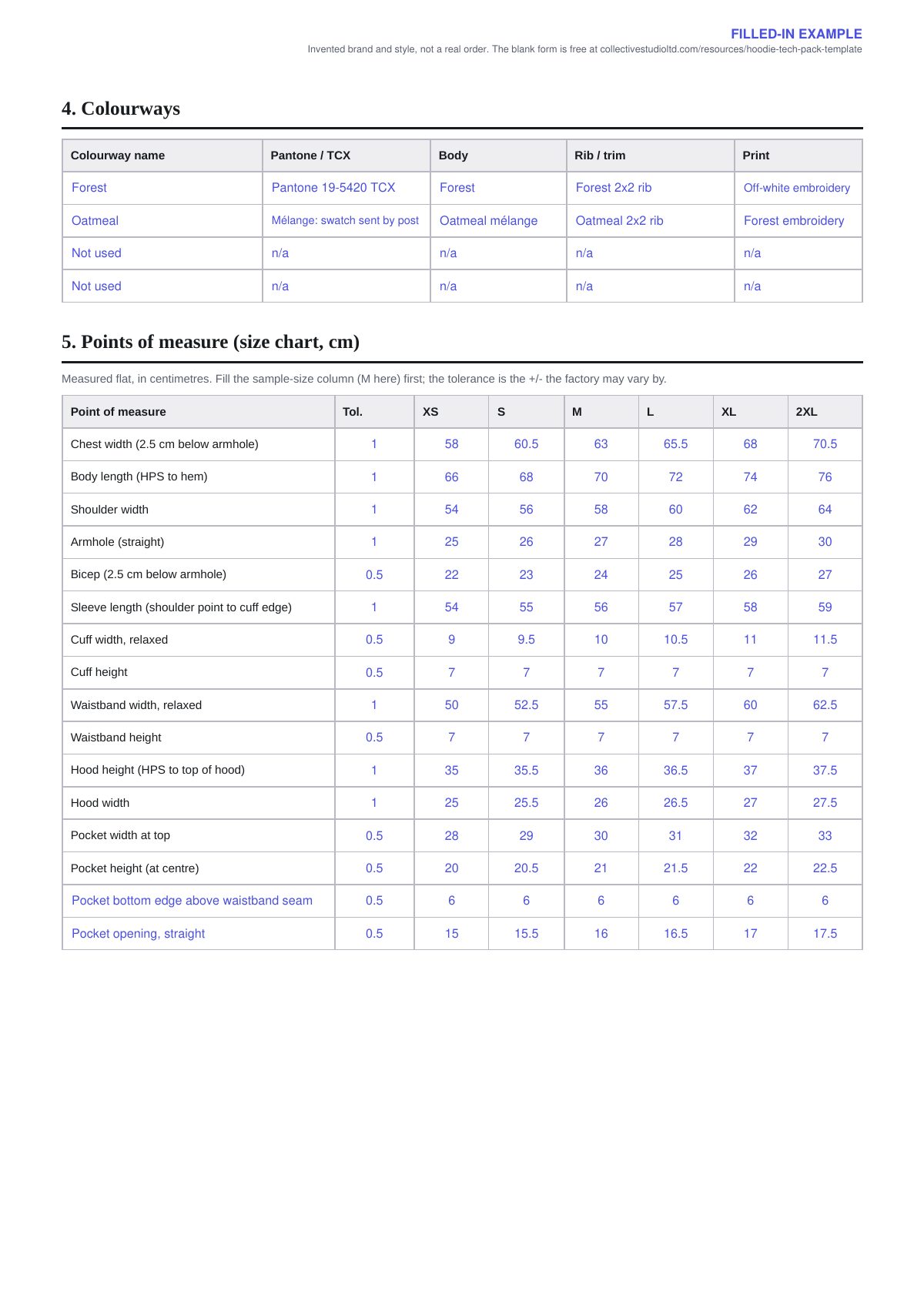
- 4. Colourways
- One row per colour, saying which colour the body, the rib and the embroidery take. The mill dyes to the reference, and you approve a lab dip before the bulk fabric is dyed. Each colour is its own dye lot, which is why a minimum is counted per colour.In the exampleForest: Pantone 19-5420 TCX, off-white embroidery · Oatmeal mélange: swatch sent by post, forest embroidery · rows 3 and 4: not usedThe gap a factory sees: A colour given as a name. Forest, like navy, is a family of shades. Write a Pantone TCX reference, or post a physical swatch when you have no reference, as the oatmeal row does.
- 5. Points of measure
- The size chart, measured flat and in centimetres. The pattern maker drafts to it, and quality control measures finished garments against it. The M column is filled in first, because M is the sample size, and the other sizes are graded from it. The tolerance is how far a finished piece may measure over or under the figure and still be accepted.In the exampleChest 63 cm ± 1 · body length 70 cm ± 1 · sleeve length 56 cm ± 1 · hood height 36 cm ± 1 · cuff width, relaxed 10 cm ± 0.5The gap a factory sees: Measurements with no tolerance, which leaves nothing agreed to judge a sample against. A hoodie adds two more: a body length that stops at the seam above the waistband and leaves the rib out, and a cuff or waistband pulled open when rib is measured relaxed.
Here is the sample-size column on its own, with the range each point may fall in. A chest of 63 cm with a tolerance of 1 cm passes at any reading from 62 to 64 cm. Our guide to measuring a T-shirt and a hoodie shows where the tape starts and ends for each point.
| Point of measure | M (cm) | Tol. (+/-) | Passes between (cm) |
|---|---|---|---|
| Chest width (2.5 cm below armhole) | 63 | 1 | 62 to 64 |
| Body length (HPS to hem) | 70 | 1 | 69 to 71 |
| Shoulder width | 58 | 1 | 57 to 59 |
| Armhole (straight) | 27 | 1 | 26 to 28 |
| Bicep (2.5 cm below armhole) | 24 | 0.5 | 23.5 to 24.5 |
| Sleeve length (shoulder point to cuff edge) | 56 | 1 | 55 to 57 |
| Cuff width, relaxed | 10 | 0.5 | 9.5 to 10.5 |
| Cuff height | 7 | 0.5 | 6.5 to 7.5 |
| Waistband width, relaxed | 55 | 1 | 54 to 56 |
| Waistband height | 7 | 0.5 | 6.5 to 7.5 |
| Hood height (HPS to top of hood) | 36 | 1 | 35 to 37 |
| Hood width | 26 | 1 | 25 to 27 |
| Pocket width at top | 30 | 0.5 | 29.5 to 30.5 |
| Pocket height (at centre) | 21 | 0.5 | 20.5 to 21.5 |
| Pocket bottom edge above waistband seam | 6 | 0.5 | 5.5 to 6.5 |
| Pocket opening, straight | 16 | 0.5 | 15.5 to 16.5 |
Size M of the example, measured flat. The first 14 rows are printed on the hoodie template; the last two were typed into its spare rows.
Page 3: construction, labels, packaging and the order
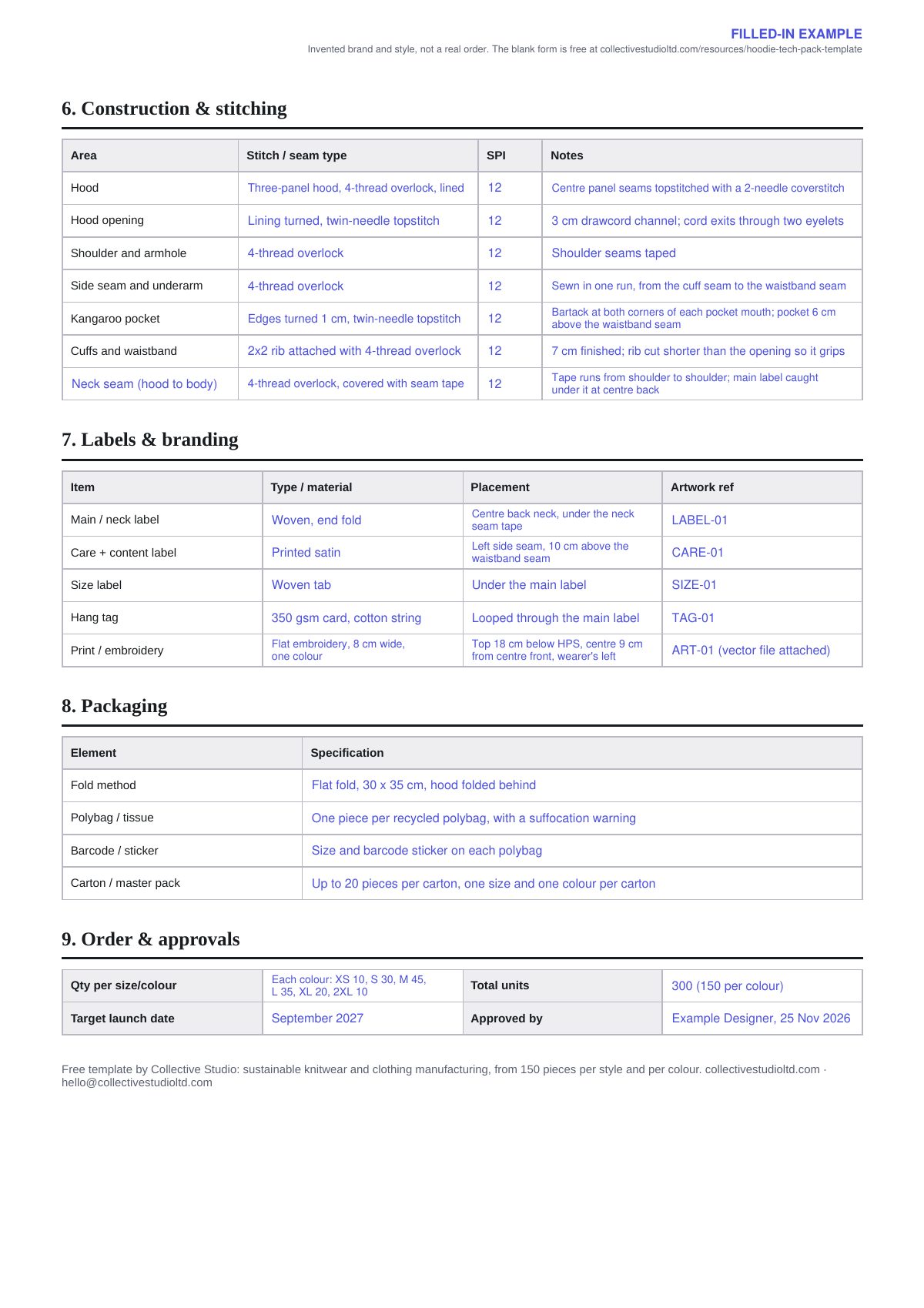
- 6. Construction and stitching
- One row per seam, read by the sewing line. It says how each seam is made, not only where it is: the stitch type, the stitches per inch (SPI) and a note on the finish. The spare row is used here for the seam that joins the hood to the body.In the example4-thread overlock at 12 SPI · twin-needle topstitch on the pocket and the hood opening · bartack at both corners of each pocket mouth · rib 7 cm finishedThe gap a factory sees: A blank row, which is a decision the factory will make for you. If you do not know the name of a stitch, describe what you want in plain words, or write factory to advise.
- 7. Labels and branding
- Each label, the hang tag and the artwork: what it is made of, where it sits and which artwork file it uses. Finishing and the embroidery unit place them from these numbers. Every position is measured from a fixed point, so it can be checked on every piece.In the exampleEmbroidery ART-01: flat, one colour, 8 cm wide, top 18 cm below the high point of the shoulder (HPS), centre 9 cm from centre front, wearer's leftThe gap a factory sees: A placement left open, or written as centred. A factory guessing at a position will centre it and hope. Artwork sent as a screenshot is the second gap: label and embroidery artwork needs to be a vector file.
- 8. Packaging
- How each piece is folded, bagged, stickered and packed into cartons. Finishing packs every piece from this table.In the exampleFlat fold, 30 x 35 cm · one piece per recycled polybag with a suffocation warning · size and barcode sticker · up to 20 pieces per carton, one size and one colourThe gap a factory sees: Leaving it out. The fold, the bag and the pieces per carton are part of the product, and each one changes the carton count.
- 9. Order and approvals
- The quantity by colour and size, the target launch date and who approved this version. Bulk is checked against the approved version and nothing else.In the exampleEach colour: XS 10, S 30, M 45, L 35, XL 20, 2XL 10 · 150 pieces per colour, 300 in total · approved by name, with the dateThe gap a factory sees: One total for the whole order. State the quantity per style and per colour, because that is how minimums and dye lots work.
What the factory reads first
A pack does not have to be complete to be useful. If you have time for a few boxes, these are the ones a first sample depends on, with the value each holds in this example.
| Field | In this example | Why it matters |
|---|---|---|
| Version and date | Version 2, 25 November 2026 | They show which pack is the current one. A correct change made to an old copy is one of the easiest ways to get a wrong sample. |
| Sample size | M | The first sample is cut in this size, and every other size is graded from it. |
| Front and back sketch | Two flats, 12 callouts | The pattern maker drafts the pattern from the sketch and the measurements together. |
| Fabric composition and weight | 100% combed cotton French terry, 330 GSM | Fabric is bought against these two facts, and it is bought before anyone cuts. |
| Colour reference | Pantone 19-5420 TCX, or a posted swatch | The mill dyes to the reference. A colour name alone can be read as more than one shade. |
| Chest, body length and sleeve length | 63, 70 and 56 cm, each ± 1 cm | The sample is cut to these numbers and measured against them, so each one needs a tolerance. |
| Quantity per colour | 150 pieces of each colour | Each colourway is its own fabric batch and dye lot, so minimums are counted per style and per colour. |
How to use the example
Keep it open beside the blank form. Download the hoodie tech pack template, or the T-shirt tech pack template or the general tech pack template for another garment, and fill in one section at a time. Where you are unsure what belongs in a box, look at the same box here.
- Measure a hoodie whose fit you like, laid flat, and write those numbers in the M column. The guide to measuring a garment flat covers each point and its tolerance.
- New to all of this? Read what a tech pack is, then follow how to make a tech pack step by step.
- Before you send your own pack, run it past the tech pack checklist.
If you would rather watch than read, this 68-second video goes through the general template one section at a time. Its nine sections are the same nine as in this hoodie example.
Collective Studio Ltd is a family-run knitwear factory in Narayanganj, Bangladesh, that cuts and sews hoodies, T-shirts and joggers from 150 pieces per style and per colour, and reads tech packs like this one every week. Our hoodie manufacturing page covers the fabric weights and constructions we make. When your pack is ready, gaps included, send it to us.
Frequently asked questions
What does a tech pack look like?
A tech pack looks like a short form with a table for each part of the garment, filled in with numbers and names a factory can check. This hoodie example runs to three pages. Page 1 has the style summary, a front and back sketch with numbered callouts and the bill of materials. Page 2 has the colourways and a size chart from XS to 2XL with a tolerance on every point. Page 3 has the stitching for each seam, the labels, the packaging and the order by size and colour. Each page is shown in full above.
Is there a free tech pack example I can download?
Yes. The filled-in hoodie tech pack on this page is a free PDF, on A4 or US Letter paper, with no email address and no sign-up. It is our hoodie tech pack template with all 226 boxes typed in for an invented brand, so you can see a finished pack before you start your own. The boxes stay editable: open the file in a PDF reader and you can type over any value. If you would rather start from empty boxes, the blank hoodie template and the general template for any garment are free as well, each as a PDF and an Excel file.
What should a hoodie tech pack include?
A hoodie tech pack should include the nine standard sections, with the parts that belong to a hoodie written out. In this example those are a three-panel hood with a jersey lining, a flat drawcord 140 cm long leaving through embroidered eyelets, a 2x2 rib with elastane for the cuffs and waistband, and a kangaroo pocket with a bartack at each corner of both mouths. The size chart has the fourteen hoodie points, such as hood height and width, cuff and waistband height and pocket size, plus two spare rows used for the pocket position and the pocket opening.
Can I use this example for my own garment?
Yes, as a guide to the level of detail, but not as a set of measurements to copy. The numbers describe one invented hoodie, a relaxed fit with a dropped shoulder, and your fit will differ. Measure a hoodie whose fit you like, laid flat, and write your own figures in the sample-size column. Then replace the fabric, colours, labels and quantities with your own decisions. You can type over the values in this PDF, or start from the blank hoodie template. For a T-shirt, joggers or another garment, use that garment's template, because its parts and its points of measure are different.
How detailed does a tech pack need to be?
Detailed enough that every line can be measured or looked up. In this example the fabric is 100% combed cotton French terry at 330 GSM, where a vague pack would say soft, heavy cotton. The colour is a Pantone TCX reference or a posted swatch, not a colour name. The chest is 63 cm, taken 2.5 cm below the armhole, with a tolerance of 1 cm either way. The embroidery starts 18 cm below the high point of the shoulder. You do not need every box decided before you send a pack: write factory to advise where you are unsure, and settle it during sampling.
Is a tech pack example the same as a spec sheet example?
Nearly. Spec sheet is used two ways: loosely for the whole tech pack, and strictly for the measurement page inside it. In this example the spec sheet in the strict sense is section 5 on page 2, the size chart with sixteen rows, a tolerance beside each and sizes from XS to 2XL. The other eight sections say what the hoodie is made of, what colour it is, how it is sewn and how it is labelled and packed. If a supplier asks for your spec sheet, send the whole tech pack, because the measurement page is inside it.
Download the example (PDF, A4)Download on US LetterGet the blank hoodie template