What Is Elastane? Elastane vs Spandex vs Lycra Explained
Elastane is a synthetic fibre made of segmented polyurethane that can be stretched to several times its length and spring back. It is the same fibre as spandex and Lycra: elastane is the international name and the one required on labels in the UK and EU, spandex is the American name (Canada allows both), and LYCRA is a brand name owned by The LYCRA Company. In clothing it is always blended. A few percent knitted in with cotton, polyester or nylon gives a fabric stretch that recovers.
We are Collective Studio, a family-run knitwear factory in Narayanganj, Bangladesh. Elastane is in the neck rib of our T-shirts, the cuffs of our hoodies and joggers and the fabric of our leggings, so we write its percentage into the fabric specification for each of those parts. The drawings are our own. Use them in coursework or in a brief to any factory, with credit.
The short version
- One fibre, three names: elastane in the UK and EU, spandex in the US, and LYCRA as a trademark.
- What it is: at least 85% segmented polyurethane, under both the EU and the US definitions.
- Stretch: the fibre can usually stretch more than 500% without breaking, and recovers almost all of its length.
- How much is used: always a blend, from about 3 to 5% in stretch jersey and rib to 12 to 25% in leggings and sports bras.
- What harms it: chlorine. Keep dryer and iron heat low.
- Recycling: blends with elastane are hard to recycle, because separating the fibres is labour-intensive.
Elastane, spandex and Lycra: are they the same?
Yes. All three words describe the same fibre, and the difference is only who uses which word. The international standard for man-made fibre names, ISO 2076, calls it elastane. US rules (16 CFR 303.7) set spandex as the American name and also adopt the ISO 2076 names, and the Federal Trade Commission's labelling guidance says of the two: "You may use either name." The LYCRA Company describes LYCRA as its trademarked brand name for the class of fibres known as spandex in the US and elastane in the rest of the world.
| Market | Name on the fibre-content label | Rule behind it |
|---|---|---|
| United Kingdom | Elastane, in English | Great Britain: the UK version of Regulation (EU) No 1007/2011, where elastane is name 43 in Annex I, enforced under the Textile Products (Labelling and Fibre Composition) Regulations 2012. Northern Ireland follows the EU Regulation under the Windsor Framework |
| European Union | Elastane, in the official language of each country of sale | Regulation (EU) No 1007/2011, Article 5, Article 16(3) and Annex I |
| United States | Spandex or elastane | FTC Textile Rules, 16 CFR 303.7, which define spandex and also adopt the ISO 2076 names |
| Canada | Spandex or elastane in English; spandex or élasthanne in French | Textile Labelling and Advertising Regulations, section 26(2)(r) |
| Australia | None set by law; we use elastane, the ISO 2076 name | No national mandatory standard for fibre content labelling, as the Australian Fashion Council notes; any fibre claim that is made must be accurate |
A brand name can go next to the generic name, never instead of it. Article 16(2) of Regulation 1007/2011 allows a trade mark immediately before or after the fibre composition, and the FTC allows a fibre trademark beside the generic name in lettering of the same size. 95% cotton, 5% elastane is always correct.
What is elastane made of?
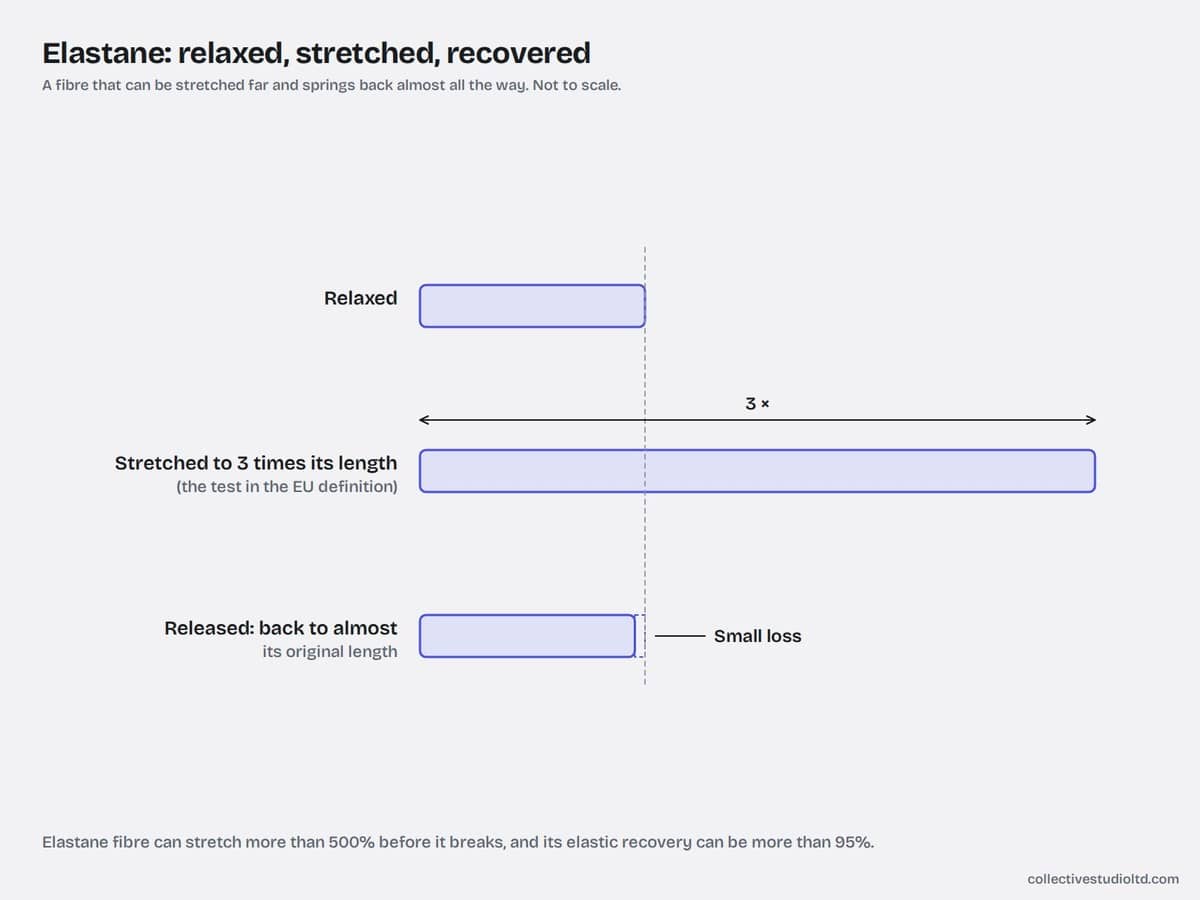
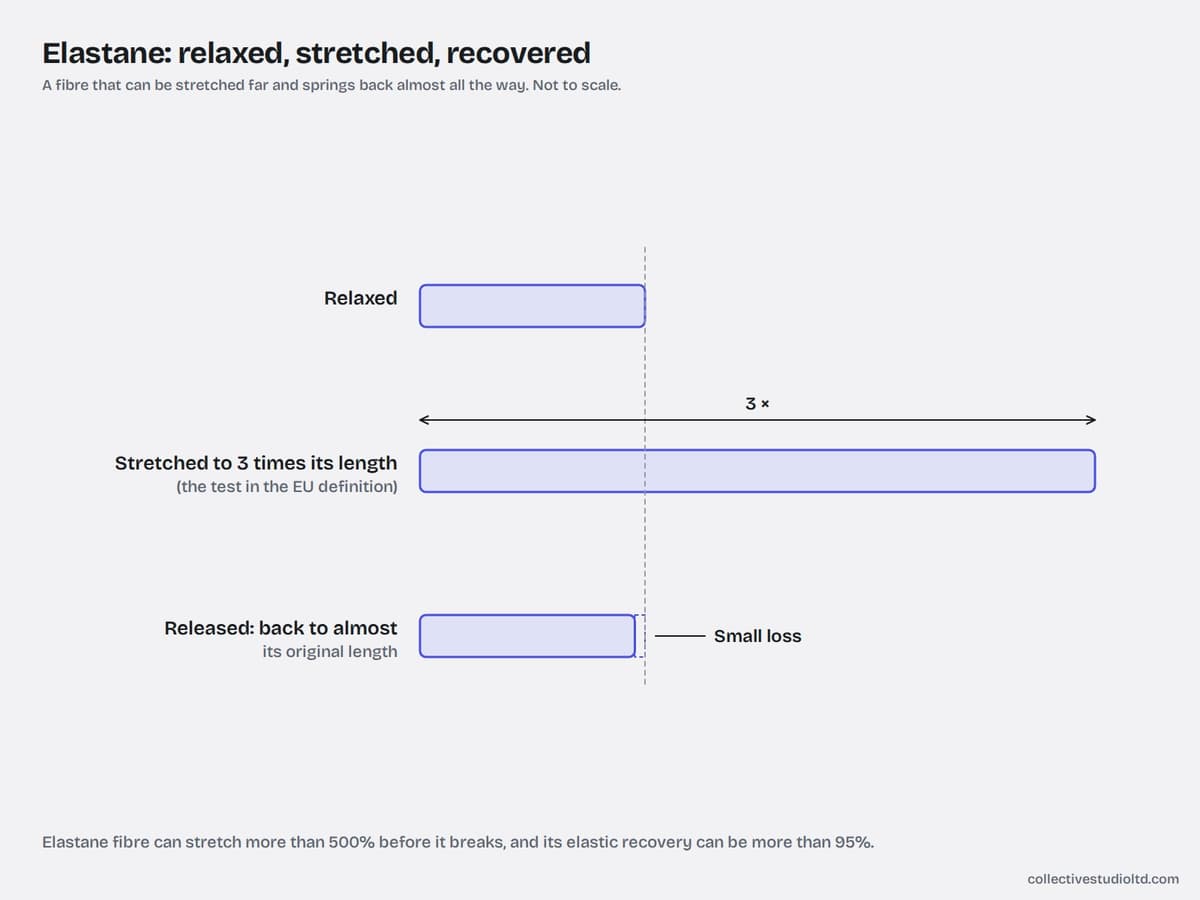
Elastane is made of segmented polyurethane, and the law defines it that way. The EU describes it as an "elastofibre composed of at least 85 % (by mass) of a segmented polyurethane" that recovers rapidly and substantially to its initial length after being stretched to three times that length and released. The US definition of spandex, in 16 CFR 303.7, uses the same 85% threshold but has no stretch test.
Segmented means the polymer chain alternates two kinds of section. The American Fiber Manufacturers Association describes long, soft, coiled segments that straighten out when the fibre is pulled, and hard segments that tie the chains together so they cannot slide past each other. Let go, and the soft segments coil up again, which pulls the fibre back to its original length. The polymer is extruded as one filament or as fine filaments joined into one thread.
How far does elastane stretch?
On its own, elastane fibre can generally be stretched more than 500% without breaking, and it recovers to very near its original length, according to the American Fiber Manufacturers Association. Stretching by 500% means pulling it to six times its length. A 2018 study of cotton and elastane knits by textile engineers at Ege University puts it the same way: elasticity "that can be more than 500%", while elastic recovery "reaches more than 95%". The EU's legal test is gentler, asking only that the fibre recover rapidly and substantially after being stretched to three times its length.
A fabric never stretches that far, because the cotton, polyester or nylon around the elastane limits the cloth. In a rib or a fitted tee, what a few percent of elastane mainly gives is recovery, the pull back to shape after a cuff goes over a hand, which our rib knit guide explains.
How elastane goes into a fabric
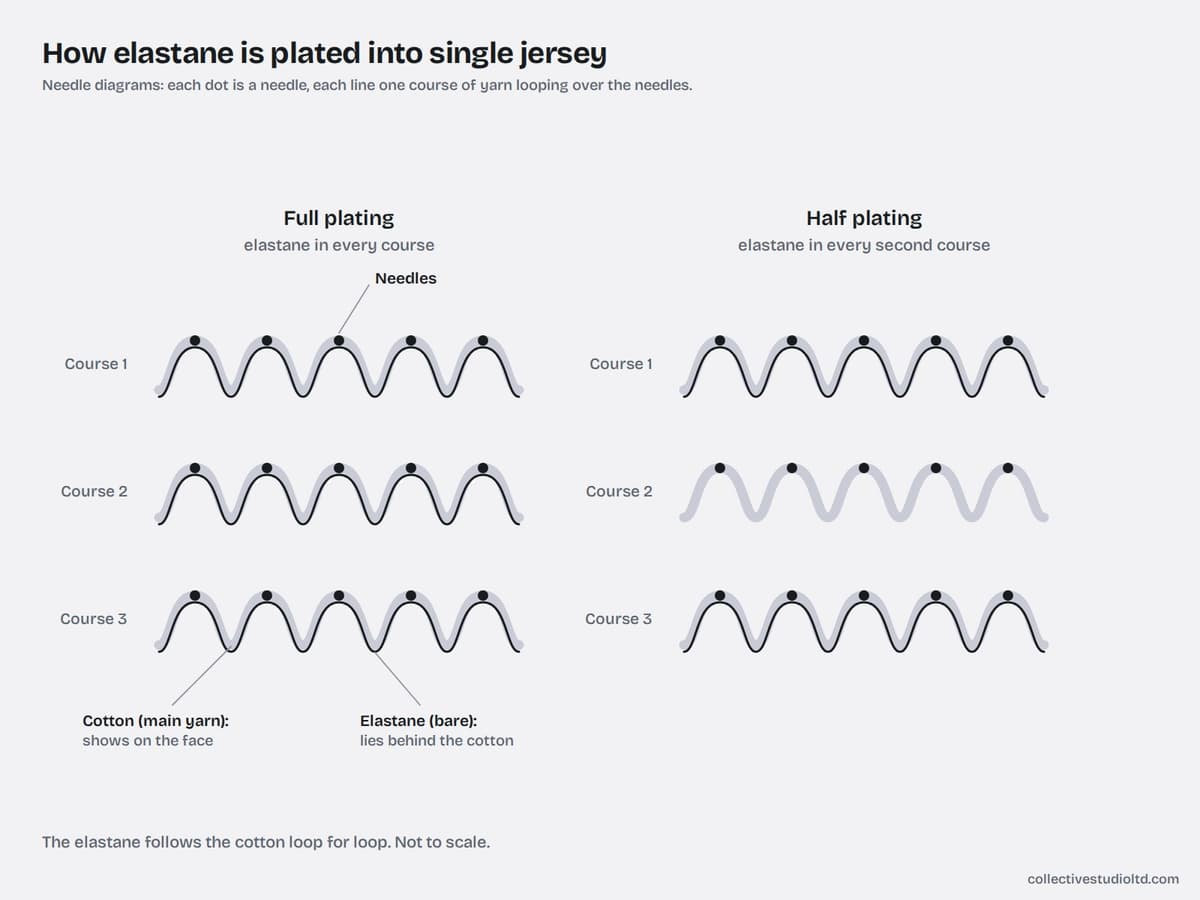
In clothing, elastane is always combined with another fibre, such as cotton, polyester, viscose or nylon. There are two common ways to combine them. The elastane can be covered by another fibre before knitting, for example in a core-spun yarn, where cotton is spun around an elastane core. Or bare elastane can be fed into a circular knitting machine alongside the main yarn, which is called plating: both yarns form each loop together. The main yarn shows on the face and the elastane lies behind it, which is how the knitting machine maker Stoll describes plating with an elastic yarn.
Knitters call each row of loops a course. Plating can put elastane in every course, called full plating, or in every second course, called half plating. Full plating puts more elastane in the cloth, and the Ege University study found that knits with more elastane were heavier and thicker.
Our fabric is knitted and dyed at partner mills, so the elastane percentage is fixed weeks before anything reaches our sewing floor. It has to be in the specification before knitting starts.
How much elastane is in common garments?
The share depends on how hard the garment has to grip: a few percent in a rib or a fitted tee, 12 to 25% in leggings. These are the figures we work to, plus two dated trade figures for swimwear and lingerie.
| Garment or part | Typical elastane | What it does there |
|---|---|---|
| T-shirt body, regular or boxy fit | Usually none | Cotton jersey has natural give, and a loose fit forgives limited recovery |
| T-shirt body, fitted | 3 to 5% | Lets a fitted shape and its neckline spring back instead of bagging |
| T-shirt neck rib | About 5% | Pulls the neckline closed after it goes over a head; our template rib is 95% cotton, 5% elastane |
| Hoodie, sweatshirt and jogger rib cuffs and hems | A few percent, often 5% | Keeps a cuff closing after a season of being pulled over a hand or a heel |
| Stretch French terry and fleece joggers | 2 to 5% | Recovery at the knee, seat, cuffs and waistband of a fitted jogger |
| Leggings | 12 to 25% | Compression and recovery; opacity comes from knit density and weight, so we specify 240 to 280 GSM |
| Sports bras | 12 to 25%, towards the upper end for support | Holds the bra close to the body and recovers at the underband |
| Swimwear | An average of 15 to 17% (Textile World, 2001) | A close fit in and out of the water, so the elastane must stand up to chlorine |
| Underwear and lingerie | 2 to 3% for hems, lace and cuffs; up to 20 to 25% in body-control garments (Textile World, 2001) | Comfort and fit at the edges, or control across the body |
Our leggings page compares stretch blends, and the activewear page explains how compression sets the percentage.
Two-way and four-way stretch
Four-way stretch fabric stretches and recovers both across the width and down the length. Two-way stretch has no standard definition, and the trade uses it in two ways: some mean stretch in one direction, usually across the width, and some mean stretch both widthwise and lengthwise. Leggings, sports bras and swimwear need four-way stretch, because the body pulls them both ways at once. A T-shirt or a rib cuff mostly needs stretch across the width, which knitted fabric gives most readily, as our knit vs woven guide explains.
Because two-way can mean either, the names are not a specification. In a tech pack, say which directions the fabric must stretch in, and ask the mill for stretch and recovery figures in each.
Is elastane breathable?
A little less than the same knit without it. In the Ege University study, cotton knits with elastane in every course, or with a thicker elastane yarn, let less air and water vapour through than the same knits with less. So we specify the lowest elastane content that gives the compression a garment needs.
For sweat the partner fibre matters more: polyester and nylon move moisture along the fibre, while cotton absorbs and holds it. Our cotton vs polyester guide compares the two.
What damages elastane?
Chlorine is the main thing to keep away from elastane, and heat should be kept low. Damage shows as a garment that loses its grip and goes baggy. The care advice below is from the American Fiber Manufacturers Association, with our own practice for pool wear.
| Exposure | What the advice says | What goes on the label or the spec |
|---|---|---|
| Chlorine bleach | No chlorine bleach on any fabric containing spandex; oxygen-type bleach instead | Non-chlorine bleach only, the triangle with two lines |
| Pool water | Swimwear demands elastane that resists chlorine (Textile World); in our experience standard elastane loses its recovery in pool water | Chlorine-resistant elastane or PBT polyester for pool wear; rinse after swimming |
| Tumble drying | Drip dry; if machine dried, use a low temperature | Tumble dry low, or line dry |
| Ironing | Iron quickly on a low setting, without leaving the iron in one place | A low iron setting |
Our care label guide explains the symbols, and the US rule that a label must warn against a treatment that would harm the garment.
Does elastane shrink?
A stretch fabric can shrink like any knit, and the fix is the same as for plain cotton: finish the fabric before cutting and wash-test the sample. Elastane is heat-settable, which helps a mill turn a puckered stretch fabric into a flat one during finishing. Our cotton knits are compacted at the partner mill before cutting, and because even a well-finished cotton knit keeps around 3 to 5% residual shrinkage, the pattern carries an allowance.
Can elastane be recycled?
Not easily. Textile Exchange's 2025 Materials Market Report says blends such as cotton and polyester or elastane pose significant challenges for recycling post-consumer textile waste, because separating the different fibres is labour-intensive and chemical and mechanical recycling need different conditions. The report adds that chemical recycling may help, and that start-ups are working on recycling blends. Elastane is a small fibre by volume, about 1.1% of global fibre production in 2024 by the report's figures, and around 3% of the elastane made that year was recycled.
If recyclability matters, keep elastane out of parts that do not need it, such as the body of a regular-fit tee. Our sustainable fabrics guide covers recycled nylon and polyester partners.
A worked example from our sewing floor
Take a brand ordering a classic crew T-shirt, a fitted tee and leggings. The classic tee's body is combed cotton single jersey at 180 GSM, without elastane, because a regular fit does not need the recovery. Its 2 cm 1x1 rib neckband is different: our template rib is 95% cotton and 5% elastane at 220 GSM, because a pure cotton rib stretches permanently once pulled over a head.
The fitted tee moves to cotton jersey with 3 to 5% elastane, and we check its recovery on the sample rather than trusting the mill's spec sheet. The leggings are nylon or polyester with 12 to 25% elastane at 240 to 280 GSM, squat-tested for opacity. All three figures go into the fabric order before knitting, because none can change once the cloth arrives.
In the UK and EU the label names the elastane with its percentage. Under Article 11 of Regulation 1007/2011, each part with a different fibre content normally gets its own line, but that is not compulsory for a part that meets two conditions: it is not a main lining, and it is less than 30% of the total weight of the product. The body's fibre content must still be given. A tee's neck rib is not a lining and weighs far less than 30% of the tee, so its own line may be left off, or kept, as in Rib: 95% cotton, 5% elastane. In the US, the FTC treats collars, cuffs and waist and wrist bands as trim, which is excluded from fibre content disclosure.
If you are having this made
Tell us the fit and use of each piece, and we will propose the elastane content for the body and the rib and write both into the fabric order. Our swimwear and underwear and intimates pages cover the high-stretch categories, and you can send us your designs. Our minimum is 150 pieces per style and per colour.
Frequently asked questions
Is elastane the same as spandex?
Yes. Elastane and spandex are two names for the same fibre, a segmented polyurethane that stretches and recovers. Elastane is the name in the international standard ISO 2076 and the name required on labels in the UK and EU under Regulation 1007/2011. Spandex is the usual US name, and the FTC says either may be used on a US label. Canada accepts spandex or elastane in English, and spandex or élasthanne in French. The EU and US definitions both require at least 85% segmented polyurethane, so a fabric sold as 5% spandex in New York is sold as 5% elastane in London.
Elastane vs Lycra: what is the difference?
Elastane is the generic name of the fibre, and LYCRA is one company's brand of it. The LYCRA Company describes LYCRA as its trademarked brand name for the class of fibres called spandex in the US and elastane elsewhere, and elastane from any other maker is simply elastane. On a label the generic name must always appear. In the EU a trade mark may sit immediately before or after the fibre composition, and in the US a fibre trademark must sit next to the generic name, in lettering of the same size. A brand name never replaces the word elastane or spandex.
Is elastane stretchy?
Very. The fibre can generally be stretched more than 500% without breaking and returns to very near its original length, according to the American Fiber Manufacturers Association, and the EU's legal definition requires it to recover rapidly after being stretched to three times its length. A fabric containing elastane stretches far less than that, because the cotton, polyester or nylon around it limits the cloth. What a few percent of elastane mainly adds is recovery, the pull back to shape that stops a neckline gaping or leggings bagging at the knee. Higher shares, around 12 to 25% in leggings, add compression.
Is elastane breathable?
A little less than the same fabric without it. A 2018 study at Ege University found that cotton knits with elastane in every course, or with a thicker elastane yarn, let less air and water vapour through than similar knits with less elastane. That is one reason we specify the lowest elastane content that gives a garment the compression it needs. For sweat the partner fibre matters more than the elastane: polyester and nylon move moisture along the fibre, while cotton absorbs it and holds it, so a hard-wearing training legging is usually nylon or polyester with elastane rather than cotton.
What is elastane made of?
Elastane is made of segmented polyurethane. The EU defines it as an elastofibre of at least 85% segmented polyurethane by mass that recovers after being stretched to three times its length, and the US definition of spandex uses the same 85% figure. Segmented means the polymer chain alternates soft, coiled sections, which straighten when the fibre is pulled, with hard sections that tie the chains together, so the fibre springs back when it is released. It is extruded as a single filament or as many fine filaments joined into one thread. In clothing it is always combined with another fibre, such as cotton, polyester or nylon.
Does elastane shrink?
A stretch fabric can shrink like any knit, and the fix is the same as for plain cotton: finish the fabric properly before cutting, and wash-test the sample before bulk. Elastane is heat-settable, which helps a mill turn a puckered stretch fabric into a flat one during finishing. Our cotton knits are compacted at the partner mill before cutting, and because even a well-finished cotton knit keeps around 3 to 5% residual shrinkage, the pattern carries an allowance. At home, keep the heat low: fibre makers advise drip drying or a low dryer setting, and a quick iron on a low setting.
How much elastane should a T-shirt have?
A regular or boxy T-shirt usually needs none in the body, because plain cotton jersey has natural give and a loose fit forgives limited recovery. A fitted tee is better with 3 to 5% elastane, so the shape and the neckline spring back instead of bagging. The neckband is the exception on almost every tee: our template neck rib is 95% cotton and 5% elastane, because a pure cotton rib stretches permanently once it has been pulled over a head. Write the elastane content of the body and of the rib separately in your tech pack, since they are knitted as different fabrics.
Where this applies
The manufacturing pages this guide relates to, if you are costing a real run.
Free tools & guides for this
Sources & further reading
- legislation.gov.uk: Regulation (EU) No 1007/2011 on textile fibre names, UK version as it applies in Great Britain, Annex I (Articles 2, 5, 11 and 16 on the same site; Annex I and Articles 5, 11 and 16(2) read the same as the EU text as made)
- eCFR: 16 CFR Part 303, Rules under the Textile Fiber Products Identification Act (303.7 generic names, 303.17 fibre trademarks)
- Federal Trade Commission: Threading Your Way Through the Labeling Requirements Under the Textile and Wool Acts
- Justice Laws Website (Canada): Textile Labelling and Advertising Regulations, C.R.C., c. 1551, section 26(2)(r)
- American Fiber Manufacturers Association (Fibersource): Spandex fiber
- The LYCRA Company: Frequently asked questions, Quality (LYCRA)
- Tekstil ve Mühendis: Ertekin, Oğlakçıoğlu and Marmaralı, Strength and Comfort Characteristics of Cotton/Elastane Knitted Fabrics (2018)
- Textile Exchange: Materials Market Report (2025)
Cite this guide
For journalists, writers, researchers and students.
Quoting this guide? Please credit Collective Studio and link to this page.
Reference
Homaira Jashim, Collective Studio. "What Is Elastane? Elastane vs Spandex vs Lycra Explained." 19 November 2026. https://collectivestudioltd.com/journal/what-is-elastane
Writing about us? Our press kit has our facts, logos and photos, free to use with credit.
Have an idea? Let’s make it.
We manufacture from 150 pieces per style and colour, with organic cotton options from our GOTS-certified facility and photos at every stage. Send a sketch or a sentence — we’ll reply within one business day.