Shorts Tech Pack Template
A tech pack built for knit shorts. Waist relaxed and stretched, rise, inseam, thigh and leg opening, with the elastic waistband, the drawcord and the pockets each on their own line and a complete filled-in example. Free as a PDF or an Excel file, with no email required.
Our general tech pack template works for any garment. This version is for shorts only: the size chart lists the 15 points a pair of shorts is measured on, and the materials, construction, label and packaging tables already name the parts of a pair of shorts, so you fill in values rather than work out what to ask for. The sections and their order are the same, so any factory reads it the usual way.
The PDF is the blank form, three A4 pages to print and fill in by hand, with a light outline of a pair of shorts in the sketch boxes to draw over. The Excel file is the same form with every box already filled in for an invented brand, in grey italics to type over. We publish it as a factory that reads these documents every week; our shorts manufacturing page covers fabrics and minimums.
What is a shorts tech pack?
A shorts tech pack is the document a factory makes your shorts from. It names the fabric by composition and GSM, describes the waistband, elastic, drawcord and pockets, gives every point of measure in each size with a tolerance, and lists the stitches, labels, packaging and order quantities. Ours fits on three A4 pages.
Shorts share most of their measurements with joggers. If you are making full-length bottoms, our jogger tech pack template adds the knee, the cuff and the longer leg.
What the template looks like
Three A4 pages, shown here in full. Nothing is hidden behind a form.
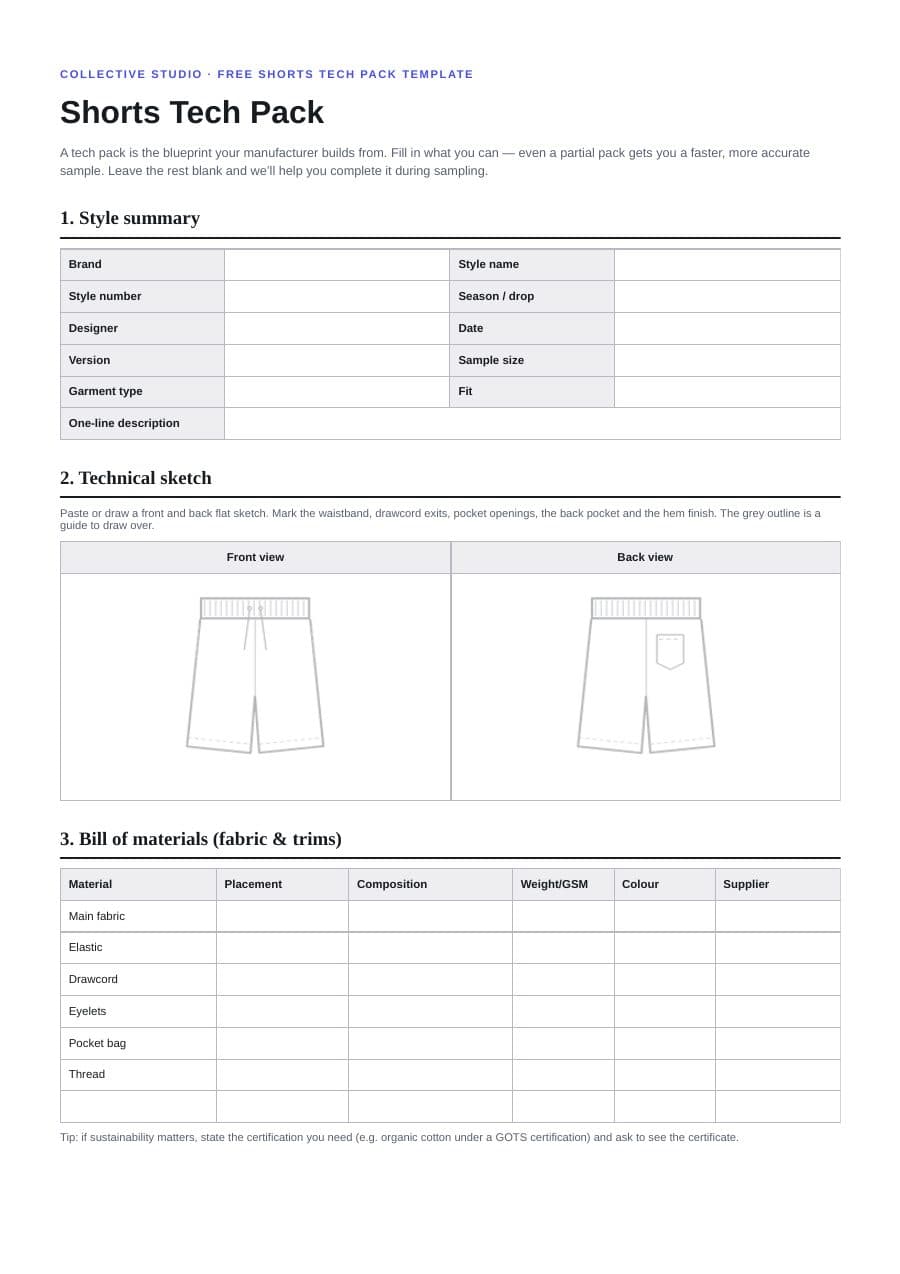
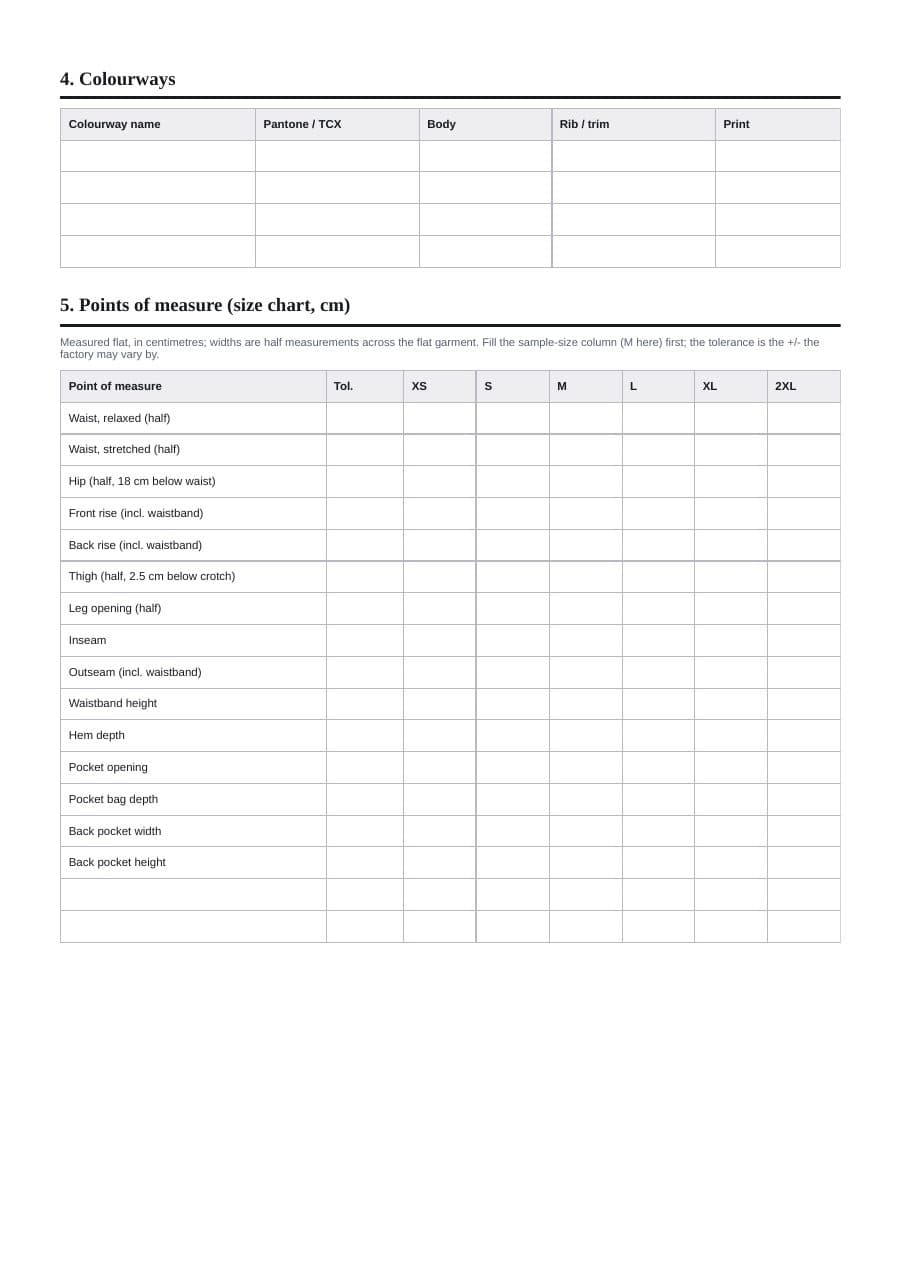
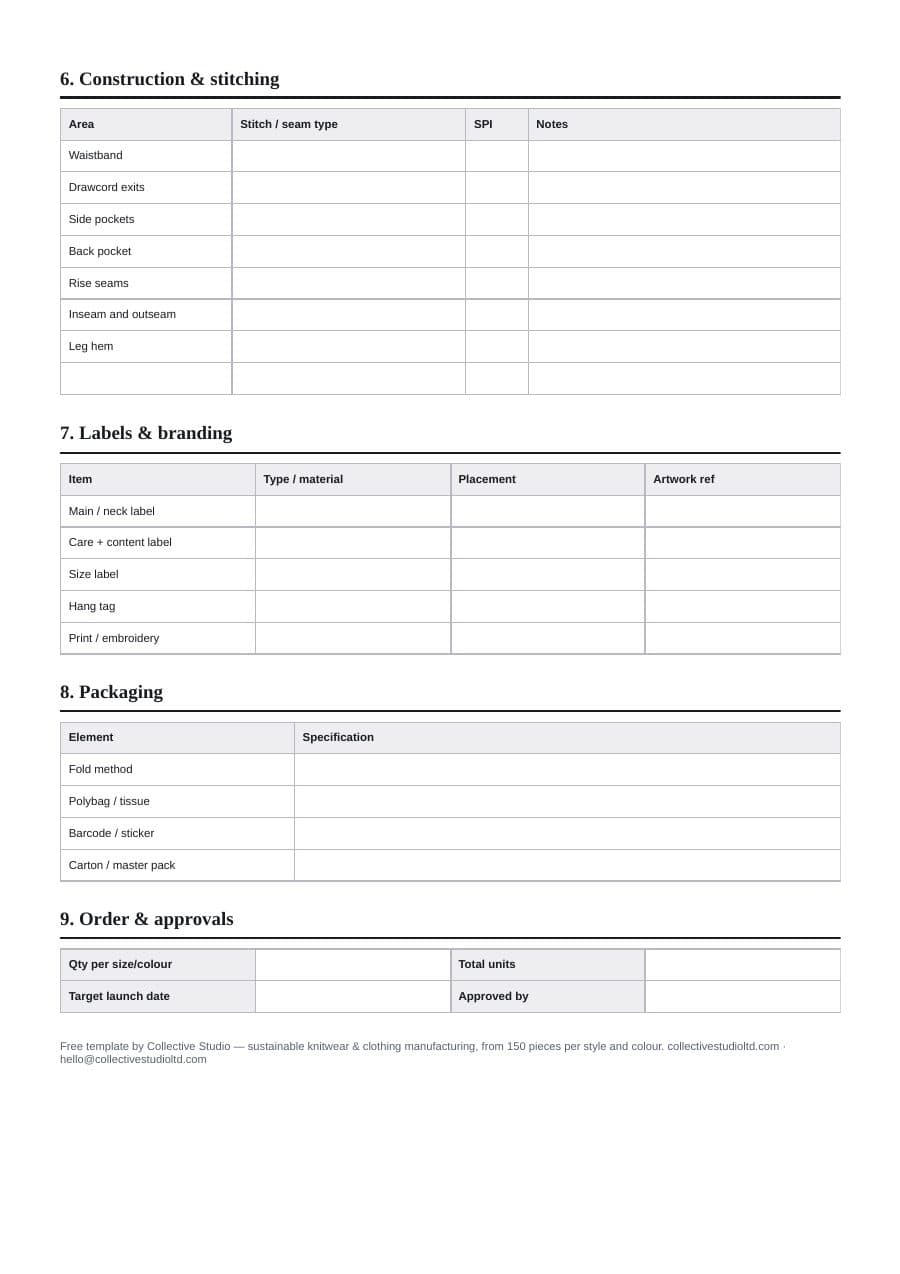
Shorts size chart example
The example in the Excel version is a sweat short in loopback French terry with a covered-elastic waistband and drawcord, in-seam side pockets, a back patch pocket and a coverstitched hem. Here is the part a factory reads most closely, graded from XS to 2XL. The brand and the numbers are invented to show the level of detail; measure a pair of shorts you like and use your own.
| Point of measure | Tol. (+/-) | XS | S | M | L | XL | 2XL |
|---|---|---|---|---|---|---|---|
| Waist, relaxed (half) | 1 | 33 | 35.5 | 38 | 40.5 | 43 | 45.5 |
| Waist, stretched (half) | 1 | 46 | 48.5 | 51 | 53.5 | 56 | 58.5 |
| Hip (half, 18 cm below waist) | 1 | 50 | 52.5 | 55 | 57.5 | 60 | 62.5 |
| Front rise (incl. waistband) | 0.5 | 29 | 30 | 31 | 32 | 33 | 34 |
| Back rise (incl. waistband) | 0.5 | 37 | 38 | 39 | 40 | 41 | 42 |
| Thigh (half, 2.5 cm below crotch) | 1 | 32 | 33.5 | 35 | 36.5 | 38 | 39.5 |
| Leg opening (half) | 1 | 28 | 29.5 | 31 | 32.5 | 34 | 35.5 |
| Inseam | 0.5 | 17 | 17.5 | 18 | 18.5 | 19 | 19.5 |
| Outseam (incl. waistband) | 1 | 44.5 | 46 | 47.5 | 49 | 50.5 | 52 |
| Waistband height | 0.5 | 4 | 4 | 4 | 4 | 4 | 4 |
| Hem depth | 0.3 | 2.5 | 2.5 | 2.5 | 2.5 | 2.5 | 2.5 |
| Pocket opening | 0.5 | 15 | 15.5 | 16 | 16.5 | 17 | 17.5 |
| Pocket bag depth | 0.5 | 21 | 21.5 | 22 | 22.5 | 23 | 23.5 |
| Back pocket width | 0.3 | 13 | 13.5 | 14 | 14.5 | 15 | 15.5 |
| Back pocket height | 0.3 | 14 | 14.5 | 15 | 15.5 | 16 | 16.5 |
Measured flat, in centimetres; widths are half measurements across the flat garment. Fill the sample-size column (M here) first; the tolerance is the +/- the factory may vary by.
How to measure each point
Lay the garment flat, smooth it without stretching it, and measure with a soft tape in centimetres. The grade is how much each point grows from one size to the next in this example.
- Waist, relaxed (half)
- Straight across the top edge of the waistband, laid flat with the elastic relaxed.ExampleM 38 cm · ±1 cm · grade 2.5 cm a size
- Waist, stretched (half)
- The same line with the waistband stretched as far as it goes without straining the stitching.ExampleM 51 cm · ±1 cm · grade 2.5 cm a size
- Hip (half, 18 cm below waist)
- Straight across, 18 cm below the top of the waistband, side to side.ExampleM 55 cm · ±1 cm · grade 2.5 cm a size
- Front rise (incl. waistband)
- From the crotch seam junction up the front seam to the top of the waistband.ExampleM 31 cm · ±0.5 cm · grade 1 cm a size
- Back rise (incl. waistband)
- From the crotch seam junction up the back seam to the top of the waistband.ExampleM 39 cm · ±0.5 cm · grade 1 cm a size
- Thigh (half, 2.5 cm below crotch)
- Across one leg, at right angles to it, 2.5 cm below the crotch seam junction.ExampleM 35 cm · ±1 cm · grade 1.5 cm a size
- Leg opening (half)
- Straight across the bottom edge of one leg, from the inseam to the outseam.ExampleM 31 cm · ±1 cm · grade 1.5 cm a size
- Inseam
- Along the inside leg seam, from the crotch seam junction to the hem edge.ExampleM 18 cm · ±0.5 cm · grade 0.5 cm a size
- Outseam (incl. waistband)
- Along the side of the leg, from the top of the waistband to the hem edge.ExampleM 47.5 cm · ±1 cm · grade 1.5 cm a size
- Waistband height
- From the waistband seam to the top edge of the waistband.ExampleM 4 cm · ±0.5 cm · same in every size
- Hem depth
- From the folded hem edge to the line of coverstitching.ExampleM 2.5 cm · ±0.3 cm · same in every size
- Pocket opening
- Along the side seam, from the top bartack of the pocket opening to the bottom one.ExampleM 16 cm · ±0.5 cm · grade 0.5 cm a size
- Pocket bag depth
- From the top of the pocket opening straight down to the bottom of the pocket bag.ExampleM 22 cm · ±0.5 cm · grade 0.5 cm a size
- Back pocket width
- Straight across the top edge of the back patch pocket.ExampleM 14 cm · ±0.3 cm · grade 0.5 cm a size
- Back pocket height
- From the top edge of the back patch pocket to its lowest point.ExampleM 15 cm · ±0.3 cm · grade 0.5 cm a size
Materials and construction example
The bill of materials and the construction table from the same example. A factory buys fabric against composition and weight, and sews to the stitch named for each seam, so these two tables decide most of the price and most of the finish.
| Material | Placement | Composition | Weight |
|---|---|---|---|
| Main fabric | Legs, waistband, back pocket | 100% combed cotton French terry (loopback), compacted | 330 GSM |
| Elastic | Waistband, enclosed | Covered elastic, 3.5 cm wide | — |
| Drawcord | Waistband | Flat cotton cord, 1 cm wide, 120 cm long, silicone-dipped tips | — |
| Eyelets | Waistband front, drawcord exits | Embroidered eyelets, no metal | — |
| Pocket bag | Side pockets | 100% cotton single jersey | 180 GSM |
| Thread | All seams | 100% polyester, core-spun | — |
| Area | Stitch / seam | Notes |
|---|---|---|
| Waistband | Folded band, 4-thread overlock, elastic enclosed, 12 SPI | 3.5 cm covered elastic in a 4 cm band; elastic tacked at side seams and centre back so it cannot twist |
| Drawcord exits | Embroidered eyelets at centre front, 12 SPI | Flat cord runs through the elastic channel; tipped ends |
| Side pockets | In-seam, jersey pocket bags, 4-thread overlock, 12 SPI | Bartacks at top and bottom of each opening |
| Back pocket | Patch pocket, edges turned 1 cm, twin-needle topstitched, 12 SPI | Right back, 7 cm below the waistband seam; bartacks at both top corners |
| Rise seams | 4-thread overlock, back rise twin-needle topstitched, 12 SPI | Crotch seams matched at the junction |
| Inseam and outseam | 4-thread overlock, 12 SPI | Inseam sewn in one run, hem to hem |
| Leg hem | 2-needle coverstitch, 12 SPI | Hem depth 2.5 cm |
SPI is stitches per inch. Labels: main / neck label (centre back waistband, inside, sewn into the seam); care + content label (inside left side seam, 5 cm below the waistband seam); size label (beside the main label); hang tag (looped through the main label); print / embroidery (left leg front, 4 cm above the hem and 5 cm from the side seam).
What a shorts tech pack needs that a jogger one doesn't
Inseam is the style decision
On shorts, the inseam sets the look more than any other number. Five inches, about 13 cm, reads athletic; seven, about 18 cm, reads casual; nine, about 23 cm, reads basketball. Give it in centimetres from the crotch junction to the hem edge, with the outseam as a check. If you sell two lengths, make them two styles, because the pattern and the minimum are counted separately.
Leg opening with the inseam
The same inseam looks very different with a wide or a narrow leg opening, so give both, plus the thigh 2.5 cm below the crotch. On a short leg a centimetre at the opening shows, so keep its tolerance to about a centimetre and say whether the leg should fall straight or flare slightly.
The waistband carries more of the garment
A short uses far less cloth than a jogger, so the waistband, the pockets and the hem carry a larger share of the quality and the cost. Give the waist relaxed and stretched, the elastic type and width, and the band height. Our example uses a 3.5 cm covered elastic in a 4 cm band with a flat drawcord through embroidered eyelets; a jacquard elastic with your name knitted in is the usual upgrade.
Drawcord: working or decorative
Say whether the drawcord actually draws or is only for show, its shape, width, length and tip finish, and whether it sits inside the band or outside. If the shorts are for children, check the drawstring rules for every market before you add a cord; in Europe they are set by EN 14682.
Pockets, by type and depth
In-seam pockets sit in the side seam; a back patch pocket adds a panel; a zip pocket adds a trim and an operation. Give each pocket's type, opening and bag depth, and the bag fabric. On a short the pocket bag has little room, so check on the sample that a phone sits well below the opening when the wearer sits down.
The hem finish and the fabric weight
A coverstitched hem lies flat on French terry, a folded and topstitched hem suits fleece, and a raw or curved hem is a streetwear choice that needs a stable fabric so it does not roll. Sweat shorts sit between 280 and 400 GSM, with 320 to 360 the premium band; gym and lounge shorts sit between 140 and 220 GSM. Write the weight as a number.
For the fabric side, read what French terry is and jersey for lounge and gym shorts. To work out how much fabric an order needs, try the fabric consumption calculator.
Adapting the template for other shorts
The example is a French terry sweat short. Gym, lounge and rib-cuffed shorts use the same three pages; the table shows the lines that change. Our shorts manufacturing page covers fabrics, waistbands and minimums.
| Style | Sketch and size chart | Materials and construction |
|---|---|---|
| Gym short | Usually a shorter inseam and a wider leg opening. Mark any liner on the sketch. | Change the main fabric to a lightweight jersey, mesh or performance blend, use a wider, softer elastic with an internal drawcord, and add the liner fabric and its seams. |
| Lounge or sleep short | Often a longer inseam and a softer waistband. | Change the main fabric to cotton or cotton-modal jersey and choose a hem that suits it. |
| Rib-cuffed short | Add the cuff height and the relaxed cuff width; the leg opening becomes the cuff. | Add a rib to the bill of materials and a cuff attach row to construction. |
| Raw or curved hem | Replace the hem depth with the curve depth at the side seam, or note a raw edge. | Change the hem row; a raw edge needs a stable fabric that will not roll. |
| Zip pocket | Mark the pocket and zip on the sketch and give the zip opening length. | Add the zip to the bill of materials: type, length, tape and puller colour. |
The template is drawn for a French terry sweat short. Other shorts use the same three pages; these are the lines that change.
Templates for other garments
- T-shirt tech pack template
- Hoodie tech pack template
- Jogger tech pack template
- Sweatshirt tech pack template
- Polo Shirt tech pack template
- General tech pack template, for any other garment
- Tech pack checklist, if you prefer a tick-list
What clients say
Best supplier! On time, reliable and perfect craft.
Collective Studio is up and coming. Very hard working people who want to please their customers and grow partnerships together. Homaira is very knowledgeable in the knit industry and always willing to learn more. We are looking to grow our business with them.
Frequently asked questions
What should a shorts tech pack include?
The nine standard sections, with the waistband, the inseam and the pockets filled in carefully. A style summary with the fit and the sample size. Front and back flat sketches showing the waistband, the drawcord exits, the pocket openings, any back pocket and the hem finish. A bill of materials naming the main fabric by composition and weight, such as 100% combed cotton French terry at 330 GSM, plus the elastic and its width, the drawcord, the eyelets, the pocket bag fabric and the thread. Colourways with Pantone TCX references. A size chart: ours has fifteen points, including waist relaxed and stretched, front and back rise, thigh, leg opening, inseam and pocket depth, because on a short a few centimetres change the whole look. Then construction for each seam, label and embroidery placement, packaging, and the order split by size and colour. Fill in what you know and send it.
How do I measure inseam, rise and leg opening on shorts?
Lay the shorts flat with the front facing up and smooth them without stretching. Find the crotch seam junction, where the front seam, the back seam and the two inside leg seams meet. Inseam runs from that point down the inside leg seam to the hem edge, 18 cm in our size M. Front rise runs from the same point up the front seam to the top of the waistband, and back rise up the back seam; turn the shorts over to measure it. Our example uses 31 cm front and 39 cm back. Leg opening runs straight across the bottom edge of one leg, from inseam to outseam, laid flat: 31 cm in our M, a half measurement. Follow the curve of each seam rather than a straight line, measure twice in centimetres, and start from a pair you already like wearing, ideally one that has been washed.
What inseam length should shorts have?
It depends on the look you want, so treat it as a style decision rather than a size. As a rough guide, a five-inch inseam, about 13 cm, reads athletic, a seven-inch inseam, about 18 cm, reads casual, and a nine-inch inseam, about 23 cm, reads longer and looser, closer to a basketball short. Our example uses 18 cm in size M, growing by half a centimetre a size. The inseam does not fix the look on its own: the same 18 cm reads very differently with a wide or a narrow leg opening, so give the leg opening and the thigh with it. If you want to sell two lengths, make them two styles with their own style numbers, because the pattern, the fabric and the minimum are counted separately. Measure a pair you like on a real person before you decide, because the same number looks shorter on a taller wearer.
What fabric weight should sweat shorts be?
Write a number in GSM, because medium weight means something different to each supplier. Sweat shorts sit between about 280 and 400 GSM in French terry or brushed fleece, and 320 to 360 GSM is the premium band, which is why our example uses 330 GSM loopback French terry. It has soft loops on the inside, breathes in warm weather and keeps its shape at the hem. Brushed fleece is warmer and suits shorts worn in cooler months. Gym and lounge shorts are lighter, usually between 140 and 220 GSM in jersey, mesh or a cotton-modal blend. Fabric is bought by the kilo, so a heavier weight costs more for the same pair of shorts and adds weight to every carton, although a short uses far less cloth than a jogger. Ask for the fabric to be compacted before cutting, so the inseam you approve is the inseam after washing.
Is there a free shorts tech pack template?
Yes. Collective Studio's shorts tech pack template is free on this page, as a printable PDF and an Excel file, with no email or sign-up. It is built for knit shorts, so the elastic waistband, the drawcord and the pockets each have their own lines. The size chart has fifteen points of measure from XS to 2XL: waist relaxed and stretched, hip, front and back rise, thigh, leg opening, inseam, outseam, waistband height, hem depth, pocket opening, pocket bag depth, and the back pocket width and height. The Excel file is filled in for an invented brand, a 330 GSM French terry sweat short in heather grey and black, with every value in grey italics to type over. The PDF is the blank form, three A4 pages to print and fill in by hand. If you are making full-length bottoms, use the jogger template instead, which adds the knee, the cuff and the longer leg.
What waistband should I specify for sweat shorts?
Specify the waist relaxed and stretched, the elastic type and width, the band height and the drawcord, because on a short the waistband carries a larger share of the quality than it does on a jogger. A short uses far less cloth, so the waistband, the pockets and the hem are what a customer notices. Our example uses a 3.5 cm covered elastic enclosed in a 4 cm folded band, tacked at the side seams and centre back so it cannot twist, with a flat cotton drawcord 1 cm wide and 120 cm long running through embroidered eyelets at centre front. The usual upgrade is a jacquard elastic with your brand name knitted in. Say whether the drawcord actually draws or is only for show, and whether it sits inside or outside the band. For children's shorts, check the drawstring rules for every market before you add a cord; in Europe they are set by EN 14682.
How do I specify pockets on shorts in a tech pack?
Give each pocket its type, the opening length, the bag depth and the bag fabric, and draw each one on the sketch. In-seam pockets hide in the side seam, a back patch pocket adds a panel, and a zip pocket adds a trim and an operation. Our example has in-seam side pockets with bags in 180 GSM cotton jersey, bartacked at the top and bottom of each opening, and a patch pocket on the right back, 7 cm below the waistband seam, with its edges turned 1 cm, twin-needle topstitched and bartacked at both top corners. The size chart carries the pocket opening, the bag depth and the back pocket width and height, each with a tolerance. A short has little room for a pocket bag, so on the sample, sit down with a phone in the pocket and check that it stays well below the opening. For a zip pocket, add the zip to the bill of materials.
What hem finish should knit shorts have?
It depends on the fabric and the look: a coverstitched hem lies flat on French terry, a folded and topstitched hem suits fleece, and a raw or curved hem is a streetwear choice. Our French terry example uses a 2-needle coverstitch with a 2.5 cm hem depth, which appears in the size chart with a tight tolerance of 0.3 cm. A raw edge needs a stable fabric, or it will roll after washing, and a curved hem needs its curve depth at the side seam in place of the hem depth. A rib-cuffed short is different again: add the cuff height and the relaxed cuff width, and the leg opening becomes the cuff. Whatever you choose, write it in the construction table as a stitch and a depth, and give the leg opening beside it, because on a short leg a centimetre at the opening shows. Measure any embroidery near the hem from the hem edge.
Can I use the shorts tech pack template for gym or lounge shorts?
Yes: gym, lounge and rib-cuffed shorts use the same three pages, with a few lines changed. For a gym short the inseam is usually shorter and the leg opening wider. Change the main fabric to a lightweight jersey, mesh or performance blend, use a wider, softer elastic with an internal drawcord, and mark any liner on the sketch, adding its fabric and seams to the bill of materials and construction table. For a lounge or sleep short, the inseam is often longer and the waistband softer; change the fabric to cotton or cotton-modal jersey and choose a hem that suits it. Gym and lounge shorts sit at about 140 to 220 GSM, against 280 to 400 GSM for sweat shorts, so write the new weight as a number. If you sell two lengths of the same short, make them two styles with their own style numbers, because the pattern and the minimum are counted separately.
Sources
Download the shorts template (PDF)Download the Excel version (.xlsx)Send us your tech pack