Sweatshirt Tech Pack Template
A tech pack built for one garment: the crewneck sweatshirt. The neck rib, the cuffs and the hem rib each get their own lines, with fourteen points of measure, relaxed rib widths and a complete filled-in example. Free as a PDF or an Excel file, with no email required.
Our general tech pack template works for any garment. This version is for sweatshirts only: the size chart lists the 14 points a sweatshirt is measured on, and the materials, construction, label and packaging tables already name the parts of a sweatshirt, so you fill in values rather than work out what to ask for. The sections and their order are the same, so any factory reads it the usual way.
The PDF is the blank form, three A4 pages to print and fill in by hand, with a light outline of a sweatshirt in the sketch boxes to draw over. The Excel file is the same form with every box already filled in for an invented brand, in grey italics to type over. We publish it as a factory that reads these documents every week; our sweatshirt manufacturing page covers fabrics and minimums.
What is a sweatshirt tech pack?
A sweatshirt tech pack is the document a factory makes your crewneck from. It names the body fabric and the rib by composition and GSM, gives every point of measure in each size with a tolerance, including the neck and the relaxed rib widths, and lists the stitches, labels, packaging and order quantities. Ours fits on three A4 pages.
A crewneck shares much of its size chart with a hoodie. If your style has a hood, use our hoodie tech pack template instead, which adds the hood, drawcord and pocket lines.
What the template looks like
Three A4 pages, shown here in full. Nothing is hidden behind a form.
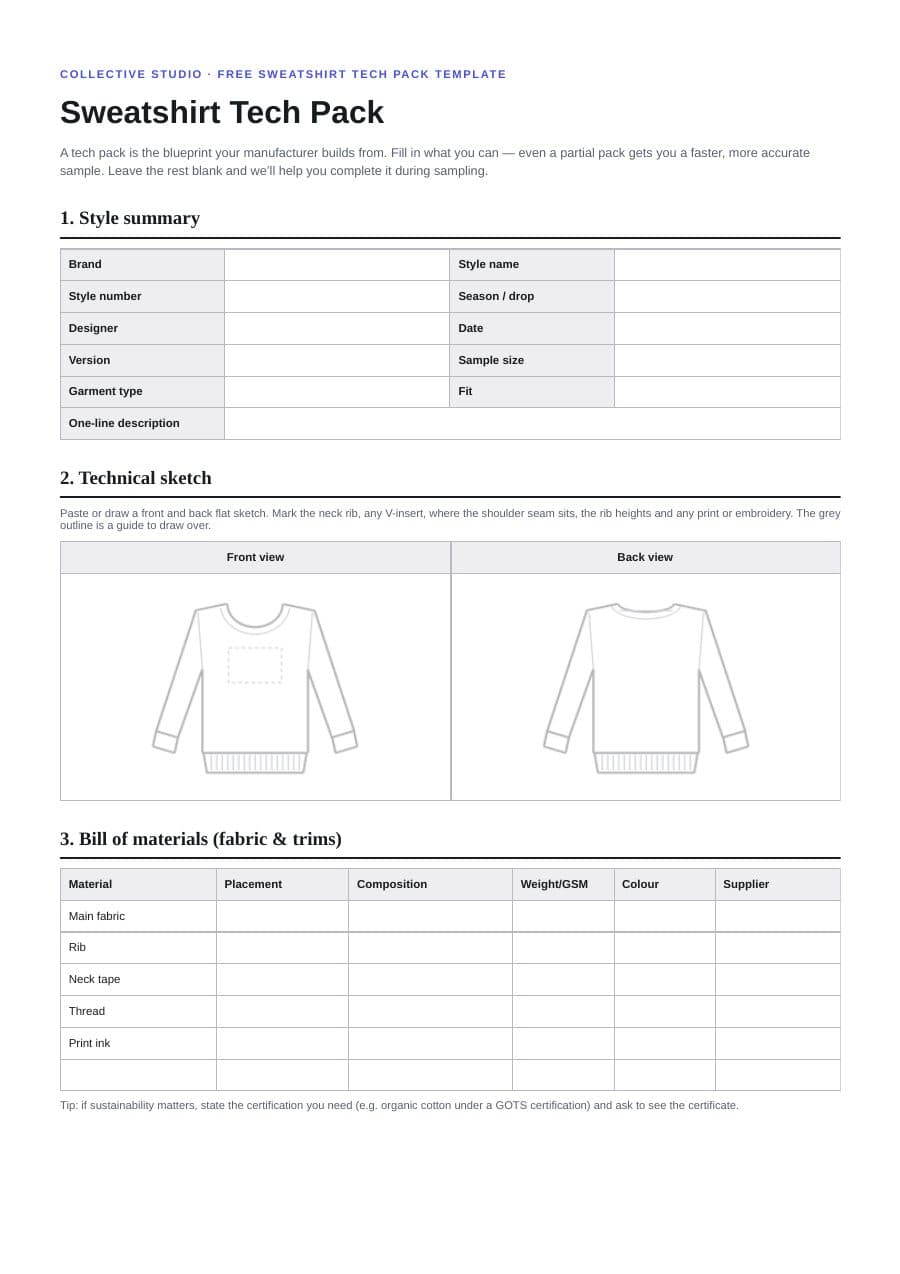
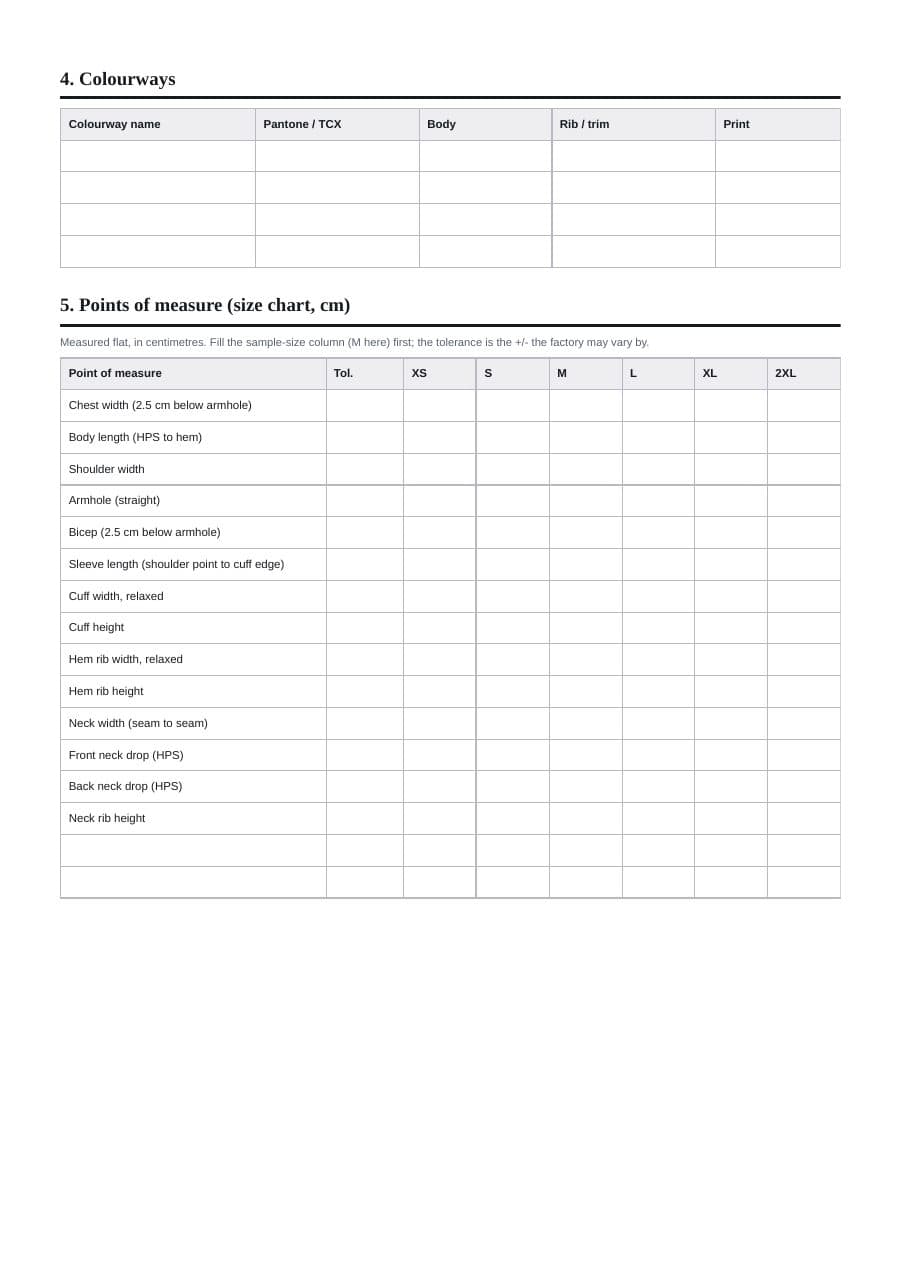
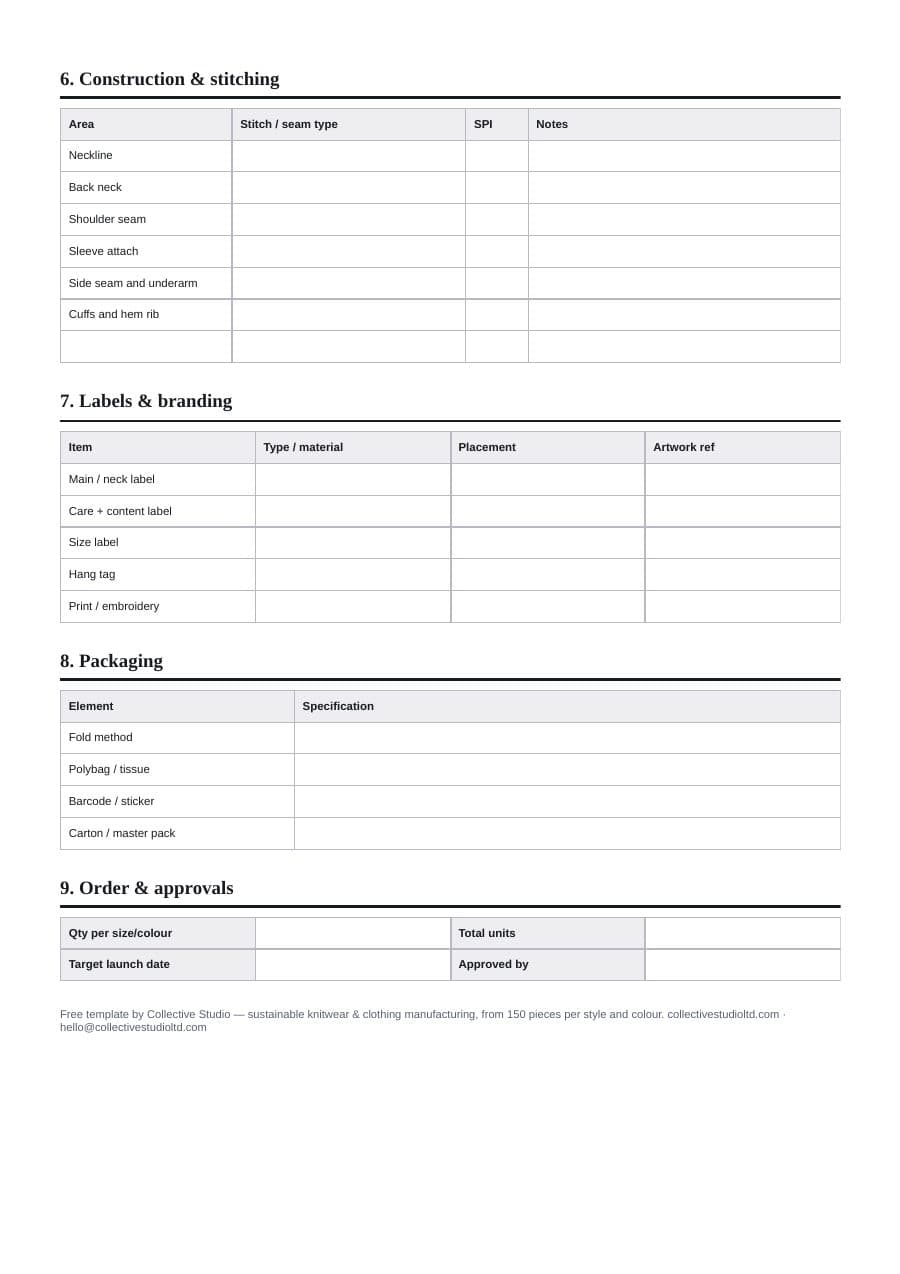
Sweatshirt size chart example
The example in the Excel version is a regular-fit crewneck sweatshirt in loopback French terry with a set-in sleeve and 2x2 rib at the neck, cuffs and hem. Here is the part a factory reads most closely, graded from XS to 2XL. The brand and the numbers are invented to show the level of detail; measure a sweatshirt you like and use your own.
| Point of measure | Tol. (+/-) | XS | S | M | L | XL | 2XL |
|---|---|---|---|---|---|---|---|
| Chest width (2.5 cm below armhole) | 1 | 52 | 54.5 | 57 | 59.5 | 62 | 64.5 |
| Body length (HPS to hem) | 1 | 64 | 66 | 68 | 70 | 72 | 74 |
| Shoulder width | 1 | 43 | 45 | 47 | 49 | 51 | 53 |
| Armhole (straight) | 0.5 | 22 | 23 | 24 | 25 | 26 | 27 |
| Bicep (2.5 cm below armhole) | 0.5 | 19.5 | 20.5 | 21.5 | 22.5 | 23.5 | 24.5 |
| Sleeve length (shoulder point to cuff edge) | 1 | 61 | 62 | 63 | 64 | 65 | 66 |
| Cuff width, relaxed | 0.5 | 8.5 | 9 | 9.5 | 10 | 10.5 | 11 |
| Cuff height | 0.5 | 6 | 6 | 6 | 6 | 6 | 6 |
| Hem rib width, relaxed | 1 | 45 | 47.5 | 50 | 52.5 | 55 | 57.5 |
| Hem rib height | 0.5 | 6 | 6 | 6 | 6 | 6 | 6 |
| Neck width (seam to seam) | 0.5 | 17 | 17.5 | 18 | 18.5 | 19 | 19.5 |
| Front neck drop (HPS) | 0.5 | 8.5 | 9 | 9.5 | 10 | 10.5 | 11 |
| Back neck drop (HPS) | 0.3 | 2 | 2 | 2 | 2 | 2 | 2 |
| Neck rib height | 0.3 | 2.5 | 2.5 | 2.5 | 2.5 | 2.5 | 2.5 |
Measured flat, in centimetres. Fill the sample-size column (M here) first; the tolerance is the +/- the factory may vary by.
How to measure each point
Lay the garment flat, smooth it without stretching it, and measure with a soft tape in centimetres. The grade is how much each point grows from one size to the next in this example.
- Chest width (2.5 cm below armhole)
- Straight across from side seam to side seam, 2.5 cm below the bottom of the armhole.ExampleM 57 cm · ±1 cm · grade 2.5 cm a size
- Body length (HPS to hem)
- From the high point of the shoulder, where the shoulder seam meets the neck rib, straight down to the bottom edge of the hem rib.ExampleM 68 cm · ±1 cm · grade 2 cm a size
- Shoulder width
- Straight across the back from one shoulder point, where the sleeve is set in, to the other.ExampleM 47 cm · ±1 cm · grade 2 cm a size
- Armhole (straight)
- In a straight line from the shoulder point down to the bottom of the armhole, along the sleeve seam.ExampleM 24 cm · ±0.5 cm · grade 1 cm a size
- Bicep (2.5 cm below armhole)
- Across the sleeve, at right angles to its top fold, 2.5 cm below the bottom of the armhole.ExampleM 21.5 cm · ±0.5 cm · grade 1 cm a size
- Sleeve length (shoulder point to cuff edge)
- From the shoulder point along the top fold of the sleeve to the bottom edge of the cuff, cuff included.ExampleM 63 cm · ±1 cm · grade 1 cm a size
- Cuff width, relaxed
- Straight across the cuff at its bottom edge, laid flat and not stretched.ExampleM 9.5 cm · ±0.5 cm · grade 0.5 cm a size
- Cuff height
- From the cuff seam to the bottom edge of the cuff.ExampleM 6 cm · ±0.5 cm · same in every size
- Hem rib width, relaxed
- Straight across the bottom edge of the hem rib, laid flat and not stretched.ExampleM 50 cm · ±1 cm · grade 2.5 cm a size
- Hem rib height
- From the hem rib seam to the bottom edge of the rib.ExampleM 6 cm · ±0.5 cm · same in every size
- Neck width (seam to seam)
- Straight across the neck opening, from the neck rib seam at one high point of the shoulder to the other.ExampleM 18 cm · ±0.5 cm · grade 0.5 cm a size
- Front neck drop (HPS)
- From an imaginary line between the two high points of the shoulder, straight down to the neck rib seam at centre front.ExampleM 9.5 cm · ±0.5 cm · grade 0.5 cm a size
- Back neck drop (HPS)
- From the same line between the high points of the shoulder, straight down to the neck rib seam at centre back.ExampleM 2 cm · ±0.3 cm · same in every size
- Neck rib height
- The finished height of the neck rib, from the neck edge to the seam that joins it to the body.ExampleM 2.5 cm · ±0.3 cm · same in every size
Materials and construction example
The bill of materials and the construction table from the same example. A factory buys fabric against composition and weight, and sews to the stitch named for each seam, so these two tables decide most of the price and most of the finish.
| Material | Placement | Composition | Weight |
|---|---|---|---|
| Main fabric | Body and sleeves | 100% combed cotton French terry (loopback), compacted | 340 GSM |
| Rib | Neck, cuffs and hem | 95% cotton, 5% elastane, 2x2 rib | 380 GSM |
| Neck tape | Back neck, shoulder to shoulder | Cotton herringbone tape, 1 cm | — |
| Thread | All seams | 100% polyester, core-spun | — |
| Print ink | Front chest | Water-based screen-print ink | — |
| Area | Stitch / seam | Notes |
|---|---|---|
| Neckline | Rib attached with 4-thread overlock, then 2-needle coverstitch, 12 SPI | 2x2 rib, 2.5 cm finished; rib cut shorter than the neck opening so it lies flat and recovers |
| Back neck | Taped, single-needle topstitch, 12 SPI | Herringbone tape covers the seam shoulder to shoulder |
| Shoulder seam | 4-thread overlock, 12 SPI | Taped so it does not stretch and widen the neck |
| Sleeve attach | 4-thread overlock, set-in, 12 SPI | Sleeve eased into the armhole |
| Side seam and underarm | 4-thread overlock, 12 SPI | Sewn in one run, cuff to hem rib |
| Cuffs and hem rib | Rib attached with 4-thread overlock, 12 SPI | 6 cm finished height; rib cut shorter than the opening so it grips |
SPI is stitches per inch. Labels: main / neck label (centre back neck, sewn under the neck tape); care + content label (left side seam, 10 cm above the hem rib seam); size label (under the main label); hang tag (looped through the main label); print / embroidery (front chest, 9 cm below the neck seam at centre front, centred).
What a sweatshirt tech pack needs that a T-shirt one doesn't
Three rib pieces, each with its own numbers
A crewneck has rib at the neck, the cuffs and the hem, and each needs a finished height; the cuffs and hem also need a relaxed width. Name the rib itself too: 1x1 or 2x2, its composition and its weight. A 2x2 rib with a little elastane comes back after it is stretched over a head, which is why our example uses 95% cotton and 5% elastane. Keep the rib tolerances tighter than the body's, because a few millimetres shows on a rib in a way it never does across a chest.
A neckline that stays put
Give the neck width, the front and back neck drop and the neck rib height. The rib is cut shorter than the neck opening so it lies flat and grips, so say whether you want it to sit close to the neck or a little open. Ask for the back neck and the shoulder seams to be taped, because a shoulder seam that stretches widens the neck for good.
Set-in, raglan or drop shoulder
The sleeve sets the silhouette and changes the measurements. A set-in sleeve, as in our example, joins at the natural shoulder point. A raglan has no shoulder seam, so its sleeve is measured from the centre back neck. A drop shoulder falls down the arm, so the shoulder width grows and the sleeve, measured from that seam, gets shorter. Mark which you want on the sketch and the size chart reads correctly.
French terry or brushed fleece, and the weight
We make sweatshirts in loopback French terry or brushed fleece from 280 to 500 GSM. French terry has soft loops on the inside; brushed fleece has those loops raised into a warmer, fluffier face. Fabric is bought by the kilo and a sweatshirt uses a lot of it, so a 280 GSM crewneck and a 400 GSM one are different products. Write the weight as a number.
Shrinkage, before the chart is final
Cotton terry and fleece contract in their first hot wash, in length more than in width. Ask for the fabric to be compacted before cutting, and say whether your size chart describes the garment as it leaves the factory or after a wash. We wash the sample and build the size chart from the washed measurements.
A bloused hem or a straight one
The hem rib can grip the body so the sweatshirt blouses over it, or sit almost as wide as the chest for a straighter, boxier look. The difference is the relaxed hem rib width set against the chest width: 50 cm against 57 cm in our size M. Write both numbers, and attach a photo of the look you want.
For the fabric side, read what French terry is, rib knit for necks, cuffs and hems and how to build a size chart. To work out how much fabric an order needs, try the fabric consumption calculator.
Adapting the template for other sweatshirt styles
The example is a regular-fit crewneck with a set-in sleeve, the plainest and most common style. Raglan, half-zip, oversized and cropped sweatshirts use the same three pages; the table shows the lines that change. Add the rows in the Excel version, or on an extra page with the same column headings if you fill in the PDF, and mark the new shape on the sketch. Our sweatshirt manufacturing page describes each style in more detail.
| Style | Sketch and size chart | Materials and construction |
|---|---|---|
| Raglan | No shoulder seam. Replace shoulder width and sleeve length from the shoulder point with sleeve length from centre back neck, and measure the raglan armhole along its seam. | Replace the shoulder seam and sleeve attach rows with the front and back raglan seams. |
| Half-zip | Draw the zip line and where it stops. Add the zip opening length, and the collar height if the collar stands up. | Add the zip to the bill of materials: type, length, tape and puller colour. Add a placket row to construction. |
| Oversized or drop shoulder | Mark where the shoulder seam falls on the arm. Shoulder width grows, the armhole deepens and the sleeve, measured from that seam, gets shorter. | Check the rib widths still suit the wider body, and say whether the hem should blouse. |
| Cropped | Shorten the body length and recheck the hem rib width against the chest, since a cropped body often has a wider hem. | Same rows as the crewneck; recheck the print position on the shorter body. |
| V-insert | Draw the V at centre front, below the neck rib, and give its depth. | Say whether it is a small rib triangle or a V of stitching. |
The template is drawn for a set-in crewneck. Other sweatshirt styles use the same three pages; these are the lines that change.
Templates for other garments
- T-shirt tech pack template
- Hoodie tech pack template
- Jogger tech pack template
- Polo Shirt tech pack template
- Shorts tech pack template
- General tech pack template, for any other garment
- Tech pack checklist, if you prefer a tick-list
What clients say
Best supplier! On time, reliable and perfect craft.
Collective Studio is up and coming. Very hard working people who want to please their customers and grow partnerships together. Homaira is very knowledgeable in the knit industry and always willing to learn more. We are looking to grow our business with them.
Frequently asked questions
What should a sweatshirt tech pack include?
The nine standard sections, with the rib and the neckline filled in properly. A style summary with the fit and the sample size. Front and back flat sketches marking the neck rib, where the shoulder seam sits and any print. A bill of materials naming the body fabric by composition and weight, such as 100% combed cotton loopback French terry at 340 GSM, plus the 2x2 rib for the neck, cuffs and hem, the back neck tape and the thread. Colourways with Pantone TCX references. A size chart: ours has fourteen points, including neck width and drop, neck rib height and the relaxed widths of the cuffs and hem rib, because those decide how a crewneck looks after a month of wear. Then construction for each seam, label and print placement, packaging, and the order split by size and colour. Fill in what you have decided and send it.
How do I measure a crewneck sweatshirt for a size chart?
Lay it flat, face up, smooth it without stretching, and measure in centimetres with a soft tape. Chest width runs straight across, side seam to side seam, 2.5 cm below the armhole. Body length runs from the high point of the shoulder, where the shoulder seam meets the neck rib, down to the bottom edge of the hem rib. Sleeve length runs from the shoulder point to the cuff edge, cuff included. For the neck, measure the width from seam to seam, then the front and back drop from an imaginary line between the two high points of the shoulder. Measure the cuffs and the hem rib across their bottom edge, relaxed and never stretched, and their heights from seam to edge. Our example gives a 57 cm chest and a 68 cm body length in size M. Start from a sweatshirt you like, ideally one that has already been washed.
What fabric weight should a sweatshirt be?
Write a number in GSM, because heavyweight means something different to every supplier. We make sweatshirts from 280 to 500 GSM, in loopback French terry or brushed fleece. Around 280 to 320 GSM layers easily and suits a year-round range. Our example uses 340 GSM French terry, which feels substantial without being stiff. From about 400 GSM upwards a crewneck reads as a heavyweight piece, holds its shape and takes a print or embroidery cleanly, but it uses noticeably more cloth. Fabric is bought by the kilo, so the weight moves the cost of a sweatshirt more than it does on a tee, and it adds weight to every carton you ship. Name the rib separately, with its own composition and weight. If you are unsure, send us a sweatshirt you like and we will weigh the fabric and work from the real thing.
Why do sweatshirt necklines go baggy, and how does a tech pack prevent it?
Usually because the rib is under-specified or the neckline is not stabilised. A neck rib without elastane stretches every time the sweatshirt goes over a head and does not fully come back, and a shoulder seam without tape stretches along its length, which widens the neck for good. The tech pack prevents both in writing. In the bill of materials, name the rib with its knit and composition, such as a 2x2 rib in 95% cotton and 5% elastane. In the size chart, give the neck width, the front and back drop and the finished rib height, with a tight tolerance. In the construction table, ask for taped shoulder seams, a taped back neck and a rib cut shorter than the opening so it lies flat. Then check the sample after a wash rather than before, because that is when poor recovery shows.
Is there a free crewneck sweatshirt tech pack template?
Yes. This page has a free crewneck sweatshirt tech pack template from Collective Studio, as a three-page PDF to print and an Excel file to type into, with no email or sign-up needed. It is built around the parts a crewneck is judged on, so the neck rib, the cuffs and the hem rib each get their own lines. The size chart has fourteen points of measure from XS to 2XL, including neck width, front and back neck drop, neck rib height, and the relaxed widths and heights of the cuffs and the hem rib. The bill of materials already lists the body fabric, the 2x2 rib, the back neck tape, the thread and the print ink. The Excel version is filled in for an invented brand, a 340 GSM French terry crewneck in mocha and cloud, so you can see the level of detail a factory needs and type your own values over it.
Should I use the hoodie or the sweatshirt tech pack template?
Use the sweatshirt template for a crewneck and the hoodie template for anything with a hood. The two share much of their size chart, including chest, body length, shoulder, armhole, bicep, sleeve length and the cuffs. The difference is at the neck and the front. The sweatshirt template measures the neckline: neck width, front and back neck drop and neck rib height, with a taped back neck in the construction table, and it has a hem rib at the bottom. The hoodie template replaces the neckline with hood height and width, a lined hood, a drawcord with its eyelets, and a kangaroo pocket with its own size and position. If your style is a half-zip crewneck, stay with the sweatshirt template and add the zip and a placket row. If it is a zip-up with a hood, use the hoodie version and add the zip there. Both templates are free in PDF and Excel.
How do I get a bloused hem or a straight hem on a sweatshirt?
You set it with two numbers in the size chart: the relaxed width of the hem rib against the chest width. A hem rib cut noticeably narrower than the body grips at the waist, so the sweatshirt blouses over it, which is the classic look. A hem rib almost as wide as the chest gives a straighter, boxier line. In our size M example the relaxed hem rib is 50 cm against a 57 cm chest, which gives a gentle blouse. Write both numbers, keep the rib tolerance tighter than the body's, because a few millimetres shows on a rib, and attach a photo of the look you want. Name the rib as well: a 2x2 rib in 95% cotton and 5% elastane recovers after stretching. Our hem rib is 6 cm high. On a cropped style, recheck the hem rib width, since a cropped body often has a wider hem.
How do I adapt the sweatshirt tech pack for a raglan, half-zip or cropped style?
Use the same three pages and change only the lines that differ. For a raglan there is no shoulder seam, so replace shoulder width and sleeve length from the shoulder point with sleeve length from centre back neck, measure the raglan armhole along its seam, and swap the shoulder seam and sleeve attach rows for front and back raglan seams. For a half-zip, draw the zip line and where it stops, add the zip opening length and the collar height if the collar stands up, put the zip in the bill of materials with its type, length, tape and puller colour, and add a placket row to the construction table. For a cropped style, shorten the body length, recheck the hem rib width against the chest, and move the print so it still sits right on the shorter body. For an oversized or drop-shoulder fit, mark on the sketch where the shoulder seam falls on the arm.
Should a sweatshirt size chart be measured before or after washing?
Say which in the tech pack, because cotton French terry and fleece contract in their first hot wash, in length more than in width. If the chart describes the garment as it leaves the factory, a sample that measures right on the table can come back short after one wash. If it describes the washed garment, the factory has to cut a little larger to allow for that shrinkage. Two lines in the template settle this. In the bill of materials, ask for the fabric to be compacted before cutting, which takes much of the shrinkage out at the fabric stage; our example specifies compacted loopback French terry at 340 GSM. In the size chart note, state whether the figures are before or after washing. At Collective Studio we wash the sample and build the size chart from the washed measurements. Wash any sample the way your customer will before you judge it.
Download the sweatshirt template (PDF)Download the Excel version (.xlsx)Send us your tech pack